
Republic of the Philippines PHILIPPINE STATISTICS AUTHORITY Evaluation

Republic of the Philippines PHILIPPINE STATISTICS AUTHORITY Evaluation of the Quality of Civil Registration and Vital Statistics System: The Philippine Setting 15 November 2017 Hanoi, Vietnam Presented by: Editha R. Orcilla Assistant National Statistician Civil Registration Service
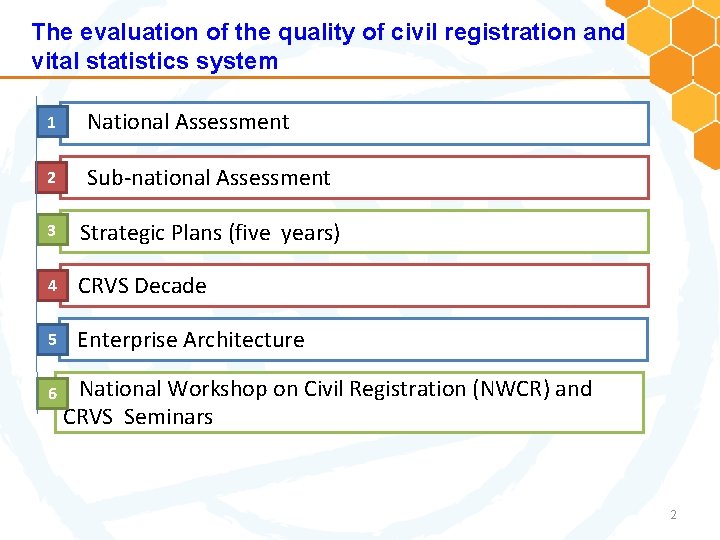
The evaluation of the quality of civil registration and vital statistics system 1 National Assessment 2 Sub-national Assessment 3 Strategic Plans (five years) 4 CRVS Decade 5 Enterprise Architecture 6 National Workshop on Civil Registration (NWCR) and CRVS Seminars 2
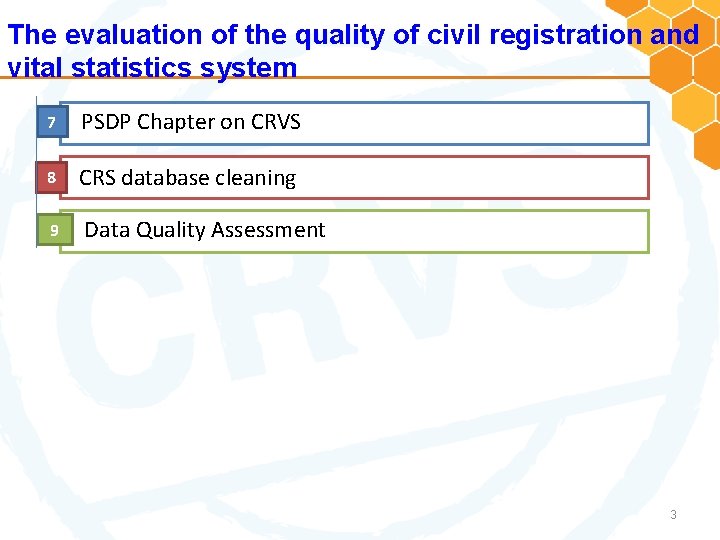
The evaluation of the quality of civil registration and vital statistics system 7 PSDP Chapter on CRVS 8 CRS database cleaning 9 Data Quality Assessment 3

Republic of the Philippines PHILIPPINE STATISTICS AUTHORITY ADMINISTRATIVE ARRANGEMENT OF CRVS Civil Registrar General (National Statistician) Office of the Head of the Local Government Unit Deputy National Statistician Civil Registration Services PSA Regional Statistical Service Offices PSA-Provincial Statistical Offices Health Sector Local Civil Registrar Offices Civil Register Management Division (documents) Vital Statistics Division (data files) Barangays Churches
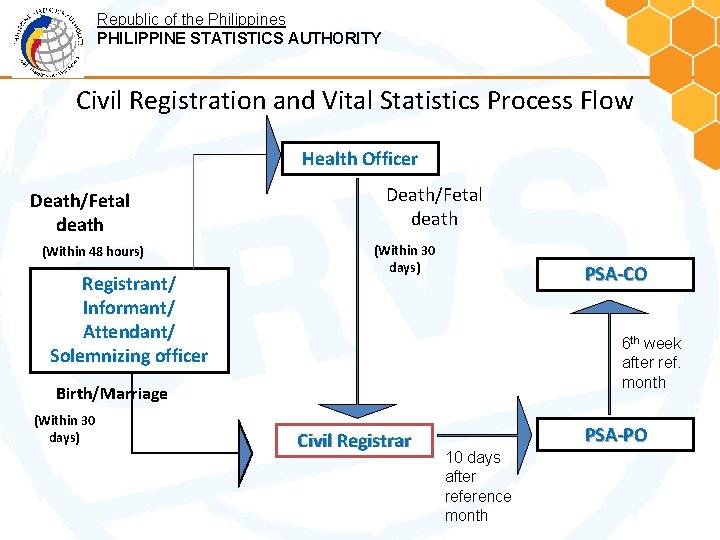
Republic of the Philippines PHILIPPINE STATISTICS AUTHORITY Civil Registration and Vital Statistics Process Flow Health Officer Death/Fetal death (Within 48 hours) Registrant/ Informant/ Attendant/ Solemnizing officer Death/Fetal death (Within 30 days) PSA-CO 6 th week after ref. month Birth/Marriage (Within 30 days) Civil Registrar PSA-PO 10 days after reference month
National Assessment 6
WHO Assessment Framework q Developed by the World Health Organization (WHO) and University of Queensland (UQ) that allows countries to comprehensively evaluate their civil registration and vital statistics system. 7
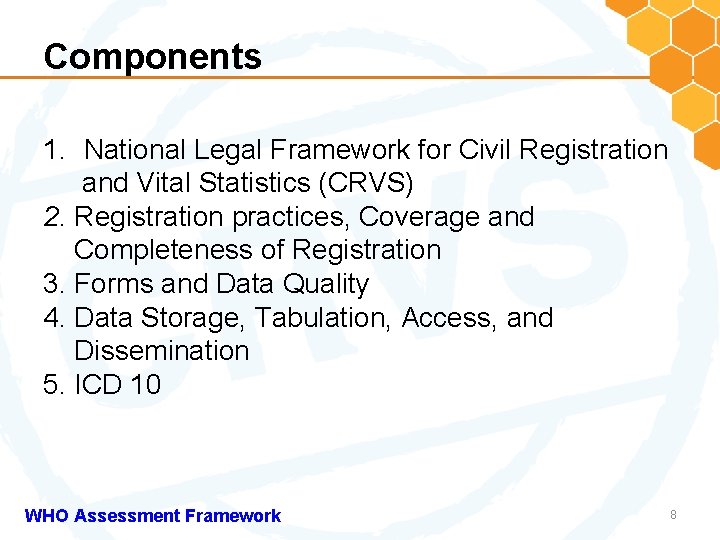
Components 1. National Legal Framework for Civil Registration and Vital Statistics (CRVS) 2. Registration practices, Coverage and Completeness of Registration 3. Forms and Data Quality 4. Data Storage, Tabulation, Access, and Dissemination 5. ICD 10 WHO Assessment Framework 8
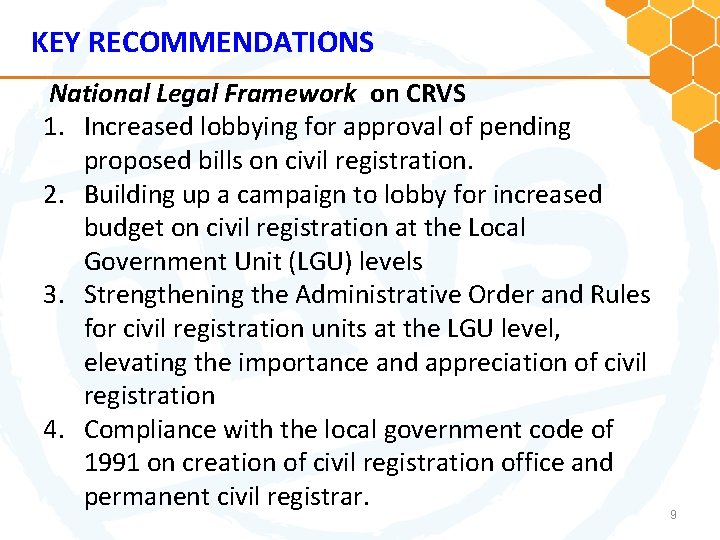
KEY RECOMMENDATIONS National Legal Framework on CRVS 1. Increased lobbying for approval of pending proposed bills on civil registration. 2. Building up a campaign to lobby for increased budget on civil registration at the Local Government Unit (LGU) levels 3. Strengthening the Administrative Order and Rules for civil registration units at the LGU level, elevating the importance and appreciation of civil registration 4. Compliance with the local government code of 1991 on creation of civil registration office and permanent civil registrar. 9
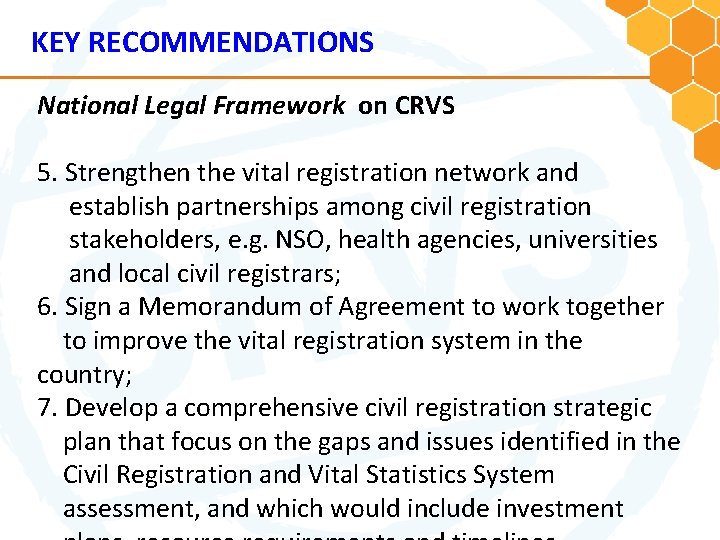
KEY RECOMMENDATIONS National Legal Framework on CRVS 5. Strengthen the vital registration network and establish partnerships among civil registration stakeholders, e. g. NSO, health agencies, universities and local civil registrars; 6. Sign a Memorandum of Agreement to work together to improve the vital registration system in the country; 7. Develop a comprehensive civil registration strategic plan that focus on the gaps and issues identified in the Civil Registration and Vital Statistics System assessment, and which would include investment
KEY RECOMMENDATIONS Registration practices, Coverage and Completeness of Registration 1. Orientation/training of medical/health officers, hospital administrators and other stakeholders on civil registration and vital statistics 2. Establishing vital registration protocols, guidelines, and procedures for each sector including private and public hospitals, Municipal Health Offices and other institutions. 3. Information campaign on registration focused on marginalised populations (e. g. Muslim population, Indigenous Cultural Communities, Indigenous Peoples and Children In Need of Special Protection) and poorer provinces. 11
KEY RECOMMENDATIONS Registration practices, Coverage and Completeness of Registration 4. Lobbying for free registration of timely registered documents 5. Study on the level of registration by province 6. Study on the level of registration by sector (depressed areas, marginalized populations)
KEY RECOMMENDATIONS Forms and Data Quality 1. Assessment of data quality using hospital records and the National Statistics Office’s Decentralized Vital Statistics System database 2. Developing methodology/study to check data quality and pertinent adjustment techniques for Philippine cause-ofdeath data 3. Conducting a study on the patterns of cause-specific mortality (diseases to be identified by a technical working group) 4. Developing a mechanism to keep medically and lay reported data separated to improve the quality of data
KEY RECOMMENDATIONS Data Storage, Tabulation, Access, and Dissemination 1. Making presentations to the Mayors of LGUs to clearly define functions of a Local Civil Registrar Office with regards to timeliness and completeness of submission of civil registry documents. 2. NSO to study ways to improve the timeliness of the Vital Statistics Report. 3. Intensive promotion of the electronic Civil Registration Information System (CRIS) to LGUs, hospitals and other related institutions.
KEY RECOMMENDATIONS Data Storage, Tabulation, Access, and Dissemination 4. Tabulating statistics on specific place of occurrence of the vital event (hospitals, health institutions, home, etc. ) and expand the number of age groups. 5. Motivating LGUs in cities to purchase computers using their own resources and other municipalities to develop resource mobilization schemes for obtaining computers in order to facilitate data storage and transmission to National Statistics Office (NSO). 6. Continuous training to LGU staff in civil registration procedures and use of electronic systems.
KEY RECOMMENDATIONS ICD 10 1. Training on ICD-10 and related topics (e. g. verbal autopsy, completion of Death Certificate Form) for staff of the Ministry of Health, Local Civil Registration Officers, Medical Records Officers, Provincial Statistical Office staff 2. Inclusion of ICD-10 in medical and paramedical curricula. 3. Conducting evaluation of the quality of ICD 10 coding.
KEY RECOMMENDATIONS ICD 10 4. Developing a guidebook and quick reference guide on certification of cause of death for doctors. 5. Conducting an evaluation of the quality of medical certification on death certificates. 6. Conducting a nationwide launch of the new Death Certificate Form.
Subnational Assessment 18
Subnational Assessment The Assessment of the Civil Registration System and Conduct of Completeness Study of Death Registration Project • The project has two components namely: assessment of the civil registration system at the sub-national level and conduct of completeness study of death registration in the country. 19
Subnational Assessment Component 1: The Assessment of the Civil Registration System • To assess the civil registration system in the country at the sub-national level, the Technical Working Group (TWG) composed of representatives from the NSO, Department of Health, National Statistical Coordination Board and University of the Philippines-Population Institute selected 7 sample provinces (Rizal, Cebu, Palawan, Ilocos Norte, Leyte, Davao del Sur, and Cotabato) • Using the UQ-WHO Vital Registration Framework, the major findings of the study identified the barriers of birth and death registration and concerns on data quality and data storage 20
Subnational Assessment Component 2: Completeness Study of Death Registration in the Country The study aims to determine the current under-registration of deaths by estimating the extent of completeness using the 2007 census data. • The results of the study showed that around 70 percent of all deaths that had occurred in the country during the year 2007 had been registered • The proportion of males whose death was registered in 2007 (72 %) is higher than the corresponding proportion of females (67 %). 21
Strategic Plans (CRVS) 22
Strategic Plans In line with the key recommendations during the National Assessment of CRVS, then National Statistics Office (NSO) and the Department of Health prepared the CRVS Strategic Plans for CRVS. • Vision • Mission • 5 -year Strategic Plans • Participants: Major Stakeholders of CRVS
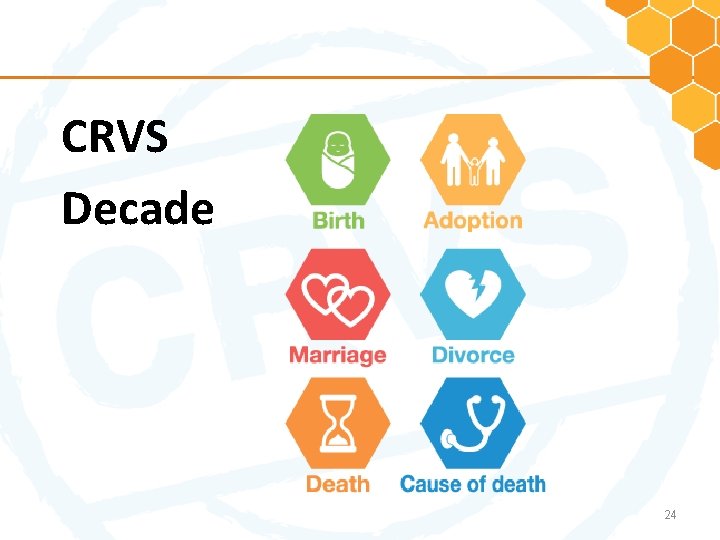
CRVS Decade 24
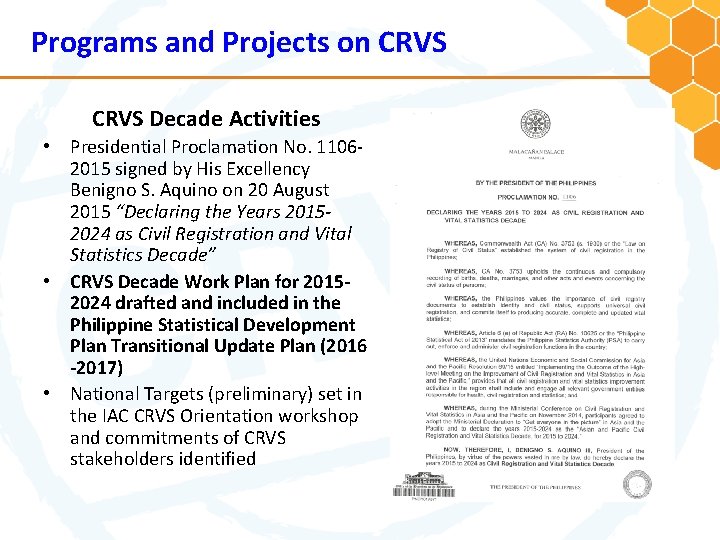
Programs and Projects on CRVS Decade Activities • Presidential Proclamation No. 11062015 signed by His Excellency Benigno S. Aquino on 20 August 2015 “Declaring the Years 20152024 as Civil Registration and Vital Statistics Decade” • CRVS Decade Work Plan for 20152024 drafted and included in the Philippine Statistical Development Plan Transitional Update Plan (2016 -2017) • National Targets (preliminary) set in the IAC CRVS Orientation workshop and commitments of CRVS stakeholders identified

Enterprise Architecture 26
Enterprise Architecture • Enterprise Architecture (EA) is one of the interventions of the Data for Health (D 4 H) project implemented by the Union of North America together with the Philippine Statistics Authority (PSA) and the Department of Health (DOH) in the Philippines. D 4 H seeks to support at least 20 countries, the Philippines included, improve their collection and use of crucial public health information through three components, namely: a) civil registration and vital statistics (CRVS); b) strategic use of data for policy and planning; and c) availability of information on non-communicable disease risk factors 27
Enterprise Architecture • Workshop on Enterprise Architecture • 25 -26 January 2016 28
Enterprise Architecture WORKSHOP DESIGN The Workshop on Enterprise Architecture aimed to strengthen capabilities to analyse the functioning of CRVS systems and find effective pathways for improving the efficiencies and quality of the vital statistics. Specifically, at the end of the workshop, the participants are expected to: • Understand the need for system thinking and have a much better understanding of the entire CRVS systems and not only the sub-system they are associated with • Be able to produce flow maps of three types of descriptive processes which will help understand problems with 1) organizational designs, including social network analysis; 2) CRVS processes, standards and integration ; and 3) CRVS performance. • Be able to interpret the flow maps and suggest improved ways on how CRVS processes and CRVS information technologies can work together to deliver systems performance and products. 29
Enterprise Architecture The maps cover all sub-processes beginning with the declaration of the event (birth or death) until the statistics from these events are disseminated. These sub-processes include: Civil Registration • Declare vital event (include notify and record vital event) • Validate vital event data • Register vital event • Certify vital event • Generate vital event statistical data • Store and Archive vital event data Vital Statistics • Compile vital event statistical data • Quality control vital event statistical data • Generate vital event statistical data • Disseminate vital event statistical data 30
Conduct of NWCR 31
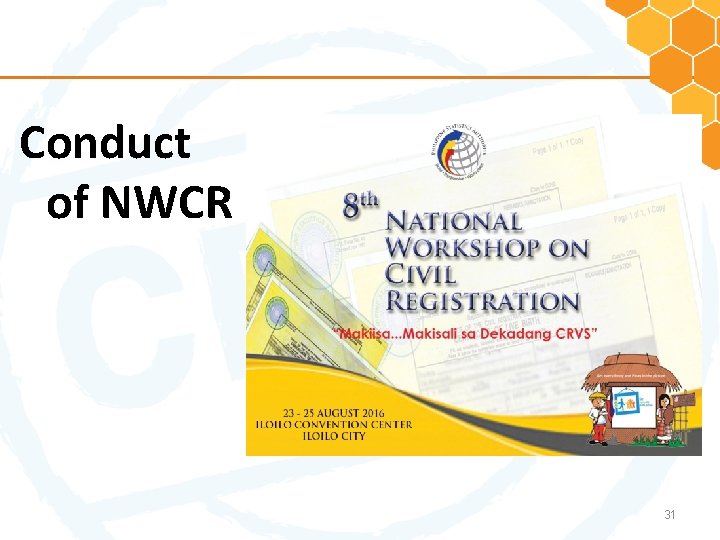
National Workshop on Civil Registration (NWCR) Continuous capacity building of CRVS Stakeholders • PSA is now on its 9 th series of the biennial National Workshop on Civil Registration (NWCR) in 2015 while the National Convention of Solemnizing Officers (NCSO) is on its 10 th series by 2016. • The NWCR and NCSO aims to provide a venue for civil registrars, solemnizing officers, and other civil registration stakeholders to discuss issues and concerns on civil registration, share their best practices and experiences, and update them regarding new laws, policies, and rules on regulations on civil registration and vital statistics.
Philippines Statistical Development Plans (PSDP) Chapter on CRVS 33
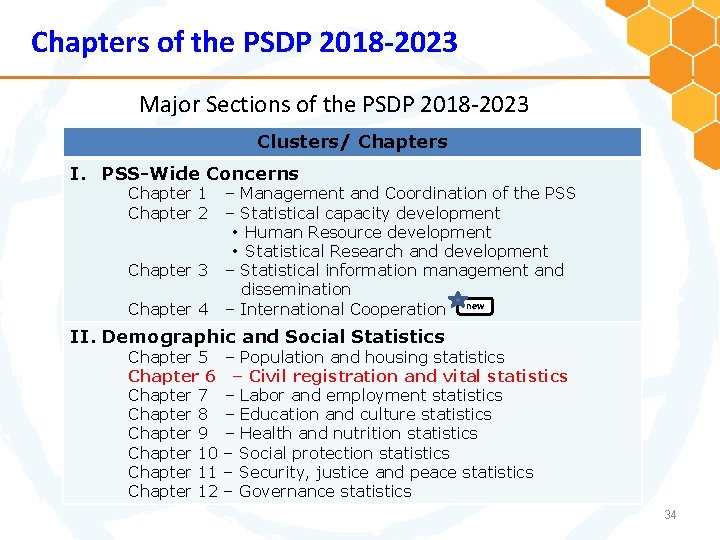
Chapters of the PSDP 2018 -2023 Major Sections of the PSDP 2018 -2023 Clusters/ Chapters I. PSS-Wide Concerns Chapter 1 Chapter 2 Chapter 3 Chapter 4 – Management and Coordination of the PSS – Statistical capacity development • Human Resource development • Statistical Research and development – Statistical information management and dissemination ew – International Cooperation new II. Demographic and Social Statistics Chapter 5 Chapter 6 Chapter 7 Chapter 8 Chapter 9 Chapter 10 Chapter 11 Chapter 12 – Population and housing statistics – Civil registration and vital statistics – Labor and employment statistics – Education and culture statistics – Health and nutrition statistics – Social protection statistics – Security, justice and peace statistics – Governance statistics 34
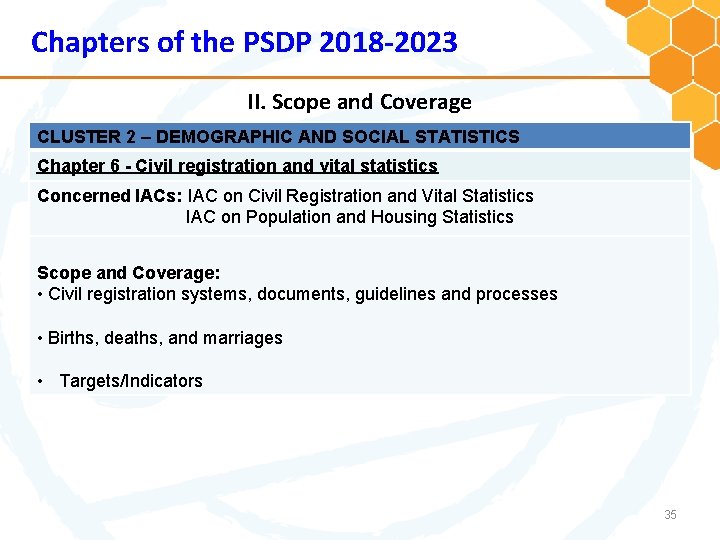
Chapters of the PSDP 2018 -2023 II. Scope and Coverage CLUSTER 2 – DEMOGRAPHIC AND SOCIAL STATISTICS Chapter 6 - Civil registration and vital statistics Concerned IACs: IAC on Civil Registration and Vital Statistics IAC on Population and Housing Statistics Scope and Coverage: • Civil registration systems, documents, guidelines and processes • Births, deaths, and marriages • Targets/Indicators 35
In summary • PSDP Plans/Targets/indicator • Philippines CRVS Decade Strategic Plans and Targets • PSA Strategic Plans/Goals/Thrusts (2 Goals and 12 Strategic Thrusts) • PSA Civil Registration Service Work Programs & Targets 36
CRS database cleaning 37
BRENLinking Process of linking records of an individual in the Civil Registry System Database 38
Production Vital Event Maintenance Another way of cleansing the Civil Registry System database which involves the correction of the index of a record in the CRS database to ensure that a correct copy of the document is issued to the document owner 39
Deduping of birth records • Cleansing of the Civil Registry System database • Automated matching of multiple records of an individual 40
DATA QUALITY ASSESSMENT 41
Manual Assessment 42
100% checking on causes of death 43
Data quality is being evaluated under the following: a. Data accuracy -IRIS -ANACONDA - RA 9048/ RA 10172 b. Data access and availability - Vital Statistics Reports/Special Releases/Vital Statistics Tables/PUFs c. Timeliness of data -DVSS 2 K/DVSS 211/Phil. Cris 44
CRS www. psa. gov. ph
- Slides: 45