
Republic of the Philippines Improving Public Service Integrity
Republic of the Philippines Improving Public Service Integrity: The Integrity Management Program CONCHITA CARPIO MORALES Ombudsman 7 th Anti-Corruption Agency Forum 2 -3 September 2013 Seoul, South Korea

Background ü Introduced in 2003 IDR IDAP ü Preventive measure against corruption ü It entails a systematic assessment of the agency’s corruption resistance mechanisms and its vulnerabilities to corruption ü Monitoring of the IDR was done by the Office of the Ombudsman Improving Public Service Integrity: The Integrity Management Program 7 th Anti-Corruption Agency Forum, 2 -3 September 2013 Seoul, South Korea ü Introduced in 2004 ü National anti-corruption framework of the Executive Branch ü A holistic approach in fighting corruption and composed of 22 specific anti-corruption “doables” ü Monitoring of the IDR was done by the Presidential Anti-Graft Commission
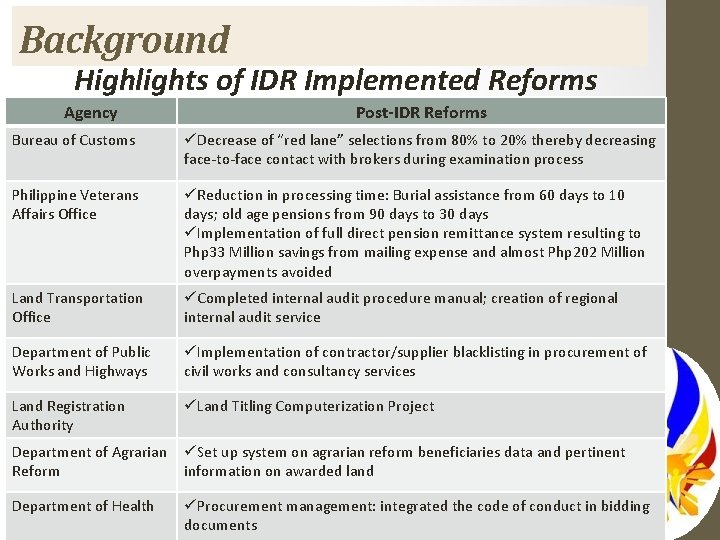
Background Highlights of IDR Implemented Reforms Agency Post-IDR Reforms Bureau of Customs üDecrease of “red lane” selections from 80% to 20% thereby decreasing face-to-face contact with brokers during examination process Philippine Veterans Affairs Office üReduction in processing time: Burial assistance from 60 days to 10 days; old age pensions from 90 days to 30 days üImplementation of full direct pension remittance system resulting to Php 33 Million savings from mailing expense and almost Php 202 Million overpayments avoided Land Transportation Office üCompleted internal audit procedure manual; creation of regional internal audit service Department of Public Works and Highways üImplementation of contractor/supplier blacklisting in procurement of civil works and consultancy services Land Registration Authority üLand Titling Computerization Project Department of Agrarian Reform üSet up system on agrarian reform beneficiaries data and pertinent information on awarded land Department of Health üProcurement management: integrated the code of conduct in bidding documents
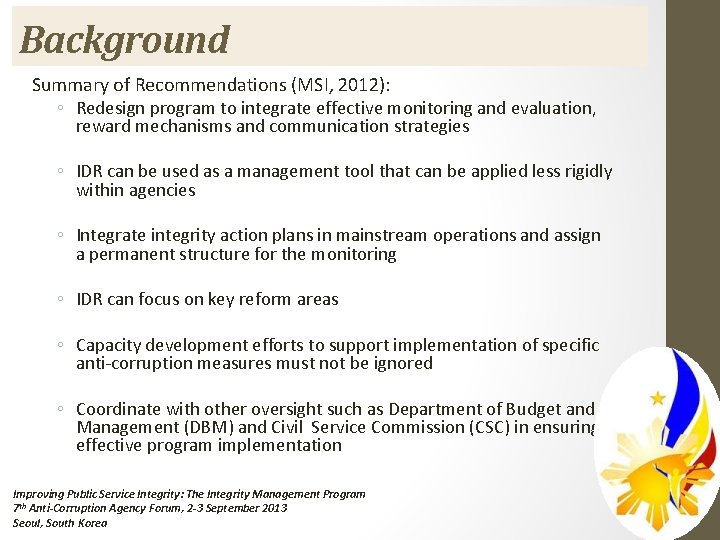
Background Summary of Recommendations (MSI, 2012): ◦ Redesign program to integrate effective monitoring and evaluation, reward mechanisms and communication strategies ◦ IDR can be used as a management tool that can be applied less rigidly within agencies ◦ Integrate integrity action plans in mainstream operations and assign a permanent structure for the monitoring ◦ IDR can focus on key reform areas ◦ Capacity development efforts to support implementation of specific anti-corruption measures must not be ignored ◦ Coordinate with other oversight such as Department of Budget and Management (DBM) and Civil Service Commission (CSC) in ensuring effective program implementation Improving Public Service Integrity: The Integrity Management Program 7 th Anti-Corruption Agency Forum, 2 -3 September 2013 Seoul, South Korea
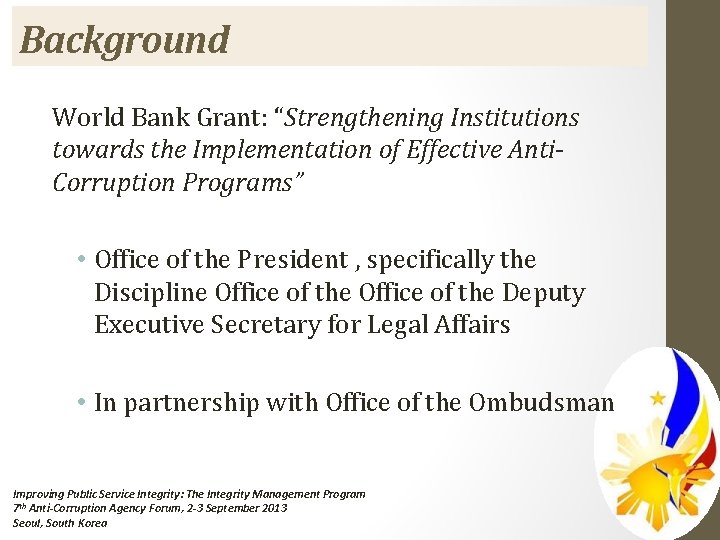
Background World Bank Grant: “Strengthening Institutions towards the Implementation of Effective Anti. Corruption Programs” • Office of the President , specifically the Discipline Office of the Deputy Executive Secretary for Legal Affairs • In partnership with Office of the Ombudsman Improving Public Service Integrity: The Integrity Management Program 7 th Anti-Corruption Agency Forum, 2 -3 September 2013 Seoul, South Korea

Background Transition to Integrity Management Program Project: “Harmonization and Simplification of Integrity Development Programs and Development of Results-Based Monitoring Plans and Evaluation Tools” • World Bank • Office of the President • Office of the Ombudsman • Development Academy of the Philippines Improving Public Service Integrity: The Integrity Management Program 7 th Anti-Corruption Agency Forum, 2 -3 September 2013 Seoul, South Korea

Integrity Management Program Objectives: 1. Build culture of integrity and excellence in the public sector 2. Install the Integrity Management System standard but flexible approach at the Department/Agency level 3. Ensure that standard norms of conduct for public officials are consistently applied Improving Public Service Integrity: The Integrity Management Program 7 th Anti-Corruption Agency Forum, 2 -3 September 2013 Seoul, South Korea

Program Features Characteristics Features Strengthened program design • • • Monitoring and evaluation Rewards and incentives Technical assistance arrangements Capacity-building initiatives Anti-corruption tools and measures Alignment and harmonization • Aligned with current anti-corruption priorities (Open Government Partnership, GGAC and PDP) Harmonized with past integrity development programs Flexibility • • Agency-specific tools and measures Tools suited for the objectives and peculiarities of the implementing agency Focus on results • Contribution of program- and agency-level outputs to the achievement of purpose and goal of the IMP Mainstreamed program • Integrated with strategic plans and operations of the agency • Improving Public Service Integrity: The Integrity Management Program 7 th Anti-Corruption Agency Forum, 2 -3 September 2013 Seoul, South Korea

Program Results Framework OUTPUTS LEVEL (AGENCY) Integrity Management is mainstreamed in agencies 1. Integrity Management Committees mobilized 2. Integrity management plans developed 3. Integrity management measures implemented OUTPUTS LEVEL (PROGRAM MANAGEMENT COMMITTEE) Agencies are supported to implement the Integrity Management Program 1. Agencies are trained in IMP 2. Integrity Management Committees are provided advice/technical assistance in IMP 3. Incentives to Practice IM are established 4. Passage of required anticorruption laws (e. g. FOIA, Whistleblower Protection) are advocated OUTCOMES LEVEL • • Agencies are less vulnerable to corruption More transparent, accountable, and participatory governance Improving Public Service Integrity: The Integrity Management Program 7 th Anti-Corruption Agency Forum, 2 -3 September 2013 Seoul, South Korea OBJECTIVES LEVEL (IMPACT) • Level of Corruption in the Public Sector is reduced • Integrity is practiced in the public sector

How to Manage Integrity? Integrity as defined. • Application of public values and norms in the daily practice of public sector organizations • Proper use of powers, authorities, assets, resources and funds for official purposes • Opposite of “corruption” or “abuse” • Fostering a culture intolerant to corruption Improving Public Service Integrity: The Integrity Management Program 7 th Anti-Corruption Agency Forum, 2 -3 September 2013 Seoul, South Korea

How to Manage Integrity? Integrity Management ◦ The continuous process of building, enforcing, and fostering a culture of integrity within the organization Integrity Management Cycle ◦ An iterative and systems-based approach in managing integrity Improving Public Service Integrity: The Integrity Management Program 7 th Anti-Corruption Agency Forum, 2 -3 September 2013 Seoul, South Korea
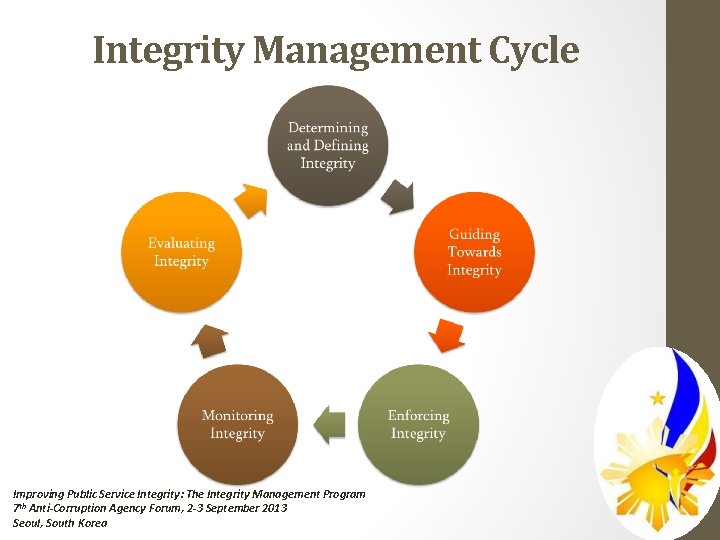
Integrity Management Cycle Improving Public Service Integrity: The Integrity Management Program 7 th Anti-Corruption Agency Forum, 2 -3 September 2013 Seoul, South Korea
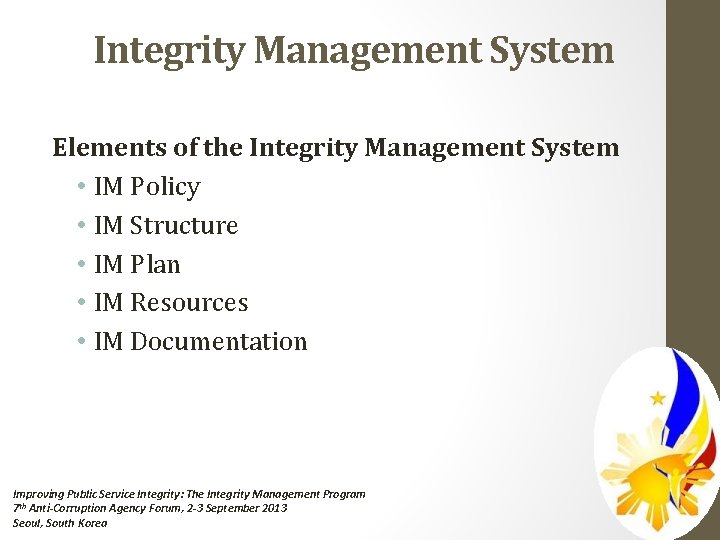
Integrity Management System Elements of the Integrity Management System • IM Policy • IM Structure • IM Plan • IM Resources • IM Documentation Improving Public Service Integrity: The Integrity Management Program 7 th Anti-Corruption Agency Forum, 2 -3 September 2013 Seoul, South Korea
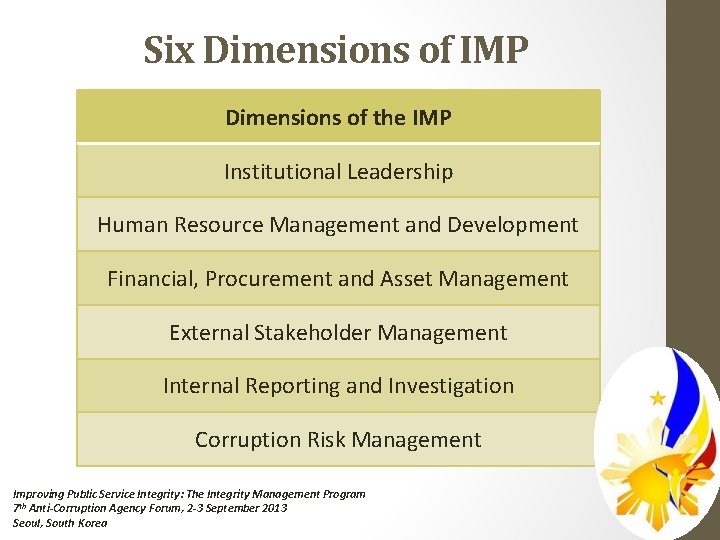
Six Dimensions of IMP Dimensions of the IMP Institutional Leadership Human Resource Management and Development Financial, Procurement and Asset Management External Stakeholder Management Internal Reporting and Investigation Corruption Risk Management Improving Public Service Integrity: The Integrity Management Program 7 th Anti-Corruption Agency Forum, 2 -3 September 2013 Seoul, South Korea
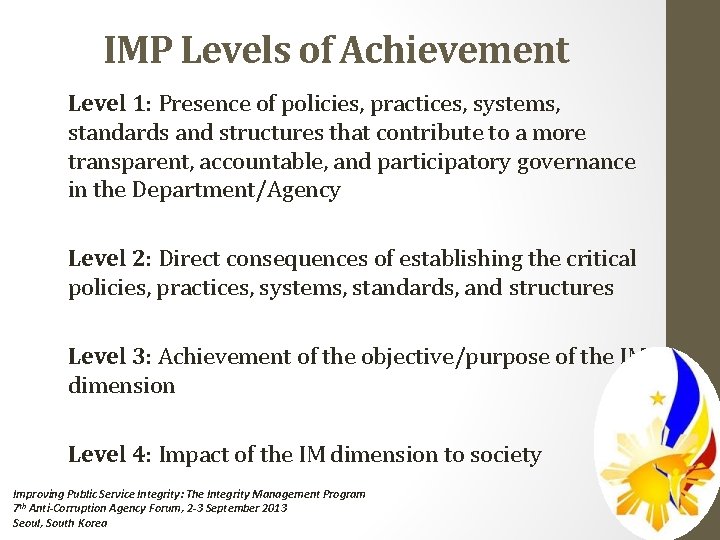
IMP Levels of Achievement Level 1: Presence of policies, practices, systems, standards and structures that contribute to a more transparent, accountable, and participatory governance in the Department/Agency Level 2: Direct consequences of establishing the critical policies, practices, systems, standards, and structures Level 3: Achievement of the objective/purpose of the IM dimension Level 4: Impact of the IM dimension to society Improving Public Service Integrity: The Integrity Management Program 7 th Anti-Corruption Agency Forum, 2 -3 September 2013 Seoul, South Korea

IMP Tools Integrity Scorecard Integrity Management Survey Templates for: ◦ Integrity Management Plan ◦ Integrity Management Progress Report ◦ Corruption Risk Identification and Evaluation Improving Public Service Integrity: The Integrity Management Program 7 th Anti-Corruption Agency Forum, 2 -3 September 2013 Seoul, South Korea
Integrity Management Review Baseline/periodic Integrity Management Review shall involve: �Integrity Management Assessment (IMA) �Corruption Risk Assessment (CRA) Improving Public Service Integrity: The Integrity Management Program 7 th Anti-Corruption Agency Forum, 2 -3 September 2013 Seoul, South Korea
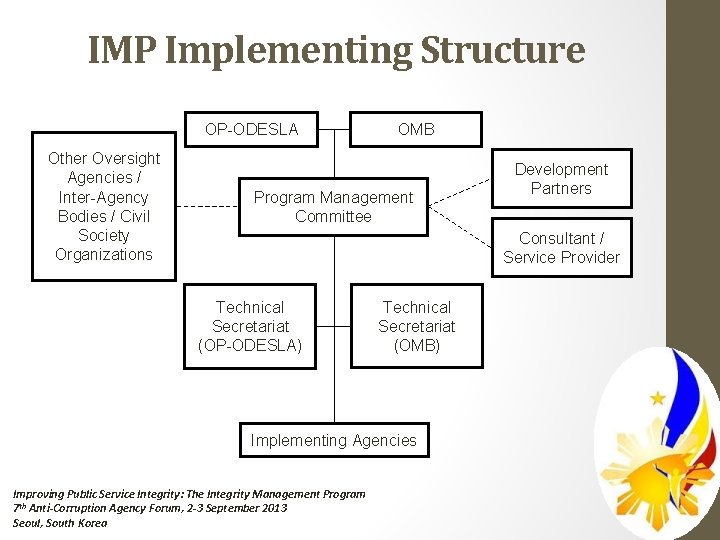
IMP Implementing Structure OP-ODESLA Other Oversight Agencies / Inter-Agency Bodies / Civil Society Organizations OMB Program Management Committee Development Partners Consultant / Service Provider Technical Secretariat (OP-ODESLA) Technical Secretariat (OMB) Implementing Agencies Improving Public Service Integrity: The Integrity Management Program 7 th Anti-Corruption Agency Forum, 2 -3 September 2013 Seoul, South Korea
Rewards and Incentives Purpose: Recognize the cooperation and efforts of agencies in implementing the program Two types: 1. Agency-level • Adjectival rating of agency will be the basis • Departments/agencies determined to be best performing and with substantial achievement of integrity management objectives and sophistication of the implementation of IM measures will be recognized 2. Individual-level • Criteria: Compliance to integrity standards • Aligned with the: • Results-Based Performance Management System • Performance-Based Incentive System • Existing rewards system of the Civil Service Commission Improving Public Service Integrity: The Integrity Management Program 7 th Anti-Corruption Agency Forum, 2 -3 September 2013 Seoul, South Korea
IMP Pilot Implementing Agencies 5 Implementing Pilot Agencies Department of Health Department of Justice Department of Public Works and Highways Department of Social Welfare and Development Bureau of Internal Revenue Oversight Pilot Agency Office of the Ombudsman (OMB) Improving Public Service Integrity: The Integrity Management Program 7 th Anti-Corruption Agency Forum, 2 -3 September 2013 Seoul, South Korea
Republic of the Philippines Thank You. CONCHITA CARPIO MORALES Ombudsman 7 th Anti-Corruption Agency Forum 2 -3 September 2013 Seoul, South Korea
- Slides: 21