
Reptiles Kingdom Anamalia Phylum Chordata Subphylum Vertebrata Class
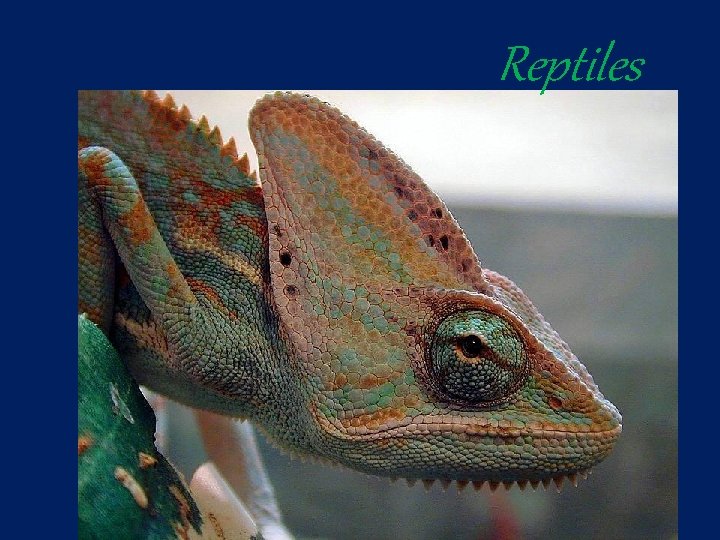
Reptiles
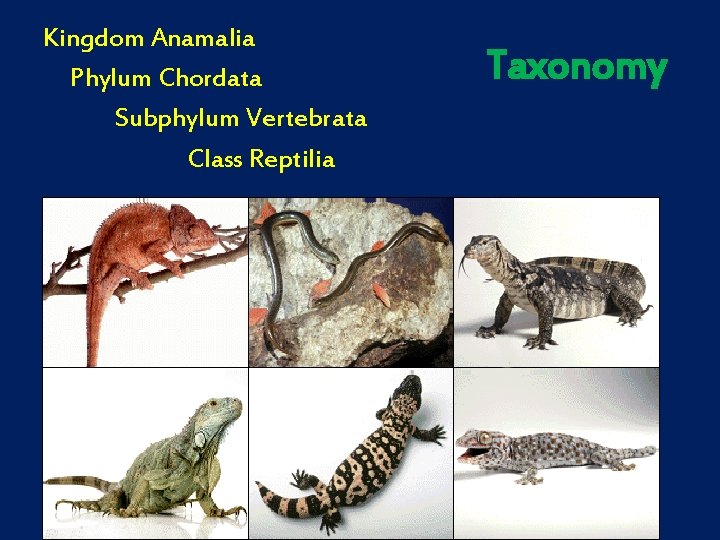
Kingdom Anamalia Phylum Chordata Subphylum Vertebrata Class Reptilia Taxonomy
General Characteristics 1. 2. 3. 4. 5. 6. 7. Amniotic egg – shelled Internal fertilization Scales or plates If legs – 2 pair with claws Well developed lungs Partial division of ventricle Poikilothermic
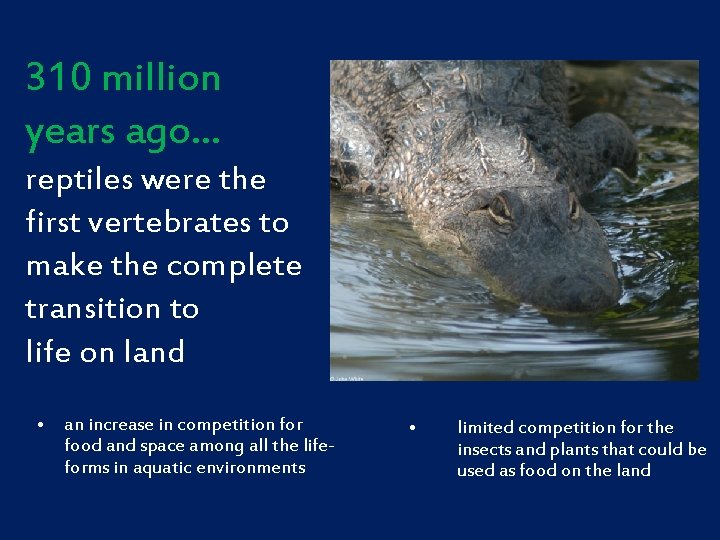
310 million years ago… reptiles were the first vertebrates to make the complete transition to life on land • an increase in competition for food and space among all the lifeforms in aquatic environments • limited competition for the insects and plants that could be used as food on the land
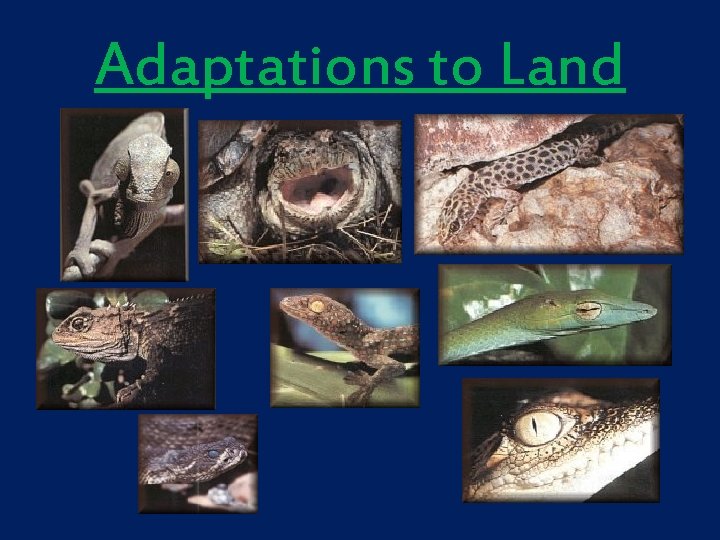
Adaptations to Land
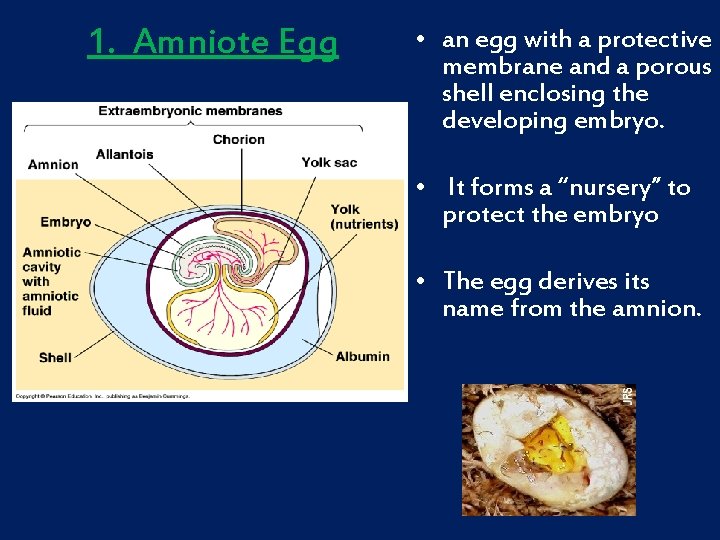
1. Amniote Egg • an egg with a protective membrane and a porous shell enclosing the developing embryo. • It forms a “nursery” to protect the embryo • The egg derives its name from the amnion.
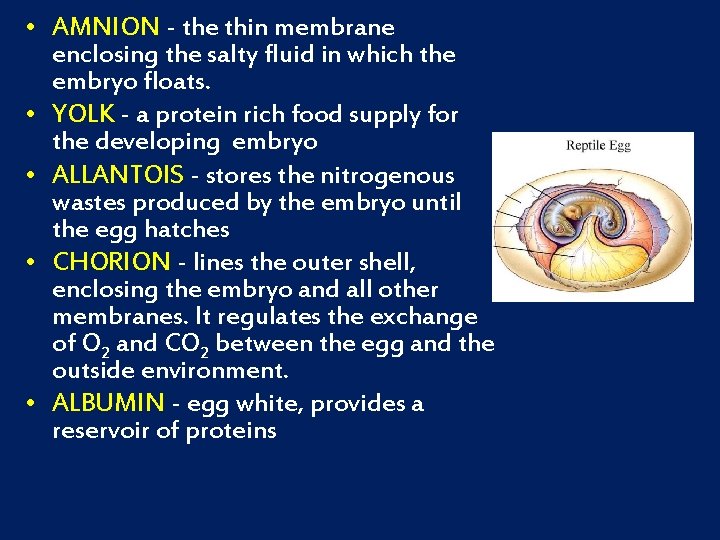
• AMNION - the thin membrane enclosing the salty fluid in which the embryo floats. • YOLK - a protein rich food supply for the developing embryo • ALLANTOIS - stores the nitrogenous wastes produced by the embryo until the egg hatches • CHORION - lines the outer shell, enclosing the embryo and all other membranes. It regulates the exchange of O 2 and CO 2 between the egg and the outside environment. • ALBUMIN - egg white, provides a reservoir of proteins
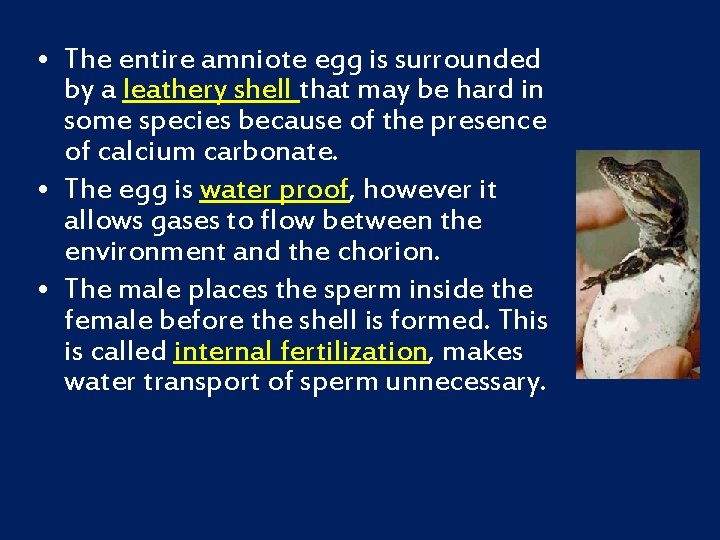
• The entire amniote egg is surrounded by a leathery shell that may be hard in some species because of the presence of calcium carbonate. • The egg is water proof, however it allows gases to flow between the environment and the chorion. • The male places the sperm inside the female before the shell is formed. This is called internal fertilization, makes water transport of sperm unnecessary.
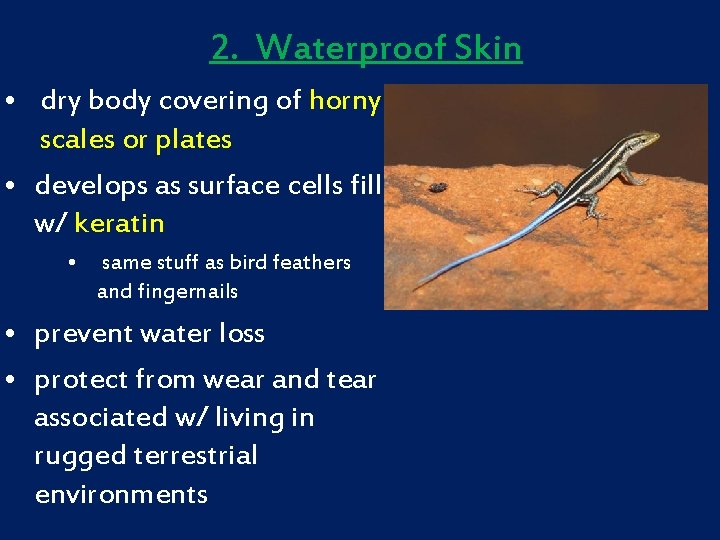
2. Waterproof Skin • dry body covering of horny scales or plates • develops as surface cells fill w/ keratin • same stuff as bird feathers and fingernails • prevent water loss • protect from wear and tear associated w/ living in rugged terrestrial environments
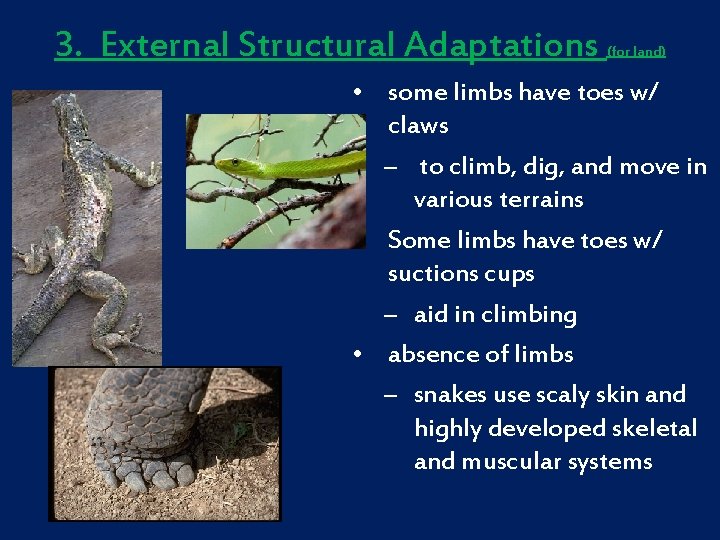
3. External Structural Adaptations (for land) • some limbs have toes w/ claws – to climb, dig, and move in various terrains • Some limbs have toes w/ suctions cups – aid in climbing • absence of limbs – snakes use scaly skin and highly developed skeletal and muscular systems
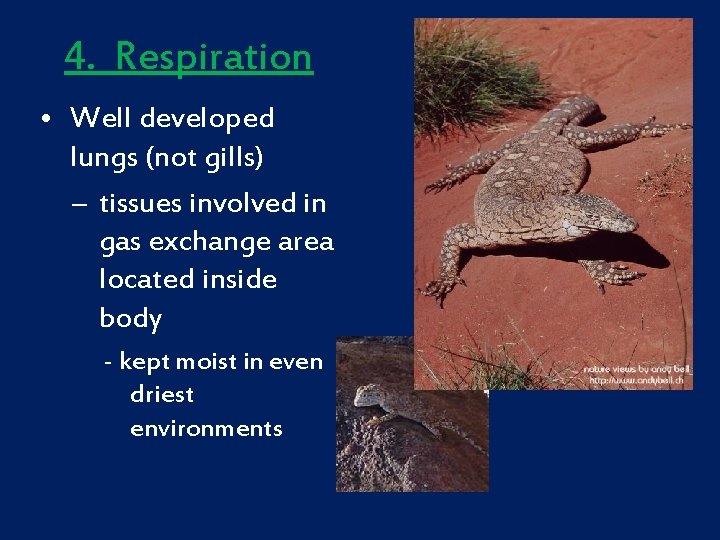
4. Respiration • Well developed lungs (not gills) – tissues involved in gas exchange area located inside body - kept moist in even driest environments
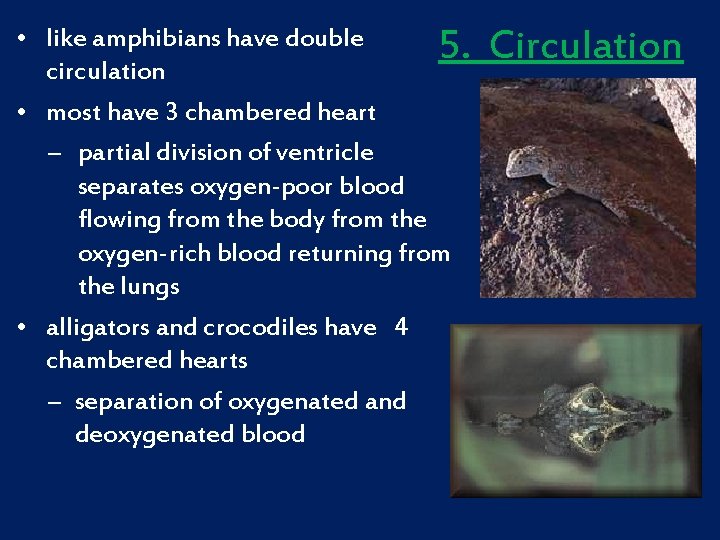
• like amphibians have double 5. circulation • most have 3 chambered heart – partial division of ventricle separates oxygen-poor blood flowing from the body from the oxygen-rich blood returning from the lungs • alligators and crocodiles have 4 chambered hearts – separation of oxygenated and deoxygenated blood Circulation
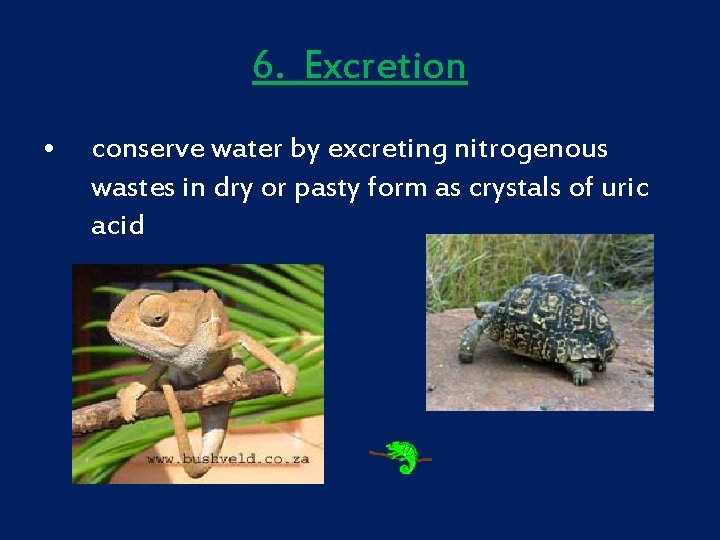
6. Excretion • conserve water by excreting nitrogenous wastes in dry or pasty form as crystals of uric acid
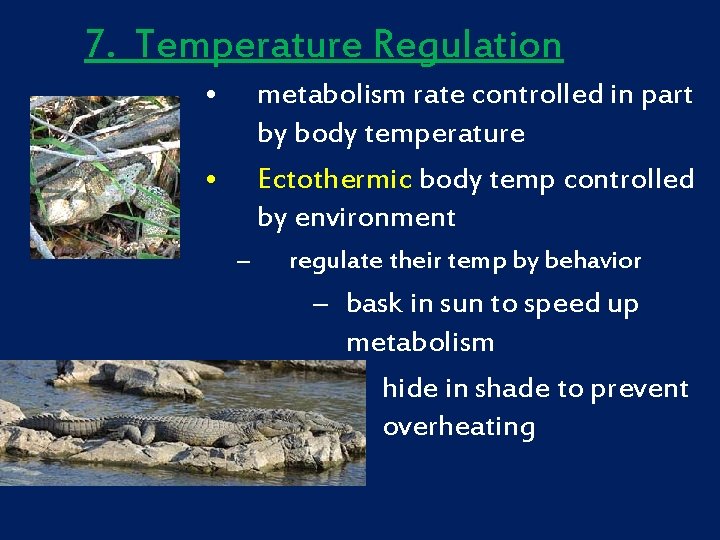
7. Temperature Regulation • metabolism rate controlled in part by body temperature Ectothermic body temp controlled by environment • – regulate their temp by behavior – bask in sun to speed up metabolism » hide in shade to prevent overheating
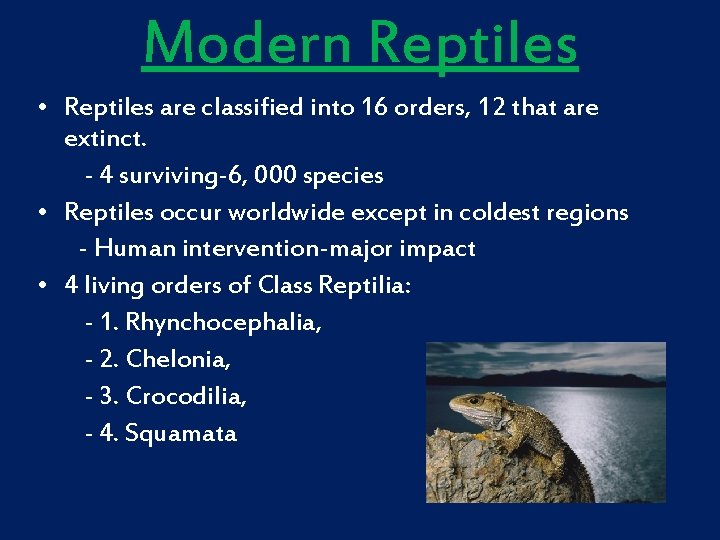
Modern Reptiles • Reptiles are classified into 16 orders, 12 that are extinct. - 4 surviving-6, 000 species • Reptiles occur worldwide except in coldest regions - Human intervention-major impact • 4 living orders of Class Reptilia: - 1. Rhynchocephalia, - 2. Chelonia, - 3. Crocodilia, - 4. Squamata
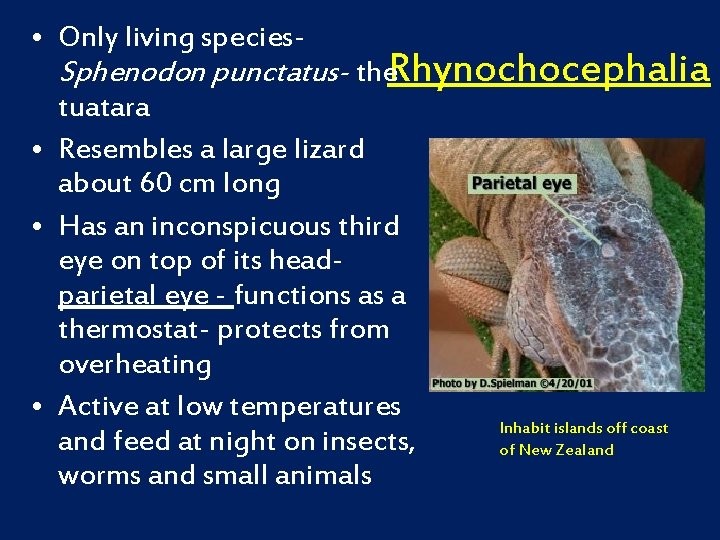
• Only living species. Sphenodon punctatus- the. Rhynochocephalia tuatara • Resembles a large lizard about 60 cm long • Has an inconspicuous third eye on top of its headparietal eye - functions as a thermostat- protects from overheating • Active at low temperatures Inhabit islands off coast and feed at night on insects, of New Zealand worms and small animals
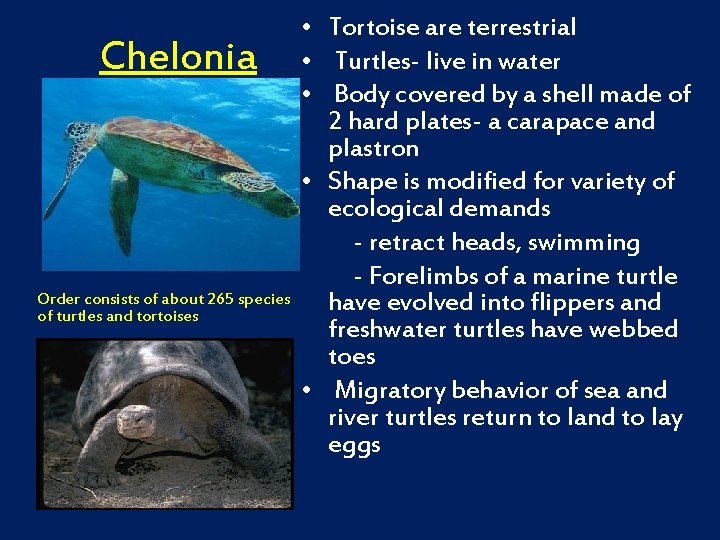
Chelonia Order consists of about 265 species of turtles and tortoises • Tortoise are terrestrial • Turtles- live in water • Body covered by a shell made of 2 hard plates- a carapace and plastron • Shape is modified for variety of ecological demands - retract heads, swimming - Forelimbs of a marine turtle have evolved into flippers and freshwater turtles have webbed toes • Migratory behavior of sea and river turtles return to land to lay eggs
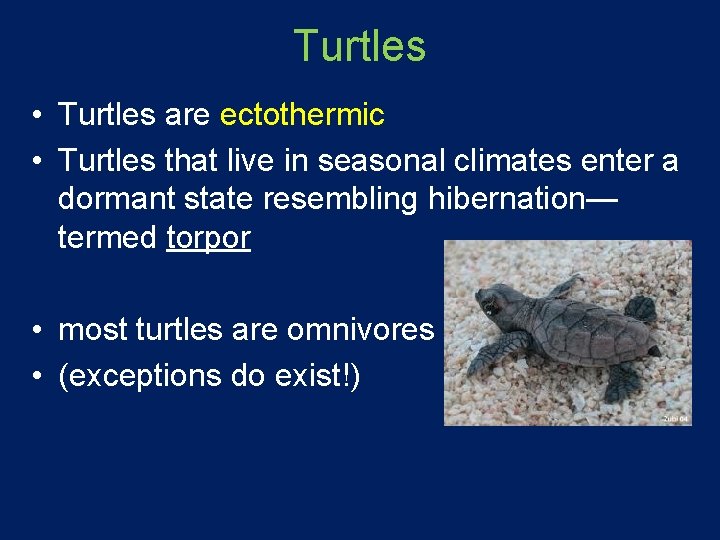
Turtles • Turtles are ectothermic • Turtles that live in seasonal climates enter a dormant state resembling hibernation— termed torpor • most turtles are omnivores • (exceptions do exist!)
• have bony upper and lower shells that surround much of the body • upper shell, carapace / lower shell, plastron • upper shell connects to the lower shell by way of a bony bridge. • The hard shell often is covered with large scales called scutes – In some species, new scutes grow under old ones, and the old ones pile up – count the # of scutes in the pile to tell age • no teeth - have hard, flat surfaces on jaws to grip and tear bits of plants or animals – look much like the hook on the end of a hawk's or eagle's beak
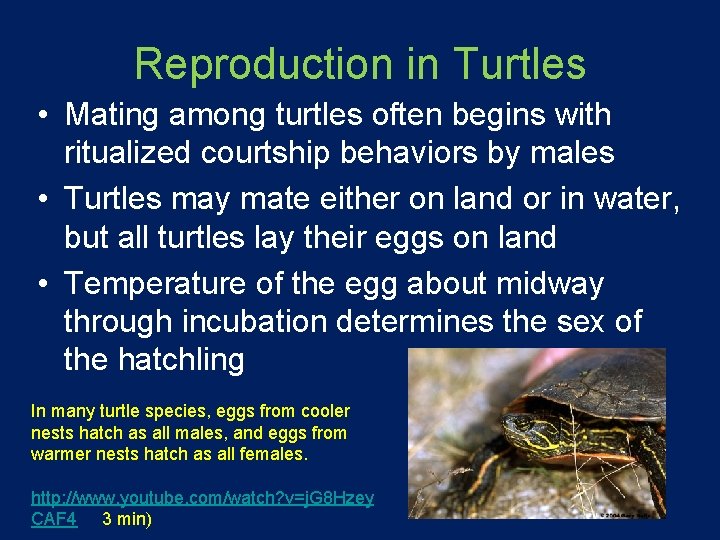
Reproduction in Turtles • Mating among turtles often begins with ritualized courtship behaviors by males • Turtles may mate either on land or in water, but all turtles lay their eggs on land • Temperature of the egg about midway through incubation determines the sex of the hatchling In many turtle species, eggs from cooler nests hatch as all males, and eggs from warmer nests hatch as all females. http: //www. youtube. com/watch? v=j. G 8 Hzey CAF 4 3 min)
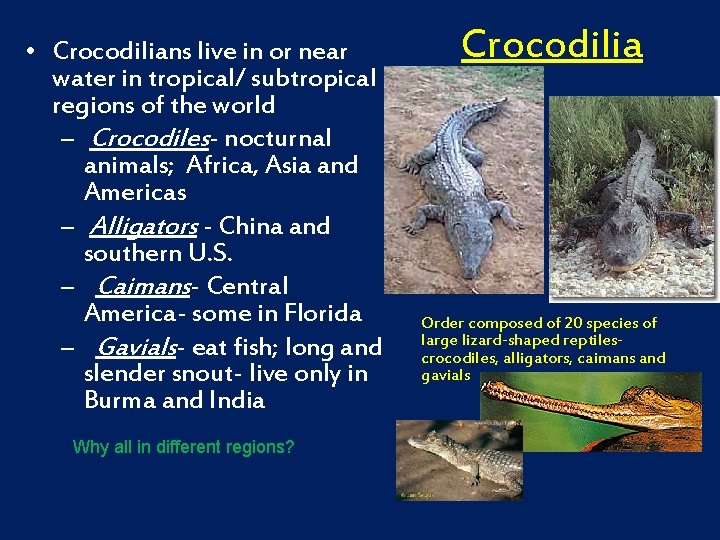
• Crocodilians live in or near water in tropical/ subtropical regions of the world – Crocodiles- nocturnal animals; Africa, Asia and Americas – Alligators - China and southern U. S. – Caimans- Central America- some in Florida – Gavials- eat fish; long and slender snout- live only in Burma and India Why all in different regions? Crocodilia Order composed of 20 species of large lizard-shaped reptilescrocodiles, alligators, caimans and gavials
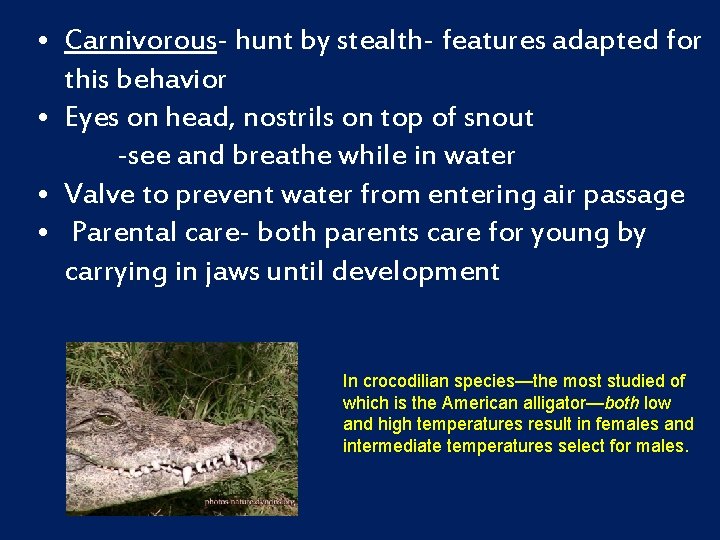
• Carnivorous- hunt by stealth- features adapted for this behavior • Eyes on head, nostrils on top of snout -see and breathe while in water • Valve to prevent water from entering air passage • Parental care- both parents care for young by carrying in jaws until development In crocodilian species—the most studied of which is the American alligator—both low and high temperatures result in females and intermediate temperatures select for males.
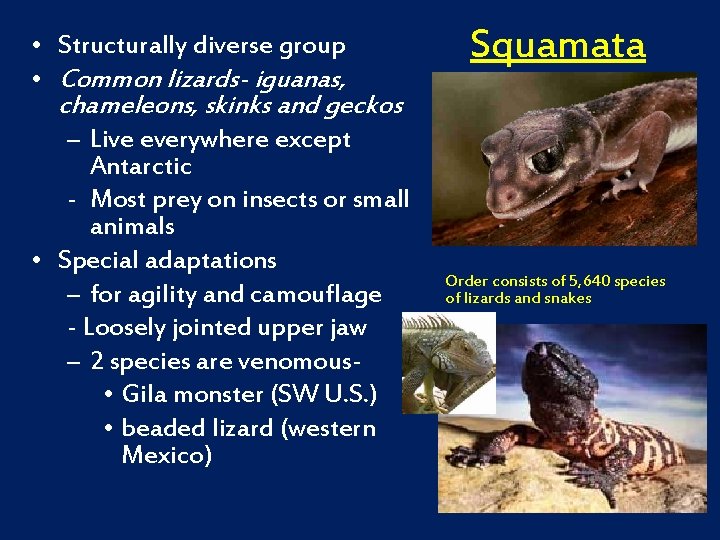
• Structurally diverse group • Common lizards- iguanas, chameleons, skinks and geckos – Live everywhere except Antarctic - Most prey on insects or small animals • Special adaptations – for agility and camouflage - Loosely jointed upper jaw – 2 species are venomous • Gila monster (SW U. S. ) • beaded lizard (western Mexico) Squamata Order consists of 5, 640 species of lizards and snakes
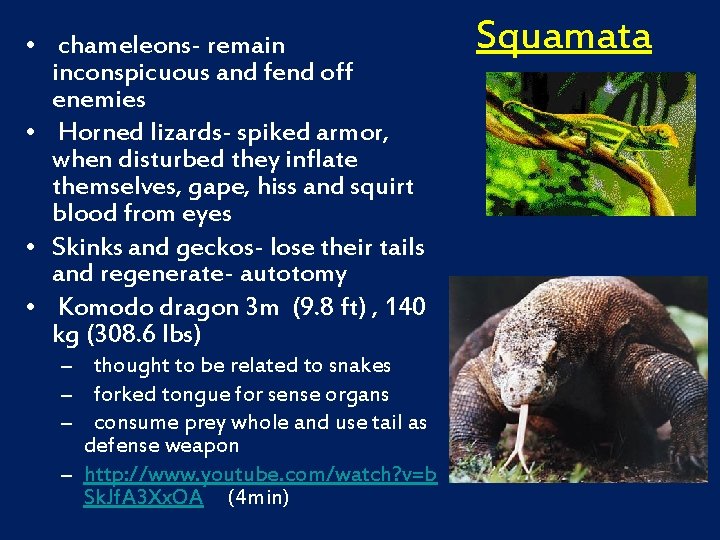
• chameleons- remain inconspicuous and fend off enemies • Horned lizards- spiked armor, when disturbed they inflate themselves, gape, hiss and squirt blood from eyes • Skinks and geckos- lose their tails and regenerate- autotomy • Komodo dragon 3 m (9. 8 ft) , 140 kg (308. 6 lbs) – thought to be related to snakes – forked tongue for sense organs – consume prey whole and use tail as defense weapon – http: //www. youtube. com/watch? v=b Sk. Jf. A 3 Xx. OA (4 min) Squamata
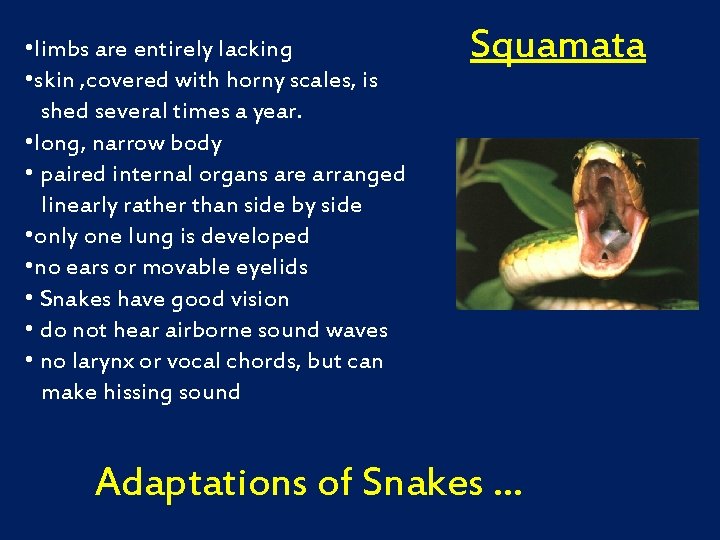
• limbs are entirely lacking • skin , covered with horny scales, is shed several times a year. • long, narrow body • paired internal organs are arranged linearly rather than side by side • only one lung is developed • no ears or movable eyelids • Snakes have good vision • do not hear airborne sound waves • no larynx or vocal chords, but can make hissing sound Squamata Adaptations of Snakes …
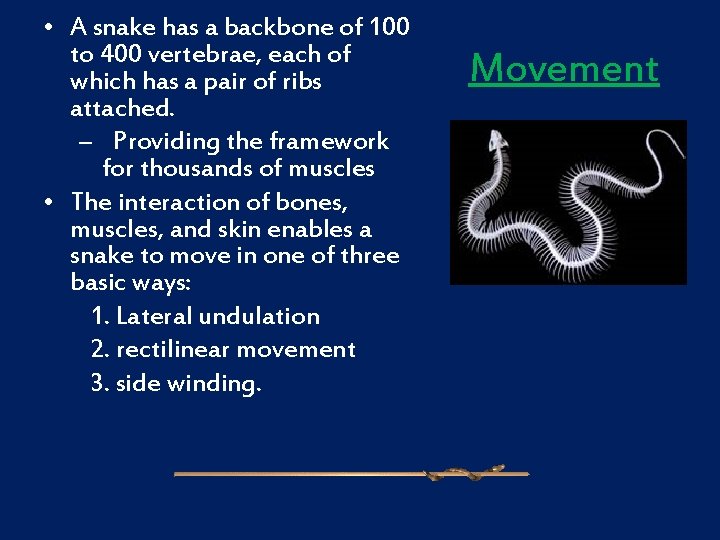
• A snake has a backbone of 100 to 400 vertebrae, each of which has a pair of ribs attached. – Providing the framework for thousands of muscles • The interaction of bones, muscles, and skin enables a snake to move in one of three basic ways: 1. Lateral undulation 2. rectilinear movement 3. side winding. Movement
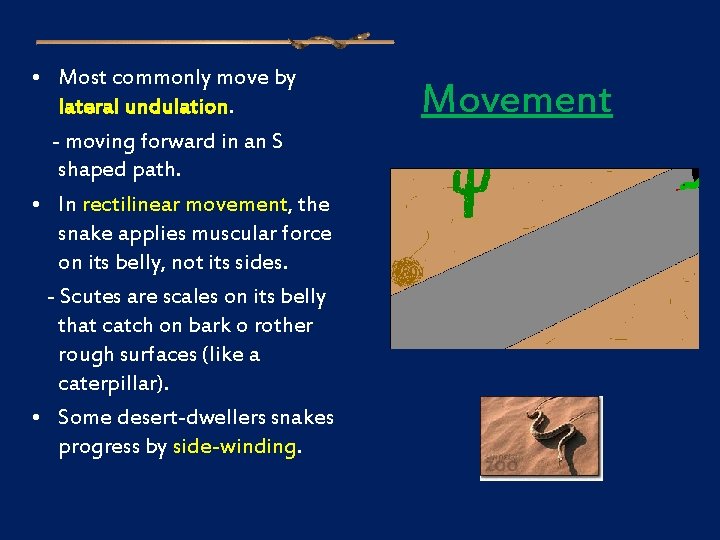
• Most commonly move by lateral undulation. - moving forward in an S shaped path. • In rectilinear movement, the snake applies muscular force on its belly, not its sides. - Scutes are scales on its belly that catch on bark o rother rough surfaces (like a caterpillar). • Some desert-dwellers snakes progress by side-winding. Movement
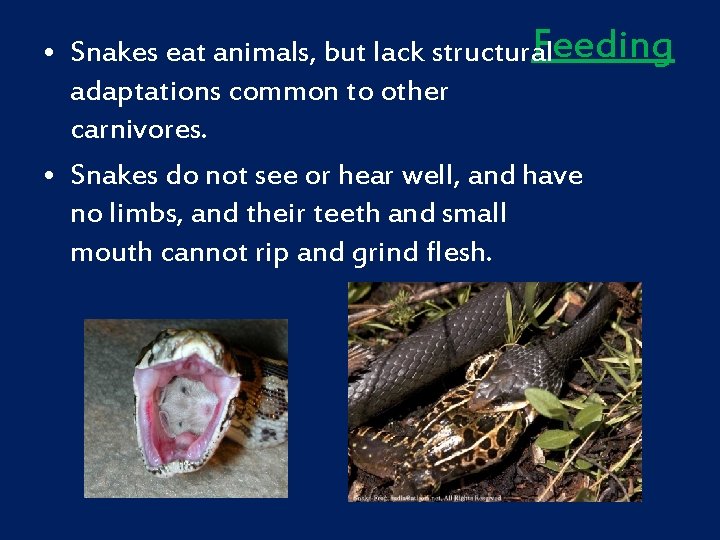
Feeding • Snakes eat animals, but lack structural adaptations common to other carnivores. • Snakes do not see or hear well, and have no limbs, and their teeth and small mouth cannot rip and grind flesh.
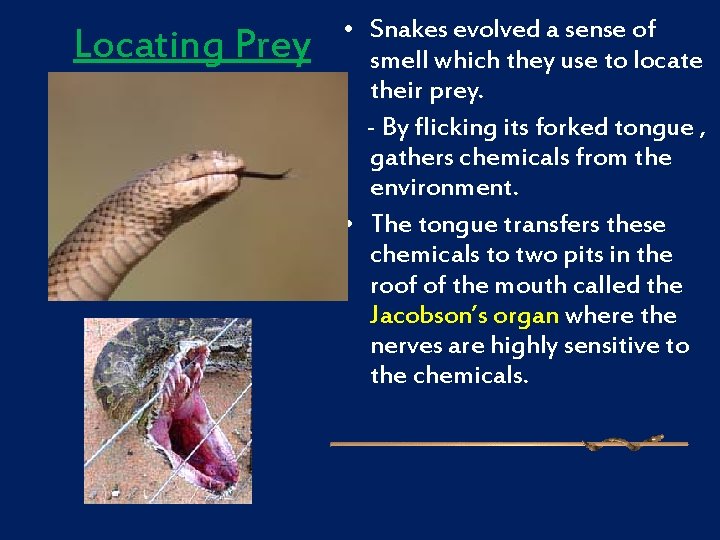
Locating Prey • Snakes evolved a sense of smell which they use to locate their prey. - By flicking its forked tongue , gathers chemicals from the environment. • The tongue transfers these chemicals to two pits in the roof of the mouth called the Jacobson’s organ where the nerves are highly sensitive to the chemicals.
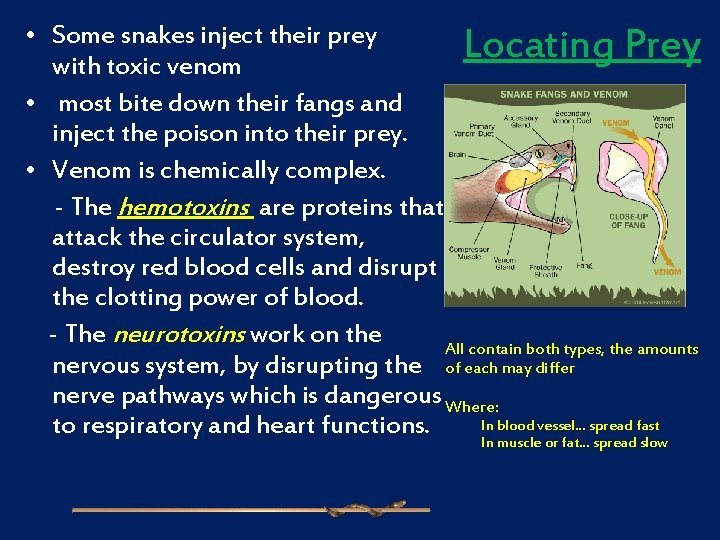
• Some snakes inject their prey Locating Prey with toxic venom • most bite down their fangs and inject the poison into their prey. • Venom is chemically complex. - The hemotoxins are proteins that attack the circulator system, destroy red blood cells and disrupt the clotting power of blood. - The neurotoxins work on the All contain both types, the amounts nervous system, by disrupting the of each may differ nerve pathways which is dangerous Where: In blood vessel… spread fast to respiratory and heart functions. In muscle or fat… spread slow
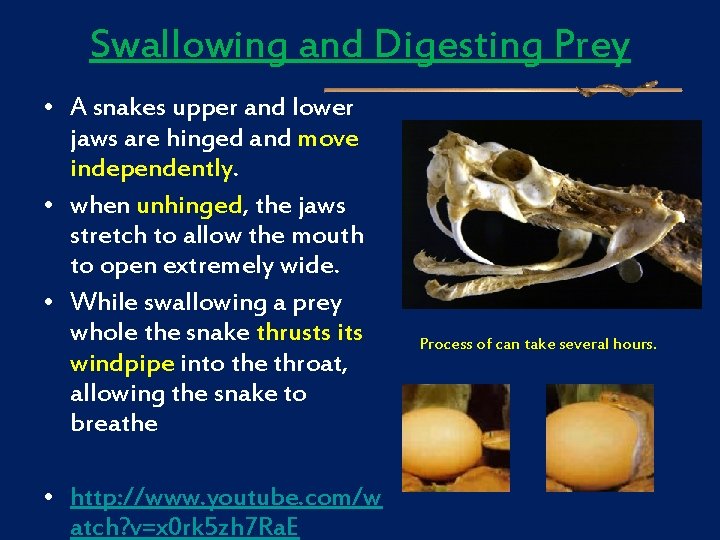
Swallowing and Digesting Prey • A snakes upper and lower jaws are hinged and move independently. • when unhinged, the jaws stretch to allow the mouth to open extremely wide. • While swallowing a prey whole the snake thrusts its windpipe into the throat, allowing the snake to breathe • http: //www. youtube. com/w atch? v=x 0 rk 5 zh 7 Ra. E Process of can take several hours.
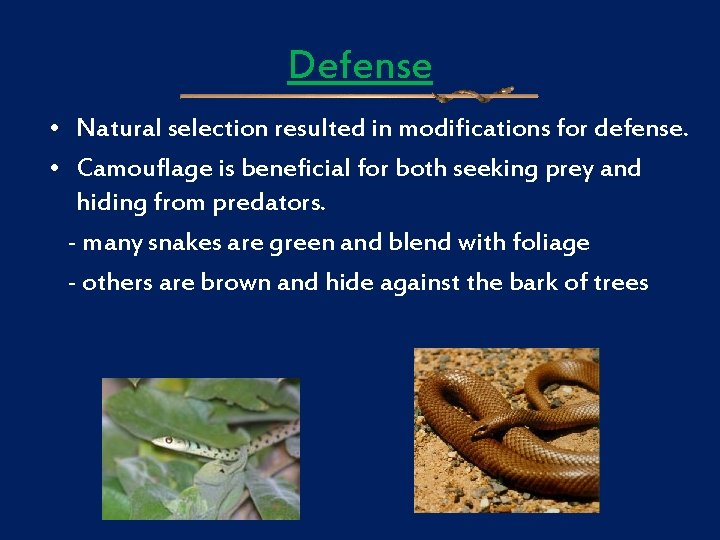
Defense • Natural selection resulted in modifications for defense. • Camouflage is beneficial for both seeking prey and hiding from predators. - many snakes are green and blend with foliage - others are brown and hide against the bark of trees
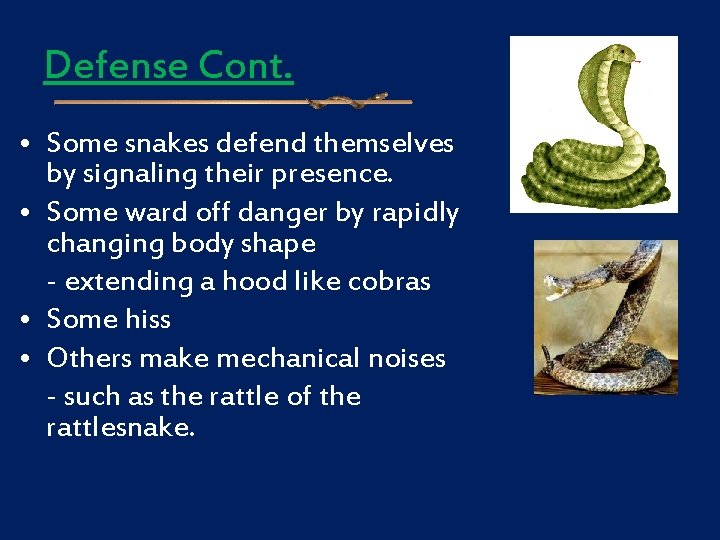
Defense Cont. • Some snakes defend themselves by signaling their presence. • Some ward off danger by rapidly changing body shape - extending a hood like cobras • Some hiss • Others make mechanical noises - such as the rattle of the rattlesnake.
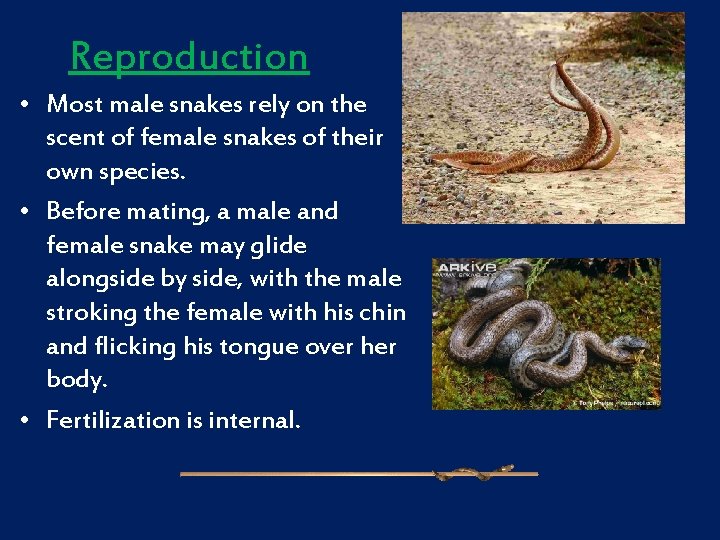
Reproduction • Most male snakes rely on the scent of female snakes of their own species. • Before mating, a male and female snake may glide alongside by side, with the male stroking the female with his chin and flicking his tongue over her body. • Fertilization is internal.
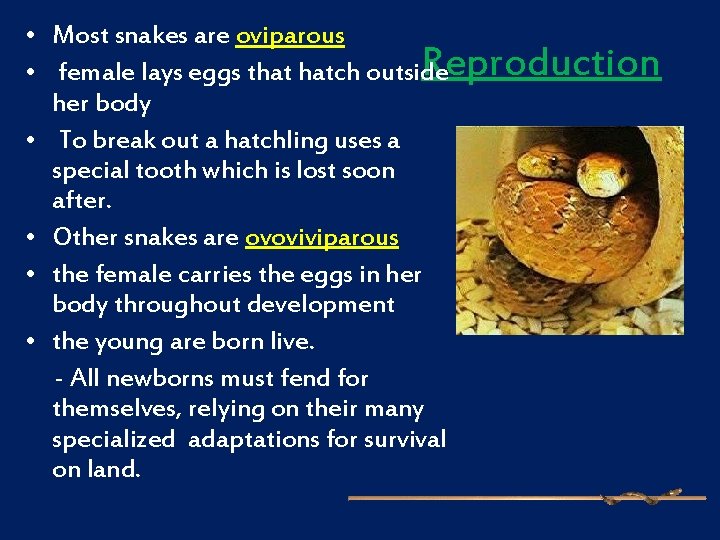
• Most snakes are oviparous Reproduction • female lays eggs that hatch outside her body • To break out a hatchling uses a special tooth which is lost soon after. • Other snakes are ovoviviparous • the female carries the eggs in her body throughout development • the young are born live. - All newborns must fend for themselves, relying on their many specialized adaptations for survival on land.
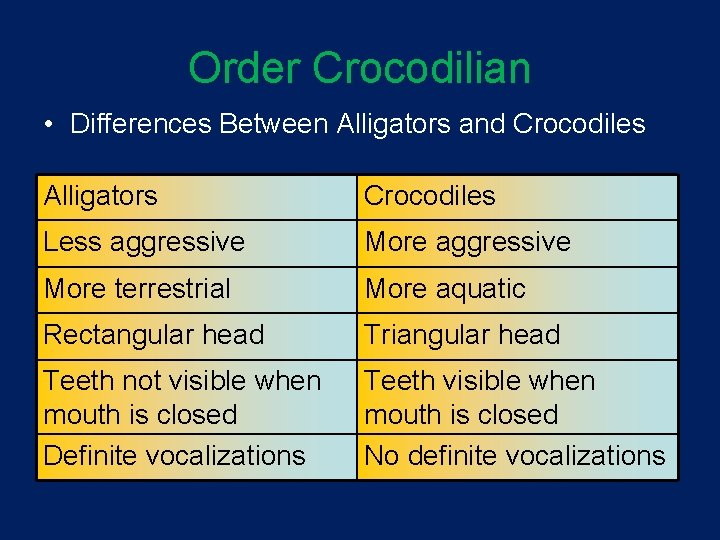
Order Crocodilian • Differences Between Alligators and Crocodiles Alligators Crocodiles Less aggressive More terrestrial More aquatic Rectangular head Triangular head Teeth not visible when mouth is closed Definite vocalizations Teeth visible when mouth is closed No definite vocalizations
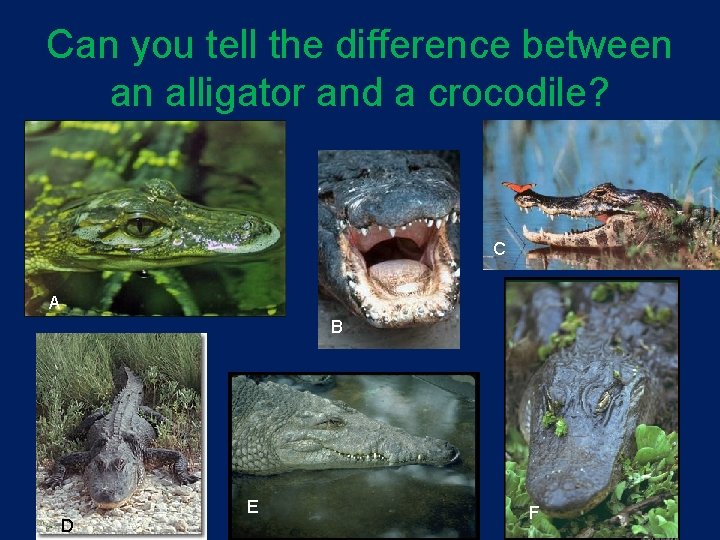
Can you tell the difference between an alligator and a crocodile? C A B D E F
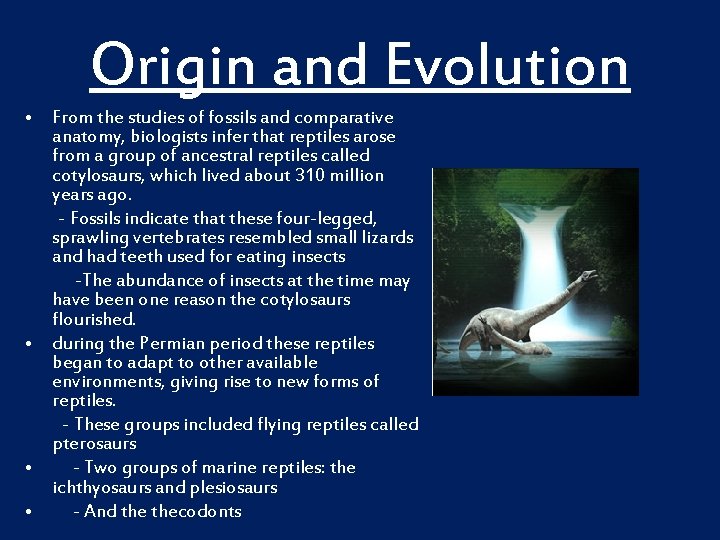
Origin and Evolution • From the studies of fossils and comparative anatomy, biologists infer that reptiles arose from a group of ancestral reptiles called cotylosaurs, which lived about 310 million years ago. - Fossils indicate that these four-legged, sprawling vertebrates resembled small lizards and had teeth used for eating insects -The abundance of insects at the time may have been one reason the cotylosaurs flourished. • during the Permian period these reptiles began to adapt to other available environments, giving rise to new forms of reptiles. - These groups included flying reptiles called pterosaurs • - Two groups of marine reptiles: the ichthyosaurs and plesiosaurs • - And thecodonts
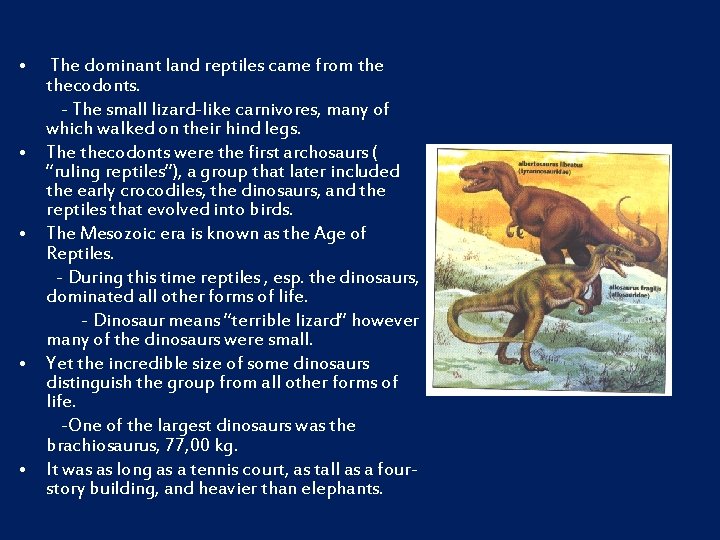
• • • The dominant land reptiles came from thecodonts. - The small lizard-like carnivores, many of which walked on their hind legs. The thecodonts were the first archosaurs ( “ruling reptiles”), a group that later included the early crocodiles, the dinosaurs, and the reptiles that evolved into birds. The Mesozoic era is known as the Age of Reptiles. - During this time reptiles , esp. the dinosaurs, dominated all other forms of life. - Dinosaur means “terrible lizard” however many of the dinosaurs were small. Yet the incredible size of some dinosaurs distinguish the group from all other forms of life. -One of the largest dinosaurs was the brachiosaurus, 77, 00 kg. It was as long as a tennis court, as tall as a fourstory building, and heavier than elephants.
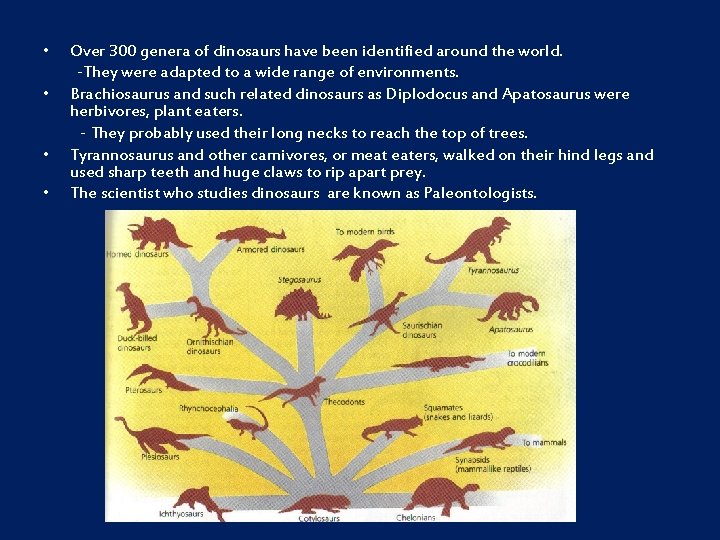
• • Over 300 genera of dinosaurs have been identified around the world. -They were adapted to a wide range of environments. Brachiosaurus and such related dinosaurs as Diplodocus and Apatosaurus were herbivores, plant eaters. - They probably used their long necks to reach the top of trees. Tyrannosaurus and other carnivores, or meat eaters, walked on their hind legs and used sharp teeth and huge claws to rip apart prey. The scientist who studies dinosaurs are known as Paleontologists.
- Slides: 41