
Reptation Monte Carlo and other topics OUTLINE REFERENCES
- Slides: 23
Reptation Monte Carlo and other topics OUTLINE REFERENCES • Review of Diffusion Monte Carlo and Path Integral Monte Carlo • Path Integral representation of the projector Method • What action to use? • How to sample paths? • Advantages and disadvantages • Excited states and Max. Ent(? ) 10/29/2021 Reptation MC • • • Ceperley, D. M. , Rev. Mod. Phys. 67, 279 (1995). Stefano Baroni and Saverio Moroni, Phys. Rev. Lett. 82, 4745 (1999) Pierleoni, C. and D. M. Ceperley, Chem. Phys. Chem, 6, 1 (2005); physics/0501013. Ceperley, D. M. , and Bernu, B. , J. Chem. Phys. 89, 6316 (1988). Boninsegni, M. and D. M. Ceperley, J. Low Temp. Phys. , 104, 339 (1996). Ceperley 1
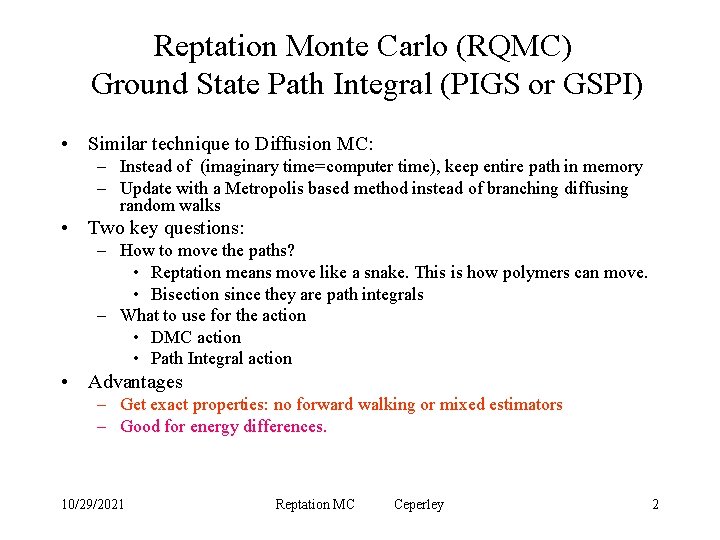
Reptation Monte Carlo (RQMC) Ground State Path Integral (PIGS or GSPI) • Similar technique to Diffusion MC: – Instead of (imaginary time=computer time), keep entire path in memory – Update with a Metropolis based method instead of branching diffusing random walks • Two key questions: – How to move the paths? • Reptation means move like a snake. This is how polymers can move. • Bisection since they are path integrals – What to use for the action • DMC action • Path Integral action • Advantages – Get exact properties: no forward walking or mixed estimators – Good for energy differences. 10/29/2021 Reptation MC Ceperley 2
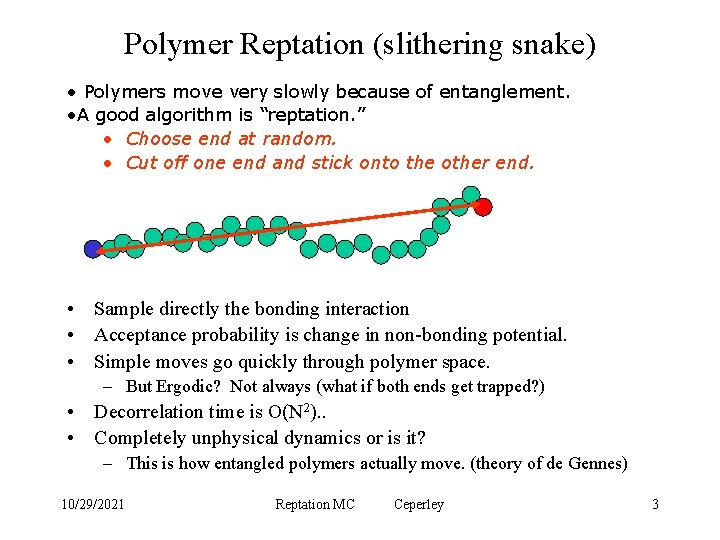
Polymer Reptation (slithering snake) • Polymers move very slowly because of entanglement. • A good algorithm is “reptation. ” • Choose end at random. • Cut off one end and stick onto the other end. • Sample directly the bonding interaction • Acceptance probability is change in non-bonding potential. • Simple moves go quickly through polymer space. – But Ergodic? Not always (what if both ends get trapped? ) • Decorrelation time is O(N 2). . • Completely unphysical dynamics or is it? – This is how entangled polymers actually move. (theory of de Gennes) 10/29/2021 Reptation MC Ceperley 3
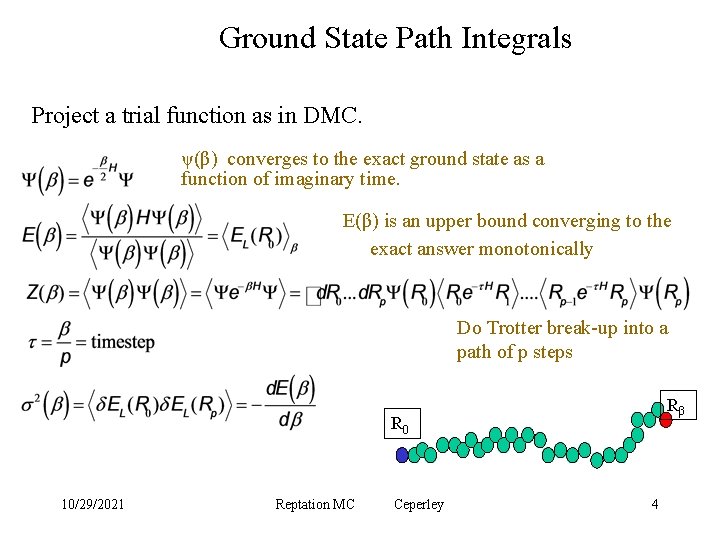
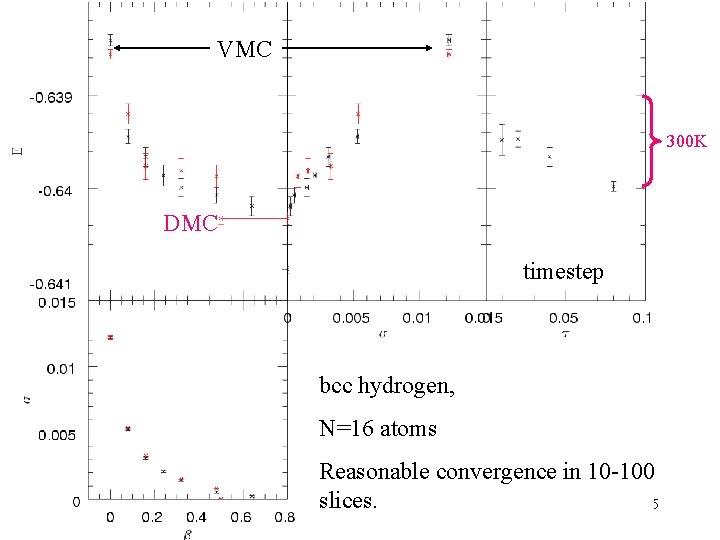
Ground State Path Integrals Project a trial function as in DMC. ψ(β) converges to the exact ground state as a function of imaginary time. E(β) is an upper bound converging to the exact answer monotonically Do Trotter break-up into a path of p steps Rβ R 0 10/29/2021 Reptation MC Ceperley 4
VMC 300 K DMC timestep bcc hydrogen, N=16 atoms 10/29/2021 Reasonable convergence in 10 -100 slices. Reptation MC Ceperley 5
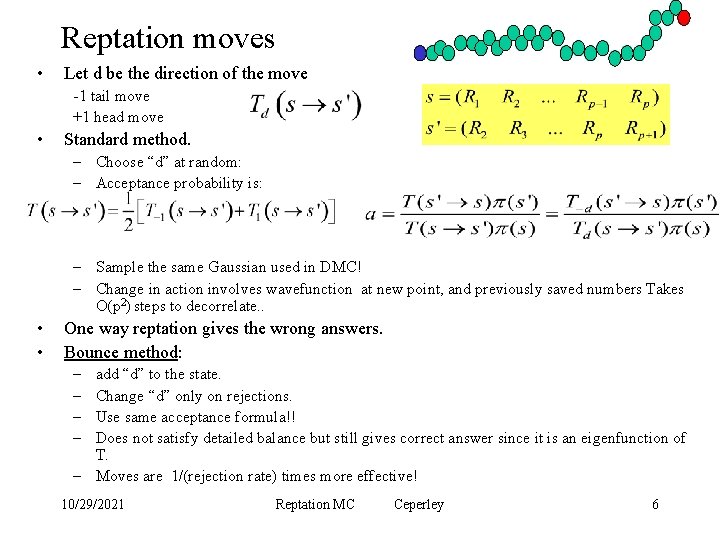
Reptation moves • Let d be the direction of the move -1 tail move +1 head move • Standard method. – Choose “d” at random: – Acceptance probability is: – Sample the same Gaussian used in DMC! – Change in action involves wavefunction at new point, and previously saved numbers Takes O(p 2) steps to decorrelate. . • • One way reptation gives the wrong answers. Bounce method: – – add “d” to the state. Change “d” only on rejections. Use same acceptance formula!! Does not satisfy detailed balance but still gives correct answer since it is an eigenfunction of T. – Moves are 1/(rejection rate) times more effective! 10/29/2021 Reptation MC Ceperley 6
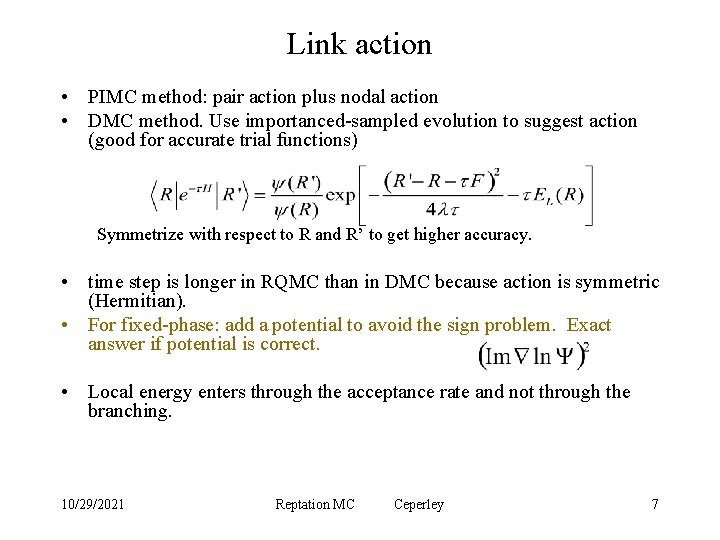
Link action • PIMC method: pair action plus nodal action • DMC method. Use importanced-sampled evolution to suggest action (good for accurate trial functions) Symmetrize with respect to R and R’ to get higher accuracy. • time step is longer in RQMC than in DMC because action is symmetric (Hermitian). • For fixed-phase: add a potential to avoid the sign problem. Exact answer if potential is correct. • Local energy enters through the acceptance rate and not through the branching. 10/29/2021 Reptation MC Ceperley 7
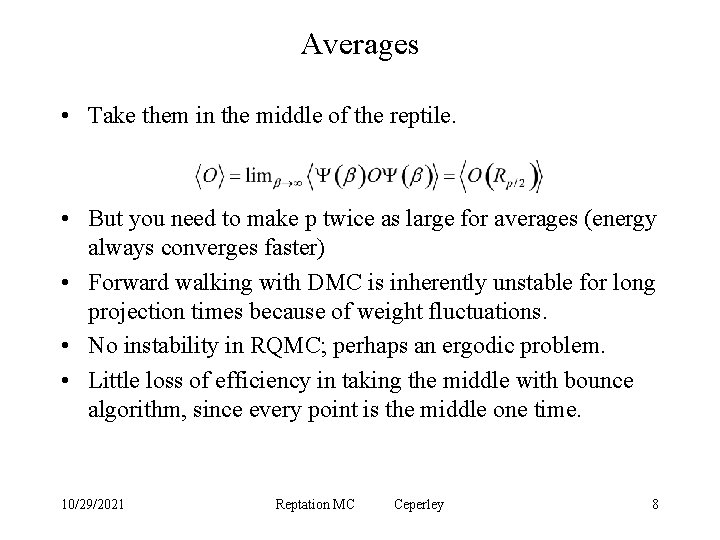
Averages • Take them in the middle of the reptile. • But you need to make p twice as large for averages (energy always converges faster) • Forward walking with DMC is inherently unstable for long projection times because of weight fluctuations. • No instability in RQMC; perhaps an ergodic problem. • Little loss of efficiency in taking the middle with bounce algorithm, since every point is the middle one time. 10/29/2021 Reptation MC Ceperley 8
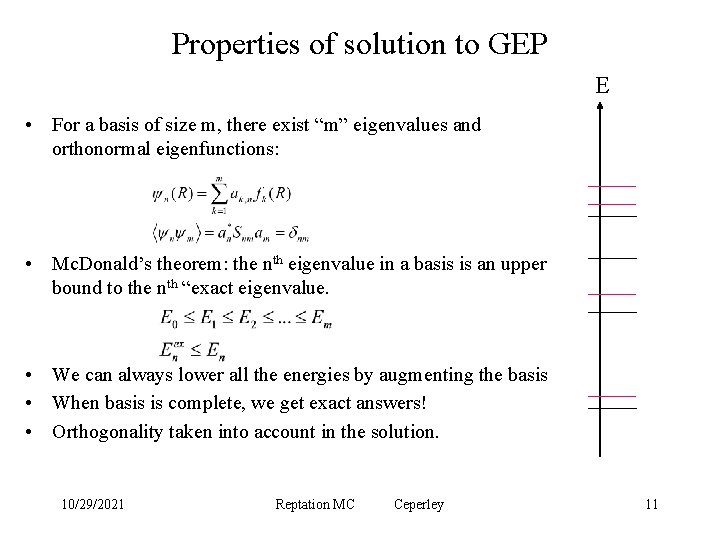
Properties of solution to GEP E • For a basis of size m, there exist “m” eigenvalues and orthonormal eigenfunctions: • Mc. Donald’s theorem: the nth eigenvalue in a basis is an upper bound to the nth “exact eigenvalue. • We can always lower all the energies by augmenting the basis • When basis is complete, we get exact answers! • Orthogonality taken into account in the solution. 10/29/2021 Reptation MC Ceperley 11
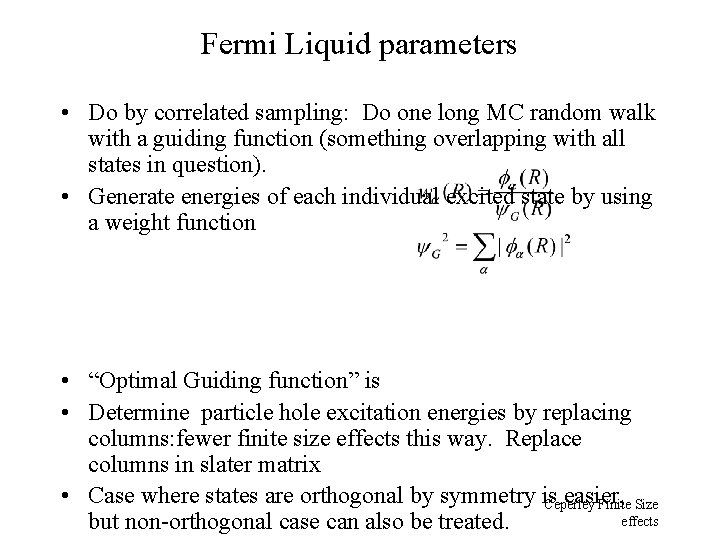
Fermi Liquid parameters • Do by correlated sampling: Do one long MC random walk with a guiding function (something overlapping with all states in question). • Generate energies of each individual excited state by using a weight function • “Optimal Guiding function” is • Determine particle hole excitation energies by replacing columns: fewer finite size effects this way. Replace columns in slater matrix • Case where states are orthogonal by symmetry is easier, Ceperley Finite Size effects but non-orthogonal case can also be treated.
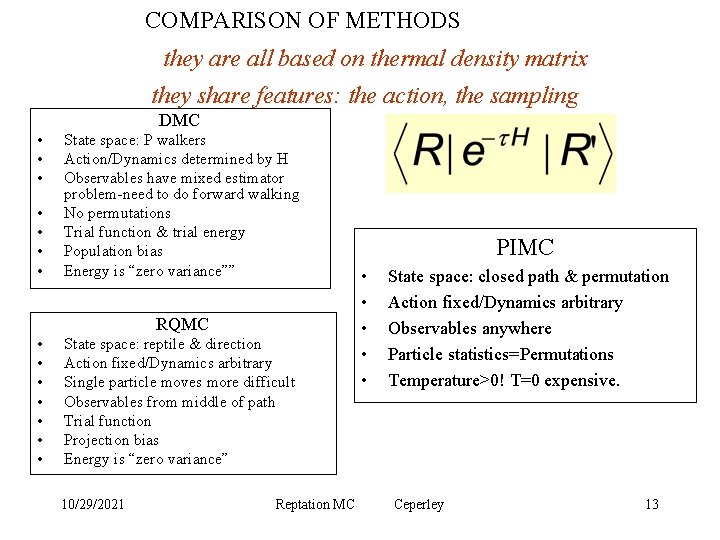
COMPARISON OF METHODS they are all based on thermal density matrix they share features: the action, the sampling DMC • • State space: P walkers Action/Dynamics determined by H Observables have mixed estimator problem-need to do forward walking No permutations Trial function & trial energy Population bias Energy is “zero variance”” RQMC • • State space: reptile & direction Action fixed/Dynamics arbitrary Single particle moves more difficult Observables from middle of path Trial function Projection bias Energy is “zero variance” 10/29/2021 Reptation MC PIMC • • • State space: closed path & permutation Action fixed/Dynamics arbitrary Observables anywhere Particle statistics=Permutations Temperature>0! T=0 expensive. Ceperley 13
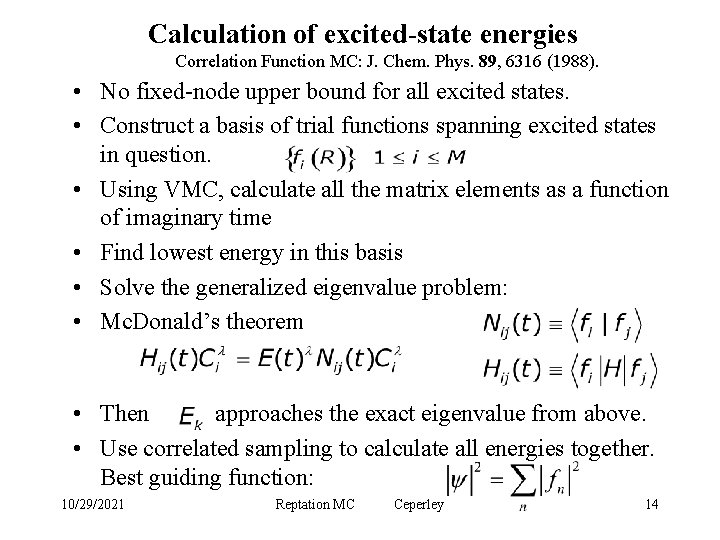
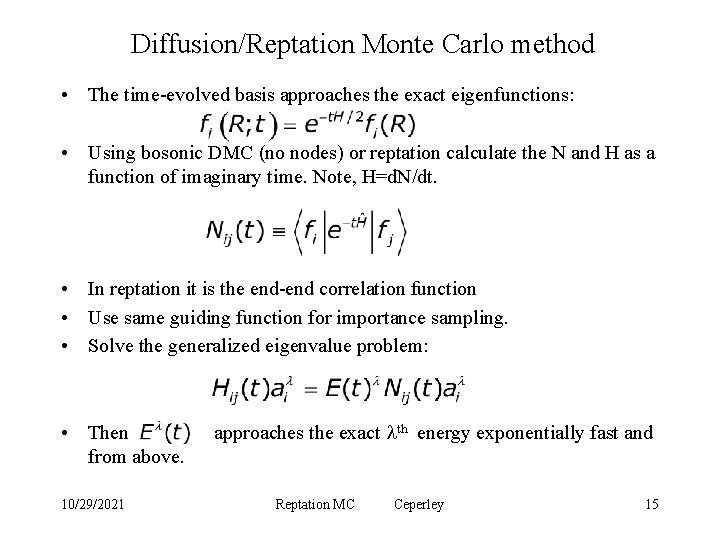
Calculation of excited-state energies Correlation Function MC: J. Chem. Phys. 89, 6316 (1988). • No fixed-node upper bound for all excited states. • Construct a basis of trial functions spanning excited states in question. • Using VMC, calculate all the matrix elements as a function of imaginary time • Find lowest energy in this basis • Solve the generalized eigenvalue problem: • Mc. Donald’s theorem • Then approaches the exact eigenvalue from above. • Use correlated sampling to calculate all energies together. Best guiding function: 10/29/2021 Reptation MC Ceperley 14
Diffusion/Reptation Monte Carlo method • The time-evolved basis approaches the exact eigenfunctions: • Using bosonic DMC (no nodes) or reptation calculate the N and H as a function of imaginary time. Note, H=d. N/dt. • In reptation it is the end-end correlation function • Use same guiding function for importance sampling. • Solve the generalized eigenvalue problem: • Then from above. 10/29/2021 approaches the exact th energy exponentially fast and Reptation MC Ceperley 15
Remarks on CFMC • Zero variance principle applies. • Can treat a large basis and hence get a whole spectrum at once. • Sign problem is still there. In practice “t” cannot be too large. • If nodes in the DMC are present, excited state energies will be wrong. • Maybe Max. Ent methods can do better. But problems working in energy space. Much better in effective Hamiltonian space. • Difficult to make realistic basis for many-body systems. 10/29/2021 Reptation MC Ceperley 17
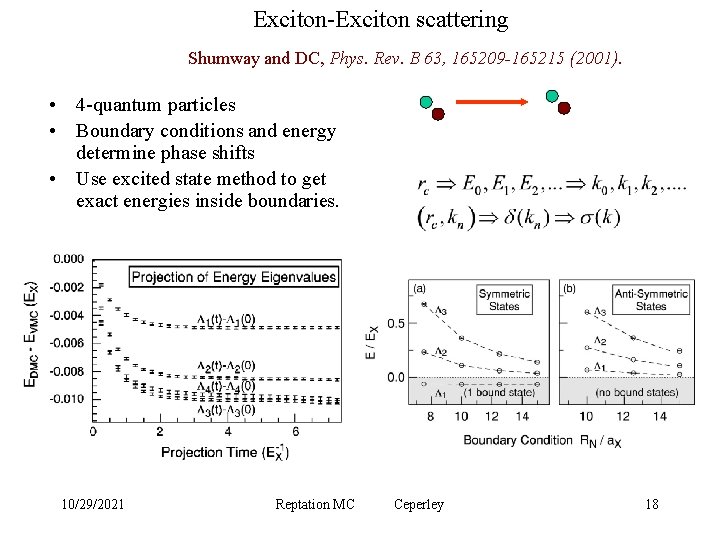
Exciton-Exciton scattering Shumway and DC, Phys. Rev. B 63, 165209 -165215 (2001). • 4 -quantum particles • Boundary conditions and energy determine phase shifts • Use excited state method to get exact energies inside boundaries. 10/29/2021 Reptation MC Ceperley 18
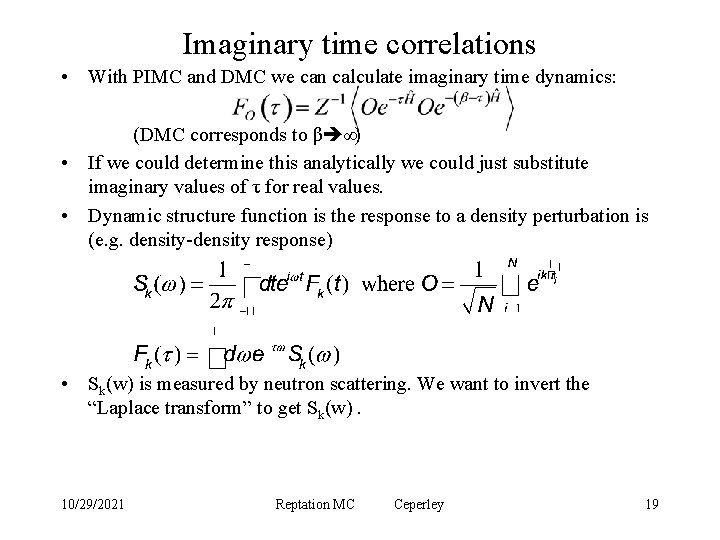
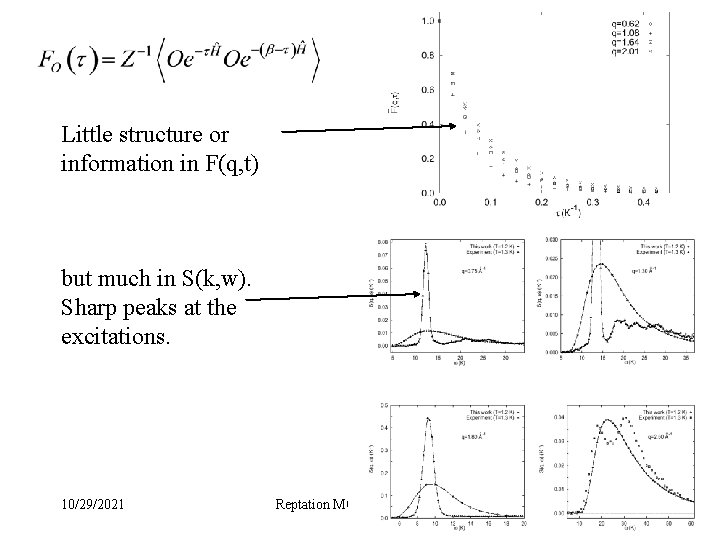
Imaginary time correlations • With PIMC and DMC we can calculate imaginary time dynamics: (DMC corresponds to β ∞) • If we could determine this analytically we could just substitute imaginary values of τ for real values. • Dynamic structure function is the response to a density perturbation is (e. g. density-density response) • Sk(w) is measured by neutron scattering. We want to invert the “Laplace transform” to get Sk(w). 10/29/2021 Reptation MC Ceperley 19
Little structure or information in F(q, t) but much in S(k, w). Sharp peaks at the excitations. 10/29/2021 Reptation MC Ceperley 20
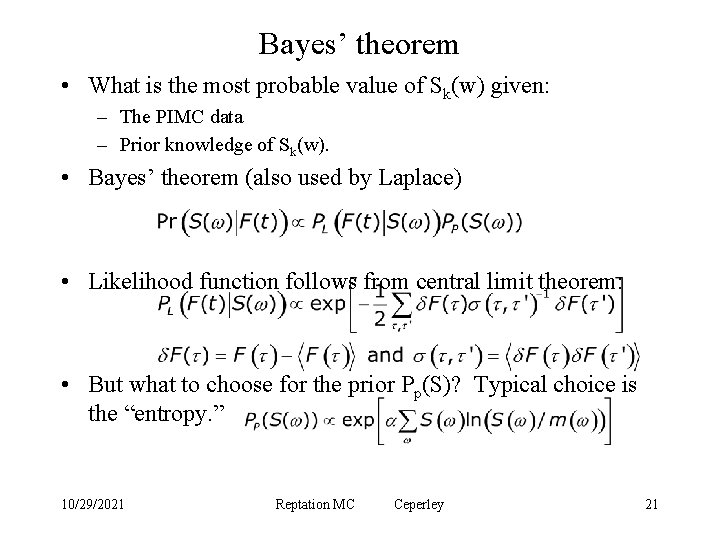
Bayes’ theorem • What is the most probable value of Sk(w) given: – The PIMC data – Prior knowledge of Sk(w). • Bayes’ theorem (also used by Laplace) • Likelihood function follows from central limit theorem: • But what to choose for the prior Pp(S)? Typical choice is the “entropy. ” 10/29/2021 Reptation MC Ceperley 21
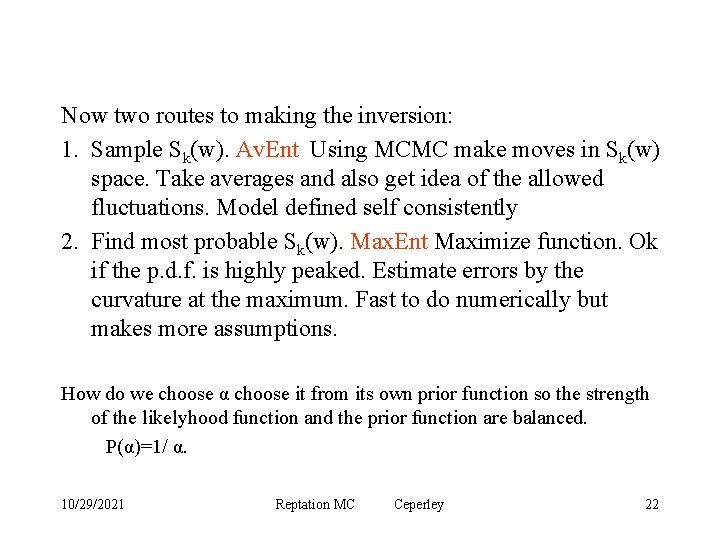
Now two routes to making the inversion: 1. Sample Sk(w). Av. Ent Using MCMC make moves in Sk(w) space. Take averages and also get idea of the allowed fluctuations. Model defined self consistently 2. Find most probable Sk(w). Max. Ent Maximize function. Ok if the p. d. f. is highly peaked. Estimate errors by the curvature at the maximum. Fast to do numerically but makes more assumptions. How do we choose α choose it from its own prior function so the strength of the likelyhood function and the prior function are balanced. P(α)=1/ α. 10/29/2021 Reptation MC Ceperley 22
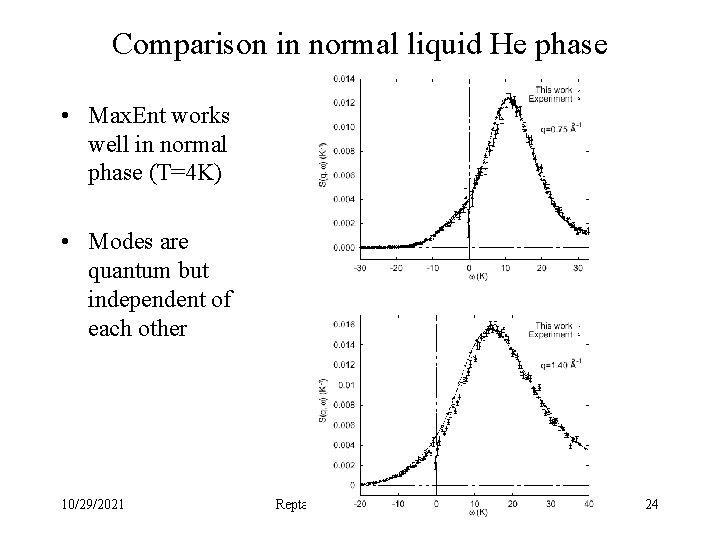
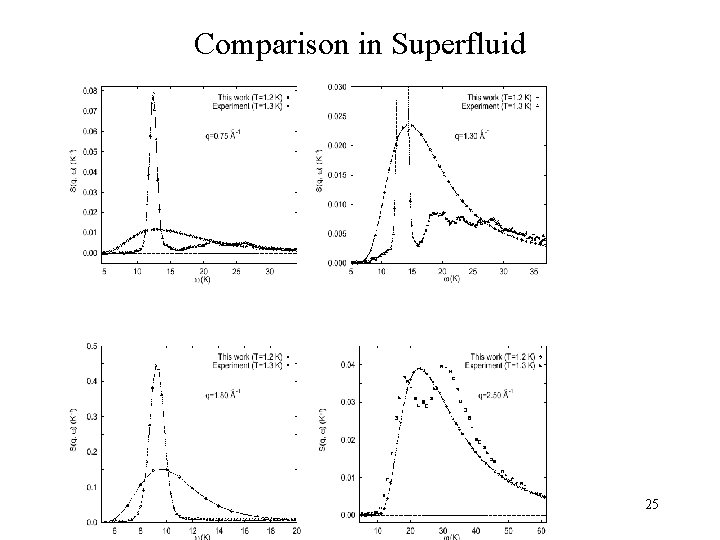
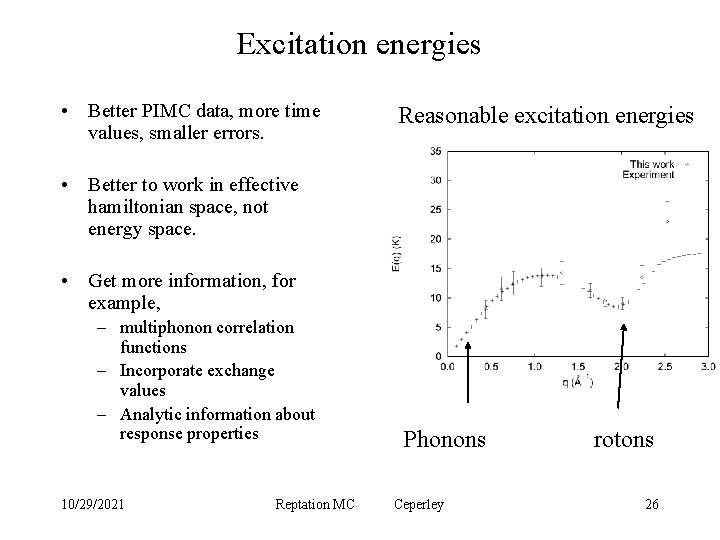
Example: Liquid 4 He Boninsegni and DMC • Calculate Fk(τ) using PIMC (UPI). • Av. Ent works beautifully in normal phase. • Gives peaks too broad in the superfluid phase. Failure of the entropic prior. • It makes the assumption that energy modes are uncoupled. This is false! Energy levels repel each other so that if there is energy at one level, it is unlikely at nearby values. • Would require incredible precision to get sharp features. • But good method for determining the excitation energy. 10/29/2021 Reptation MC Ceperley 23
Comparison in normal liquid He phase • Max. Ent works well in normal phase (T=4 K) • Modes are quantum but independent of each other 10/29/2021 Reptation MC Ceperley 24
Comparison in Superfluid 10/29/2021 Reptation MC Ceperley 25
Excitation energies • Better PIMC data, more time values, smaller errors. Reasonable excitation energies • Better to work in effective hamiltonian space, not energy space. • Get more information, for example, – multiphonon correlation functions – Incorporate exchange values – Analytic information about response properties 10/29/2021 Reptation MC Phonons Ceperley rotons 26