
Reproductive System n n Primary sex organs gonads




- Slides: 40
Reproductive System n n Primary sex organs (gonads) – testes in males, ovaries in females Gonads produce sex cells called gametes and secrete sex hormones Accessory reproductive organs – ducts, glands, and external genitalia Sex hormones – androgens (males), and estrogens and progesterone (females)
Reproductive System n Sex hormones play roles in: n n n The development and function of the reproductive organs Sexual behavior and drives The growth and development of many other organs and tissues
Male Reproductive System n n n The male gonads (testes) produce sperm and lie within the scrotum Sperm are delivered to the exterior through a system of ducts: epididymis, ductus deferens, ejaculatory duct, and the urethra Accessory sex glands: n n Empty their secretions into the ducts during ejaculation Include the seminal vesicles, prostate gland, and bulbourethral glands
The Scrotum n n n Sac of skin and superficial fascia that hangs outside the abdominopelvic cavity at the root of the penis Contains paired testicles separated by a midline septum Its external positioning keeps the testes 3 C lower than core body temperature (needed for sperm production)
The Scrotum n Intrascrotal temperature is kept constant by two sets of muscles: n n Dartos – smooth muscle that wrinkles scrotal skin Cremaster – bands of skeletal muscle that elevate the testes
The Testes n Each testis is surrounded by two tunics: n n n The tunica vaginalis, derived from peritoneum The tunica albuginea, the fibrous capsule of the testis Septa divide the testis into 250 -300 lobules, each containing 1 -4 seminiferous tubules
The Testes n Seminiferous tubules: n n n Produce the sperm Converge to form the tubulus rectus The straight tubulus rectus conveys sperm to the rete testis
The Testes n From the rete testis, the sperm: n n n Leave the testis via efferent ductules Enter the epididymis Surrounding the seminiferous tubules are interstitial cells that produce androgens
The Testes n n n Testicular arteries branch from the abdominal aorta and supply the testes Testicular veins arise from the pampiniform plexus Spermatic cord – encloses PNS and SNS nerve fibers, blood vessels, and lymphatics that supply the testes
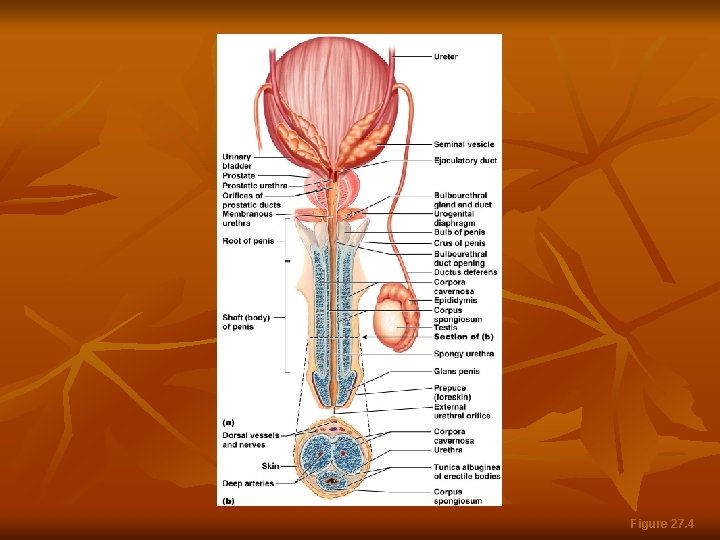
The Penis n n n A copulatory organ designed to deliver sperm into the female reproductive tract Consists of an attached root and a free shaft that ends in the glans penis Prepuce, or foreskin – cuff of skin covering the distal end of the penis n Circumcision – surgical removal of the foreskin after birth
The Penis n n Internal penis – the urethra and three cylindrical bodies of erectile tissue Erectile tissue – spongy network of connective tissue and smooth muscle riddled with vascular spaces
The Penis n n Erection – during sexual excitement, the erectile tissue fills with blood causing the penis to enlarge and become rigid Corpus spongiosum – surrounds the urethra and expands to form the glans and bulb of the penis Corpora cavernosa – paired dorsal erectile bodies bound by fibrous tunica albuginea Crura – proximal end of the penis surrounded by the ischiocavernosus muscle; anchors the penis to the pubic arch
The Penis Figure 27. 4
Epididymis n n Its head joins the efferent ductules and caps the superior aspect of the testis The duct of the epididymis has stereocilia that: n n Absorb testicular fluid Pass nutrients to the sperm Nonmotile sperm enter, pass through its tubes and become motile Upon ejaculation the epididymis contracts, expelling sperm into the ductus deferens
Ductus Deferens and Ejaculatory Duct n n Runs from the epididymis through the inguinal canal into the pelvic cavity Its terminus expands to form the ampulla and then joins the duct of the seminal vesicle to form the ejaculatory duct Propels sperm from the epididymis to the urethra Vasectomy – cutting and ligating the ductus deferens, which is a nearly 100% effective form of birth control
Urethra n n Conveys both urine and semen (at different times) Consists of three regions n n n Prostatic – portion surrounded by the prostate Membranous – lies in the urogenital diaphragm Spongy, or penile – runs through the penis and opens to the outside at the external urethral orifice
Accessory Glands: Seminal Vesicles n Lie on the posterior wall of the bladder and secrete 60% of the volume of semen n Semen – viscous alkaline fluid containing fructose, ascorbic acid, coagulating enzyme (vesiculase), and prostaglandins Join the ductus deferens to form the ejaculatory duct Sperm and seminal fluid mix in the ejaculatory duct and enter the prostatic urethra during ejaculation
Accessory Glands: Prostate Gland n n Doughnut-shaped gland that encircles part of the urethra inferior to the bladder Its milky, slightly acid fluid, which contains citrate, enzymes, and prostate-specific antigen (PSA), accounts for one-third of the semen volume Plays a role in the activation of sperm Enters the prostatic urethra during ejaculation
Accessory Glands: Bulbourethral Glands (Cowper’s Glands) n n Pea-sized glands inferior to the prostate Produce thick, clear mucus prior to ejaculation that neutralizes traces of acidic urine in the urethra
Semen n Milky white, sticky mixture of sperm and accessory gland secretions Provides a transport medium and nutrients (fructose), protects and activates sperm, and facilitates their movement Prostaglandins in semen: n n n Decrease the viscosity of mucus in the cervix Stimulate reverse peristalsis in the uterus Facilitate the movement of sperm through the female reproductive tract
Semen n n The hormone relaxin enhances sperm motility The relative alkalinity of semen neutralizes the acid environment found in the male urethra and female vagina Seminalplasmin – antibiotic chemical that destroys certain bacteria Clotting factors coagulate semen immediately after ejaculation, then fibrinolysin liquefies the sticky mass Only 2 -5 ml of semen are ejaculated, but it contains 50 -130 million sperm/ml
Male Sexual Response: Erection n n Enlargement and stiffening of the penis from engorgement of erectile tissue with blood During sexual arousal, a PNS reflex promotes the release of nitric oxide Nitric oxide causes erectile tissue to fill with blood Expansion of the corpora cavernosa: n n n Compresses their drainage veins Retards blood outflow and maintains engorgement The corpus spongiosum functions in keeping the urethra open during ejaculation
Male Sexual Response n n n Erection is initiated by sexual stimuli Erection can be induced or inhibited solely by emotional or higher mental activity Impotence – inability to attain erection
Ejaculation n n The propulsion of semen from the male duct system At ejaculation, sympathetic nerves serving the genital organs cause: n n Reproductive ducts and accessory organs to contract and empty their contents The bladder sphincter muscle to constrict, preventing the expulsion of urine Bulbospongiosus muscles to undergo a rapid series of contractions Propulsion of semen from the urethra
Spermatogenesis n n n The sequence of events that produces sperm in the seminiferous tubules of the testes Each cell has two sets of chromosomes (one maternal, one paternal) and is said to be diploid (2 n chromosomal number) Humans have 23 pairs of homologous chromosomes Gametes only have 23 chromosomes and are said to be haploid (n chromosomal number) Gamete formation is by meiosis, in which the number of chromosomes is halved (from 2 n to n)
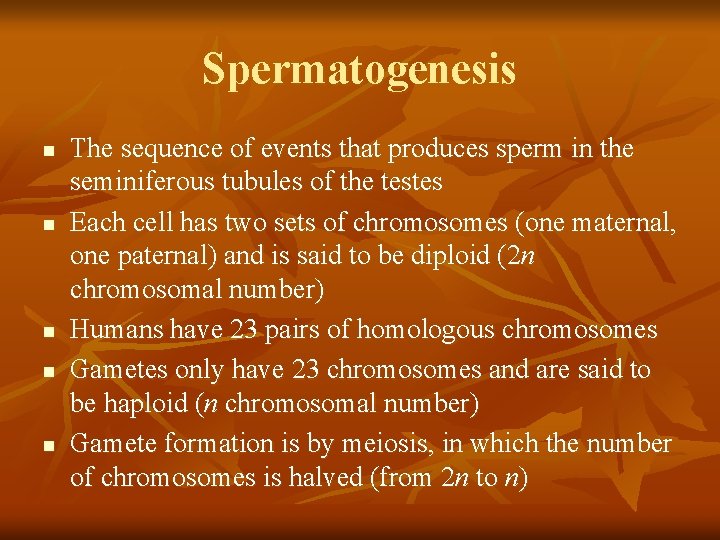
Meiosis – Interphase n n Two nuclear divisions halve the number of chromosomes Chromosomes replicate prior to meiosis I Figure 27. 7. 1
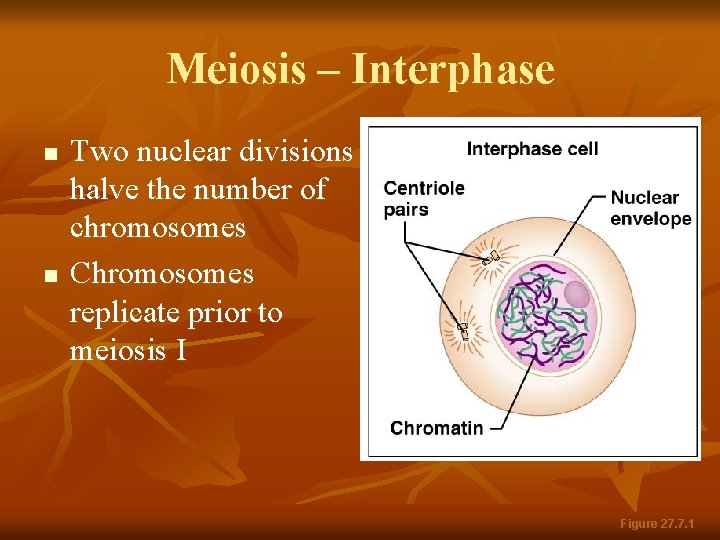
Meiosis – Prophase I n n n Homologous chromosomes undergo synapsis Tetrads are formed with homologous partners Crossing over takes place during prophase I Figure 27. 7. 2. 1
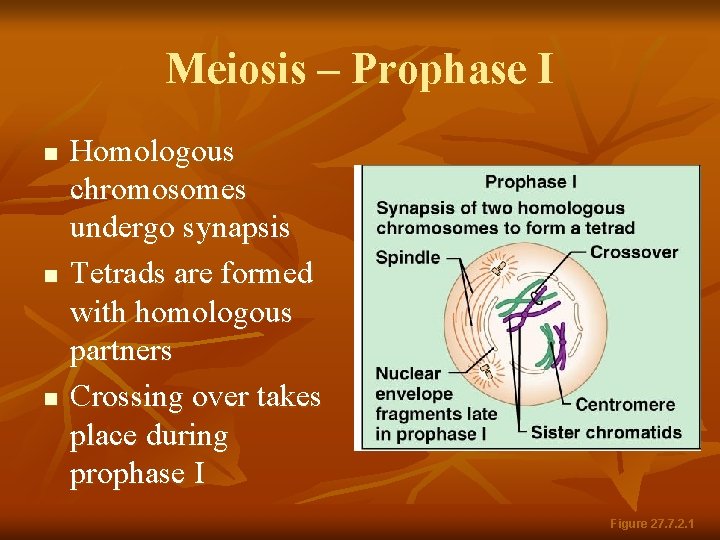
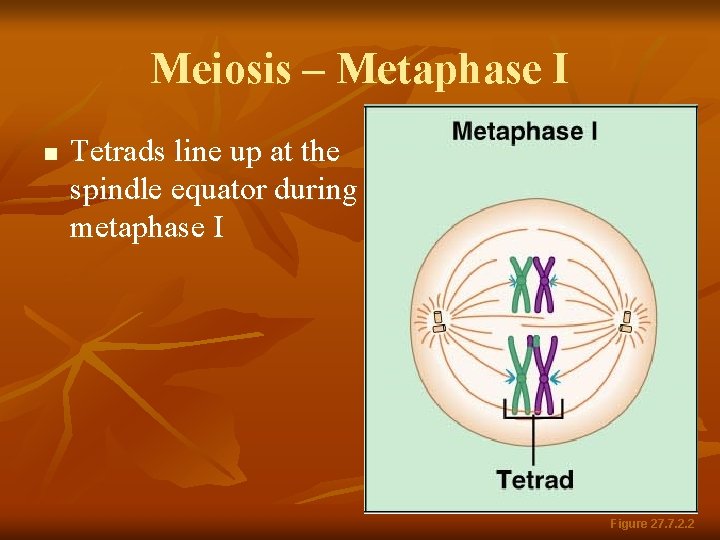
Meiosis – Metaphase I n Tetrads line up at the spindle equator during metaphase I Figure 27. 7. 2. 2
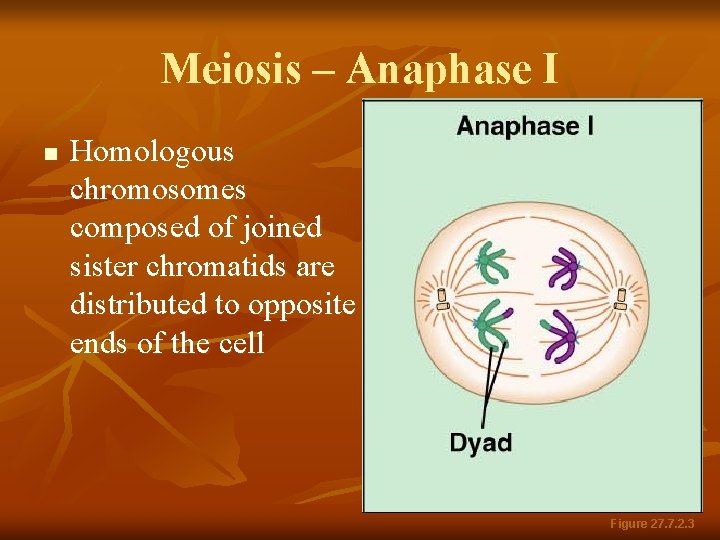
Meiosis – Anaphase I n Homologous chromosomes composed of joined sister chromatids are distributed to opposite ends of the cell Figure 27. 7. 2. 3
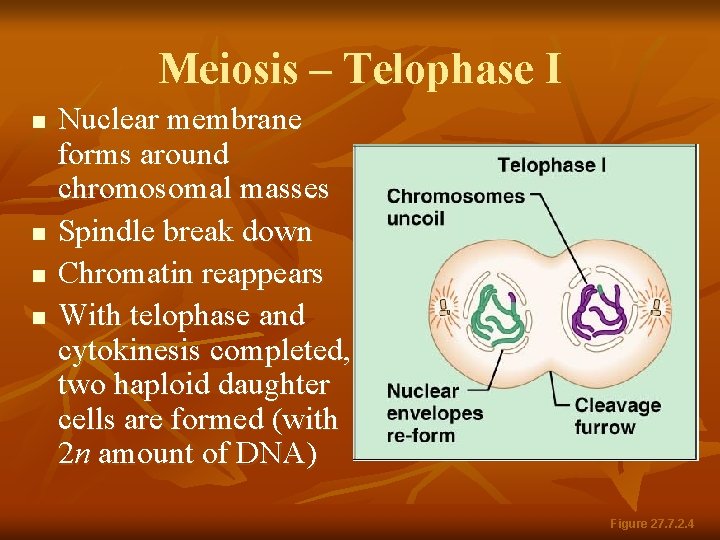
Meiosis – Telophase I n n Nuclear membrane forms around chromosomal masses Spindle break down Chromatin reappears With telophase and cytokinesis completed, two haploid daughter cells are formed (with 2 n amount of DNA) Figure 27. 7. 2. 4
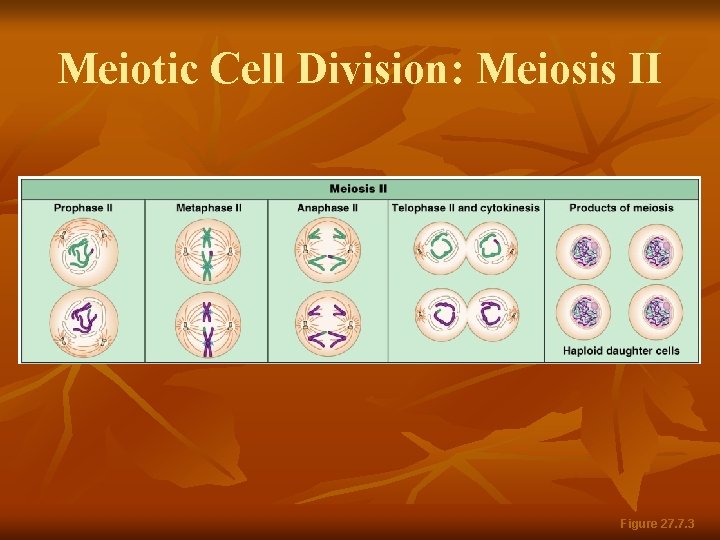
Meiosis II n n Mirrors mitosis except that chromosomes are not replicated before it begins Meiosis accomplishes two tasks: n n It reduces the chromosome number by half (2 n to n) It introduces genetic variability
Meiotic Cell Division: Meiosis II Figure 27. 7. 3
Spermatogenesis n n Cells making up the walls of seminiferous tubules are in various stages of cell division These spermatogenic cells give rise to sperm in a series of events n n n Mitosis of spermatogonia, forming spermatocytes Meiosis forms spermatids from spermatocytes Spermiogenesis – spermatids form sperm
Mitosis of Spermatogonia n n Spermatogonia – outermost cells in contact with the epithelial basal lamina Spermatogenesis begins at puberty as each mitotic division of spermatogonia results in type A or type B daughter cells Type A cells remain at the basement membrane and maintain the germ line Type B cells move toward the lumen and become primary spermatocytes
Spermatocytes to Spermatids n n n Primary spermatocytes undergo meiosis I, forming two haploid cells called secondary spermatocytes Secondary spermatocytes undergo meiosis II and their daughter cells are called spermatids Spermatids are small round cells seen close to the lumen of the tubule
Spermiogenesis: Spermatids to Sperm n n Late in spermatogenesis, spermatids are haploid but nonmotile Spermiogenesis – spermatids lose excess cytoplasm and form a tail, becoming sperm
Spermiogenesis: Spermatids to Sperm n Sperm have three major regions n n n Head – contains DNA and has a helmetlike acrosome containing hydrolytic enzymes that allow the sperm to penetrate and enter the egg Midpiece – contains mitochondria spiraled around the tail filaments Tail – a typical flagellum produced by a centriole
Sustentacular Cells (Sertoli Cells) n n Cells that extend from the basal lamina to the lumen of the tubule that surrounds developing cells They are bound together with tight junctions forming an unbroken layer with the seminiferous tubule, dividing it into two compartments n n The basal compartment – contains spermatogonia and primary spermatocytes Adluminal compartment – contains meiotically active cells and the tubule lumen
Sustentacular Cells n n Their tight junctions form a blood-testis barrier This prevents sperm antigens from escaping through the basal lamina into the blood Since sperm are not formed until puberty, they are absent during thymic education Spermatogonia are recognized as “self” and are influenced by bloodborne chemical messengers that prompt spermatogenesis
Adluminal Compartment Activities n Spermatocytes and spermatids are nearly enclosed in sustentacular cells, which: n n n Deliver nutrients to dividing cells Move them along to the lumen Secrete testicular fluid that provides the transport medium for sperm Dispose of excess cytoplasm sloughed off during maturation to sperm Produce chemical mediators that help regulate spermatogenesis