
Reproductive Physiology Puberty in males and females DR
Reproductive Physiology Puberty in males and females DR. MOHAMMED ALOTAIBI
Objectives By the end of this lecture, you should be able to: �Define Puberty �Recognize the physiology of puberty related to changes in hypothalamic-pituitary-gonadal axis �Describe the physical changes that occur at puberty in boys and girls �Recognize the influencing factors leading to puberty �Describe the pathophysiological conditions associated with puberty
PUBERTY �Definition: Physiological transition from childhood (juvenile) to adulthood. At puberty: � The primary sexual organs mature (gonads). � The secondary sexual characteristics develop. � The adolescent experiences the adolescent growth spurt. � The adolescent achieves the ability to procreate.
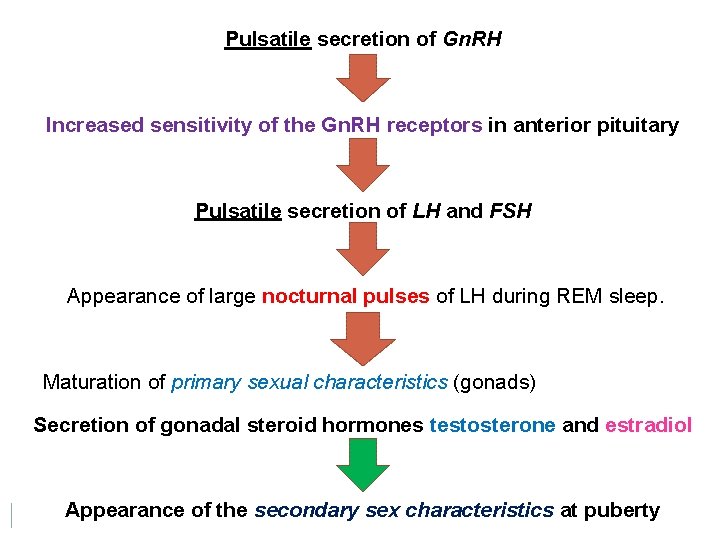
Pulsatile secretion of Gn. RH Increased sensitivity of the Gn. RH receptors in anterior pituitary Pulsatile secretion of LH and FSH Appearance of large nocturnal pulses of LH during REM sleep. Maturation of primary sexual characteristics (gonads) Secretion of gonadal steroid hormones testosterone and estradiol Appearance of the secondary sex characteristics at puberty
Puberty Appearance of secondary sexual characteristics (pubic and axillary hair, female breast development, male voice changes, . . . ) - Menstruation and spermatogenesis begin Occurs between 8 and 14 yrs in girls Occurs between 9 and 14 yrs in boys

Puberty – Terms & Events �Thelarche: development of breast �Puberache: development of pubic & axillary hair �Menarche: the first menstrual period �Adrenarche: the onset of an increase in the secretion of androgens; responsible for the development of pubic/axillary hair, body odour and acne. �Gonadarche: maturation of gonadal function
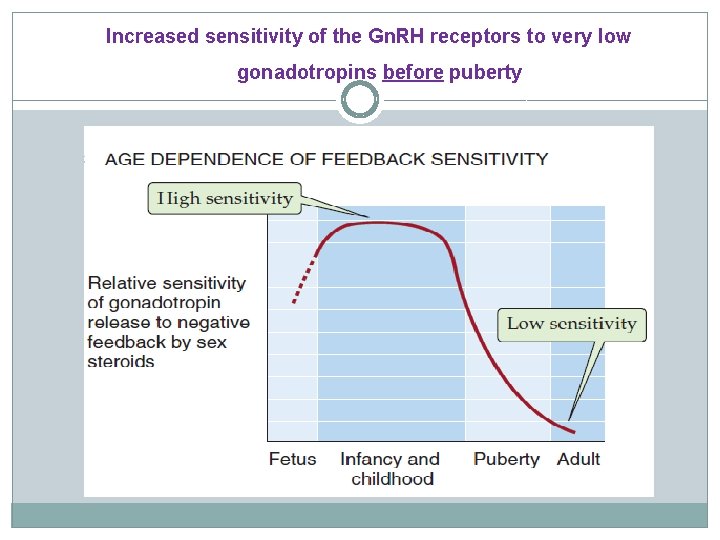
Increased sensitivity of the Gn. RH receptors to very low gonadotropins before puberty
Puberty – hormonal changes �In young children, low gonadotropins and increased sensitivity of Gn. RH receptors to low gonadotropins cannot initiate gonadal function �Between 9 -12 yrs, blood levels of LH, FSH increase. �High levels of LH, FSH initiate gonadal development q Nocturnal Gn. RH pulsatility (LH secretion) precedes phenotypic changes by several years q First phenotypic changes: breast development / testicular enlargement
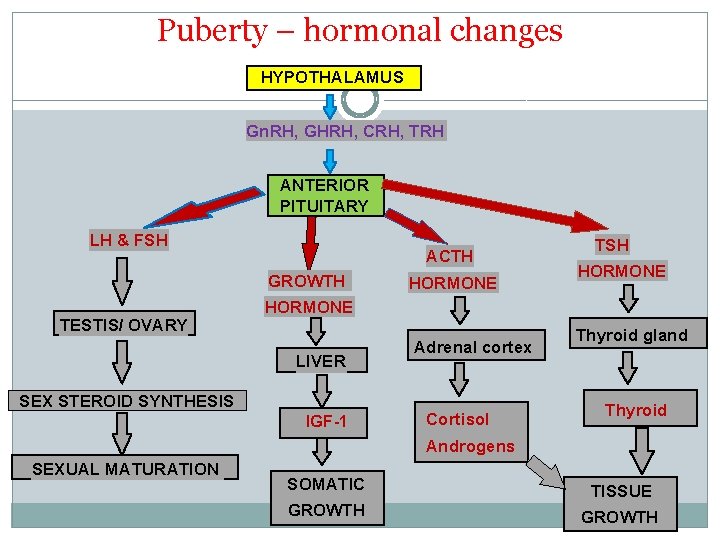
Puberty – hormonal changes HYPOTHALAMUS Gn. RH, GHRH, CRH, TRH ANTERIOR PITUITARY LH & FSH ACTH GROWTH TESTIS/ OVARY HORMONE TSH HORMONE LIVER SEX STEROID SYNTHESIS IGF-1 Adrenal cortex Cortisol Thyroid gland Thyroid Androgens SEXUAL MATURATION SOMATIC TISSUE GROWTH
Physical
Physical Changes � 5 stages from childhood to full maturity �Tanner Scale (1 – 5) �Reflect progression in changes of the external genitalia/breast and pubic hair �Secondary sexual characteristics Mean age 11 yrs in girls Mean age 11. 5 – 12 yrs in boys
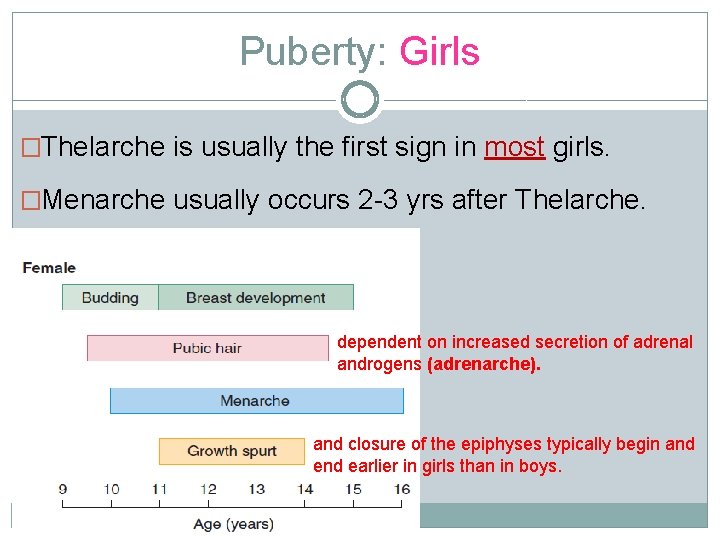
Puberty: Girls �Thelarche is usually the first sign in most girls. �Menarche usually occurs 2 -3 yrs after Thelarche. dependent on increased secretion of adrenal androgens (adrenarche). and closure of the epiphyses typically begin and earlier in girls than in boys.
Puberty: Boys Ø Puberty is associated with activation of the HPG axis. Ø Leydig cell proliferation in the testes, and increased synthesis and secretion of testosterone. Ø There is growth of the testes, largely because of an increased number of seminiferous tubules. Ø There is growth of the sex accessory organs such as the prostate. Ø There is a pronounced linear growth spurt. Ø As plasma levels of testosterone increase, facial, pubic, and axillary hair appears and there is growth of the penis, lowering of the voice, and initiation of spermatogenesis (spermarche).
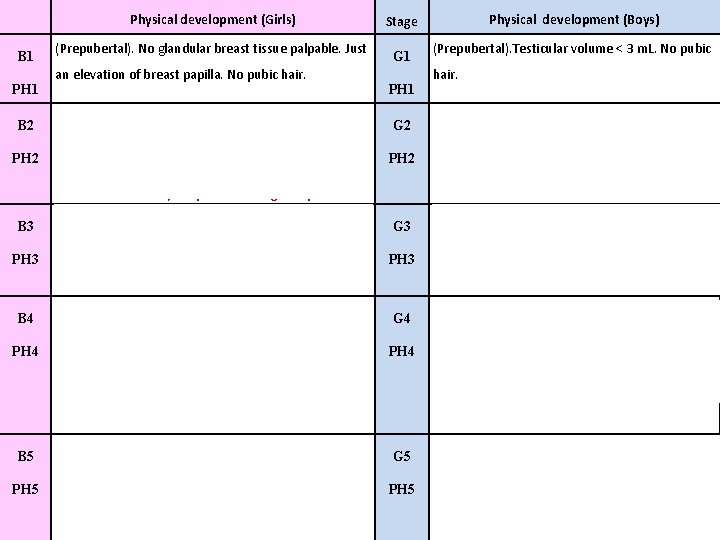
B 1 PH 1 B 2 PH 2 Physical development (Girls) Stage Physical development (Boys) (Prepubertal). No glandular breast tissue palpable. Just G 1 (Prepubertal). Testicular volume < 3 m. L. No pubic an elevation of breast papilla. No pubic hair. Breast budding with elevation of breast and papilla as a small mound [1 st pubertal sign in girls]. Downy soft pubic hair. PH 1 G 2 PH 2 hair. Enlargement of testicular volume (3 -6 m. L) [1 st pubertal sign in boys]. Little or no change in penile size. Downy soft pubic hair. Growth spurt (between stage 2 -3) B 3 PH 3 B 4 PH 4 Further enlargement of breast and areola. Darker, coarser and curled hair. Projection of areola and papilla to form a “double mound” above the level of the breast. More dense hair that fills the entire triangle overlying the pubic region G 3 PH 3 G 4 PH 4 and external genitalia and no spread to the inner thigh. Testicular volume 8 -12 m. L. Penile lengthening. Darker, coarser, and curled hair. Growth spurt (between stage 3 -4) Testicular volume 12 -15 m. L. Penile lengthening and broadening. Terminal hair that fills the entire triangle overlying the pubic region and external genitalia and no spread to the inner thigh. Menarche (between stage 4 -5) B 5 PH 5 Mature breast. Loss of double mound due to the projection of papilla only and recession of the areola to the level of the breast. Dense hair that extends beyond the inguinal area onto the inner thigh. G 5 PH 5 Testicular volume > 15 m. L. Adult genitalia. Terminal hair that extends beyond the inguinal area onto the inner thigh.
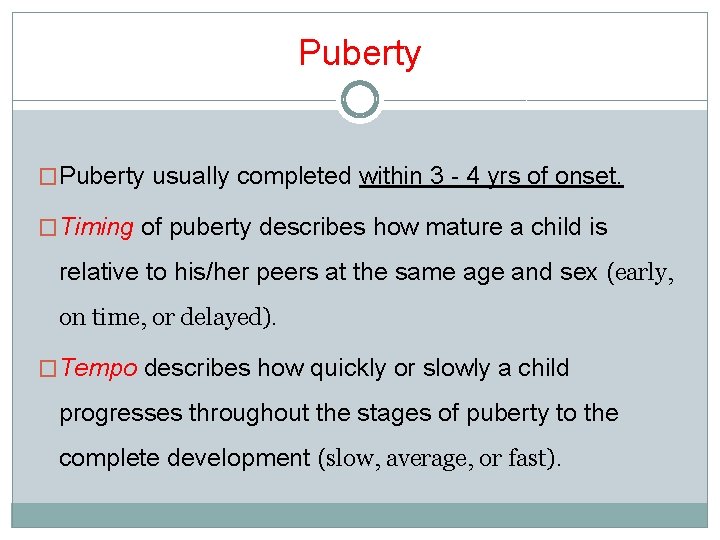
Puberty �Puberty usually completed within 3 - 4 yrs of onset. �Timing of puberty describes how mature a child is relative to his/her peers at the same age and sex (early, on time, or delayed). �Tempo describes how quickly or slowly a child progresses throughout the stages of puberty to the complete development (slow, average, or fast).
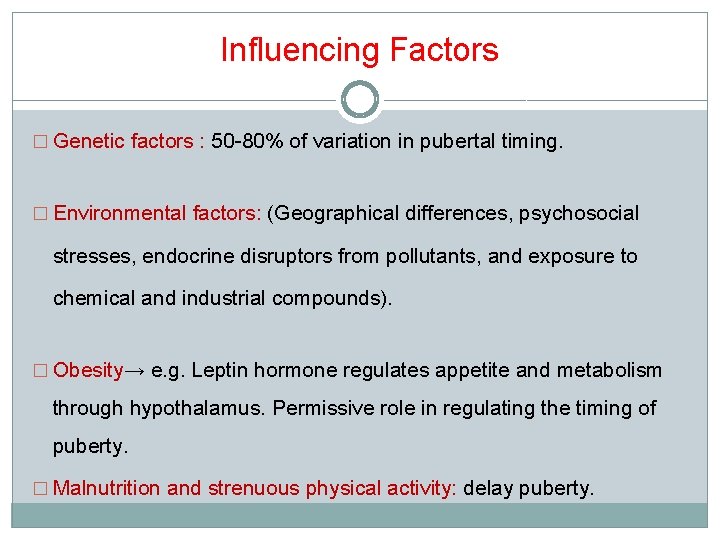
Influencing Factors � Genetic factors : 50 -80% of variation in pubertal timing. � Environmental factors: (Geographical differences, psychosocial stresses, endocrine disruptors from pollutants, and exposure to chemical and industrial compounds). � Obesity→ e. g. Leptin hormone regulates appetite and metabolism through hypothalamus. Permissive role in regulating the timing of puberty. � Malnutrition and strenuous physical activity: delay puberty.
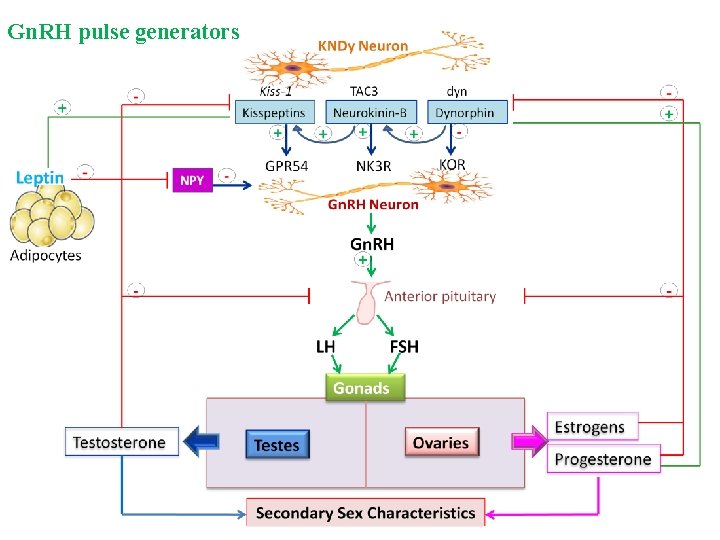
Gn. RH pulse generators
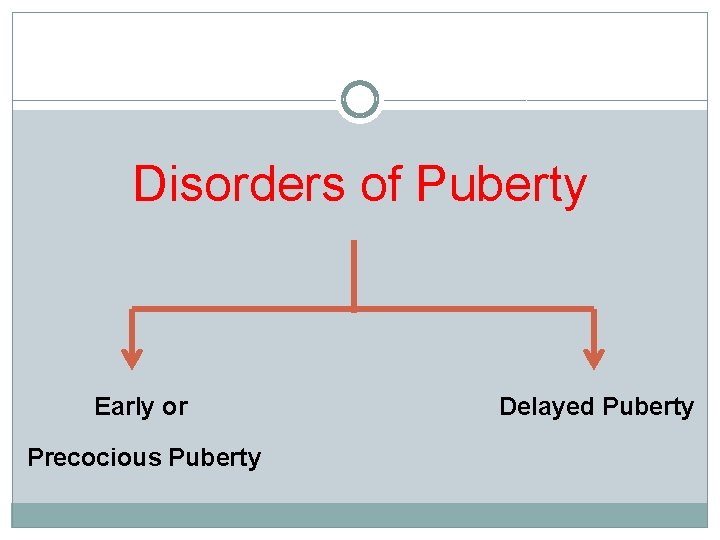
Disorders of Puberty Early or Precocious Puberty Delayed Puberty

PRECOCIOUS PUBERTY Precocious onset of puberty is defined as occurring younger than 2 yrs before the average Girls < 8 years old Boys < 9 years old
![(1) Central Precocious Puberty [Gonadotropin-dependent] PRECOCIOUS PUBERTY - Idiopathic central precocious puberty CNS tumours](http://slidetodoc.com/presentation_image_h/2acc885e6d5de37efd9e32bb7c0fe8c5/image-20.jpg "(1) Central Precocious Puberty [Gonadotropin-dependent] PRECOCIOUS PUBERTY - Idiopathic central precocious puberty CNS tumours")
(1) Central Precocious Puberty [Gonadotropin-dependent] PRECOCIOUS PUBERTY - Idiopathic central precocious puberty CNS tumours CNS congenital abnormalities Infectious or post-infectious conditions of hypothalamus (2) Pseudoprecocious (Peripheral) Puberty [Gonadotropin-independent] - Congenital adrenal hyperplasia (CAH) Gonads or adrenal gland tumours FSH and LH are suppressed No spermatogenesis or ovarian development
Delayed PUBERTY Initial physical changes of puberty are not present � by age 13 years in girls (or primary amenorrhea at 15. 5 - 16 y) � by age 14 years in boys Pubertal development is inappropriate - The interval between first signs of puberty and menarche in girls, completion of genital growth in boys is > 5 years
(1) Gonadal Failure DELAYED PUBERTY Hypergonadotropic hypogonadism: - Turner syndromes - Chemo/radio therapies - Congenital gonadal dysgenesis or Cryptorchidism - FSH, LH androgen receptor gene mutations - Gonadal damage secondary to trauma, tumours, surgical removal, and infectious or autoimmune diseases. (2) Gonadal Deficiency Hypogonadotropic hypogonadism: - Idiopathic - FSH and LH gene mutations from pituitary gonadotropes - Low FSH and LH levels - Ki. SS-1 or GPR 54 gene mutations - CNS congenital anomalies and panhypopituitarism

The End Thank You
- Slides: 23