
Reproductive biology of the female Japanese mantis Shrimp
Reproductive biology of the female Japanese mantis Shrimp Oratosquilla oratoria (Stomatopoda) in relation to changes in the seasonal pattern of larval occurrence in Tokyo Bay, Japan Keita KODAMA, Takamichi SHIMIZU, Takashi YAMAKAWA and Ichiro AOKI reporter: 黃薇蓉
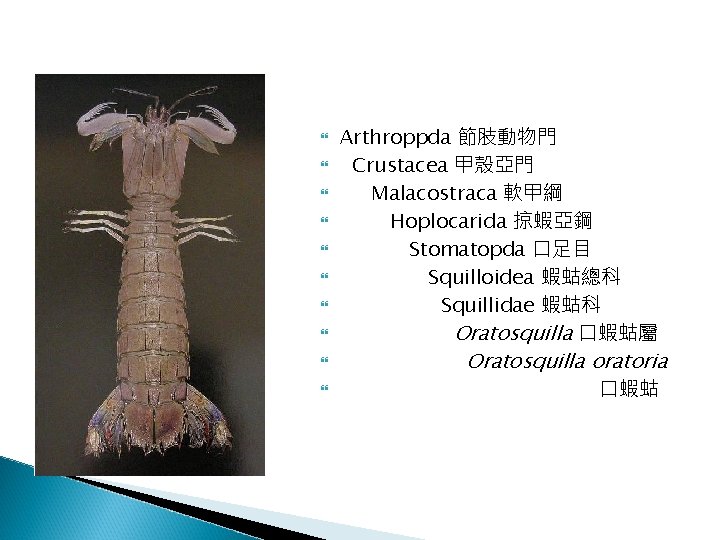
Arthroppda 節肢動物門 Crustacea 甲殼亞門 Malacostraca 軟甲綱 Hoplocarida 掠蝦亞鋼 Stomatopda 口足目 Squilloidea 蝦蛄總科 Squillidae 蝦蛄科 Oratosquilla 口蝦蛄屬 Oratosquilla oratoria 口蝦蛄
INTORDUCTION The Japanese mantis shrimp Oratosquilla oratoria (de Haan) (Crustacea: Stomatopoda) is found on muddy bottoms in coastal waters around Japan. The catch of O. oratoria from Tokyo Bay : the mid to the late 1980 s > the early 1990 s.
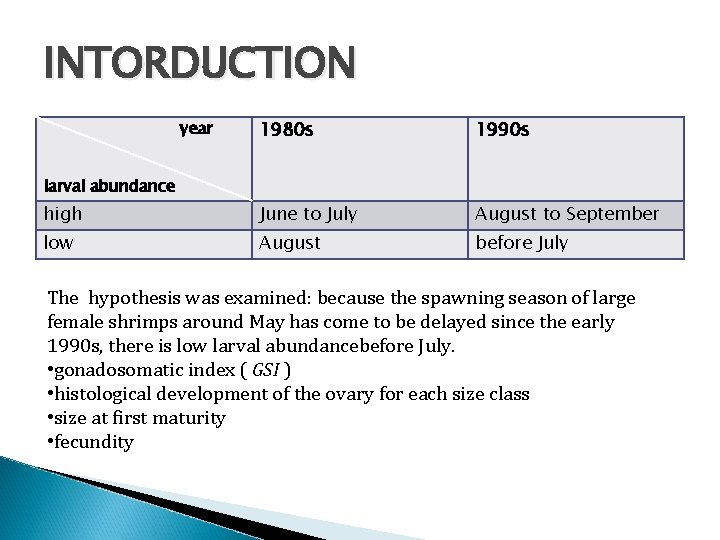
INTORDUCTION 1980 s 1990 s high June to July August to September low August before July year larval abundance The hypothesis was examined: because the spawning season of large female shrimps around May has come to be delayed since the early 1990 s, there is low larval abundancebefore July. • gonadosomatic index ( GSI ) • histological development of the ovary for each size class • size at first maturity • fecundity

MATERIALS AND METHODS Samples Histological procedure Reproductive cycle and size at first maturity Fecundity Larval data
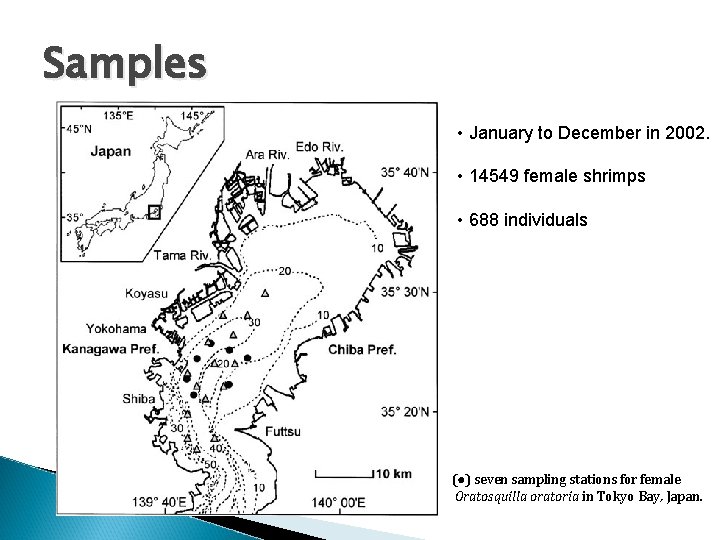
Samples • January to December in 2002. • 14549 female shrimps • 688 individuals (●) seven sampling stations for female Oratosquilla oratoria in Tokyo Bay, Japan.
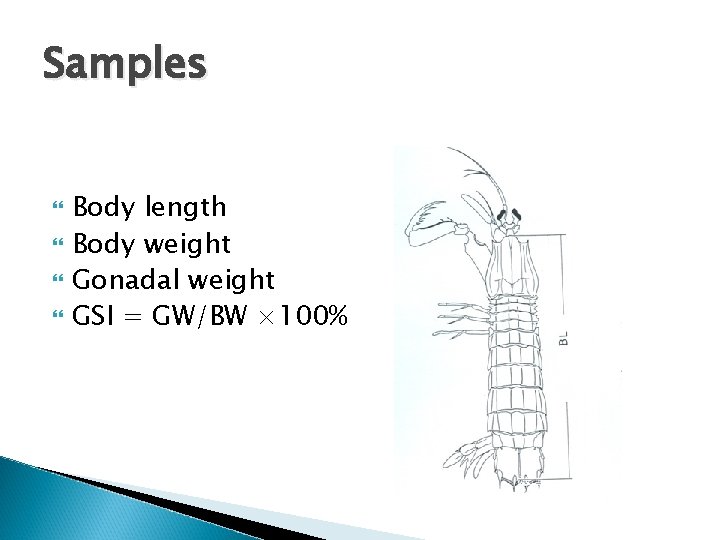
Samples Body length Body weight Gonadal weight GSI = GW/BW × 100%
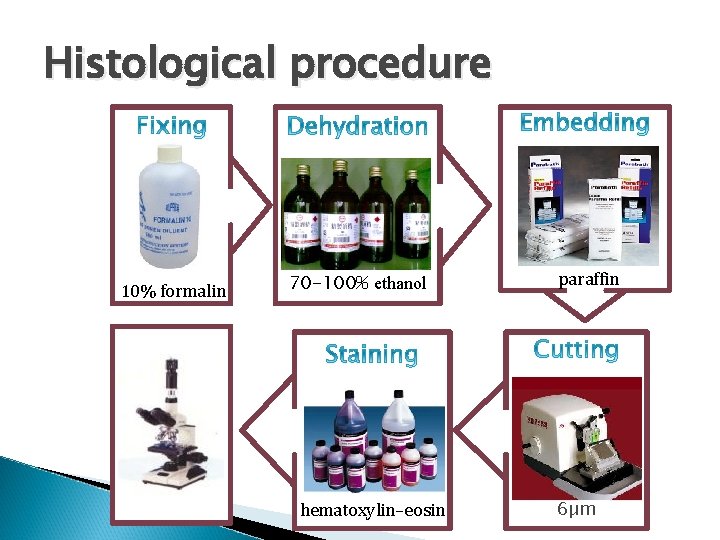
Histological procedure 10% formalin 70 -100% ethanol hematoxylin–eosin paraffin 6µm
Reproductive cycle and size at first maturity Ovarian developmental stage and the mean GSI were investigated for the size classes that could attain vitellogenic oocytes. 7 ≤ BL <8 cm, 8≤BL <9 cm, 9 ≤ BL <10 cm, 10 ≤ BL <11 cm, 11 ≤ BL <12 cm, BL ≥ 12 cm. Size at first maturity was defined as the smallest size class at which more than 50% of individuals attained vitellogenic oocytes in the ovary.
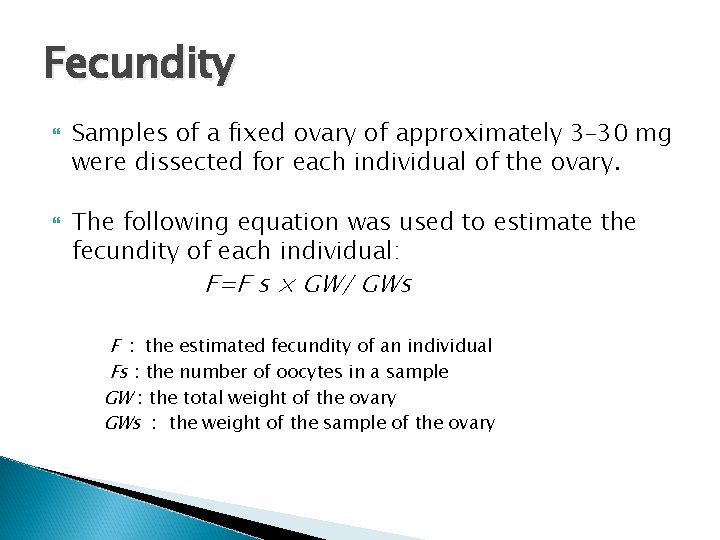
Fecundity Samples of a fixed ovary of approximately 3– 30 mg were dissected for each individual of the ovary. The following equation was used to estimate the fecundity of each individual: F=F s × GW/ GWs F : the estimated fecundity of an individual Fs:the number of oocytes in a sample GW:the total weight of the ovary GWs : the weight of the sample of the ovary

Fecundity in relation to BL was estimated using the following equation: b F(x) =ax x:BL in cm, F(x): the fecundity against BL a and b: constants
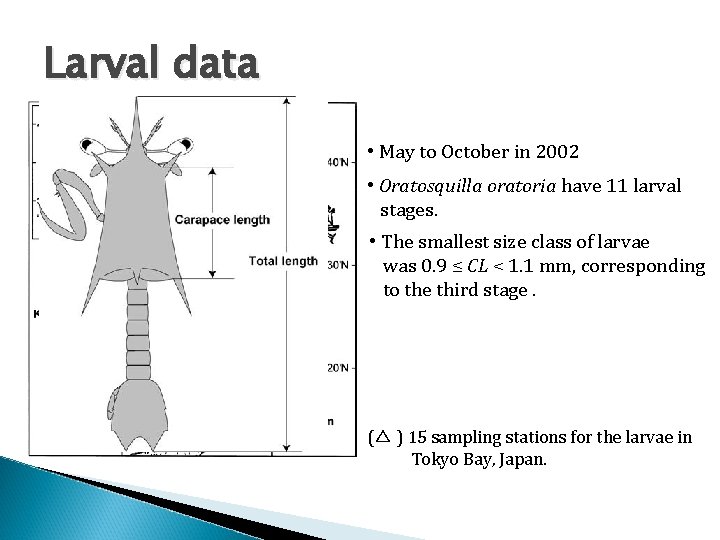
Larval data • May to October in 2002 • Oratosquilla oratoria have 11 larval stages. • The smallest size class of larvae was 0. 9 ≤ CL < 1. 1 mm, corresponding to the third stage. (△ ) 15 sampling stations for the larvae in Tokyo Bay, Japan.
RESULTS & DISCUSSION Oogenesis Developmental stage of ovary Reproductive cycle and size at first maturity Fecundity Spawning and larval abundance
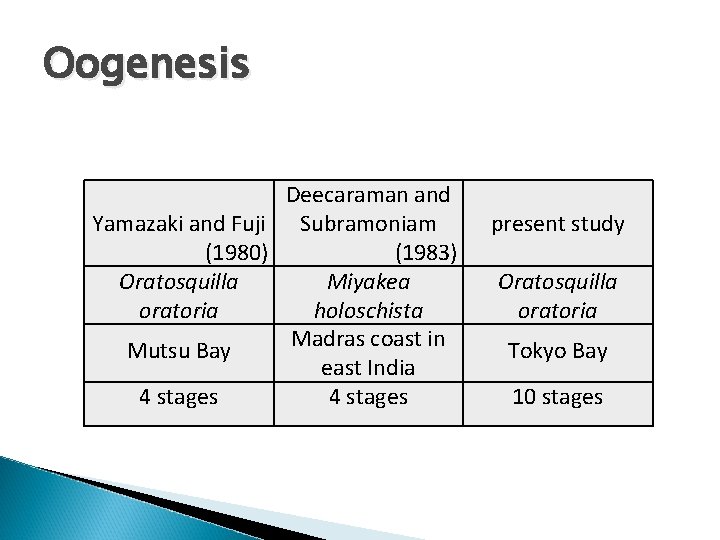
Oogenesis Deecaraman and Yamazaki and Fuji Subramoniam (1980) (1983) Oratosquilla Miyakea oratoria holoschista Madras coast in Mutsu Bay east India 4 stages present study Oratosquilla oratoria Tokyo Bay 10 stages
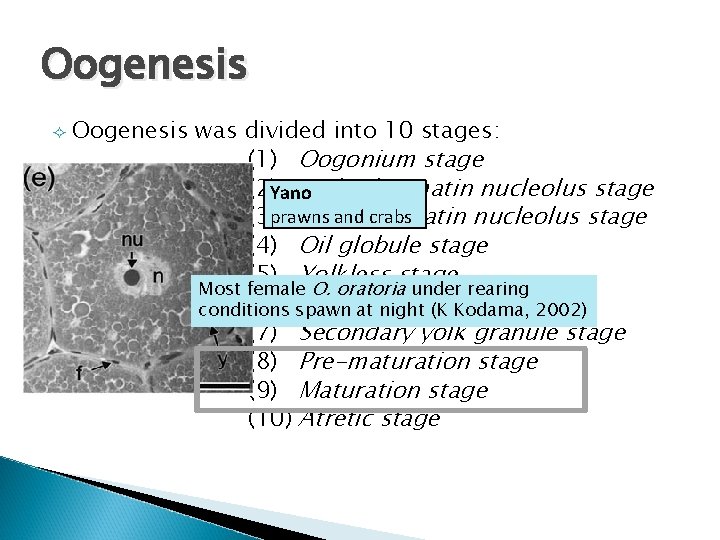
Oogenesis was divided into 10 stages: (1) Oogonium stage (2)Yano Early chromatin nucleolus stage crabs (3)prawns Lateand chromatin nucleolus stage Yamazaki and Fuji (4) Oil globule stage O. oratoria (5) Yolkless stage Most female O. oratoria under rearing (6) spawn Primary yolk(Kgranule conditions at night Kodama, stage 2002) (7) Secondary yolk granule stage (8) Pre-maturation stage (9) Maturation stage (10) Atretic stage
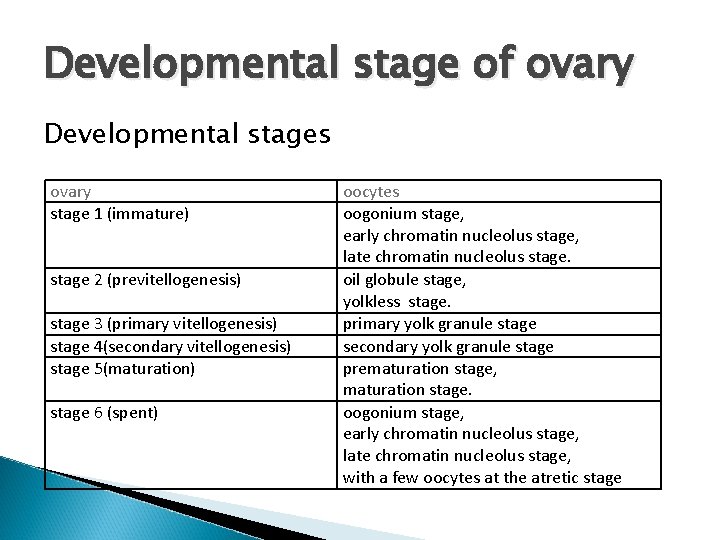
Developmental stage of ovary Developmental stages ovary stage 1 (immature) stage 2 (previtellogenesis) stage 3 (primary vitellogenesis) stage 4(secondary vitellogenesis) stage 5(maturation) stage 6 (spent) oocytes oogonium stage, early chromatin nucleolus stage, late chromatin nucleolus stage. oil globule stage, yolkless stage. primary yolk granule stage secondary yolk granule stage prematuration stage, maturation stage. oogonium stage, early chromatin nucleolus stage, late chromatin nucleolus stage, with a few oocytes at the atretic stage
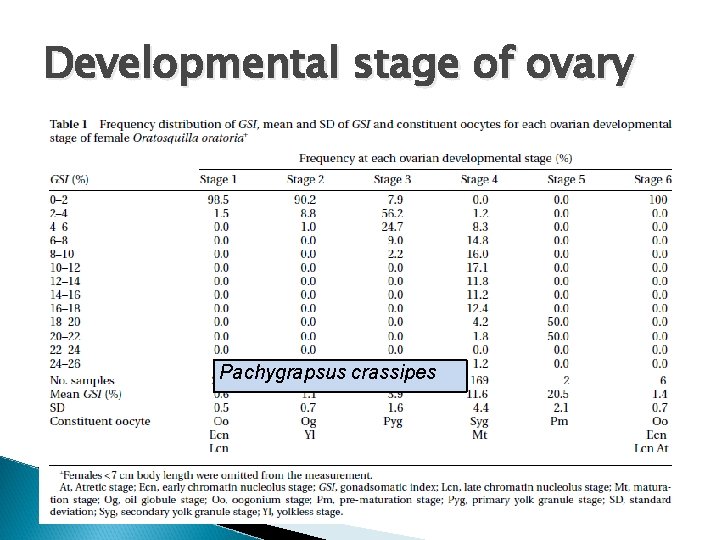
Developmental stage of ovary Pachygrapsus crassipes
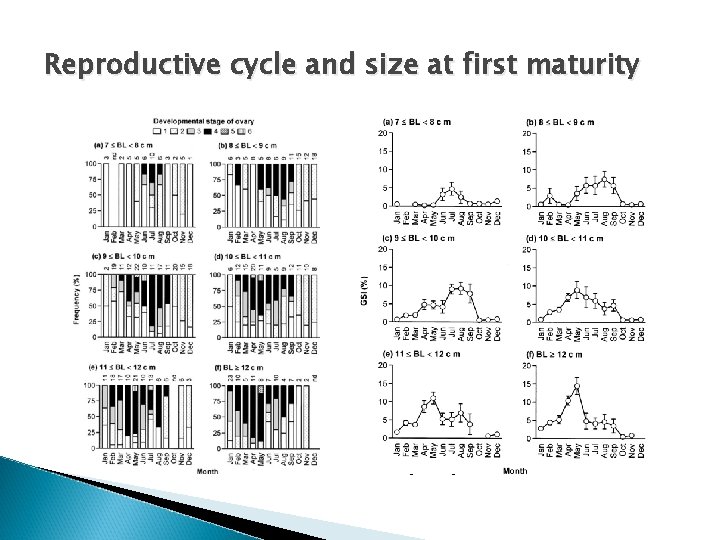
Reproductive cycle and size at first maturity stage 1 immature stage 2 previtellogenesis stage 3 primary vitellogenesis stage 4 secondary vitellogenesis stage 5 maturation stage 6 spent Tokyo Bay in 2002
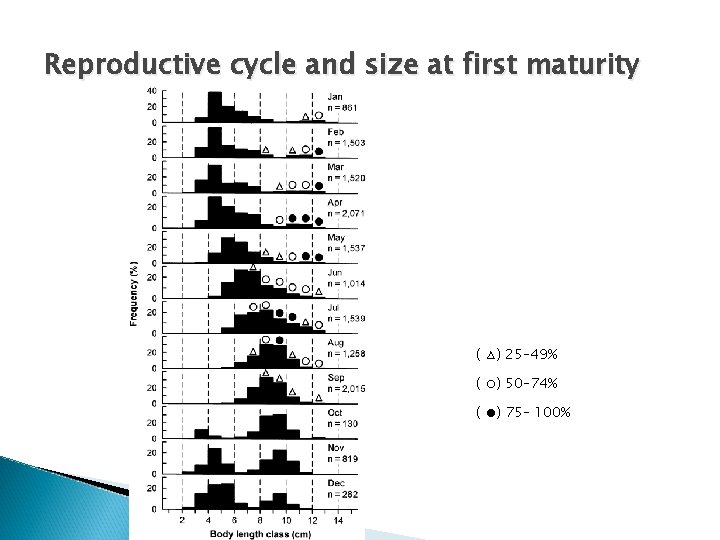
Reproductive cycle and size at first maturity ( △) 25– 49% ( ○) 50– 74% ( ●) 75– 100%
Reproductive cycle and size at first maturity The size at first maturity, 7 ≤ BL < 8 cm, was smaller than that recorded in the mid 1980 s. The CPUE of O. oratoria in the 1990 s fell dramatically to approximately one-fifth of that in the mid to late 1980 s. In addition, the annual catch of O. oratoria in Tokyo Bay was high in the mid to the late 1980 s, followed by an abrupt decrease in the early 1990 s, and the catch has since remained low. The decrease in size at first maturity seems to be concurrent with that in the stock size.
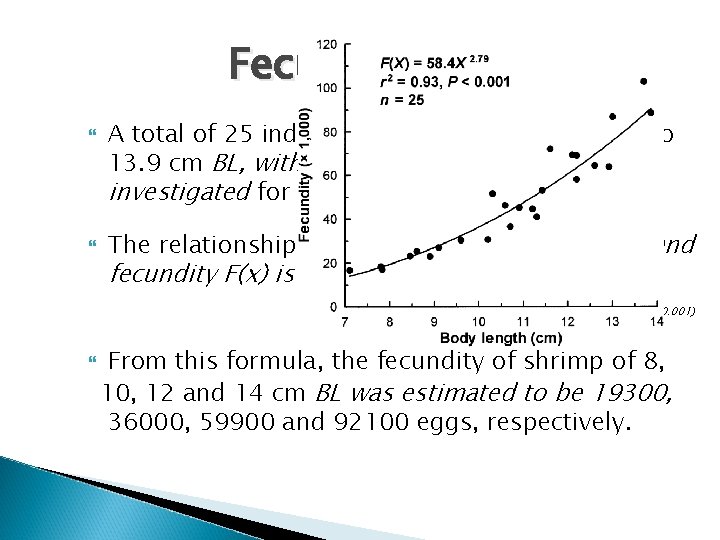
Fecundity A total of 25 individuals, ranging from 7. 1 cm to 13. 9 cm BL, with ovaries at stage 4 were investigated for the estimation of fecundity. The relationship between body length x in cm and fecundity F(x) is given by F(x) = 58. 4 x 2. 79 (r 2= 0. 93, n = 25, P < 0. 001) From this formula, the fecundity of shrimp of 8, 10, 12 and 14 cm BL was estimated to be 19300, 36000, 59900 and 92100 eggs, respectively.
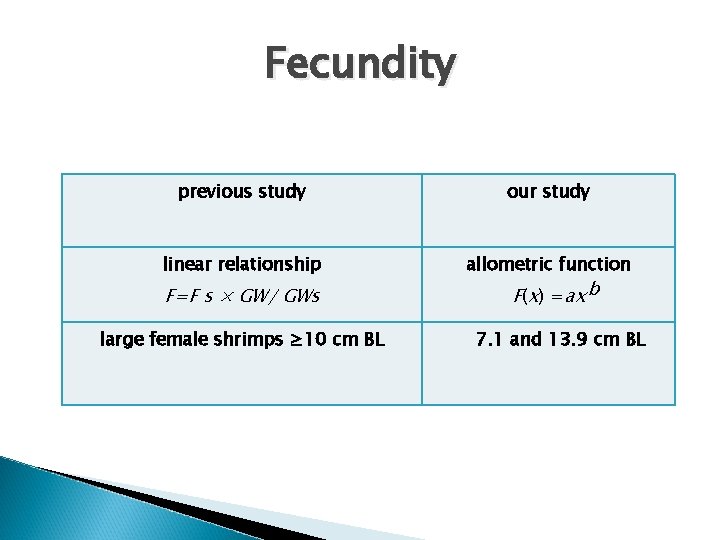
Fecundity previous study our study linear relationship allometric function F=F s × GW/ GWs large female shrimps ≥ 10 cm BL F(x) =ax b 7. 1 and 13. 9 cm BL
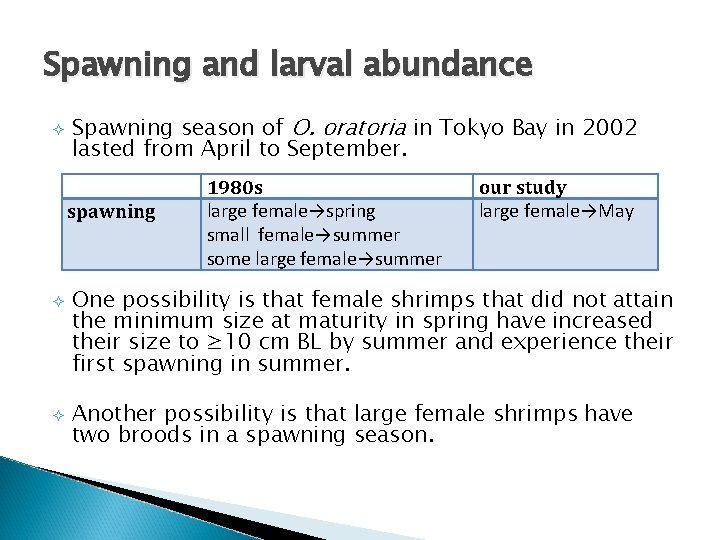
Spawning and larval abundance Spawning season of O. oratoria in Tokyo Bay in 2002 lasted from April to September. spawning 1980 s large female→spring small female→summer some large female→summer our study large female→May One possibility is that female shrimps that did not attain the minimum size at maturity in spring have increased their size to ≥ 10 cm BL by summer and experience their first spawning in summer. Another possibility is that large female shrimps have two broods in a spawning season.
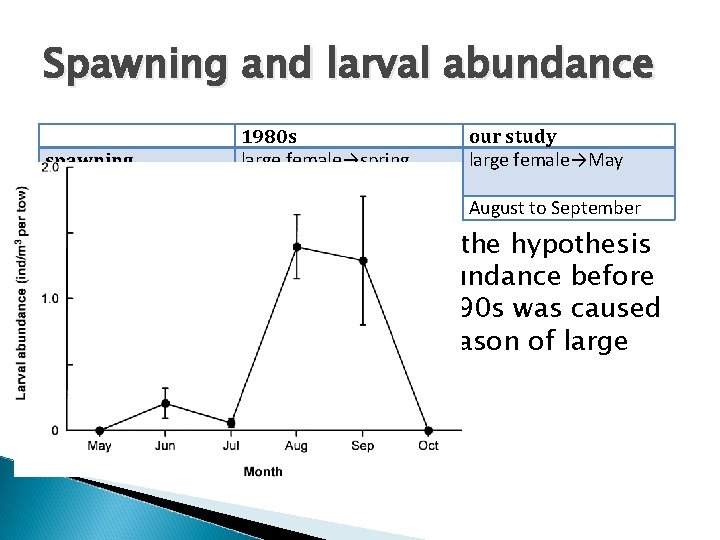
Spawning and larval abundance spawning Larve occurred 1980 s large female→spring small female→summer before July our study large female→May August to September These results do not support the hypothesis that the decrease in larval abundance before July beginning in the early 1990 s was caused by a delay in the spawning season of large female shrimps around May.
Spawning and larval abundance First, the mortality of the larvae occurring before July could be extremely high. The larval abundance was investigated at the third stage, immediately after starting the pelagic phase, and, under rearing conditions, the mortality of the larvae was low until the fifth stage.
Spawning and larval abundance Second, the hatching rate of the eggs laid by large female shrimps in spring could be low. Although the hatching rate of fertilized eggs of O. oratoria under rearing conditions was low, the reason for the low hatching rate and whether the hatching rate in the field is as low as in rearing conditions remain uncertain.
Spawning and larval abundance Third, a substantial decrease in the stock size of large female shrimps could result in decreased egg production in spring and low larval abundance before July.
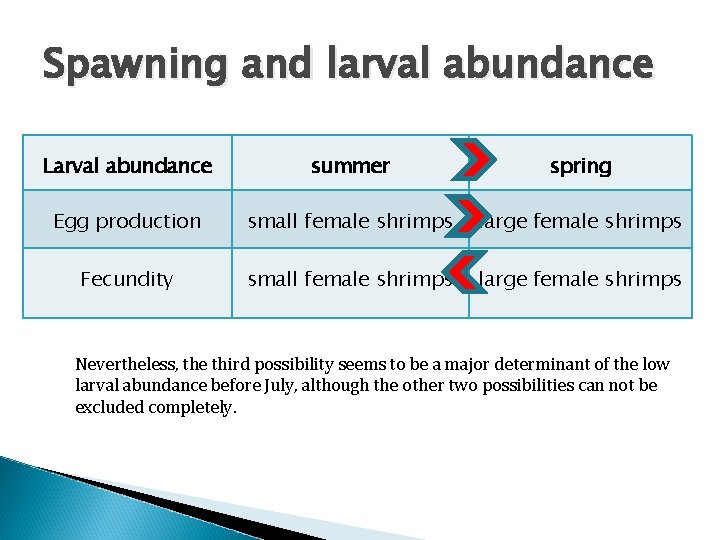
Spawning and larval abundance Larval abundance summer spring Egg production small female shrimps large female shrimps Fecundity small female shrimps large female shrimps Nevertheless, the third possibility seems to be a major determinant of the low larval abundance before July, although the other two possibilities can not be excluded completely.
Spawning and larval abundance Undoubtedly, fishery regulation during the spawning season is required to enhance the resilience of the stock size of O. oratoria. In particular, regulation around the spawning peak in spring, during which most large female shrimps with high fecundity spawn, might be effective for recovering larval abundance before July.

Thanks for your attention
- Slides: 30