
Reproduction Reproduction All living things Reproduce Unlike other




- Slides: 63
Reproduction
Reproduction - All living things Reproduce - Unlike other body systems it's not essential to sustaining the individual’s life - Two sex cells, from two different people, meet to combine genetic material and create a new life
Function - - of any reproductive system Procreation (Making babies)
Puberty - The changing and developing of the body So what causes this change? Hormones
Hormones - Chemical Messengers (Endocrine System) Functions: Functions - Formation of primary sexual characteristics (During Development) - Activates and promotes secondary sexual characteristics (During Puberty)
The Male (XY) Reproductive System
Function - Male - Procreation (Making babies)
Hormones - Male - Chemical Messengers The primary Male hormone is: Testosterone What does it do: 1. During development – Primary sexual traits 2. During puberty – Secondary sexual traits
Secondary Sexual Characteristics - Male 1. Facial, pubic, & underarm hair 2. Shoulders broaden 3. Deepened voice 4. Muscle development 5. Sperm production
STRUCTURES OF THE MALE REPRODUCTIVE SYSTEM
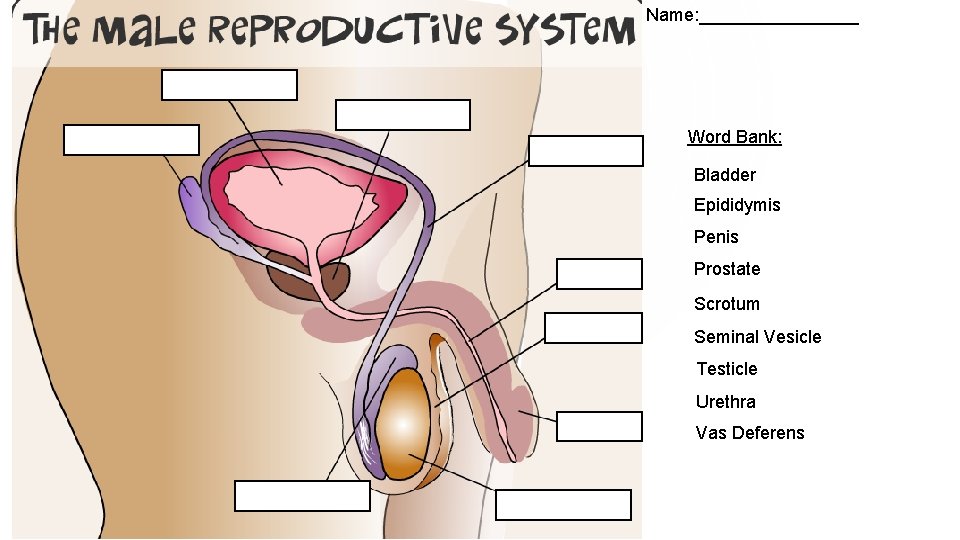
DIAGRAM OF THE MALE REPRODUCTIVE SYSTEM
Name: ________ Word Bank: Bladder Epididymis Penis Prostate Scrotum Seminal Vesicle Testicle Urethra Vas Deferens
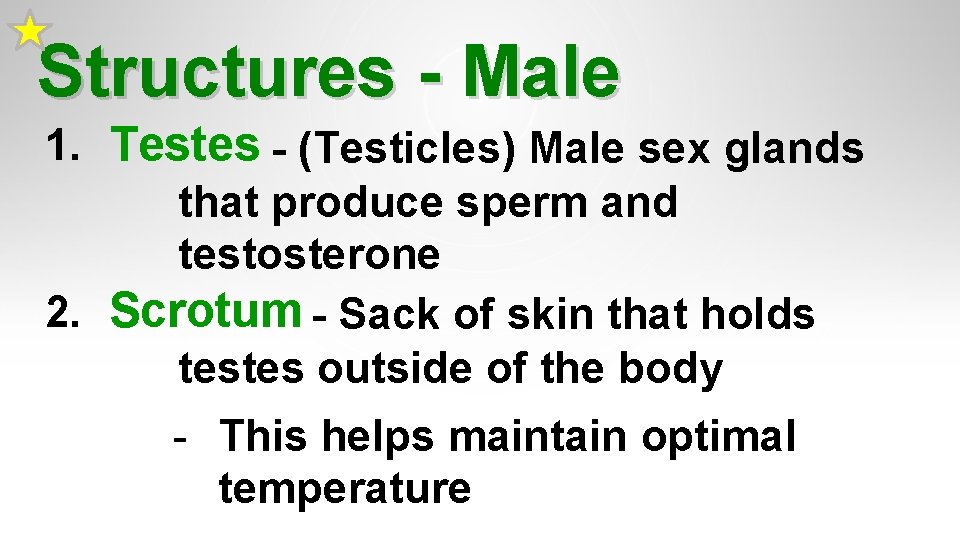
Structures - Male 1. Testes - (Testicles) Male sex glands that produce sperm and testosterone 2. Scrotum - Sack of skin that holds testes outside of the body - This helps maintain optimal temperature
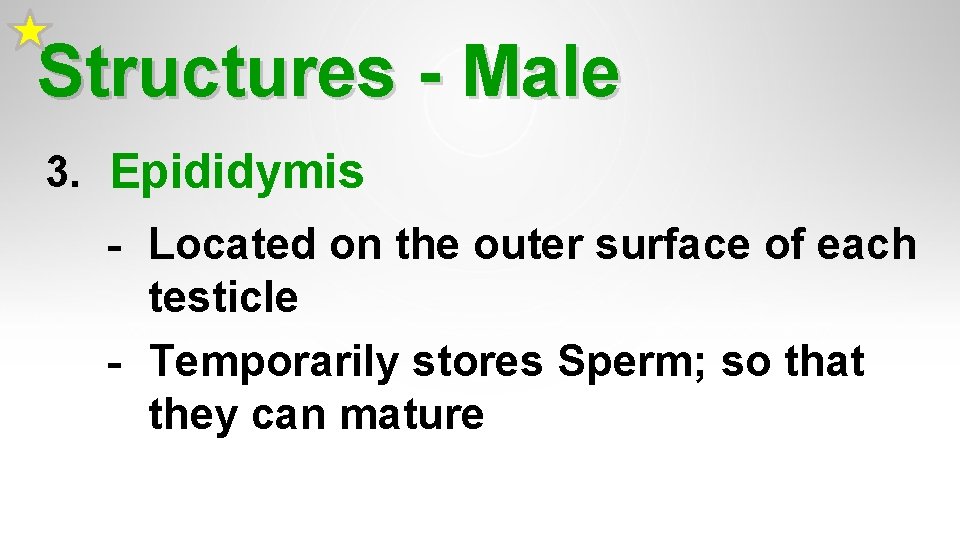
Structures - Male 3. Epididymis - Located on the outer surface of each testicle - Temporarily stores Sperm; so that they can mature
Structures - Male 4. Vas Deferens - Tube that extends from each Epididymis, around the bladder, until it. . . - Connects with the Urethra - It is about 18 inches Long
Structures - Male 5. Seminal Vesicles - Two glands at the Base of Bladder - Attached to the Vas Deferens - Makes the fluid component of Semen – Like the part Plasma of blood
Structures - Male 6. Prostate - A small gland - Surrounds a section of the Urethra - Produces a secretion to help sperm travel/survive
Structures - Male 7. Cowper’s Gland - A small gland - Below the Prostate Gland - Produces a secretion to help sperm travel/survive
Structures - Male 8. Urethra - A small tube that carries Urine and Semen - Extends from the Bladder through the Penis to the outside of the body
Structures - Male 9. Penis - The external organ – for delivery - Composed of spongy tissue and blood vessels - Increased blood flow causes an Erection
Structures - Male 10. Foreskin - Skin covering the tip of the penis - Circumcision - The surgical removal of the foreskin
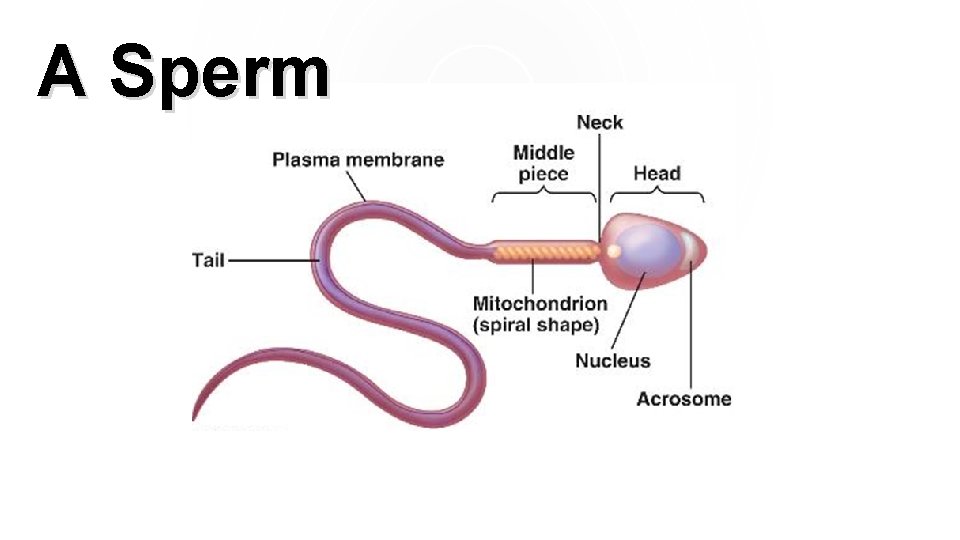
Semen A mixture of fluids/components: Sperm (spermatozoa) - The male sex cell that contains the genetic information Seminal Vesicle Fluid 70% of semen - Like the - Fluid that makes up about part. Plasma of blood Prostate Fluid - 30 -35% of the semen. Alkaline to counter the Vagina’s acidity Cowper’s Fluid - 5% of semen. Makes the environment of the urethra more hospitable
A Sperm
PROBLEMS OF THE MALE REPRODUCTIVE SYSTEM
Problems - Male Hernia - Abnormal exit of a tissue or organ through the wall of the cavity in which it normally resides - Most common in the abdomen - Abdominal muscle tears
Problems - Male 1. Inguinal Hernia - Weak spot in the abdominal wall - Located just above the scrotum - Abdominal muscle tears - Intestines push into the scrotum
Problems - Male 2. Sterility - Condition in which a person is unable to reproduce Causes: Just write down a couple - Low sperm count - Temperature change - Exposure to chemicals - Certain illnesses - STD’s Smoking/Drugs Malfunctioning of reproductive structures
Problems - Male 3. Enlarged Prostate - Difficulty urinating, inability to completely empty the bladder, and chances of a UTI increase. Causes: - Old age Infection Tumors/Cancer
Problems - Male 4. Prostate Cancer - Usually in older men - Highest type of Cancer in Males - Early Detection (by a Doctor) is Important Treatments: - Radiation Surgical Removal of Prostate
Problems - Male 5. Testicular Cancer - Usually males Ages 15 - 34 Could present as: - Slight Enlargement Painless Lump Hardening of Testes Pain in Testicle Treatments: - Radiation Surgery/Removal
CARE THE MALE REPRODUCTIVE SYSTEM OF
Care - Male 1. Cleanliness 2. Protection 3. Practice Safe-Sex - When the time comes 4. Avoid contaminants - Unhealthy food, pollutants, drugs 5. Self-examination
The Female (XX) Reproductive System
Function - Female - Procreation (Making babies) - Nourishment and protection (of the baby)
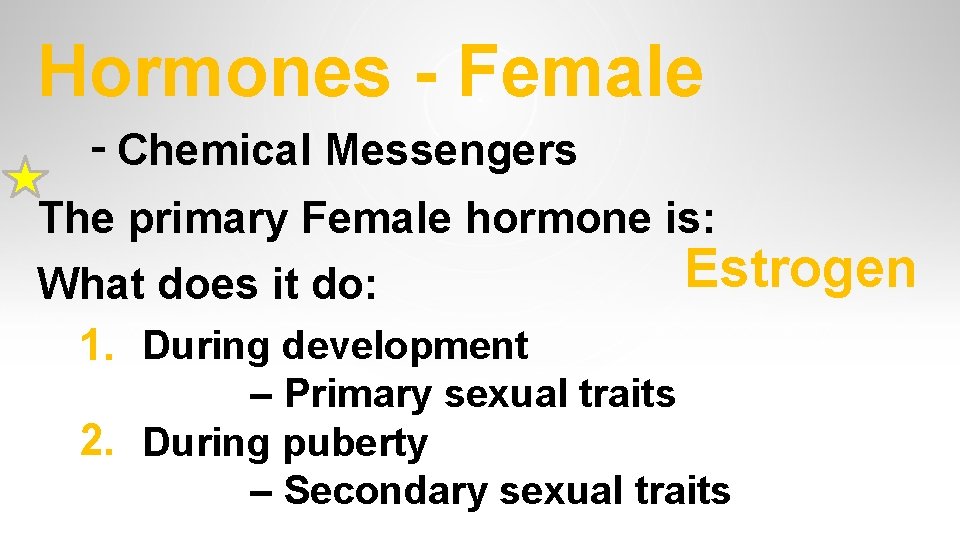
Hormones - Female - Chemical Messengers The primary Female hormone is: Estrogen What does it do: 1. During development – Primary sexual traits 2. During puberty – Secondary sexual traits
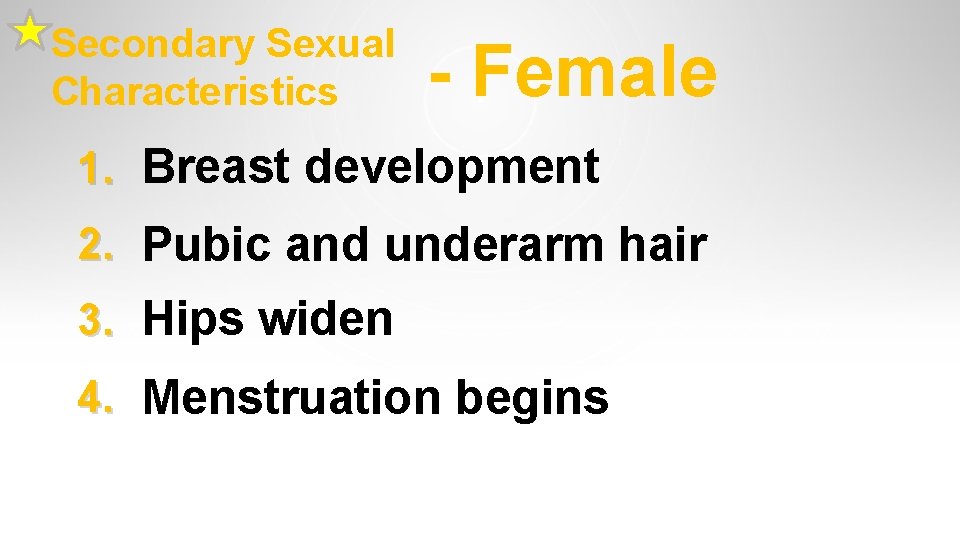
Secondary Sexual Characteristics - Female 1. Breast development 2. Pubic and underarm hair 3. Hips widen 4. Menstruation begins
STRUCTURES OF THE FEMALE REPRODUCTIVE SYSTEM
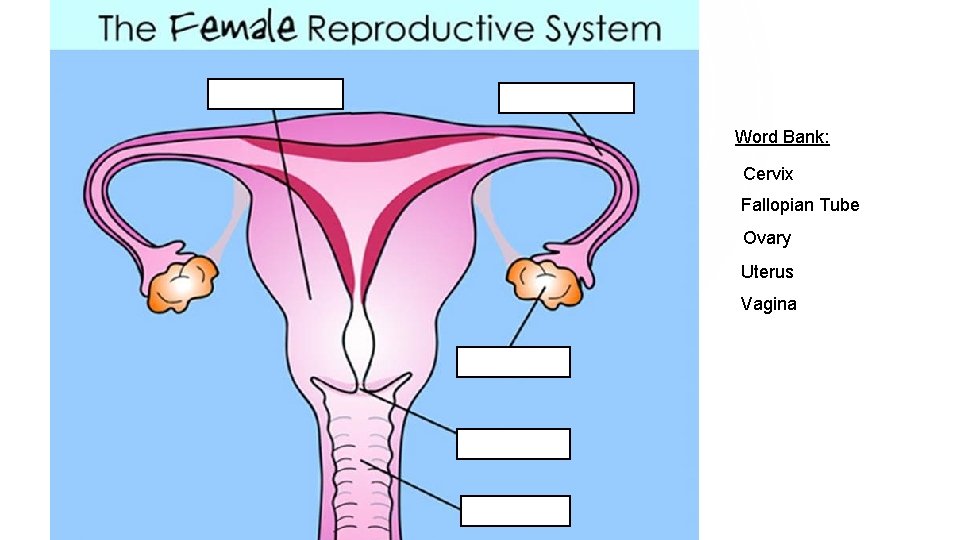
DIAGRAM OF THE FEMALE REPRODUCTIVE SYSTEM
Word Bank: Cervix Fallopian Tube Ovary Uterus Vagina
Structures - Female 1. Ovaries - Female sex gland - Produce and house the Ova (Egg) - Produce Estrogen & Progesterone - Almond sized - Located on each side of the lower abdomen.
Structures - Female 2. Ova (Egg) - Females are BORN with about 1 million ovum (No more eggs are made) - Females releases 1 ova/month - Ovulation
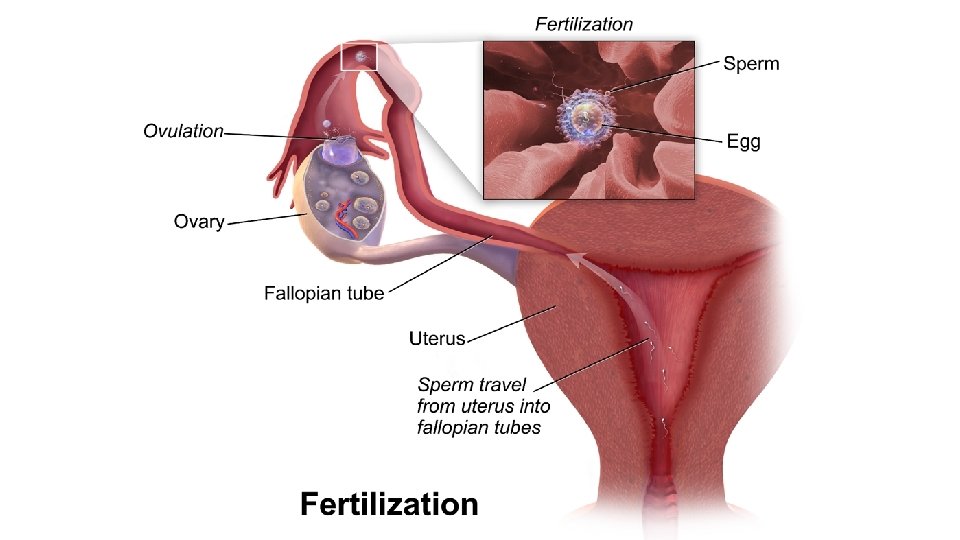
Structures - Female 3. Fallopian Tube 1 __ 3 - 4” Long & ” diameter - Ova move through Fallopian Tube to the Uterus - Waving motion draws the Ovum into the Fallopian Tube
Structures - Female 4. Uterus - Small muscular organ - Vast supply of capillaries - If fertilization has occurred. . . - The Zygote attaches to the wall Zygote = the joined egg/sperm
Structures - Female 5. Cervix - Bottom of the Uterus - A doorway to the Vagina - Dilates during child birth - To allow passage of the baby
Structures - Female 6. Vagina - The Birth Canal 1 __ 2 - A muscular tube about 3 ” long - Connection of the Uterus to the outside of the body
Structures - Female 7. Vulva - Encompassing name for all of the external parts - Folds of the vaginal entrance - Labia Minora – Inner Folds - Labia Majora – Outer Folds
Fertilization
Fertilization (Your notes are a little off for this section) - A Sperm is present while Ovum is in the - Fallopian Tube One Sperm unites with one Ova (egg) to form a Zygote - Cell Division begins and perpetuates - After 3 -4 days, the Zygote moves to Uterus
Menstruation
Menstruation 1. No fertilization occurred – 2. Ovum disintegrates Lining of the vagina breaks down – It is released out of the Vagina 3. 2 -3 oz. of blood & tissue leave the body 4. Last about 3 -5 Days 5. Occurs every 28 Days – “Monthly Cycle”
PROBLEMS OF THE FEMALE REPRODUCTIVE SYSTEM
Problems - Female 1. Menstrual Cramps - Occurs at start of Menstrual Cycle - The Uterus contracts - This creates pain in the abdominal area Treatment: - Exercise Heat/Warmth (heating pad, etc. . . )
Problems - Female 2. Premenstrual Syndrome (PMS): Causes: Changes in hormone level Symptoms: - Anxiety - Irritability - Bloating - Mood Swings - Nervous Tension - Weight Gain - Depression
Problems - Female 3. Toxic Shock Syndrome Causes: - Release of toxins from a bacterial (Staf) infection - Occurs because of incorrect tampon use Signs & Symptoms: - Flu-like / High fever & tampons used
Problems - Female 4. Vaginitis Causes: Yeast or a Fungus or a Bacteria Symptoms: - Anxiety - Irritability - Nervous Tension
Problems - Female 5. Endometriosis - Development of the uterine-lining tissue outside the uterus Treatment: - Hormone Therapy & Surgery
Problems - Female 6. Sterile or Sterility: - A condition in which a person is unable to reproduce Causes: - Damaged fallopian tubes - Surgery, infections, endometriosis - Ovaries Do Not Produce Ovum - Untreated STD’s
Problems - Female 7. Cancers – Female Specific - Breast Cancer (Can also appear in men) - Ovarian Cancer - Cervical Cancer - Uterine Cancer
CARE THE FEMALE REPRODUCTIVE SYSTEM OF
Care - Female 1. Cleanliness/Hygiene If that’s your thing 2. Choose the right birth control 3. Practice Safe-Sex - When the time comes 4. Avoid contaminants - Unhealthy food, pollutants, drugs 5. Check-ups & Self-exams (lumps)