
Reproduction Puberty the stage of growth and development
Reproduction Puberty – the stage of growth and development when both the male and female bodies become capable of producing offspring. It is a period of great physical and emotional change.
Secondary Sex Characteristics Physical and emotional changes that occur during puberty
Secondary Sex Characteristics l l l Increase in height Longer and heavier bones Broader shoulders Thicker and tougher skin Deepen voice l l l Growth of facial hair, pubic hair, and body hair Enlargement of penis, scrotum, and testes Formation of sperm
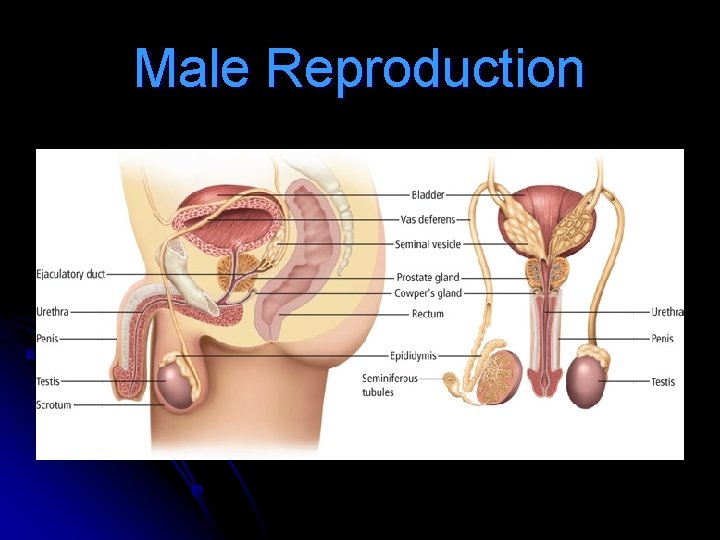
Male Reproduction
SCROTUM l Saclike pouch that hangs under the penis and holds the testes l Regulates the temperature of the testes l Testes must be 3 to 4 degrees (F) below body temperature

TESTES Male sex gland l Produces TESTOSTERONE (male hormone) l Produces sperm (sex cells) l Spermatogenesis is the process by which sperm are produced. l
SPERM Males begin to produce sperm at puberty. Measures about 1/6000 th of an inch Made up of a head, a body & a tail Produced in seminiferous tubules (1, 000) of the testes 500 million produced per day Makes up about 2 – 5 percent of the semen
SEMEN Made up of: Testes - Sperm Seminal Vesicles – sugar fluid Prostate gland – chemical fluid Cowper’s Glands – chemical fluid Amount of sperm ejaculated is less than a teaspoonful (300 to 400 million sperm)
EPIDIDYMIS a comma-shaped structure along the upper rear surface of the testes where sperm mature l Like a coiled spring (20 ft in length) l Stores newly produce sperm while they mature (sperm school) l Take about 64 days for sperm cell to mature l
VAS DEFERENS A passageway for sperm l Connects the epididymis to the urethra l Lined with cilia to move the sperm l It wraps around the pubic bone and becomes an ejaculatory duct into the urethra l Storage for mature sperm l

PROSTATE GLAND The mixer l Secretes a milky, alkaline fluid that mixes with the sperm l This fluid keeps the sperm alive in the vagina l Fluids from Cowper’s glands & seminal vesicles are mixed with sperm also l
SEMINAL VESICLES l Secretes a fluid to nourish the sperm l Helps with motility also
COWPER’S GLAND l. Secretes a clear, sticky fluid that cleanses the urethra
URETHRA A tube-like structure that travel through the penis l Starts at the bladder l A passageway for semen and urine to leave the body l Semen & urine cannot be released at the same time l
PENIS l. A tube-like organ made up of three layers of spongy tissue l Sexual reproduction l Elimination of wastes
Foreskin – a fold of skin that covers the end of the penis Circumcision – removal of the foreskin Nocturnal emissions – uncontrollable, ejaculation in sleep; also known as “wet dreams”
Protecting the Male Reproductive Health The care given to one body system affects the entire body. l Protecting the reproductive system will help maintain and promote overall health now and in the future. l Having regular checkups is an important part of protecting health. l
How to protect the male reproductive health Practice abstinence from sex. Practicing abstinence prevents teen pregnancy and infection with sexually transmitted diseases, including HIV. l Bend at the knees and keep your back straight when lifting heavy objects. Use the correct technique when lifting heavy objects to help prevent the risk of an inguinal hernia. l
Have regular medical checkups. Your physician will perform an examination and discuss the ways your body is changing. l Seek medical attention when you show signs of infection. A discharge from the penis, tenderness in the scrotum, lumps, and rashes are symptoms of STDs. l Perform testicular self-examinations. Testicular cancer is one of the most common cancers in younger males. l
FEMALE REPRODUCTION
Secondary Sex Characteristics o Increase in height o Widening of hips o Softer & smoother skin o Growth of pubic and underarm hair o Increase in breast size o Enlargement of external genitalia o Formation of mature ova o Beginning of menstruation
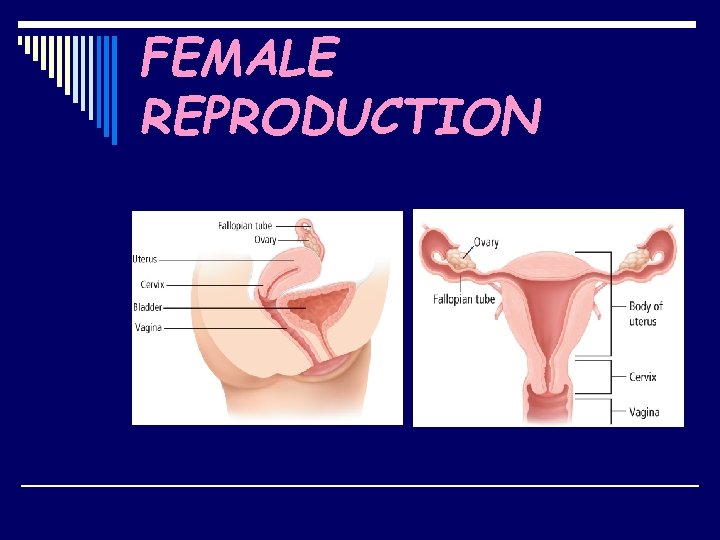
Female Reproduction o A female is born with between 200, 000 and 400, 000 immature ova in her ovaries. o During a regular menstrual cycle, an ovum matures and is released from its follicle. o Ovulation is the release of a mature ovum from one of the two ovaries. o When an ovum is released from an ovary, it enters one of the Fallopian tubes.
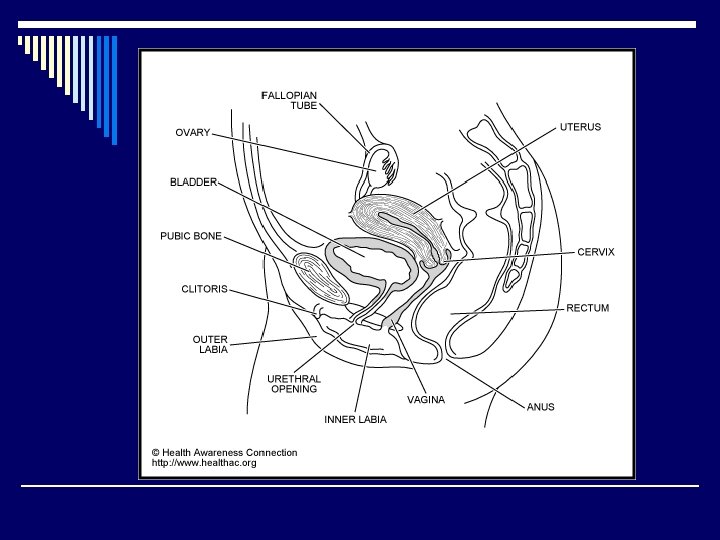
External Female Reproductive Organs o The external female reproductive organs are called the vulva and consist of the mons veneris, the labia majora, the labia minora, the clitoris, and the hymen. – The mons veneris is the fatty tissue that covers the front of the pubic bone and serves as a protective cushion for the internal reproductive organs.
– During puberty, hair begins to cover both the mons veneris and the labia majora. – The labia majora are the heavy folds of skin that surround the opening of the vagina. – The labia minora are two smaller folds of skin located within the labia majora. – The clitoris and the openings of the urethra and the vagina are located within the labia minora.
– The clitoris is a small structure located above the opening of the urethra. o The hymen is a thin membrane that stretches across the opening of the vagina.
VAGINA o. Known as the birth canal o. A passageway from the uterus out of the body o. CERVIX is the opening uterus
UTERUS o Known as the womb o Three layered muscular organ that looks like an upside down pear o Holds and nourishes the fertilized ovum (zygote) o Endometrium is the inner layer of tissue that is sloughed off during menstruation
FALLOPIAN TUBES o. Passageway for the ova lined with cilia o. Normal site of fertilization o. FERTILIZATION – is the joining of an ovum with the sperm to form a zygote.
OVARIES o. Produce the female sex hormones: estrogen and progesterone o. Produce the ova
The Menstrual Cycle o The menstrual cycle is the monthly series of changes that involves ovulation, changes in the uterine lining, and menstruation. o Menstruation is the period in the menstrual cycle in which the unfertilized egg and the lining of the uterus leave the body.
How to Protect Female Reproductive Health o Practice abstinence from sex. Practicing abstinence prevents teen pregnancy and infection with sexually transmitted diseases. o Make a note of any questions you have about cramps, mood swings, or heavy menstrual flow. Share this information with your parents or guardian and your physician.
o Practice good menstrual hygiene habits. Change your pad, panty shield, or tampon every four to six hours. o Choose habits that prevent or lessen menstrual cramps. Exercise regularly and reduce the amount of caffeine and salt in your diet. o Perform monthly breast self-examinations. Perform a breast self-examination each month after your menstrual flow stops. o Keep a calendar to record information about your menstrual cycle. Keep track of the number of days in each cycle, the number of days that you menstruate, and the date of your last menstrual period.
o Have regular medical checkups. Your parents or guardian and your physician will determine the appropriate age for you to begin having a pelvic examination and a Pap smear. o Seek medical attention when you show signs of infection. Vaginal discharge, lumps, and rashes are symptoms of infection.

Menstrual Cycle o Days 1– 5 Menstruation occurs. At the same time, a new ovum is maturing in the ovary. • Days 6– 12 The uterine lining begins to thicken and the uterus prepares for ovulation and the possibility that an ovum will be fertilized. • Days 13– 14 Ovulation occurs.
Menstrual Cycle • Days 15– 20 The corpus luteum secretes hormones to support a pregnancy. o Days 21– 28 The corpus luteum disintegrates if an ovum is not fertilized. The cells in the lining of the uterus die without progesterone. The unfertilized ovum disintegrates. The menstrual cycle begins again with menstruation.
- Slides: 37