
Reproduction Plant Reproduction Parts of the plant that
- Slides: 43
Reproduction
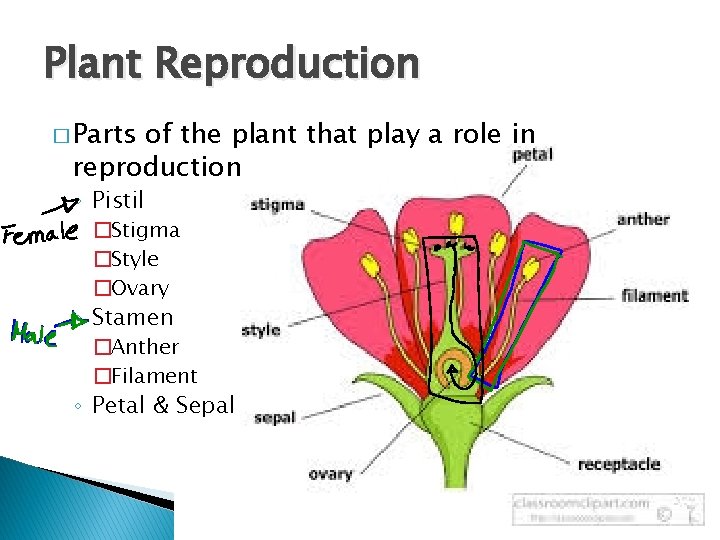
Plant Reproduction � Parts of the plant that play a role in reproduction ◦ Pistil �Stigma �Style �Ovary ◦ Stamen �Anther �Filament ◦ Petal & Sepal
The Role of… � Pistil ◦ Is the female portion of the flower ◦ Consists of the stigma, style and ovary � Stigma ◦ Sticky upper portion of the pistil ◦ Allows for pollen to stick to the stigma ◦ Pollen once stuck can fertilize the ovary by reaching down the style � Style ◦ shaft that leads to the ovary ◦ The pollen tube extends down the style to fertilize the egg � Ovary ◦ Portion that holds the egg of the flower
The Role of… � Stamen ◦ Male portion of the flower ◦ Consists of the anther and filament � Anther ◦ Pollen producing portion � Filament ◦ Holds the anther up to aid in dispersal of the pollen
The Role of… � Petals and sepal ◦ Petals may be bright colors to attract animals to the flower to aid in fertilization of the egg �Transfer of pollen to the pistil
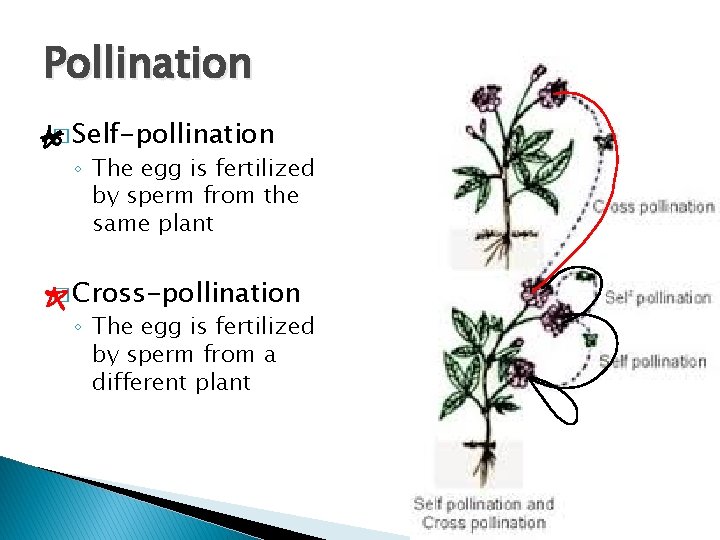
Pollination � Self-pollination ◦ The egg is fertilized by sperm from the same plant � Cross-pollination ◦ The egg is fertilized by sperm from a different plant
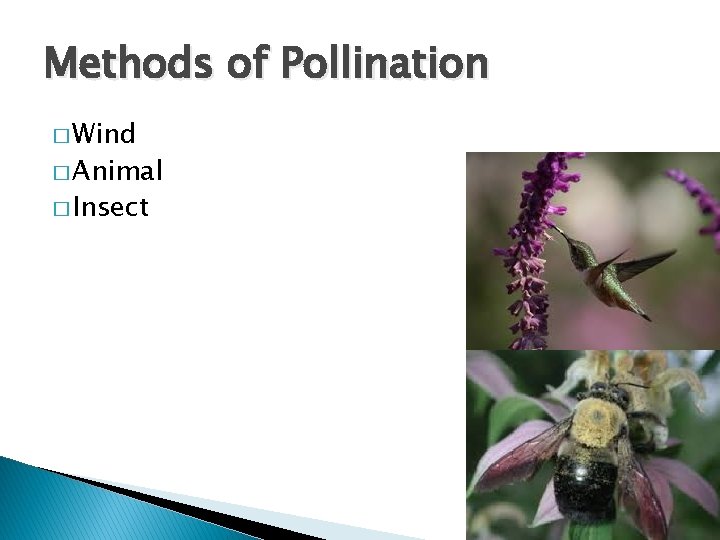
Methods of Pollination � Wind � Animal � Insect
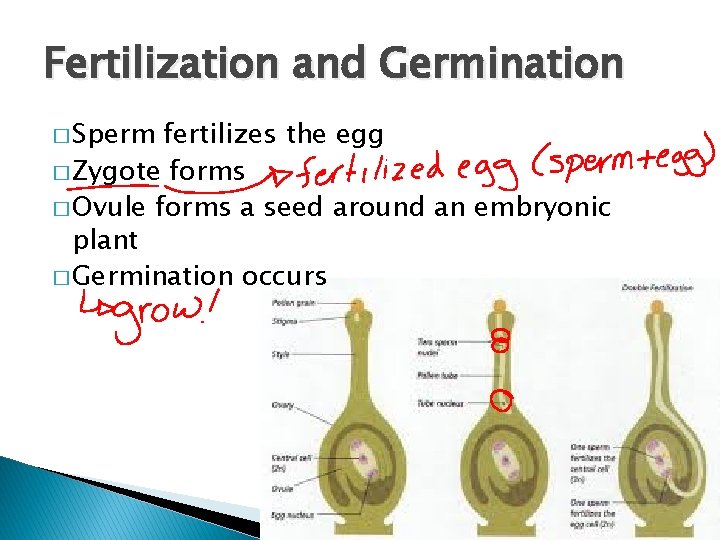
Fertilization and Germination � Sperm fertilizes the egg � Zygote forms � Ovule forms a seed around an embryonic plant � Germination occurs
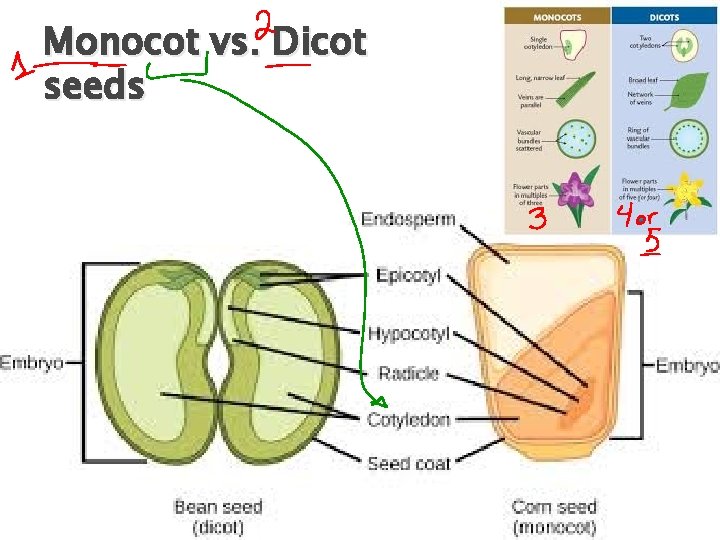
Monocot vs. Dicot seeds
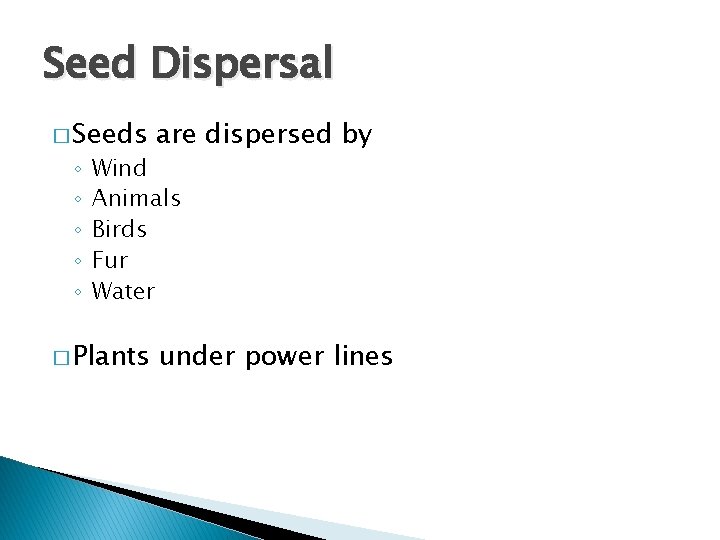
Seed Dispersal � Seeds are dispersed by � Plants under power lines ◦ ◦ ◦ Wind Animals Birds Fur Water
Germination � Seeds may require specific conditions to germinate ◦ Certain amounts of moisture, warmth, fire, or intestinal trip � They may remain dormant until these conditions are met � All seeds require at least some moisture, temperature, and warmth for germination. Seeds do not require soil, sunlight, or carbon dioxide. ◦ These are required after germination
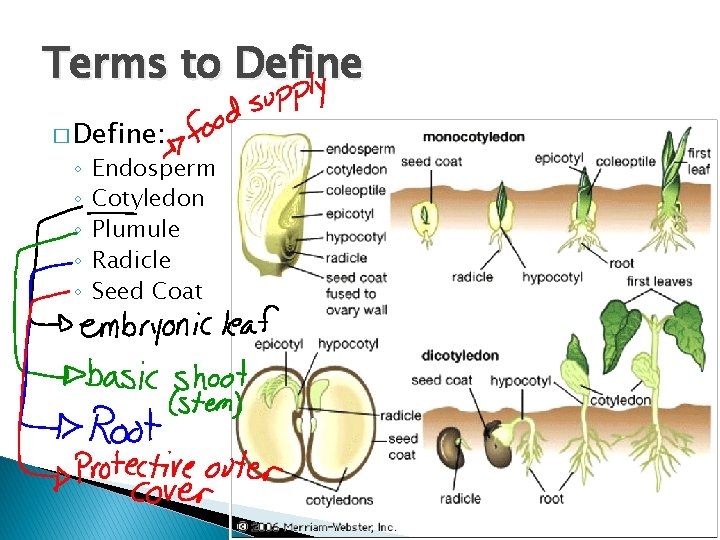
Terms to Define � Define: ◦ ◦ ◦ Endosperm Cotyledon Plumule Radicle Seed Coat
Human Reproduction and Development � Human reproduction and development are carried out by specialized organs � The function of these organs is regulated by hormones from the endocrine system ◦ In most mammals fertilization and development occur internally ◦ In most mammals the reproductive organs are similar in appearance and function
Female Reproductive System � The female reproductive system is organized to produce gametes, to support internal fertilization and development, to exchange materials through the placenta and to provide milk to the offspring ◦ Begins at puberty and continues until menopause
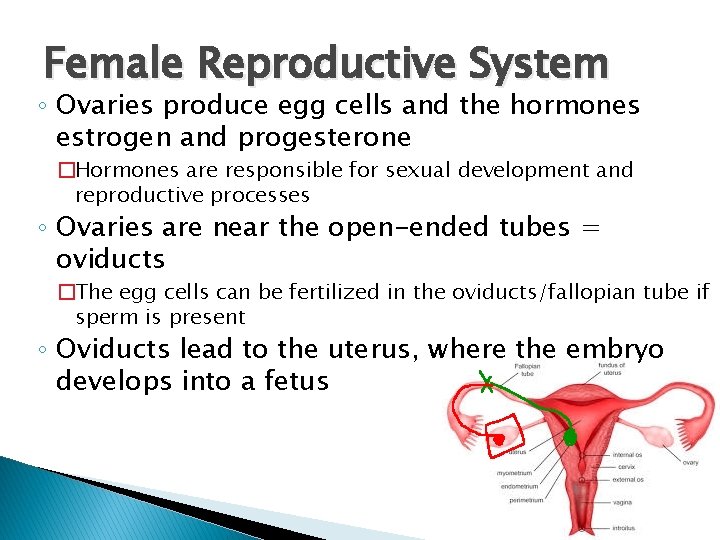
Female Reproductive System ◦ Ovaries produce egg cells and the hormones estrogen and progesterone �Hormones are responsible for sexual development and reproductive processes ◦ Ovaries are near the open-ended tubes = oviducts �The egg cells can be fertilized in the oviducts/fallopian tube if sperm is present ◦ Oviducts lead to the uterus, where the embryo develops into a fetus
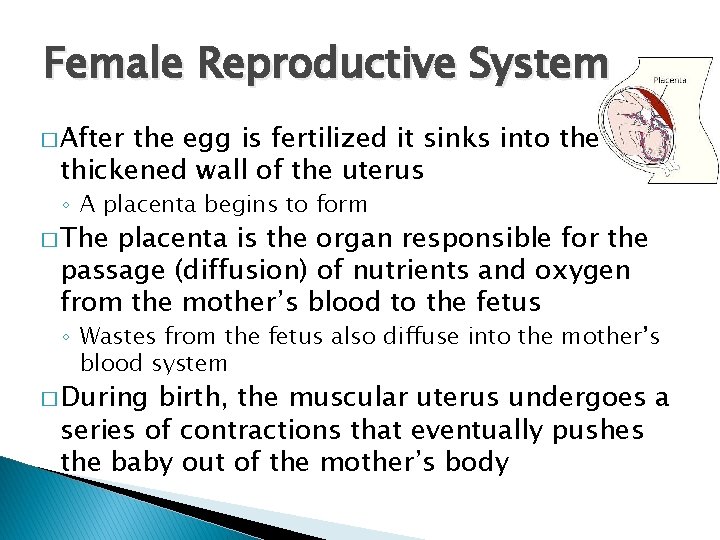
Female Reproductive System � After the egg is fertilized it sinks into the thickened wall of the uterus ◦ A placenta begins to form � The placenta is the organ responsible for the passage (diffusion) of nutrients and oxygen from the mother’s blood to the fetus ◦ Wastes from the fetus also diffuse into the mother’s blood system � During birth, the muscular uterus undergoes a series of contractions that eventually pushes the baby out of the mother’s body
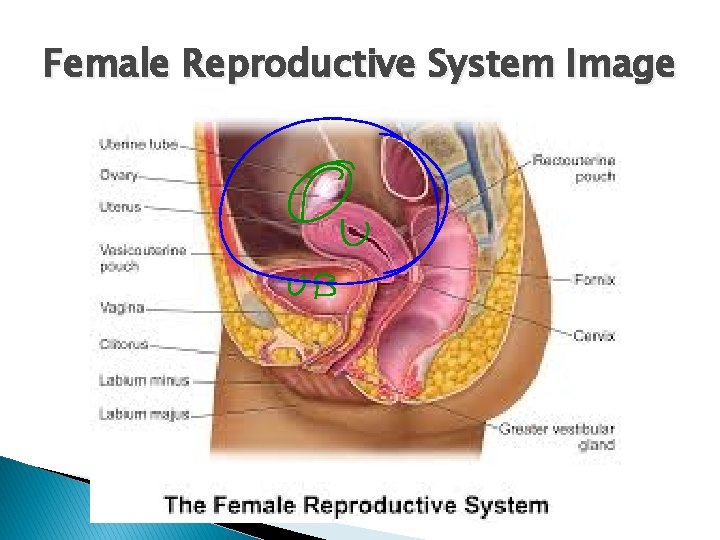
Female Reproductive System Image
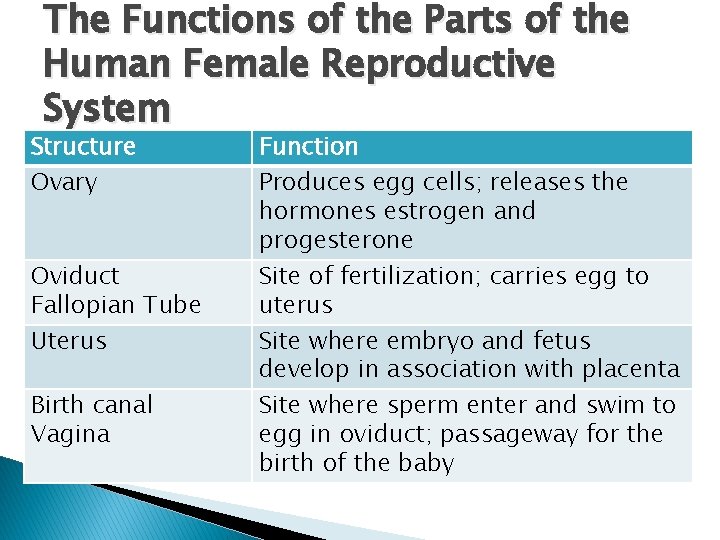
The Functions of the Parts of the Human Female Reproductive System Structure Ovary Oviduct Fallopian Tube Uterus Birth canal Vagina Function Produces egg cells; releases the hormones estrogen and progesterone Site of fertilization; carries egg to uterus Site where embryo and fetus develop in association with placenta Site where sperm enter and swim to egg in oviduct; passageway for the birth of the baby
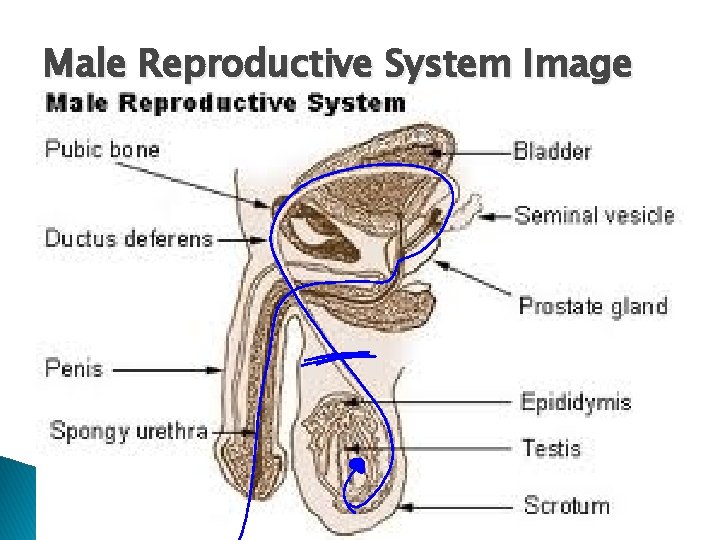
Male Reproductive System � Sperm cells are produced in the male reproductive organs, the testes ◦ Begin producing sperm at puberty and continue most of male’s life ◦ Scrotum removes testes from internal body to keep sperm lower than body temperature �Boxers vs. briefs for males trying to have children �Link to protein/enzyme denaturing ◦ The testes produce the hormone testosterone �It is associated with male sexual development and reproduction
Male Reproductive System � Other structures in the reproductive system produce fluids and nutrients that are needed for function and delivery of the male gametes to the female reproductive tract
Male Reproductive System Image
Hormonal Regulation � The male reproductive system and male characteristics (facial male, deep voice) develop as sexual maturity is reached ◦ It is reached due to hormones, testosterone � The female reproductive system and female features (breast development and widening of the hips) develop as maturity is reached as well ◦ It is also reached due to hormones, estrogen and progesterone
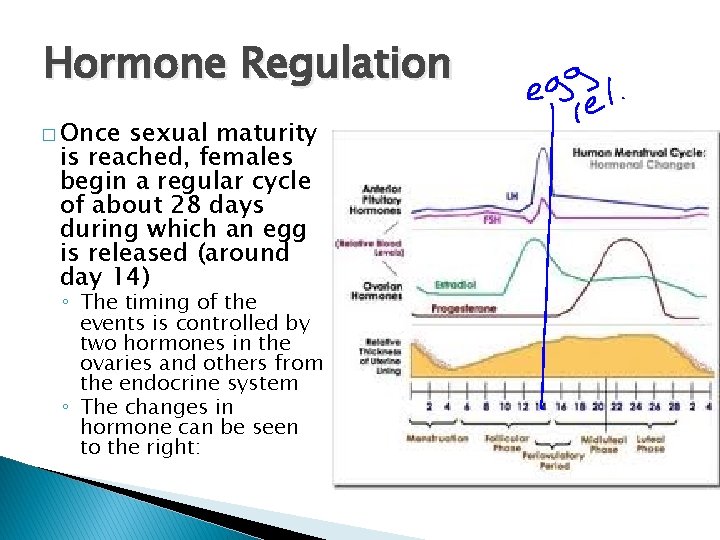
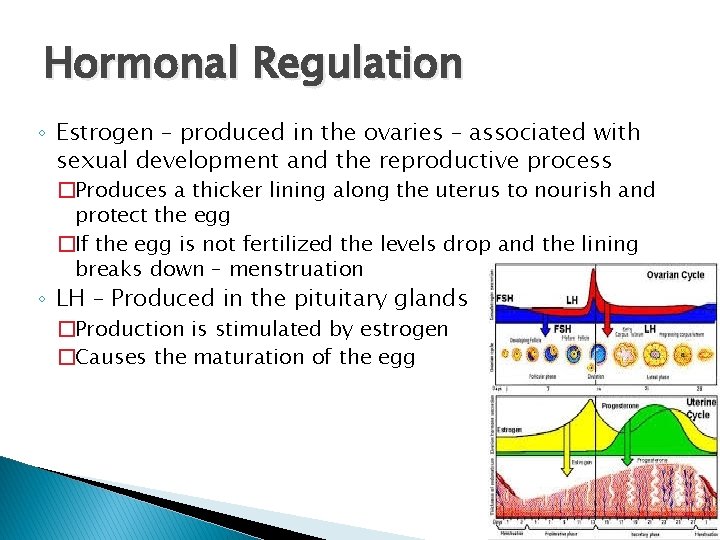
Hormone Regulation � Once sexual maturity is reached, females begin a regular cycle of about 28 days during which an egg is released (around day 14) ◦ The timing of the events is controlled by two hormones in the ovaries and others from the endocrine system ◦ The changes in hormone can be seen to the right:
Hormonal Regulation � Interactions of the hormones are complex ◦ Estrogen and progesterone are important for females �Estrogen, from the ovaries, has a lot to do with sexual development in females �Estrogen and progesterone prepare the lining of the uterus for an egg to embed itself �Progesterone maintains the uterine lining throughout pregnancy �At the end of the cycle if an egg is not fertilized, the levels of estrogen and progesterone drop and the uterus lining breaks down and the cycle begins again
Hormonal Regulation � Females ◦ Progesterone – produced in ovaries – associated with sexual development and he reproductive process �Produces thicker lining along the uterus to nourish ad protect the egg �Maintain the lining throughout the pregnancy �If the egg is not fertilized the levels drop and the lining breaks down – menstruation ◦ FSH – Produced in the pituitary gland �Stimulates the production of estrogen
Hormonal Regulation ◦ Estrogen – produced in the ovaries – associated with sexual development and the reproductive process �Produces a thicker lining along the uterus to nourish and protect the egg �If the egg is not fertilized the levels drop and the lining breaks down – menstruation ◦ LH – Produced in the pituitary glands �Production is stimulated by estrogen �Causes the maturation of the egg
Detailed � The egg in the ovary has ovarian cells form around it called the follicle ◦ Caused by FSH and occurs between days 6 -12 � The egg released between days 13 -16 (usually day 14) and matures by LH During the corpus luteum stage the follicle on the egg changes and the corpus luteum stimulates the production of progesterone � If the egg is fertilized it attaches to the wall breaks down when progesterone and estrogen are no longer produced = menstruation days 1 -6
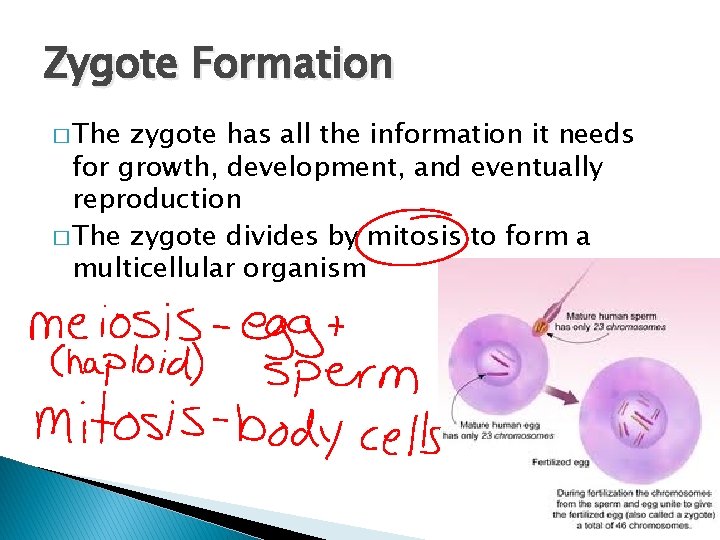
Zygote Formation � During fertilization, gametes unite to form a zygote � Zygote = a cell that contains all the genetic information needed by the offspring � The processes = recombination ◦ The genes from both parents recombine when fertilization occurs � Because each sex cell has a unique combination of genes, the combination of these unique cells allows for the evolution of the species
Zygote Formation � The zygote has all the information it needs for growth, development, and eventually reproduction � The zygote divides by mitosis to form a multicellular organism
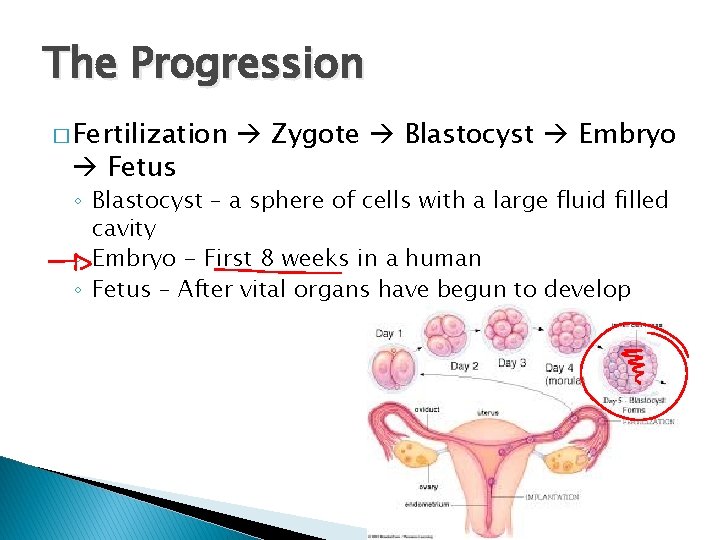
The Progression � Fertilization Fetus Zygote Blastocyst Embryo ◦ Blastocyst – a sphere of cells with a large fluid filled cavity ◦ Embryo - First 8 weeks in a human ◦ Fetus – After vital organs have begun to develop
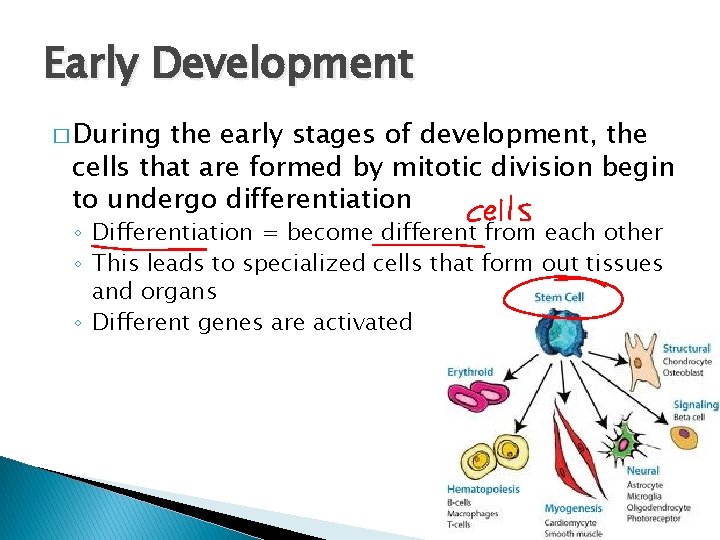
Early Development � During the early stages of development, the cells that are formed by mitotic division begin to undergo differentiation ◦ Differentiation = become different from each other ◦ This leads to specialized cells that form out tissues and organs ◦ Different genes are activated
Early Development � An embryo = early stage of development ◦ All the genetic information starts out the same � Different genes are activated or deactivated in certain cells ◦ This means they only make some proteins ◦ This makes the cells different from others �Skin cells, muscle cells, or other specialized cells ◦ The activation or deactivation of genes can be due to environment influences from within the cell or outside of the cell
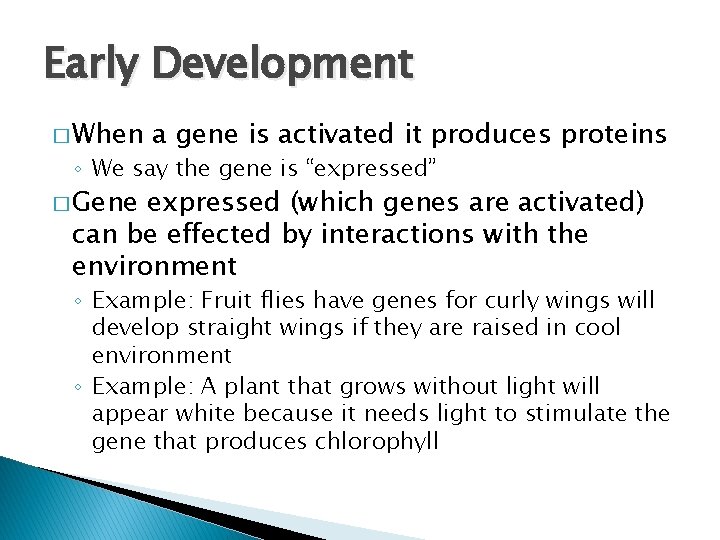
Early Development � When a gene is activated it produces proteins ◦ We say the gene is “expressed” � Gene expressed (which genes are activated) can be effected by interactions with the environment ◦ Example: Fruit flies have genes for curly wings will develop straight wings if they are raised in cool environment ◦ Example: A plant that grows without light will appear white because it needs light to stimulate the gene that produces chlorophyll
Human Development � Human (and most mammal) embryonic development continues in the uterus � In the first part of pregnancy, cells continue to divide by mitotic division and begin to differentiate, forming tissues and organs � The placenta and fluid-filled sac cushion and protects the development of an embryo � After about 2 months, the major organs have begun to form and the embryo is called a fetus
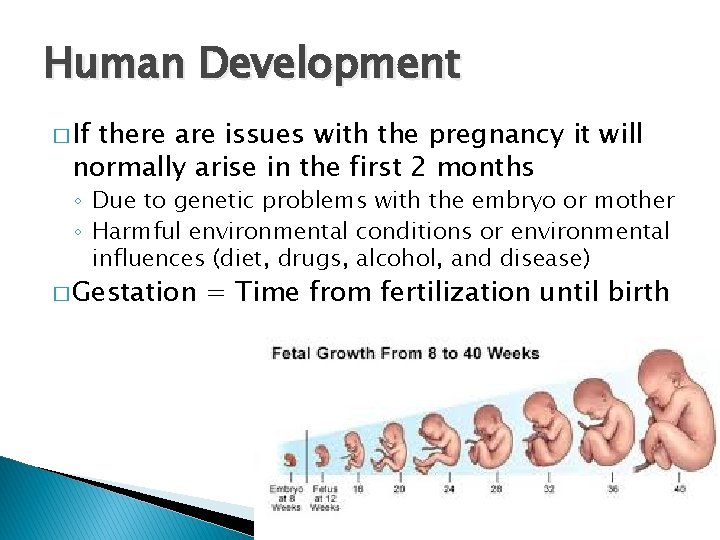
Human Development � If there are issues with the pregnancy it will normally arise in the first 2 months ◦ Due to genetic problems with the embryo or mother ◦ Harmful environmental conditions or environmental influences (diet, drugs, alcohol, and disease) � Gestation = Time from fertilization until birth
Human Development � During the first few months, essential organs are forming in the embryo ◦ Things can go wrong �Problems as a result of inherited genes or the mother’s exposure to harmful environmental factors can affect the embryo �Harmful factors a mother should avoid include: alcohol, drugs, and tobacco �Use of these can lead to a baby with brain damage, drug addiction, low birth weight, or a defect. �The fetus can also be harmed if the mother has a poor diet, exposed to toxic substances, gets certain infections (measles or AIDS)
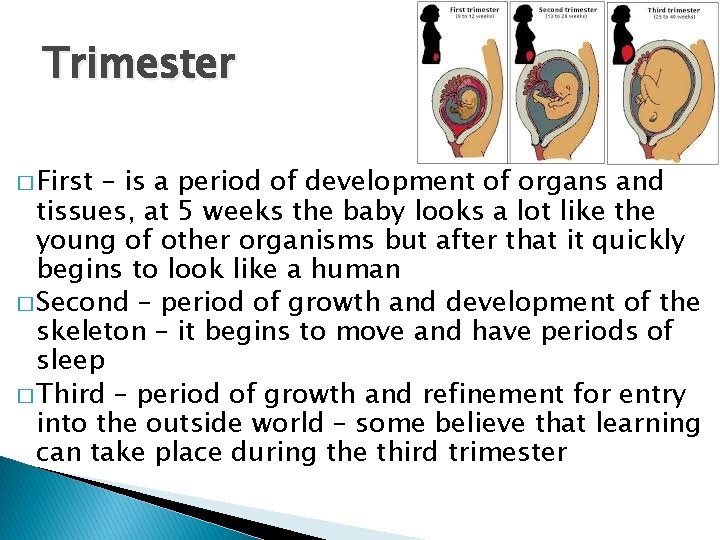
Trimester � First – is a period of development of organs and tissues, at 5 weeks the baby looks a lot like the young of other organisms but after that it quickly begins to look like a human � Second – period of growth and development of the skeleton – it begins to move and have periods of sleep � Third – period of growth and refinement for entry into the outside world – some believe that learning can take place during the third trimester
Birth � Occurs 270 -280 days after the fertilization of the egg � It is induced by hormones being released by the fetus and the mother ◦ Doctors can induce birth by using these hormones � Hormones cause the muscles to contract, breaking the amniotic sac and causing the fluid to flow out of the vagina � The cervix relaxes and expands/dilates and the baby is pushed through the vagina and out of the body
Human Development � After birth, cell differentiation and body growth continue until adulthood � During adulthood, structures in the body slowly begin to age ◦ Eventually the organism weakens and dies ◦ The process of birth growth development aging death is predictable and applies to all organisms
Applications of Reproductive Technology � Discoveries issues have helped to solve reproductive ◦ The knowledge has applied to agricultural, ecological, and medical applications � In agriculture: ◦ We have produced plants that are resistant to insects, weed killers, even frost �We can then clone the plant to produce thousands of them ◦ We can artificially inseminate farm animals and produce wanted traits �We can also freeze fertilized eggs or sperm and transport those at a severely decreased cost than transporting the animal itself
Application of Reproductive Technology � In ecology: ◦ We can build up populations of endangered species ◦ The embryos of the endangered species can be transplanted into a related species �They grow within the related animal and are birthed exactly the same as if they were developed within their own species ◦ The reproductive systems and development of insects has been studied to see if reproductive control can be used instead of poisonous chemicals in population control
Applications of Reproductive Technology � In medicine: ◦ Some woman cannot become pregnant because of problems with their hormones, ovaries, or other reproductive organs ◦ Technologies have helped infertile women become pregnant by use of hormone therapy to adjust hormone levels ◦ Doctors can extract several eggs from a woman’s ovaries and fertilize them with sperm in the laboratory. �The fertilized eggs can be implanted in the woman’s uterus
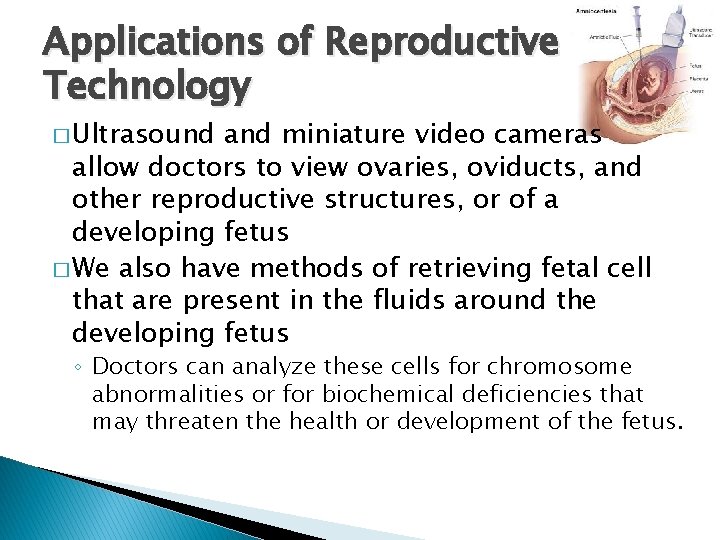
Applications of Reproductive Technology � Ultrasound and miniature video cameras allow doctors to view ovaries, oviducts, and other reproductive structures, or of a developing fetus � We also have methods of retrieving fetal cell that are present in the fluids around the developing fetus ◦ Doctors can analyze these cells for chromosome abnormalities or for biochemical deficiencies that may threaten the health or development of the fetus.