
Reproduction Plant Propagation Pollination Germination Two types of
- Slides: 21
Reproduction Plant Propagation Pollination Germination
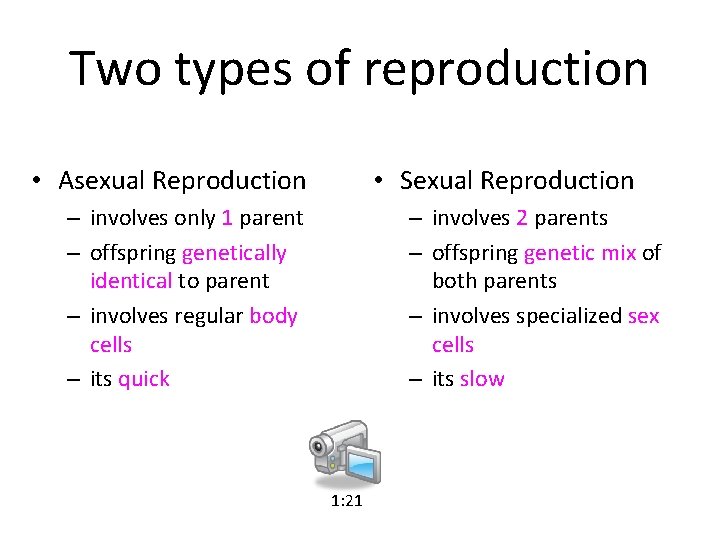
Two types of reproduction • Asexual Reproduction • Sexual Reproduction – involves only 1 parent – offspring genetically identical to parent – involves regular body cells – its quick – involves 2 parents – offspring genetic mix of both parents – involves specialized sex cells – its slow 1: 21
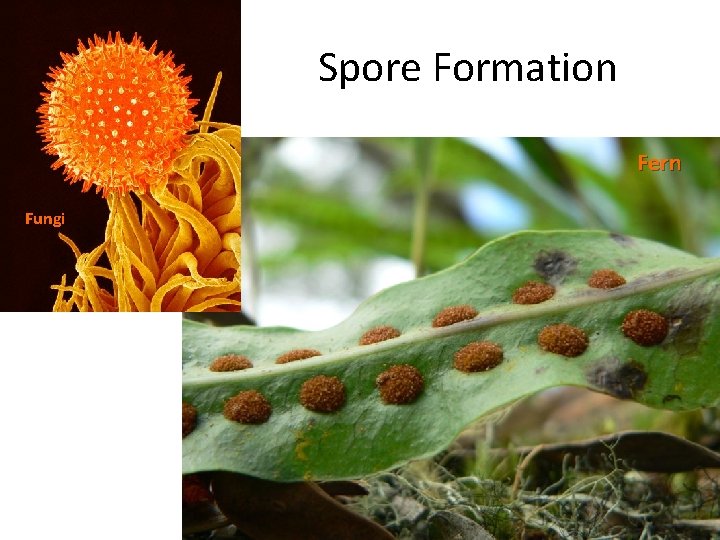
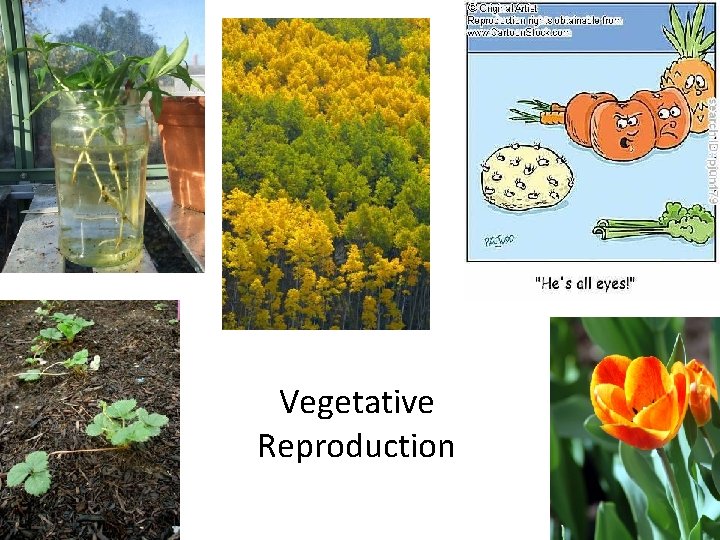
Asexual Reproduction contd. • Spore Formation – happens in fungi, green algae, moulds and non flowering plants (e. g. ferns) – spores are produced and each spore develops into offspring which are identical to parent • Vegetative Reproduction – does not involve seeds – some offspring can grow from cuttings (e. g. coleus), runners (e. g. strawberries), tubers (e. g. potatoes) or bulbs (e. g. tulips)… which are part of the parent plant
Spore Formation Fern Fungi
Vegetative Reproduction
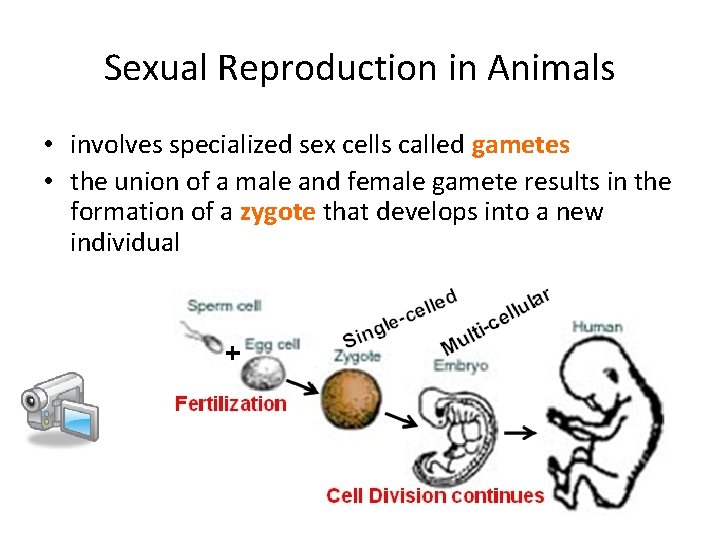
Sexual Reproduction in Animals • involves specialized sex cells called gametes • the union of a male and female gamete results in the formation of a zygote that develops into a new individual
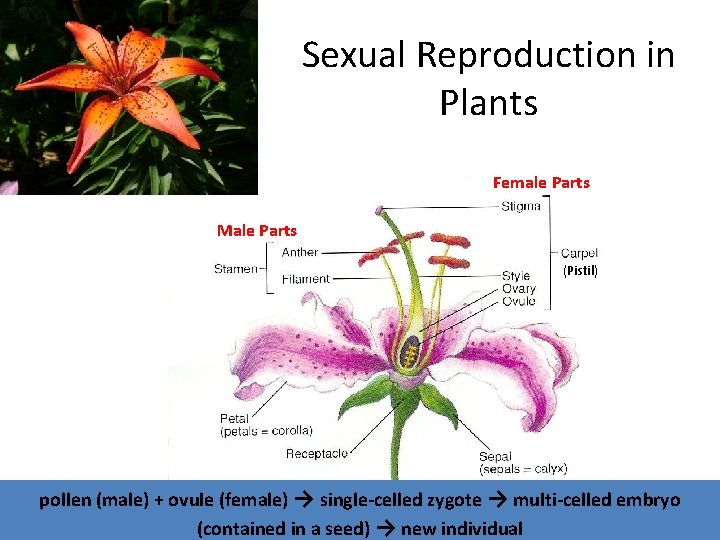
Sexual Reproduction in Plants Female Parts Male Parts (Pistil) pollen (male) + ovule (female) → single-celled zygote → multi-celled embryo (contained in a seed) → new individual
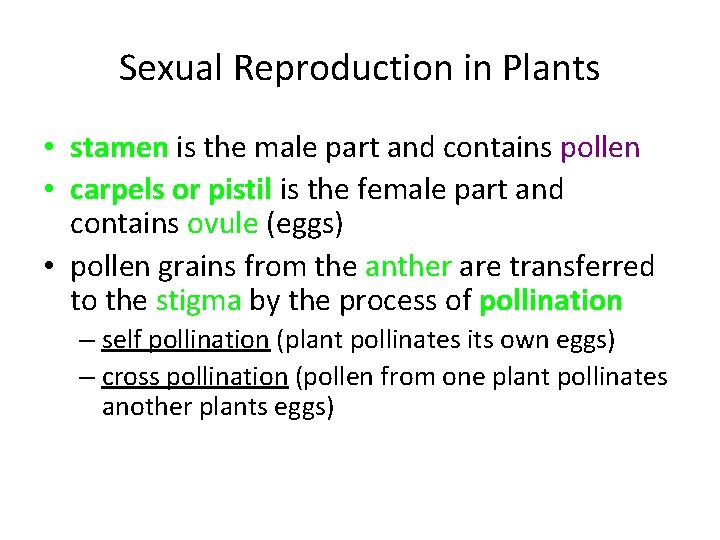
Sexual Reproduction in Plants • stamen is the male part and contains pollen • carpels or pistil is the female part and contains ovule (eggs) • pollen grains from the anther are transferred to the stigma by the process of pollination – self pollination (plant pollinates its own eggs) – cross pollination (pollen from one plant pollinates another plants eggs)
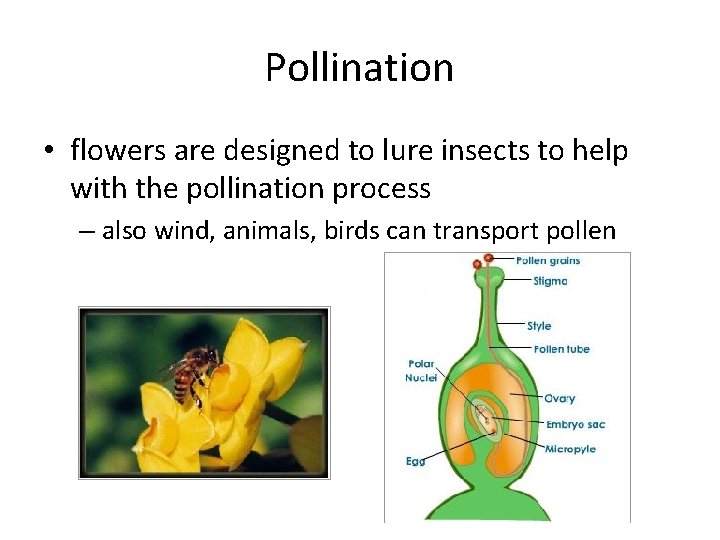
Pollination • flowers are designed to lure insects to help with the pollination process – also wind, animals, birds can transport pollen
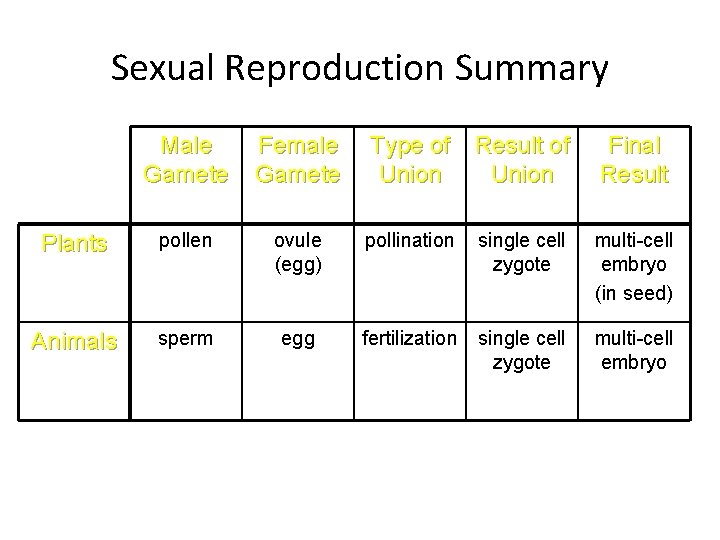
Sexual Reproduction Summary Male Gamete Female Gamete Type of Result of Union Final Result Plants pollen ovule (egg) pollination single cell zygote multi-cell embryo (in seed) Animals sperm egg fertilization single cell zygote multi-cell embryo
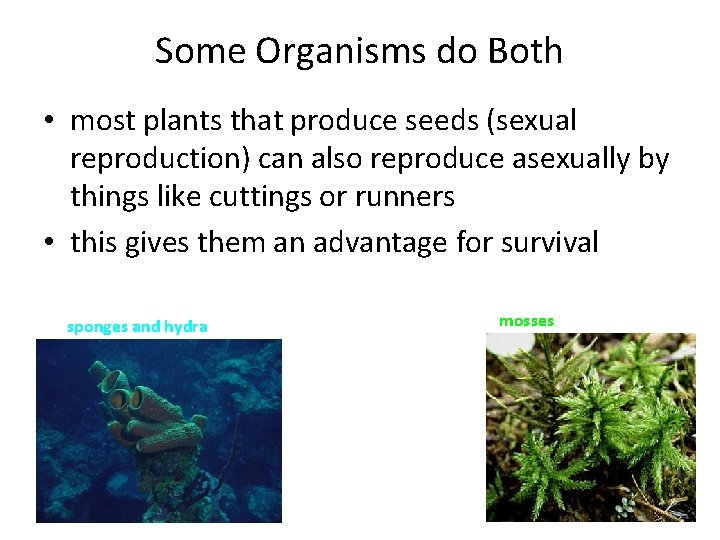
Some Organisms do Both • most plants that produce seeds (sexual reproduction) can also reproduce asexually by things like cuttings or runners • this gives them an advantage for survival sponges and hydra mosses
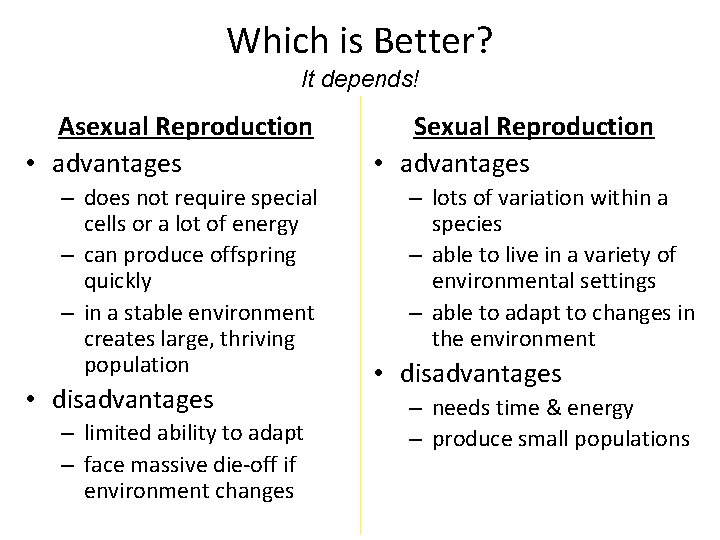
Which is Better? It depends! Asexual Reproduction • advantages – does not require special cells or a lot of energy – can produce offspring quickly – in a stable environment creates large, thriving population • disadvantages – limited ability to adapt – face massive die-off if environment changes Sexual Reproduction • advantages – lots of variation within a species – able to live in a variety of environmental settings – able to adapt to changes in the environment • disadvantages – needs time & energy – produce small populations
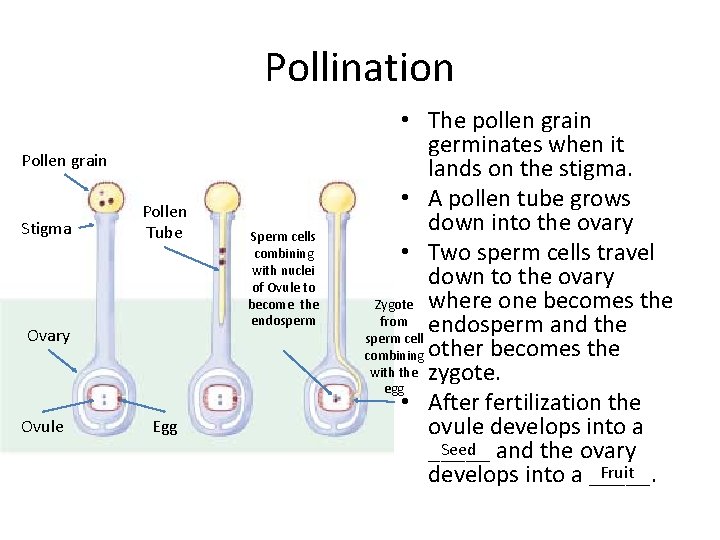
Pollination Pollen grain Stigma Pollen Tube Ovary Ovule Egg Sperm cells combining with nuclei of Ovule to become the endosperm • The pollen grain germinates when it lands on the stigma. • A pollen tube grows down into the ovary • Two sperm cells travel down to the ovary Zygote where one becomes the from endosperm and the sperm cell combining other becomes the with the zygote. egg • After fertilization the ovule develops into a Seed and the ovary _____ Fruit develops into a _____.
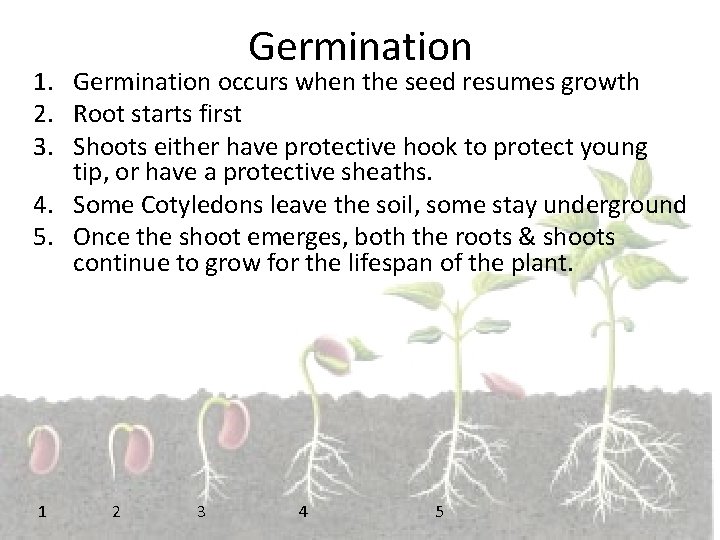
Germination 1. Germination occurs when the seed resumes growth 2. Root starts first 3. Shoots either have protective hook to protect young tip, or have a protective sheaths. 4. Some Cotyledons leave the soil, some stay underground 5. Once the shoot emerges, both the roots & shoots continue to grow for the lifespan of the plant. 1 2 3 4 5
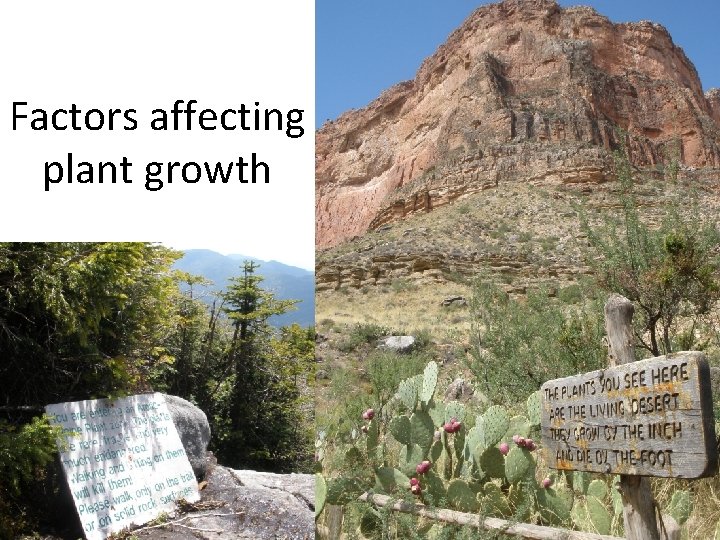
Factors affecting plant growth
Factors that affect plant growth • Hormones • Light • Relative humidity • Temperature • Co 2 & O 2 • Soil quality • Nutrient levels
Plant Hormones • Auxin – Growth promoting hormone, causes cells to become longer as they grow – Causing the plant to bend towards the light – Stops the growth of buds. – Produced at the tip of the shoots • Gibberellins – Stimulate stem elongation – Causes fruit development and seed germination – Produced in shoots & seeds • Cytokinins – Stimulates cell division & slows the aging of some plant organisms – Produced in root tip
Light • Getting enough light is the most important factors influencing plant growth • The quantity, quality and duration of light exposure is what matters most. • Why? Relative Humidity • Relative humidity is the total amount of water vapour in the air.
Temperature • Temperature influences plant processes, like photosynthesis, respiration, germination, and flowering. Co 2 & O 2 • Photosynthesis requires the presence of carbon dioxide. • Oxygen is essential for plant respiration.
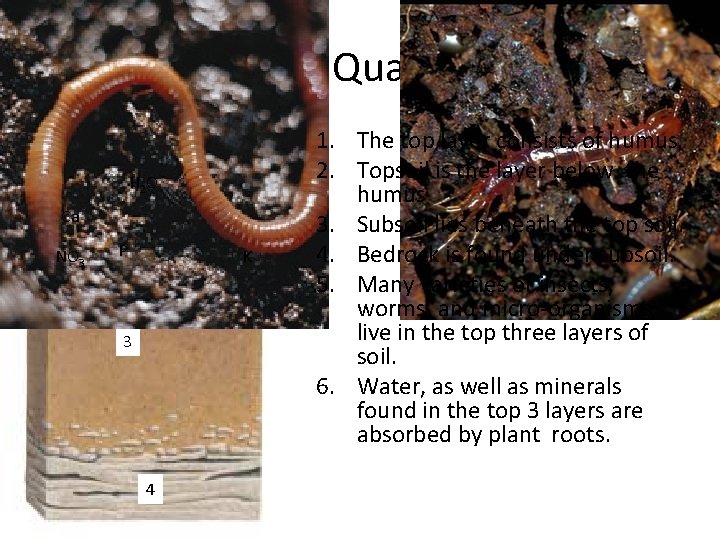
Soil Quality 1 H 2 O Ca NO 3 P 2 K 3 4 1. The top layer consists of humus. 2. Topsoil is the layer below the humus 3. Subsoil lies beneath the top soil. 4. Bedrock is found under subsoil. 5. Many varieties of insects, worms, and micro-organisms live in the top three layers of soil. 6. Water, as well as minerals found in the top 3 layers are absorbed by plant roots.
Nutrients Plants need nutrients from the soil to grow and survive. Macronutrients: Plants require a lot of these nutrients. • Nitrogen • Phosphorus • Potassium • Calcium • Magnesium Micronutrients: Plants require less of these nutrients. • Iron • Zinc • Copper