
Representative Elements Chapter 3 Section 2 Monday February

Representative Elements Chapter 3 Section 2 Monday, February 22, 2021
Groups 1 & 2, the Alkali Metals and the Alkaline Earth metals
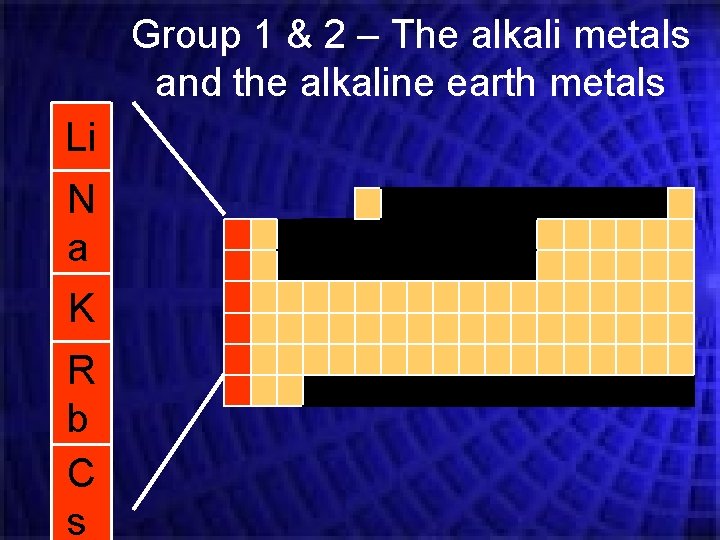
Group 1 & 2 – The alkali metals and the alkaline earth metals Li N a K R b C s
Representative Elements Groups 1 and 2 • Groups 1 and 2 are always found in nature combined with other elements. • They’re called active metals because of their readiness to form new substances with other elements. • They are all metals except hydrogen, the first element in Group 1. • Although hydrogen is placed in Group 1, it shares properties with the elements in Group 1 and Group 17.
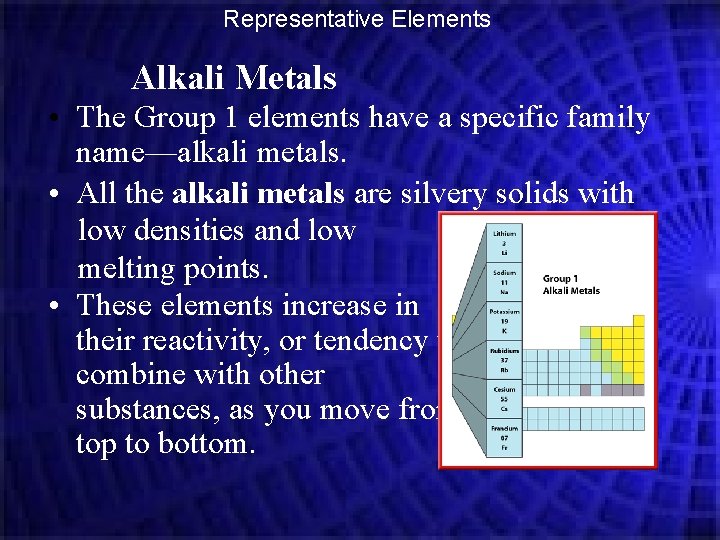
Representative Elements Alkali Metals • The Group 1 elements have a specific family name—alkali metals. • All the alkali metals are silvery solids with low densities and low melting points. • These elements increase in their reactivity, or tendency to combine with other substances, as you move from top to bottom.

Representative Elements Alkaline Earth Metals • Next to the alkali metals are the alkaline earth metals. • Each alkaline earth metal is denser and harder and has a higher melting point than the alkali metal in the same period. • Alkaline earth metals are reactive, but not as reactive as the alkali metals.
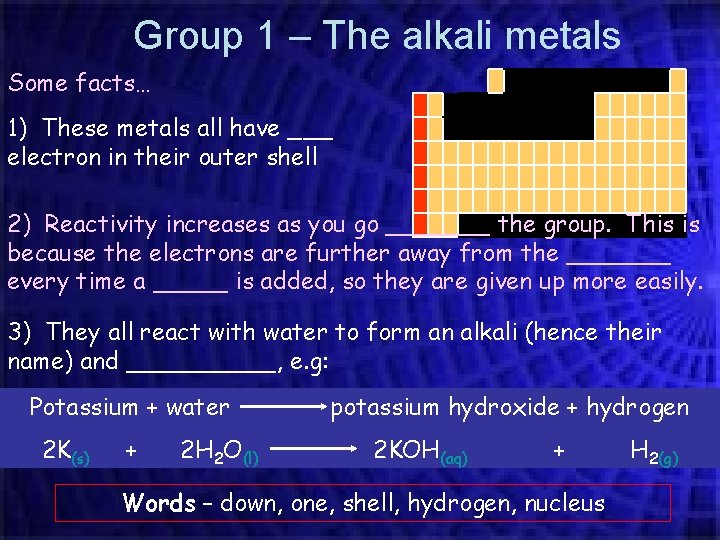
Group 1 – The alkali metals Some facts… 1) These metals all have ___ electron in their outer shell 2) Reactivity increases as you go _______ the group. This is because the electrons are further away from the _______ every time a _____ is added, so they are given up more easily. 3) They all react with water to form an alkali (hence their name) and _____, e. g: Potassium + water 2 K(s) + 2 H 2 O(l) potassium hydroxide + hydrogen 2 KOH(aq) + Words – down, one, shell, hydrogen, nucleus H 2(g)
Group 13, the Boron Family
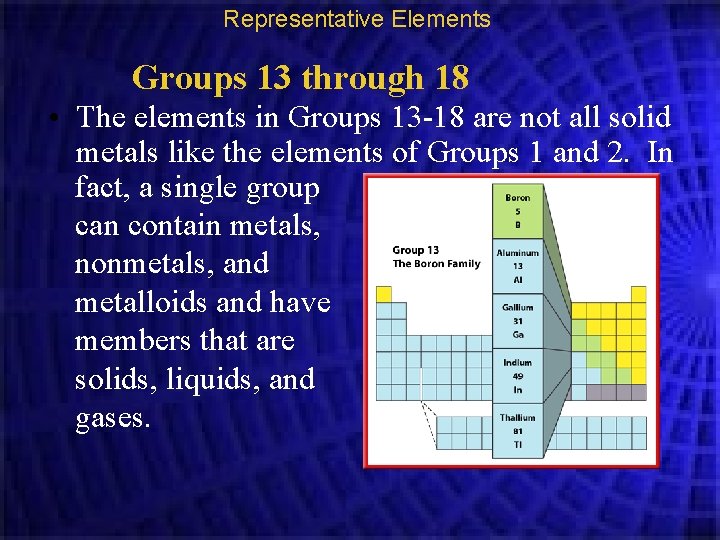
Representative Elements Groups 13 through 18 • The elements in Groups 13 -18 are not all solid metals like the elements of Groups 1 and 2. In fact, a single group can contain metals, nonmetals, and metalloids and have members that are solids, liquids, and gases.
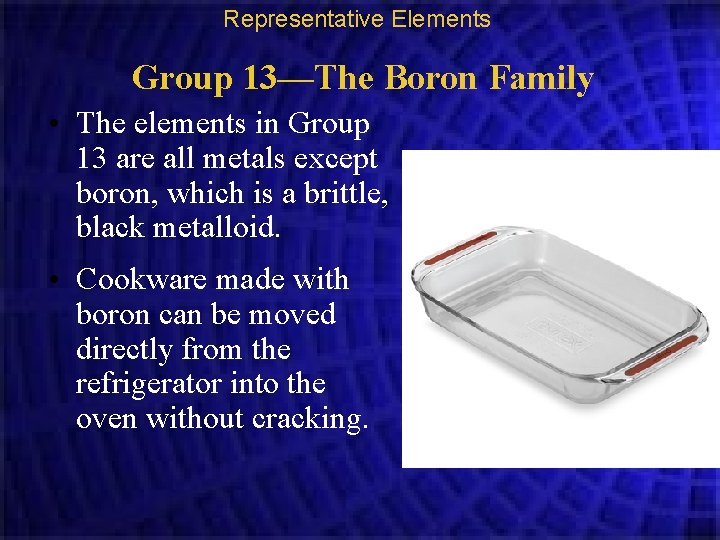
Representative Elements Group 13—The Boron Family • The elements in Group 13 are all metals except boron, which is a brittle, black metalloid. • Cookware made with boron can be moved directly from the refrigerator into the oven without cracking.
Representative Elements Group 13—The Boron Family • Aluminum is used to make soft-drink cans, cookware, siding for homes, and baseball bats. • Gallium is a solid metal, but its melting point is so low that it will melt in your hand. • It is used to make computer chips.
Group 14, the Carbon Group
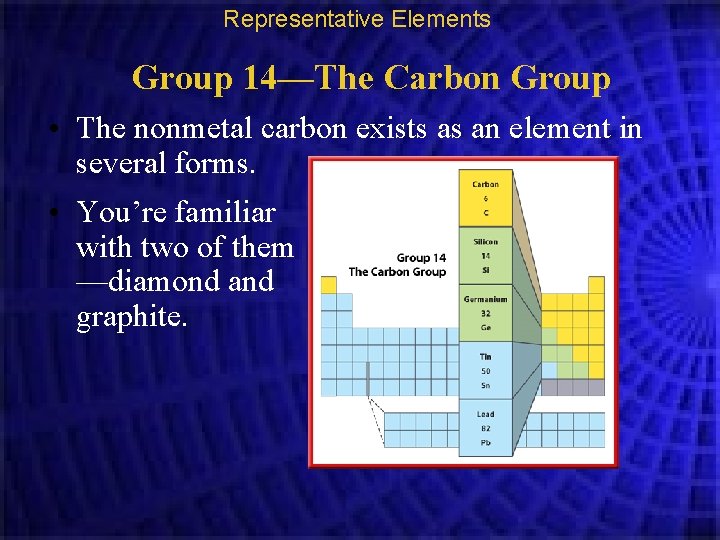
Representative Elements Group 14—The Carbon Group • The nonmetal carbon exists as an element in several forms. • You’re familiar with two of them —diamond and graphite.
Representative Elements 2 Group 14—The Carbon Group • Carbon also is found in all living things. • Carbon is followed by the metalloid silicon, an abundant element contained in sand. • Sand contains ground up particles of minerals such as quartz, which is composed of silicon and oxygen. • Glass is an important product made from sand.
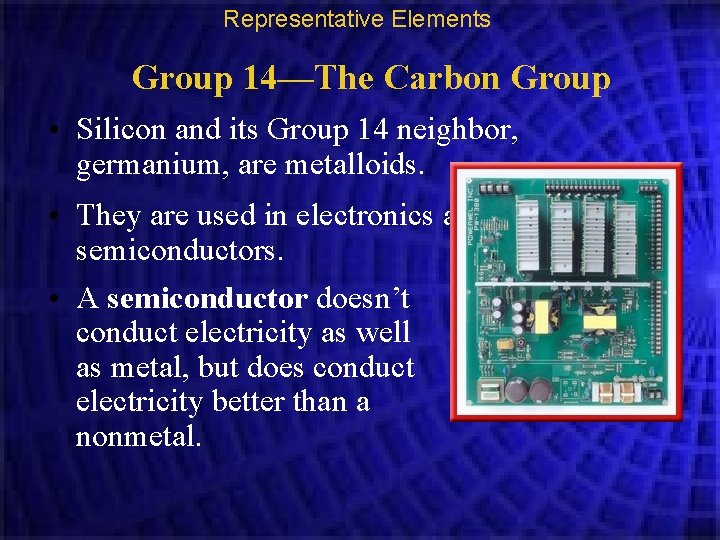
Representative Elements Group 14—The Carbon Group • Silicon and its Group 14 neighbor, germanium, are metalloids. • They are used in electronics as semiconductors. • A semiconductor doesn’t conduct electricity as well as metal, but does conduct electricity better than a nonmetal.
Representative Elements Group 14—The Carbon Group • Tin and lead are the two heaviest elements in Group 14. • Lead is used to protect your torso during dental X rays. • It also is used in car batteries, low-melting alloys, protective shielding around nuclear reactors, and containers used for storing and transporting radioactive materials. • Tin is used in pewter, toothpaste, and the coating on steel cans used for food.
Group 15, the Nitrogen Group
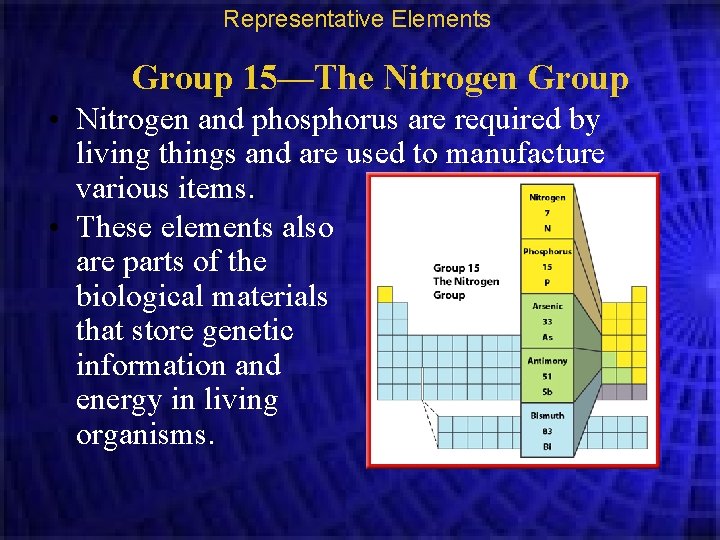
Representative Elements Group 15—The Nitrogen Group • Nitrogen and phosphorus are required by living things and are used to manufacture various items. • These elements also are parts of the biological materials that store genetic information and energy in living organisms.
Representative Elements Group 15—The Nitrogen Group • Although almost 80 percent of the air you breathe is nitrogen, you can’t get the nitrogen your body needs by breathing nitrogen gas. • Bacteria in the soil must first change nitrogen gas into substances that can be absorbed through the roots of plants. • Then, by eating some plants, nitrogen becomes available to your body.
Representative Elements Group 15—The Nitrogen Group • Ammonia is a gas that contains nitrogen and hydrogen. • When ammonia is dissolved in water, it can be used as a cleaner and disinfectant. • Ammonia also can be converted into solid fertilizers. • It also is used to freeze-dry food and as a refrigerant.
Representative Elements Group 15—The Nitrogen Group • The element phosphorus comes in two forms—white and red. • White phosphorus is so active it can’t be exposed to oxygen in the air or it will burst into flames. • The heads of matches contain the less active red phosphorus, which ignites from the heat produced by friction when the match is struck.
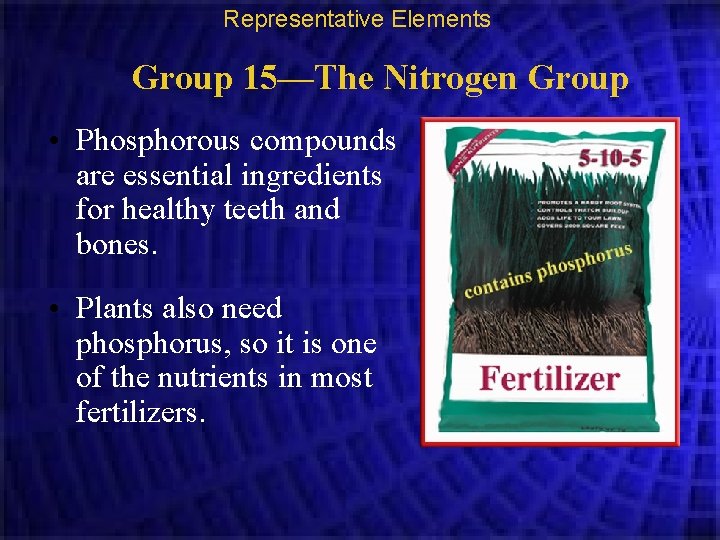
Representative Elements Group 15—The Nitrogen Group • Phosphorous compounds are essential ingredients for healthy teeth and bones. • Plants also need phosphorus, so it is one of the nutrients in most fertilizers.
Group 16, the Oxygen Group
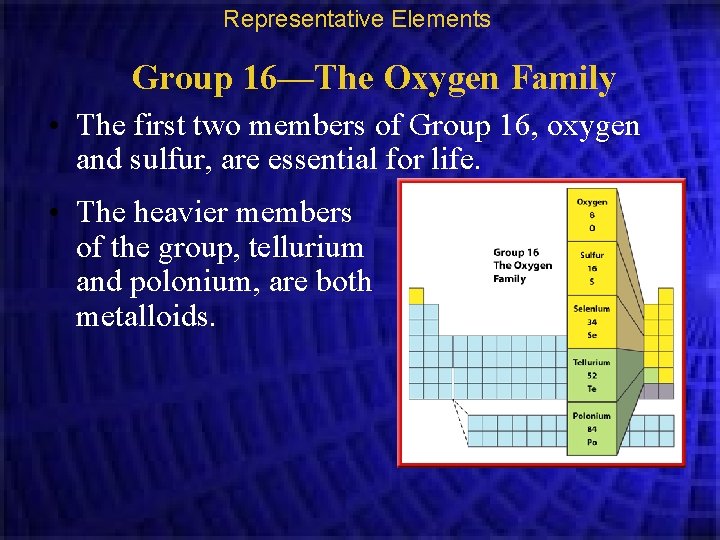
Representative Elements Group 16—The Oxygen Family • The first two members of Group 16, oxygen and sulfur, are essential for life. • The heavier members of the group, tellurium and polonium, are both metalloids.
Representative Elements Group 16—The Oxygen Family • Ozone, a less common form of oxygen, is formed in the upper atmosphere through the action of electricity during thunderstorms. • The presence of ozone is important because it shields living organisms from some harmful radiation from the Sun.
Representative Elements Group 16—The Oxygen Family • Sulfur is a solid, yellow nonmetal. • Large amounts of sulfur are used to manufacture sulfuric acid, one of the most commonly used chemicals in the world. • Sulfuric acid is a combination of sulfur, hydrogen, and oxygen. • It is used in the manufacture of paints, fertilizers, detergents, synthetic fibers, and rubber.
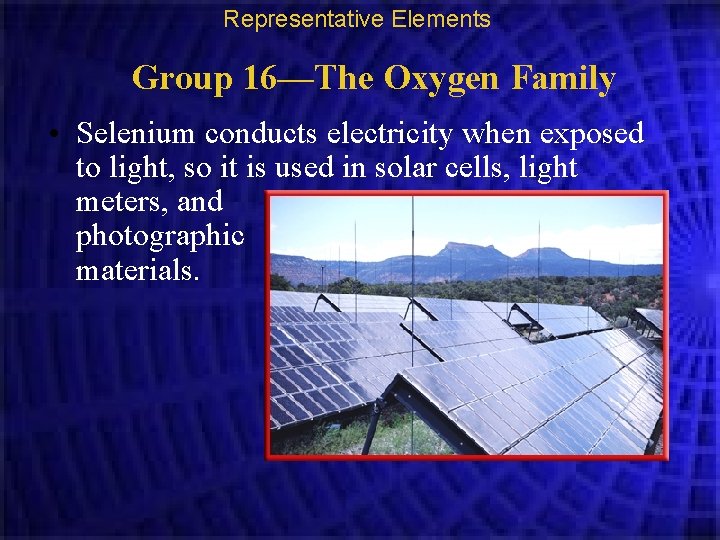
Representative Elements Group 16—The Oxygen Family • Selenium conducts electricity when exposed to light, so it is used in solar cells, light meters, and photographic materials.
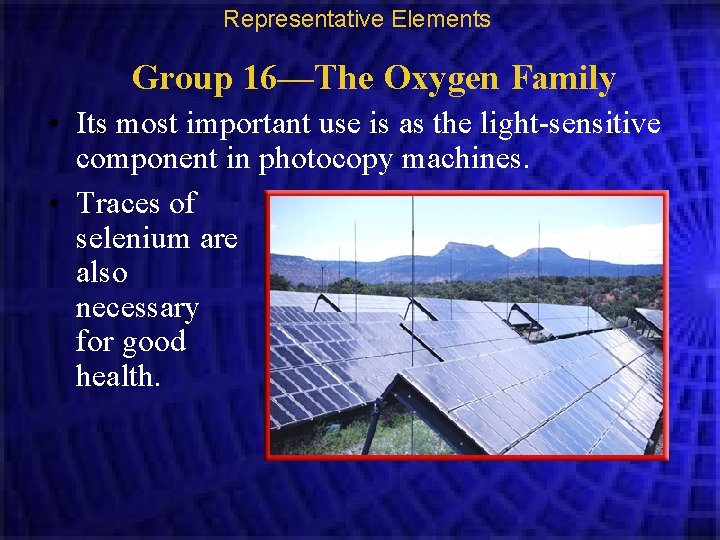
Representative Elements Group 16—The Oxygen Family • Its most important use is as the light-sensitive component in photocopy machines. • Traces of selenium are also necessary for good health.
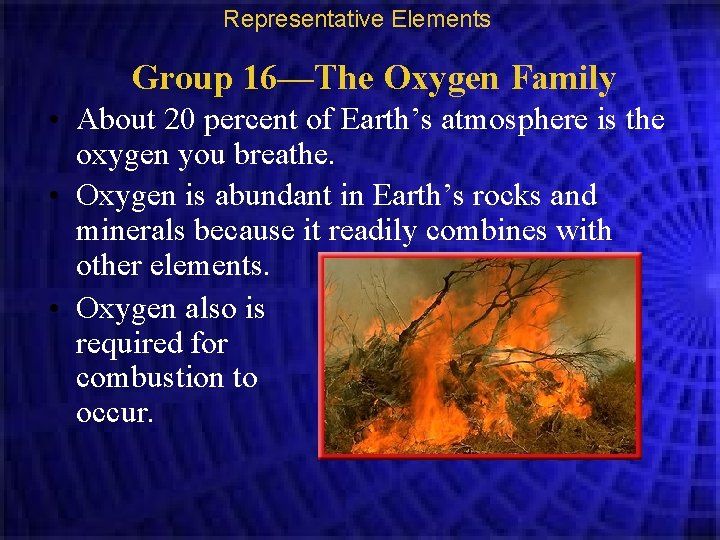
Representative Elements Group 16—The Oxygen Family • About 20 percent of Earth’s atmosphere is the oxygen you breathe. • Oxygen is abundant in Earth’s rocks and minerals because it readily combines with other elements. • Oxygen also is required for combustion to occur.
Group 17, the Halogens
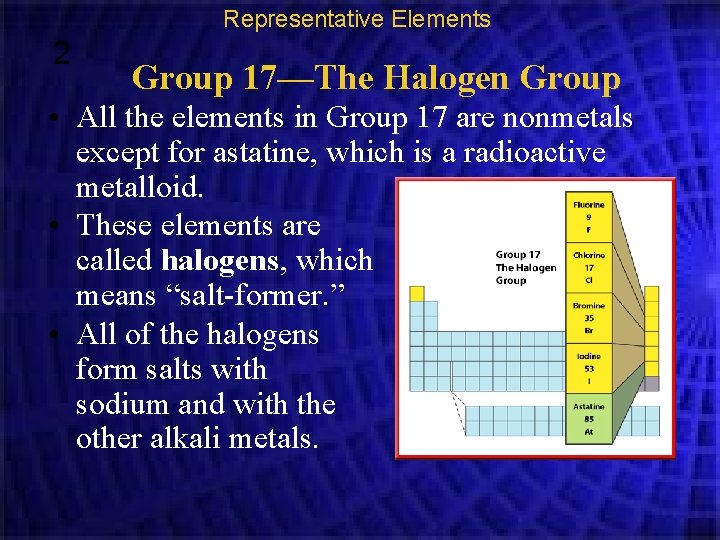
Representative Elements 2 Group 17—The Halogen Group • All the elements in Group 17 are nonmetals except for astatine, which is a radioactive metalloid. • These elements are called halogens, which means “salt-former. ” • All of the halogens form salts with sodium and with the other alkali metals.
Representative Elements Group 17—The Halogen Group • The halogen fluorine is the most reactive of the halogens in combining with other elements. • Chlorine is less reactive than fluorine, and bromine is less reactive than chlorine. • Iodine is the least reactive of the four nonmetals.
Section Check Question 1 What does the term “halogen” mean?
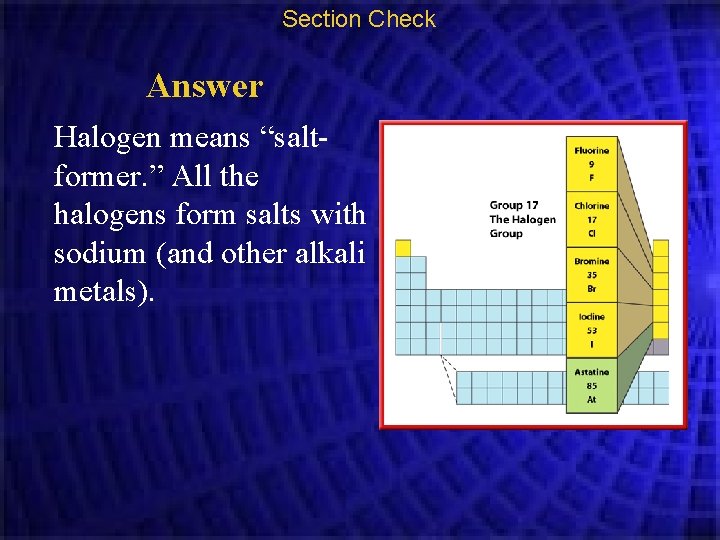
Section Check Answer Halogen means “saltformer. ” All the halogens form salts with sodium (and other alkali metals).
Group 18 The Noble Gases
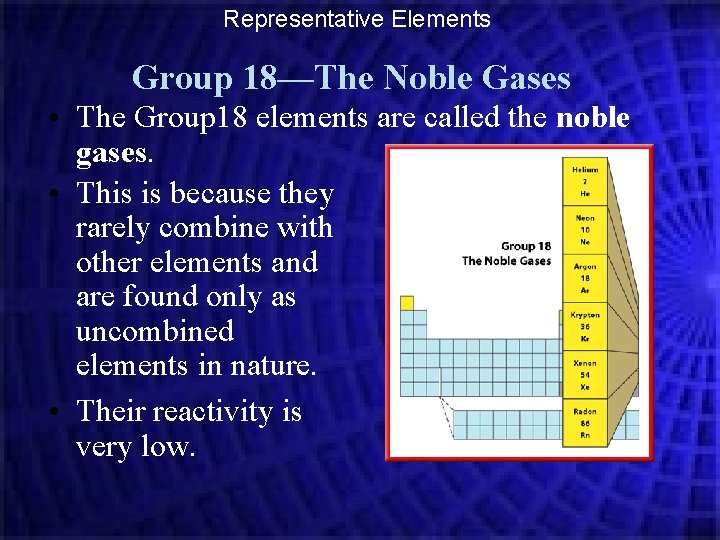
Representative Elements Group 18—The Noble Gases • The Group 18 elements are called the noble gases. • This is because they rarely combine with other elements and are found only as uncombined elements in nature. • Their reactivity is very low.
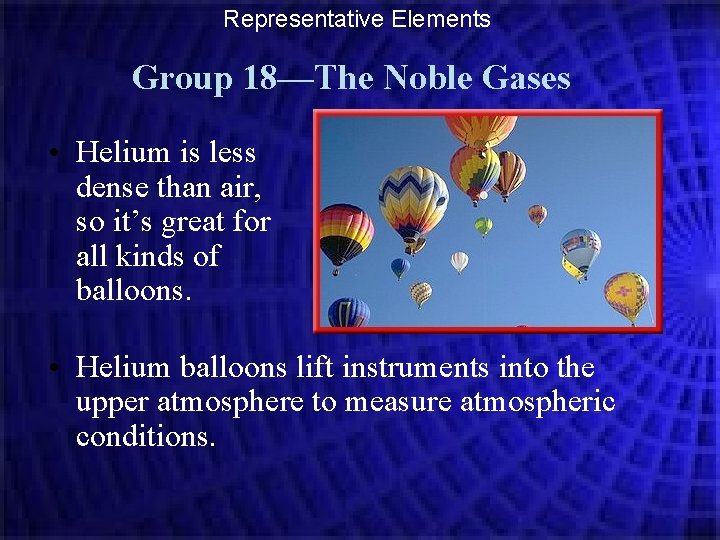
Representative Elements Group 18—The Noble Gases • Helium is less dense than air, so it’s great for all kinds of balloons. • Helium balloons lift instruments into the upper atmosphere to measure atmospheric conditions.
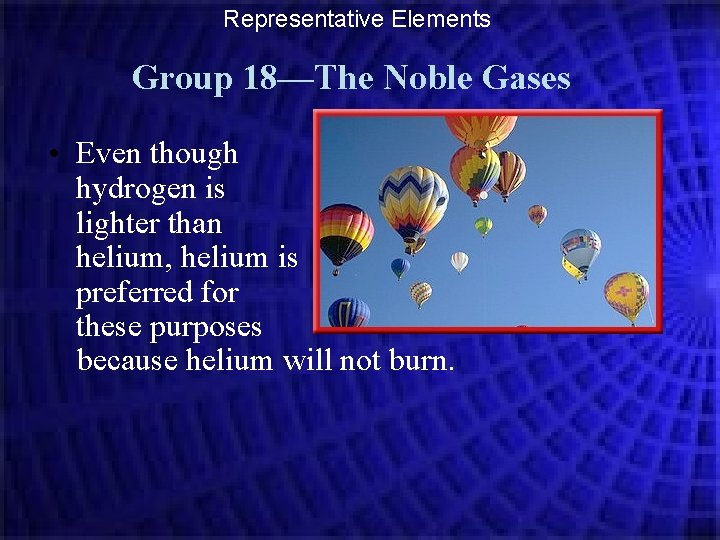
Representative Elements Group 18—The Noble Gases • Even though hydrogen is lighter than helium, helium is preferred for these purposes because helium will not burn.
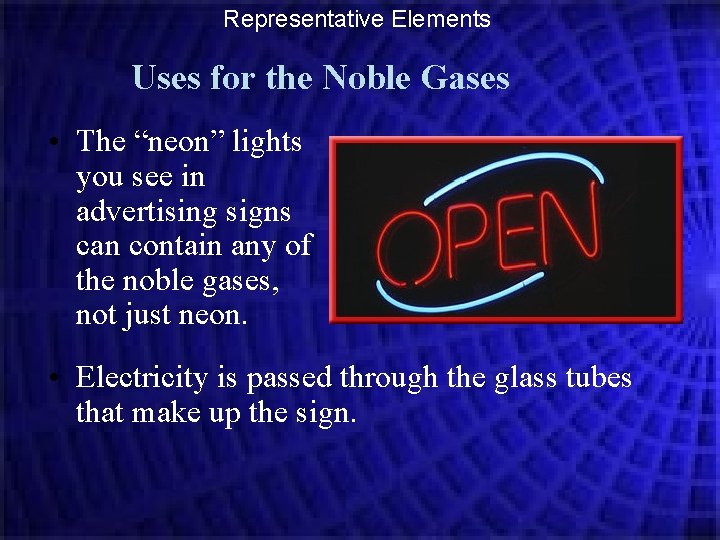
Representative Elements Uses for the Noble Gases • The “neon” lights you see in advertising signs can contain any of the noble gases, not just neon. • Electricity is passed through the glass tubes that make up the sign.
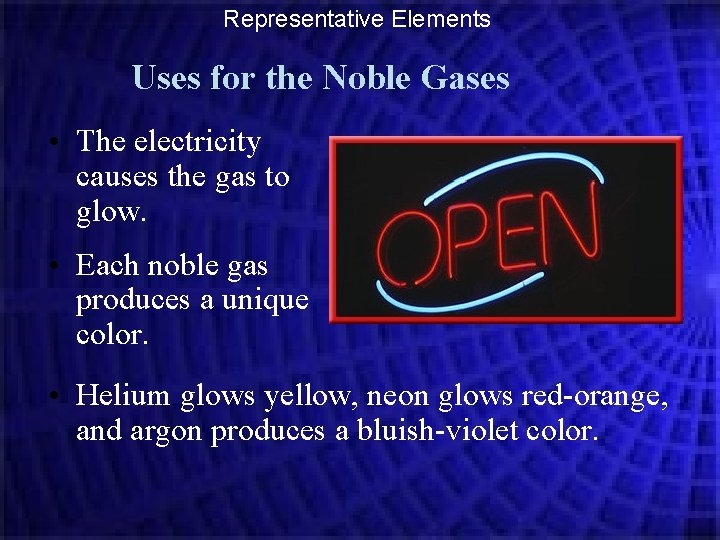
Representative Elements Uses for the Noble Gases • The electricity causes the gas to glow. • Each noble gas produces a unique color. • Helium glows yellow, neon glows red-orange, and argon produces a bluish-violet color.
Representative Elements Uses for the Noble Gases • Argon, the most abundant of the noble gases on Earth, was first found in 1894. • Krypton is used with nitrogen in ordinary lightbulbs because these gases keep the glowing filament from burning out. • Krypton lights are used to illuminate landing strips at airports, and xenon is used in strobe lights and was once used in photographic flash cubes.
Representative Elements Uses for the Noble Gases • At the bottom of the group is radon, a radioactive gas produced naturally as uranium decays in rocks and soil. • If radon seeps into a home, the gas can be harmful because it continues to emit radiation. • When people breathe gas over a period of time, it can cause lung cancer.
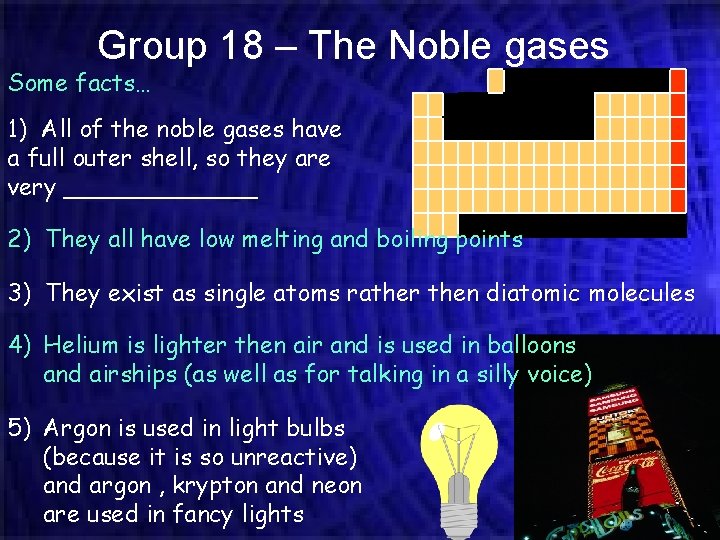
Group 18 – The Noble gases Some facts… 1) All of the noble gases have a full outer shell, so they are very _______ 2) They all have low melting and boiling points 3) They exist as single atoms rather then diatomic molecules 4) Helium is lighter then air and is used in balloons and airships (as well as for talking in a silly voice) 5) Argon is used in light bulbs (because it is so unreactive) and argon , krypton and neon are used in fancy lights
- Slides: 43