
Representative and Random Cannabis Sampling Sampler Quality Systems
Representative and Random Cannabis Sampling, Sampler Quality Systems, and Demonstration of Competency in Sampler Protocols Presented by: Kim Watson, RQAP-GLP Stone Environmental, Inc. Conference: 254 th ACS National Meeting & Exposition Division of Agrochemicals: Analytical; Environmental & Regulatory Challenges with Legalized Cannabis. Date: August 23, 2017 – 11: 20 – 11: 45 AM 1
Topics for Discussion Regulatory Challenges: Regulations: Goal Obtain Defensible Samples, Protection of Public Health Oregon Rules Oregon Protocols Testing Requirements Usable Marijuana Concentrates, Extracts, Products Why the emphasis on Sampler Training Representative & Random Sampling Basic Concepts Planning Documentation Quality Systems - Audits 2
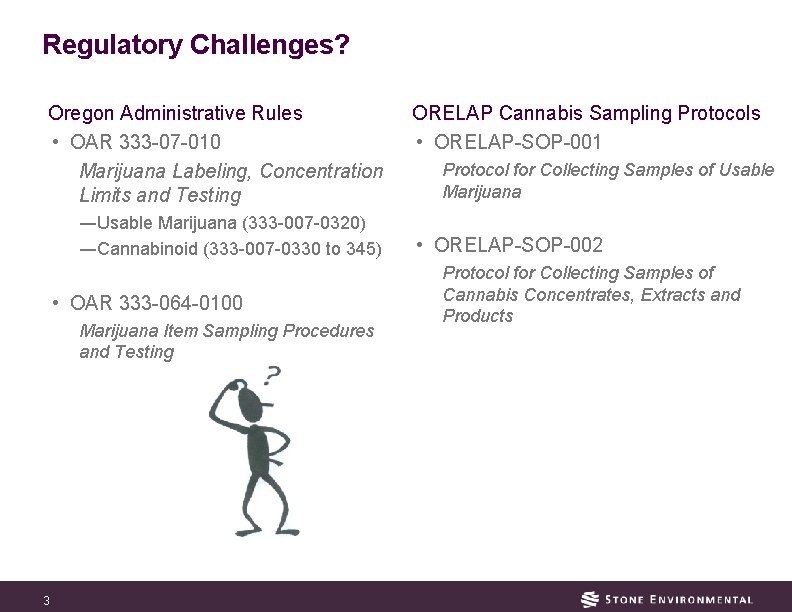
Regulatory Challenges? Oregon Administrative Rules • OAR 333 -07 -010 Marijuana Labeling, Concentration Limits and Testing ―Usable Marijuana (333 -007 -0320) ―Cannabinoid (333 -007 -0330 to 345) • OAR 333 -064 -0100 Marijuana Item Sampling Procedures and Testing 3 ORELAP Cannabis Sampling Protocols • ORELAP-SOP-001 Protocol for Collecting Samples of Usable Marijuana • ORELAP-SOP-002 Protocol for Collecting Samples of Cannabis Concentrates, Extracts and Products
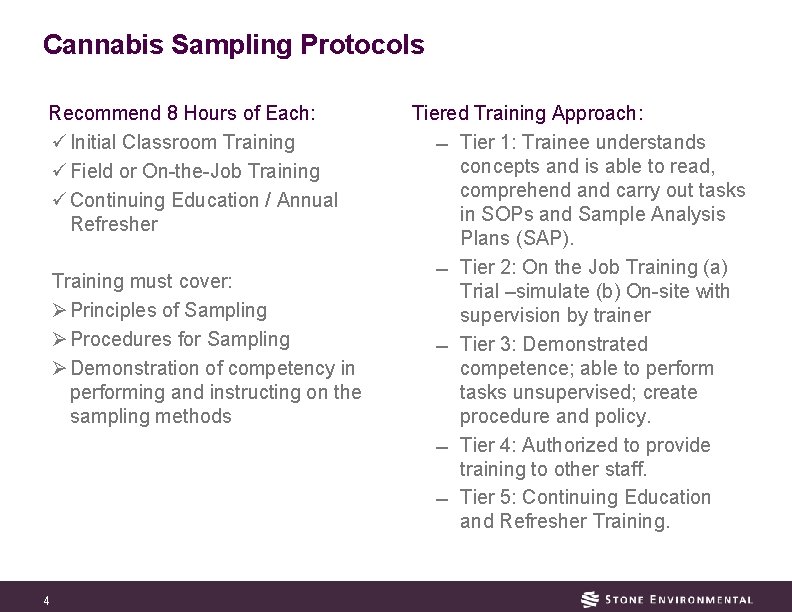
Cannabis Sampling Protocols Recommend 8 Hours of Each: ü Initial Classroom Training ü Field or On-the-Job Training ü Continuing Education / Annual Refresher Training must cover: Ø Principles of Sampling Ø Procedures for Sampling Ø Demonstration of competency in performing and instructing on the sampling methods 4 Tiered Training Approach: Tier 1: Trainee understands concepts and is able to read, comprehend and carry out tasks in SOPs and Sample Analysis Plans (SAP). Tier 2: On the Job Training (a) Trial –simulate (b) On-site with supervision by trainer Tier 3: Demonstrated competence; able to perform tasks unsupervised; create procedure and policy. Tier 4: Authorized to provide training to other staff. Tier 5: Continuing Education and Refresher Training.
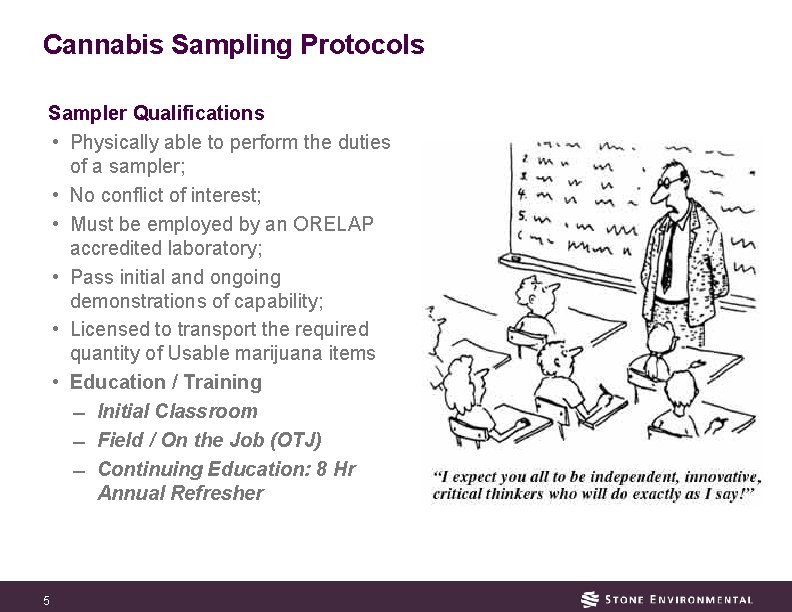
Cannabis Sampling Protocols Sampler Qualifications • Physically able to perform the duties of a sampler; • No conflict of interest; • Must be employed by an ORELAP accredited laboratory; • Pass initial and ongoing demonstrations of capability; • Licensed to transport the required quantity of Usable marijuana items • Education / Training Initial Classroom Field / On the Job (OTJ) Continuing Education: 8 Hr Annual Refresher 5
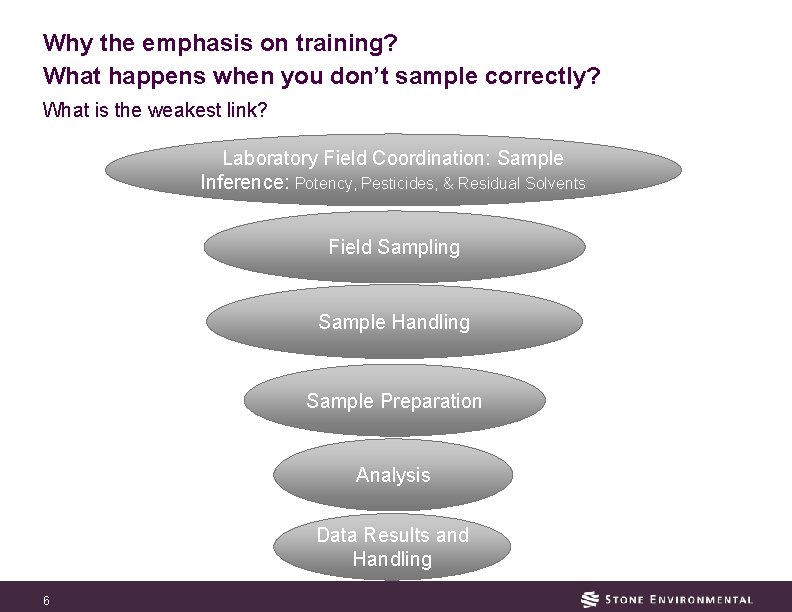
Why the emphasis on training? What happens when you don’t sample correctly? What is the weakest link? Laboratory Field Coordination: Sample Inference: Potency, Pesticides, & Residual Solvents Field Sampling Sample Handling Sample Preparation Analysis Data Results and Handling 6
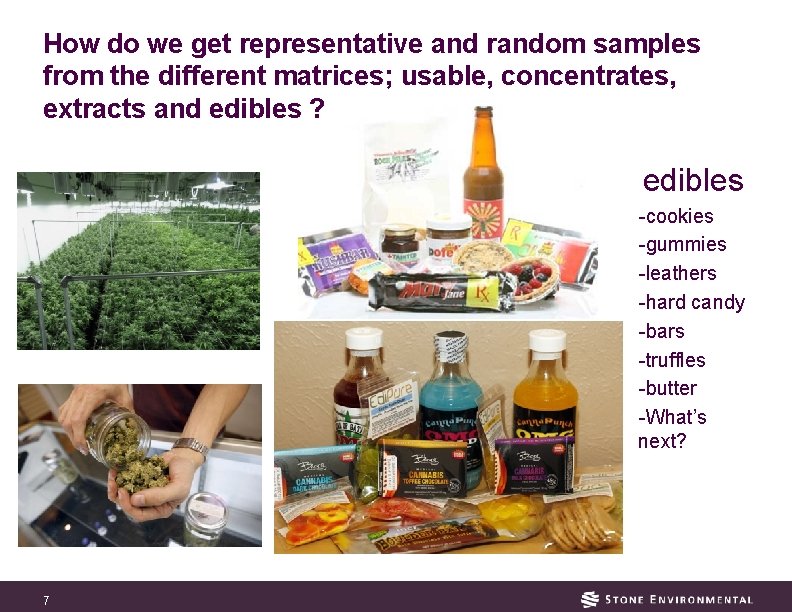
How do we get representative and random samples from the different matrices; usable, concentrates, extracts and edibles ? edibles -cookies -gummies -leathers -hard candy -bars -truffles -butter -What’s next? 7
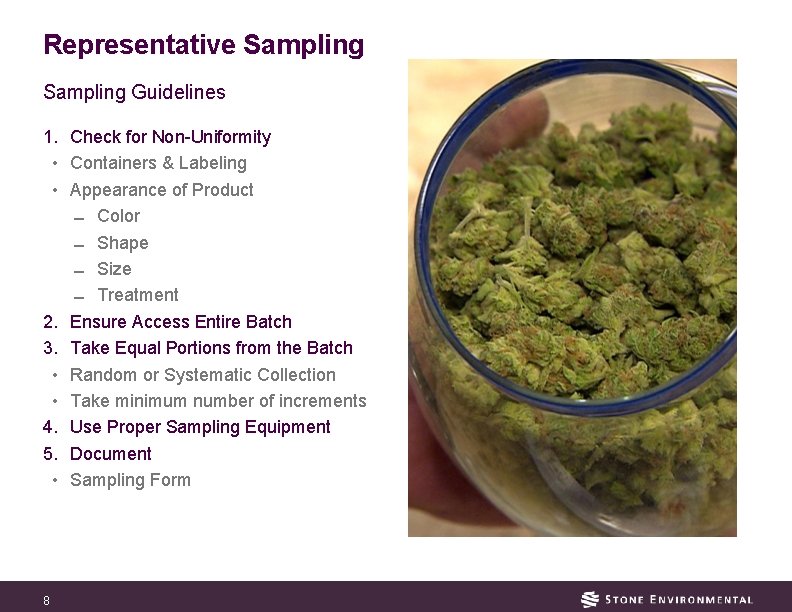
Representative Sampling Guidelines 1. Check for Non-Uniformity • Containers & Labeling • Appearance of Product Color Shape Size Treatment 2. Ensure Access Entire Batch 3. Take Equal Portions from the Batch • Random or Systematic Collection • Take minimum number of increments 4. Use Proper Sampling Equipment 5. Document • Sampling Form 8
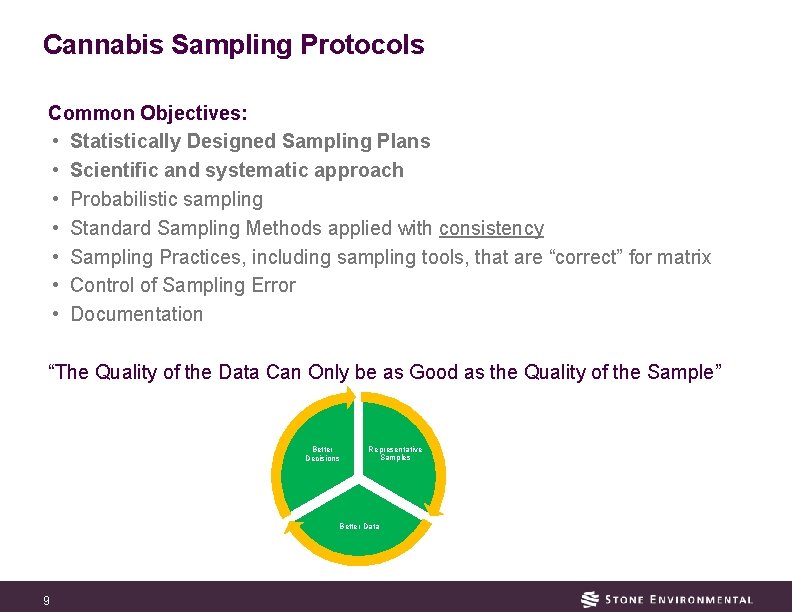
Cannabis Sampling Protocols Common Objectives: • Statistically Designed Sampling Plans • Scientific and systematic approach • Probabilistic sampling • Standard Sampling Methods applied with consistency • Sampling Practices, including sampling tools, that are “correct” for matrix • Control of Sampling Error • Documentation “The Quality of the Data Can Only be as Good as the Quality of the Sample” Better Decisions Representative Samples Better Data 9
Representative & Random Sampling Basic Concepts – WHY? ? Representative: Samples that exhibit average properties of the whole • Accuracy: The closeness of a sample value to its true value • Precision: The closeness of repeated sample values Representative Sample means a sample obtained according to a sampling procedure designed to ensure that the different parts of a batch or lot or the different properties of a batch or lot are proportionally represented. The primary objective of sampling is to collect samples that will allow analytical measurements to be sufficiently accurate and precise. When chemical measurements are sufficiently accurate and precise, the results are considered reliable estimates of the chemical properties of the matrix. SW 846 Chapter 9 10
Random Sampling In random sampling, every unit in the population has a theoretically equal chance of being sampled and measured Probability Sampling • Simple Random • Stratified Random • Systematic Random The ORELAP protocols specify use of random number generator to identify which location(s) to collect sample increments. What type of probability sampling does random number generator fall under? How to? 11 Random Sampling
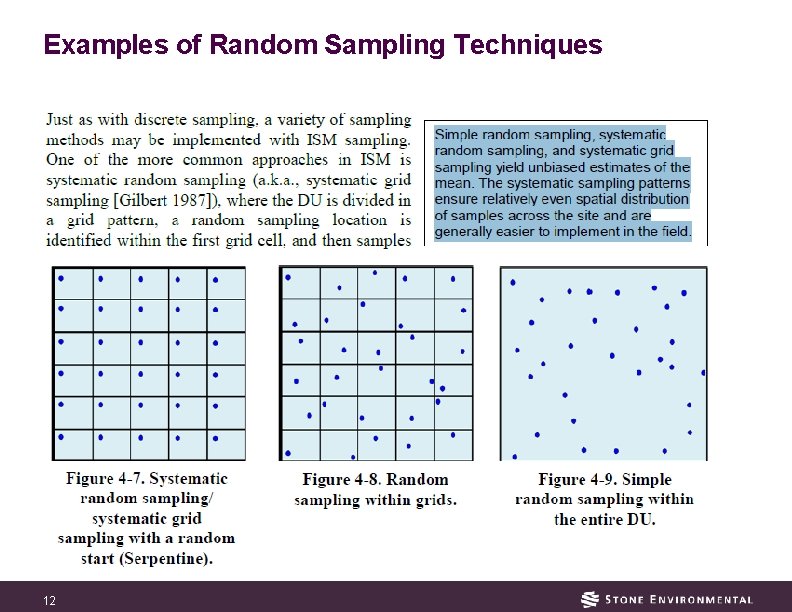
Examples of Random Sampling Techniques 12
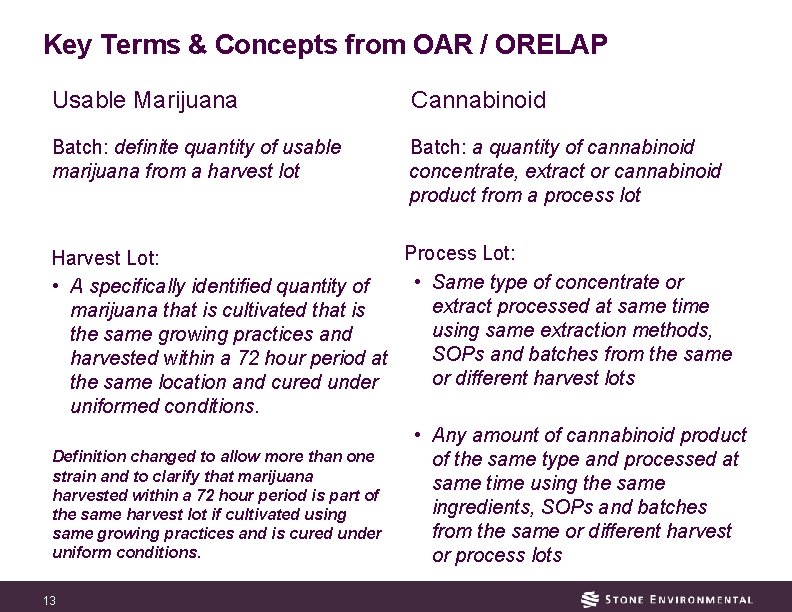
Key Terms & Concepts from OAR / ORELAP Usable Marijuana Cannabinoid Batch: definite quantity of usable marijuana from a harvest lot Batch: a quantity of cannabinoid concentrate, extract or cannabinoid product from a process lot Process Lot: Harvest Lot: • Same type of concentrate or • A specifically identified quantity of extract processed at same time marijuana that is cultivated that is using same extraction methods, the same growing practices and SOPs and batches from the same harvested within a 72 hour period at or different harvest lots the same location and cured under uniformed conditions. • Any amount of cannabinoid product Definition changed to allow more than one of the same type and processed at strain and to clarify that marijuana same time using the same harvested within a 72 hour period is part of ingredients, SOPs and batches the same harvest lot if cultivated using from the same or different harvest same growing practices and is cured under uniform conditions. or process lots 13
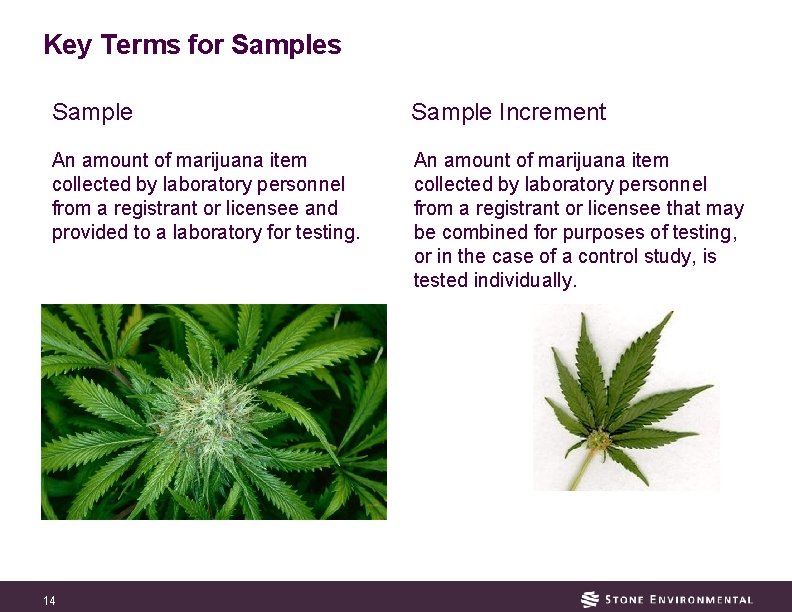
Key Terms for Samples Sample Increment An amount of marijuana item collected by laboratory personnel from a registrant or licensee and provided to a laboratory for testing. An amount of marijuana item collected by laboratory personnel from a registrant or licensee that may be combined for purposes of testing, or in the case of a control study, is tested individually. 14
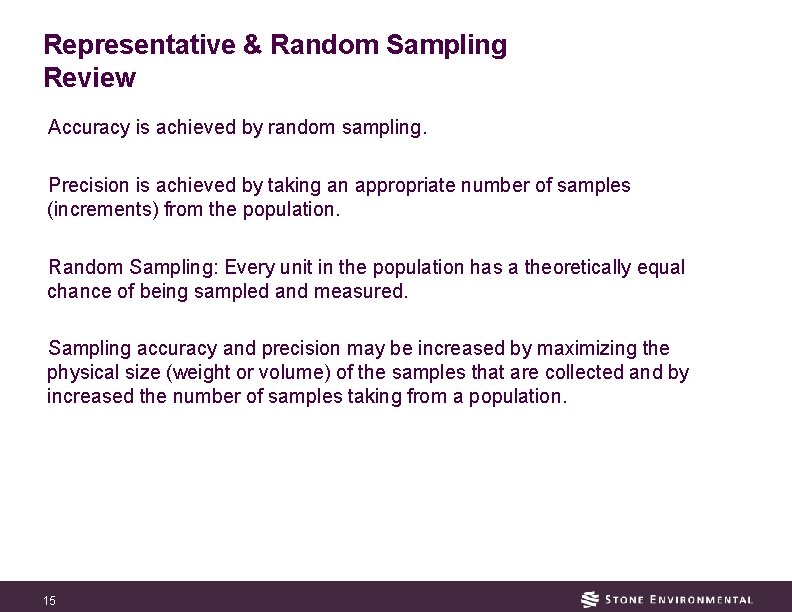
Representative & Random Sampling Review Accuracy is achieved by random sampling. Precision is achieved by taking an appropriate number of samples (increments) from the population. Random Sampling: Every unit in the population has a theoretically equal chance of being sampled and measured. Sampling accuracy and precision may be increased by maximizing the physical size (weight or volume) of the samples that are collected and by increased the number of samples taking from a population. 15
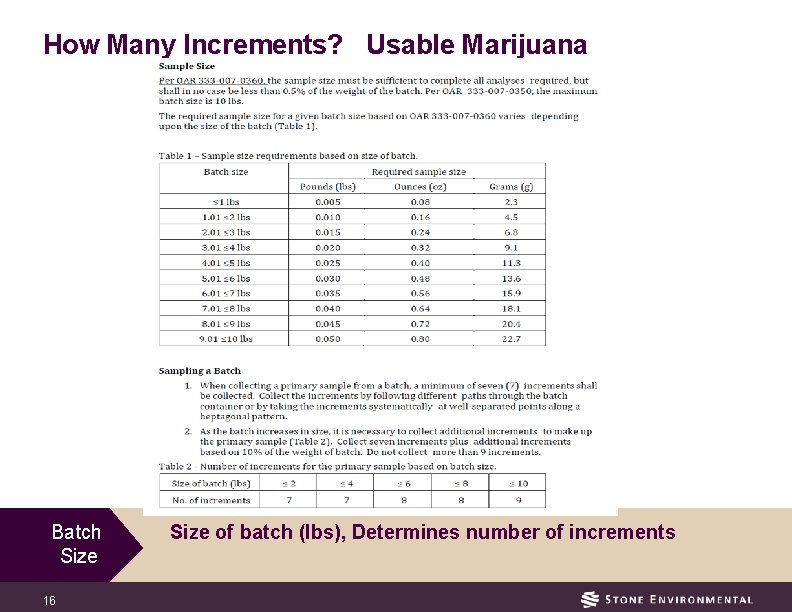
How Many Increments? Usable Marijuana Batch Size 16 Size of batch (lbs), Determines number of increments
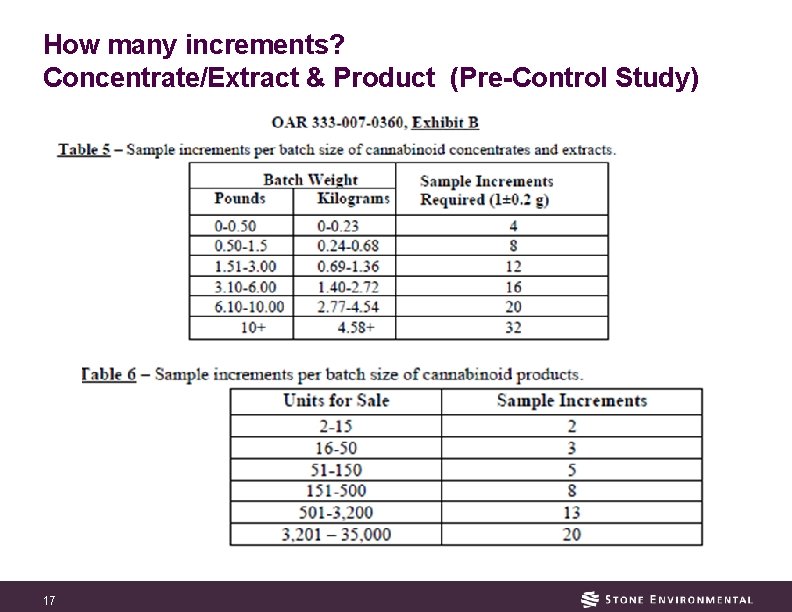
How many increments? Concentrate/Extract & Product (Pre-Control Study) 17
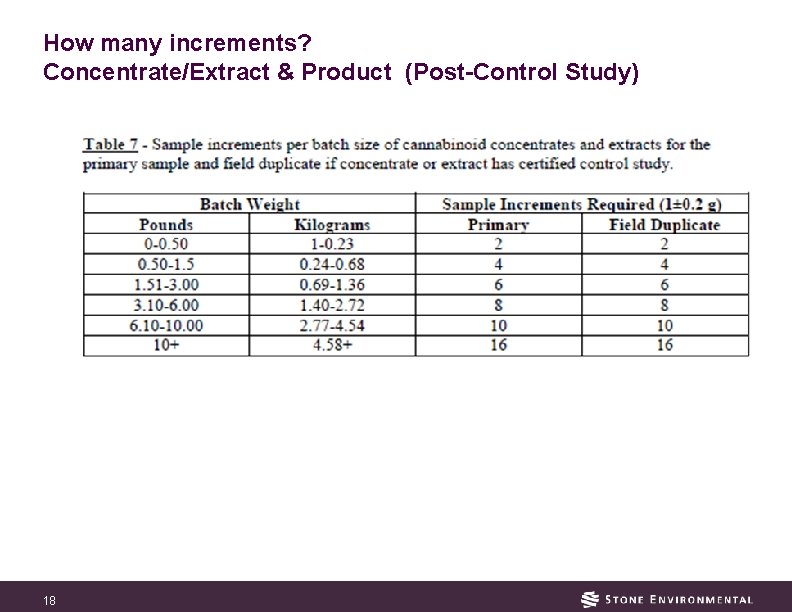
How many increments? Concentrate/Extract & Product (Post-Control Study) 18
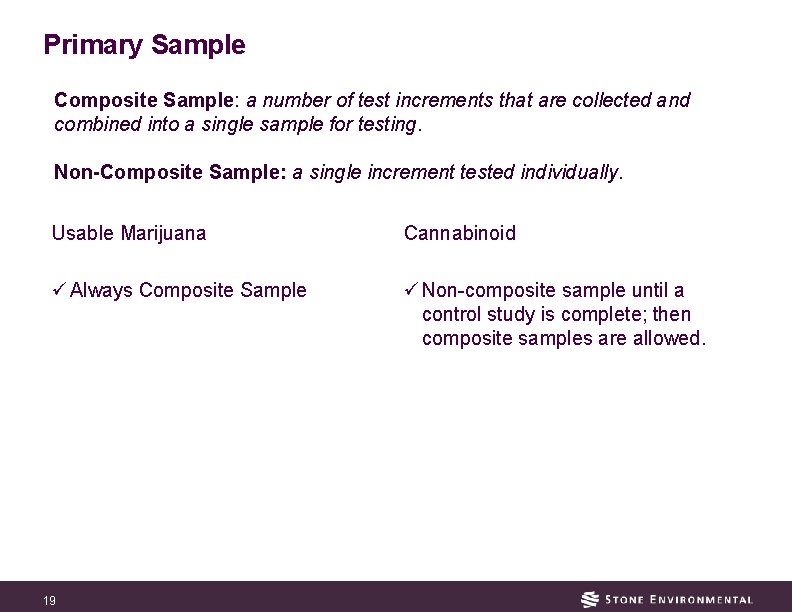
Primary Sample Composite Sample: a number of test increments that are collected and combined into a single sample for testing. Non-Composite Sample: a single increment tested individually. Usable Marijuana Cannabinoid ü Always Composite Sample ü Non-composite sample until a control study is complete; then composite samples are allowed. 19
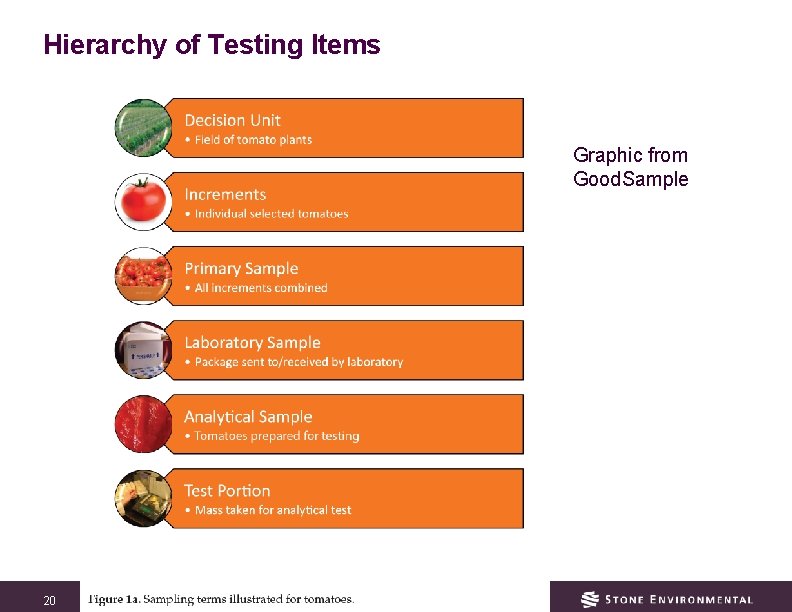
Hierarchy of Testing Items Graphic from Good. Sample 20
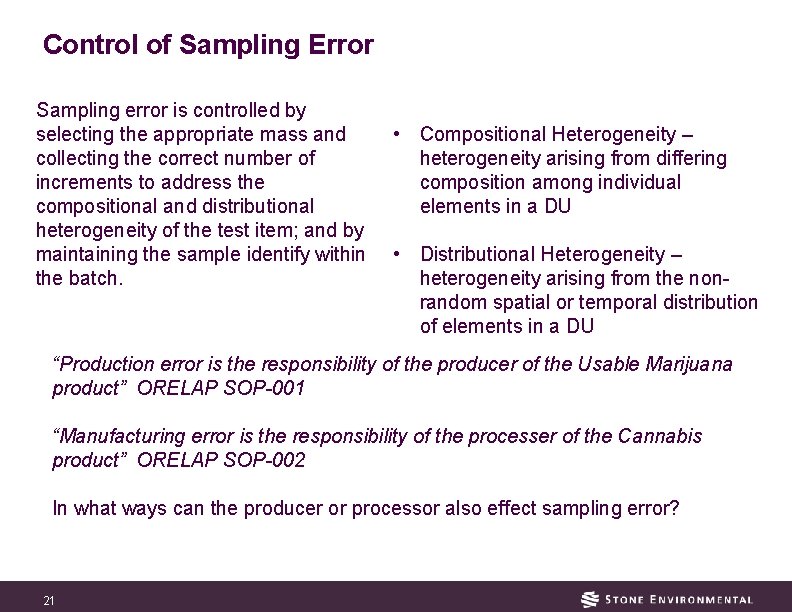
Control of Sampling Error Sampling error is controlled by selecting the appropriate mass and collecting the correct number of increments to address the compositional and distributional heterogeneity of the test item; and by maintaining the sample identify within the batch. • Compositional Heterogeneity – heterogeneity arising from differing composition among individual elements in a DU • Distributional Heterogeneity – heterogeneity arising from the nonrandom spatial or temporal distribution of elements in a DU “Production error is the responsibility of the producer of the Usable Marijuana product” ORELAP SOP-001 “Manufacturing error is the responsibility of the processer of the Cannabis product” ORELAP SOP-002 In what ways can the producer or processor also effect sampling error? 21
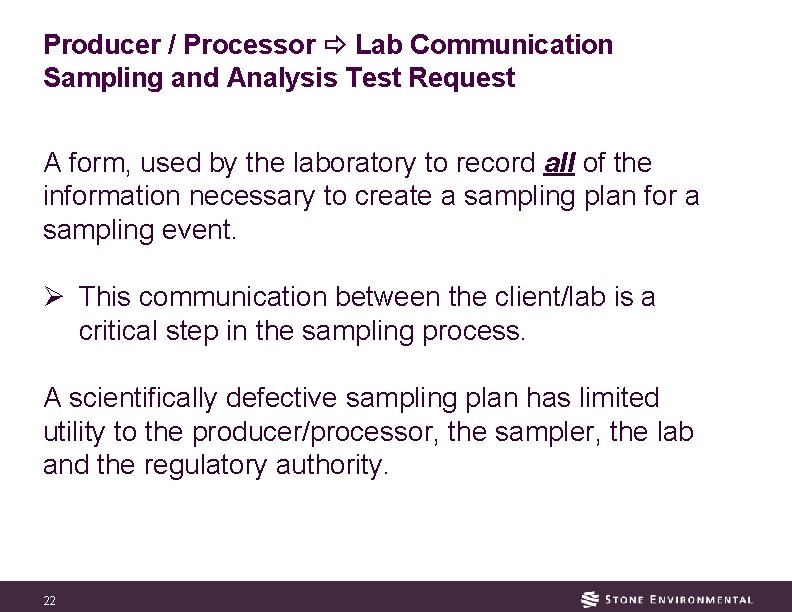
Producer / Processor Lab Communication Sampling and Analysis Test Request A form, used by the laboratory to record all of the information necessary to create a sampling plan for a sampling event. Ø This communication between the client/lab is a critical step in the sampling process. A scientifically defective sampling plan has limited utility to the producer/processor, the sampler, the lab and the regulatory authority. 22
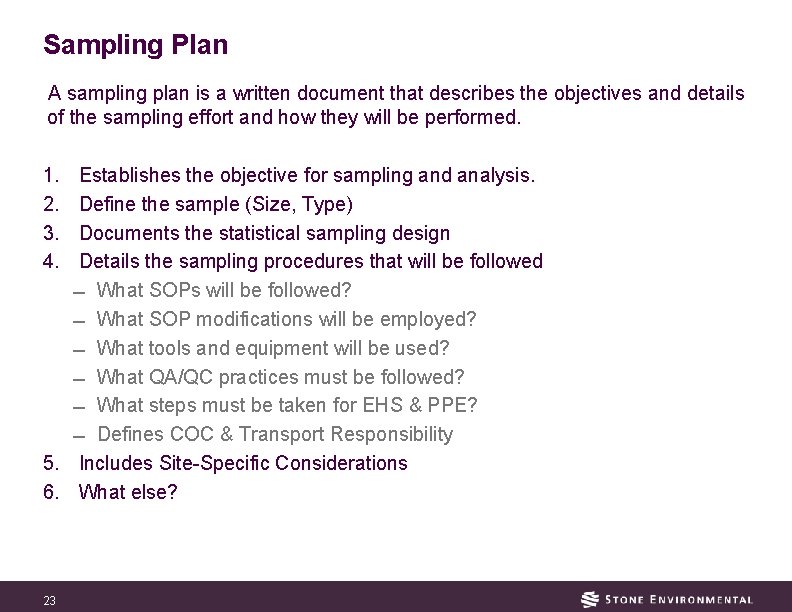
Sampling Plan A sampling plan is a written document that describes the objectives and details of the sampling effort and how they will be performed. 1. 2. 3. 4. Establishes the objective for sampling and analysis. Define the sample (Size, Type) Documents the statistical sampling design Details the sampling procedures that will be followed What SOPs will be followed? What SOP modifications will be employed? What tools and equipment will be used? What QA/QC practices must be followed? What steps must be taken for EHS & PPE? Defines COC & Transport Responsibility 5. Includes Site-Specific Considerations 6. What else? 23
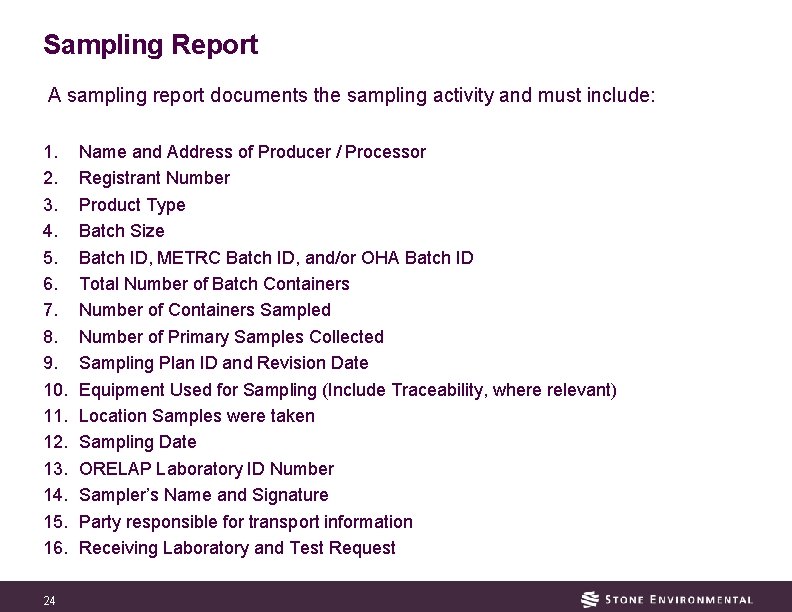
Sampling Report A sampling report documents the sampling activity and must include: 1. 2. 3. 4. 5. 6. 7. 8. 9. 10. 11. 12. 13. 14. 15. 16. 24 Name and Address of Producer / Processor Registrant Number Product Type Batch Size Batch ID, METRC Batch ID, and/or OHA Batch ID Total Number of Batch Containers Number of Containers Sampled Number of Primary Samples Collected Sampling Plan ID and Revision Date Equipment Used for Sampling (Include Traceability, where relevant) Location Samples were taken Sampling Date ORELAP Laboratory ID Number Sampler’s Name and Signature Party responsible for transport information Receiving Laboratory and Test Request
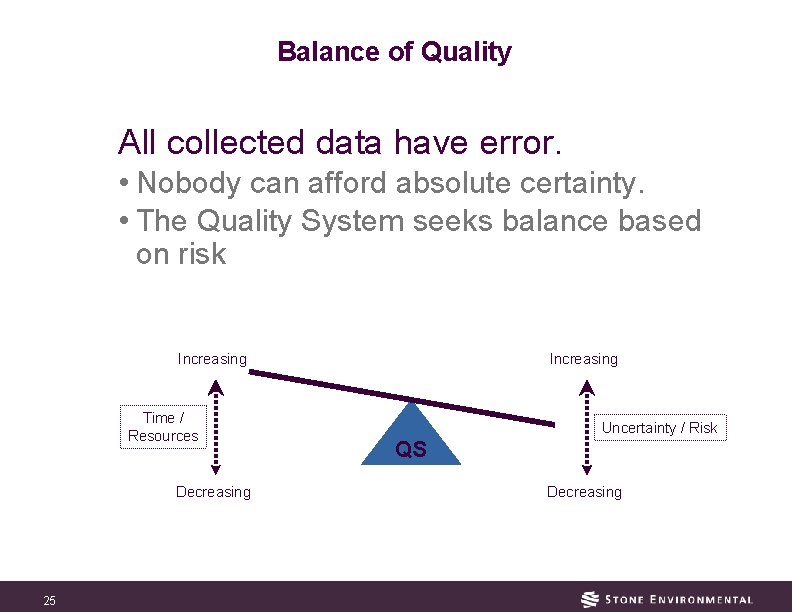
Balance of Quality All collected data have error. • Nobody can afford absolute certainty. • The Quality System seeks balance based on risk Increasing Time / Resources Decreasing 25 Increasing Uncertainty / Risk QS Decreasing
Laboratory and Field Quality Systems: Not to be Confused with an SOP Laboratory Quality Systems Manual Policy Not Procedure-Establishes policy for laboratory activities including sampling and analysis practices. Root Cause and Correction Action KISS Orientation of Employees Share the Knowledge Standard Operation Procedure - SOP • Step wise documents that explain how to carry out a policy or procedure. The QSM describes the laboratory and emphasizes management commitment to develop policy, procedures and resources necessary to generate reliable, defensible data. 26
Acknowledgements/References SW 846 Chapter 9 Method 8260; Residual Solvents www. epa. gov/epawaste/hazard/testmetho ds/sw 846/online/index. htm https: //public. health. oregon. gov/Laboratory MA Cannabis Protocol final-revised-mdph. Services/Environmental. Laboratory. Accredita mmj-mips-protocol. pdf tion/Pages/rules. aspx Title: Protocol for Sampling and Analysis of Finished Medical Marijuana Products and Marijuana-Infused Products for Massachusetts Registered ORELAP – SOPs Medical Marijuana Dispensaries • ORELAP-SOP-001 R 2 – Protocol for Collecting Samples for Usable Marijuana ITRC (Interstate Technology & Regulatory • ORELAP-SOP-002 R 3 – Protocol for Council). 2012. Incremental Sampling Collecting Samples of Cannabis Methodology. ISM-1. Washington, D. C. : Concentrates, Extracts and Products Interstate Technology & Regulatory Council, Incremental Sampling Methodology Team. www. itrcweb. org. 27
Thank you. For more information / www. stone-env. com Contact / kwatson@stone-env. com 28
- Slides: 28