
Representative alkyne addition mechanisms ones you should know
- Slides: 12
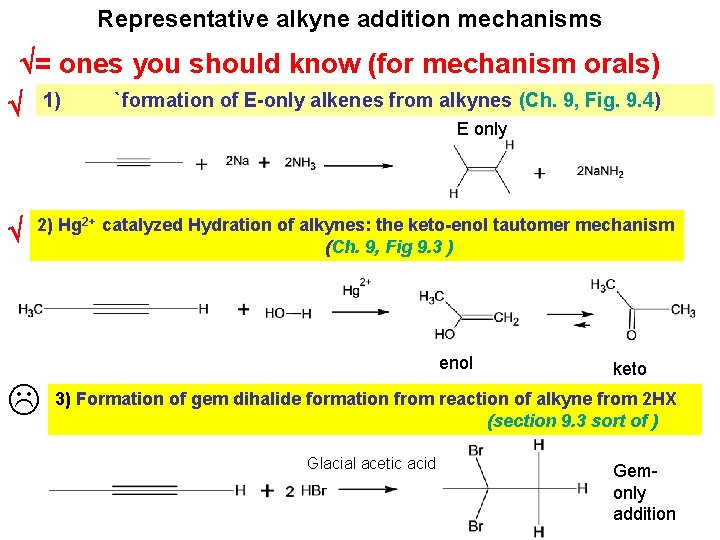
Representative alkyne addition mechanisms = ones you should know (for mechanism orals) 1) `formation of E-only alkenes from alkynes (Ch. 9, Fig. 9. 4) E only 2) Hg 2+ catalyzed Hydration of alkynes: the keto-enol tautomer mechanism (Ch. 9, Fig 9. 3 ) enol keto 3) Formation of gem dihalide formation from reaction of alkyne from 2 HX (section 9. 3 sort of ) Glacial acetic acid Gemonly addition
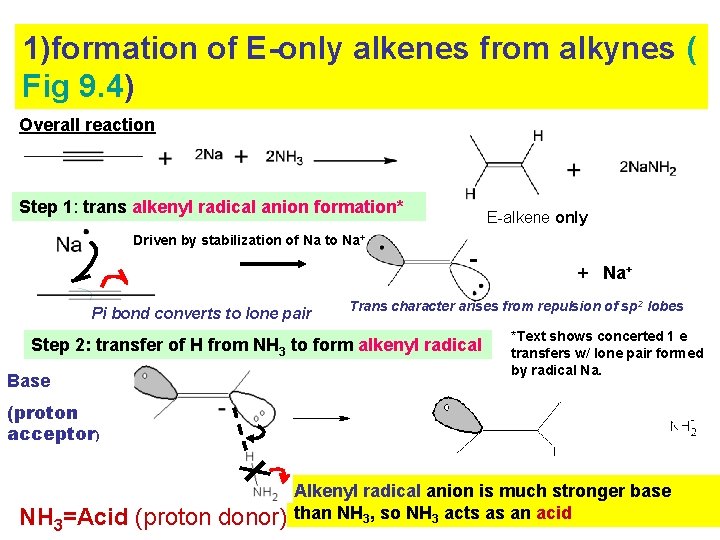
1)formation of E-only alkenes from alkynes ( Fig 9. 4) Overall reaction Step 1: trans alkenyl radical anion formation* Driven by stabilization of Na to Na+ Pi bond converts to lone pair E-alkene only - Trans character arises from repulsion of sp 2 lobes Step 2: transfer of H from NH 3 to form alkenyl radical Base + Na+ *Text shows concerted 1 e transfers w/ lone pair formed by radical Na. (proton acceptor) NH 3=Acid (proton donor) Alkenyl radical anion is much stronger base than NH 3, so NH 3 acts as an acid
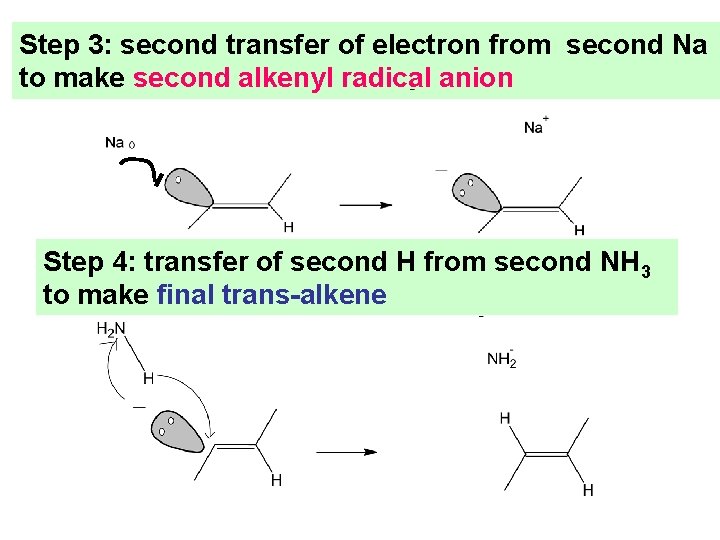
Step 3: second transfer of electron from second Na to make second alkenyl radical anion Step 4: transfer of second H from second NH 3 to make final trans-alkene
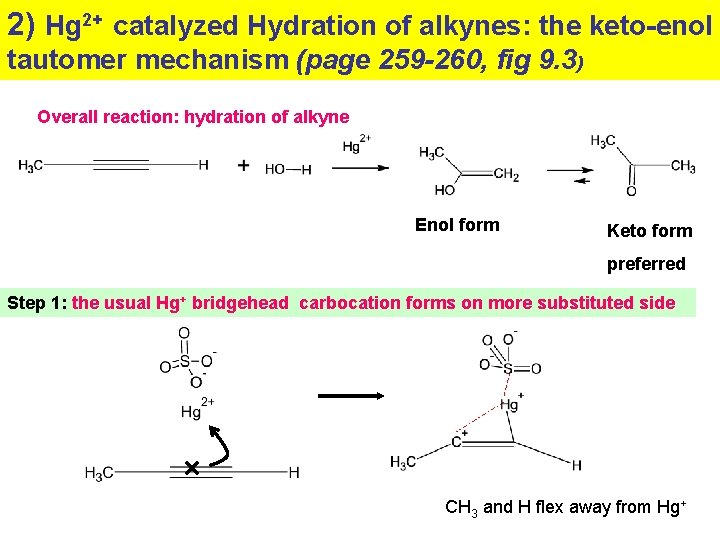
2) Hg 2+ catalyzed Hydration of alkynes: the keto-enol tautomer mechanism (page 259 -260, fig 9. 3) Overall reaction: hydration of alkyne Enol form Keto form preferred Step 1: the usual Hg+ bridgehead carbocation forms on more substituted side CH 3 and H flex away from Hg+
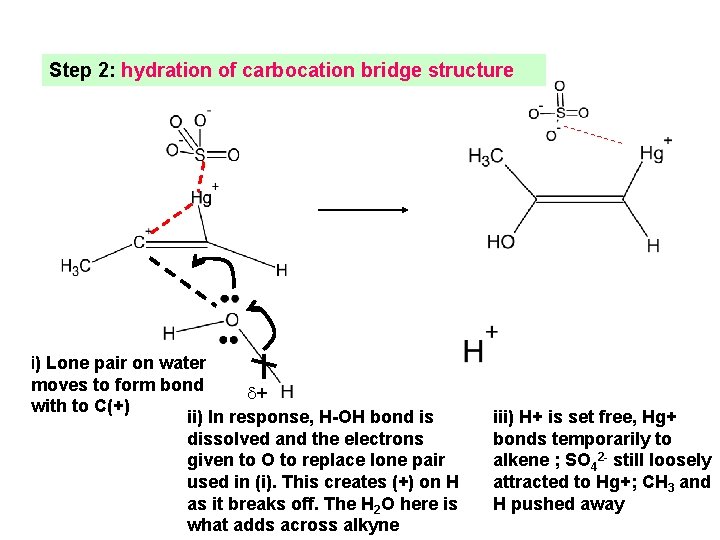
Step 2: hydration of carbocation bridge structure i) Lone pair on water moves to form bond + with to C(+) ii) In response, H-OH bond is dissolved and the electrons given to O to replace lone pair used in (i). This creates (+) on H as it breaks off. The H 2 O here is what adds across alkyne iii) H+ is set free, Hg+ bonds temporarily to alkene ; SO 42 - still loosely attracted to Hg+; CH 3 and H pushed away
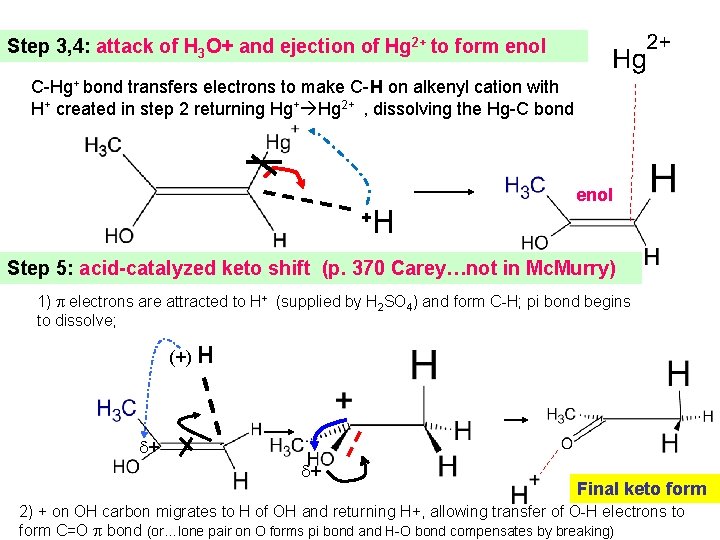
Step 3, 4: attack of H 3 O+ and ejection of Hg 2+ to form enol C-Hg+ bond transfers electrons to make C-H on alkenyl cation with H+ created in step 2 returning Hg+ Hg 2+ , dissolving the Hg-C bond + H enol Step 5: acid-catalyzed keto shift (p. 370 Carey…not in Mc. Murry) 1) electrons are attracted to H+ (supplied by H 2 SO 4) and form C-H; pi bond begins to dissolve; (+) H + + Final keto form 2) + on OH carbon migrates to H of OH and returning H+, allowing transfer of O-H electrons to form C=O bond (or…lone pair on O forms pi bond and H-O bond compensates by breaking)
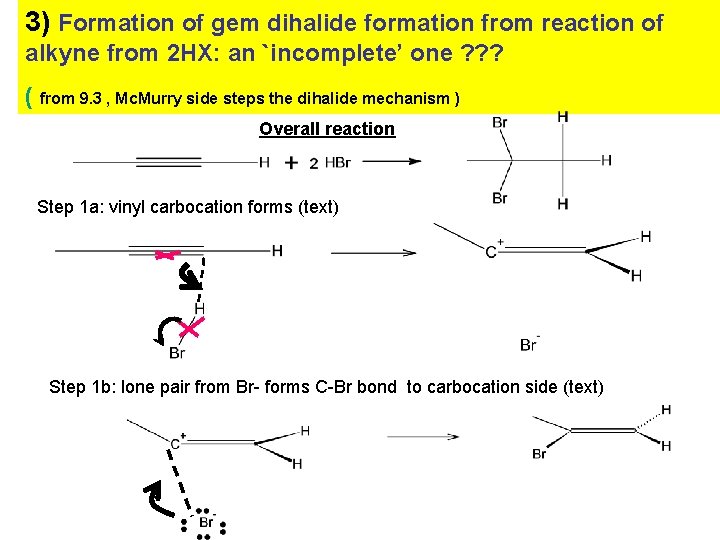
3) Formation of gem dihalide formation from reaction of alkyne from 2 HX: an `incomplete’ one ? ? ? ( from 9. 3 , Mc. Murry side steps the dihalide mechanism ) Overall reaction Step 1 a: vinyl carbocation forms (text) Step 1 b: lone pair from Br- forms C-Br bond to carbocation side (text)
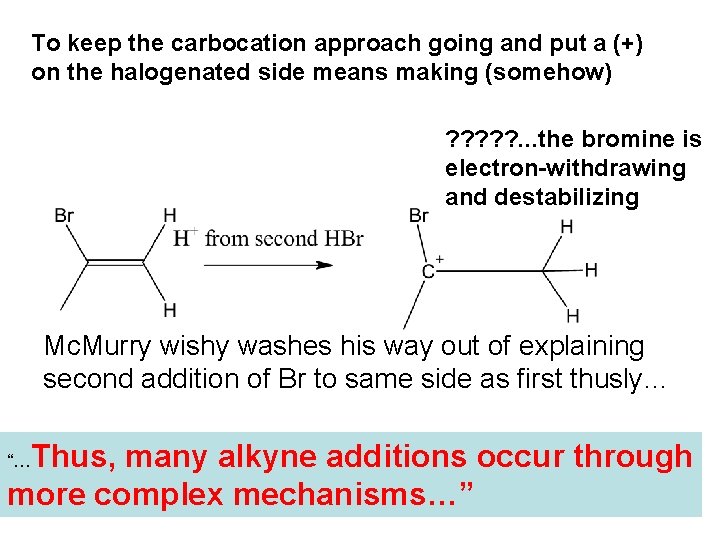
To keep the carbocation approach going and put a (+) on the halogenated side means making (somehow) ? ? ? . . . the bromine is electron-withdrawing and destabilizing Mc. Murry wishy washes his way out of explaining second addition of Br to same side as first thusly… Thus, many alkyne additions occur through more complex mechanisms…” “…
For Organic `sickos…’ can look at a more definitive and alternative mechanism of gem-dihalide formation on next two slides… (Carey proposes an unusual double termolecular route…. )
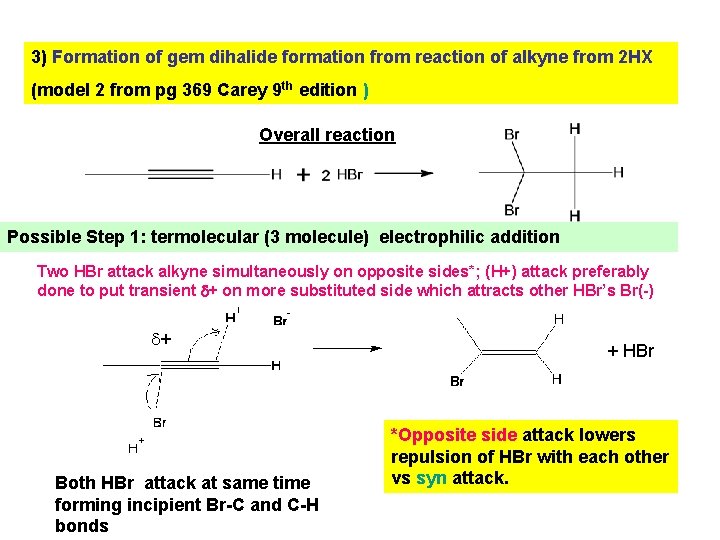
3) Formation of gem dihalide formation from reaction of alkyne from 2 HX (model 2 from pg 369 Carey 9 th edition ) Overall reaction Possible Step 1: termolecular (3 molecule) electrophilic addition Two HBr attack alkyne simultaneously on opposite sides*; (H+) attack preferably done to put transient + on more substituted side which attracts other HBr’s Br(-) + Both HBr attack at same time forming incipient Br-C and C-H bonds + HBr *Opposite side attack lowers repulsion of HBr with each other vs syn attack.
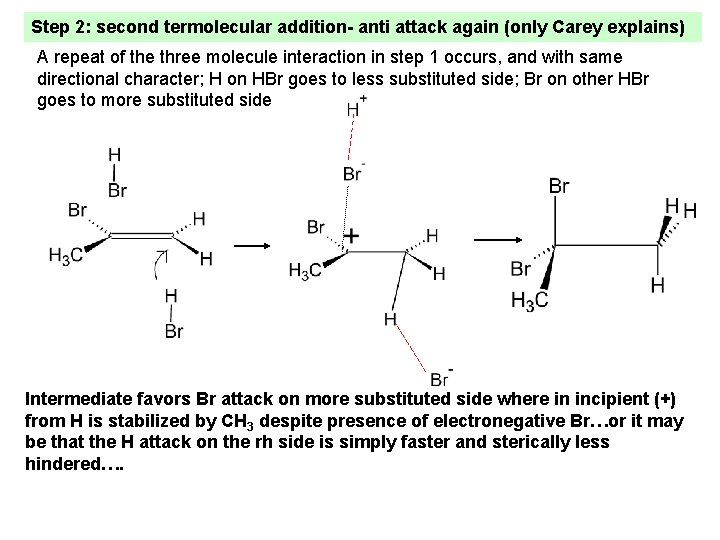
Step 2: second termolecular addition- anti attack again (only Carey explains) A repeat of the three molecule interaction in step 1 occurs, and with same directional character; H on HBr goes to less substituted side; Br on other HBr goes to more substituted side Intermediate favors Br attack on more substituted side where in incipient (+) from H is stabilized by CH 3 despite presence of electronegative Br…or it may be that the H attack on the rh side is simply faster and sterically less hindered….
1)`formation of E-only alkenes from alkynes(Fig. 9. 4) 2) Hg 2+ catalyzed Hydration of alkynes: the ketoenol tautomer mechanism (Fig 9. 3 ) Know these mechanisms, maggots !