
Representational State Transfer REST Representing Information in Web

Representational State Transfer (REST): Representing Information in Web 2. 0 Applications Emilio F Zegarra CS 2650
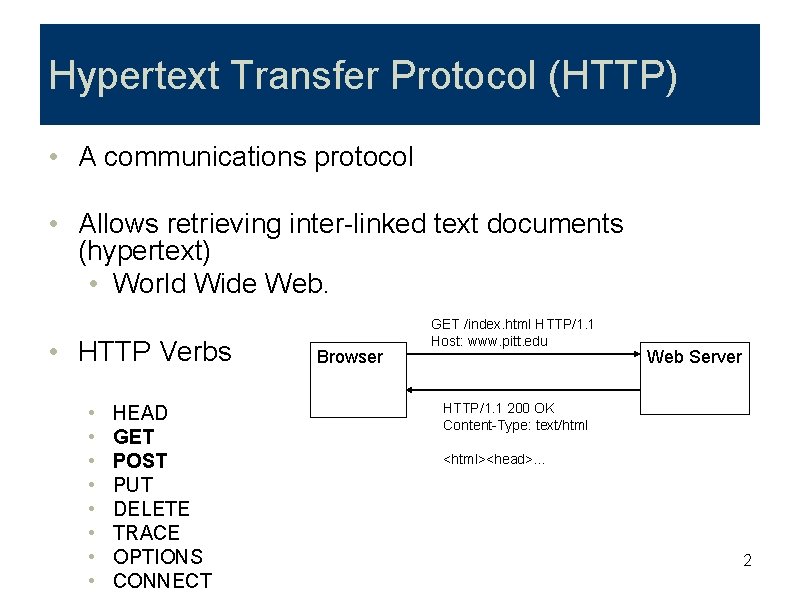
Hypertext Transfer Protocol (HTTP) • A communications protocol • Allows retrieving inter-linked text documents (hypertext) • World Wide Web. • HTTP Verbs • • HEAD GET POST PUT DELETE TRACE OPTIONS CONNECT Browser GET /index. html HTTP/1. 1 Host: www. pitt. edu Web Server HTTP/1. 1 200 OK Content-Type: text/html <html><head>… 2

Representational State Transfer (REST) • A style of software architecture for distributed hypermedia systems such as the World Wide Web. • Introduced in the doctoral dissertation of Roy Fielding • One of the principal authors of the HTTP specification. • A collection of network architecture principles which outline how resources are defined and addressed 3
REST and HTTP • The motivation for REST was to capture the characteristics of the Web which made the Web successful. • URI Addressable resources • HTTP Protocol • Make a Request – Receive Response – Display Response • Exploits the use of the HTTP protocol beyond HTTP POST and HTTP GET • HTTP PUT, HTTP DELETE 4
REST - not a Standard • REST is not a standard • JSR 311: JAX-RS: The Java. TM API for RESTful Web Services • But it uses several standards: • • HTTP URL XML/HTML/GIF/JPEG/etc (Resource Representations) text/xml, text/html, image/gif, image/jpeg, etc (Resource Types, MIME Types) 5
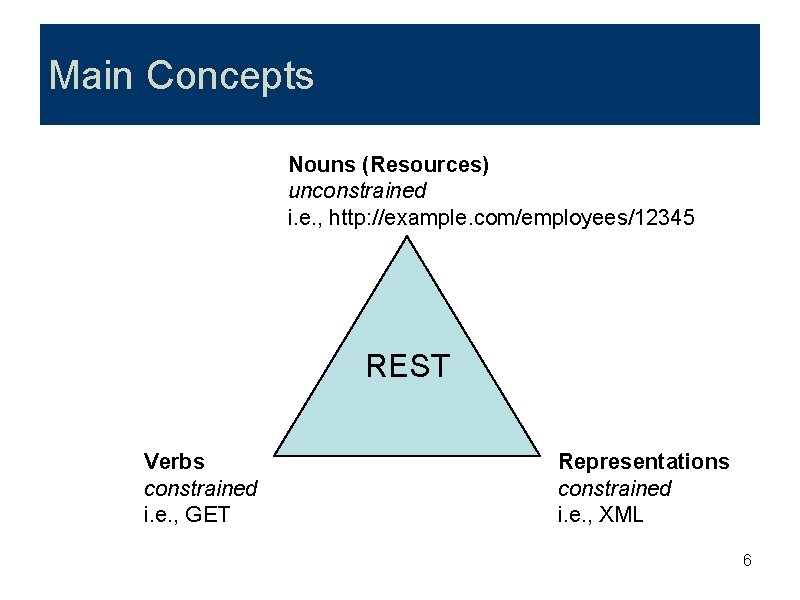
Main Concepts Nouns (Resources) unconstrained i. e. , http: //example. com/employees/12345 REST Verbs constrained i. e. , GET Representations constrained i. e. , XML 6
Resources • The key abstraction of information in REST is a resource. • A resource is a conceptual mapping to a set of entities • Any information that can be named can be a resource: a document or image, a temporal service (e. g. "today's weather in Los Angeles"), a collection of other resources, a non-virtual object (e. g. a person), and so on • Represented with a global identifier (URI in HTTP) • http: //www. boeing. com/aircraft/747 7
Naming Resources • REST uses URI to identify resources • http: //localhost/books/ISBN-0011/authors • http: //localhost/classes/cs 2650/students • As you traverse the path from more generic to more specific, you are navigating the data 8
Verbs • Represent the actions to be performed on resources • • HTTP GET HTTP POST HTTP PUT HTTP DELETE 9
HTTP GET • How clients ask for the information they seek. • Issuing a GET request transfers the data from the server to the client in some representation • GET http: //localhost/books • Retrieve all books • GET http: //localhost/books/ISBN-0011021 • Retrieve book identified with ISBN-0011021 • GET http: //localhost/books/ISBN-0011021/authors • Retrieve authors for book identified with ISBN-0011021 10
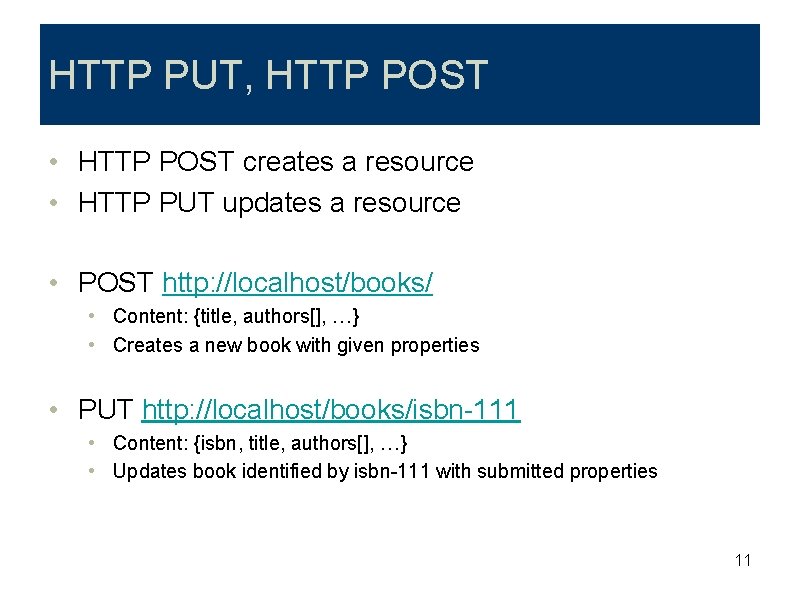
HTTP PUT, HTTP POST • HTTP POST creates a resource • HTTP PUT updates a resource • POST http: //localhost/books/ • Content: {title, authors[], …} • Creates a new book with given properties • PUT http: //localhost/books/isbn-111 • Content: {isbn, title, authors[], …} • Updates book identified by isbn-111 with submitted properties 11
HTTP DELETE • Removes the resource identified by the URI • DELETE http: //localhost/books/ISBN-0011 • Delete book identified by ISBN-0011 12
Representations • How data is represented or returned to the client for presentation. • Two main formats: • Java. Script Object Notation (JSON) • XML • It is common to have multiple representations of the same data 13
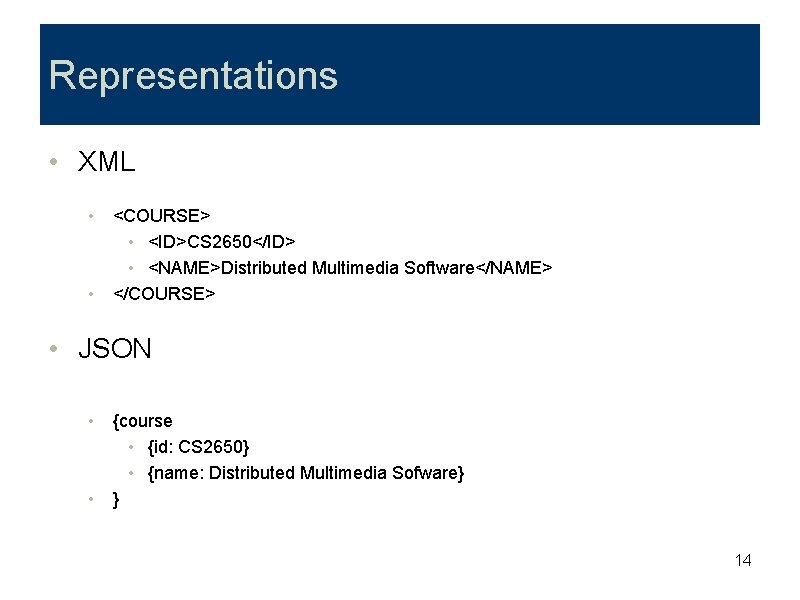
Representations • XML • • <COURSE> • <ID>CS 2650</ID> • <NAME>Distributed Multimedia Software</NAME> </COURSE> • JSON • • {course • {id: CS 2650} • {name: Distributed Multimedia Sofware} } 14
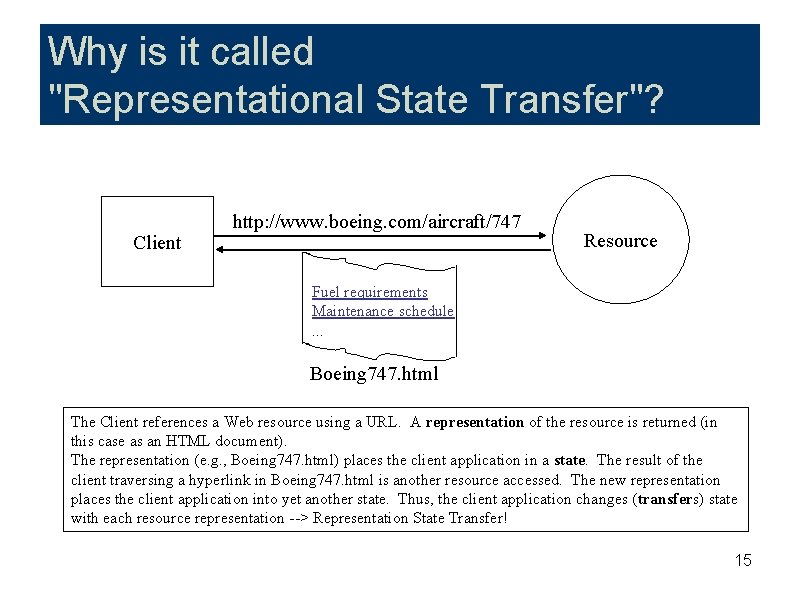
Why is it called "Representational State Transfer"? Client http: //www. boeing. com/aircraft/747 Resource Fuel requirements Maintenance schedule. . . Boeing 747. html The Client references a Web resource using a URL. A representation of the resource is returned (in this case as an HTML document). The representation (e. g. , Boeing 747. html) places the client application in a state. The result of the client traversing a hyperlink in Boeing 747. html is another resource accessed. The new representation places the client application into yet another state. Thus, the client application changes (transfers) state with each resource representation --> Representation State Transfer! 15
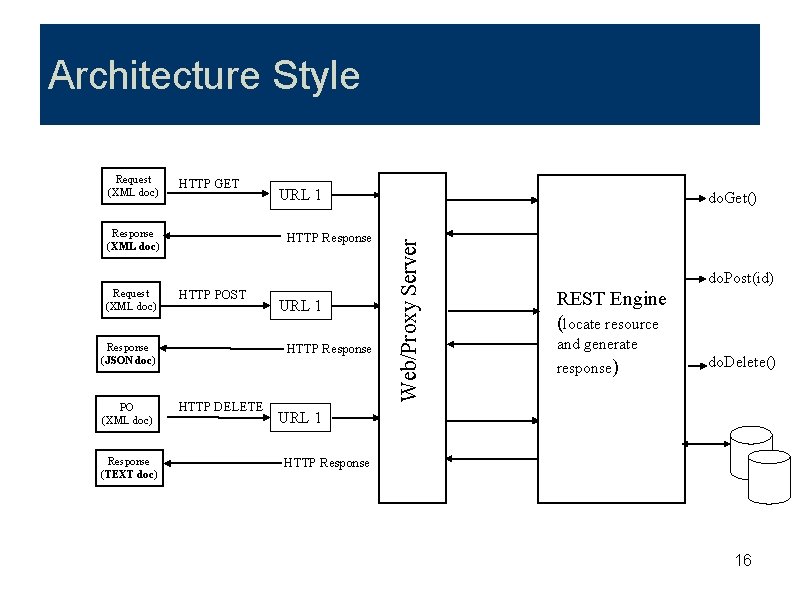
Architecture Style HTTP GET Response (XML doc) Request (XML doc) HTTP Response HTTP POST Response (JSON doc) PO (XML doc) Response (TEXT doc) URL 1 HTTP Response HTTP DELETE do. Get() Web/Proxy Server Request (XML doc) do. Post(id) REST Engine (locate resource and generate response) do. Delete() URL 1 HTTP Response 16

Real Life Examples • Google Maps • Google AJAX Search API • Yahoo Search API • Amazon Web. Services 17
REST and the Web • The Web is an example of a REST system! • All of those Web services that you have been using all these many years - book ordering services, search services, online dictionary services, etc - are RESTbased Web services. • Alas, you have been using REST, building REST services and you didn't even know it. 18
REST Implementations • Restlet • http: //www. restlet. org/ • Project Zero • http: //www. projectzero. org • Glass. Fish Jersey • https: //jersey. dev. java. net/ • JBoss RESTeasy • http: //www. jboss. org/resteasy/ 19
My Project - Web 2. 0 IC Card • Objective • Transform the IC Card Application to support REST resources • http: //www. cs. pitt. edu/icms/iccards/001 • http: //www. cs. pitt. edu/icms/groups/1/users 20
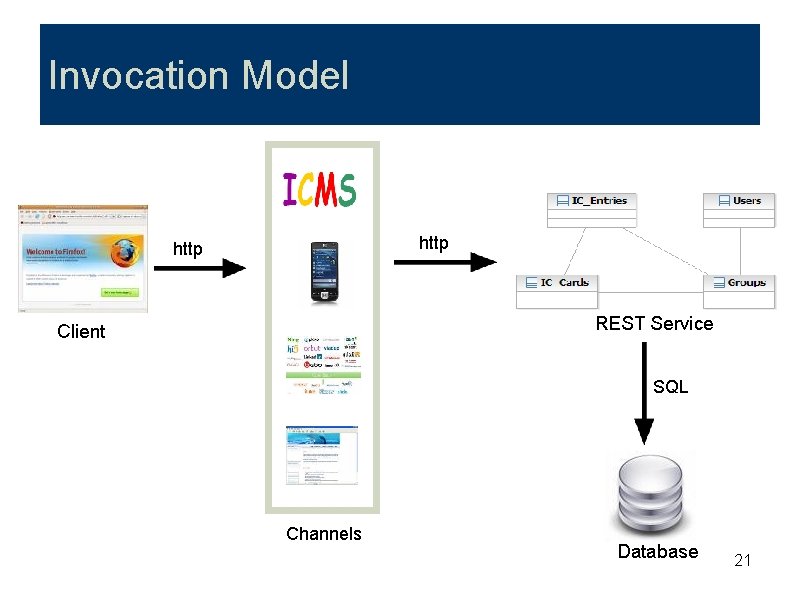
Invocation Model http REST Service Client SQL Channels Database 21
Tasks • Design a REST resource model for the IC Card • Review persistent model (My. Sql) • Configure a REST engine (Project Zero) • Create a new Rich User Interface (DOJO Toolkit) 22

References • Representational State Transfer http: //en. wikipedia. org/wiki/Representational_State_Tr ansfer • Roy Fieldings Thesis http: //www. ics. uci. edu/~fielding/pubs/dissertation/top. h tm 23
- Slides: 23