
Representation of molecular structures A hierarchy of structure
- Slides: 89
Representation of molecular structures
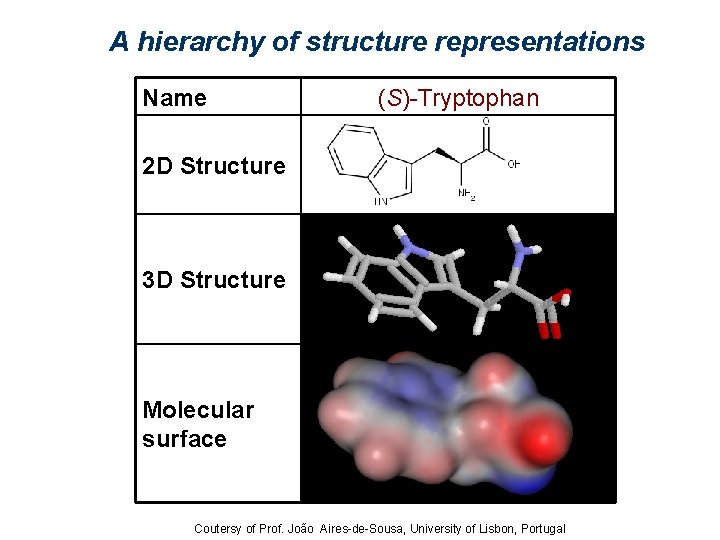
A hierarchy of structure representations Name (S)-Tryptophan 2 D Structure 3 D Structure Molecular surface Coutersy of Prof. João Aires-de-Sousa, University of Lisbon, Portugal
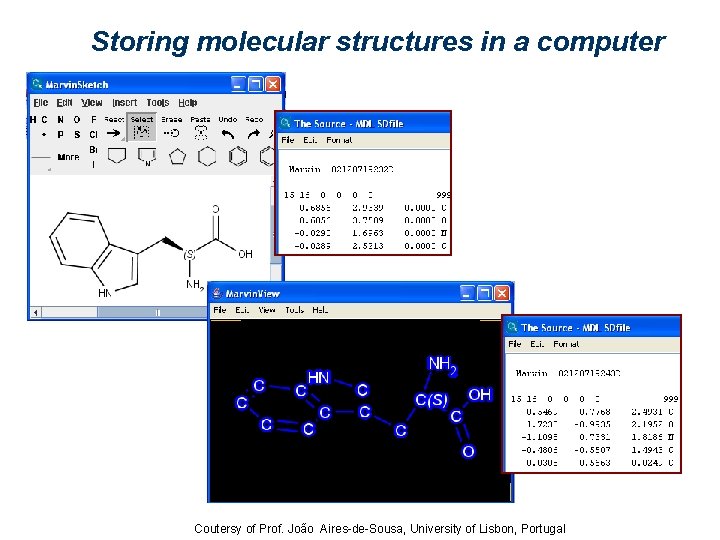
Storing molecular structures in a computer Coutersy of Prof. João Aires-de-Sousa, University of Lisbon, Portugal
Storing molecular structures in a computer § Information must be coded into interconvertible formats that can be read by software applications. § Applications: visualization, communication, database searching / management, establishment of structure-property relationships, estimation of properties, … Coutersy of Prof. João Aires-de-Sousa, University of Lisbon, Portugal
Coding molecular structures • A non-ambiguous representation identifies a single possible structure, e. g. the name ‘o-xylene’ represents one and only one possible structure. • A representation is unique if any structure has only one possible representation (some nomenclature isn’t, e. g. ‘ 1, 2 -dimethylbenzene’ and ‘o-xylene’ represent the same structure).
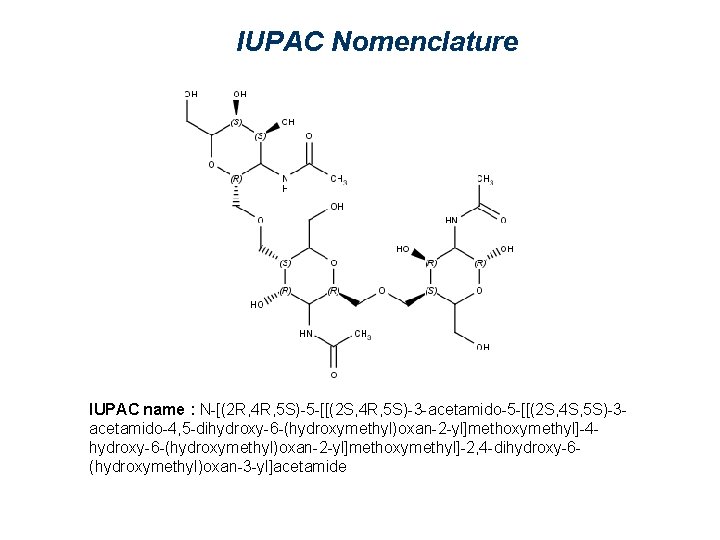
IUPAC Nomenclature IUPAC name : N-[(2 R, 4 R, 5 S)-5 -[[(2 S, 4 R, 5 S)-3 -acetamido-5 -[[(2 S, 4 S, 5 S)-3 acetamido-4, 5 -dihydroxy-6 -(hydroxymethyl)oxan-2 -yl]methoxymethyl]-4 hydroxy-6 -(hydroxymethyl)oxan-2 -yl]methoxymethyl]-2, 4 -dihydroxy-6(hydroxymethyl)oxan-3 -yl]acetamide
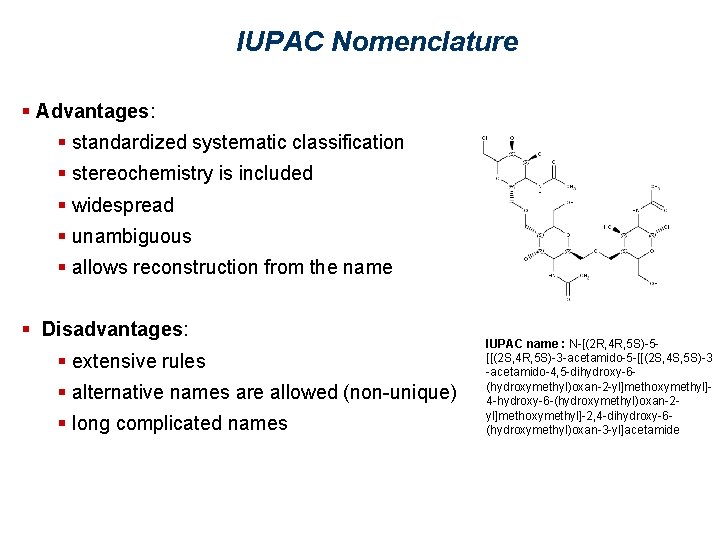
IUPAC Nomenclature § Advantages: § standardized systematic classification § stereochemistry is included § widespread § unambiguous § allows reconstruction from the name § Disadvantages: § extensive rules § alternative names are allowed (non-unique) § long complicated names IUPAC name : N-[(2 R, 4 R, 5 S)-5[[(2 S, 4 R, 5 S)-3 -acetamido-5 -[[(2 S, 4 S, 5 S)-3 -acetamido-4, 5 -dihydroxy-6(hydroxymethyl)oxan-2 -yl]methoxymethyl]4 -hydroxy-6 -(hydroxymethyl)oxan-2 yl]methoxymethyl]-2, 4 -dihydroxy-6(hydroxymethyl)oxan-3 -yl]acetamide
Linear notations Represent structures by linear sequences of letters and numbers, e. g. IUPAC nomenclature. Linear notations can be extremely compact, which is an advantage for the storage of structures in a computer (particularly when disk space is limited). Linear notations allow for an easy transmission of structures, e. g. in a Google-type search, or in an email.
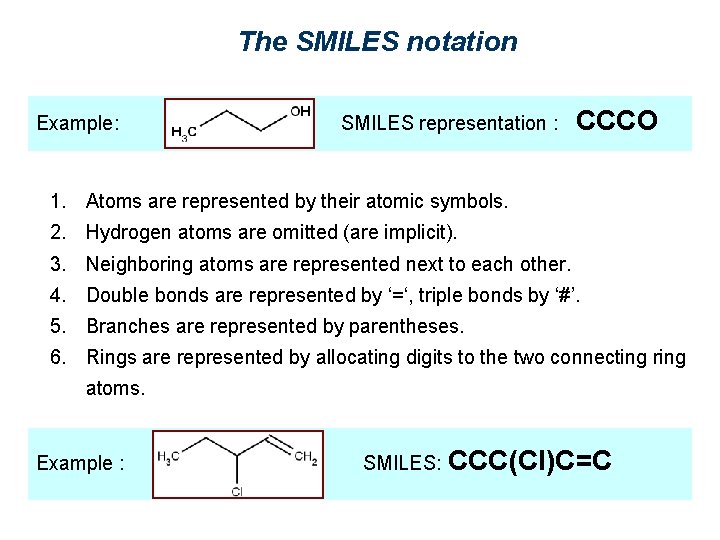
The SMILES notation Example: SMILES representation : CCCO 1. Atoms are represented by their atomic symbols. 2. Hydrogen atoms are omitted (are implicit). 3. Neighboring atoms are represented next to each other. 4. Double bonds are represented by ‘=‘, triple bonds by ‘#’. 5. Branches are represented by parentheses. 6. Rings are represented by allocating digits to the two connecting ring atoms. Example : SMILES: CCC(Cl)C=C
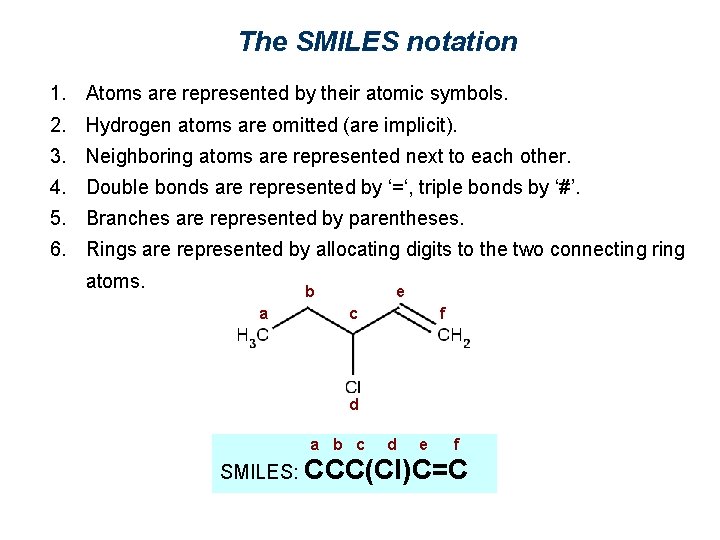
The SMILES notation 1. Atoms are represented by their atomic symbols. 2. Hydrogen atoms are omitted (are implicit). 3. Neighboring atoms are represented next to each other. 4. Double bonds are represented by ‘=‘, triple bonds by ‘#’. 5. Branches are represented by parentheses. 6. Rings are represented by allocating digits to the two connecting ring atoms. b a e c f d a b c d e f SMILES: CCC(Cl)C=C
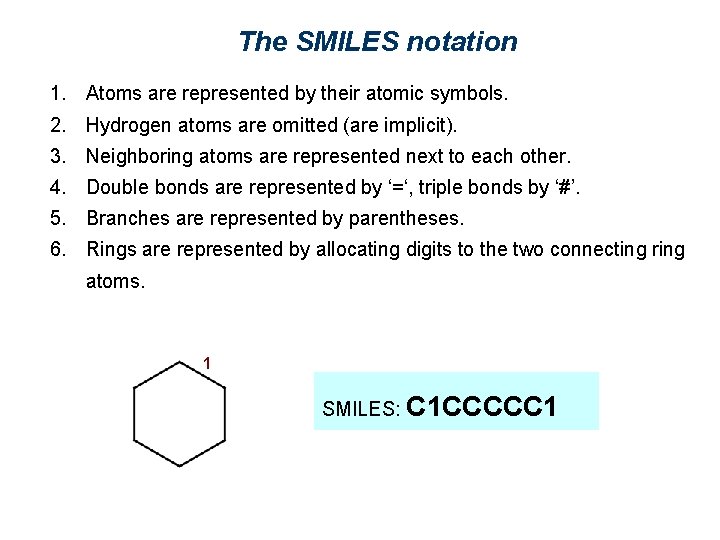
The SMILES notation 1. Atoms are represented by their atomic symbols. 2. Hydrogen atoms are omitted (are implicit). 3. Neighboring atoms are represented next to each other. 4. Double bonds are represented by ‘=‘, triple bonds by ‘#’. 5. Branches are represented by parentheses. 6. Rings are represented by allocating digits to the two connecting ring atoms. 1 SMILES: C 1 CCCCC 1
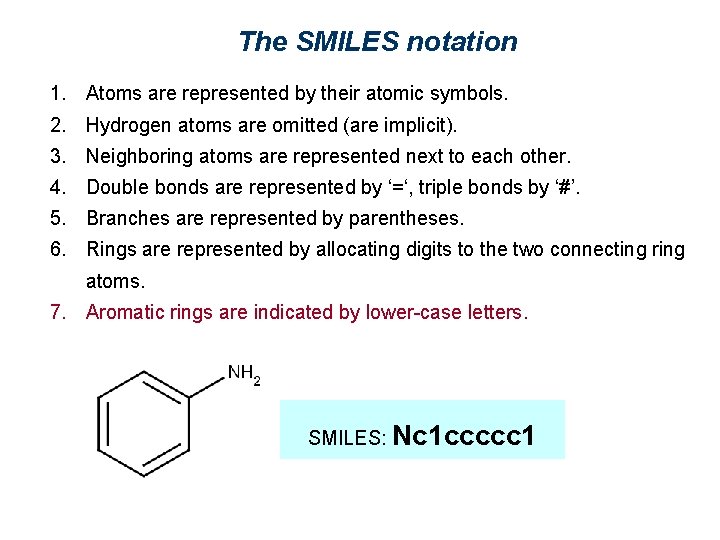
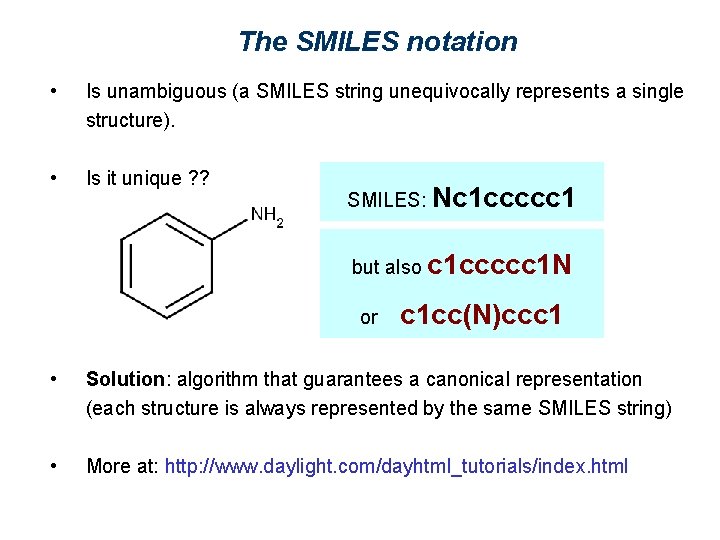
The SMILES notation 1. Atoms are represented by their atomic symbols. 2. Hydrogen atoms are omitted (are implicit). 3. Neighboring atoms are represented next to each other. 4. Double bonds are represented by ‘=‘, triple bonds by ‘#’. 5. Branches are represented by parentheses. 6. Rings are represented by allocating digits to the two connecting ring atoms. 7. Aromatic rings are indicated by lower-case letters. SMILES: Nc 1 ccccc 1
The SMILES notation • Is unambiguous (a SMILES string unequivocally represents a single structure). • Is it unique ? ? SMILES: Nc 1 ccccc 1 but also c 1 ccccc 1 N or c 1 cc(N)ccc 1 • Solution: algorithm that guarantees a canonical representation (each structure is always represented by the same SMILES string) • More at: http: //www. daylight. com/dayhtml_tutorials/index. html
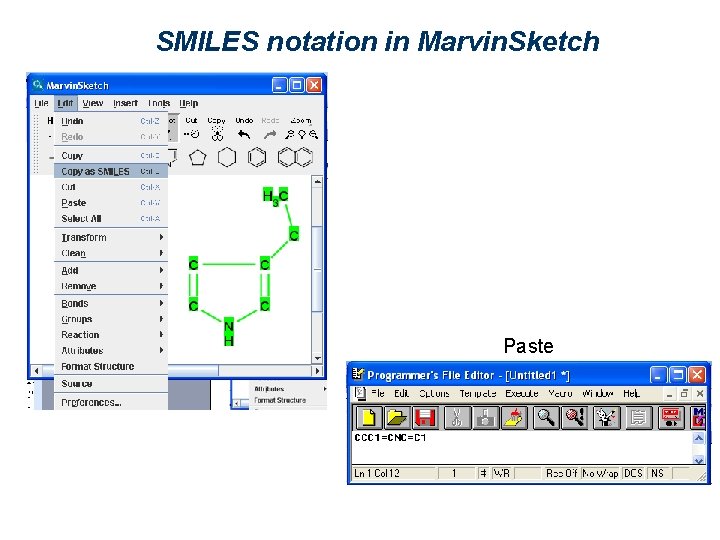
SMILES notation in Marvin. Sketch Paste
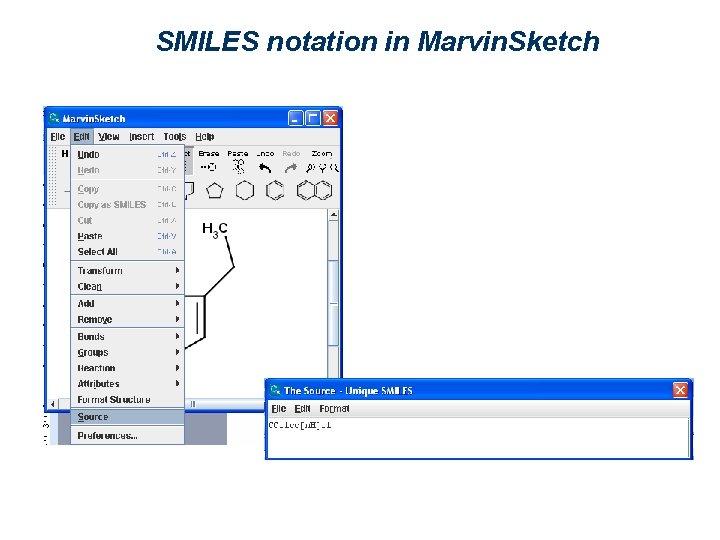
SMILES notation in Marvin. Sketch
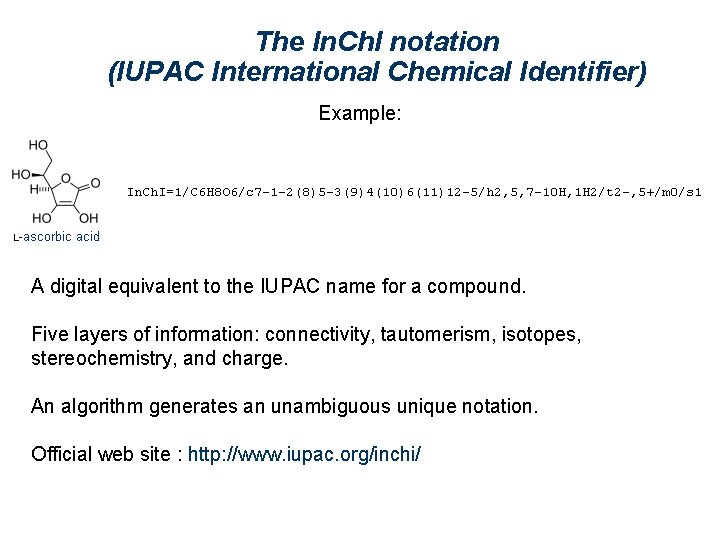
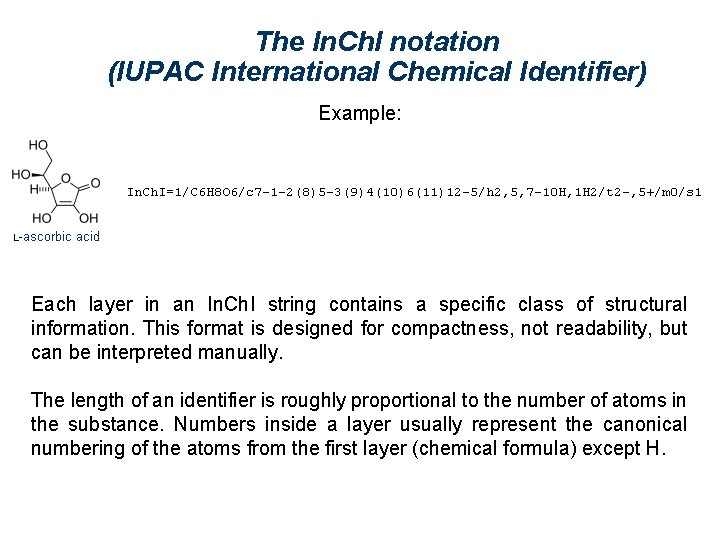
The In. Ch. I notation (IUPAC International Chemical Identifier) Example: A digital equivalent to the IUPAC name for a compound. Five layers of information: connectivity, tautomerism, isotopes, stereochemistry, and charge. An algorithm generates an unambiguous unique notation. Official web site : http: //www. iupac. org/inchi/
The In. Ch. I notation (IUPAC International Chemical Identifier) Example: Each layer in an In. Ch. I string contains a specific class of structural information. This format is designed for compactness, not readability, but can be interpreted manually. The length of an identifier is roughly proportional to the number of atoms in the substance. Numbers inside a layer usually represent the canonical numbering of the atoms from the first layer (chemical formula) except H.
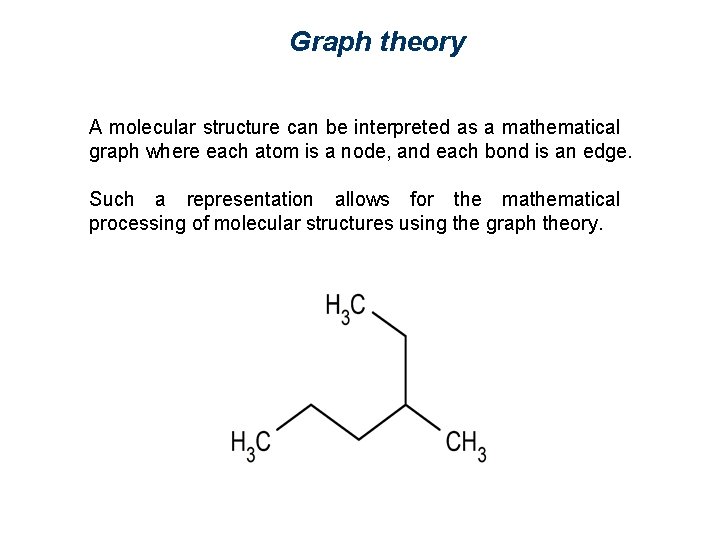
Graph theory A molecular structure can be interpreted as a mathematical graph where each atom is a node, and each bond is an edge. Such a representation allows for the mathematical processing of molecular structures using the graph theory.
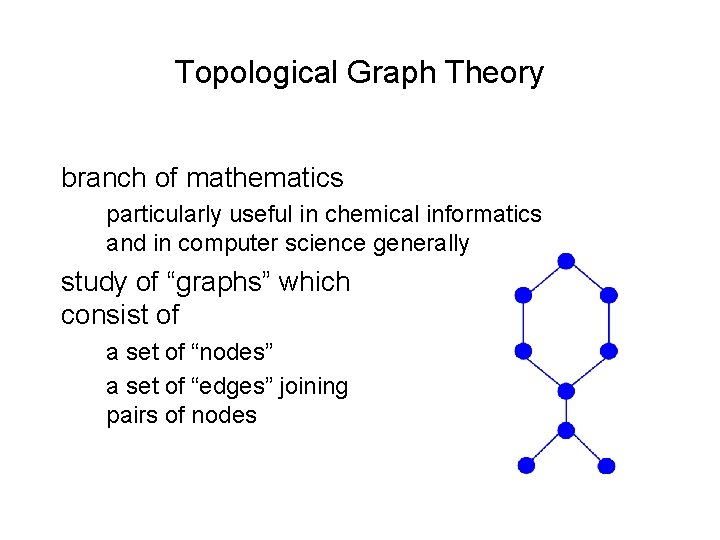
Topological Graph Theory branch of mathematics particularly useful in chemical informatics and in computer science generally study of “graphs” which consist of a set of “nodes” a set of “edges” joining pairs of nodes
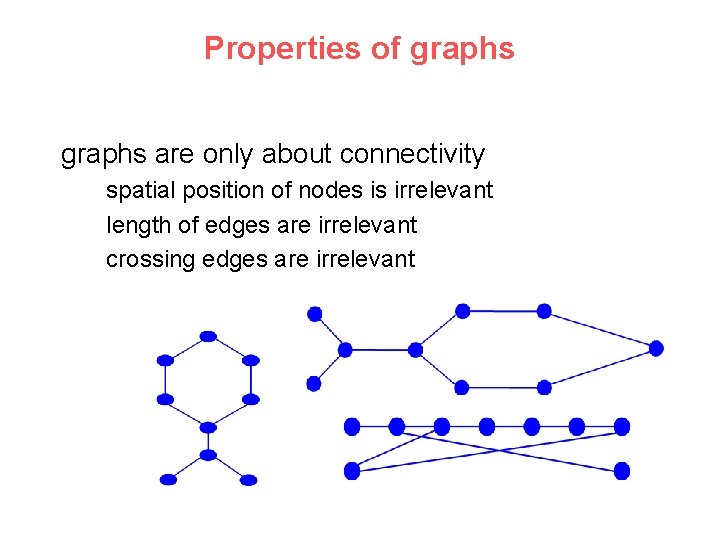
Properties of graphs are only about connectivity spatial position of nodes is irrelevant length of edges are irrelevant crossing edges are irrelevant
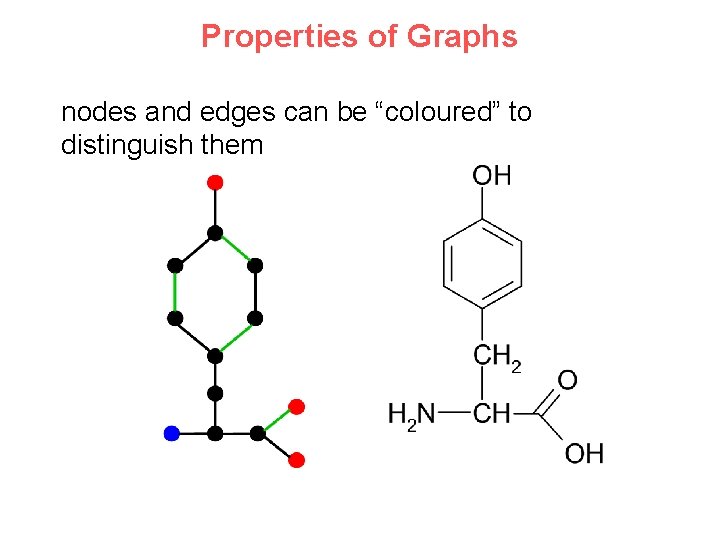
Properties of Graphs nodes and edges can be “coloured” to distinguish them
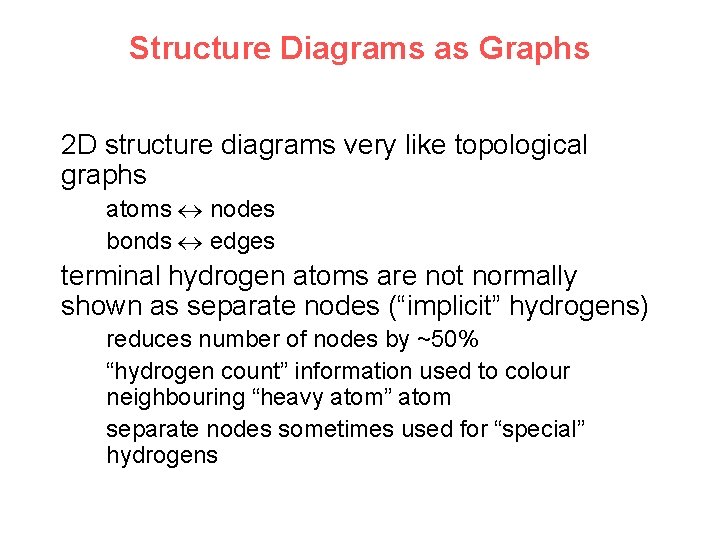
Structure Diagrams as Graphs 2 D structure diagrams very like topological graphs atoms nodes bonds edges terminal hydrogen atoms are not normally shown as separate nodes (“implicit” hydrogens) reduces number of nodes by ~50% “hydrogen count” information used to colour neighbouring “heavy atom” atom separate nodes sometimes used for “special” hydrogens • deuterium, tritium • hydrogen bonded to more than one other atom • hydrogens attached to stereocentres
Advantages of using graphs mathematical theory is well understood graphs can be easily represented in computers many useful algorithms are known identical graphs identical molecules different graphs different molecules
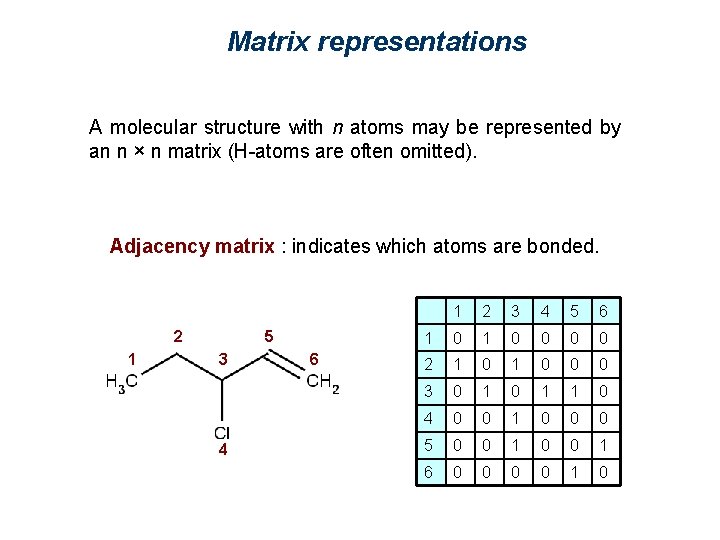
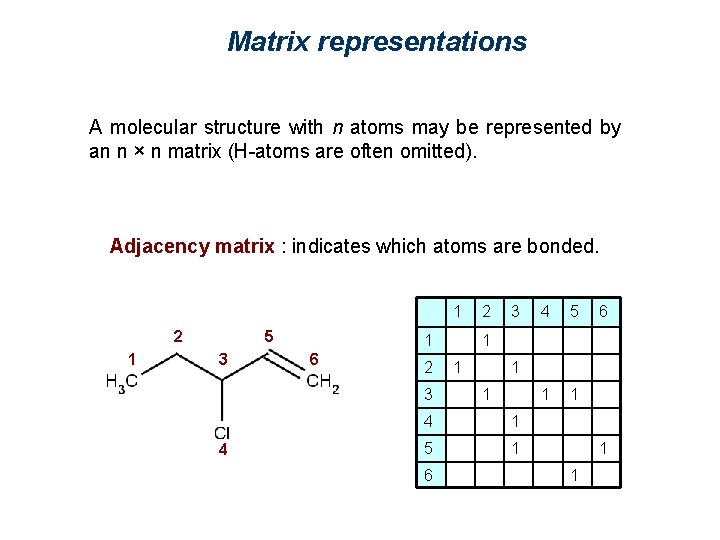
Matrix representations A molecular structure with n atoms may be represented by an n × n matrix (H-atoms are often omitted). Adjacency matrix : indicates which atoms are bonded. 2 1 5 3 4 6 1 2 3 4 5 6 1 0 0 0 0 2 1 0 0 0 3 0 1 1 0 4 0 0 1 0 0 0 5 0 0 1 6 0 0 1 0
Matrix representations A molecular structure with n atoms may be represented by an n × n matrix (H-atoms are often omitted). Adjacency matrix : indicates which atoms are bonded. 1 2 1 5 3 1 6 2 3 4 2 3 5 1 1 6 1 1 4 1 5 1 6 4 1 1
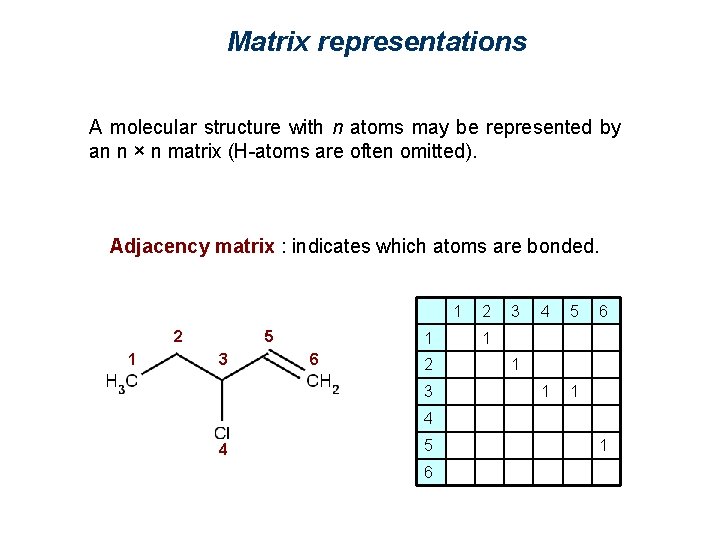
Matrix representations A molecular structure with n atoms may be represented by an n × n matrix (H-atoms are often omitted). Adjacency matrix : indicates which atoms are bonded. 1 2 1 5 3 1 6 2 3 4 5 1 1 6 1 1 4 4 5 6 1
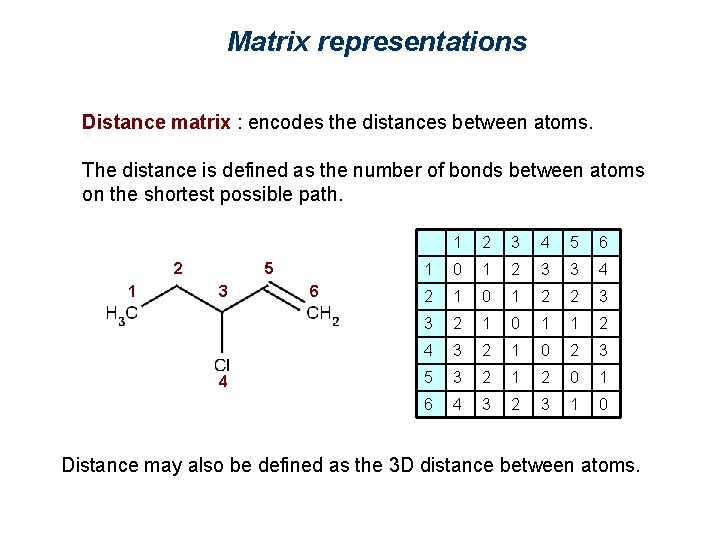
Matrix representations Distance matrix : encodes the distances between atoms. The distance is defined as the number of bonds between atoms on the shortest possible path. 2 1 5 3 4 6 1 2 3 4 5 6 1 0 1 2 3 3 4 2 1 0 1 2 2 3 3 2 1 0 1 1 2 4 3 2 1 0 2 3 5 3 2 1 2 0 1 6 4 3 2 3 1 0 Distance may also be defined as the 3 D distance between atoms.
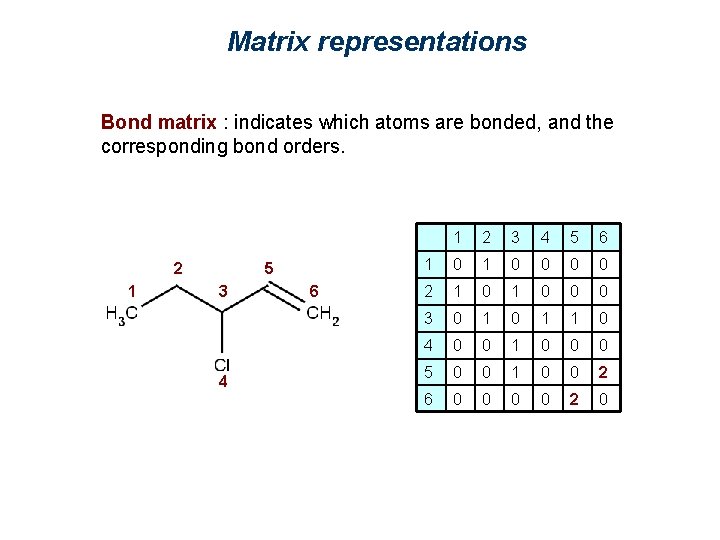
Matrix representations Bond matrix : indicates which atoms are bonded, and the corresponding bond orders. 2 1 5 3 4 6 1 2 3 4 5 6 1 0 0 0 0 2 1 0 0 0 3 0 1 1 0 4 0 0 1 0 0 0 5 0 0 1 0 0 2 6 0 0 2 0
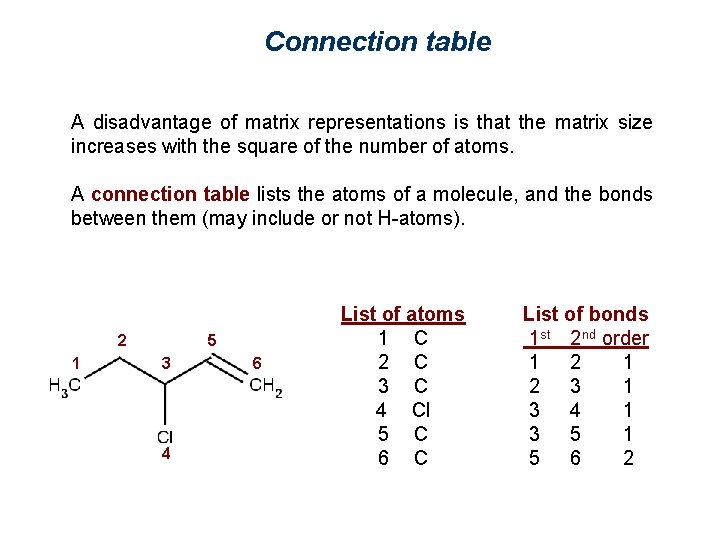
Connection table A disadvantage of matrix representations is that the matrix size increases with the square of the number of atoms. A connection table lists the atoms of a molecule, and the bonds between them (may include or not H-atoms). 2 1 5 3 4 6 List of atoms 1 C 2 C 3 C 4 Cl 5 C 6 C List of bonds 1 st 2 nd order 1 2 3 1 3 4 1 3 5 1 5 6 2
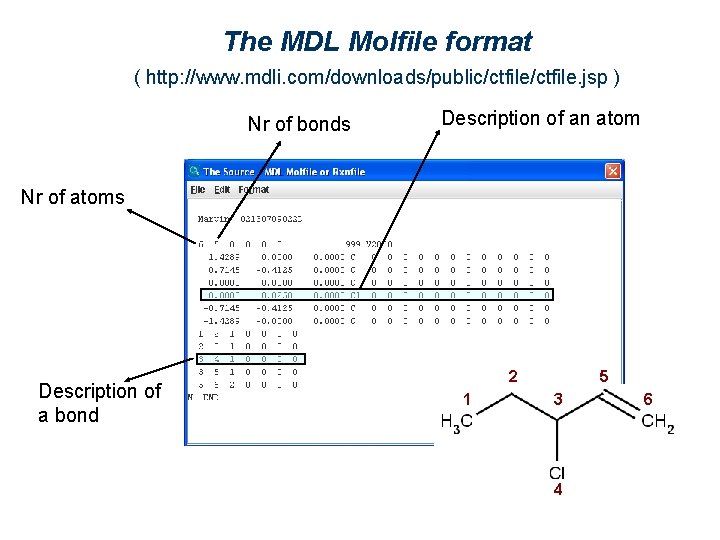
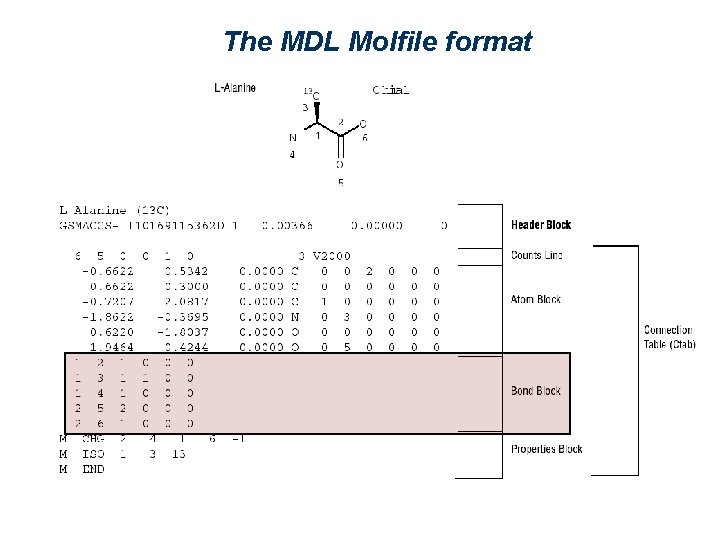
The MDL Molfile format ( http: //www. mdli. com/downloads/public/ctfile. jsp ) Nr of bonds Description of an atom Nr of atoms Description of a bond 2 1 5 3 4 6
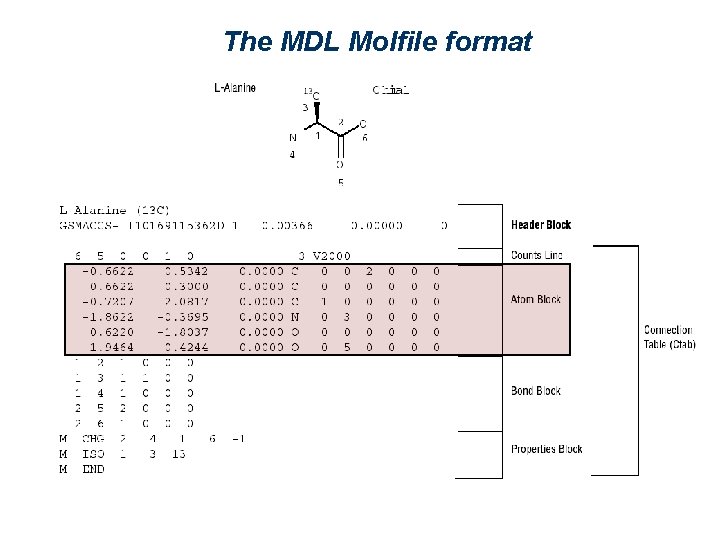
The MDL Molfile format
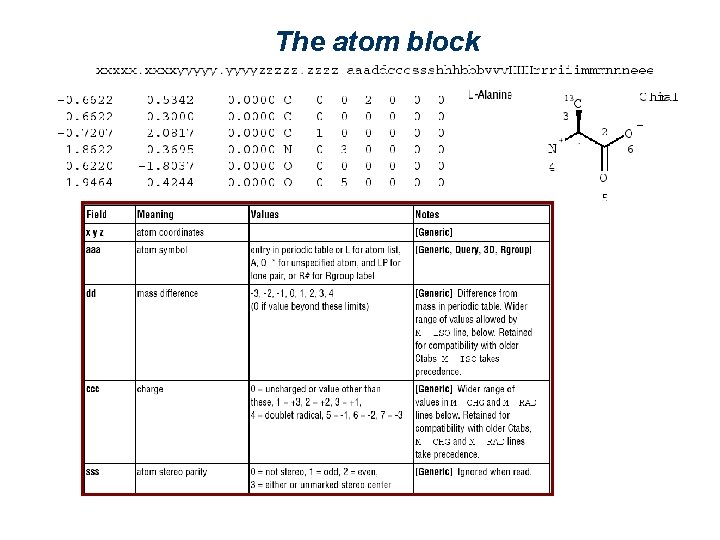
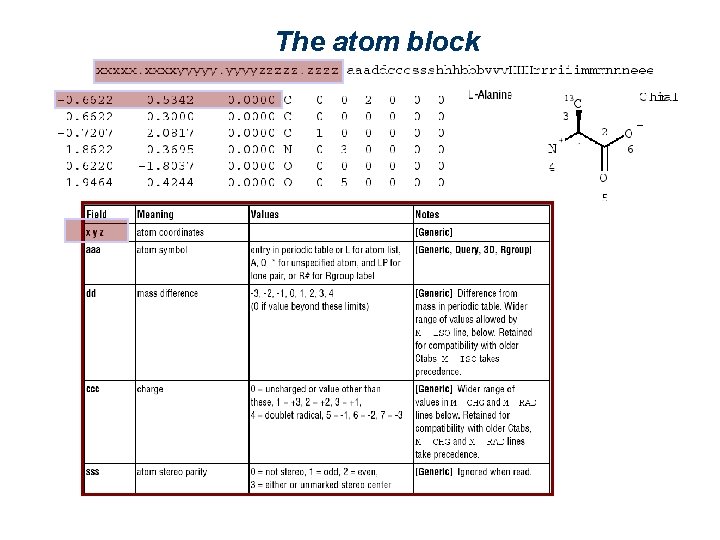
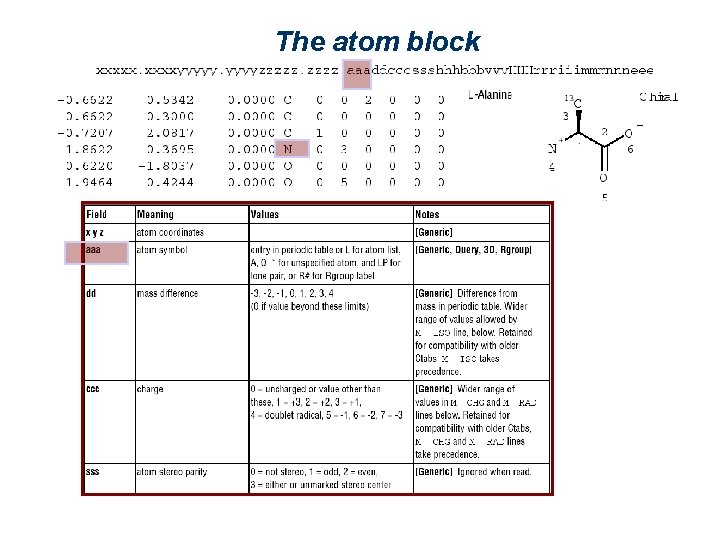
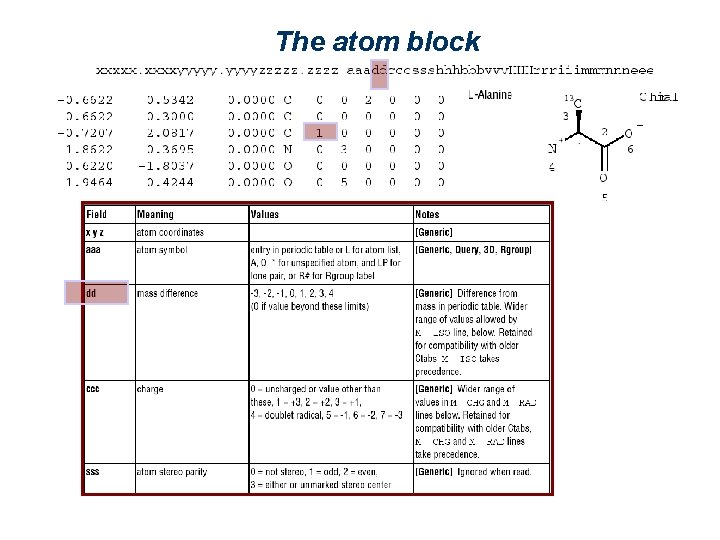
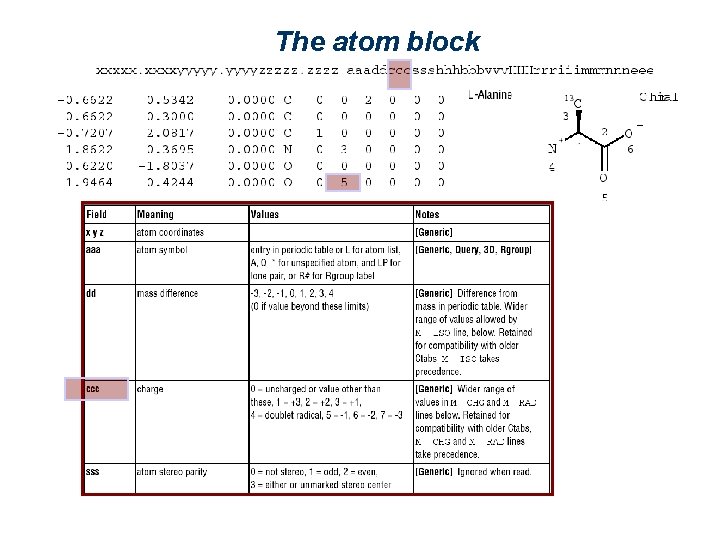
The atom block
The atom block
The atom block
The atom block
The atom block
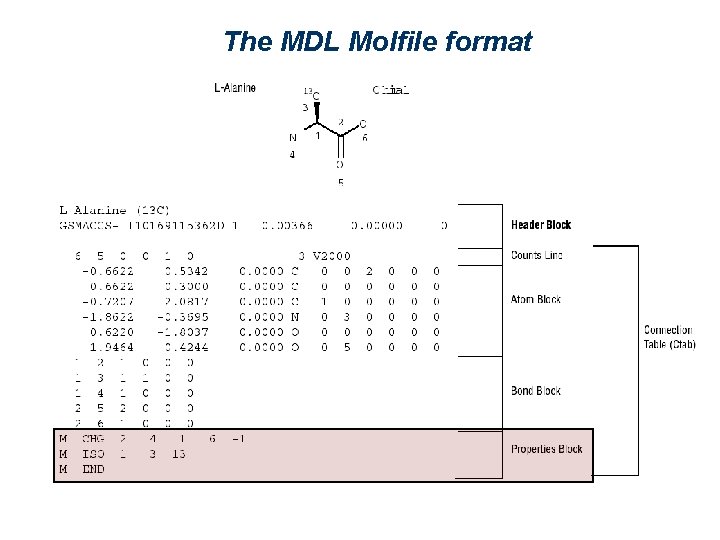
The MDL Molfile format
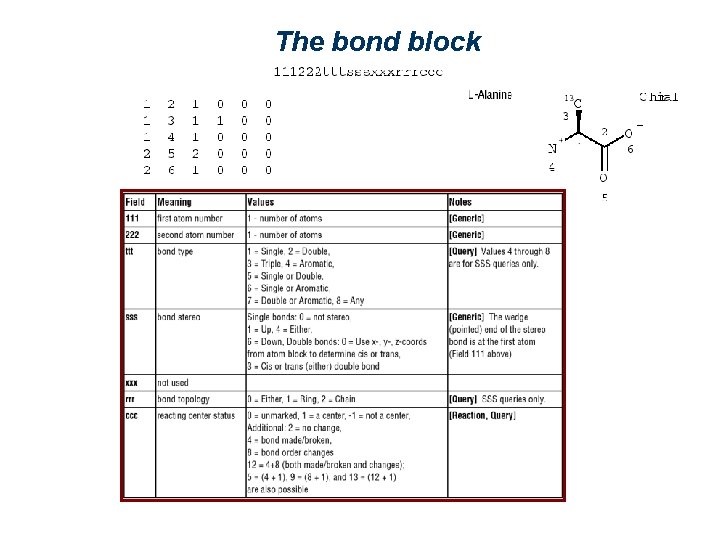
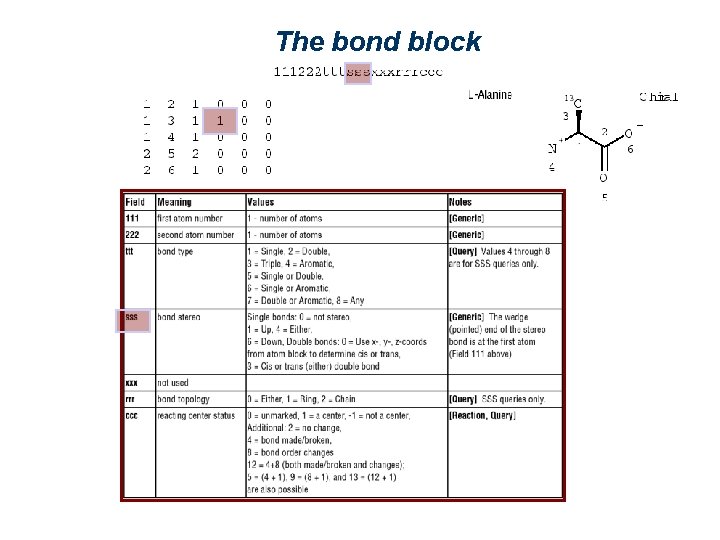
The bond block
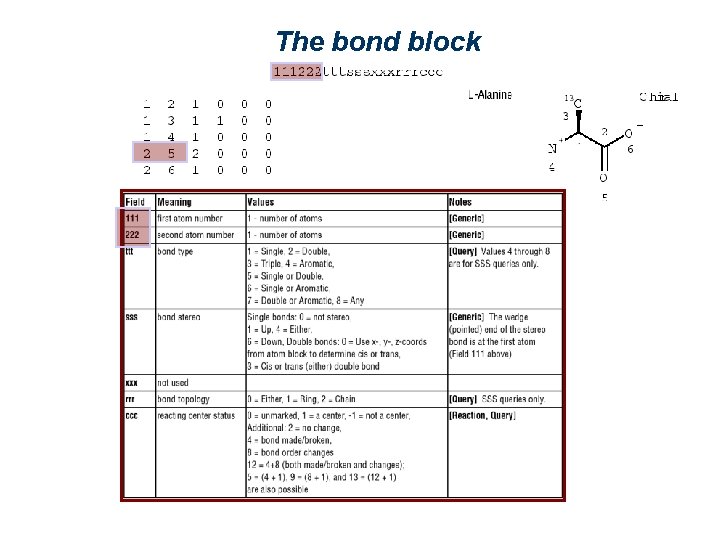
The bond block
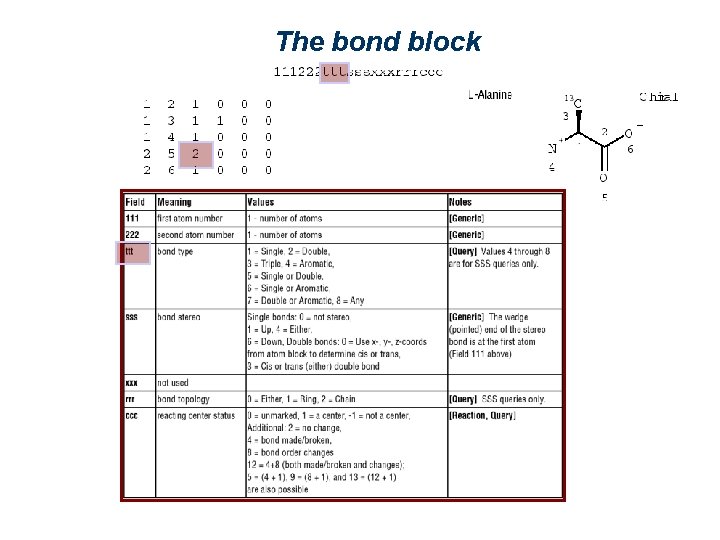
The bond block
The bond block
The MDL Molfile format
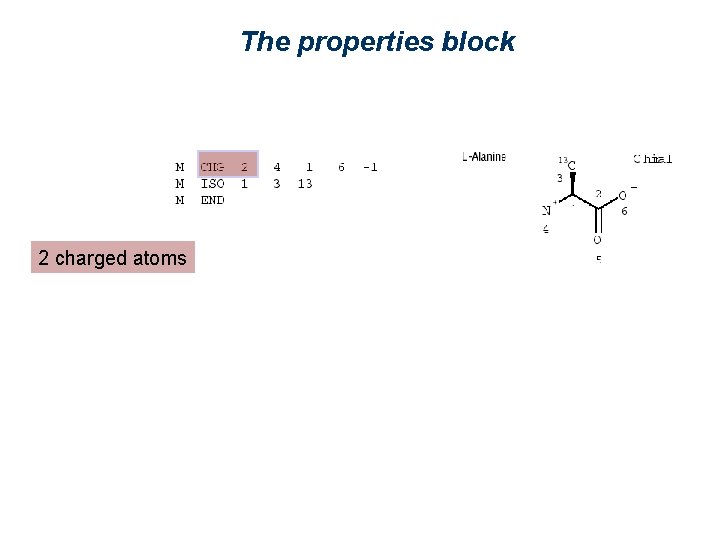
The properties block 2 charged atoms
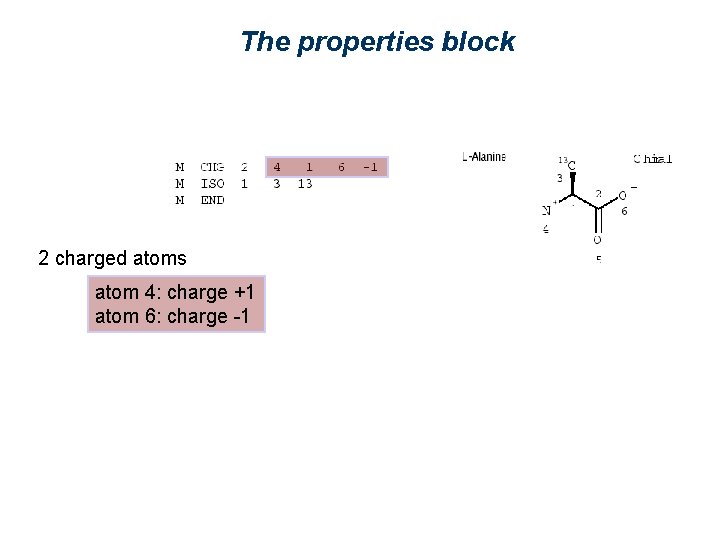
The properties block 2 charged atoms atom 4: charge +1 atom 6: charge -1
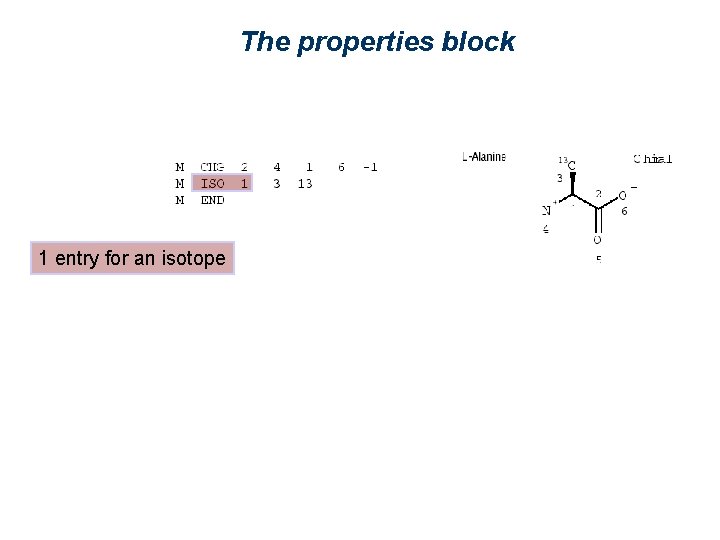
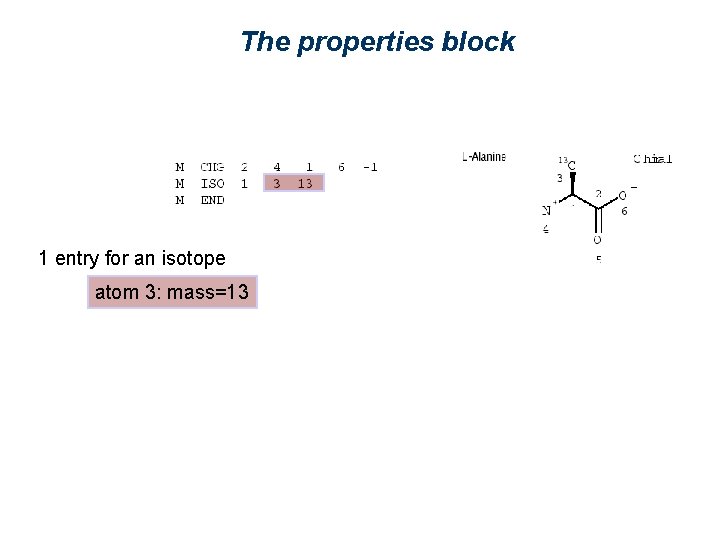
The properties block 1 entry for an isotope
The properties block 1 entry for an isotope atom 3: mass=13
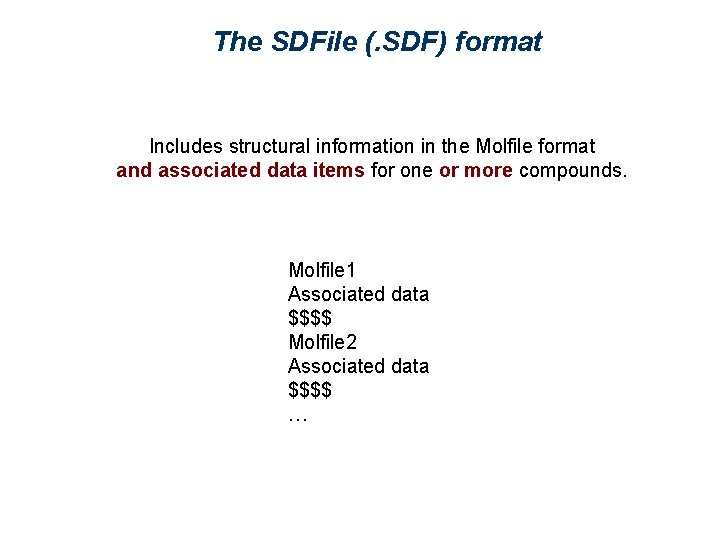
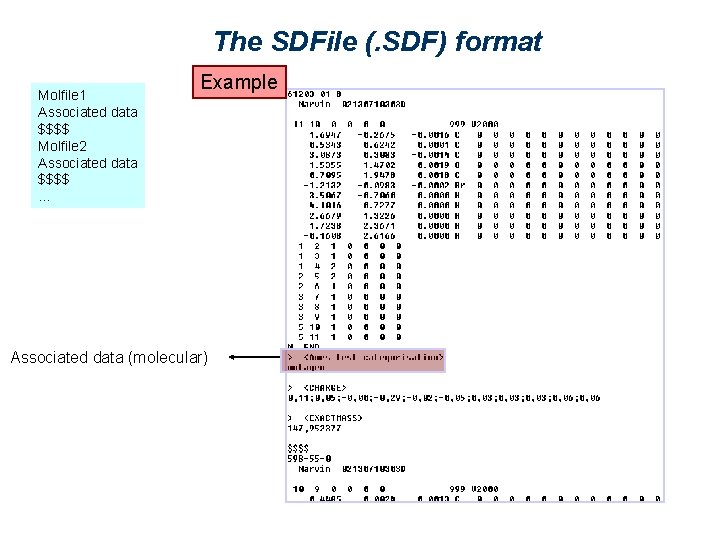
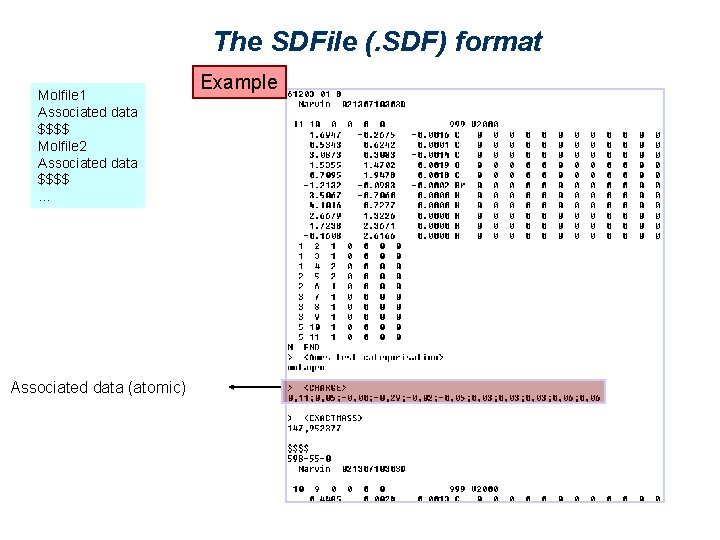
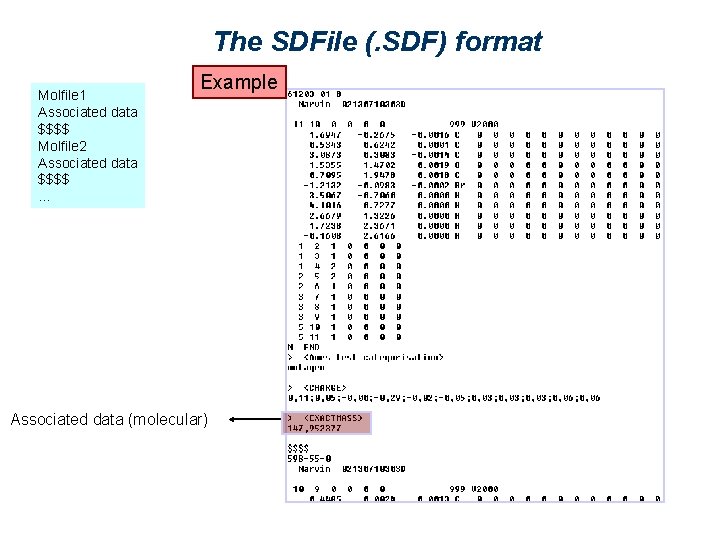
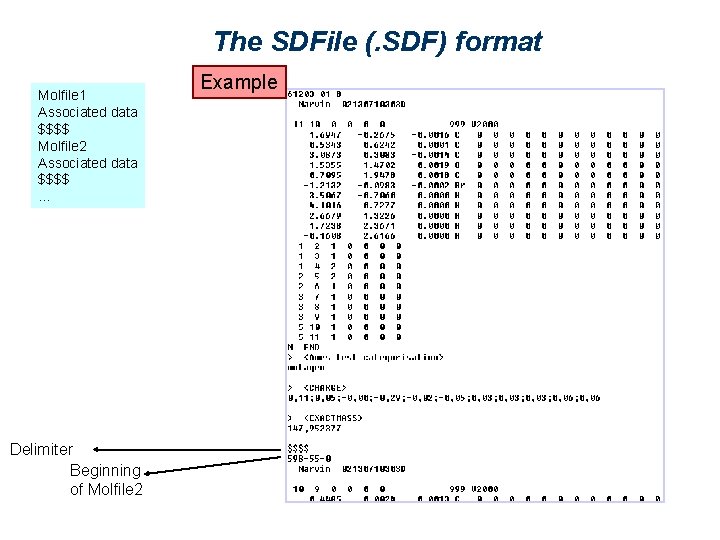
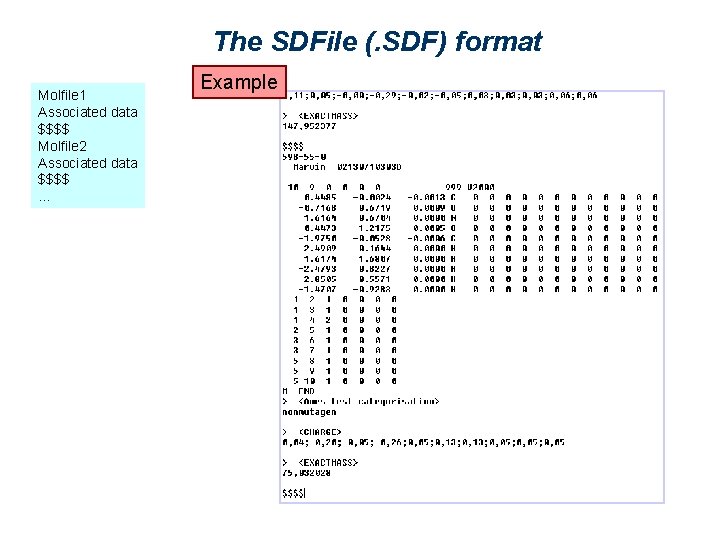
The SDFile (. SDF) format Includes structural information in the Molfile format and associated data items for one or more compounds. Molfile 1 Associated data $$$$ Molfile 2 Associated data $$$$ …
The SDFile (. SDF) format Molfile 1 Associated data $$$$ Molfile 2 Associated data $$$$ … Example Associated data (molecular)
The SDFile (. SDF) format Molfile 1 Associated data $$$$ Molfile 2 Associated data $$$$ … Associated data (atomic) Example
The SDFile (. SDF) format Molfile 1 Associated data $$$$ Molfile 2 Associated data $$$$ … Example Associated data (molecular)
The SDFile (. SDF) format Molfile 1 Associated data $$$$ Molfile 2 Associated data $$$$ … Delimiter Beginning of Molfile 2 Example
The SDFile (. SDF) format Molfile 1 Associated data $$$$ Molfile 2 Associated data $$$$ … Example
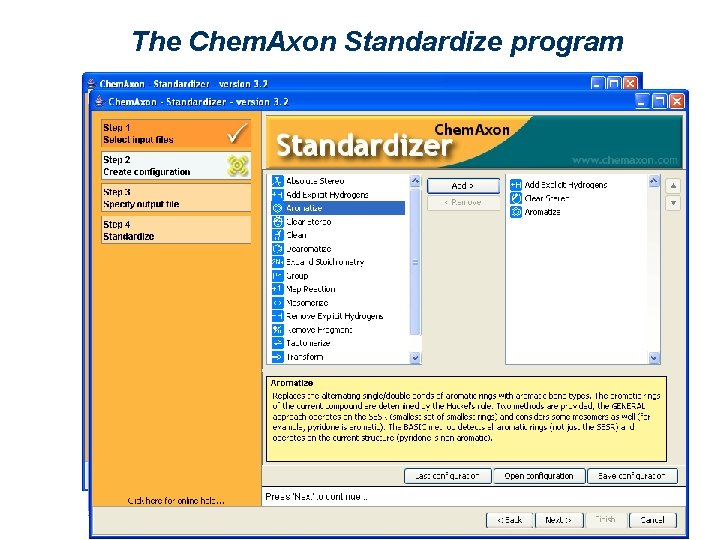
The Chem. Axon Standardize program • Conversion of file formats • Generation of unique SMILES strings • Standardization of structures • Addition of H-atoms, removal of H-atoms, assignment of aromatic systems, cleaning of stereochemistry, …
The Chem. Axon Standardize program
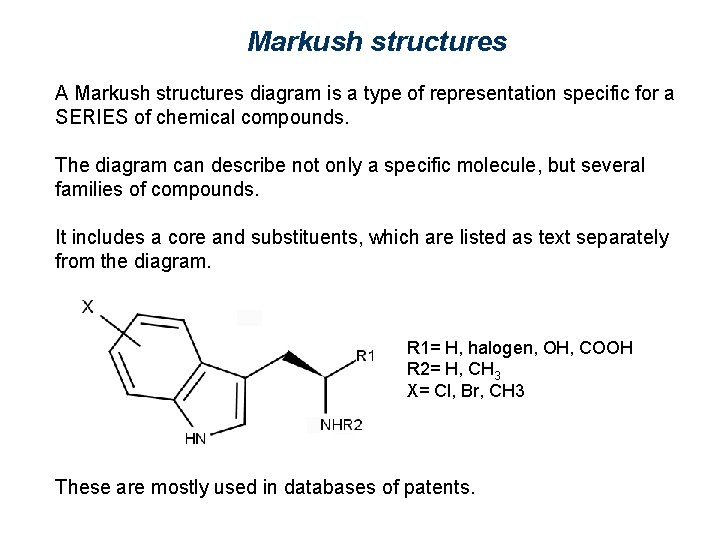
Markush structures A Markush structures diagram is a type of representation specific for a SERIES of chemical compounds. The diagram can describe not only a specific molecule, but several families of compounds. It includes a core and substituents, which are listed as text separately from the diagram. R 1= H, halogen, OH, COOH R 2= H, CH 3 X= Cl, Br, CH 3 These are mostly used in databases of patents.
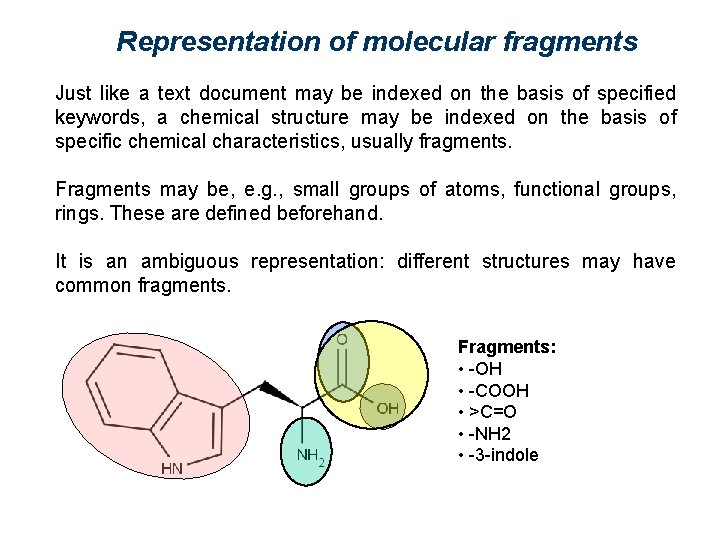
Representation of molecular fragments Just like a text document may be indexed on the basis of specified keywords, a chemical structure may be indexed on the basis of specific chemical characteristics, usually fragments. Fragments may be, e. g. , small groups of atoms, functional groups, rings. These are defined beforehand. It is an ambiguous representation: different structures may have common fragments. Fragments: • -OH • -COOH • >C=O • -NH 2 • -3 -indole
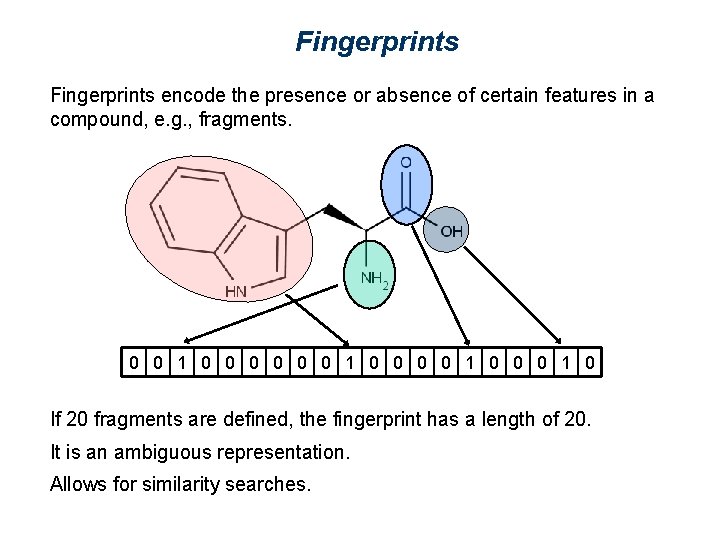
Fingerprints encode the presence or absence of certain features in a compound, e. g. , fragments. 0 0 1 0 0 0 1 0 If 20 fragments are defined, the fingerprint has a length of 20. It is an ambiguous representation. Allows for similarity searches.
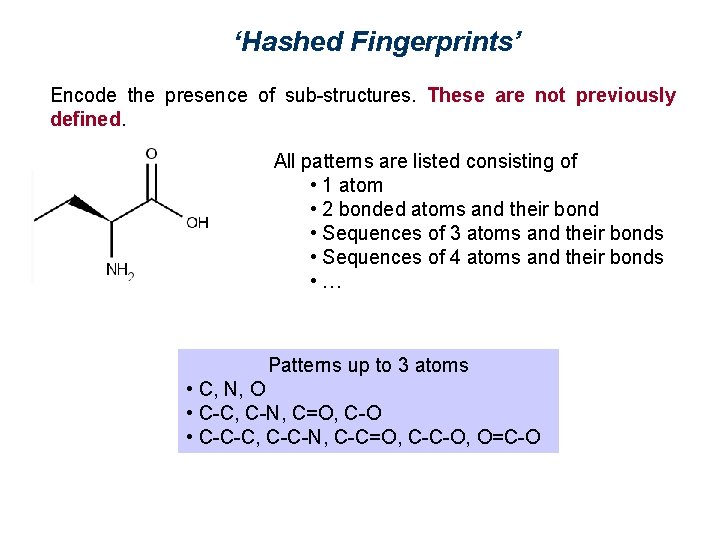
‘Hashed Fingerprints’ Encode the presence of sub-structures. These are not previously defined. All patterns are listed consisting of • 1 atom • 2 bonded atoms and their bond • Sequences of 3 atoms and their bonds • Sequences of 4 atoms and their bonds • … Patterns up to 3 atoms • C, N, O • C-C, C-N, C=O, C-O • C-C-C, C-C-N, C-C=O, C-C-O, O=C-O
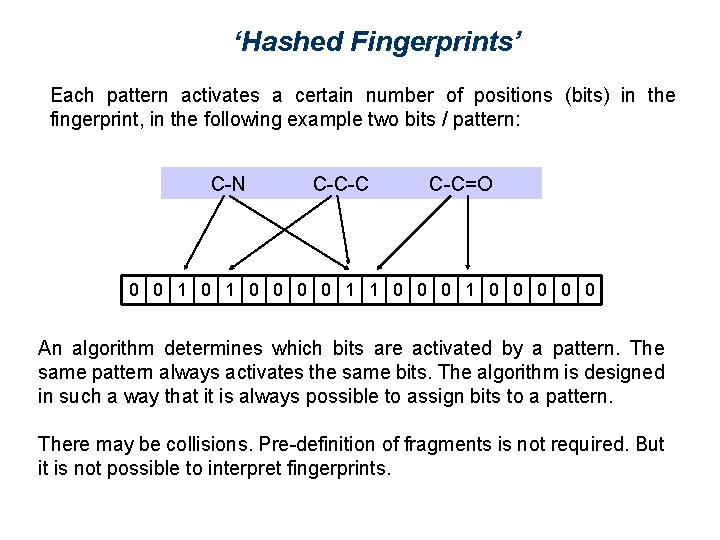
‘Hashed Fingerprints’ Each pattern activates a certain number of positions (bits) in the fingerprint, in the following example two bits / pattern: C-N C-C-C C-C=O 0 0 1 1 0 0 0 0 0 An algorithm determines which bits are activated by a pattern. The same pattern always activates the same bits. The algorithm is designed in such a way that it is always possible to assign bits to a pattern. There may be collisions. Pre-definition of fragments is not required. But it is not possible to interpret fingerprints.
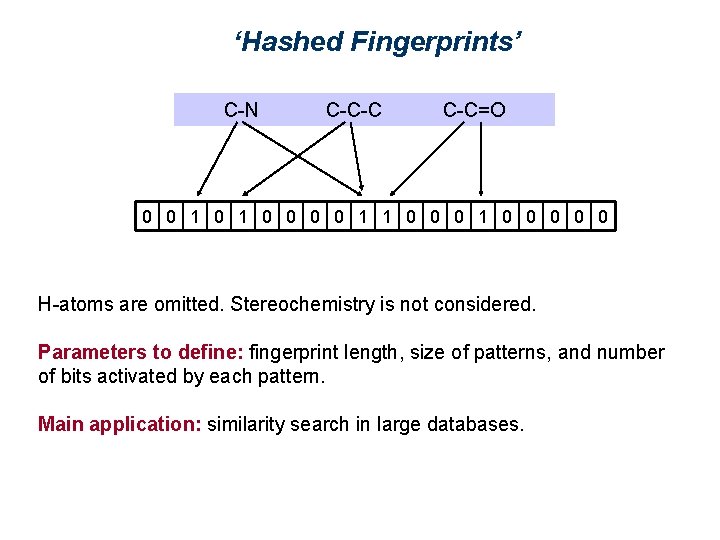
‘Hashed Fingerprints’ C-N C-C-C C-C=O 0 0 1 1 0 0 0 0 0 H-atoms are omitted. Stereochemistry is not considered. Parameters to define: fingerprint length, size of patterns, and number of bits activated by each pattern. Main application: similarity search in large databases.
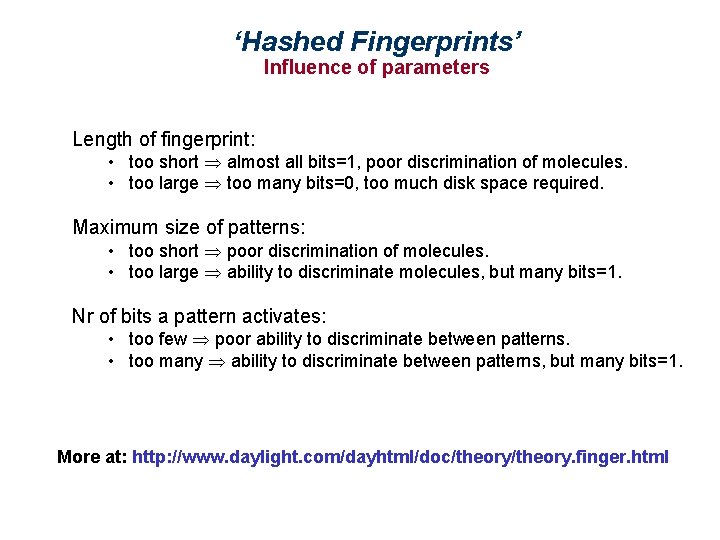
‘Hashed Fingerprints’ Influence of parameters Length of fingerprint: • too short almost all bits=1, poor discrimination of molecules. • too large too many bits=0, too much disk space required. Maximum size of patterns: • too short poor discrimination of molecules. • too large ability to discriminate molecules, but many bits=1. Nr of bits a pattern activates: • too few poor ability to discriminate between patterns. • too many ability to discriminate between patterns, but many bits=1. More at: http: //www. daylight. com/dayhtml/doc/theory. finger. html
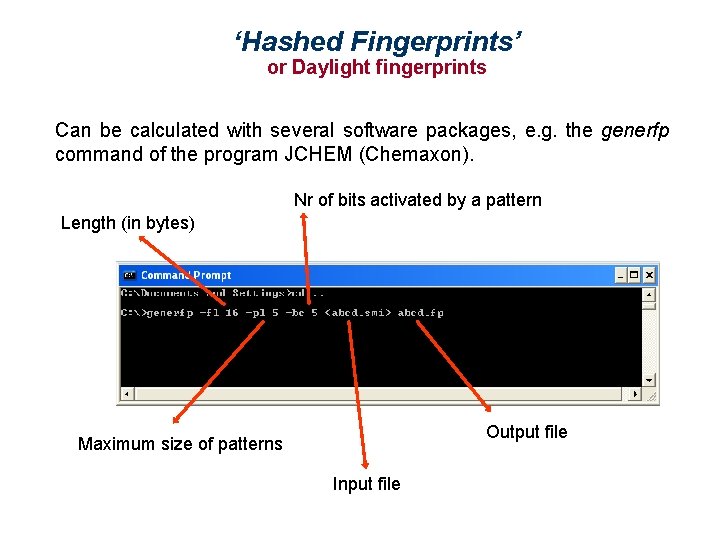
‘Hashed Fingerprints’ or Daylight fingerprints Can be calculated with several software packages, e. g. the generfp command of the program JCHEM (Chemaxon). Nr of bits activated by a pattern Length (in bytes) Output file Maximum size of patterns Input file
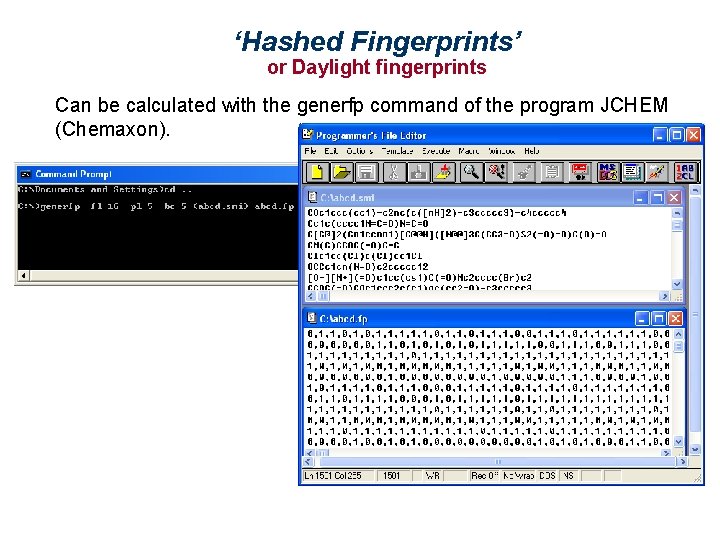
‘Hashed Fingerprints’ or Daylight fingerprints Can be calculated with the generfp command of the program JCHEM (Chemaxon).
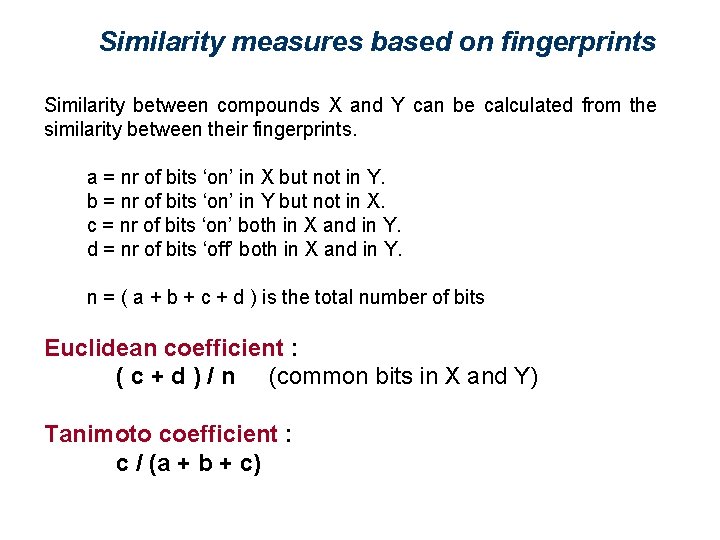
Similarity measures based on fingerprints Similarity between compounds X and Y can be calculated from the similarity between their fingerprints. a = nr of bits ‘on’ in X but not in Y. b = nr of bits ‘on’ in Y but not in X. c = nr of bits ‘on’ both in X and in Y. d = nr of bits ‘off’ both in X and in Y. n = ( a + b + c + d ) is the total number of bits Euclidean coefficient : ( c + d ) / n (common bits in X and Y) Tanimoto coefficient : c / (a + b + c)
‘Hash codes’ Hash codes result from an algorithm that transforms a molecular structure into a sequence of characters or numbers encoding the presence of fragments in the molecule. They have a fixed length. Hash codes are not interpretable. They’re used as unique identifiers of structures, e. g. in large databases of compounds hash codes allow for the fast perception of an exact match between two molecules. Hash codes can also be defined for atoms, or bonds.
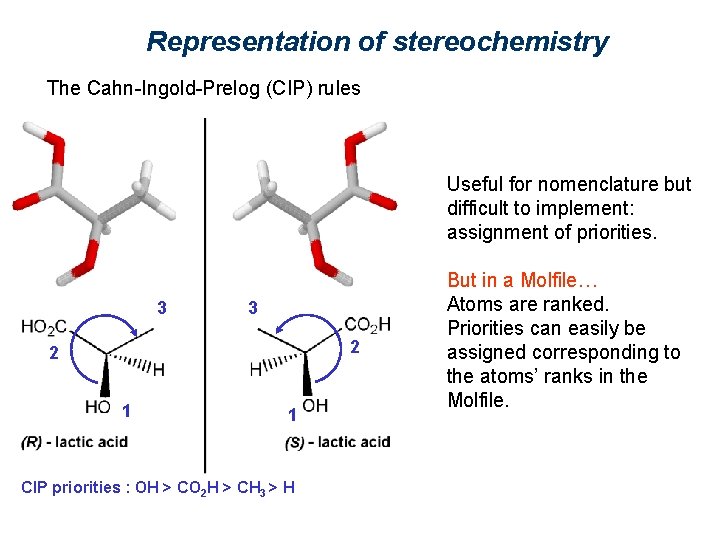
Representation of stereochemistry The Cahn-Ingold-Prelog (CIP) rules Useful for nomenclature but difficult to implement: assignment of priorities. 3 3 2 2 1 1 CIP priorities : OH > CO 2 H > CH 3 > H But in a Molfile… Atoms are ranked. Priorities can easily be assigned corresponding to the atoms’ ranks in the Molfile.
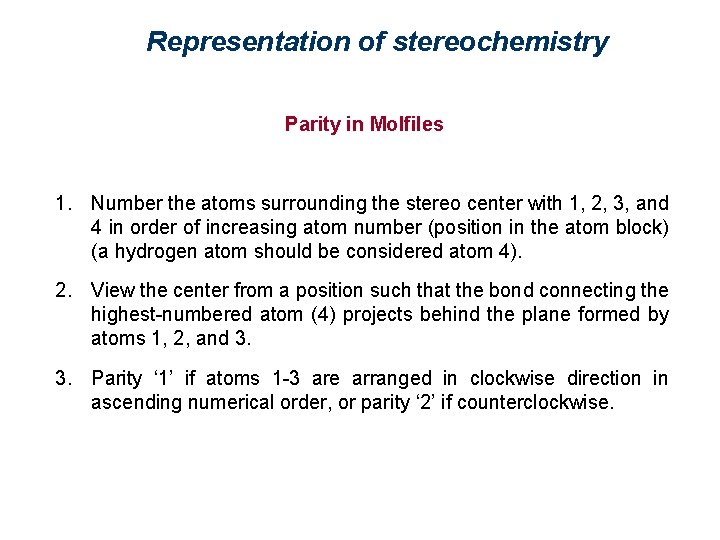
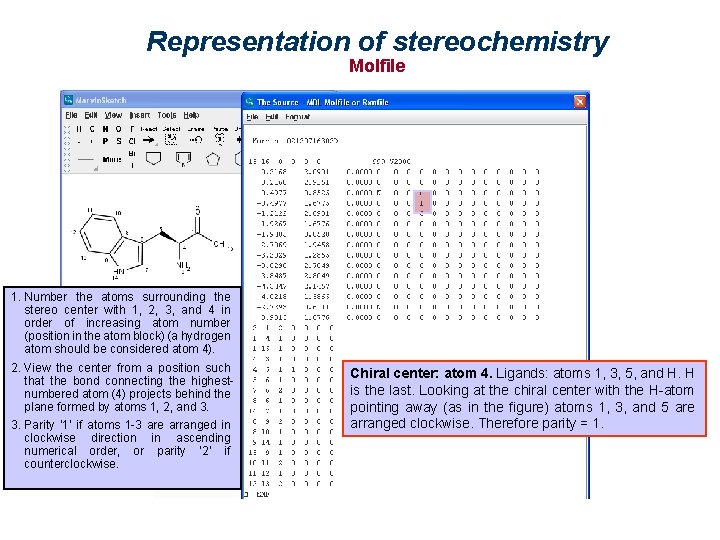
Representation of stereochemistry Parity in Molfiles 1. Number the atoms surrounding the stereo center with 1, 2, 3, and 4 in order of increasing atom number (position in the atom block) (a hydrogen atom should be considered atom 4). 2. View the center from a position such that the bond connecting the highest-numbered atom (4) projects behind the plane formed by atoms 1, 2, and 3. 3. Parity ‘ 1’ if atoms 1 -3 are arranged in clockwise direction in ascending numerical order, or parity ‘ 2’ if counterclockwise.
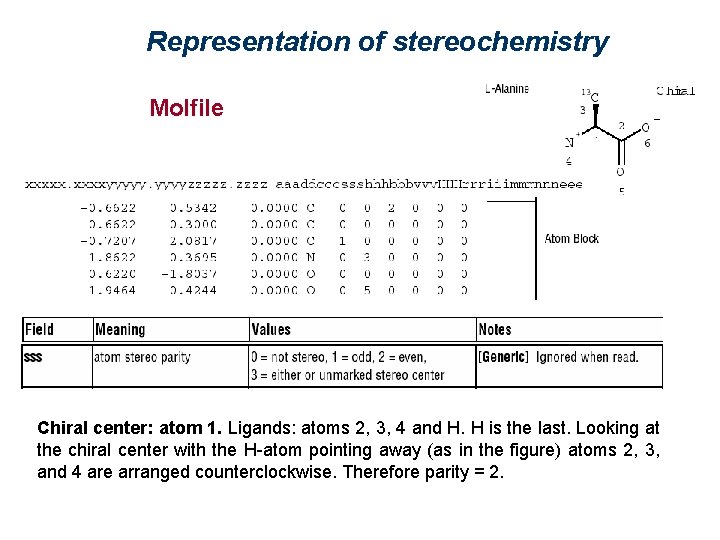
Representation of stereochemistry Molfile Chiral center: atom 1. Ligands: atoms 2, 3, 4 and H. H is the last. Looking at the chiral center with the H-atom pointing away (as in the figure) atoms 2, 3, and 4 are arranged counterclockwise. Therefore parity = 2.
Representation of stereochemistry Molfile 1. Number the atoms surrounding the stereo center with 1, 2, 3, and 4 in order of increasing atom number (position in the atom block) (a hydrogen atom should be considered atom 4). 2. View the center from a position such that the bond connecting the highestnumbered atom (4) projects behind the plane formed by atoms 1, 2, and 3. 3. Parity ‘ 1’ if atoms 1 -3 are arranged in clockwise direction in ascending numerical order, or parity ‘ 2’ if counterclockwise. Chiral center: atom 4. Ligands: atoms 1, 3, 5, and H. H is the last. Looking at the chiral center with the H-atom pointing away (as in the figure) atoms 1, 3, and 5 are arranged clockwise. Therefore parity = 1.
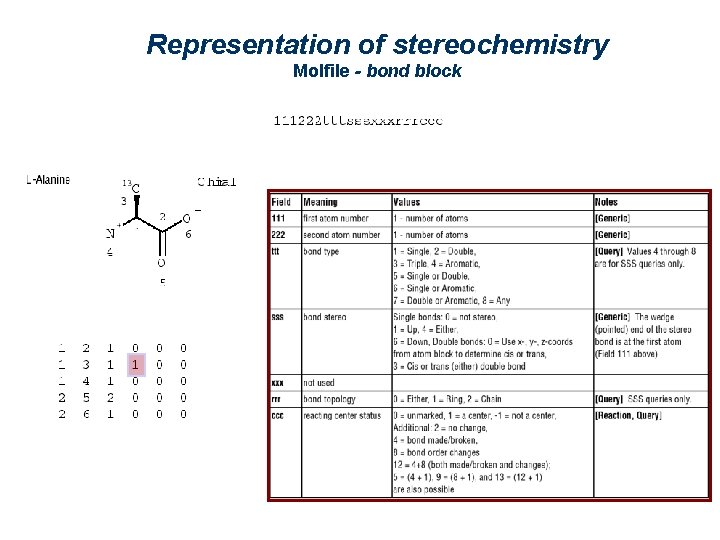
Representation of stereochemistry Molfile - bond block
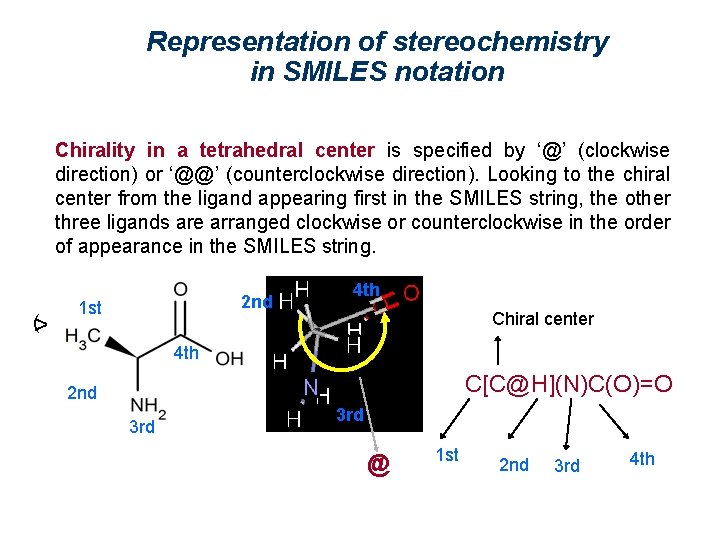
Representation of stereochemistry in SMILES notation Chirality in a tetrahedral center is specified by ‘@’ (clockwise direction) or ‘@@’ (counterclockwise direction). Looking to the chiral center from the ligand appearing first in the SMILES string, the other three ligands are arranged clockwise or counterclockwise in the order of appearance in the SMILES string. (> 2 nd 1 st 4 th Chiral center 4 th C[C@H](N)C(O)=O 2 nd 3 rd @ 1 st 2 nd 3 rd 4 th
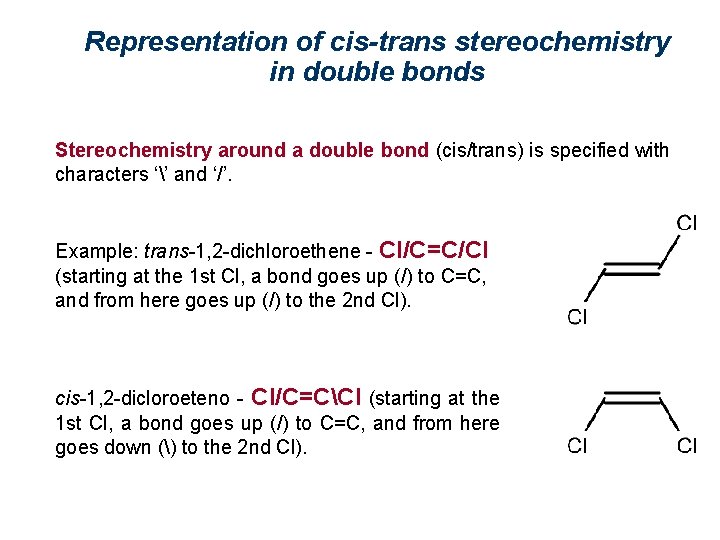
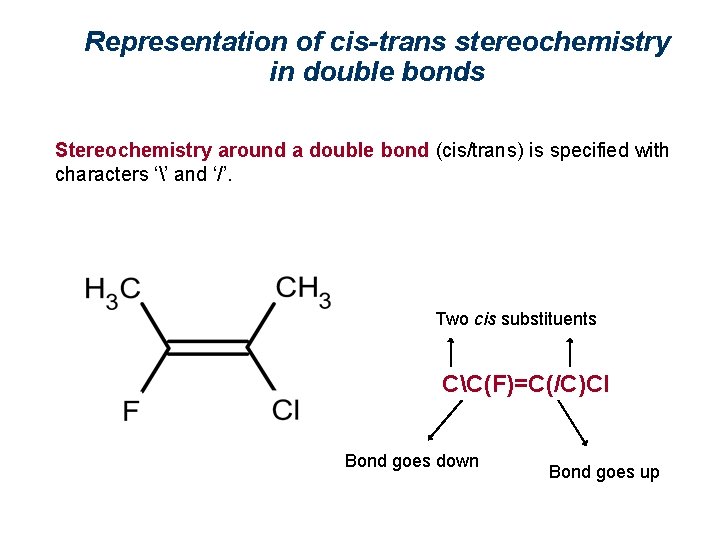
Representation of cis-trans stereochemistry in double bonds Stereochemistry around a double bond (cis/trans) is specified with characters ‘’ and ‘/’. Example: trans-1, 2 -dichloroethene - Cl/C=C/Cl (starting at the 1 st Cl, a bond goes up (/) to C=C, and from here goes up (/) to the 2 nd Cl). cis-1, 2 -dicloroeteno - Cl/C=CCl (starting at the 1 st Cl, a bond goes up (/) to C=C, and from here goes down () to the 2 nd Cl).
Representation of cis-trans stereochemistry in double bonds Stereochemistry around a double bond (cis/trans) is specified with characters ‘’ and ‘/’. Two cis substituents CC(F)=C(/C)Cl Bond goes down Bond goes up
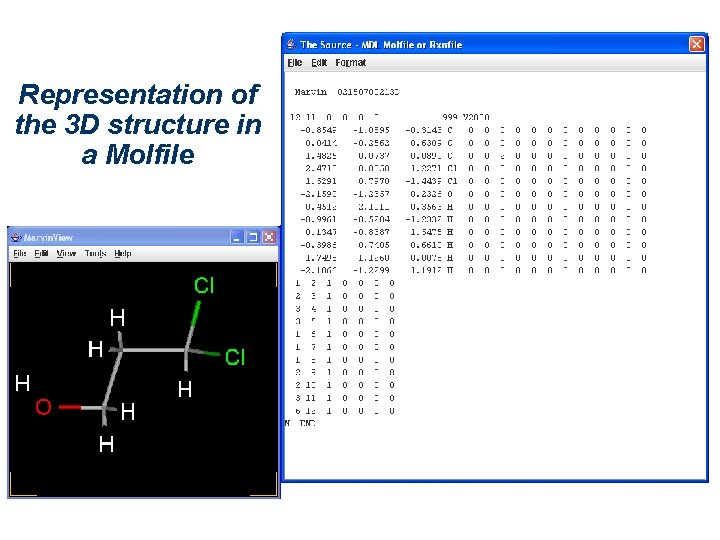
Representation of the 3 D structure The most obvious (and common) representation consists of a Cartesian system, i. e. the x, y, and z coordinates of each atom. For a given conformation the coordinates depend on the orientation of the structure relative to the reference axes. In a Molfile, 3 D coordinates can be listed.
Representation of the 3 D structure in a Molfile
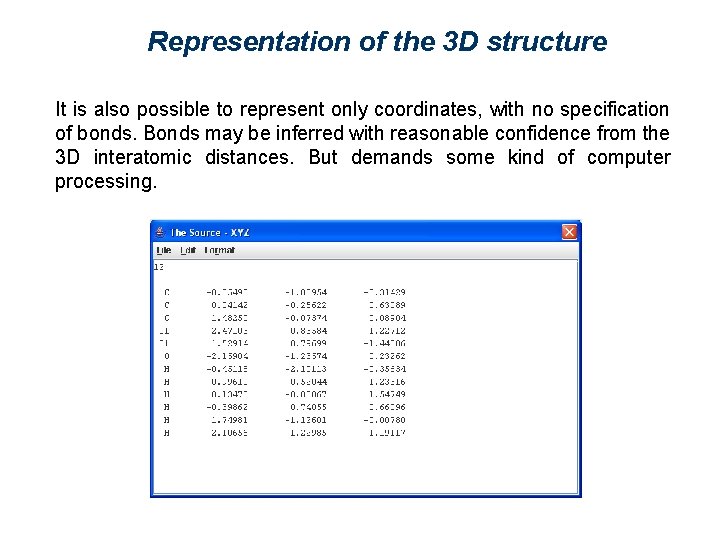
Representation of the 3 D structure It is also possible to represent only coordinates, with no specification of bonds. Bonds may be inferred with reasonable confidence from the 3 D interatomic distances. But demands some kind of computer processing.
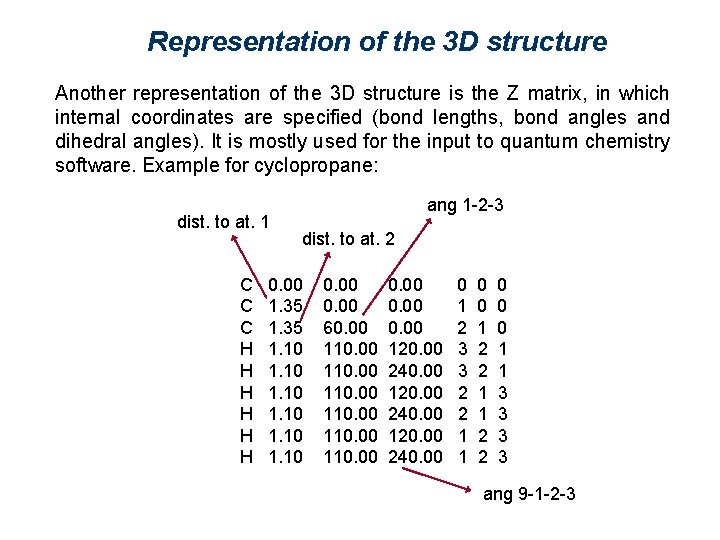
Representation of the 3 D structure Another representation of the 3 D structure is the Z matrix, in which internal coordinates are specified (bond lengths, bond angles and dihedral angles). It is mostly used for the input to quantum chemistry software. Example for cyclopropane: dist. to at. 1 C C C H H H ang 1 -2 -3 dist. to at. 2 0. 00 1. 35 1. 10 0. 00 60. 00 110. 00 0. 00 120. 00 240. 00 0 1 2 3 3 2 2 1 1 0 0 1 2 2 1 1 2 2 0 0 0 1 1 3 3 ang 9 -1 -2 -3
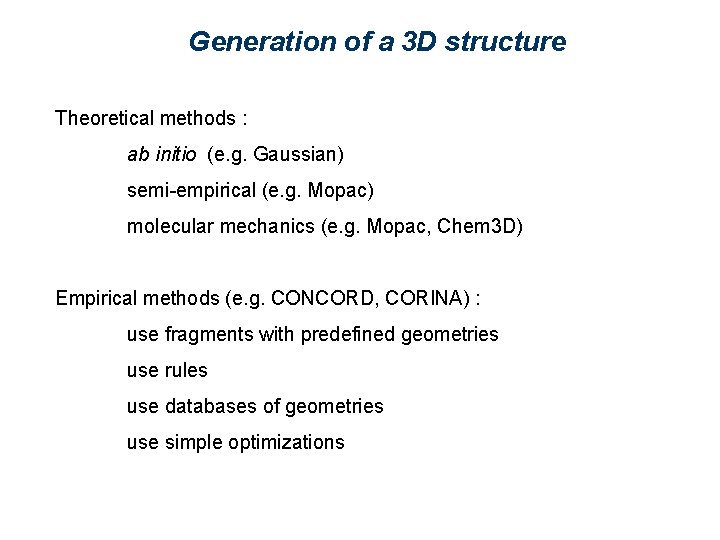
Generation of a 3 D structure Theoretical methods : ab initio (e. g. Gaussian) semi-empirical (e. g. Mopac) molecular mechanics (e. g. Mopac, Chem 3 D) Empirical methods (e. g. CONCORD, CORINA) : use fragments with predefined geometries use rules use databases of geometries use simple optimizations
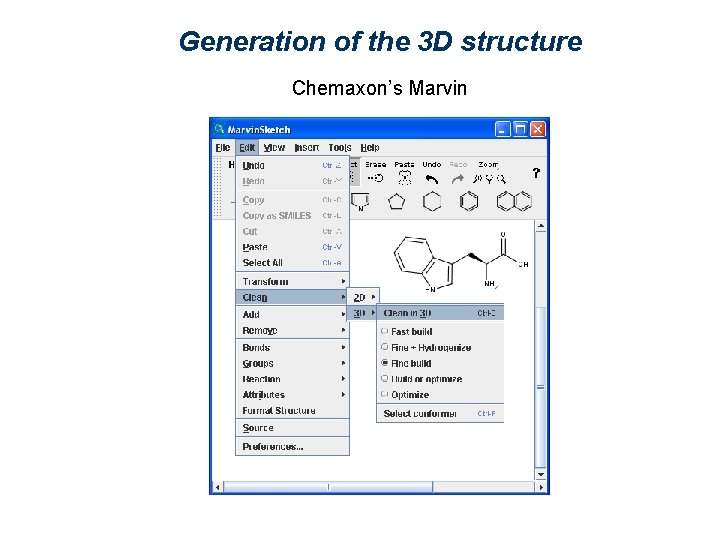
Generation of the 3 D structure Chemaxon’s Marvin
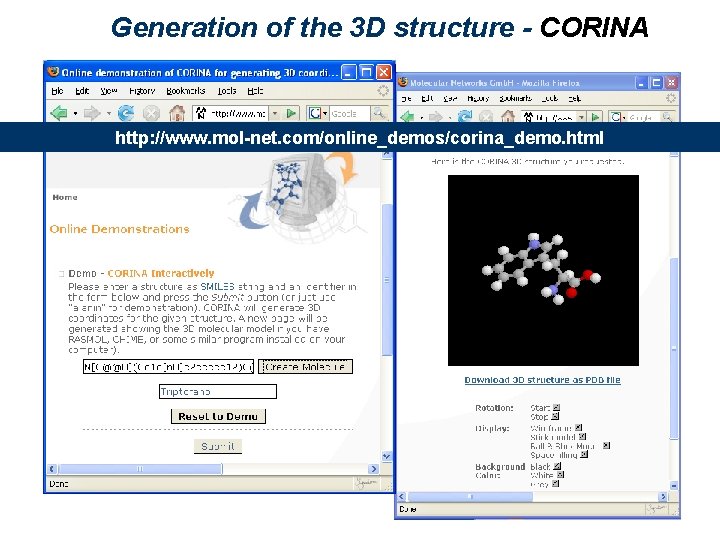
Generation of the 3 D structure - CORINA http: //www. mol-net. com/online_demos/corina_demo. html
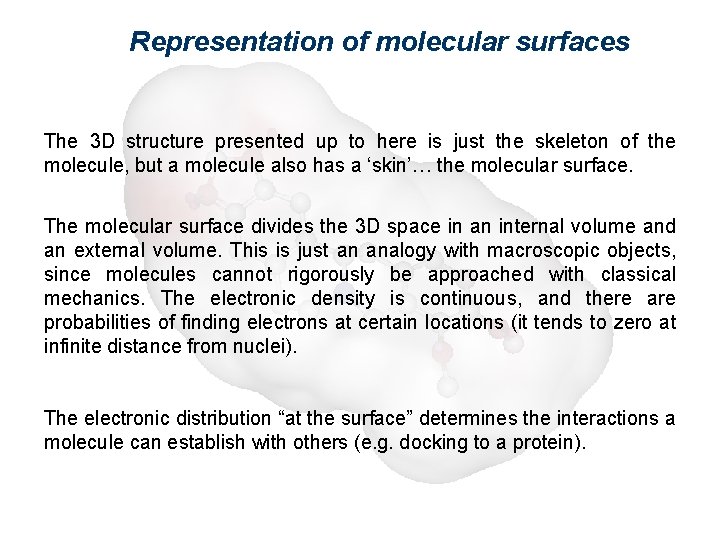
Representation of molecular surfaces The 3 D structure presented up to here is just the skeleton of the molecule, but a molecule also has a ‘skin’… the molecular surface. The molecular surface divides the 3 D space in an internal volume and an external volume. This is just an analogy with macroscopic objects, since molecules cannot rigorously be approached with classical mechanics. The electronic density is continuous, and there are probabilities of finding electrons at certain locations (it tends to zero at infinite distance from nuclei). The electronic distribution “at the surface” determines the interactions a molecule can establish with others (e. g. docking to a protein).
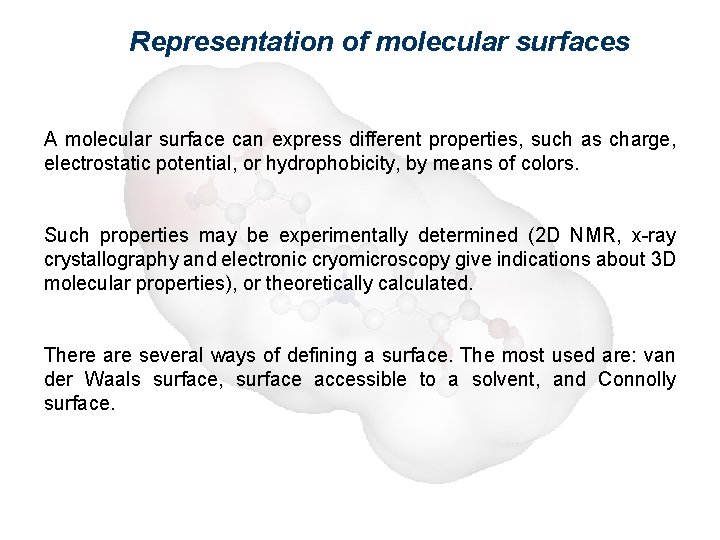
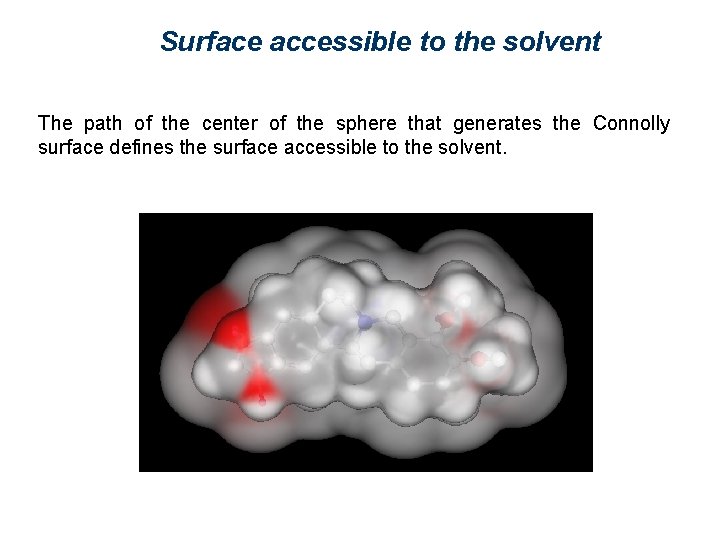
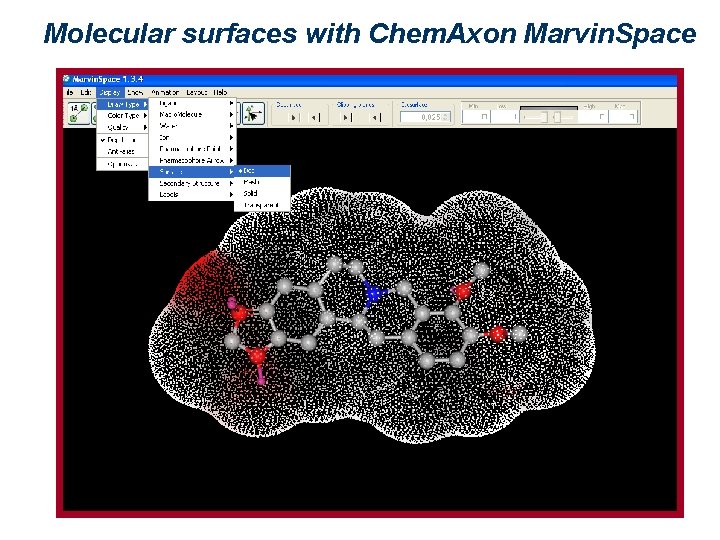
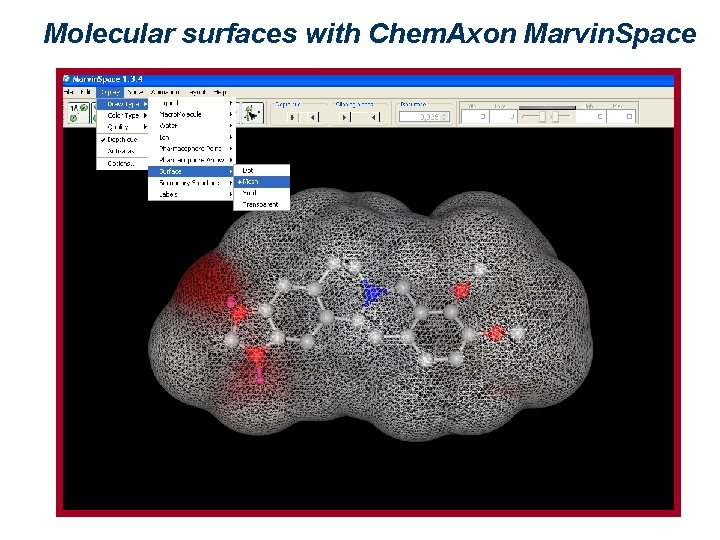
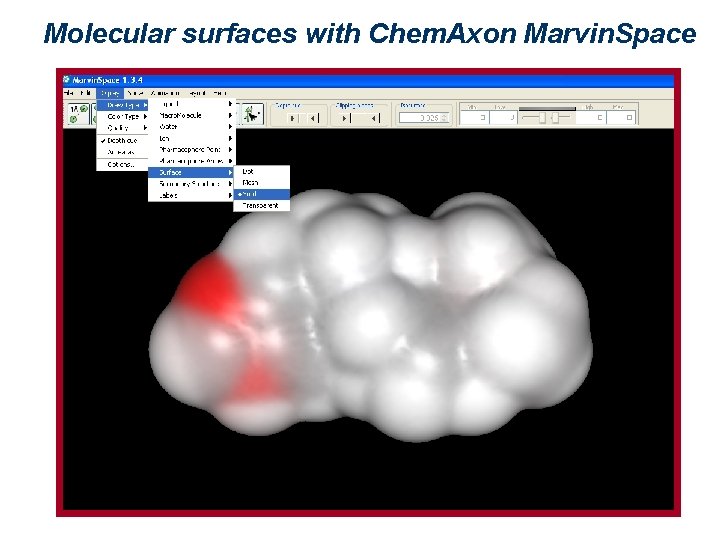
Representation of molecular surfaces A molecular surface can express different properties, such as charge, electrostatic potential, or hydrophobicity, by means of colors. Such properties may be experimentally determined (2 D NMR, x-ray crystallography and electronic cryomicroscopy give indications about 3 D molecular properties), or theoretically calculated. There are several ways of defining a surface. The most used are: van der Waals surface, surface accessible to a solvent, and Connolly surface.
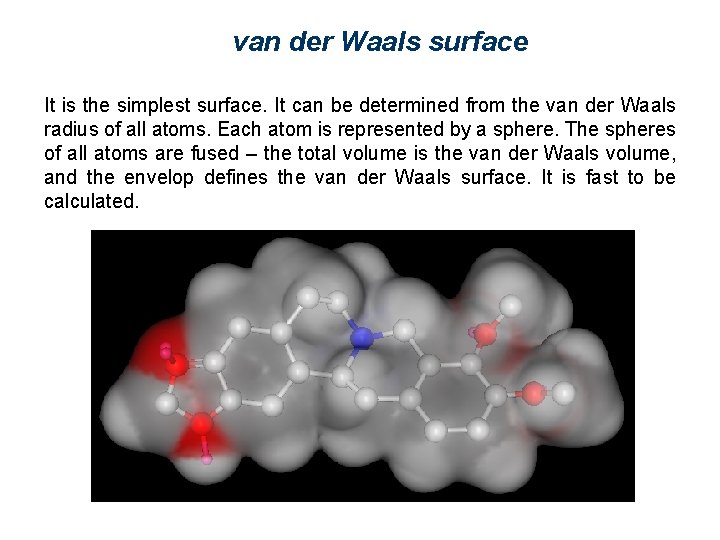
van der Waals surface It is the simplest surface. It can be determined from the van der Waals radius of all atoms. Each atom is represented by a sphere. The spheres of all atoms are fused – the total volume is the van der Waals volume, and the envelop defines the van der Waals surface. It is fast to be calculated.
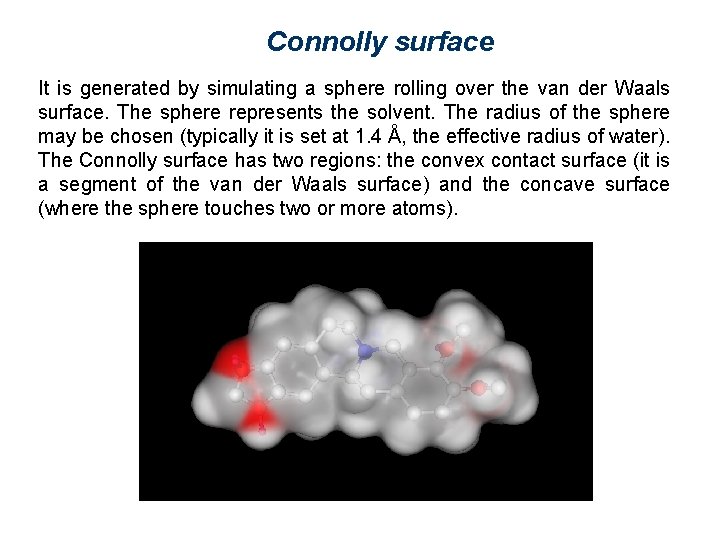
Connolly surface It is generated by simulating a sphere rolling over the van der Waals surface. The sphere represents the solvent. The radius of the sphere may be chosen (typically it is set at 1. 4 Å, the effective radius of water). The Connolly surface has two regions: the convex contact surface (it is a segment of the van der Waals surface) and the concave surface (where the sphere touches two or more atoms).
Surface accessible to the solvent The path of the center of the sphere that generates the Connolly surface defines the surface accessible to the solvent.
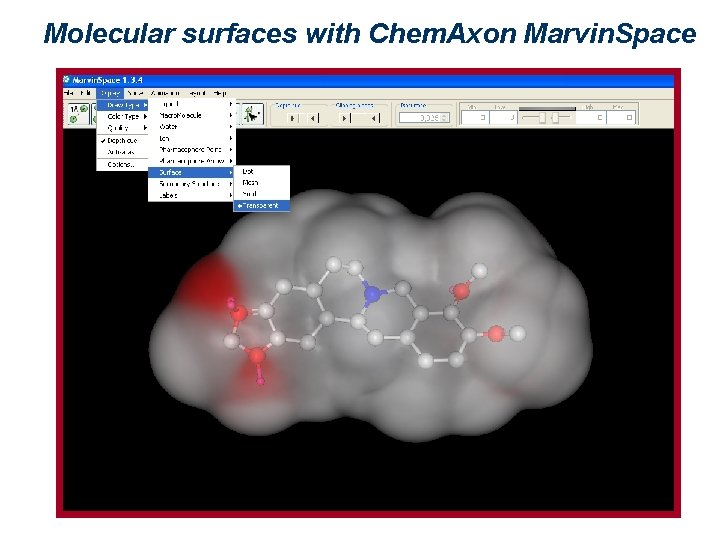
Molecular surfaces with Chem. Axon Marvin. Space
Molecular surfaces with Chem. Axon Marvin. Space
Molecular surfaces with Chem. Axon Marvin. Space
Molecular surfaces with Chem. Axon Marvin. Space