
Representation Audiences Industries Language Lesson 1 Introduction Bell
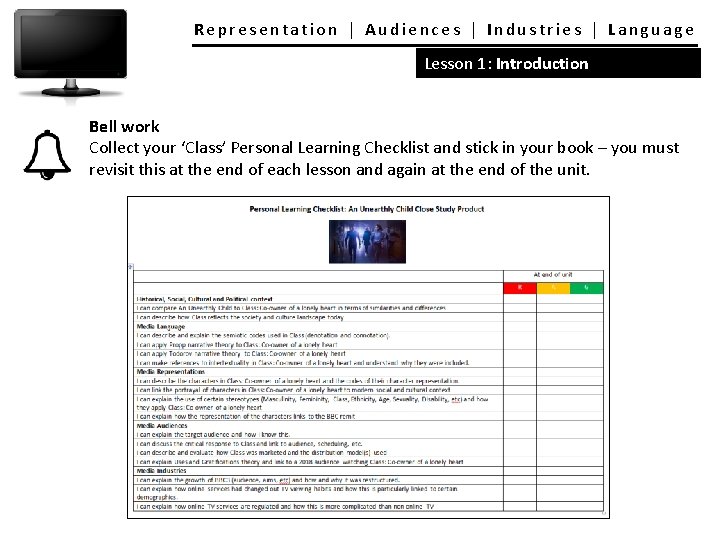
Representation │ Audiences │ Industries │ Language Lesson 1: Introduction Bell work Collect your ‘Class’ Personal Learning Checklist and stick in your book – you must revisit this at the end of each lesson and again at the end of the unit.
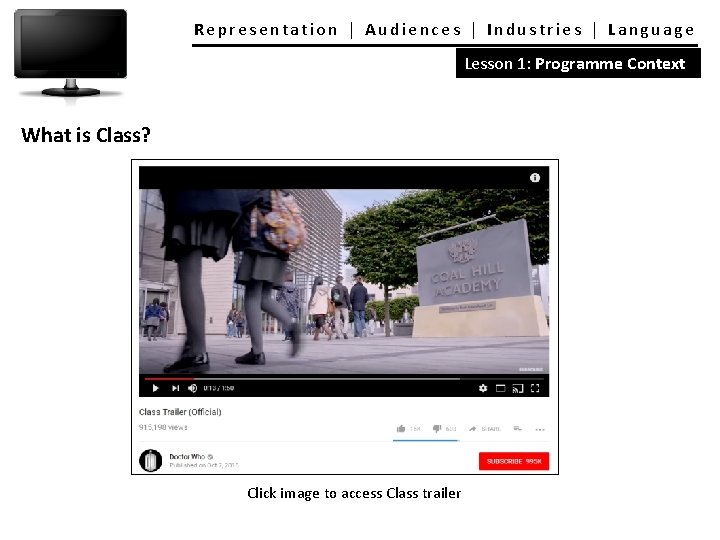
Representation │ Audiences │ Industries │ Language Lesson 1: Programme Context What is Class? Click image to access Class trailer
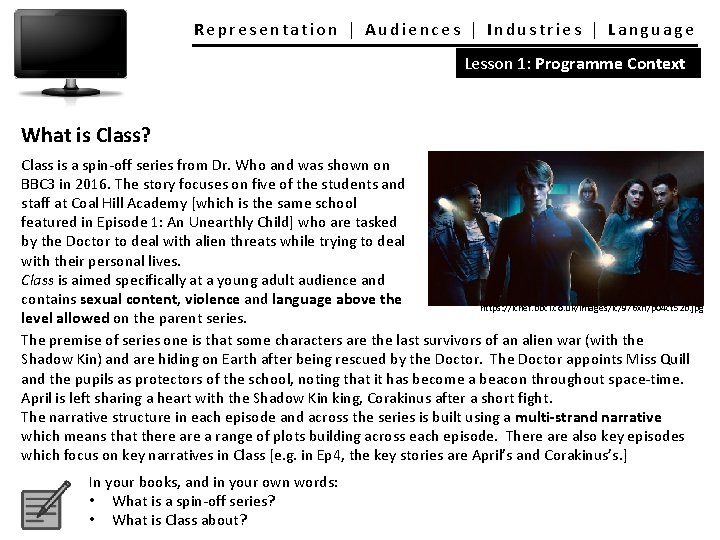
Representation │ Audiences │ Industries │ Language Lesson 1: Programme Context What is Class? Class is a spin-off series from Dr. Who and was shown on BBC 3 in 2016. The story focuses on five of the students and staff at Coal Hill Academy [which is the same school featured in Episode 1: An Unearthly Child] who are tasked by the Doctor to deal with alien threats while trying to deal with their personal lives. Class is aimed specifically at a young adult audience and contains sexual content, violence and language above the https: //ichef. bbci. co. uk/images/ic/976 xn/p 04 ct 52 b. jpg level allowed on the parent series. The premise of series one is that some characters are the last survivors of an alien war (with the Shadow Kin) and are hiding on Earth after being rescued by the Doctor. The Doctor appoints Miss Quill and the pupils as protectors of the school, noting that it has become a beacon throughout space-time. April is left sharing a heart with the Shadow Kin king, Corakinus after a short fight. The narrative structure in each episode and across the series is built using a multi-strand narrative which means that there a range of plots building across each episode. There also key episodes which focus on key narratives in Class [e. g. in Ep 4, the key stories are April’s and Corakinus’s. ] In your books, and in your own words: • What is a spin-off series? • What is Class about?
Representation │ Audiences │ Industries │ Language Lesson 1: Programme Context Introducing the characters (Additional Materials from DVD) Available at: https: //www. amazon. co. uk/Class-1 -DVD-Peter-Capaldi/dp/B 01 M 3 RZMUS/ref=sr_1_1? ie=UTF 8&qid=1514560607&sr=8 -1&keywords=class+dvd Watch the 15 minute Bonus Material clip that introduces the characters and the narrative of Class.
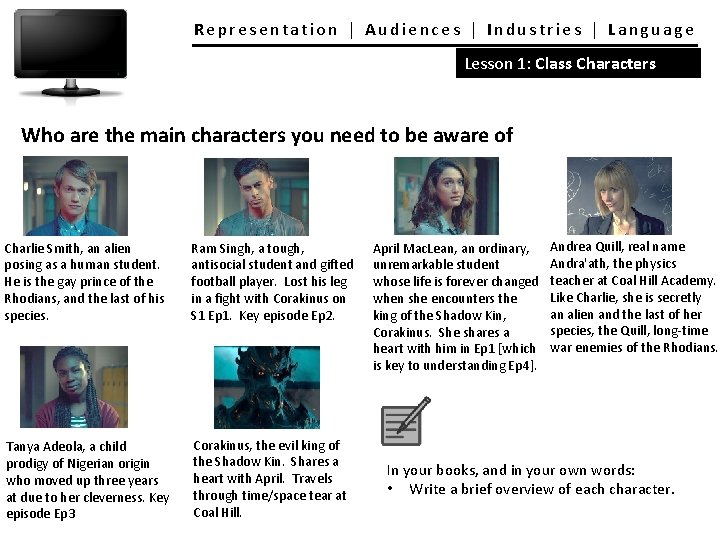
Representation │ Audiences │ Industries │ Language Lesson 1: Class Characters Who are the main characters you need to be aware of Charlie Smith, an alien posing as a human student. He is the gay prince of the Rhodians, and the last of his species. Ram Singh, a tough, antisocial student and gifted football player. Lost his leg in a fight with Corakinus on S 1 Ep 1. Key episode Ep 2. Tanya Adeola, a child prodigy of Nigerian origin who moved up three years at due to her cleverness. Key episode Ep 3 Corakinus, the evil king of the Shadow Kin. Shares a heart with April. Travels through time/space tear at Coal Hill. April Mac. Lean, an ordinary, unremarkable student whose life is forever changed when she encounters the king of the Shadow Kin, Corakinus. She shares a heart with him in Ep 1 [which is key to understanding Ep 4]. Andrea Quill, real name Andra'ath, the physics teacher at Coal Hill Academy. Like Charlie, she is secretly an alien and the last of her species, the Quill, long-time war enemies of the Rhodians. In your books, and in your own words: • Write a brief overview of each character.
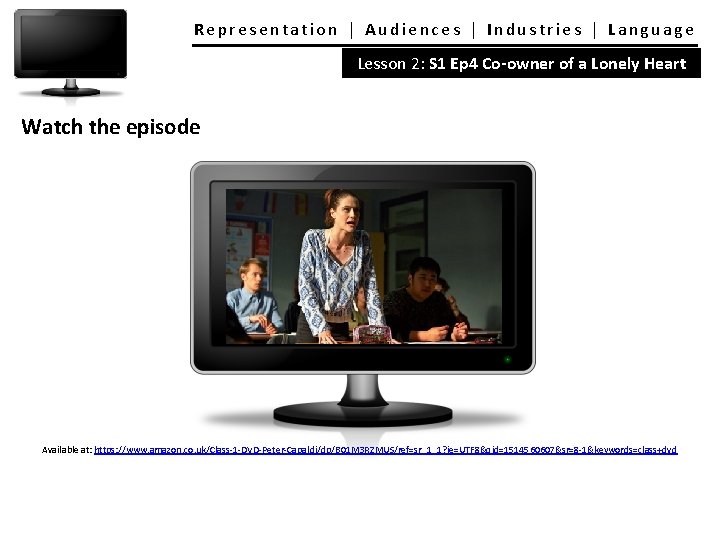
Representation │ Audiences │ Industries │ Language Lesson 2: S 1 Ep 4 Co-owner of a Lonely Heart Watch the episode Available at: https: //www. amazon. co. uk/Class-1 -DVD-Peter-Capaldi/dp/B 01 M 3 RZMUS/ref=sr_1_1? ie=UTF 8&qid=1514560607&sr=8 -1&keywords=class+dvd
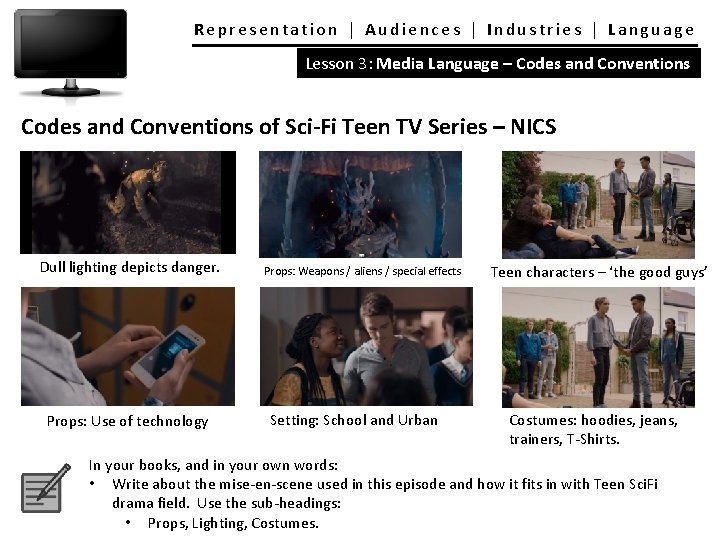
Representation │ Audiences │ Industries │ Language Lesson 3: Media Language – Codes and Conventions of Sci-Fi Teen TV Series – NICS Dull lighting depicts danger. Props: Use of technology Props: Weapons / aliens / special effects Setting: School and Urban Teen characters – ‘the good guys’ Costumes: hoodies, jeans, trainers, T-Shirts. In your books, and in your own words: • Write about the mise-en-scene used in this episode and how it fits in with Teen Sci. Fi drama field. Use the sub-headings: • Props, Lighting, Costumes.
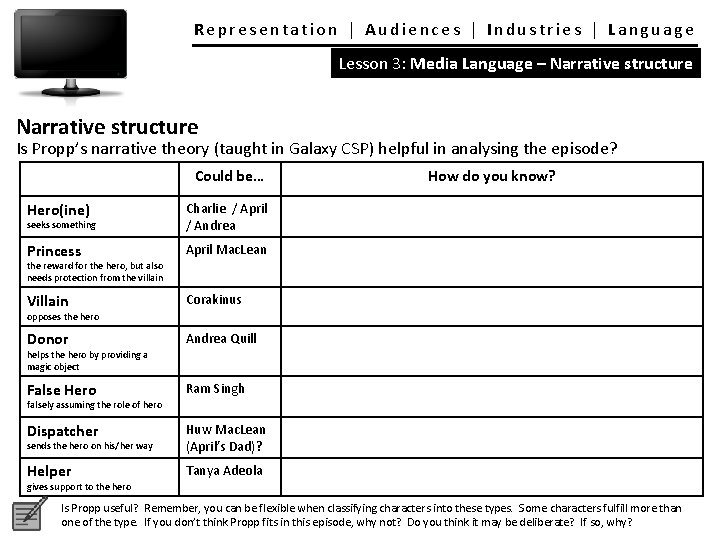
Representation │ Audiences │ Industries │ Language Lesson 3: Media Language – Narrative structure Is Propp’s narrative theory (taught in Galaxy CSP) helpful in analysing the episode? Could be… Hero(ine) seeks something Charlie / April / Andrea Princess April Mac. Lean Villain Corakinus Donor Andrea Quill False Hero Ram Singh Dispatcher sends the hero on his/her way Huw Mac. Lean (April’s Dad)? Helper Tanya Adeola How do you know? the reward for the hero, but also needs protection from the villain opposes the hero helps the hero by providing a magic object falsely assuming the role of hero gives support to the hero Is Propp useful? Remember, you can be flexible when classifying characters into these types. Some characters fulfill more than one of the type. If you don’t think Propp fits in this episode, why not? Do you think it may be deliberate? If so, why?
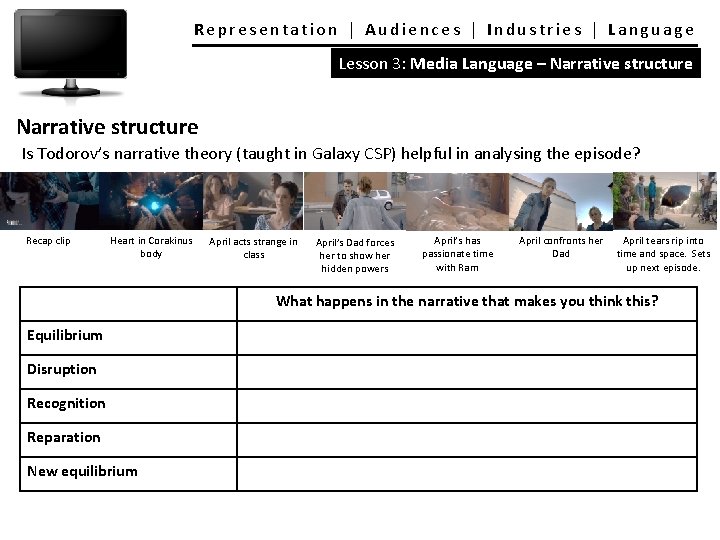
Representation │ Audiences │ Industries │ Language Lesson 3: Media Language – Narrative structure Is Todorov’s narrative theory (taught in Galaxy CSP) helpful in analysing the episode? Recap clip Heart in Corakinus body April acts strange in class April’s Dad forces her to show her hidden powers April’s has passionate time with Ram April confronts her Dad April tears rip into time and space. Sets up next episode. What happens in the narrative that makes you think this? Equilibrium Disruption Recognition Reparation New equilibrium
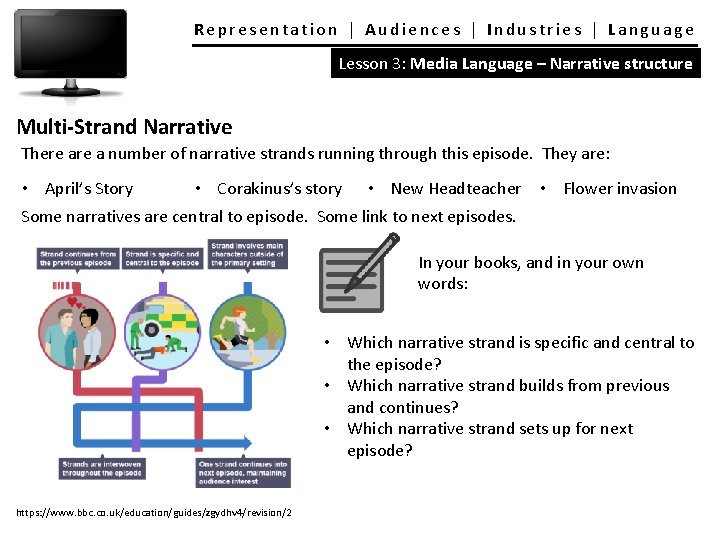
Representation │ Audiences │ Industries │ Language Lesson 3: Media Language – Narrative structure Multi-Strand Narrative There a number of narrative strands running through this episode. They are: • April’s Story • Corakinus’s story • New Headteacher Some narratives are central to episode. Some link to next episodes. • Flower invasion In your books, and in your own words: • Which narrative strand is specific and central to the episode? • Which narrative strand builds from previous and continues? • Which narrative strand sets up for next episode? https: //www. bbc. co. uk/education/guides/zgydhv 4/revision/2
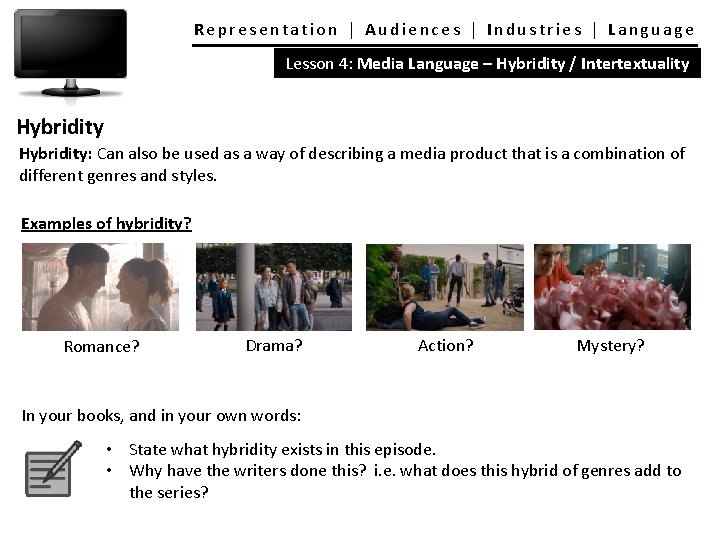
Representation │ Audiences │ Industries │ Language Lesson 4: Media Language – Hybridity / Intertextuality Hybridity: Can also be used as a way of describing a media product that is a combination of different genres and styles. Examples of hybridity? Romance? Drama? Action? Mystery? In your books, and in your own words: • State what hybridity exists in this episode. • Why have the writers done this? i. e. what does this hybrid of genres add to the series?
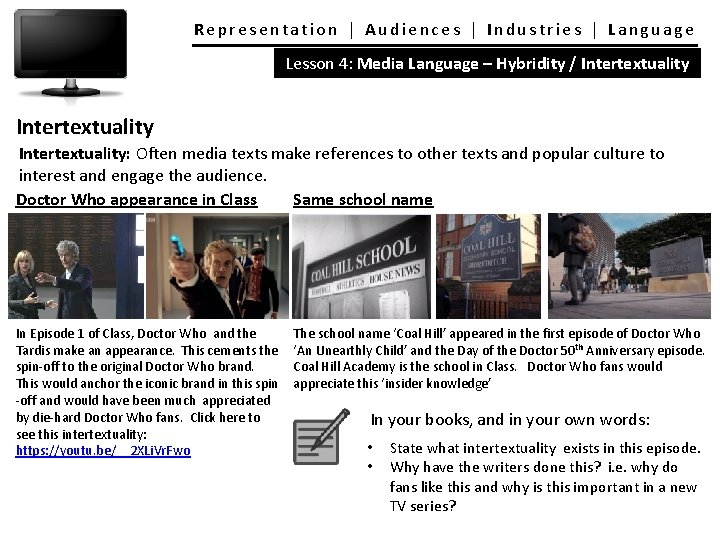
Representation │ Audiences │ Industries │ Language Lesson 4: Media Language – Hybridity / Intertextuality: Often media texts make references to other texts and popular culture to interest and engage the audience. Doctor Who appearance in Class Same school name In Episode 1 of Class, Doctor Who and the Tardis make an appearance. This cements the spin-off to the original Doctor Who brand. This would anchor the iconic brand in this spin -off and would have been much appreciated by die-hard Doctor Who fans. Click here to see this intertextuality: https: //youtu. be/__2 XLi. Vr. Fwo The school name ‘Coal Hill’ appeared in the first episode of Doctor Who ‘An Unearthly Child’ and the Day of the Doctor 50 th Anniversary episode. Coal Hill Academy is the school in Class. Doctor Who fans would appreciate this ‘insider knowledge’ In your books, and in your own words: • • State what intertextuality exists in this episode. Why have the writers done this? i. e. why do fans like this and why is this important in a new TV series?
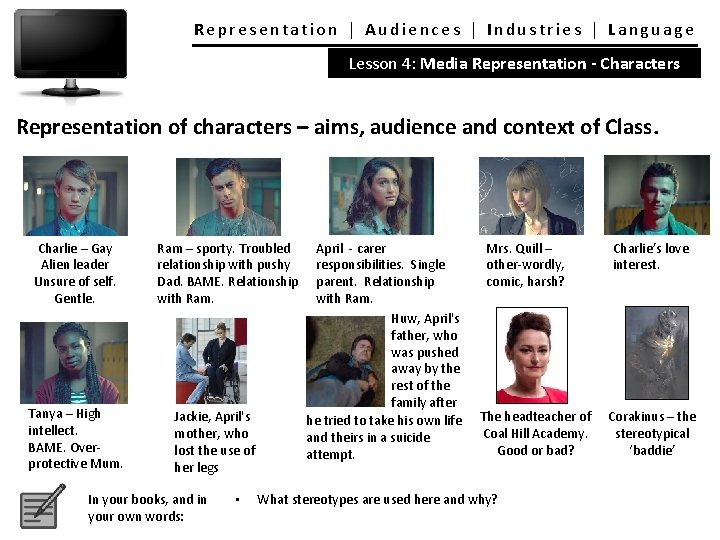
Representation │ Audiences │ Industries │ Language Lesson 4: Media Representation - Characters Representation of characters – aims, audience and context of Class. Charlie – Gay Alien leader Unsure of self. Gentle. Tanya – High intellect. BAME. Overprotective Mum. Ram – sporty. Troubled relationship with pushy Dad. BAME. Relationship with Ram. Jackie, April's mother, who lost the use of her legs In your books, and in your own words: • April - carer responsibilities. Single parent. Relationship with Ram. Huw, April's father, who was pushed away by the rest of the family after he tried to take his own life and theirs in a suicide attempt. Mrs. Quill – other-wordly, comic, harsh? The headteacher of Coal Hill Academy. Good or bad? What stereotypes are used here and why? Charlie’s love interest. Corakinus – the stereotypical ‘baddie’
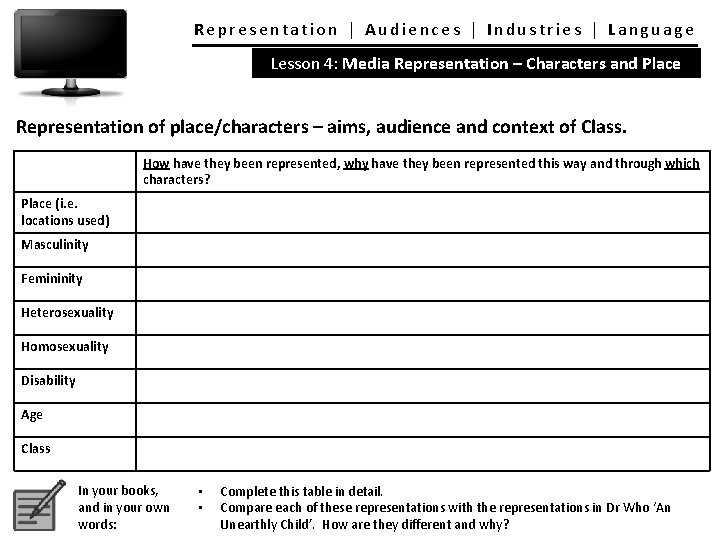
Representation │ Audiences │ Industries │ Language Lesson 4: Media Representation – Characters and Place Representation of place/characters – aims, audience and context of Class. How have they been represented, why have they been represented this way and through which characters? Place (i. e. locations used) Masculinity Femininity Heterosexuality Homosexuality Disability Age Class In your books, and in your own words: • • Complete this table in detail. Compare each of these representations with the representations in Dr Who ‘An Unearthly Child’. How are they different and why?
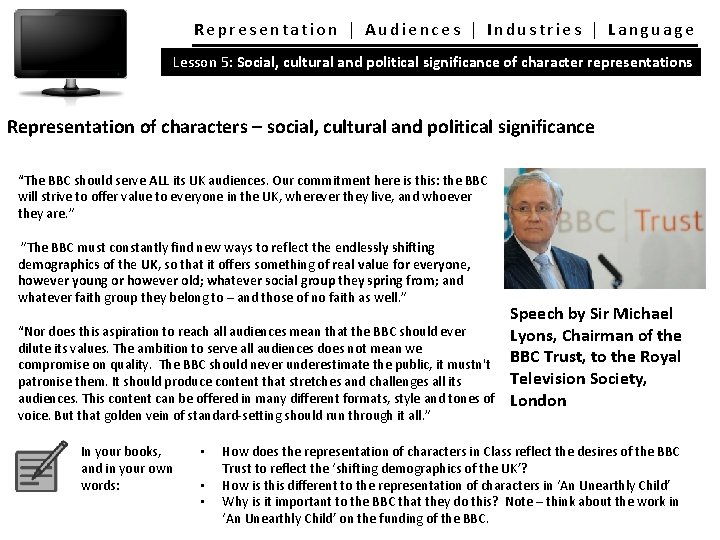
Representation │ Audiences │ Industries │ Language Lesson 5: Social, cultural and political significance of character representations Representation of characters – social, cultural and political significance “The BBC should serve ALL its UK audiences. Our commitment here is this: the BBC will strive to offer value to everyone in the UK, wherever they live, and whoever they are. ” ”The BBC must constantly find new ways to reflect the endlessly shifting demographics of the UK, so that it offers something of real value for everyone, however young or however old; whatever social group they spring from; and whatever faith group they belong to – and those of no faith as well. ” “Nor does this aspiration to reach all audiences mean that the BBC should ever dilute its values. The ambition to serve all audiences does not mean we compromise on quality. The BBC should never underestimate the public, it mustn't patronise them. It should produce content that stretches and challenges all its audiences. This content can be offered in many different formats, style and tones of voice. But that golden vein of standard-setting should run through it all. ” In your books, and in your own words: • • • Speech by Sir Michael Lyons, Chairman of the BBC Trust, to the Royal Television Society, London How does the representation of characters in Class reflect the desires of the BBC Trust to reflect the ‘shifting demographics of the UK’? How is this different to the representation of characters in ‘An Unearthly Child’ Why is it important to the BBC that they do this? Note – think about the work in ‘An Unearthly Child’ on the funding of the BBC.
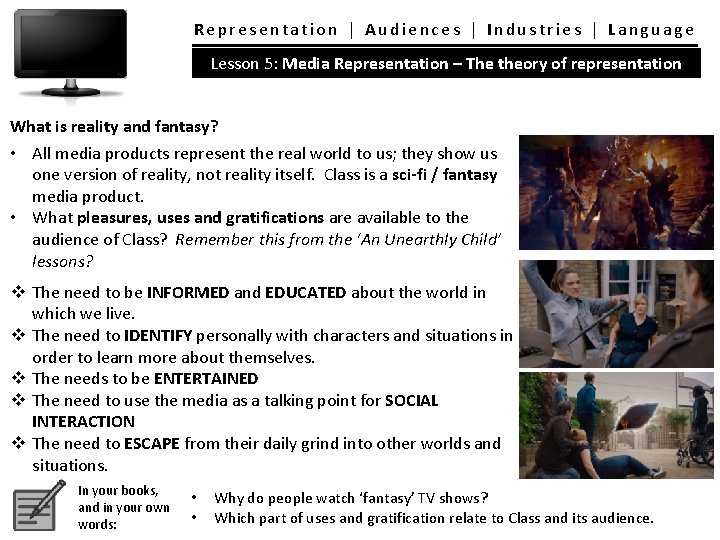
Representation │ Audiences │ Industries │ Language Lesson 5: Media Representation – The theory of representation What is reality and fantasy? • All media products represent the real world to us; they show us one version of reality, not reality itself. Class is a sci-fi / fantasy media product. • What pleasures, uses and gratifications are available to the audience of Class? Remember this from the ‘An Unearthly Child’ lessons? v The need to be INFORMED and EDUCATED about the world in which we live. v The need to IDENTIFY personally with characters and situations in order to learn more about themselves. v The needs to be ENTERTAINED v The need to use the media as a talking point for SOCIAL INTERACTION v The need to ESCAPE from their daily grind into other worlds and situations. In your books, and in your own words: • • Why do people watch ‘fantasy’ TV shows? Which part of uses and gratification relate to Class and its audience.
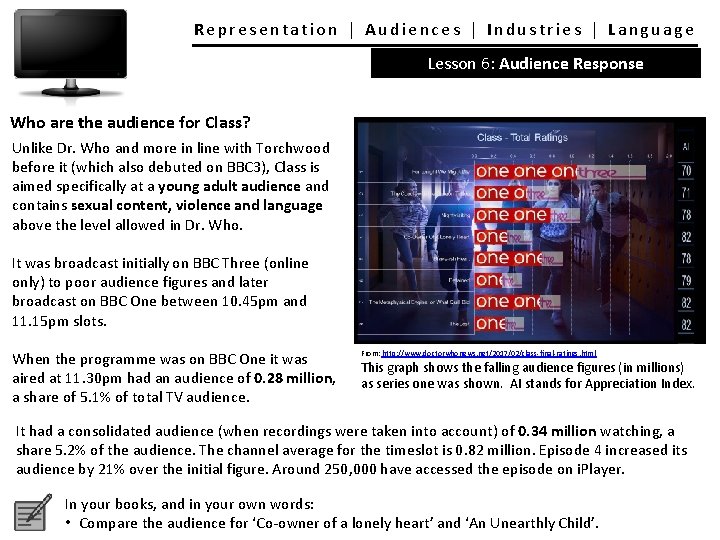
Representation │ Audiences │ Industries │ Language Lesson 6: Audience Response Who are the audience for Class? Unlike Dr. Who and more in line with Torchwood before it (which also debuted on BBC 3), Class is aimed specifically at a young adult audience and contains sexual content, violence and language above the level allowed in Dr. Who. It was broadcast initially on BBC Three (online only) to poor audience figures and later broadcast on BBC One between 10. 45 pm and 11. 15 pm slots. When the programme was on BBC One it was aired at 11. 30 pm had an audience of 0. 28 million, a share of 5. 1% of total TV audience. From: http: //www. doctorwhonews. net/2017/02/class-final-ratings. html This graph shows the falling audience figures (in millions) as series one was shown. AI stands for Appreciation Index. It had a consolidated audience (when recordings were taken into account) of 0. 34 million watching, a share 5. 2% of the audience. The channel average for the timeslot is 0. 82 million. Episode 4 increased its audience by 21% over the initial figure. Around 250, 000 have accessed the episode on i. Player. In your books, and in your own words: • Compare the audience for ‘Co-owner of a lonely heart’ and ‘An Unearthly Child’.
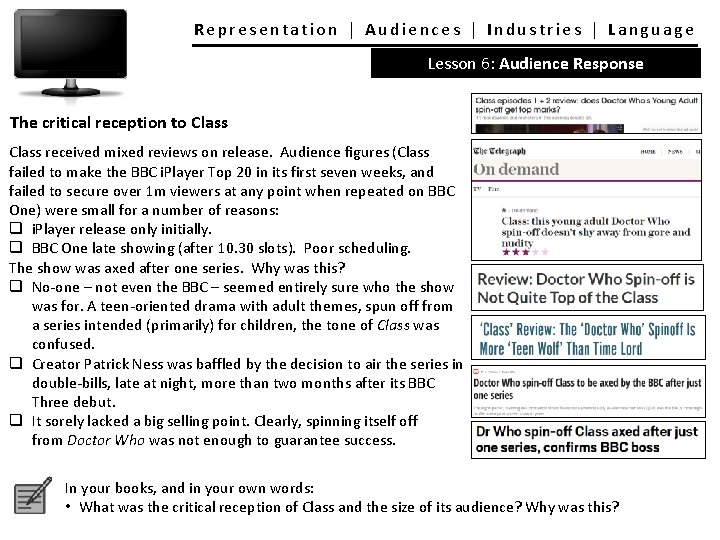
Representation │ Audiences │ Industries │ Language Lesson 6: Audience Response The critical reception to Class received mixed reviews on release. Audience figures (Class failed to make the BBC i. Player Top 20 in its first seven weeks, and failed to secure over 1 m viewers at any point when repeated on BBC One) were small for a number of reasons: q i. Player release only initially. q BBC One late showing (after 10. 30 slots). Poor scheduling. The show was axed after one series. Why was this? q No-one – not even the BBC – seemed entirely sure who the show was for. A teen-oriented drama with adult themes, spun off from a series intended (primarily) for children, the tone of Class was confused. q Creator Patrick Ness was baffled by the decision to air the series in double-bills, late at night, more than two months after its BBC Three debut. q It sorely lacked a big selling point. Clearly, spinning itself off from Doctor Who was not enough to guarantee success. In your books, and in your own words: • What was the critical reception of Class and the size of its audience? Why was this?
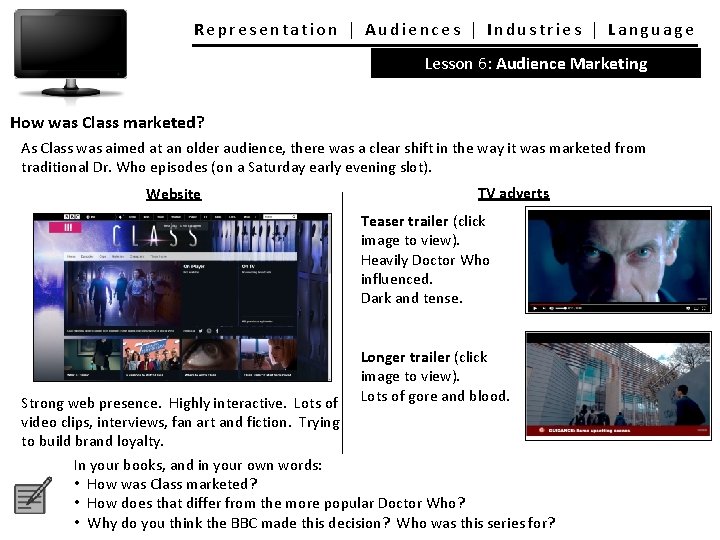
Representation │ Audiences │ Industries │ Language Lesson 6: Audience Marketing How was Class marketed? As Class was aimed at an older audience, there was a clear shift in the way it was marketed from traditional Dr. Who episodes (on a Saturday early evening slot). Website TV adverts Teaser trailer (click image to view). Heavily Doctor Who influenced. Dark and tense. Longer trailer (click image to view). Lots of gore and blood. Strong web presence. Highly interactive. Lots of video clips, interviews, fan art and fiction. Trying to build brand loyalty. In your books, and in your own words: • How was Class marketed? • How does that differ from the more popular Doctor Who? • Why do you think the BBC made this decision? Who was this series for?
Representation │ Audiences │ Industries │ Language Lesson 6: Audience Marketing How was Class distributed? Media Distribution is a term for the way the product was distributed. In the case of Class it was originally distributed (shown) online only on BBC Three: It was the shown weeks later in a late night slot “the graveyard slot” on BBC One: It was also shown on BBC America where is was more popular. The distribution model may have been part of it’s downfall: “Class seemed to be fighting a losing battle from its offset. It did seem, at least initially, that for the BBC it was used as an incentive to lure viewers towards the newly formatted BBC 3 and the world of online streaming instead of allowing the show the opportunity to present itself to audiences on television or even on already established streaming services such as Netflix or Amazon. Following the sacrifice of its own accessibility, the BBC then aired the series on BBC 1 – but restricted the series to air two episodes at a time to occupy the graveyard shift. Not only was the show let down by its distribution format, but also strangely by Doctor Who’s own marketing team, with support for the show largely (and suspiciously) absent from the parent show’s social media accounts and magazine covers to name a few. ” From http: //www. doctorwhotv. co. uk/a-song-for-the-lost-what-we-can-learn-from-class-86190. htm In your books, and in your own words: • What channels did Class show on? • Why was the distribution of Class perceived as a problem?
Representation │ Audiences │ Industries │ Language Lesson 7: BBC Three What is BBC Three and how does it fit into the profile of the BBC remit? BBC Three launched as a TV channel in 2003 and it’s remit was to provide "innovative" programming to a target audience of viewers between 16 and 34 years old. “The remit of BBC Three is to bring younger audiences to high quality public service broadcasting through a mixed-genre schedule of innovative UK content featuring new UK talent. The channel should use the full range of digital platforms to deliver its content and to build an interactive relationship with its audience. The channel's target audience is 16– 34 -year-olds. ” BBC Remit Until February 2016, BBC Three aired as a freeview TV channel. However, as a result of planned £ 100 million budget cut across the BBC, it was proposed that BBC Three be discontinued as a television service, and be converted to online only. The TV channel ceased operations on 16 February 2016, replaced by an online-only version. The BBC recognised that younger people may watch TV at different times, on different devices using different services (i. Player, You. Tube, Netflix, etc) Regulating (ie ensuring TV services meet acceptable standards – discussed in ‘An Unearthly Child’ unit] is still done by Ofcom. Online providers still need to meet the same standards agreed by Ofcom or they could get their broadcasting licence revoked. It is, though, more difficult with some streaming services outside of UK control and services like You. Tube. See the full list here. In your books, and in your own words: • Who was the audience for BBC Three? Original TV logo Current web logo • Why was the TV channel removed? • Why did the BBC think that online was appropriate for that audience?
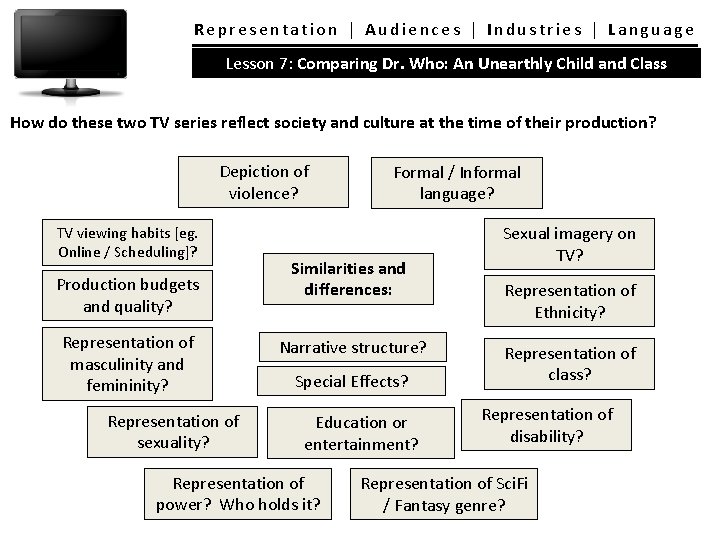
Representation │ Audiences │ Industries │ Language Lesson 7: Comparing Dr. Who: An Unearthly Child and Class How do these two TV series reflect society and culture at the time of their production? Depiction of violence? TV viewing habits [eg. Online / Scheduling]? Production budgets and quality? Representation of masculinity and femininity? Representation of sexuality? Formal / Informal language? Similarities and differences: Narrative structure? Special Effects? Education or entertainment? Representation of power? Who holds it? Sexual imagery on TV? Representation of Ethnicity? Representation of class? Representation of disability? Representation of Sci. Fi / Fantasy genre?
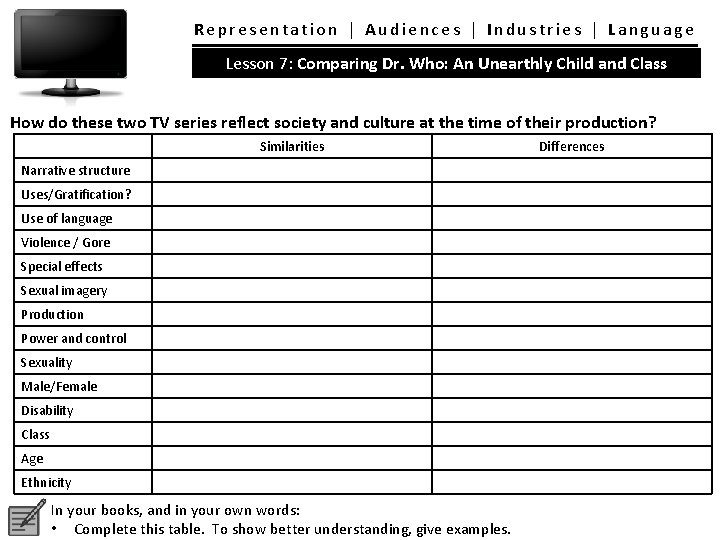
Representation │ Audiences │ Industries │ Language Lesson 7: Comparing Dr. Who: An Unearthly Child and Class How do these two TV series reflect society and culture at the time of their production? Similarities Narrative structure Uses/Gratification? Use of language Violence / Gore Special effects Sexual imagery Production Power and control Sexuality Male/Female Disability Class Age Ethnicity In your books, and in your own words: • Complete this table. To show better understanding, give examples. Differences
Representation │ Audiences │ Industries │ Language This concludes the Class: Co-owner of a Lonely Heart Close Study Product. You will be required to use some comparison skills when you have completed the Doctor Who first episode CSP, An Unearthly Child
- Slides: 24