
Reporting requirements of Land use Land use change
- Slides: 23
Reporting requirements of Land use, Land use change and Forestry sector under the United Nations Framework Convention on Climate Change (UNFCCC) Tuija Lapveteläinen 14. 12. 2011 Finnish Meteorological Institute, Helsinki, Finland
Content • LULUCF sector reporting requirements under UNFCCC Kyoto Protocol • LULUCF sector reporting in Finland (latest inventory figures) 27/11/2020 2
Essential background • The ultimate objective of the UNFCCC set in 1992 is to stabilize atmospheric concentrations of GHGs at a level that will prevent dangerous interference with the climate system (In 2010, governments agreed that emissions need to be reduced so that global temperature increases are limited to below 2 degrees Celsius) • Kyoto Protocol (1997) sets binding targets for 37 industrialized countries (Annex I parties) and the European community for reducing greenhouse gas (GHG) emissions. These reductions amount to an average of five per cent against 1990 levels over the five-year period 2008 -2012 Finland ‘s obligation to keep it’s emissions at the level of 1990 emissions during the CP. The allowable level of emissions is called the Party’s assigned amount • Each Annex I Party is required to establish and maintain a national system for the estimation of anthropogenic emissions by sources and removals by sinks 27/11/2020 3
• Greenhouse gas inventory covers human induces emissions and removals from CO 2, N 2 O, CH 4 and F-gases from 7 sectors from 1990 to latest reporting year: Energy, Industrial processes, Solvent and other product use, Agriculture, Land use, land use change and forestry (LULUCF), Waste and Other • Annex I Parties have to to submit an annual national GHG emission inventory by 15 April of each year, as required by the Convention, plus supplementary information on its implementation of the Kyoto Protocol (EU monitoring mechanism) • Reporting and calculations methods and guidance for inventories is provided in IPCC Guidelines • Inventories have to meet the quality requirements (timeliness, completeness, comparability, consistency, accuracy and transparency) • Inventories are reviewed annually by the expert review teams (ERT) adjustments, if quality requirements are not met 27/11/2020 4
Reporting of emissions and removals from land use, land use change and forestry-sector (LULUCF) under the UNFCCC • Guidance for reporting provided in IPCC GPG LULUCF (IPCC 2003) • The whole country area divided to six land use categories (FL, CL, GL, WL, S, OL) • Separation of managed vs. unmanaged lands, emissions and removals reported only from the managed lands • Further division to land remaining in the same land use category and land converted from other land use (default assumption 20 years) 27/11/2020 5
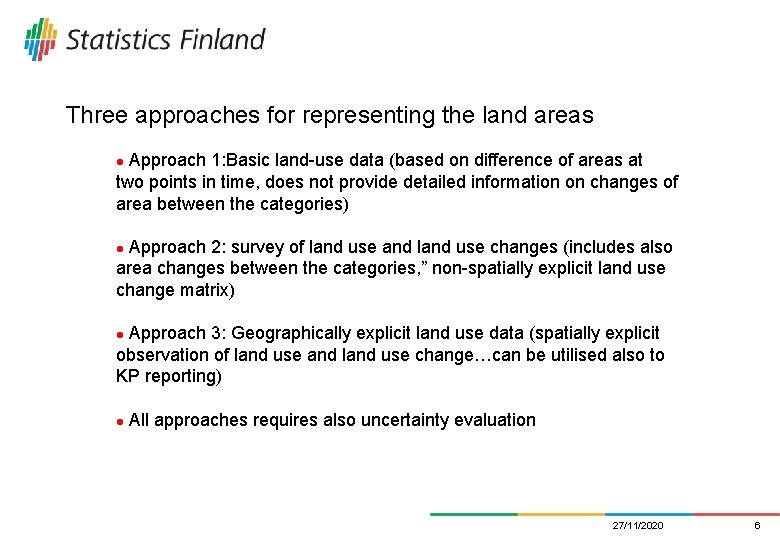
Three approaches for representing the land areas Approach 1: Basic land-use data (based on difference of areas at two points in time, does not provide detailed information on changes of area between the categories) l Approach 2: survey of land use and land use changes (includes also area changes between the categories, ” non-spatially explicit land use change matrix) l Approach 3: Geographically explicit land use data (spatially explicit observation of land use and land use change…can be utilised also to KP reporting) l l All approaches requires also uncertainty evaluation 27/11/2020 6
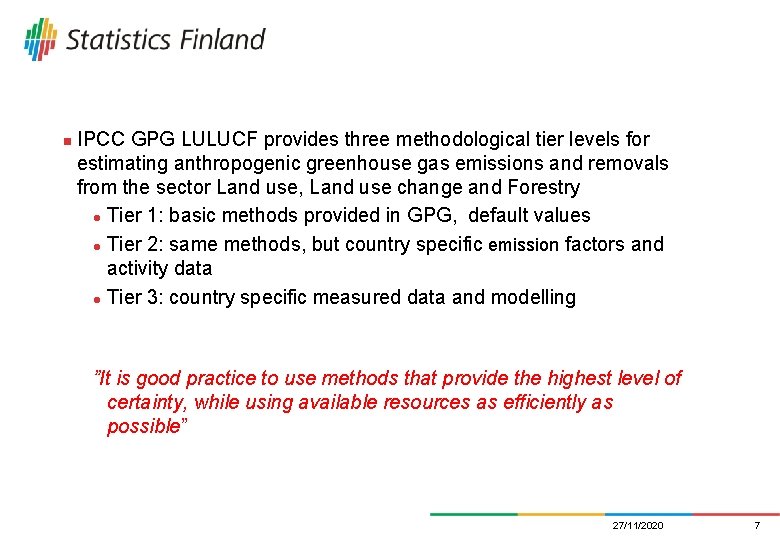
n IPCC GPG LULUCF provides three methodological tier levels for estimating anthropogenic greenhouse gas emissions and removals from the sector Land use, Land use change and Forestry l Tier 1: basic methods provided in GPG, default values l Tier 2: same methods, but country specific emission factors and activity data l Tier 3: country specific measured data and modelling ”It is good practice to use methods that provide the highest level of certainty, while using available resources as efficiently as possible” 27/11/2020 7
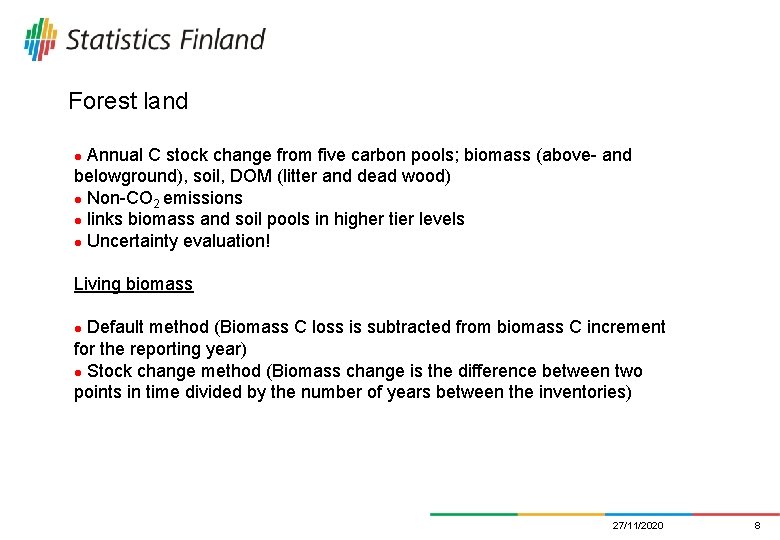
Forest land Annual C stock change from five carbon pools; biomass (above- and belowground), soil, DOM (litter and dead wood) l Non-CO 2 emissions l links biomass and soil pools in higher tier levels l Uncertainty evaluation! l Living biomass Default method (Biomass C loss is subtracted from biomass C increment for the reporting year) l Stock change method (Biomass change is the difference between two points in time divided by the number of years between the inventories) l 27/11/2020 8
Dead organic matter, DOM l Separation of dead wood and litter l Default assumption: no change on C stock l Needs to be estimated when using Tier 2 -3 methods methodology where transfer into and out of the C pool is estimated or use of stock change method l 27/11/2020 9
Soils l Separation of mineral and organic soils Default assumption for mineral soils no change in C stock, for organic soils Tier 1 methodology including emission factors provided in IPCC GPG LULUCF l In Tier 2 methodology changes in soil organic C stocks on mineral soils are calculated with ”factors” reflecting the changes in carbon stock compared to reference C stock of native, unmanaged forest soils (change in the forest type, management intensity and in disturbance regime). In organic soils country specific EF’s should be used l Tier 3 requires country specific methodologies and parameters, empirical and/or process based modeling l 27/11/2020 10
l Non-CO 2 emissions: l Forest fires (CO 2, N 2 O, CH 4, CO, NOx). Both wildfires and controlled burnings on managed forest land have to be reported l N fertilization on forest land l Liming of forest soils l N 2 O emissions from drained organic forest soils (not mandatory so far) 27/11/2020 11
LULUCF sector reporting in Kyoto Protocol l LULUF sector is only partially included in the KP reporting Parties have to report emissions and removals related to direct human induced conversion of forest land area since 1990 , article 3. 3 ghg emissions and removals resulting from activities afforestation, reforestation and deforestation since 1990 (mandatory) l In addition parties may report under KP article 3. 4 GHG-emissions and removals from following activities ; a) forest management, b) cropland management, c) grazingland management and revegetation since 1990 (decision made in Parties initial reports) l KP reporting requieres some supplementary information to be reported compared to the UNFCCC inventory reporting l 27/11/2020 12
• Reported land areas subject to the activities under article 3. 3 and 3. 4 must be identifiable methods used in UNFCCC land area estimation may need to be complemented with additional spatial data so that the reporting requirements under the Kyoto Protocol are met • Method 1 (broad area identification) use geographic boundary/ies that encompasses units of land or lands subject to multiple activities • Method 2 (complete identification) provides the geographic boundary/ies that encompasses units of land or lands subject to a single activity • Parties have to define the national definition forest within the following limits: “Forest” is a minimum area of land of 0. 05– 1. 0 ha with tree crown cover (or equivalent stocking level) of more than 10– 30 per cent with trees with the potential to reach minimum height of 2– 5 metres at maturity in situ 27/11/2020 13
l l l If emissions/removals from any of the carbon pools are not reported, parties should provide verifiable information in the national inventory report that the pool is not a net source of emissions Tier 2 or 3 methods should be applied to all pools, unless the Party chooses not to report a certain pool and demonstrate that the pool is not a source A more detailed classification of the different carbon pools is used in the Kyoto Protocol tables than in UNFCCC reporting Once land is accounted for under the LULUCF activities, reporting shall continue throughout subsequent and contiguous commitment periods 27/11/2020 14
LULUCF sector accounting rules under the KP • KP restricts the accounting of the LULUCF sector to net emissions and removals from specific activities under Article 3, paragraphs 3 and 4, of the Kyoto Protocol • Each activity under article 3, paragraphs 3 and 4, is subject to different accounting rules (net-net for CM, GM, RV, gross-net for ARD and FM) • The accounting of emissions and removals from article 3. 3 and 3. 4 (issuance of RMUs) can be done annually or at the end of the commitment period • Each Party is subject to a country specific ‘forest management cap’ that applies to both additions to and subtractions from its assigned amount • Party is allowed to use article 3. 4 Forest management net sinks to compensate net emissions from ARD-activities 27/11/2020 15
LULUCF sector reporting in Finland • Calculations and reporting made by Finnish Forest Research Institute (Metla) and Agrifood Finland (MTT) • The area estimates for the all land-use categories are based on the Finnish National Forest Inventories (NFI) carried out by the Metla. The NFI is a samplingbased forest inventory system and it covers all land-use classes. To have a complete data of NFI, five years measurements are needed. • All NFI data are reclassified according to the IPCC land-use categories • Area estimates are made separately for South and North Finland for mineral and organic soils 27/11/2020 16
• The method for estimating areas of land-use changes between 19902010 is the same in the Convention and Kyoto Protocol reporting. In the Convention reporting the older NFI data is utilised for estimation of landuse changes before 1990 • For Kyoto reporting (FM, and ARD areas) NFI plots are doublechecked from old map data, satellite images and thematic maps to find land-use changes which were not recorded on the field. Aerial images are employed for the final checking of land-use changes 27/11/2020 17
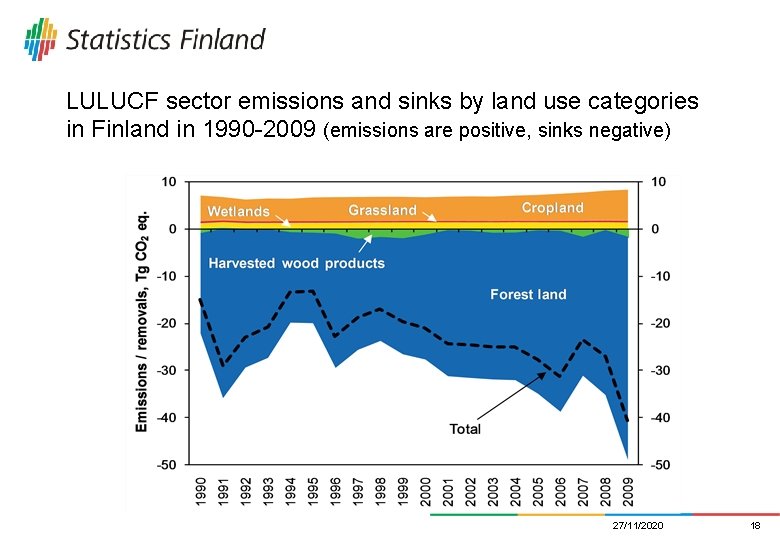
LULUCF sector emissions and sinks by land use categories in Finland in 1990 -2009 (emissions are positive, sinks negative) 27/11/2020 18
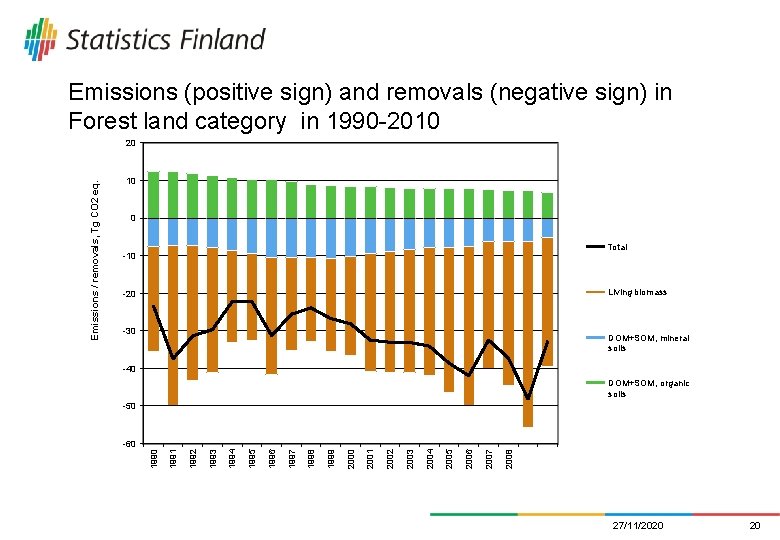
Forest land under the UNFCCC • Finland reports all the forests as managed, separation to South-Finland North-Finland • Forest land is defined as land with a tree crown cover, or equivalent stocking level, of more than 10% and an area of more than 0. 25 ha in South Finland 0. 5 ha in North Finland. The trees should be able to reach a minimum height of 5 m at maturity in situ. • Under the forest land Finland reports both sinks and emissions • In 2010 forests were in total a net sink of -33 mil. t CO 2 eq (tree biomass 34 mill t of CO 2) • Drained organic forest soils were a source of 6, 8 mil t CO 2 eq, mineral soils a sink of 5, 2 mil t CO 2 eq. in 2010 27/11/2020 19
Emissions (positive sign) and removals (negative sign) in Forest land category in 1990 -2010 10 0 Total -10 Living biomass -20 -30 DOM+SOM, mineral soils -40 DOM+SOM, organic soils -50 2008 2007 2006 2005 2004 2003 2002 2001 2000 1999 1998 1997 1996 1995 1994 1993 1992 1991 -60 1990 Emissions / removals, Tg CO 2 eq. 20 27/11/2020 20
LULUCF KP reporting in Finland • Finland elected Forest management under the KP art. 3. 4 • FM was a net sink of 31, 8 mil. t CO 2 -ekv in 2010 • Net emission from ARD (article 3. 3) in Finland amounted 4 mil. t CO 2 eq in 2010 • Election of FM important to Finland, because the compensation option of the ARD- net emissions during the 1 st CP • In addition FM cap for Finland 0, 58 mil. t CO 2/year (in total 2, 93 mil. t CO 2 during the 1 st CP ) • Finland was allowed to utilize 14 percent of the total FM sink in 2010 (compensation + FM cap) 27/11/2020 21
LULUCF in 2 nd CP of KP • In Durban Climate change conference last week some decision were made concerning LULUCF sector calculations in the second commitment period of KP • Article 3. 3 (ARD) continues as mandatory, but no compensation option with FM sinks • Forest management as part of mandatory reporting • FM calculation method: Reference level method, where country specific FM projections for the 2013 -2020 (reference level) is compared with the actual FM sinks/emissions during those years • For FM a cap of 3, 5 percent from the year 1990 total emissions without LULUCF • New IPCC 2006 Guidelines in use with updated methodologies and some new requirement also for the LULUCF sector 27/11/2020 22
Thank you! 27/11/2020 23