
Reporting Introduction There are two main ways of

- Slides: 20
Reporting
Introduction There are two main ways of reporting people’s words, thoughts, beliefs, etc. § Direct Speech § Indirect Speech
Direct Speech We can give the exact words (more or less) that were said, or that we imagine were thought. § Did she say, “What do you want? ” § And then I thought, “Well, does he really mean it? ”
Indirect Speech We can make a speaker’s words or thoughts part of our own sentence, using conjunctions (e. g. that), and changing pronouns, tenses and other words where necessary. § Did she just ask what I wanted? § And then I wondered whether he really meant it.
Mixing Structures These two structures cannot normally be mixed. § She said to me “I have got no money” and asked me for help. OR § She said to me that she had got no money and asked me for help. NOT She said to me that I have got no money and asked me for help.
Basic Rules for Indirect Speech § Change of Situation § Pronouns § “Here and Now” Words § Tenses § Dropping that § Questions and Answers § Actions
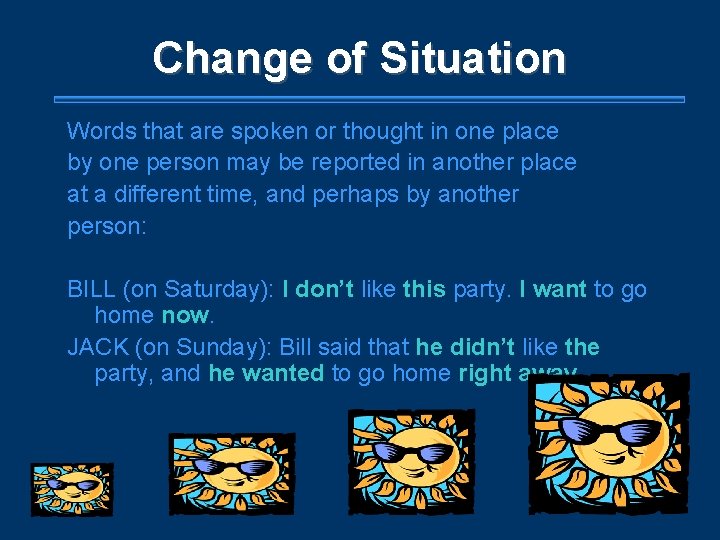
Change of Situation Words that are spoken or thought in one place by one person may be reported in another place at a different time, and perhaps by another person: BILL (on Saturday): I don’t like this party. I want to go home now. JACK (on Sunday): Bill said that he didn’t like the party, and he wanted to go home right away.
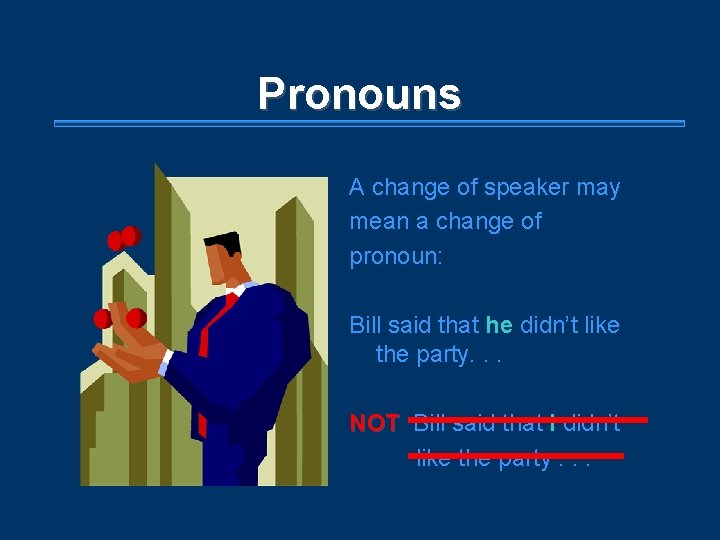
Pronouns A change of speaker may mean a change of pronoun: Bill said that he didn’t like the party. . . NOT Bill said that I didn’t like the party. . .
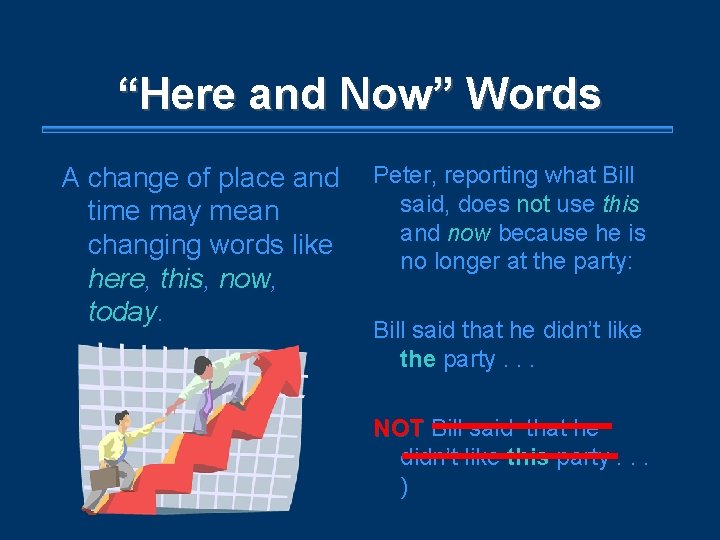
“Here and Now” Words A change of place and time may mean changing words like here, this, now, today. Peter, reporting what Bill said, does not use this and now because he is no longer at the party: Bill said that he didn’t like the party. . . NOT Bill said that he didn’t like this party. . . )
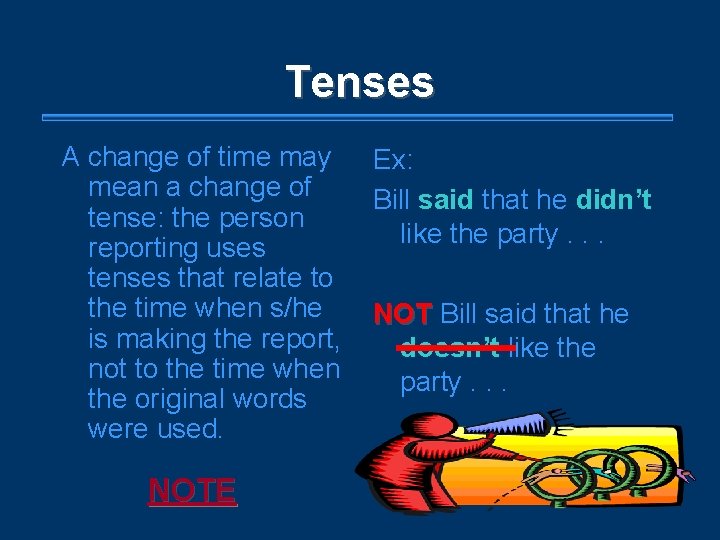
Tenses A change of time may mean a change of tense: the person reporting uses tenses that relate to the time when s/he is making the report, not to the time when the original words were used. NOTE Ex: Bill said that he didn’t like the party. . . NOT Bill said that he doesn’t like the party. . .
NOTE It is not always necessary to change the verb when you use reported speech. If you report something and it is still true, you do not need to change the verb: § Tom said that New York is more lively than London. (New York is still more lively than London. )
Dropping that The conjunction that is often dropped, esp. after common reporting verbs (e. g. say, think) in informal speech. § I think (that) you’re probably right.
Questions and Answers § Reported Questions § Question Marks § Yes/No Questions § Say and Tell
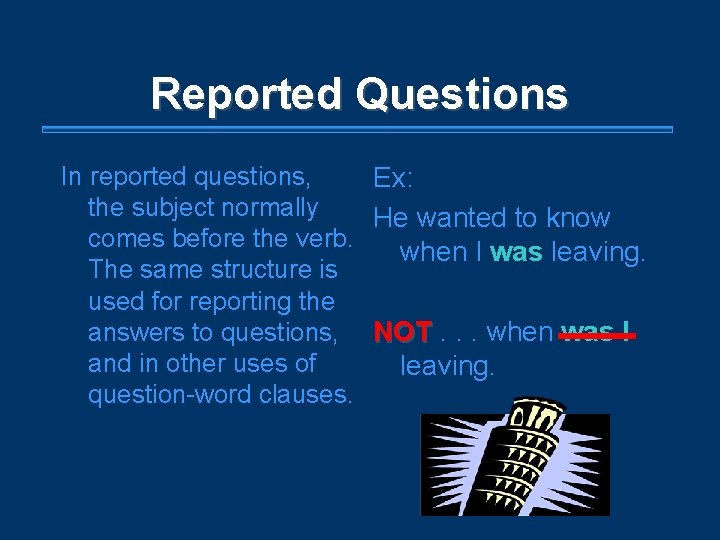
Reported Questions In reported questions, Ex: the subject normally He wanted to know comes before the verb. when I was leaving. The same structure is used for reporting the answers to questions, NOT. . . when was I and in other uses of leaving. question-word clauses.
Question Marks Question marks are not used in reported questions: § We asked where the money was. NOT. . . where the money was?
Yes/No Questions Yes/no questions are reported with if or whether. The driver asked if/whether I wanted the town center.
Say and Tell Say and tell are not used to report questions. NOT The driver said whether I wanted the town center.
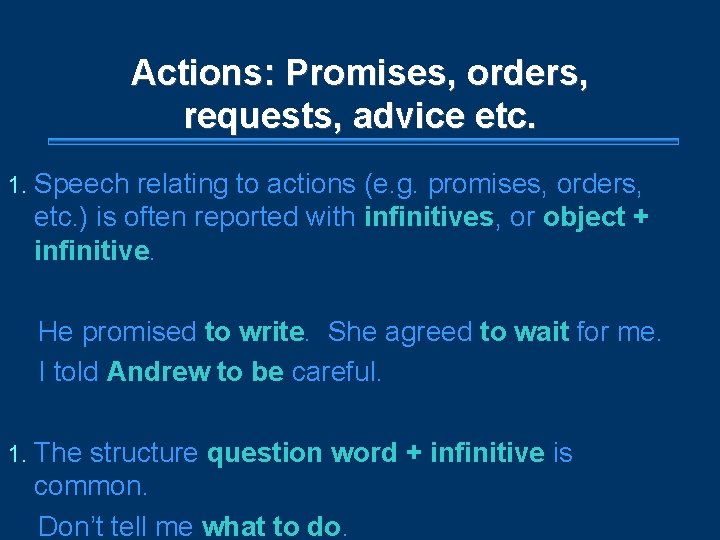
Actions: Promises, orders, requests, advice etc. 1. Speech relating to actions (e. g. promises, orders, etc. ) is often reported with infinitives, or object + infinitive. He promised to write. She agreed to wait for me. I told Andrew to be careful. 1. The structure question word + infinitive is common. Don’t tell me what to do.
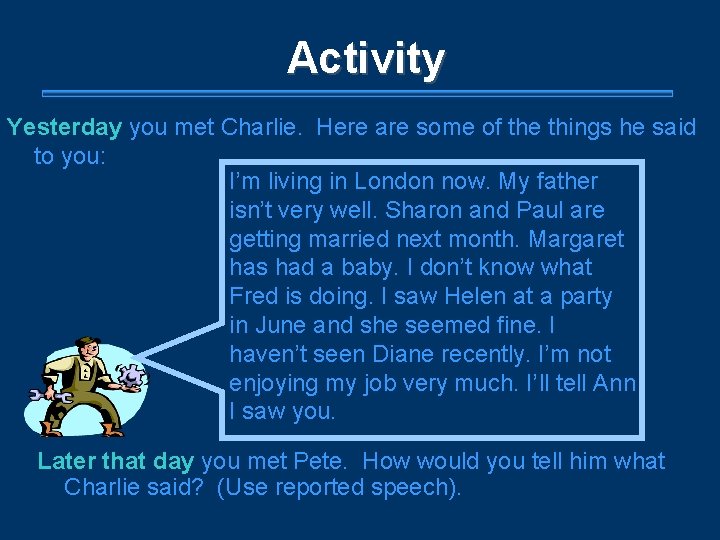
Activity Yesterday you met Charlie. Here are some of the things he said to you: I’m living in London now. My father isn’t very well. Sharon and Paul are getting married next month. Margaret has had a baby. I don’t know what Fred is doing. I saw Helen at a party in June and she seemed fine. I haven’t seen Diane recently. I’m not enjoying my job very much. I’ll tell Ann I saw you. Later that day you met Pete. How would you tell him what Charlie said? (Use reported speech).
Where can you go for more exercises and advanced points on reporting? § R. Murphy’s English Grammar in Use, 2 nd Edition, Cambridge University, 1994, pp. 92 -95. § M. Swan’s Practical English Usage, New Edition, Oxford, 1997, pp. 500 -507.