
Reporting Health Insurance Coverage for Individuals and Families
- Slides: 45
Reporting Health Insurance Coverage for Individuals and Families: Individual Shared Responsibility Provision & Premium Tax Credit Richard G. Furlong, Jr. Senior Stakeholder Liaison Internal Revenue Service December 17, 2014 1
The information contained in this presentation is current as of December 2014: • This presentation makes references to draft forms and instructions. • Check IRS. gov for final forms and instructions before filing. • For the latest information about tax provisions of the Affordable Care Act, visit IRS. gov/ACA. 2
Agenda Ø Health Insurance Marketplace Ø Individual Shared Responsibility Provision (ISRP) • Minimum Essential Coverage • Coverage Exemptions • Form 8965, Health Coverage Exemptions Ø Health Insurance Premium Tax Credit (PTC) • Eligibility • Advance Payments of Premium Tax Credit • Form 8962 , Premium Tax Credit Ø Resources 3
HHS & Role of the Health Insurance Marketplace • HHS: Administers the Marketplace and advance payments of PTC and other financial assistance • Marketplace: Health Insurance options, purchases & financial assistance • Health. Care. gov has more information 4
Individual Shared Responsibility Provision (ISRP) 5
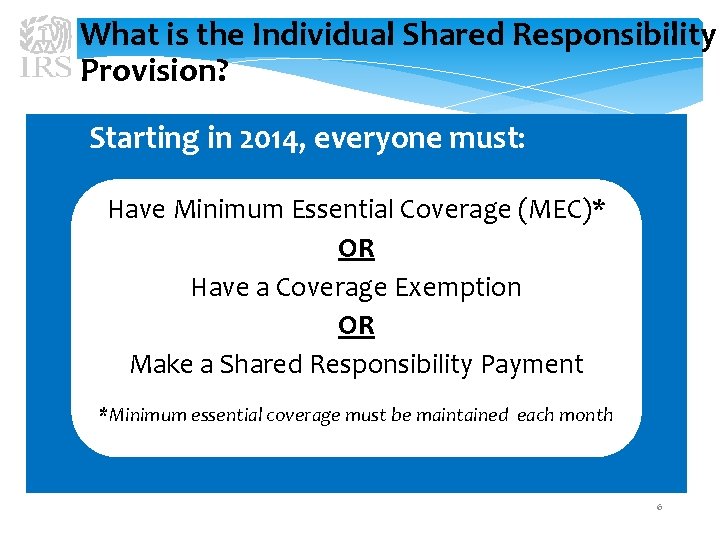
What is the Individual Shared Responsibility Provision? Starting in 2014, everyone must: Have Minimum Essential Coverage (MEC)* OR Have a Coverage Exemption OR Make a Shared Responsibility Payment *Minimum essential coverage must be maintained each month 6
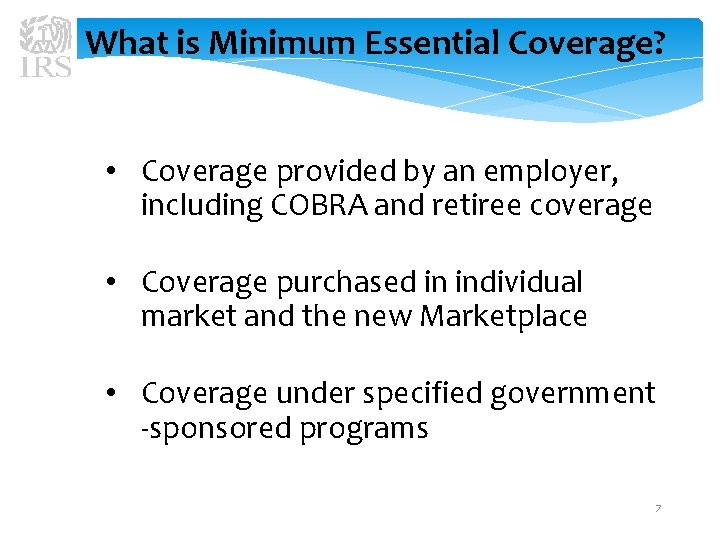
What is Minimum Essential Coverage? • Coverage provided by an employer, including COBRA and retiree coverage • Coverage purchased in individual market and the new Marketplace • Coverage under specified government -sponsored programs 7
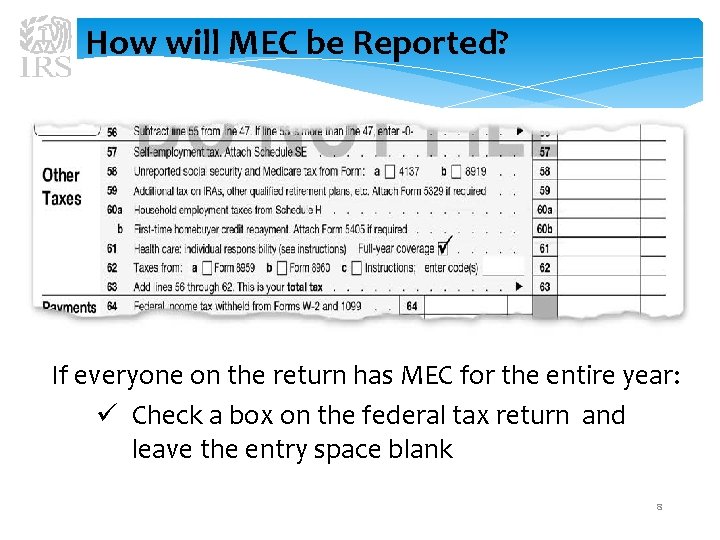
How will MEC be Reported? If everyone on the return has MEC for the entire year: ü Check a box on the federal tax return and leave the entry space blank 8
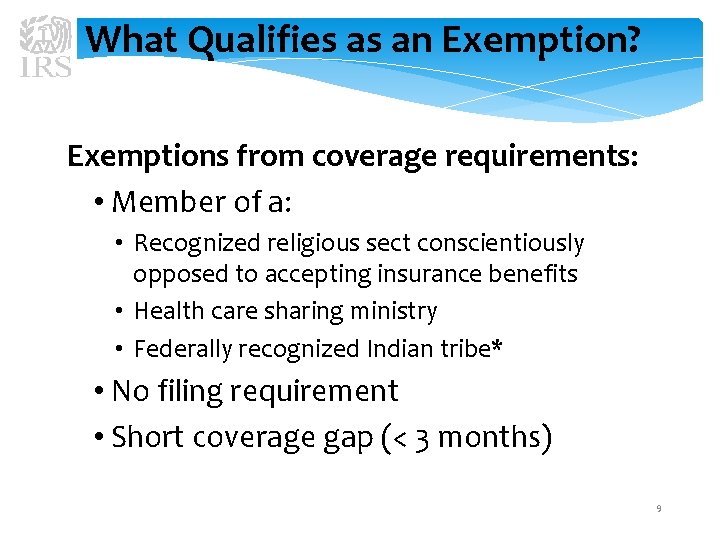
What Qualifies as an Exemption? Exemptions from coverage requirements: • Member of a: • Recognized religious sect conscientiously opposed to accepting insurance benefits • Health care sharing ministry • Federally recognized Indian tribe* • No filing requirement • Short coverage gap (< 3 months) 9
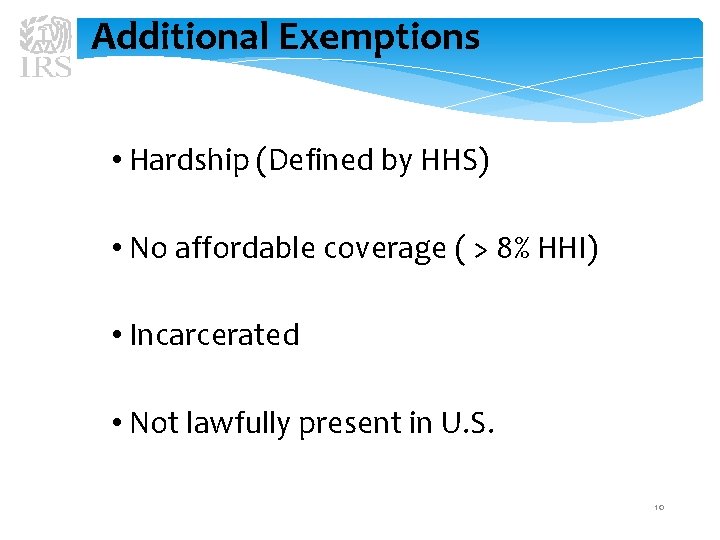
Additional Exemptions • Hardship (Defined by HHS) • No affordable coverage ( > 8% HHI) • Incarcerated • Not lawfully present in U. S. 10
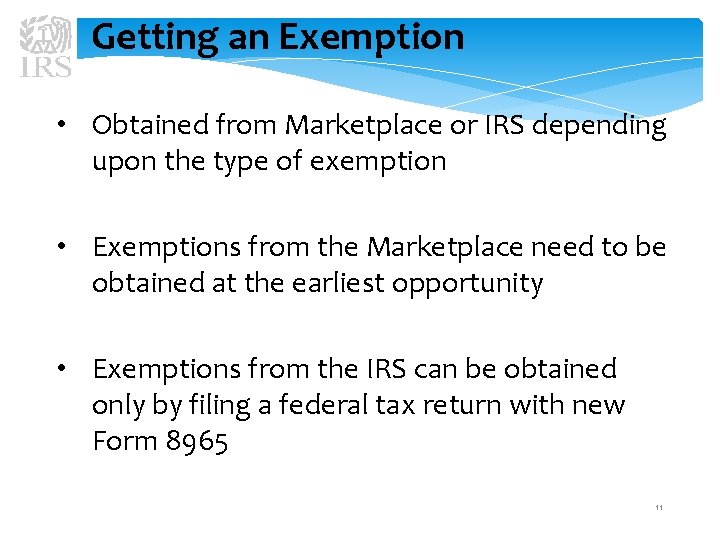
Getting an Exemption • Obtained from Marketplace or IRS depending upon the type of exemption • Exemptions from the Marketplace need to be obtained at the earliest opportunity • Exemptions from the IRS can be obtained only by filing a federal tax return with new Form 8965 11
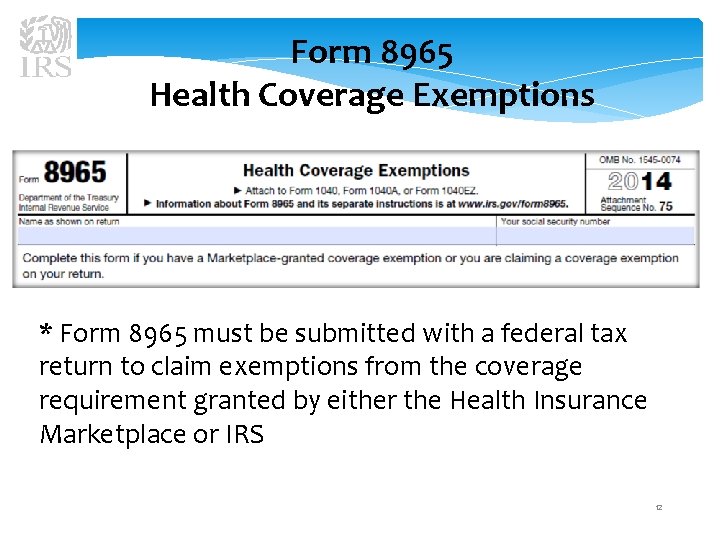
Form 8965 Health Coverage Exemptions * Form 8965 must be submitted with a federal tax return to claim exemptions from the coverage requirement granted by either the Health Insurance Marketplace or IRS 12
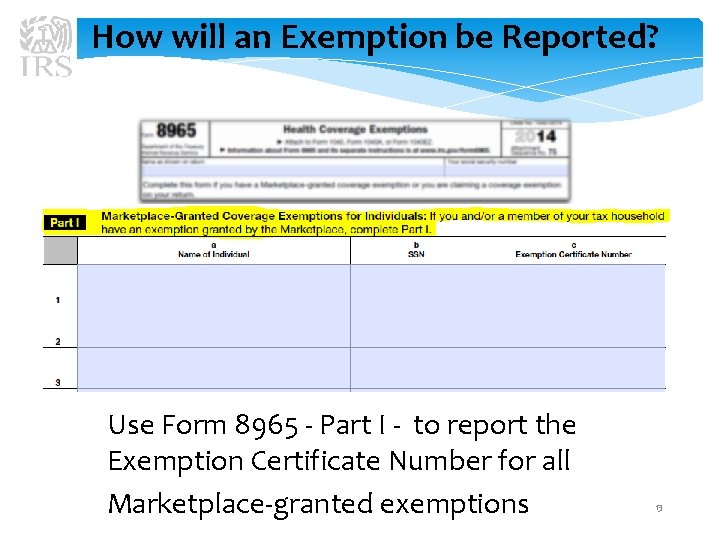
How will an Exemption be Reported? Use Form 8965 - Part I - to report the Exemption Certificate Number for all Marketplace-granted exemptions 13
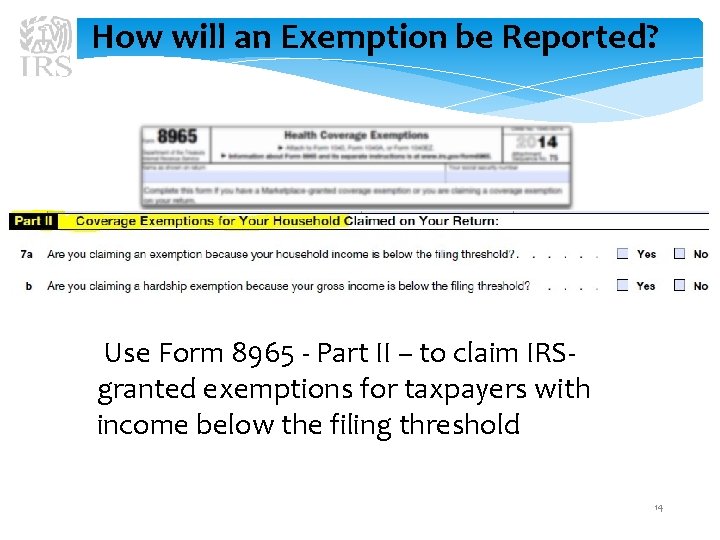
How will an Exemption be Reported? Use Form 8965 - Part II – to claim IRSgranted exemptions for taxpayers with income below the filing threshold 14
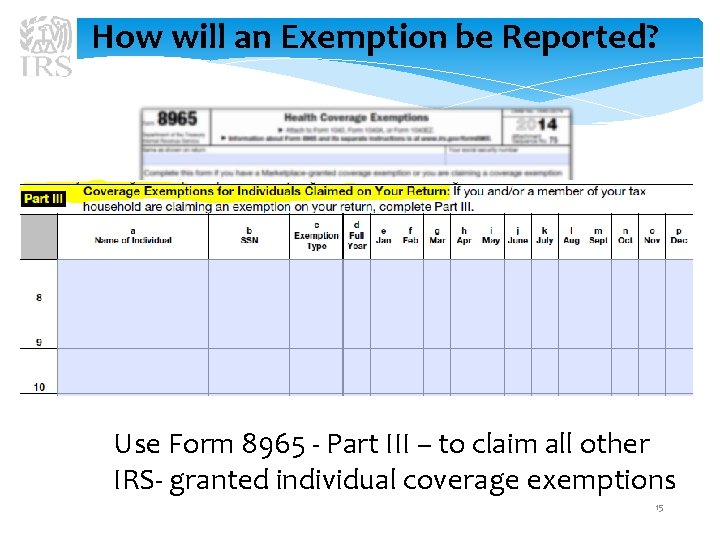
How will an Exemption be Reported? Use Form 8965 - Part III – to claim all other IRS- granted individual coverage exemptions 15
When Would an Individual Need to Make a Shared Responsibility Payment? Taxpayers and their dependents may need to make an SRP if they don’t have: �MEC for every month of the year, or �An exemption for the months without MEC. 16
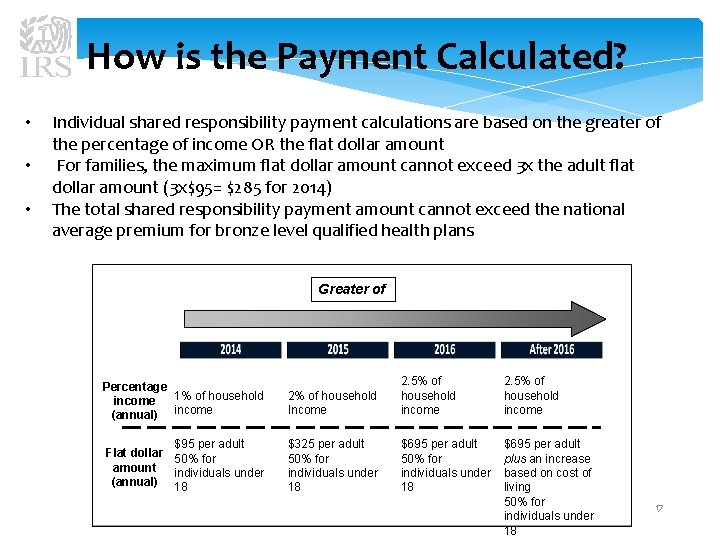
How is the Payment Calculated? • • • Individual shared responsibility payment calculations are based on the greater of the percentage of income OR the flat dollar amount For families, the maximum flat dollar amount cannot exceed 3 x the adult flat dollar amount (3 x$95= $285 for 2014) The total shared responsibility payment amount cannot exceed the national average premium for bronze level qualified health plans Greater of Percentage 1% of household income (annual) income 2% of household Income 2. 5% of household income $95 per adult Flat dollar 50% for amount individuals under (annual) 18 $325 per adult 50% for individuals under 18 $695 per adult plus an increase based on cost of living 50% for individuals under 18 17
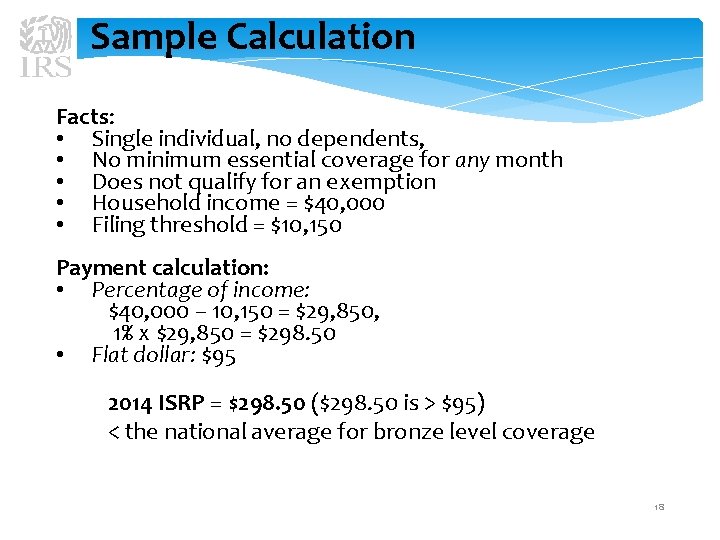
Sample Calculation Facts: • Single individual, no dependents, • No minimum essential coverage for any month • Does not qualify for an exemption • Household income = $40, 000 • Filing threshold = $10, 150 Payment calculation: • Percentage of income: $40, 000 – 10, 150 = $29, 850, 1% x $29, 850 = $298. 50 • Flat dollar: $95 2014 ISRP = $298. 50 ($298. 50 is > $95) < the national average for bronze level coverage 18
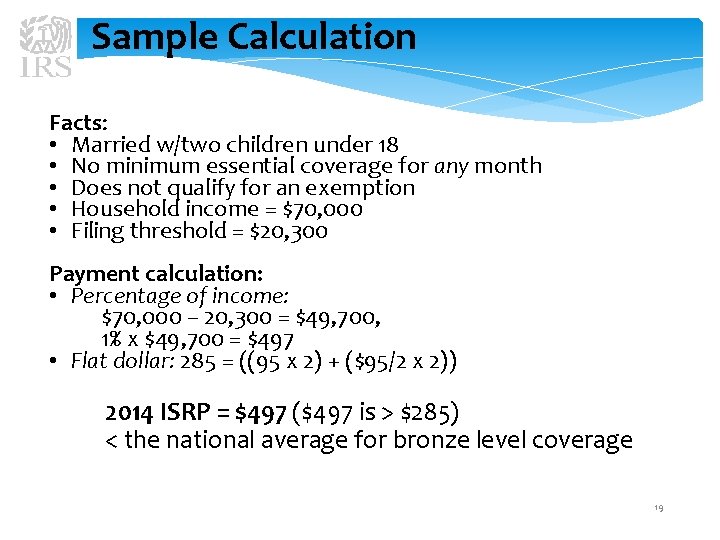
Sample Calculation Facts: • Married w/two children under 18 • No minimum essential coverage for any month • Does not qualify for an exemption • Household income = $70, 000 • Filing threshold = $20, 300 Payment calculation: • Percentage of income: $70, 000 – 20, 300 = $49, 700, 1% x $49, 700 = $497 • Flat dollar: 285 = ((95 x 2) + ($95/2 x 2)) 2014 ISRP = $497 ($497 is > $285) < the national average for bronze level coverage 19
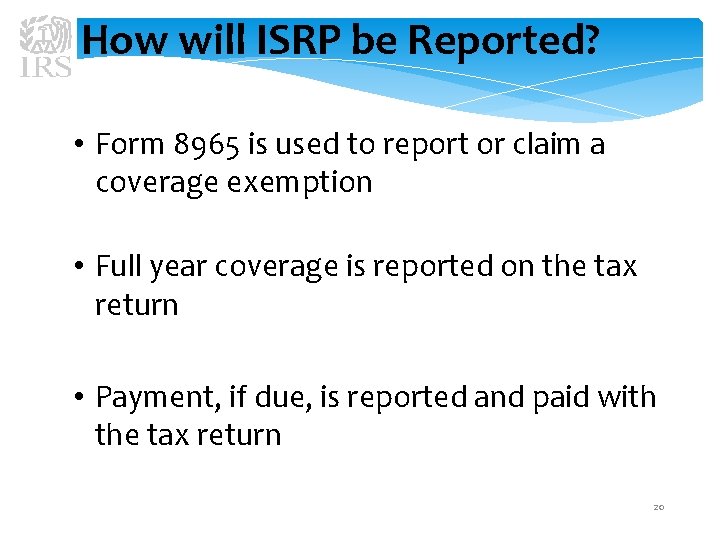
How will ISRP be Reported? • Form 8965 is used to report or claim a coverage exemption • Full year coverage is reported on the tax return • Payment, if due, is reported and paid with the tax return 20
The Premium Tax Credit (PTC) 21
What is the Premium Tax Credit? • Refundable tax credit claimed on new Form 8962, Premium Tax Credit, filed with Form 1040 • Two options: - advance payments of PTC - no advance payments (get all benefit of PTC when filing return) • Marketplace administers advance payment of PTC 22
PTC Eligibility You may be eligible if you meet all of the following: Ø buy health insurance through Marketplace Ø are ineligible for coverage through employer or government plan Ø are within certain income limits Ø do not file a Married Filing Separately tax return (unless you meet the criteria in section 1. 36 B-2 T(b)(2) of the Temporary Income Tax Regulations, which allows certain victims of domestic abuse and spousal abandonment to claim the premium tax credit Ø cannot be claimed as a dependent by another person 23
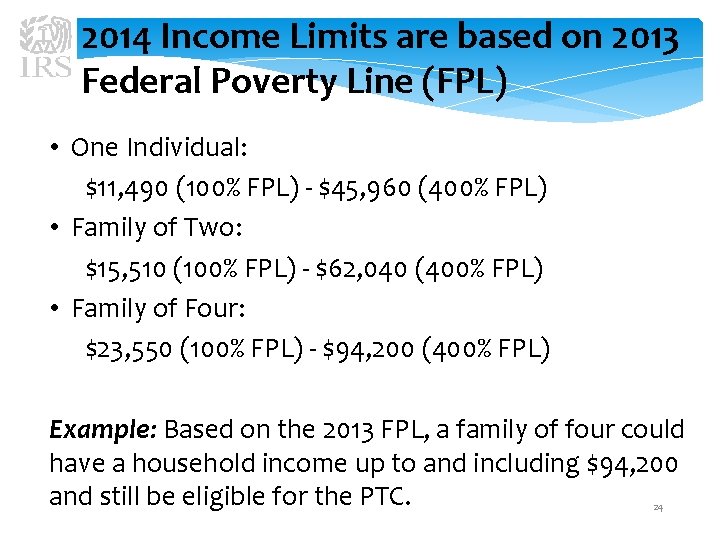
2014 Income Limits are based on 2013 Federal Poverty Line (FPL) • One Individual: $11, 490 (100% FPL) - $45, 960 (400% FPL) • Family of Two: $15, 510 (100% FPL) - $62, 040 (400% FPL) • Family of Four: $23, 550 (100% FPL) - $94, 200 (400% FPL) Example: Based on the 2013 FPL, a family of four could have a household income up to and including $94, 200 and still be eligible for the PTC. 24
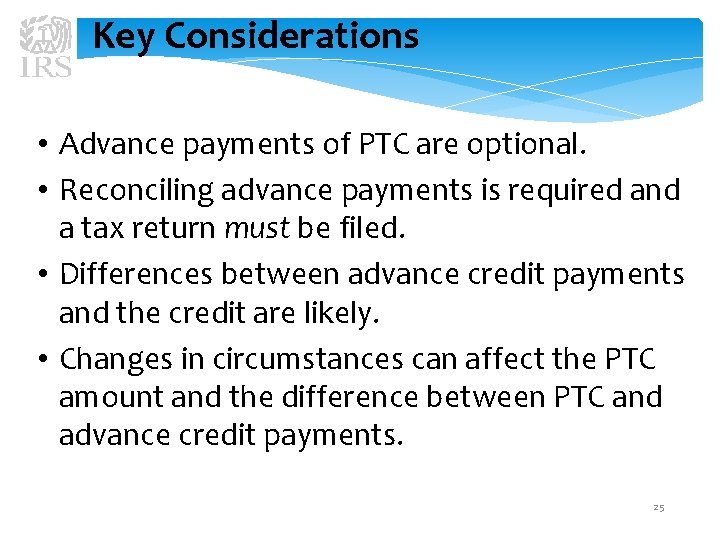
Key Considerations • Advance payments of PTC are optional. • Reconciling advance payments is required and a tax return must be filed. • Differences between advance credit payments and the credit are likely. • Changes in circumstances can affect the PTC amount and the difference between PTC and advance credit payments. 25
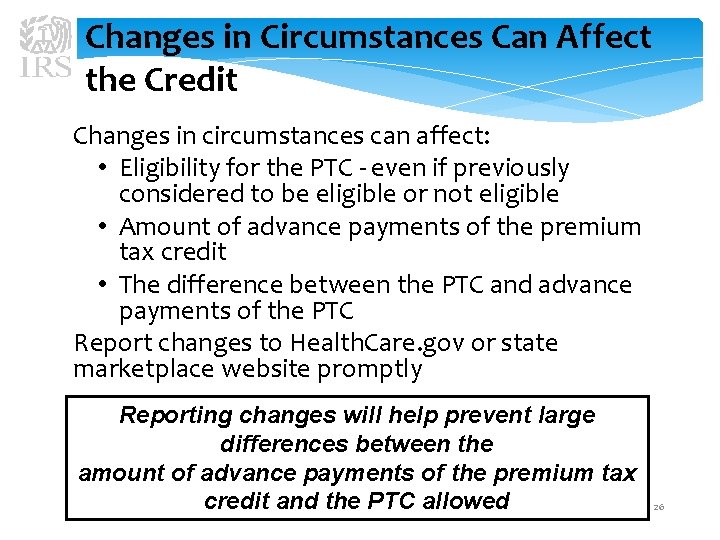
Changes in Circumstances Can Affect the Credit Changes in circumstances can affect: • Eligibility for the PTC - even if previously considered to be eligible or not eligible • Amount of advance payments of the premium tax credit • The difference between the PTC and advance payments of the PTC Report changes to Health. Care. gov or state marketplace website promptly Reporting changes will help prevent large differences between the amount of advance payments of the premium tax credit and the PTC allowed 26
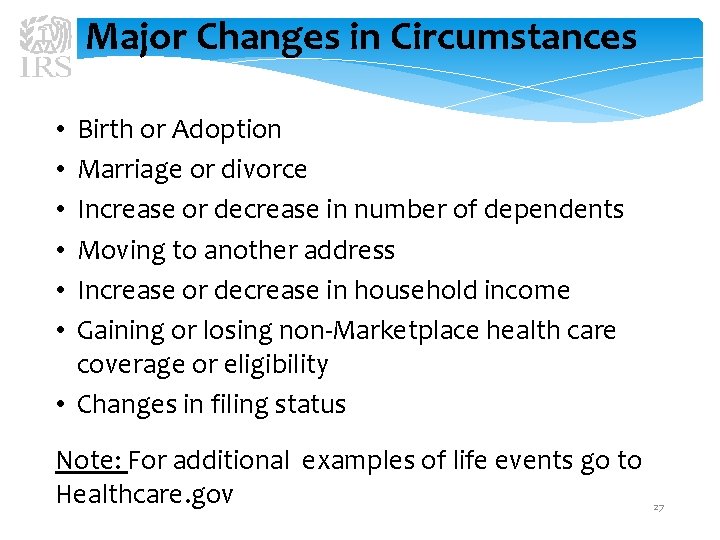
Major Changes in Circumstances Birth or Adoption Marriage or divorce Increase or decrease in number of dependents Moving to another address Increase or decrease in household income Gaining or losing non-Marketplace health care coverage or eligibility • Changes in filing status • • • Note: For additional examples of life events go to Healthcare. gov 27
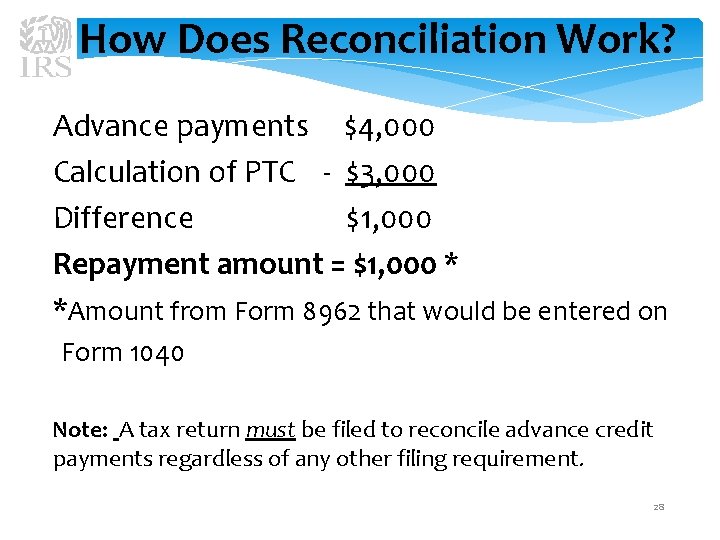
How Does Reconciliation Work? Advance payments $4, 000 Calculation of PTC - $3, 000 Difference $1, 000 Repayment amount = $1, 000 * *Amount from Form 8962 that would be entered on Form 1040 Note: A tax return must be filed to reconcile advance credit payments regardless of any other filing requirement. 28
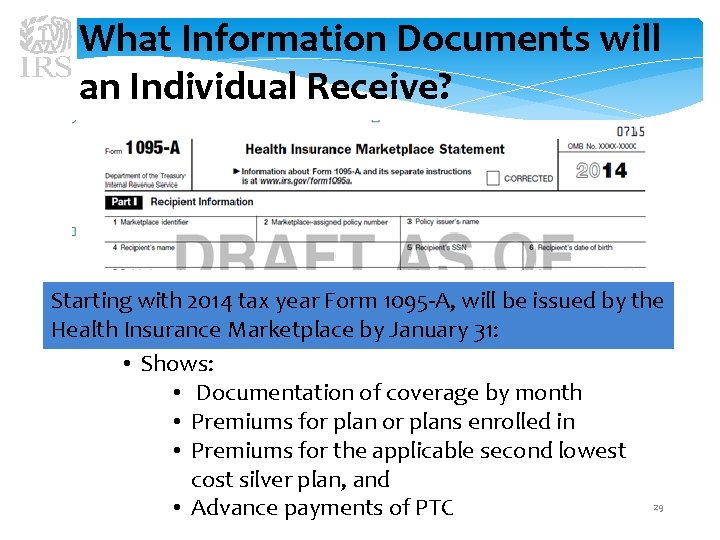
What Information Documents will an Individual Receive? Starting with 2014 tax year Form 1095 -A, will be issued by the Health Insurance Marketplace by January 31: • Shows: • Documentation of coverage by month • Premiums for plans enrolled in • Premiums for the applicable second lowest cost silver plan, and 29 • Advance payments of PTC
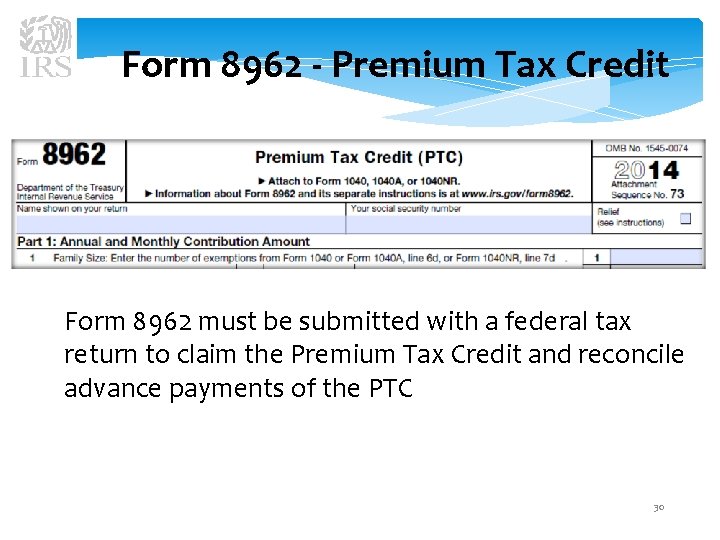
Form 8962 - Premium Tax Credit Form 8962 must be submitted with a federal tax return to claim the Premium Tax Credit and reconcile advance payments of the PTC 30
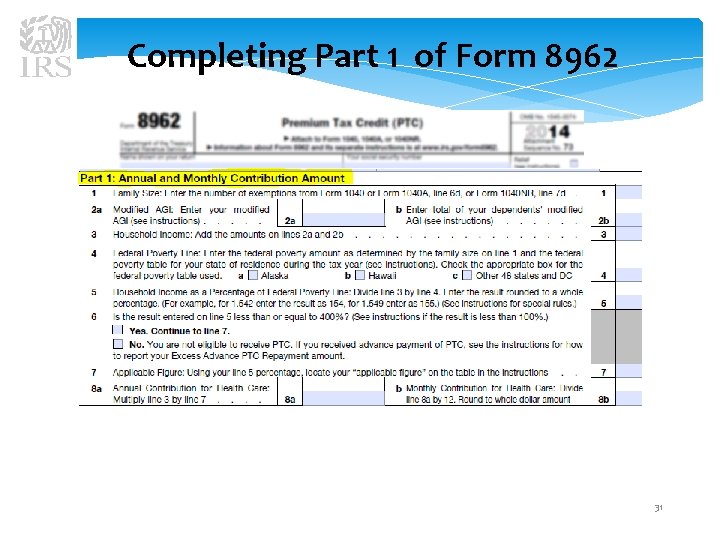
Completing Part 1 of Form 8962 31
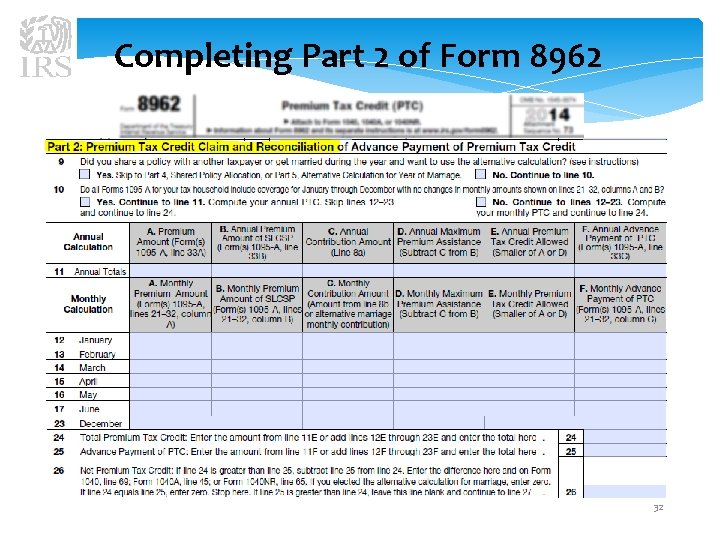
Completing Part 2 of Form 8962 32
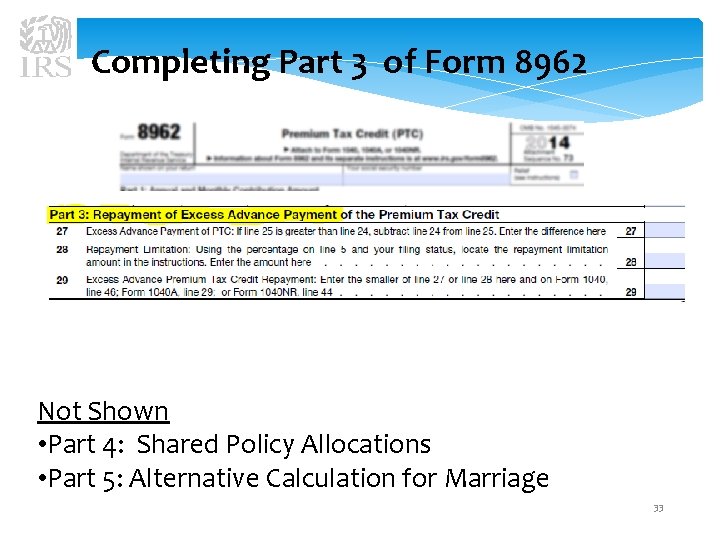
Completing Part 3 of Form 8962 Not Shown • Part 4: Shared Policy Allocations • Part 5: Alternative Calculation for Marriage 33
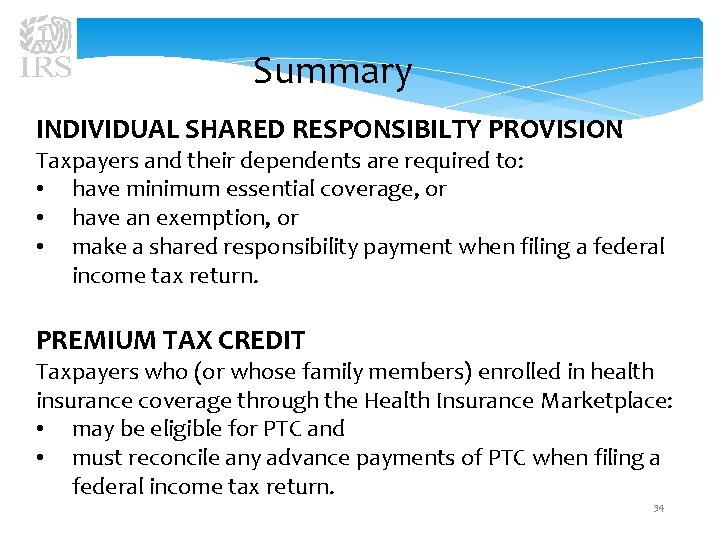
Summary INDIVIDUAL SHARED RESPONSIBILTY PROVISION Taxpayers and their dependents are required to: • have minimum essential coverage, or • have an exemption, or • make a shared responsibility payment when filing a federal income tax return. PREMIUM TAX CREDIT Taxpayers who (or whose family members) enrolled in health insurance coverage through the Health Insurance Marketplace: • may be eligible for PTC and • must reconcile any advance payments of PTC when filing a federal income tax return. 34
The Small Business Health Care Tax Credit § What is the Small Business Health Care Tax Credit? § Which Employers Qualify? § What are the Changes to the Credit Beginning in 2014? 35
What is the Small Business Health Care Tax Credit? • Tax credit for small employers, including tax-exempt employers • Help with the cost of providing health care coverage for low- and moderate-income workers • Designed to encourage employers to offer first-time coverage and maintain existing coverage for employees 36
Which Employers Qualify? Small employers who: • Pay at least half of employee health insurance premiums (single coverage) • Have fewer than 25 full-time equivalent employees (FTEs) for the tax year • Pay average annual wages of less than $50, 000 per FTE 37
What are the Changes to the Credit Beginning in 2014? Looking back – 2010 -2013 • Credit up to 35% for employers and 25% for tax-exempt employer Looking forward – 2014 and later • Credit up to 50% for employers and 35% for tax-exempt employers • Requires coverage through SHOP (Marketplace) • Two consecutive years • Cost of living adjustment 38
How to Claim Use Form 8941, Credit for Small Employer Health Insurance Premiums, to calculate the credit Small business: include the amount as part of the general business credit on the income tax return – 1040, 1065, 1120 or 1120 S Tax-exempt organization: include the amount on line 44 f of the Form 990 -T 39
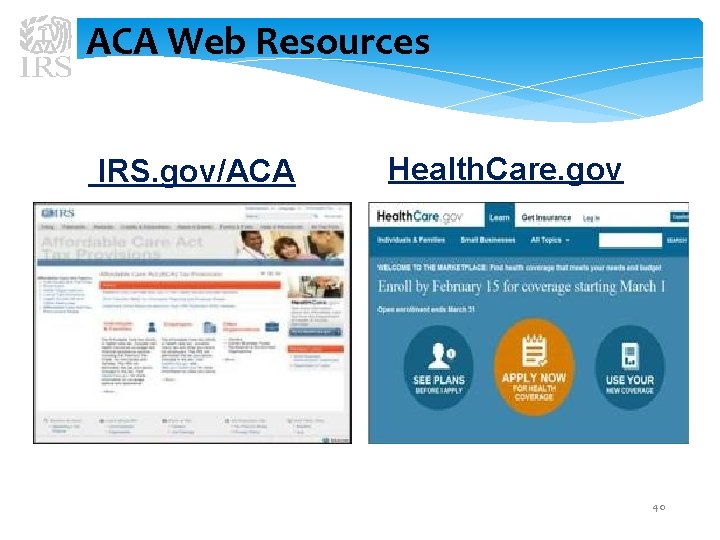
ACA Web Resources IRS. gov/ACA Health. Care. gov 40
Appendix 41
ISRP Resources IRS. gov/aca pages include: • MEC chart, • Exemption chart, and • Q&A section • Electronic Publications 5156 and 5172 • Health Care Tax Tips and legal guidance Health. Care. gov or state Marketplace website for Marketplace information 42
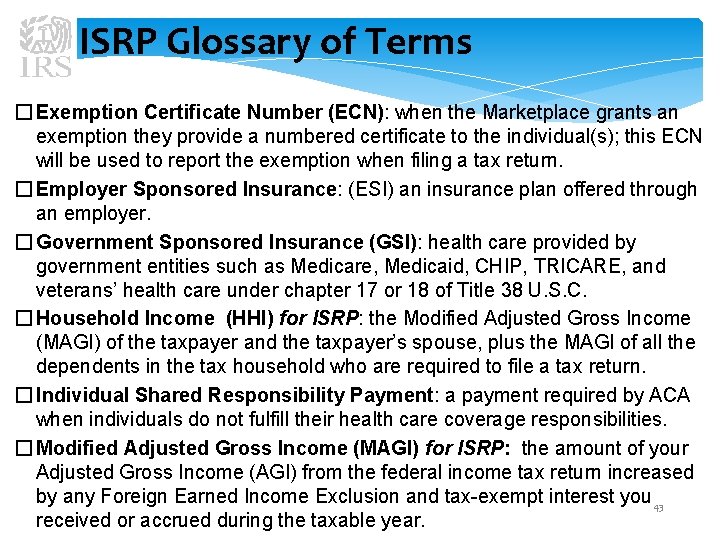
ISRP Glossary of Terms � Exemption Certificate Number (ECN): when the Marketplace grants an exemption they provide a numbered certificate to the individual(s); this ECN will be used to report the exemption when filing a tax return. � Employer Sponsored Insurance: (ESI) an insurance plan offered through an employer. � Government Sponsored Insurance (GSI): health care provided by government entities such as Medicare, Medicaid, CHIP, TRICARE, and veterans’ health care under chapter 17 or 18 of Title 38 U. S. C. � Household Income (HHI) for ISRP: the Modified Adjusted Gross Income (MAGI) of the taxpayer and the taxpayer’s spouse, plus the MAGI of all the dependents in the tax household who are required to file a tax return. � Individual Shared Responsibility Payment: a payment required by ACA when individuals do not fulfill their health care coverage responsibilities. � Modified Adjusted Gross Income (MAGI) for ISRP: the amount of your Adjusted Gross Income (AGI) from the federal income tax return increased by any Foreign Earned Income Exclusion and tax-exempt interest you 43 received or accrued during the taxable year.
PTC Resources IRS. gov/aca pages include: • PTC and including Q&A section • Tax tips and legal guidance • Electronic publications 5120, 5121 and 5152 Health. Care. gov or state Marketplace website for Marketplace information 44
PTC Glossary of Terms • Affordable employer coverage: Annual premium for the lowest-cost option of employer-sponsored self-only coverage that provides minimum value and does not exceed 9. 5 percent of household income. • Minimum Value: Employer-sponsored plans that cover at least 60 percent of the total allowed costs of benefits. • Household Income for PTC: The Modified Adjusted Gross Income (MAGI) of the taxpayer and the taxpayer’s spouse, plus the MAGI of all the dependents in the tax household who are required to file a tax return because their income meets the tax return filing threshold. • MAGI for PTC: Adjusted gross income from the federal income tax return, plus any excluded foreign income, non-taxable Social Security benefits (including tier 1 railroad retirement benefits), and tax-exempt interest received or accrued during the taxable year. MAGI does not include 45 Supplemental Security Income (SSI).