
Reporting Conventions To start go through the sample
- Slides: 15
Reporting Conventions To start - go through the sample report. Identify the different sections of the report. Learning Questions: What are reporting conventions? What format must a psychological report take? How do I reference in psychology? How do I create a scientific poster?
Reporting Conventions Reporting conventions are wellestablished and widely recognised standards for how a report is written and presented. These are based on the American Psychological Association Publication Manual. APA format is used by psychologists around the world.
Written Report There are generally 8 different sections in a psychological report that appear in the following order: Title Abstract Introduction Method Results Discussion References Appendices
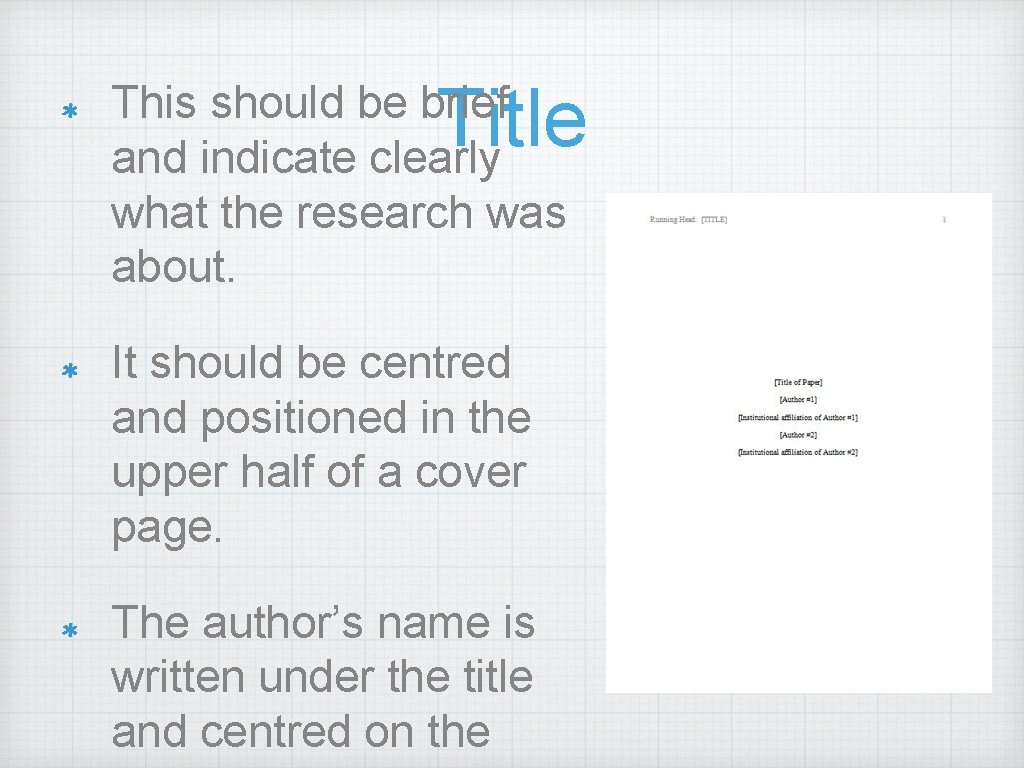
Title This should be brief and indicate clearly what the research was about. It should be centred and positioned in the upper half of a cover page. The author’s name is written under the title and centred on the
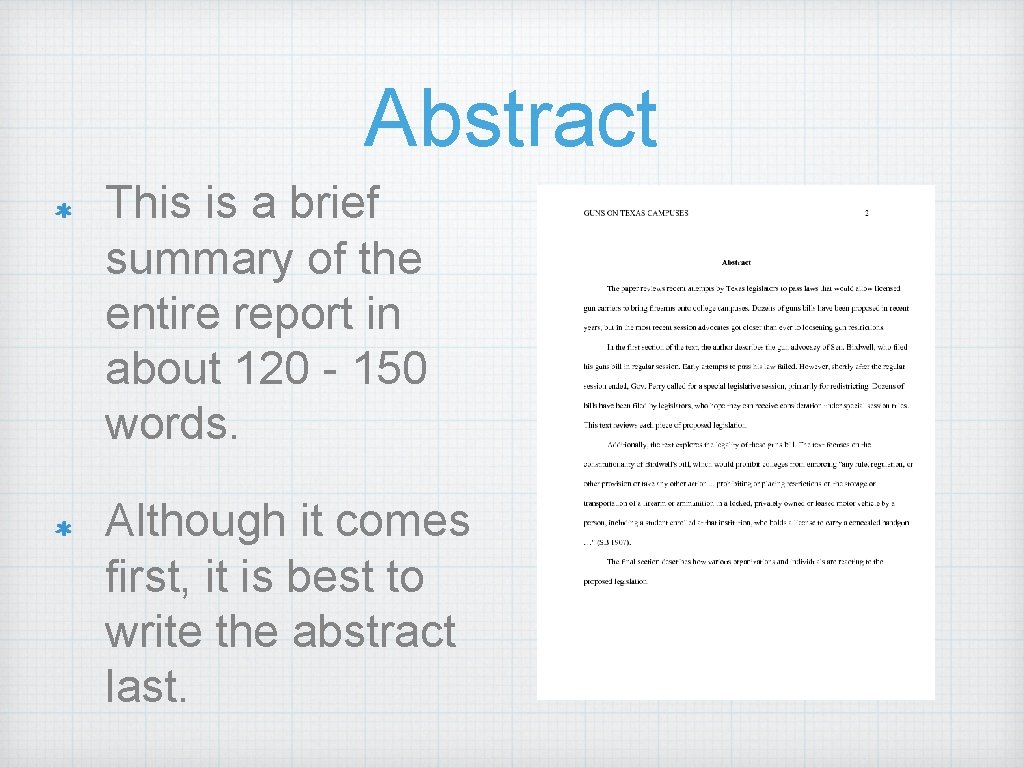
Abstract This is a brief summary of the entire report in about 120 - 150 words. Although it comes first, it is best to write the abstract last.
Introduction This section gives the background to the research. It summarises theory and results of other relevant research. It states the aim and hypothesis at the end of the section.
Method This clearly describes how the research was conducted. It is often broken into 3 sub-sections, each with its own heading: Participants - how many were used, relevant characteristics of them, population and how the sample was selected and allocated. Measures - the test or other means used to collect the data. Any evidence of the reliability and validity of the measure should also be included. Procedure - Detailed description of all of the data collection procedures.
Results This is a summary of the main results. There should be enough detail to justify your conclusions. Graphs, tables, charts and other figures are used and should be clear so that the reader can understand them easily.
Discussion Results are examined, interpreted and explained, particularly in reference to the hypothesis. Conclusions are drawn. State whether the hypothesis was supported or not. If not, explain why. What is the relevance of your results? What are the practical applications of your findings?
References Every source you cite in your report must be in your references. These need to be presented in alphabetical order. In psychology, this is always done in APA format.
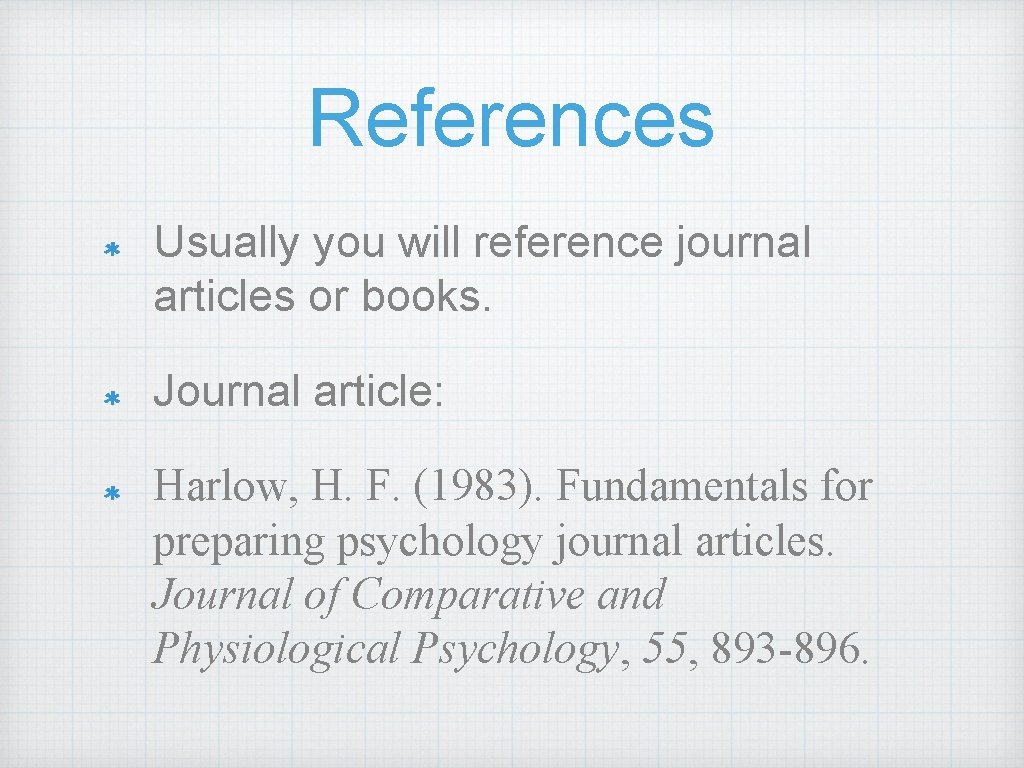
References Usually you will reference journal articles or books. Journal article: Harlow, H. F. (1983). Fundamentals for preparing psychology journal articles. Journal of Comparative and Physiological Psychology, 55, 893 -896.
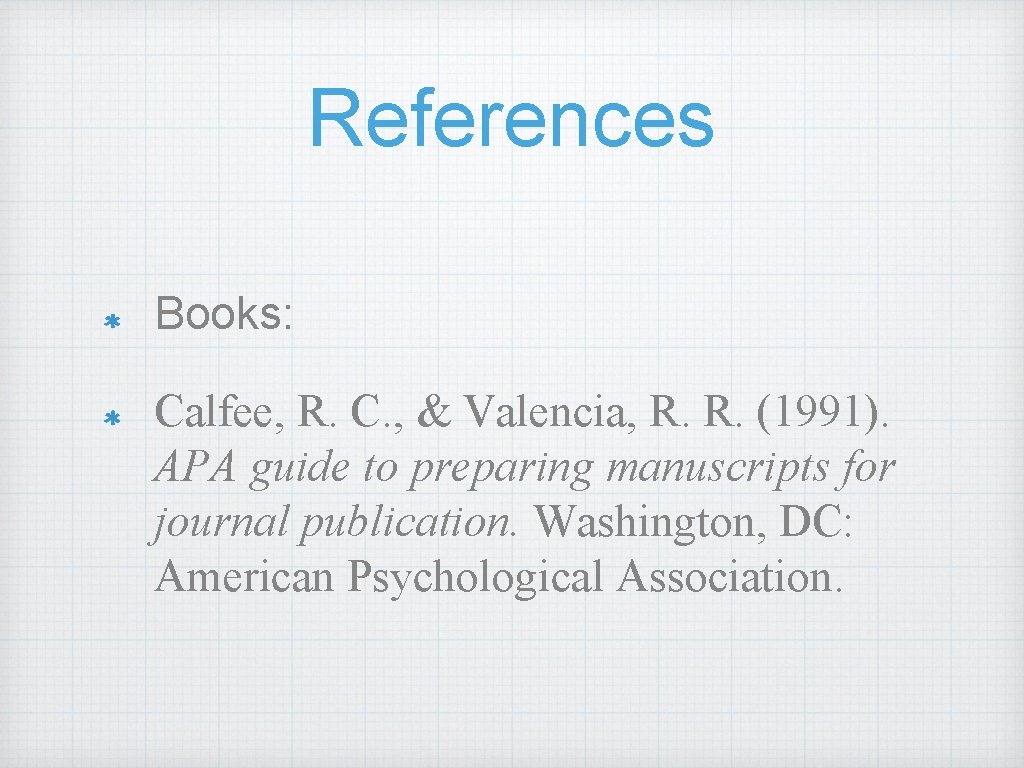
References Books: Calfee, R. C. , & Valencia, R. R. (1991). APA guide to preparing manuscripts for journal publication. Washington, DC: American Psychological Association.
References In-text references - if you are referring to information that is not original or using quotes in your report, you must put an in-text reference. According to Jones (1998), "Students often had difficulty using APA style, especially when it was their first time" (p. 199). (Quotes need a page number) She stated, "Students often had difficulty using APA style" (Jones, 1998, p. 199), but she did not offer an explanation ason to why. Use the guide pages 95 -97 of your textbook to help you complete your references
Poster Report You will be creating a poster report on a practical investigation for one of your Unit 4 SACs. This poster must follow the VCAA poster format that can be found on page 94 of your textbook. Your poster will be similar to a written report, only less detailed.
Homework Create your own psychology report/poster writing template or guide.