
Reporting Comment Building With content from Growing Success
Reporting Comment Building With content from Growing Success, Planting Seeds for Success, and adaptation from Comment Framework for Progress Reports and Report Cards, Developed by: London Region MISA PNC, Revised February 2011
Learning Goals We are learning to… use the general comment framework incorporate more descriptive qualifiers in comments for subject/strand learning skills/work habits to improve communication with parents and students link the strengths and next steps in learning skills and work habits to Ontario Catholic School Graduate Expectations explore Catholic perspective resources as a means to crafting meaningful comments
Big Ideas for Building Comments: Teachers should write comments that: focus on what students have learned describe significant strengths identify next steps for improvement
Keeping in mind that comments… Focus on one cluster of expectations Provide meaningful feedback that is personalized, clear, and precise Relate directly to Learning Skills/Work Habits/Expectations Use parent & student friendly language and provide specific classroom examples Highlight personalized strengths, specific examples & next steps
Write key learning with qualifiers and descriptors. The teacher identifies big ideas related to a learning goal developed from clusters of expectations or learning skills and work habits. The qualifiers on the progress report should reflect the student's progress toward curriculum expectations or development of Learning Skills and Work Habits. The qualifiers on the report card should reflect the student's level of achievement of curriculum expectations or attainment of Learning Skills and Work Habits. The descriptors take the tasks and learning goals into account to clarify and more specifically define effectiveness. Growing Success says, "focus on what students have learned. "
Share specific examples that demonstrate the learning. The teacher uses information gathered from observations, conversations, and student products to share specific examples of what the student has done to demonstrate his/her strengths. This information should be personalized and connected to the success criteria for the learning goal(s). Growing Success says, "describe significant strengths. "
Communicate next steps to students and parents. The teacher should communicate success criteria the student still needs to accomplish or extend their learning. These next steps should be connected to the learning goal and be meaningful, clear, and attainable. Growing Success says, "identify next steps for improvement. ” Adapted from: Comment Framework for Progress Reports and Report Cards Developed by: London Region MISA PNC, Revised February 2011
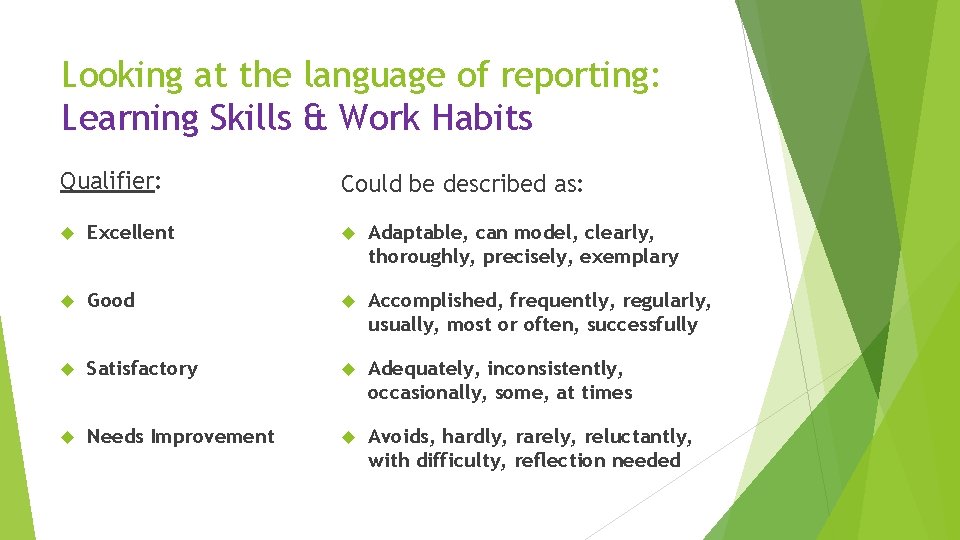
Looking at the language of reporting: Learning Skills & Work Habits Qualifier: Could be described as: Excellent Adaptable, can model, clearly, thoroughly, precisely, exemplary Good Accomplished, frequently, regularly, usually, most or often, successfully Satisfactory Adequately, inconsistently, occasionally, some, at times Needs Improvement Avoids, hardly, rarely, reluctantly, with difficulty, reflection needed
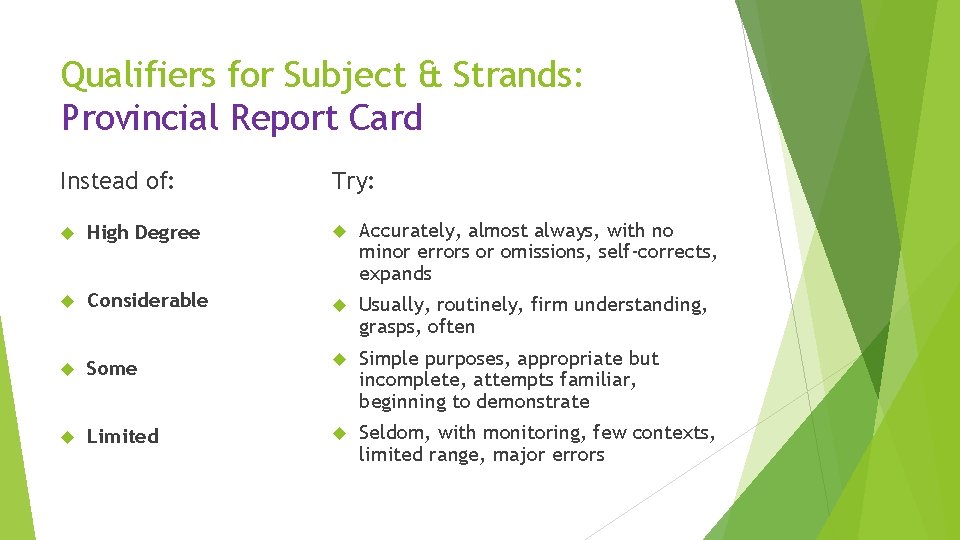
Qualifiers for Subject & Strands: Provincial Report Card Instead of: Try: High Degree Accurately, almost always, with no minor errors or omissions, self-corrects, expands Considerable Usually, routinely, firm understanding, grasps, often Some Simple purposes, appropriate but incomplete, attempts familiar, beginning to demonstrate Limited Seldom, with monitoring, few contexts, limited range, major errors

With a partner, annotate the sample comment and level: 1. focus on what students have learned 2. describe significant strengths 3. identify next steps for improvement
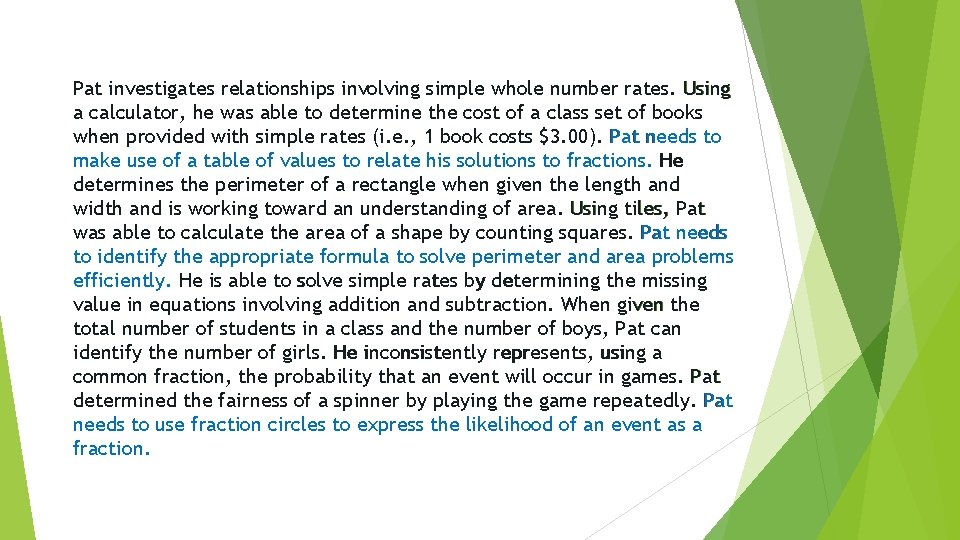
Pat investigates relationships involving simple whole number rates. Using a calculator, he was able to determine the cost of a class set of books when provided with simple rates (i. e. , 1 book costs $3. 00). Pat needs to make use of a table of values to relate his solutions to fractions. He determines the perimeter of a rectangle when given the length and width and is working toward an understanding of area. Using tiles, Pat was able to calculate the area of a shape by counting squares. Pat needs to identify the appropriate formula to solve perimeter and area problems efficiently. He is able to solve simple rates by determining the missing value in equations involving addition and subtraction. When given the total number of students in a class and the number of boys, Pat can identify the number of girls. He inconsistently represents, using a common fraction, the probability that an event will occur in games. Pat determined the fairness of a spinner by playing the game repeatedly. Pat needs to use fraction circles to express the likelihood of an event as a fraction.
Just to clarify: The development of learning skills and work habits is an integral part of a student’s learning. To the extent possible, however, the evaluation of learning skills and work habits, apart from any that may be included as part of a curriculum expectation in a subject or course, should not be considered in the determination of a student’s grades. Assessing, evaluating, and reporting on the achievement of curriculum expectations and on the demonstration of learning skills and work habits separately allows teachers to provide information to the parents and student that is specific to each of the two areas of achievement. Growing Success, p. 10
With a partner, analyze the sample comment: Identify strengths and areas for improvement Identify associated learning skills & work habits
Link the annotations to CGEs A Discerning Believer An Effective Communicator A Reflective, Creative, and Holistic Thinker A Self-Directed, Responsible, Lifelong Learner A Collaborative Contributor A Caring Family Member A Responsible Citizen
Rewrite the comment to reflect our Catholic perspective.
Tony contributes to making our classroom a community of friends of Jesus by consistently welcoming others into group activities. He enjoys sharing his ideas with others and is an effective communicator. He must remember to listen to the ideas of others. Tony is working to become a self-directed learner. He is handing in homework assignments on time and completing class work in the time allotted. Improvement is still needed in Tony’s ability to organize his materials and in following oral and written directions. He needs to reflect on strategies to solve problems as they arise before asking for help. Tony is developing self-regulation skills by respecting the space and belongings of others but needs to include others in games or activities that he may be doing. A next step for Tony is to develop the ability to accept responsibility for his behaviour and demonstrate Christian leadership on a daily basis.
For more information: Your friendly neighbourhood itinerant Check your take-away package
- Slides: 17