
Reporting Category 1 CELL STRUCTURE FUNCTION Biomolecules All

Reporting Category 1 CELL STRUCTURE & FUNCTION
Biomolecules • All living things are made of organic (carbon containing) molecules. • There are four biomolecules: – Carbohydrates – Proteins • Enzymes (all enzymes are proteins) – Lipids – Nucleic Acids
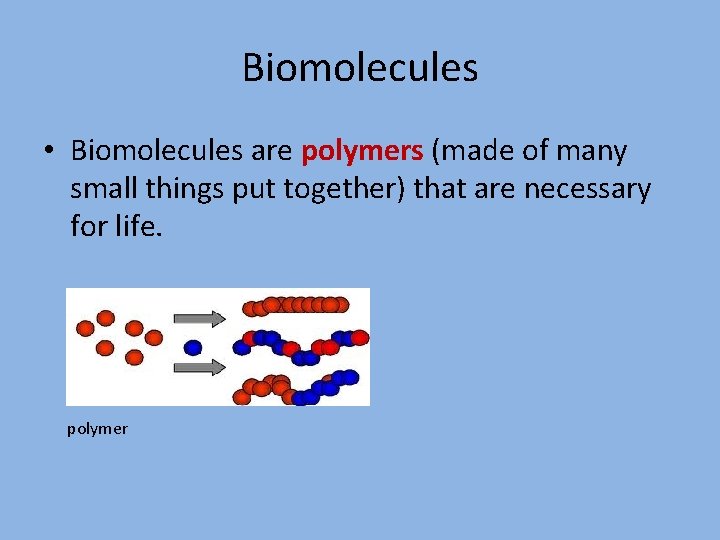
Biomolecules • Biomolecules are polymers (made of many small things put together) that are necessary for life. polymer
Question: • What are the 4 biomolecules? Carbohydrates Proteins Lipids Nucleic Acids
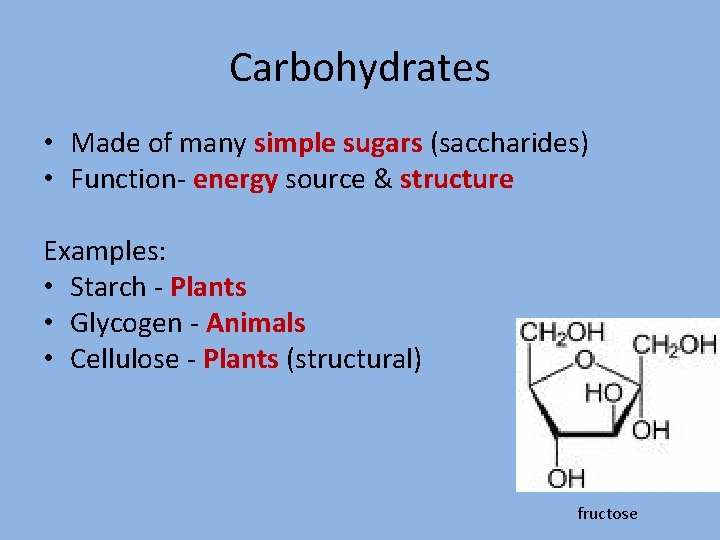
Carbohydrates • Made of many simple sugars (saccharides) • Function- energy source & structure Examples: • Starch - Plants • Glycogen - Animals • Cellulose - Plants (structural) fructose
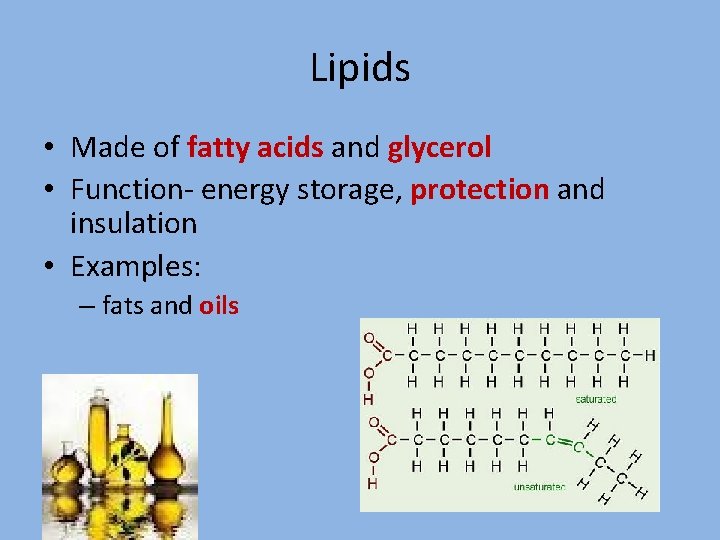
Lipids • Made of fatty acids and glycerol • Function- energy storage, protection and insulation • Examples: – fats and oils
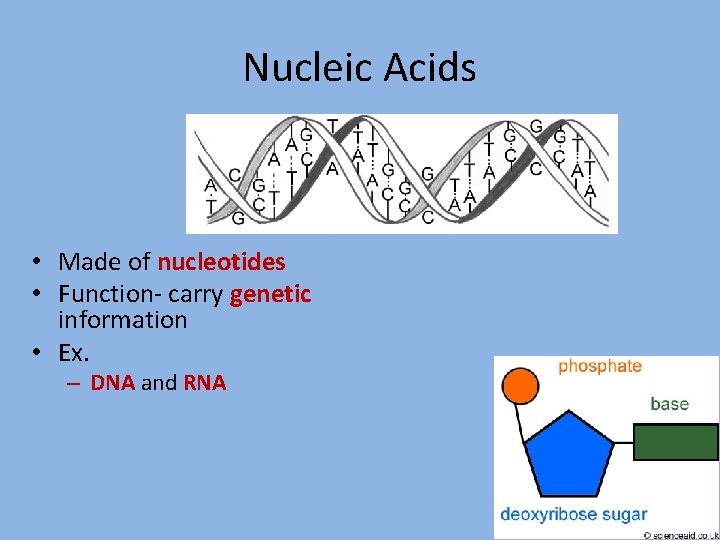
Nucleic Acids • Made of nucleotides • Function- carry genetic information • Ex. – DNA and RNA
Question DNA is made of: 1. 2. 3. Sugar Phosphate Nitrogen Base
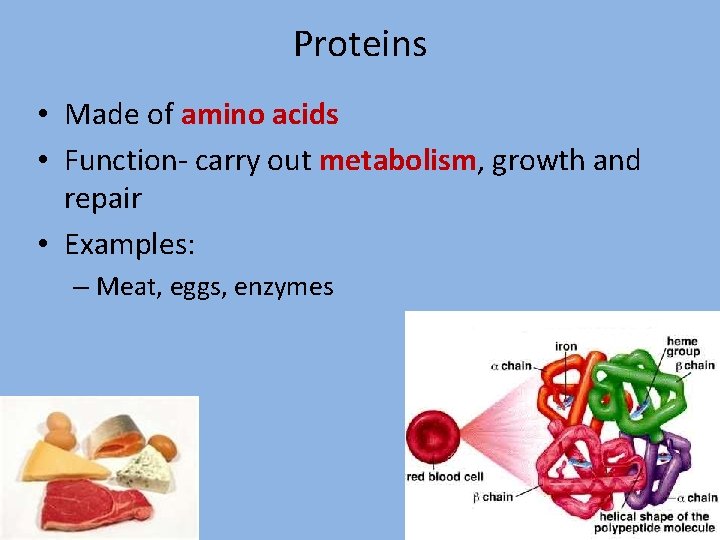
Proteins • Made of amino acids • Function- carry out metabolism, growth and repair • Examples: – Meat, eggs, enzymes
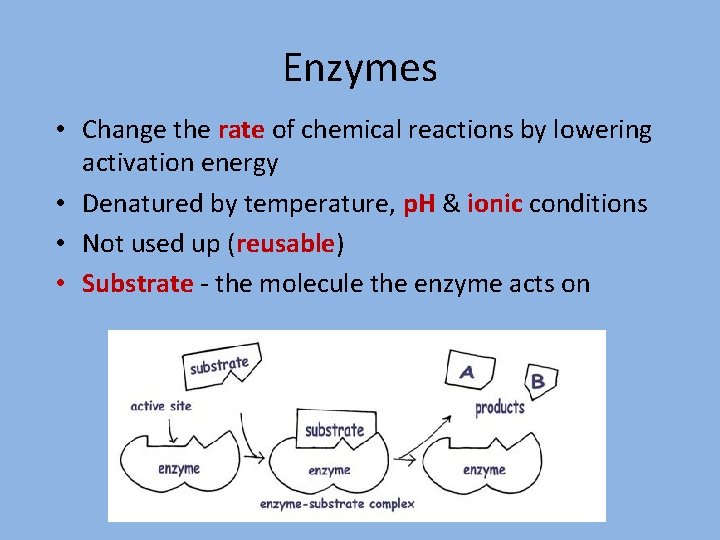
Enzymes • Change the rate of chemical reactions by lowering activation energy • Denatured by temperature, p. H & ionic conditions • Not used up (reusable) • Substrate - the molecule the enzyme acts on
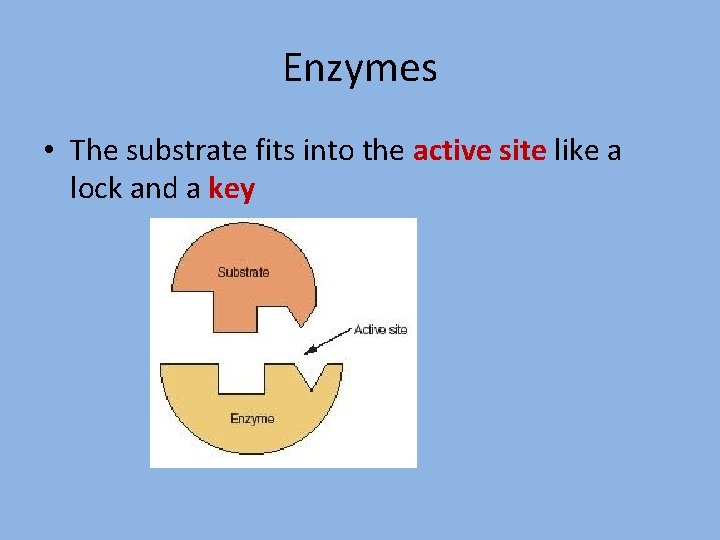
Enzymes • The substrate fits into the active site like a lock and a key
Question • The enzyme catalase is an enzyme common to all organisms that are exposed to oxygen. The enzyme breaks down hydrogen peroxide into water and oxygen. • What molecule is the enzyme and what is the substrate? Enzyme: Catalase Substrate: Hydrogen peroxide **-ase=enzyme**
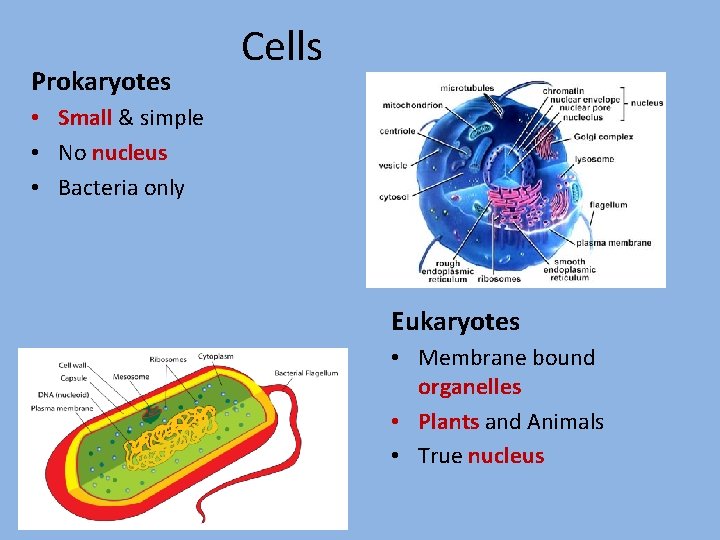
Prokaryotes Cells • Small & simple • No nucleus • Bacteria only Eukaryotes • Membrane bound organelles • Plants and Animals • True nucleus
Question What are two differences between eukaryotes and prokaryotes? 1. Eukaryotes have a nucleus 2. Eukaryotes have membrane-bound organelles
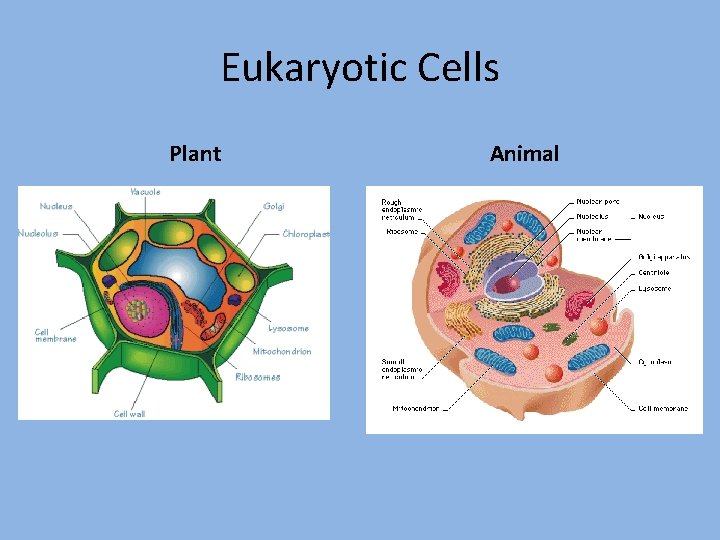
Eukaryotic Cells Plant Animal
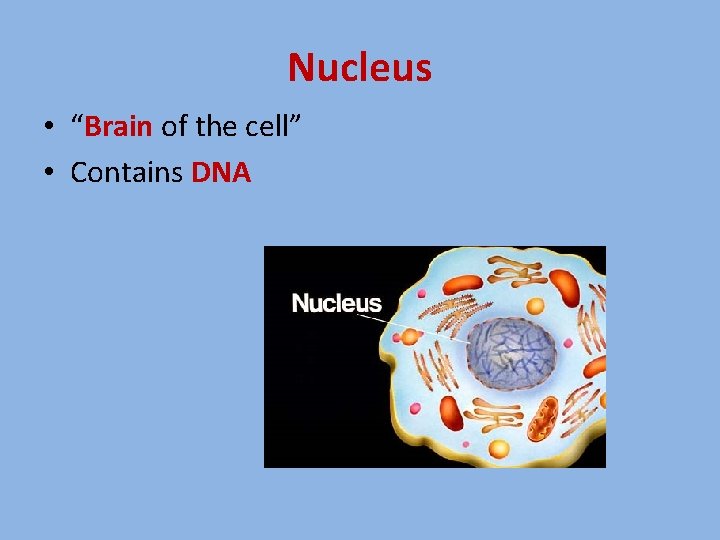
Nucleus • “Brain of the cell” • Contains DNA
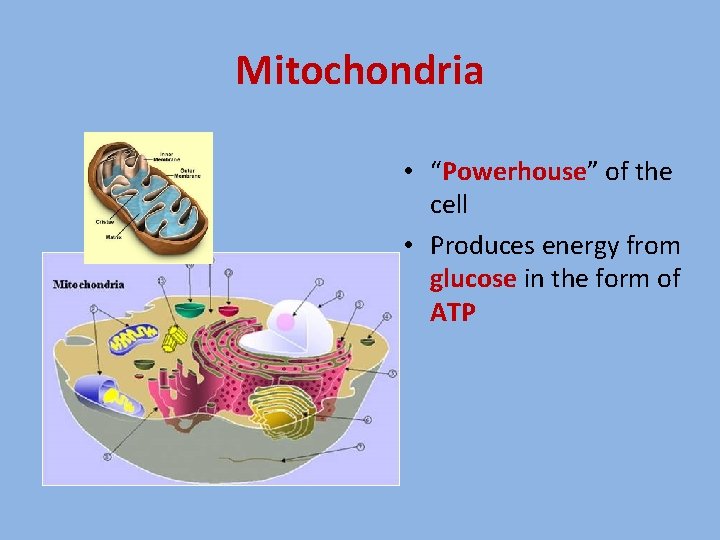
Mitochondria • “Powerhouse” of the cell • Produces energy from glucose in the form of ATP
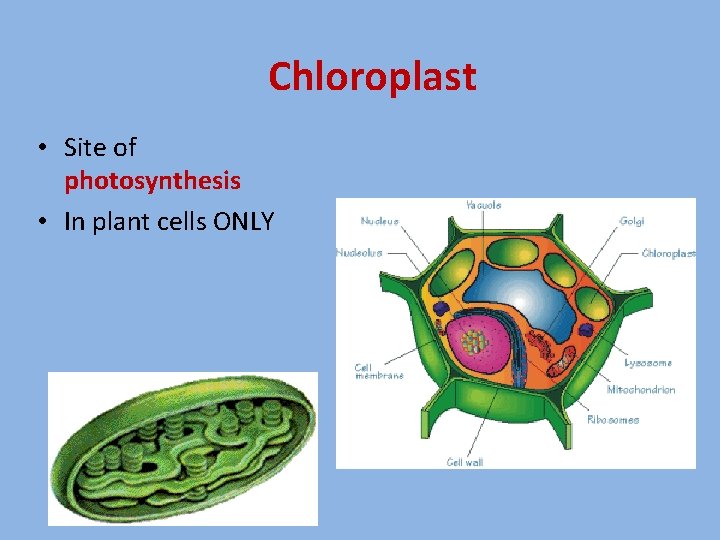
Chloroplast • Site of photosynthesis • In plant cells ONLY
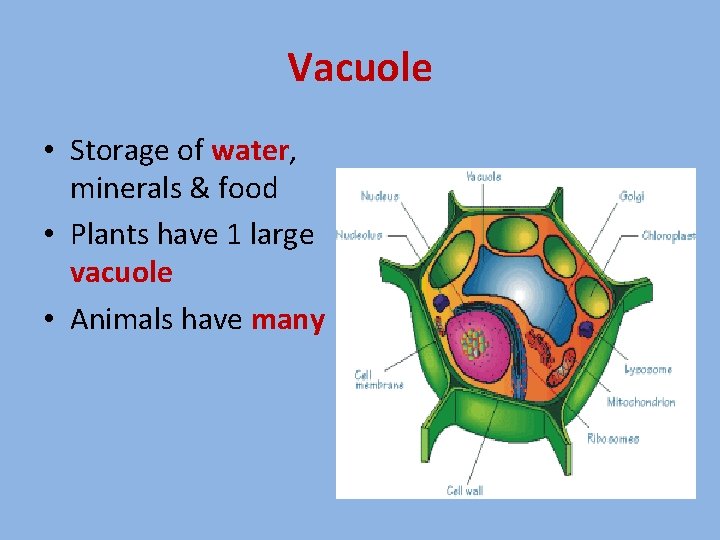
Vacuole • Storage of water, minerals & food • Plants have 1 large vacuole • Animals have many
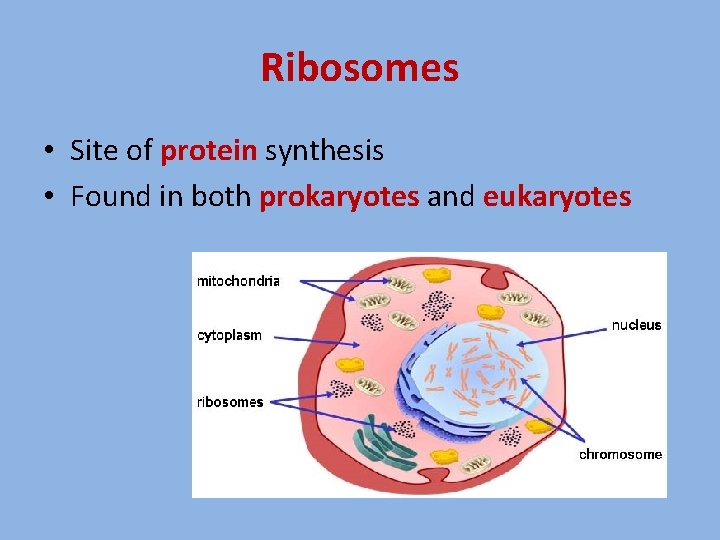
Ribosomes • Site of protein synthesis • Found in both prokaryotes and eukaryotes
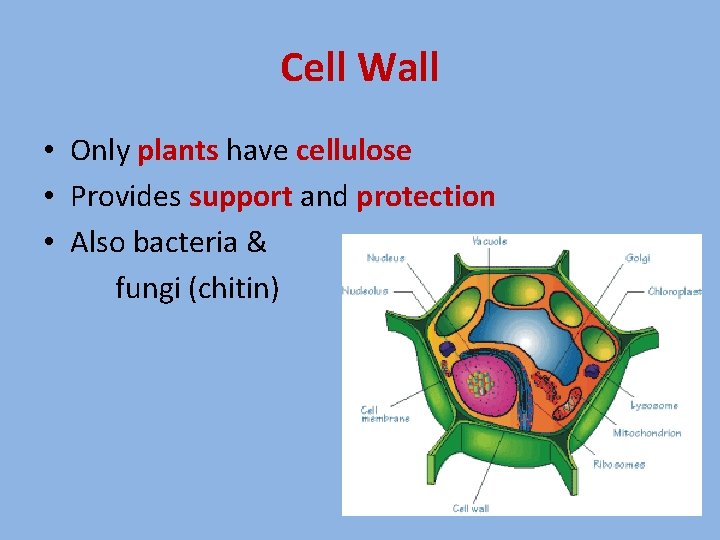
Cell Wall • Only plants have cellulose • Provides support and protection • Also bacteria & fungi (chitin)
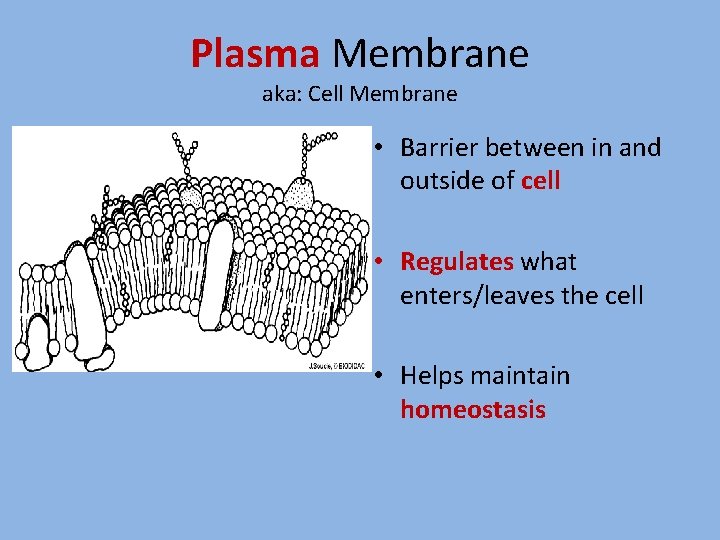
Plasma Membrane aka: Cell Membrane • Barrier between in and outside of cell • Regulates what enters/leaves the cell • Helps maintain homeostasis
Homeostasis- maintaining a stable internal environment. Example: body temp, p. H of blood
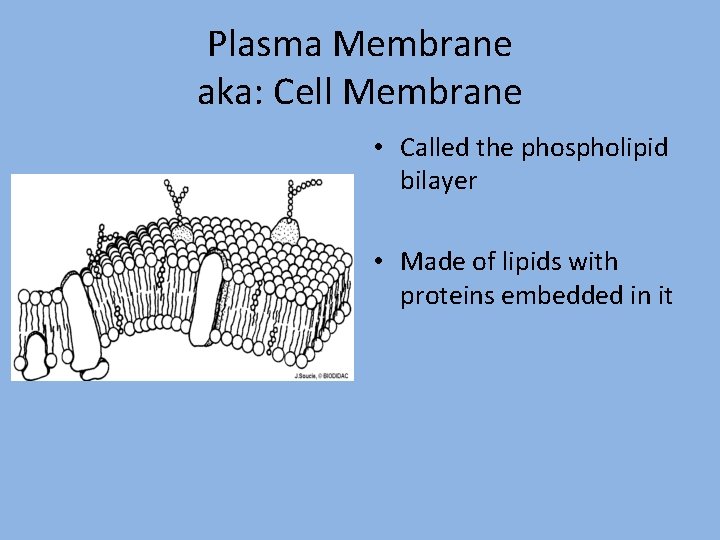
Plasma Membrane aka: Cell Membrane • Called the phospholipid bilayer • Made of lipids with proteins embedded in it
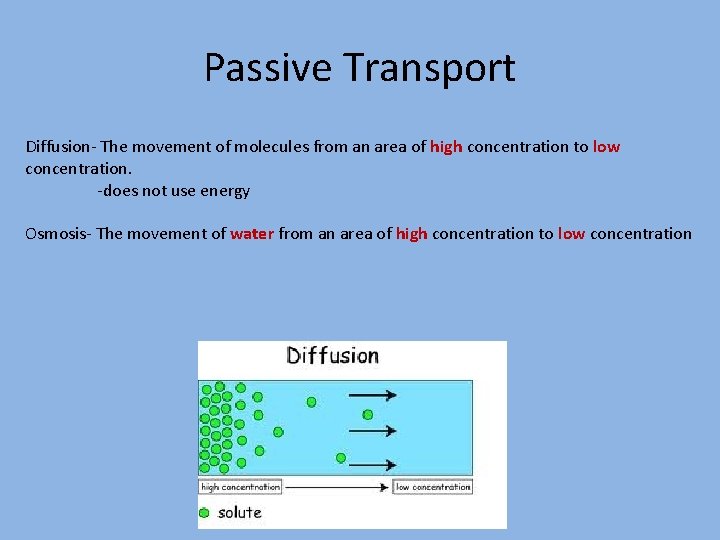
Passive Transport Diffusion- The movement of molecules from an area of high concentration to low concentration. -does not use energy Osmosis- The movement of water from an area of high concentration to low concentration
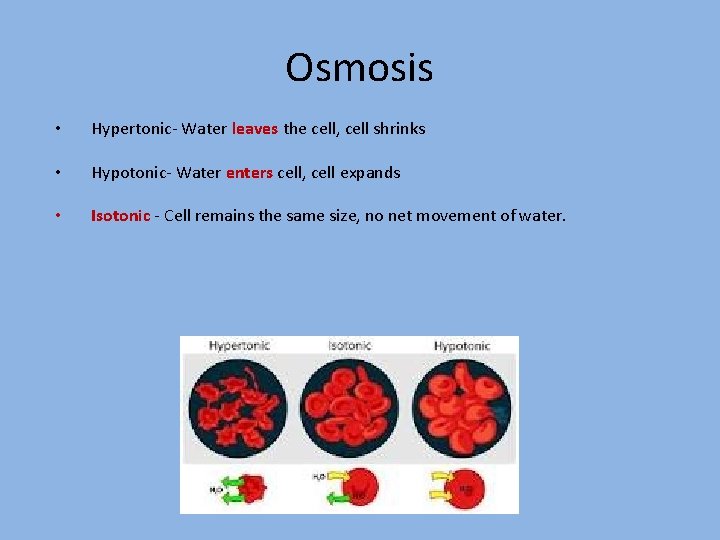
Osmosis • Hypertonic- Water leaves the cell, cell shrinks • Hypotonic- Water enters cell, cell expands • Isotonic - Cell remains the same size, no net movement of water.
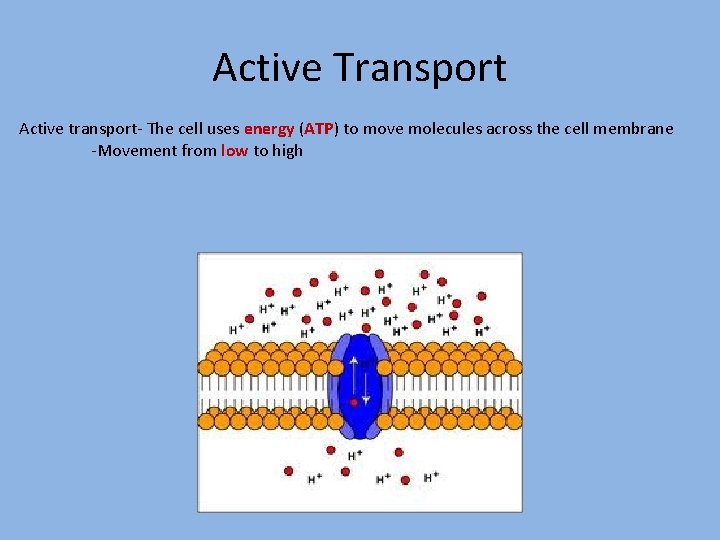
Active Transport Active transport- The cell uses energy (ATP) to move molecules across the cell membrane -Movement from low to high
Question • A cell was discovered that had impaired protein synthesis production. What cell part would most likely be the cause of this? Ribosome
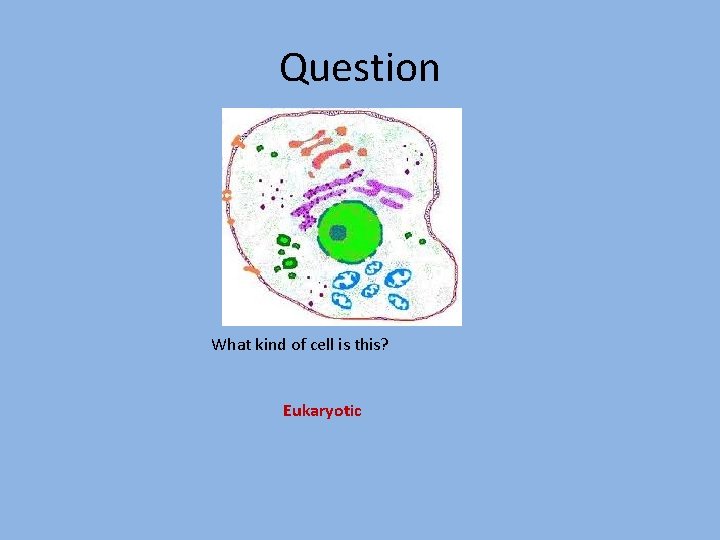
Question What kind of cell is this? Eukaryotic
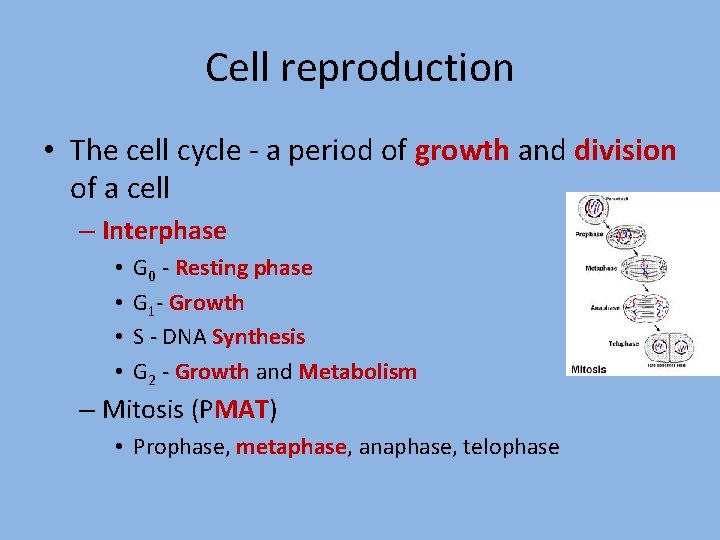
Cell reproduction • The cell cycle - a period of growth and division of a cell – Interphase • • G 0 - Resting phase G 1 - Growth S - DNA Synthesis G 2 - Growth and Metabolism – Mitosis (PMAT) • Prophase, metaphase, anaphase, telophase
Question • The process that happens during the S phase of interphase is called: DNA Synthesis
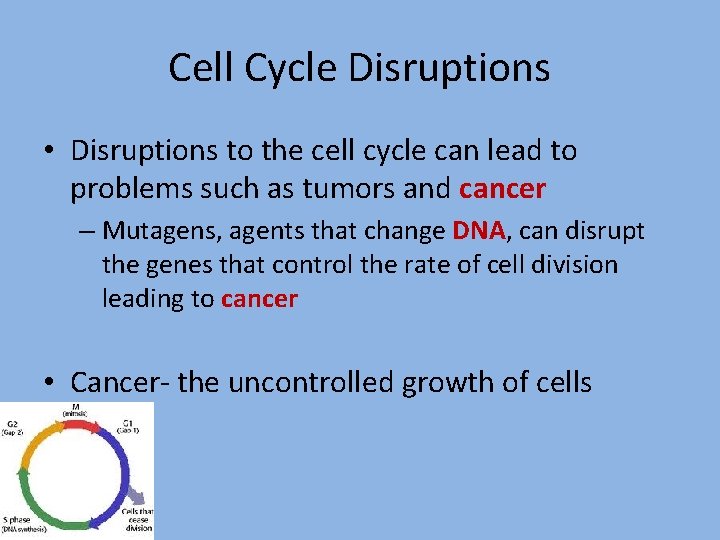
Cell Cycle Disruptions • Disruptions to the cell cycle can lead to problems such as tumors and cancer – Mutagens, agents that change DNA, can disrupt the genes that control the rate of cell division leading to cancer • Cancer- the uncontrolled growth of cells
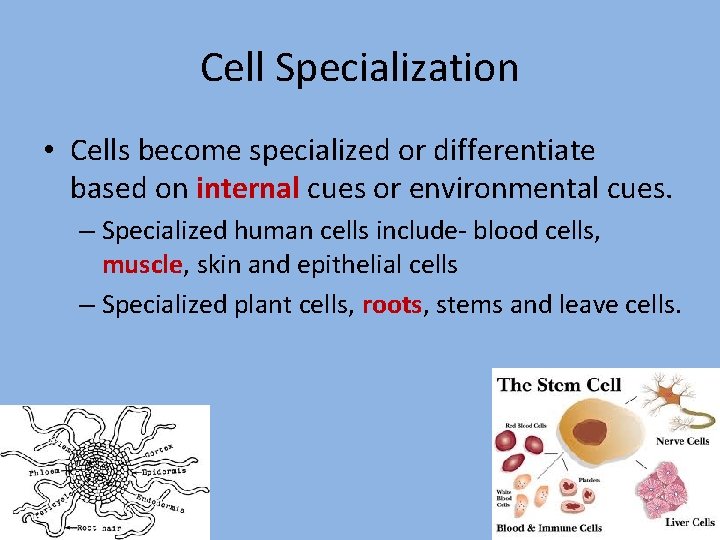
Cell Specialization • Cells become specialized or differentiate based on internal cues or environmental cues. – Specialized human cells include- blood cells, muscle, skin and epithelial cells – Specialized plant cells, roots, stems and leave cells.
Cell Differentiation • Although all cells have the same DNA, different genes are expressed in different cell types • Hormones, sunlight and oxygen levels are examples of factors that can influence genes expression.
Question What is the term that means a gene is exhibited or shown in an organism? Expressed
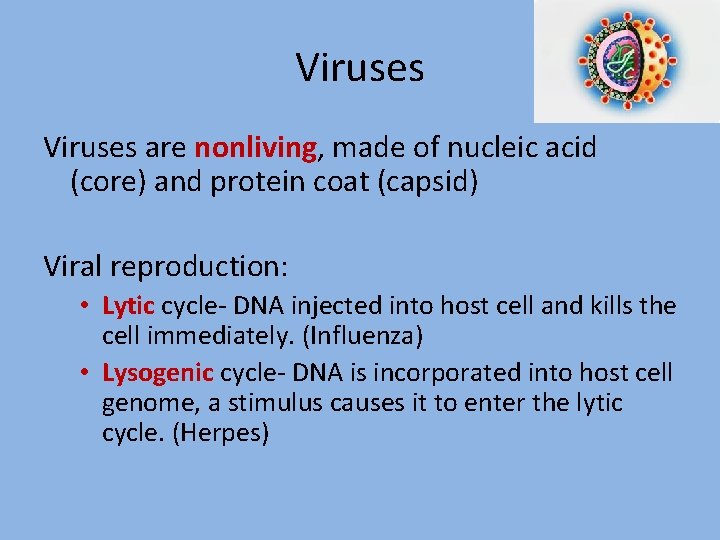
Viruses are nonliving, made of nucleic acid (core) and protein coat (capsid) Viral reproduction: • Lytic cycle- DNA injected into host cell and kills the cell immediately. (Influenza) • Lysogenic cycle- DNA is incorporated into host cell genome, a stimulus causes it to enter the lytic cycle. (Herpes)
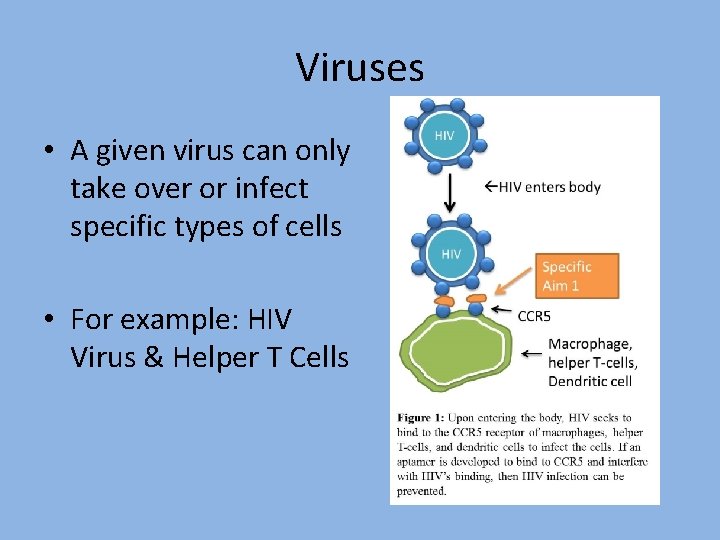
Viruses • A given virus can only take over or infect specific types of cells • For example: HIV Virus & Helper T Cells
Question What cell does HIV virus infect? Helper T Cells
Question Viruses are nonliving. Give three characteristics of viruses that make them different from living organisms: 1. Not made of cells 2. Cannot reproduce on their own 3. No metabolism (eat, breath, etc. )
Reporting Category 2 MECHANISMS OF GENETICS
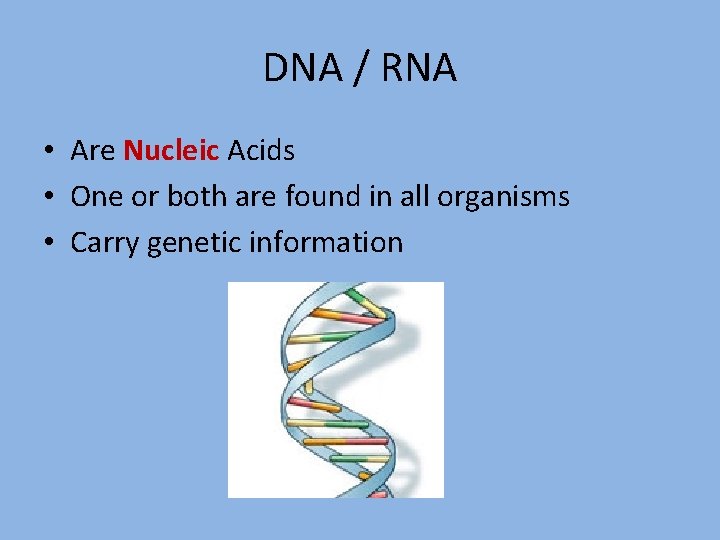
DNA / RNA • Are Nucleic Acids • One or both are found in all organisms • Carry genetic information
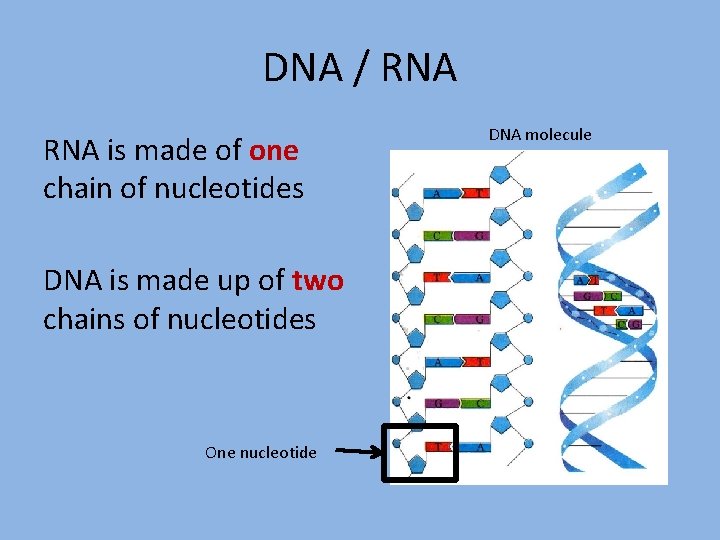
DNA / RNA is made of one chain of nucleotides DNA is made up of two chains of nucleotides One nucleotide DNA molecule
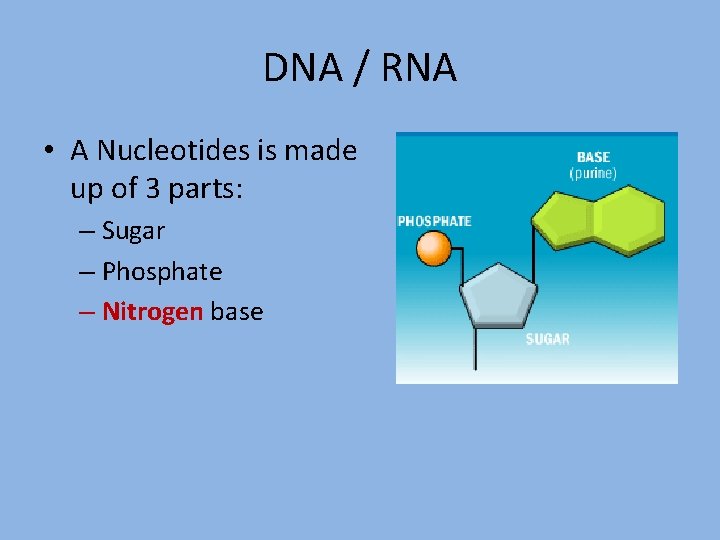
DNA / RNA • A Nucleotides is made up of 3 parts: – Sugar – Phosphate – Nitrogen base
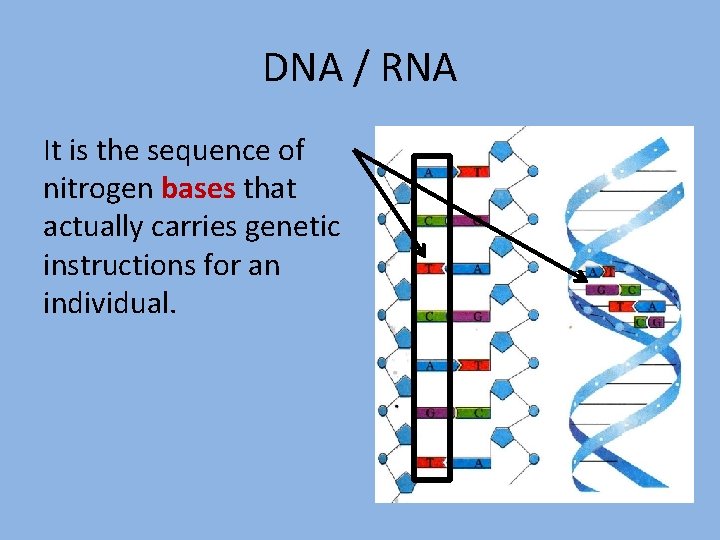
DNA / RNA It is the sequence of nitrogen bases that actually carries genetic instructions for an individual.
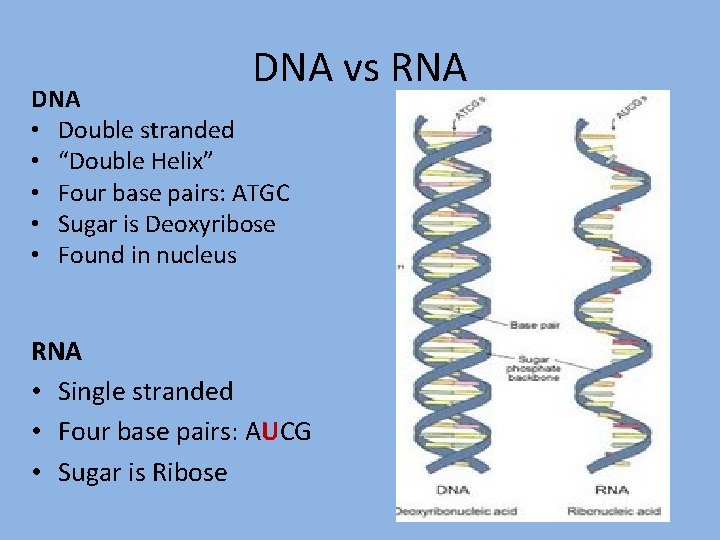
DNA vs RNA DNA • Double stranded • “Double Helix” • Four base pairs: ATGC • Sugar is Deoxyribose • Found in nucleus RNA • Single stranded • Four base pairs: AUCG • Sugar is Ribose
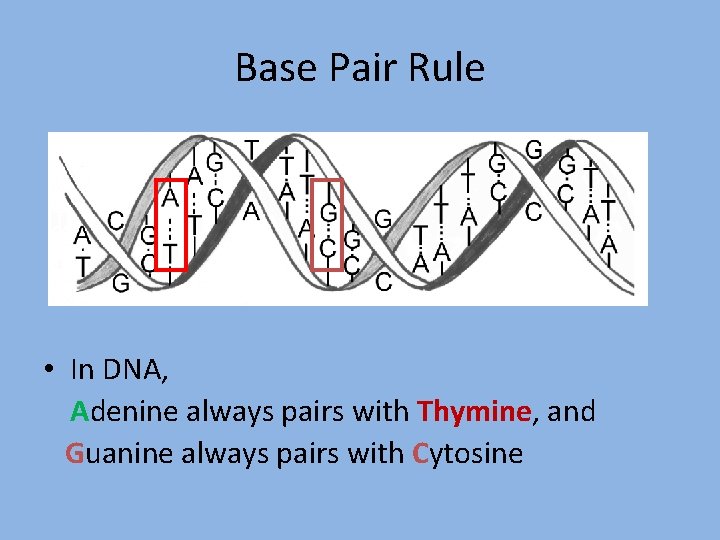
Base Pair Rule • In DNA, Adenine always pairs with Thymine, and Guanine always pairs with Cytosine
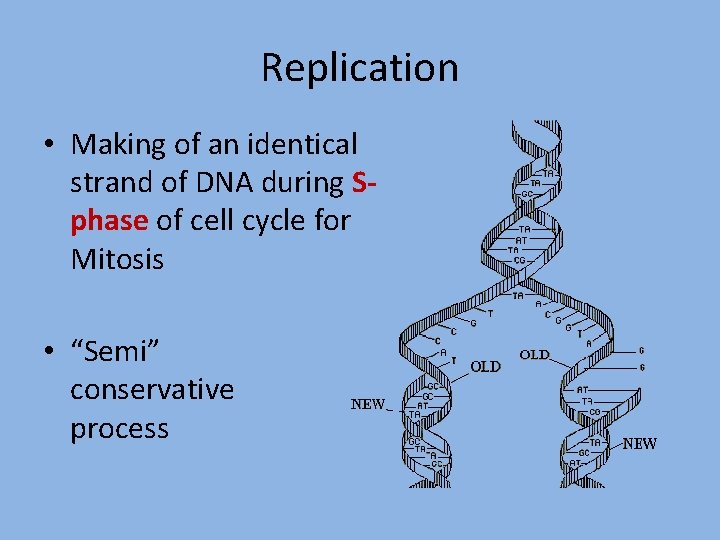
Replication • Making of an identical strand of DNA during Sphase of cell cycle for Mitosis • “Semi” conservative process
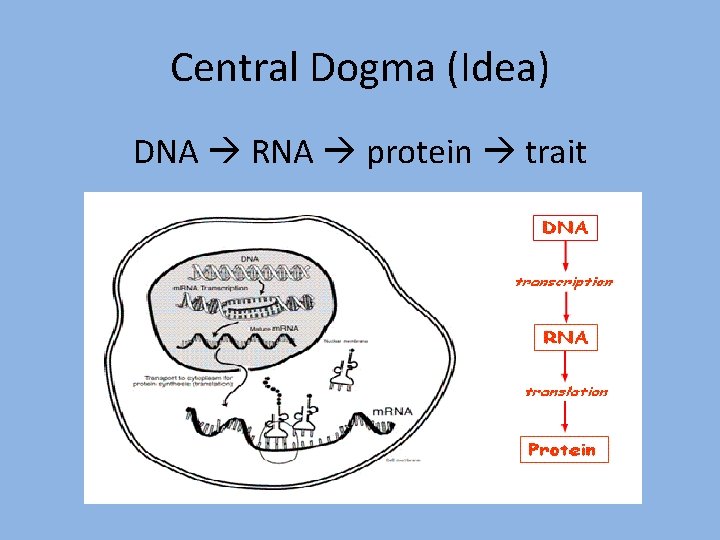
Central Dogma (Idea) DNA RNA protein trait
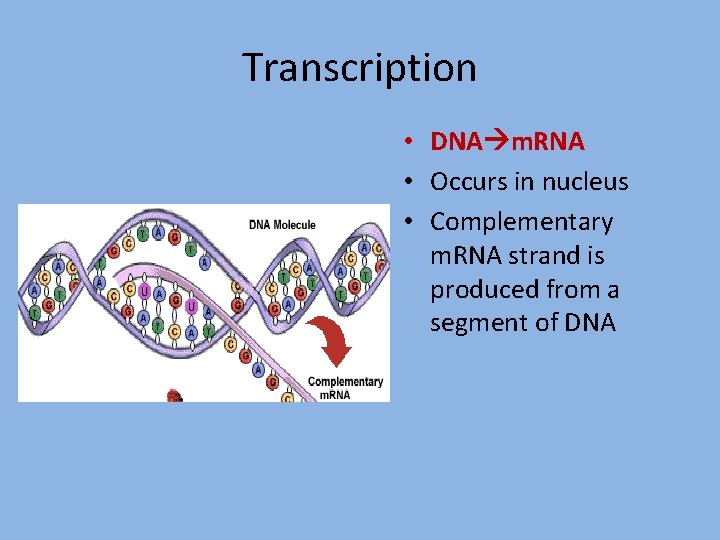
Transcription • DNA m. RNA • Occurs in nucleus • Complementary m. RNA strand is produced from a segment of DNA
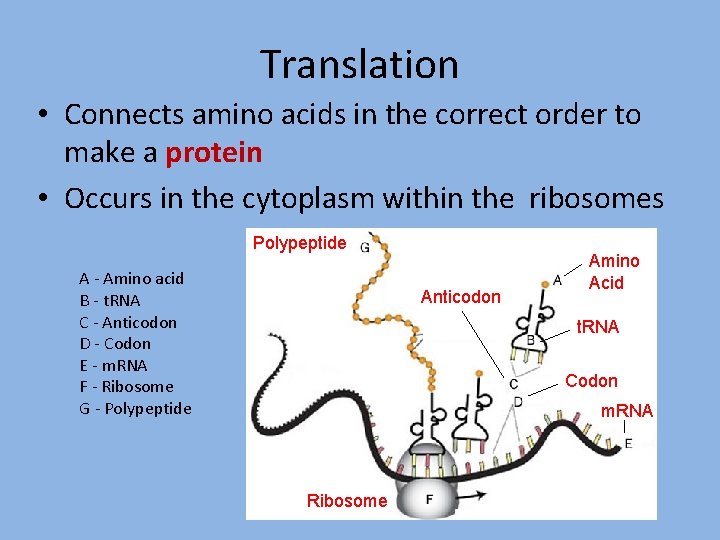
Translation • Connects amino acids in the correct order to make a protein • Occurs in the cytoplasm within the ribosomes Polypeptide A - Amino acid B - t. RNA C - Anticodon D - Codon E - m. RNA F - Ribosome G - Polypeptide Anticodon Amino Acid t. RNA Codon m. RNA Ribosome
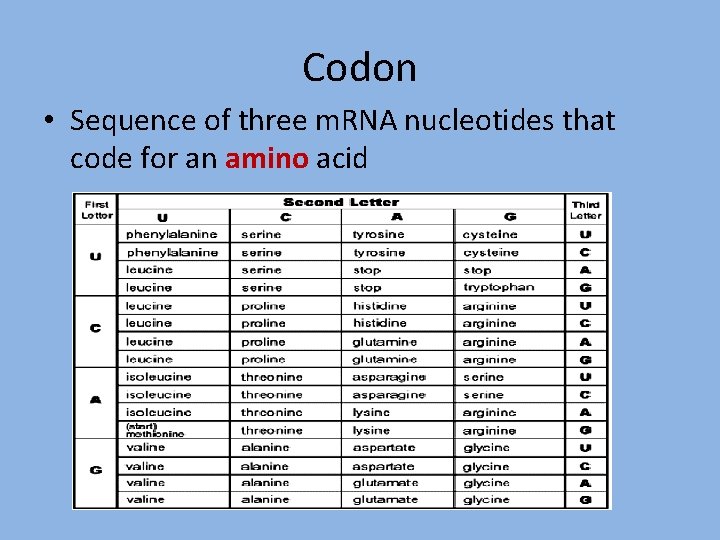
Codon • Sequence of three m. RNA nucleotides that code for an amino acid
Gene Expression • Gene expression refers to genes being ‘turned on’ and producing a product. • The product could be an enzyme, a structural protein, or a control molecule. • Most mechanisms that control gene expression do so by controlling transcription, the synthesis of m. RNA. • Gene Expression Animation
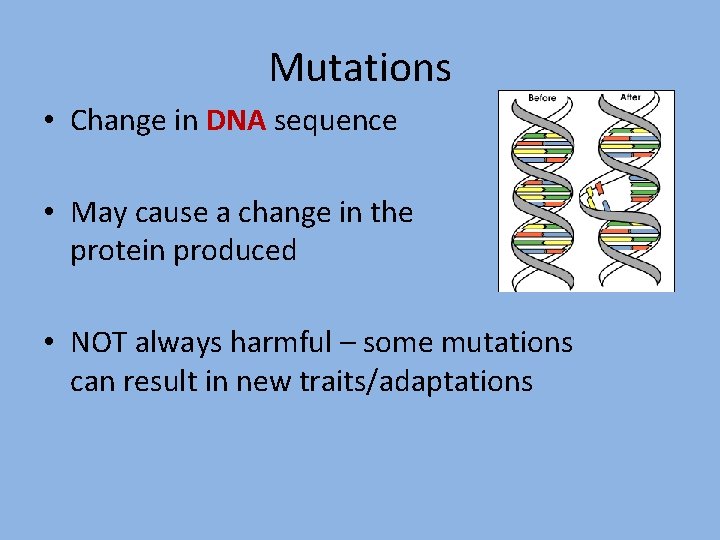
Mutations • Change in DNA sequence • May cause a change in the protein produced • NOT always harmful – some mutations can result in new traits/adaptations
Mutations • Has to occur in the gametes in order to be passed on • Changes in somatic cells are not passed on
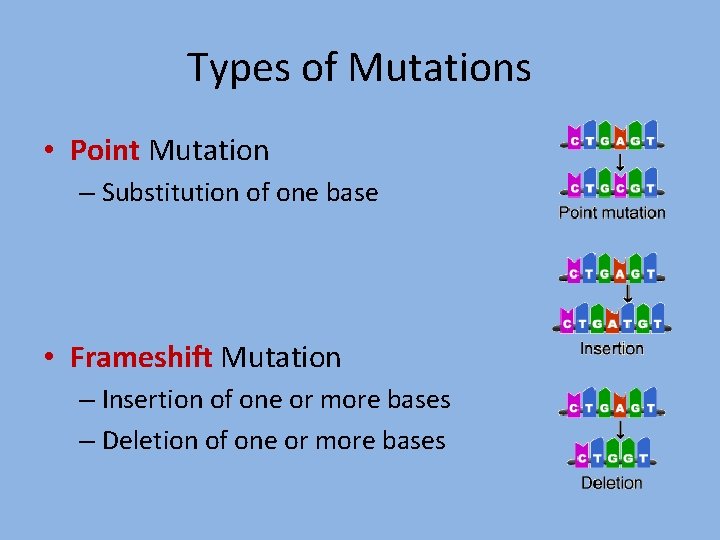
Types of Mutations • Point Mutation – Substitution of one base • Frameshift Mutation – Insertion of one or more bases – Deletion of one or more bases
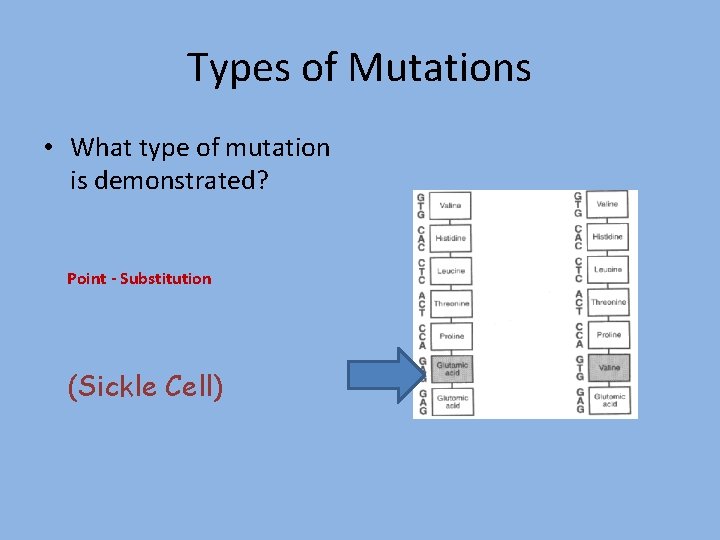
Types of Mutations • What type of mutation is demonstrated? Point - Substitution (Sickle Cell)
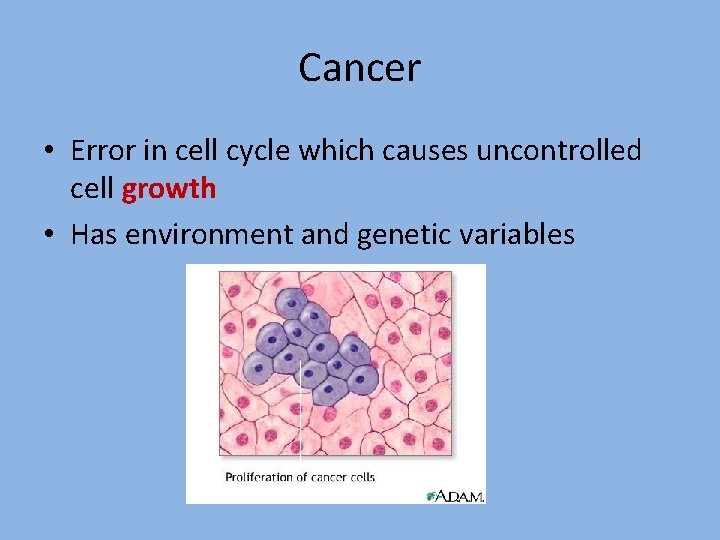
Cancer • Error in cell cycle which causes uncontrolled cell growth • Has environment and genetic variables
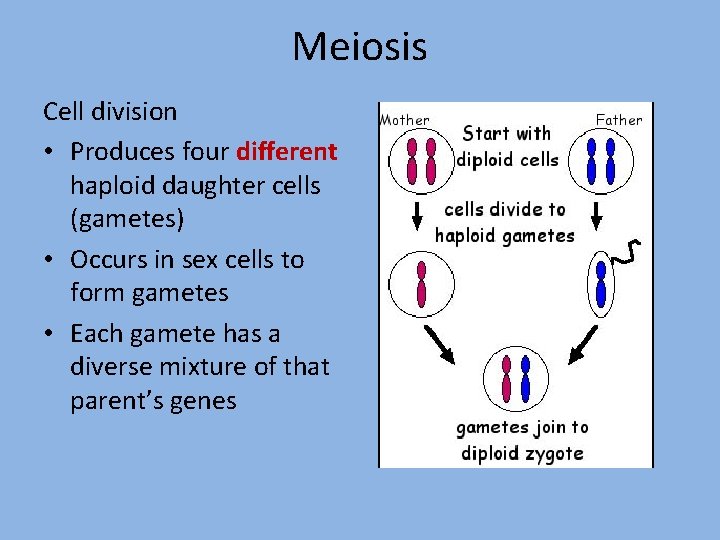
Meiosis Cell division • Produces four different haploid daughter cells (gametes) • Occurs in sex cells to form gametes • Each gamete has a diverse mixture of that parent’s genes
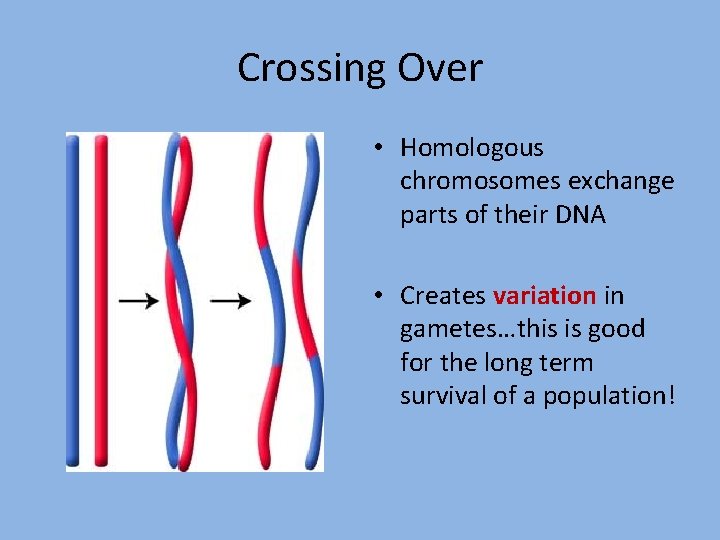
Crossing Over • Homologous chromosomes exchange parts of their DNA • Creates variation in gametes…this is good for the long term survival of a population!
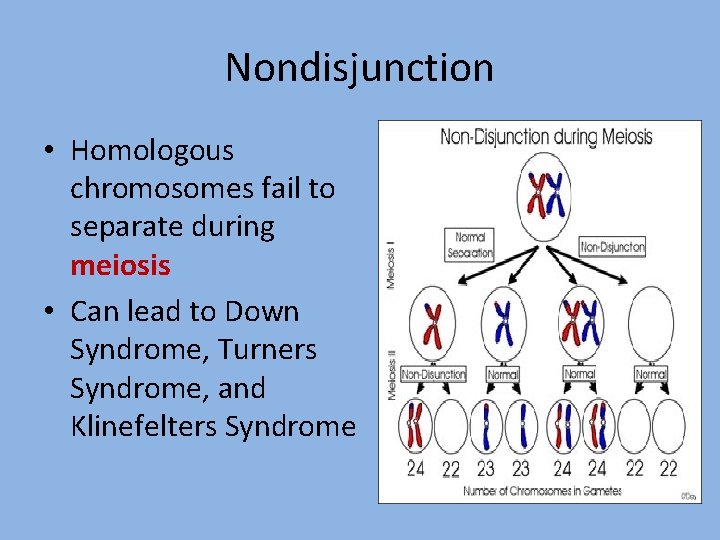
Nondisjunction • Homologous chromosomes fail to separate during meiosis • Can lead to Down Syndrome, Turners Syndrome, and Klinefelters Syndrome
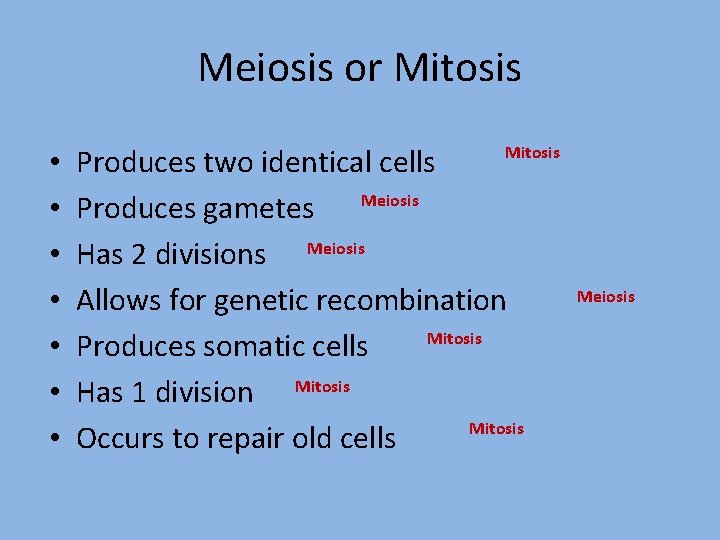
Meiosis or Mitosis • • Mitosis Produces two identical cells Produces gametes Meiosis Has 2 divisions Meiosis Allows for genetic recombination Mitosis Produces somatic cells Has 1 division Mitosis Occurs to repair old cells Meiosis
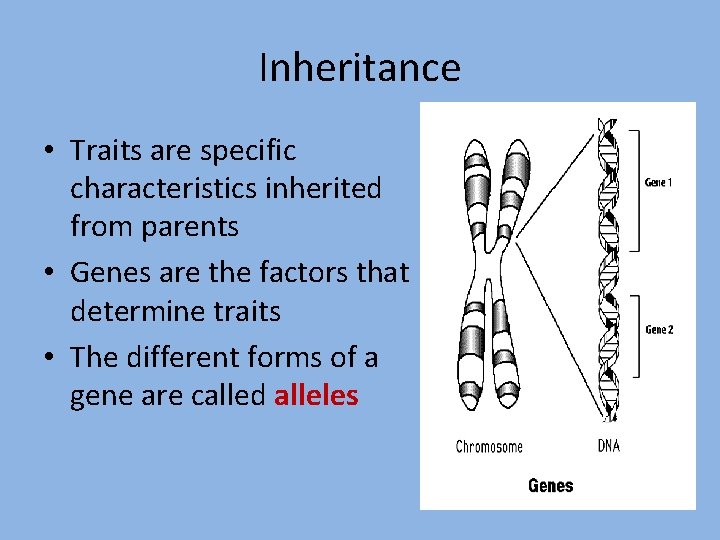
Inheritance • Traits are specific characteristics inherited from parents • Genes are the factors that determine traits • The different forms of a gene are called alleles
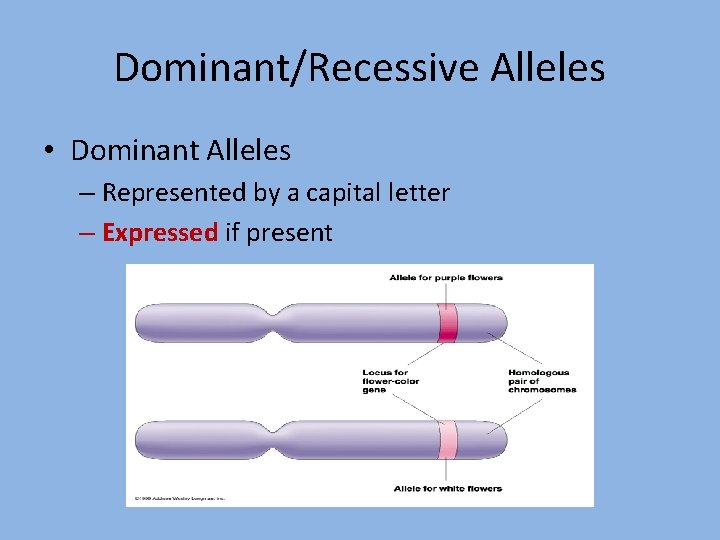
Dominant/Recessive Alleles • Dominant Alleles – Represented by a capital letter – Expressed if present
Dominant/Recessive Alleles • Recessive Alleles – Represented by a lower case letter – Hidden unless paired with another recessive allele
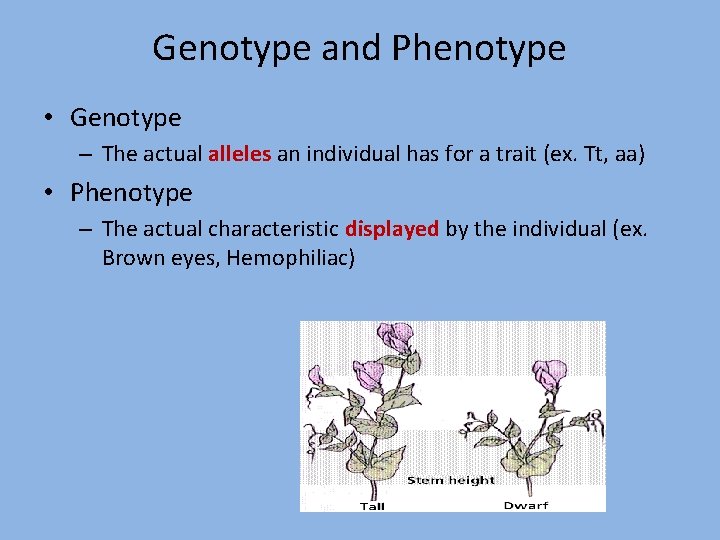
Genotype and Phenotype • Genotype – The actual alleles an individual has for a trait (ex. Tt, aa) • Phenotype – The actual characteristic displayed by the individual (ex. Brown eyes, Hemophiliac)
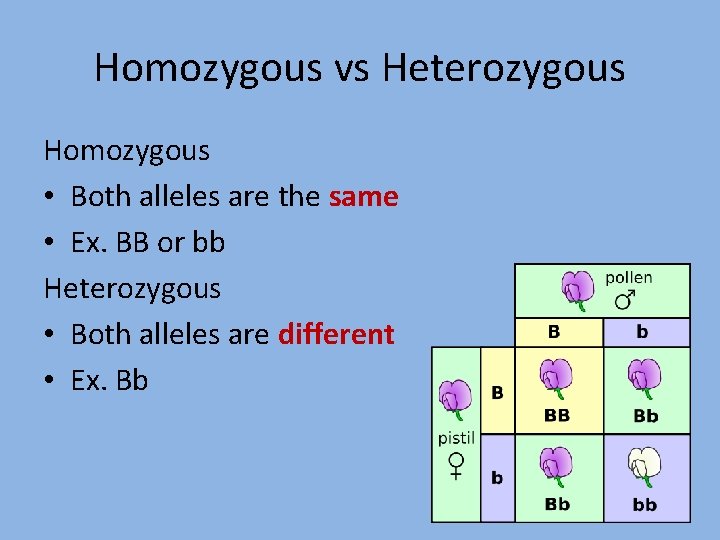
Homozygous vs Heterozygous Homozygous • Both alleles are the same • Ex. BB or bb Heterozygous • Both alleles are different • Ex. Bb
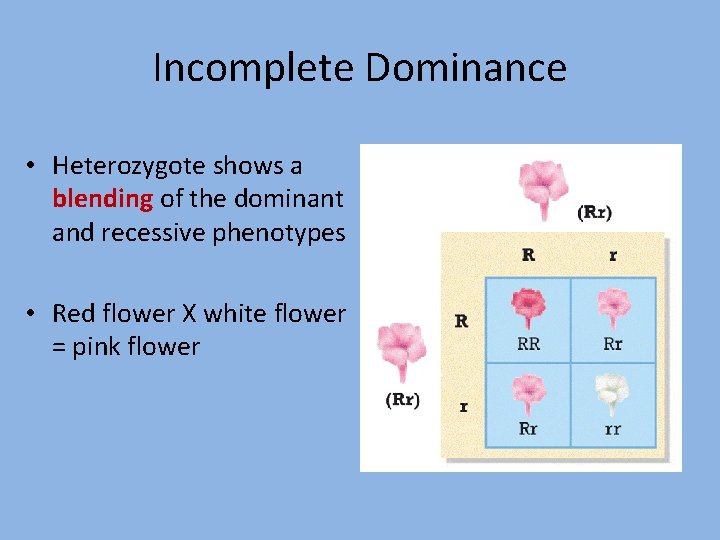
Incomplete Dominance • Heterozygote shows a blending of the dominant and recessive phenotypes • Red flower X white flower = pink flower
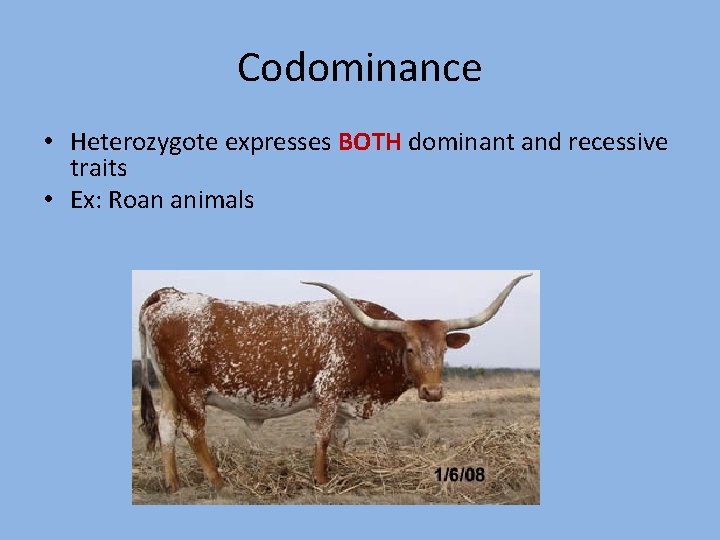
Codominance • Heterozygote expresses BOTH dominant and recessive traits • Ex: Roan animals
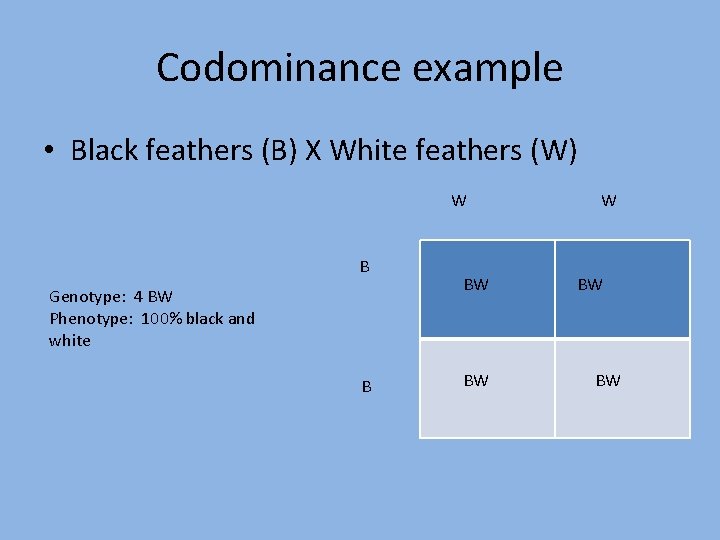
Codominance example • Black feathers (B) X White feathers (W) W B Genotype: 4 BW Phenotype: 100% black and white B BW BW BW
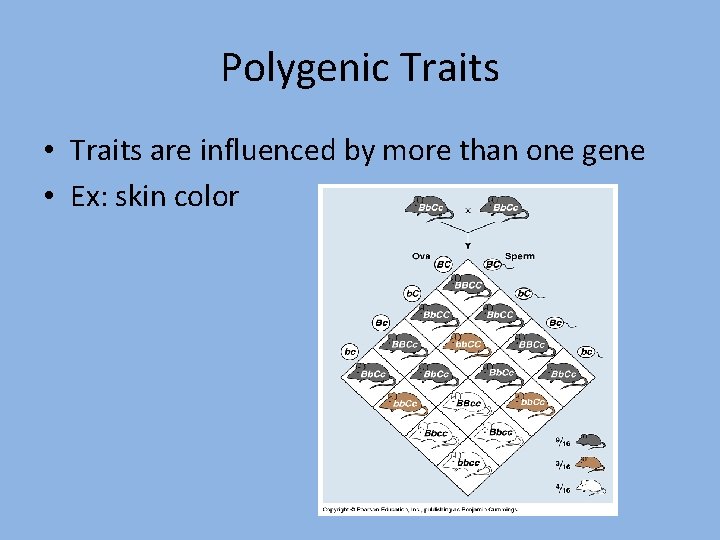
Polygenic Traits • Traits are influenced by more than one gene • Ex: skin color
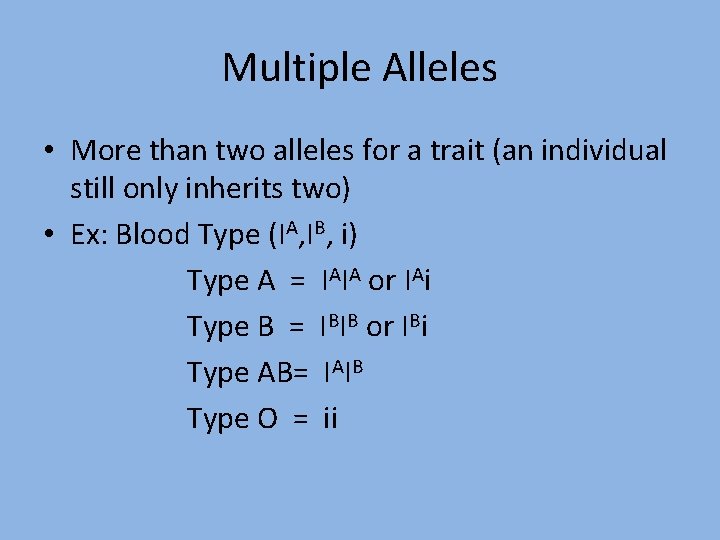
Multiple Alleles • More than two alleles for a trait (an individual still only inherits two) • Ex: Blood Type (IA, IB, i) Type A = IAIA or IAi Type B = IBIB or IBi Type AB= IAIB Type O = ii
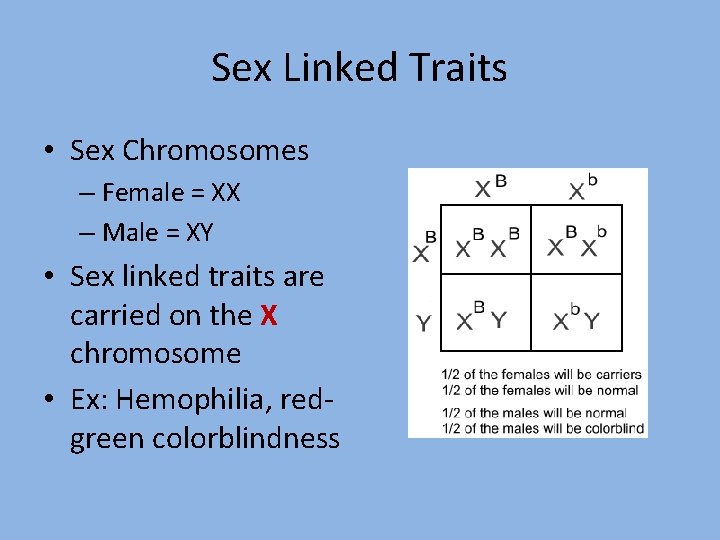
Sex Linked Traits • Sex Chromosomes – Female = XX – Male = XY • Sex linked traits are carried on the X chromosome • Ex: Hemophilia, redgreen colorblindness
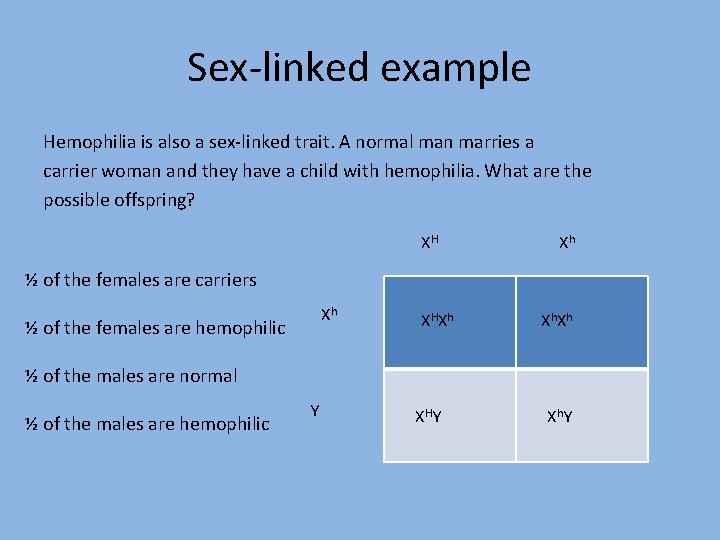
Sex-linked example Hemophilia is also a sex-linked trait. A normal man marries a carrier woman and they have a child with hemophilia. What are the possible offspring? XH Xh ½ of the females are carriers ½ of the females are hemophilic Xh XHXh Xh Xh ½ of the males are normal ½ of the males are hemophilic Y XHY Xh Y
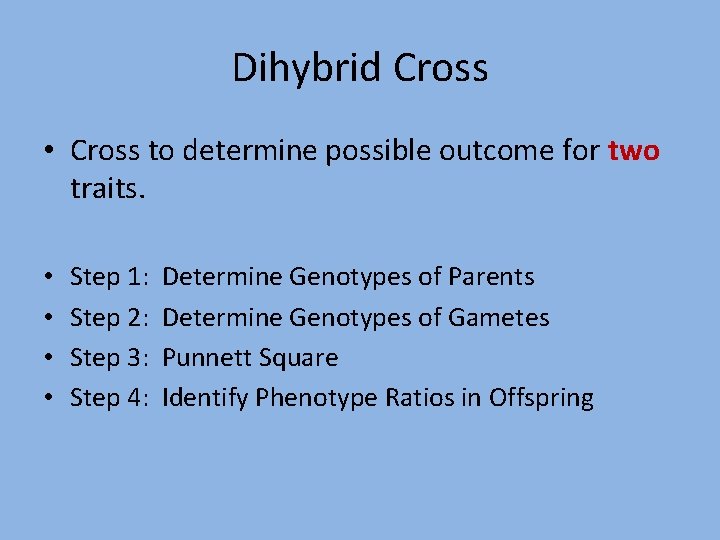
Dihybrid Cross • Cross to determine possible outcome for two traits. • • Step 1: Determine Genotypes of Parents Step 2: Determine Genotypes of Gametes Step 3: Punnett Square Step 4: Identify Phenotype Ratios in Offspring
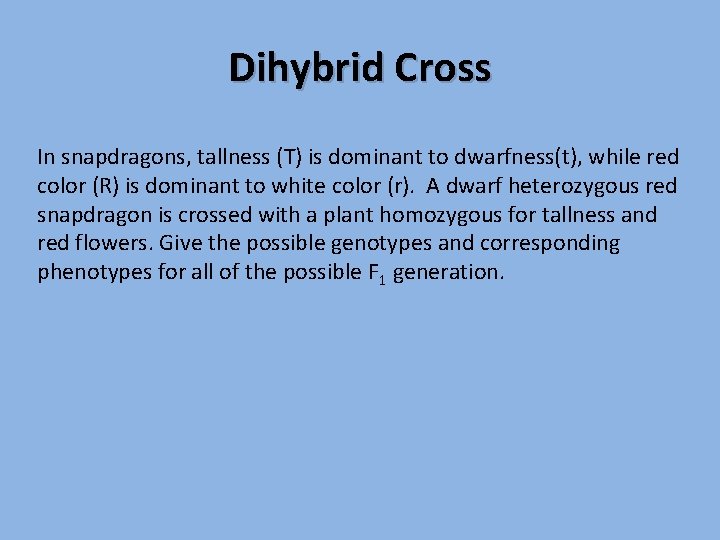
Dihybrid Cross In snapdragons, tallness (T) is dominant to dwarfness(t), while red color (R) is dominant to white color (r). A dwarf heterozygous red snapdragon is crossed with a plant homozygous for tallness and red flowers. Give the possible genotypes and corresponding phenotypes for all of the possible F 1 generation.
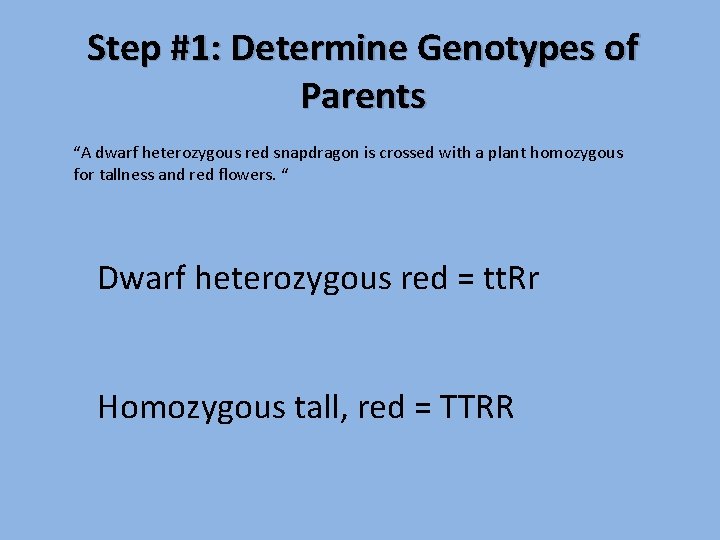
Step #1: Determine Genotypes of Parents “A dwarf heterozygous red snapdragon is crossed with a plant homozygous for tallness and red flowers. “ Dwarf heterozygous red = tt. Rr Homozygous tall, red = TTRR
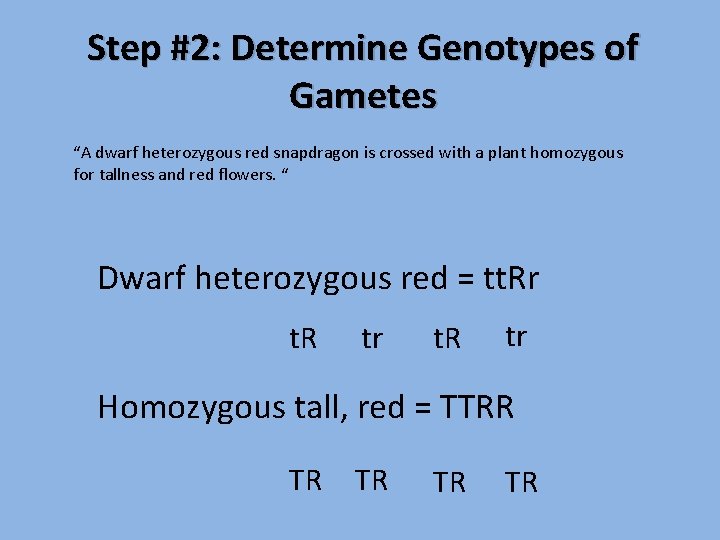
Step #2: Determine Genotypes of Gametes “A dwarf heterozygous red snapdragon is crossed with a plant homozygous for tallness and red flowers. “ Dwarf heterozygous red = tt. Rr t. R tr Homozygous tall, red = TTRR TR TR
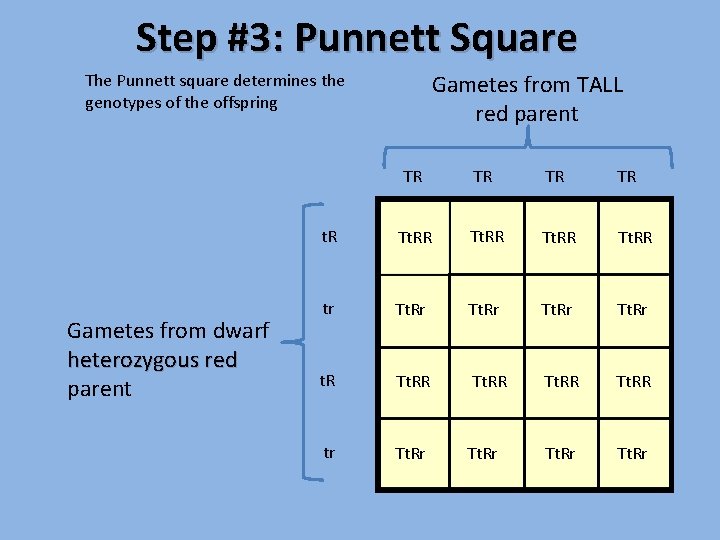
Step #3: Punnett Square Gametes from TALL red parent The Punnett square determines the genotypes of the offspring Gametes from dwarf heterozygous red parent TR TR t. R Tt. RR Tt. RR tr Tt. Rr Tt. Rr
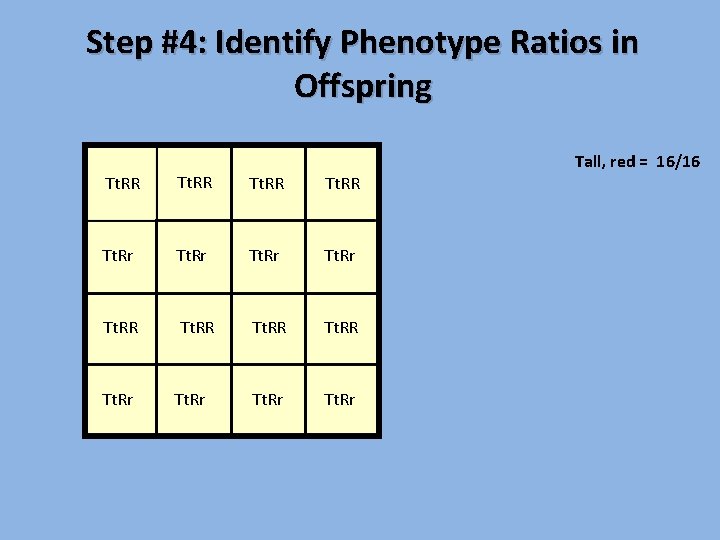
Step #4: Identify Phenotype Ratios in Offspring Tall, red = 16/16 Tt. RR Tt. Rr Tt. Rr
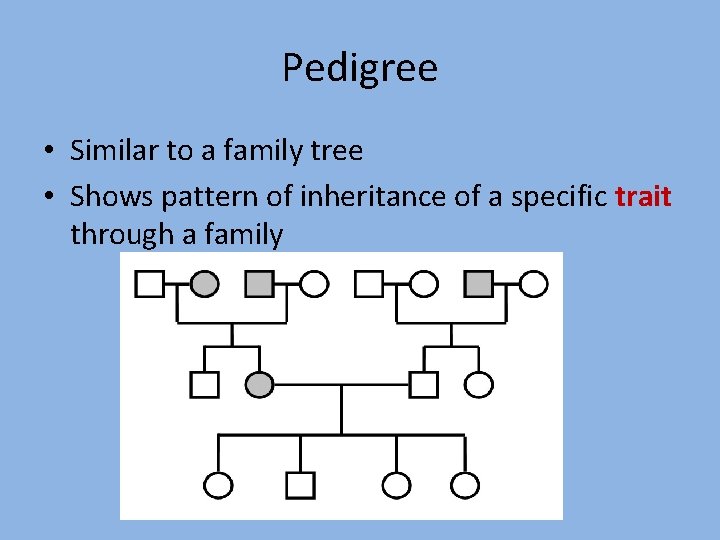
Pedigree • Similar to a family tree • Shows pattern of inheritance of a specific trait through a family
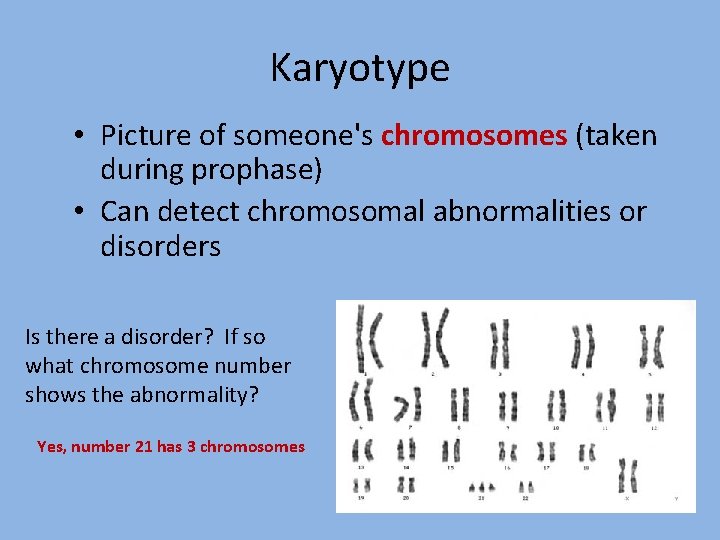
Karyotype • Picture of someone's chromosomes (taken during prophase) • Can detect chromosomal abnormalities or disorders Is there a disorder? If so what chromosome number shows the abnormality? Yes, number 21 has 3 chromosomes
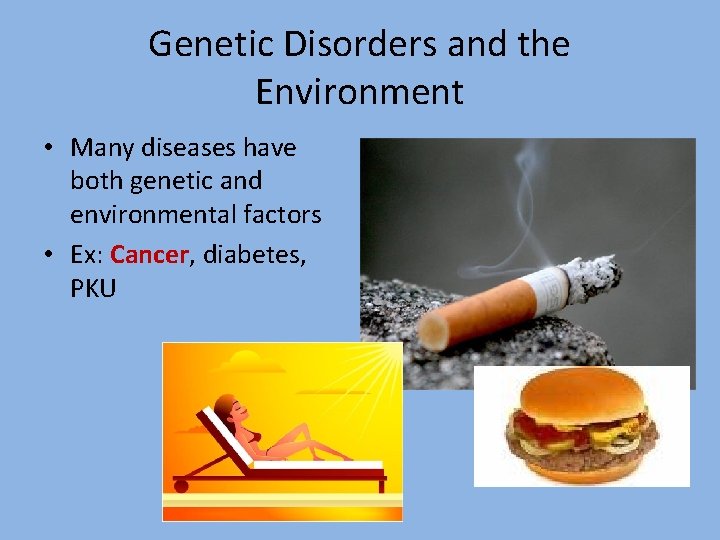
Genetic Disorders and the Environment • Many diseases have both genetic and environmental factors • Ex: Cancer, diabetes, PKU
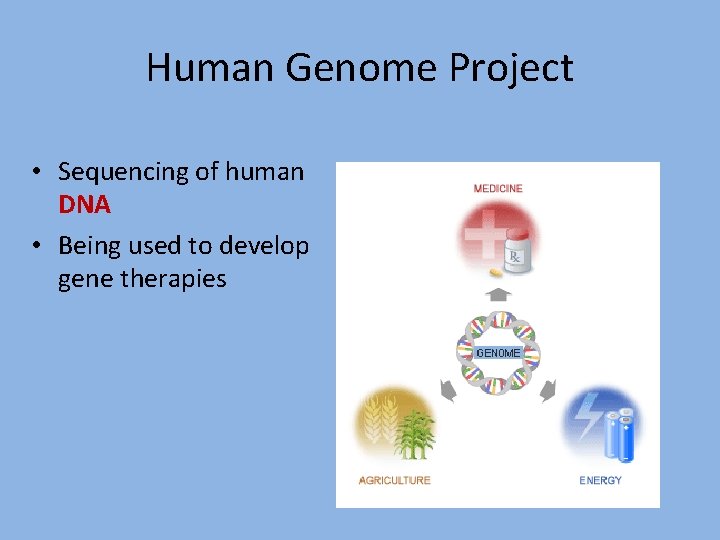
Human Genome Project • Sequencing of human DNA • Being used to develop gene therapies
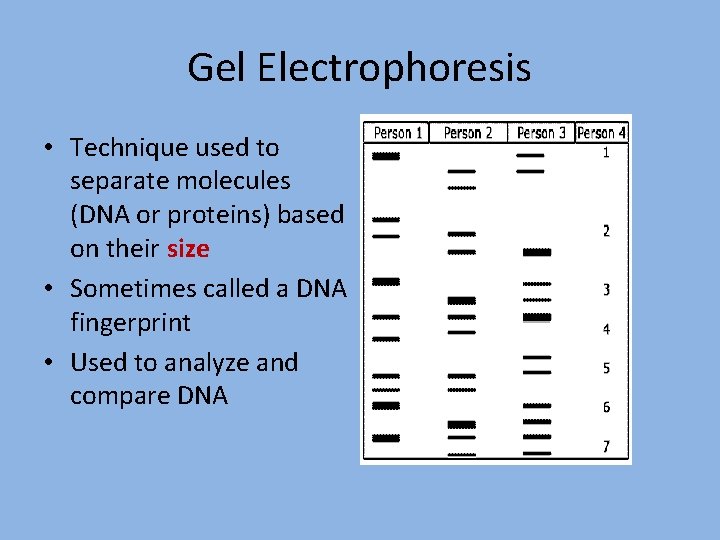
Gel Electrophoresis • Technique used to separate molecules (DNA or proteins) based on their size • Sometimes called a DNA fingerprint • Used to analyze and compare DNA
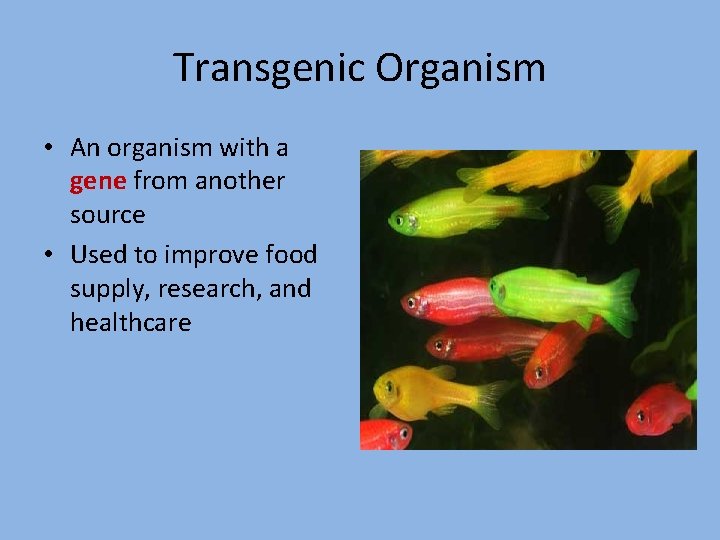
Transgenic Organism • An organism with a gene from another source • Used to improve food supply, research, and healthcare
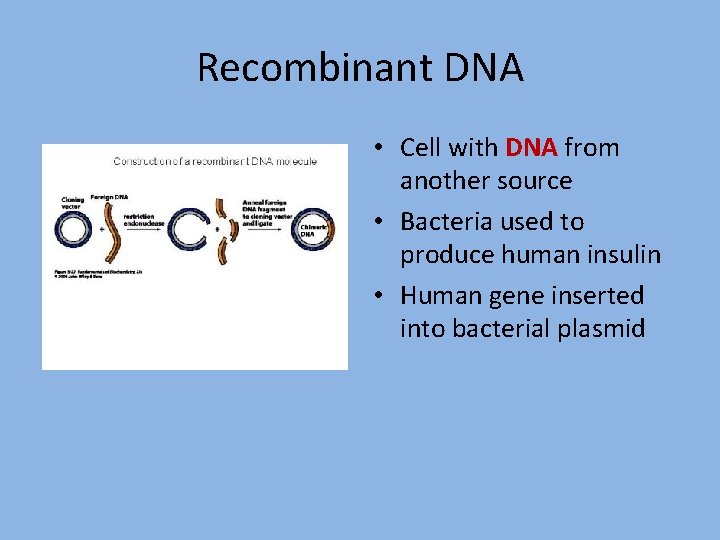
Recombinant DNA • Cell with DNA from another source • Bacteria used to produce human insulin • Human gene inserted into bacterial plasmid
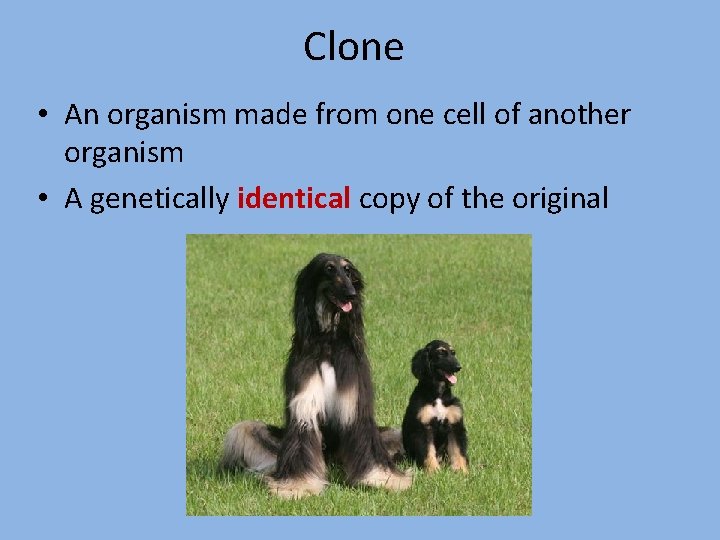
Clone • An organism made from one cell of another organism • A genetically identical copy of the original
Reporting Category 3 EVOLUTION & CLASSIFICATION
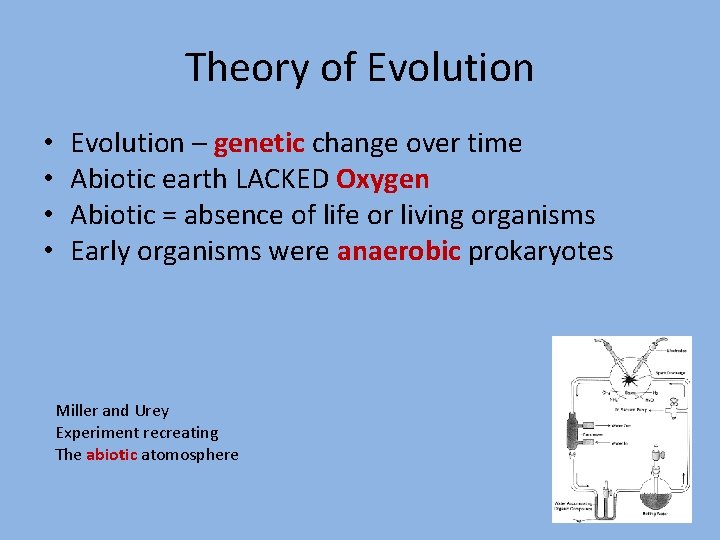
Theory of Evolution • • Evolution – genetic change over time Abiotic earth LACKED Oxygen Abiotic = absence of life or living organisms Early organisms were anaerobic prokaryotes Miller and Urey Experiment recreating The abiotic atomosphere
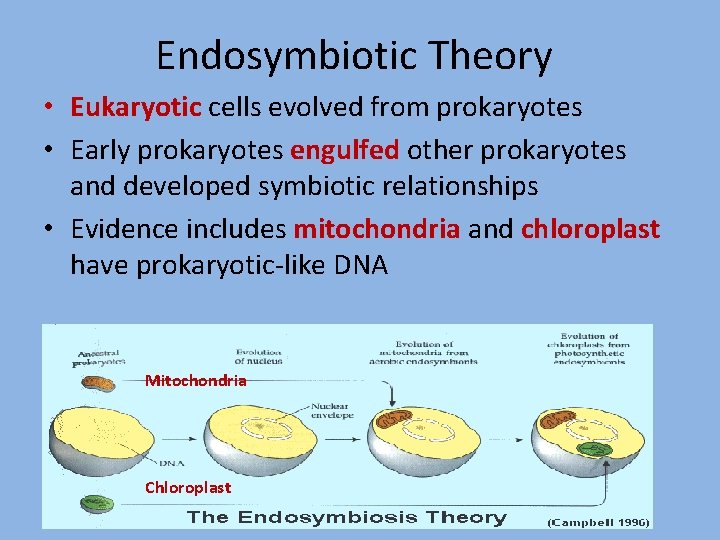
Endosymbiotic Theory • Eukaryotic cells evolved from prokaryotes • Early prokaryotes engulfed other prokaryotes and developed symbiotic relationships • Evidence includes mitochondria and chloroplast have prokaryotic-like DNA Mitochondria Chloroplast
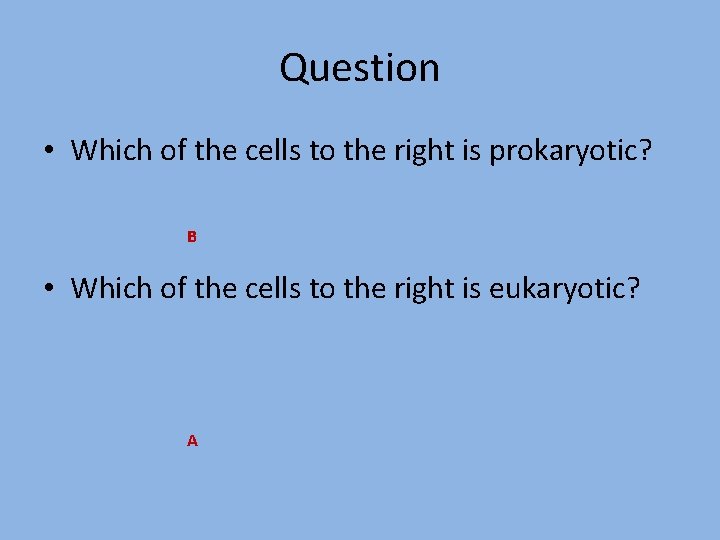
Question • Which of the cells to the right is prokaryotic? B • Which of the cells to the right is eukaryotic? A
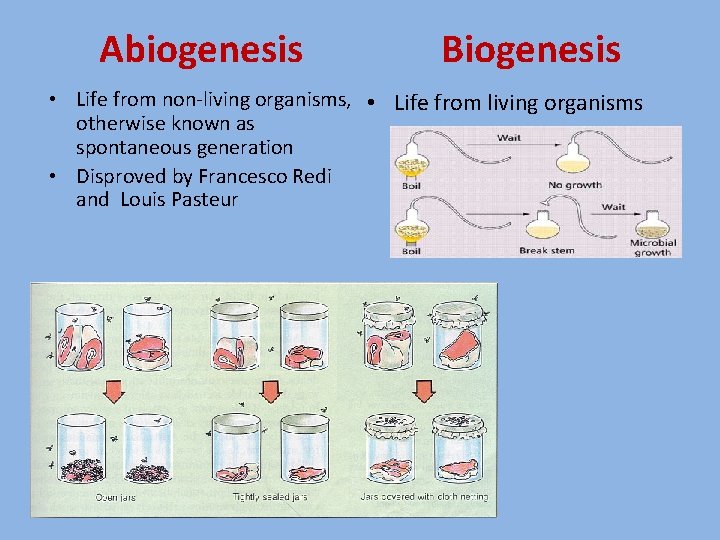
Abiogenesis Biogenesis • Life from non-living organisms, • Life from living organisms otherwise known as spontaneous generation • Disproved by Francesco Redi and Louis Pasteur
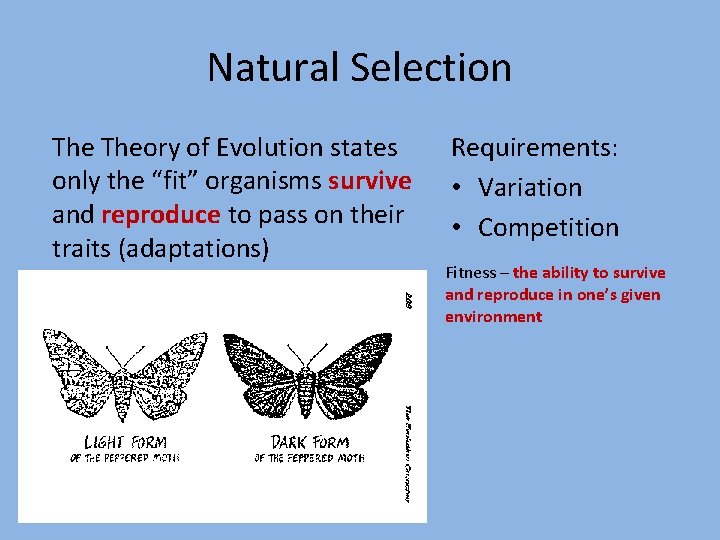
Natural Selection Theory of Evolution states only the “fit” organisms survive and reproduce to pass on their traits (adaptations) Requirements: • Variation • Competition Fitness – the ability to survive and reproduce in one’s given environment
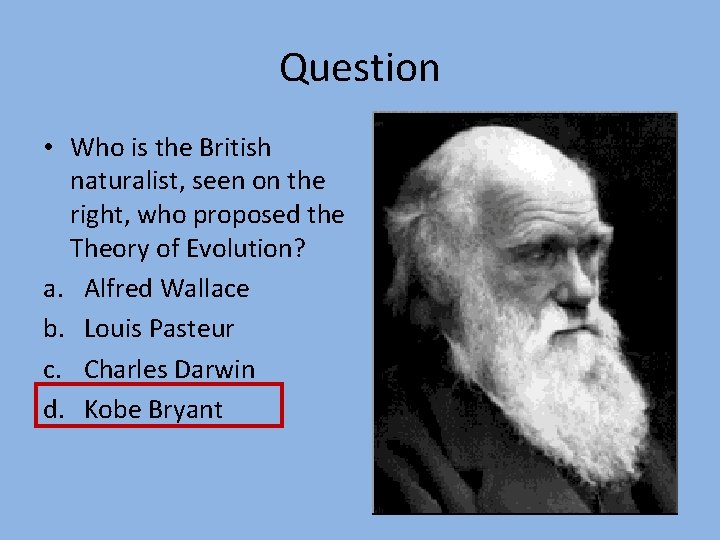
Question • Who is the British naturalist, seen on the right, who proposed the Theory of Evolution? a. Alfred Wallace b. Louis Pasteur c. Charles Darwin d. Kobe Bryant
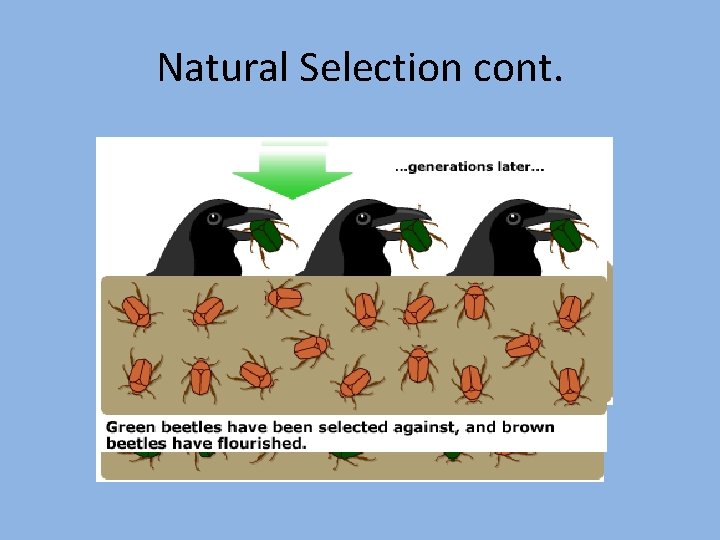
Natural Selection cont. • Natural selection – the differential reproduction and survival of competing organisms. • Fit organisms survive better because they are well adapted to their environments.
Natural Selection cont.
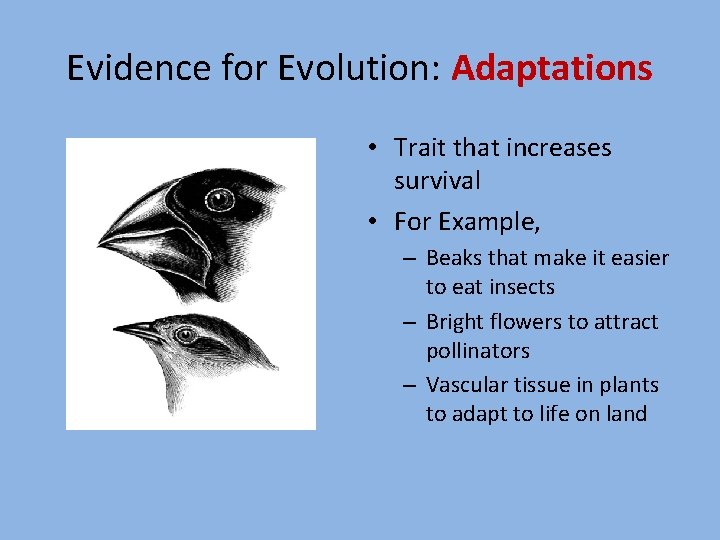
Evidence for Evolution: Adaptations • Trait that increases survival • For Example, – Beaks that make it easier to eat insects – Bright flowers to attract pollinators – Vascular tissue in plants to adapt to life on land
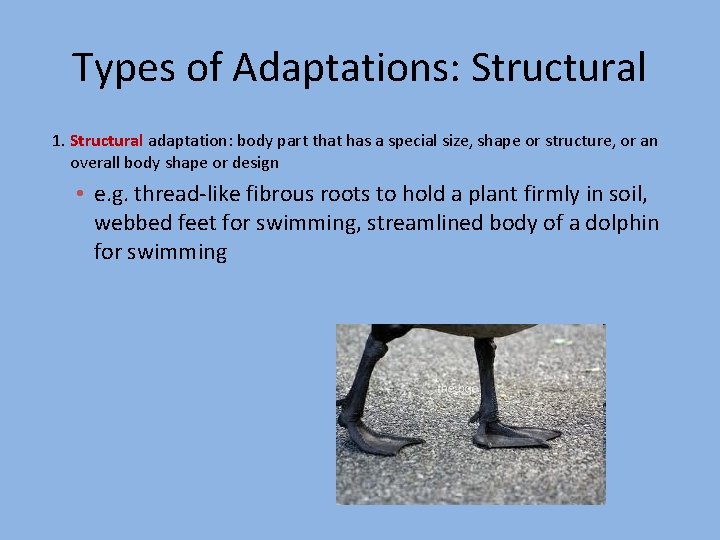
Types of Adaptations: Structural 1. Structural adaptation: body part that has a special size, shape or structure, or an overall body shape or design • e. g. thread-like fibrous roots to hold a plant firmly in soil, webbed feet for swimming, streamlined body of a dolphin for swimming
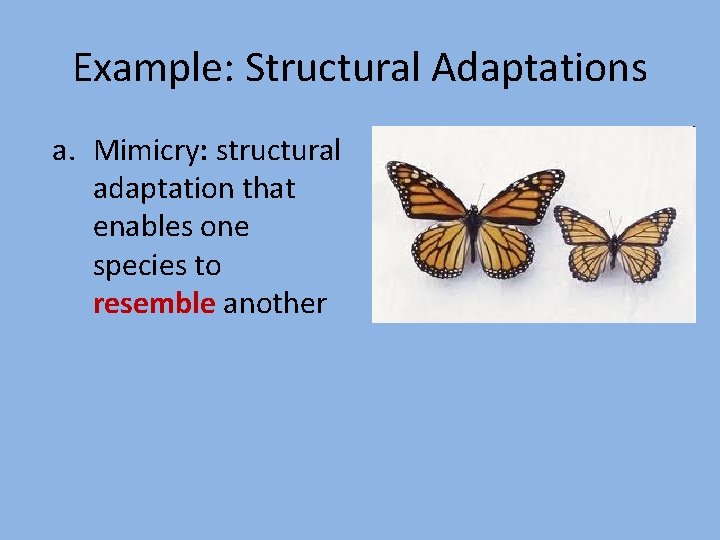
Example: Structural Adaptations a. Mimicry: structural adaptation that enables one species to resemble another
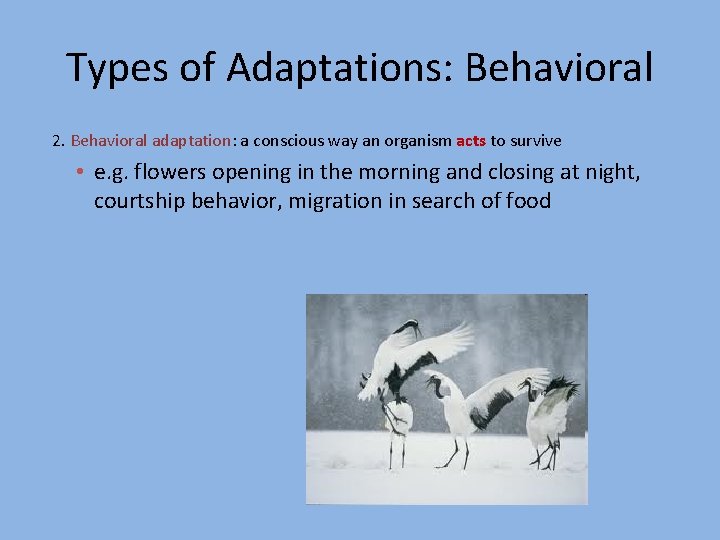
Types of Adaptations: Behavioral 2. Behavioral adaptation: a conscious way an organism acts to survive • e. g. flowers opening in the morning and closing at night, courtship behavior, migration in search of food
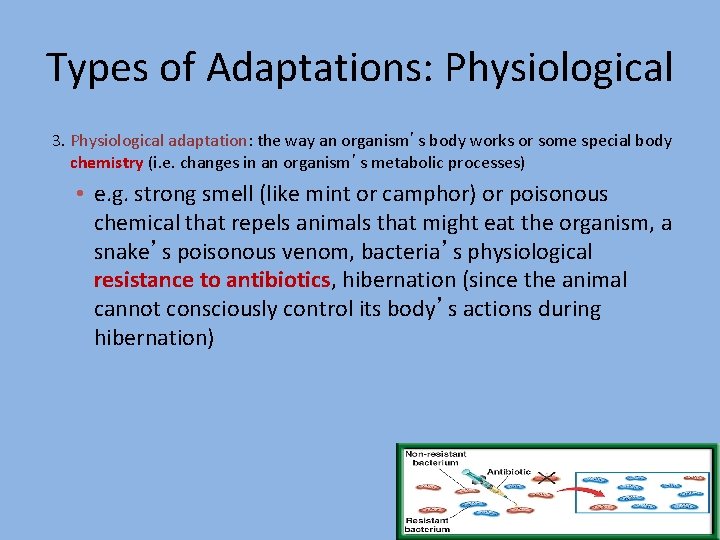
Types of Adaptations: Physiological 3. Physiological adaptation: the way an organism’s body works or some special body chemistry (i. e. changes in an organism’s metabolic processes) • e. g. strong smell (like mint or camphor) or poisonous chemical that repels animals that might eat the organism, a snake’s poisonous venom, bacteria’s physiological resistance to antibiotics, hibernation (since the animal cannot consciously control its body’s actions during hibernation)
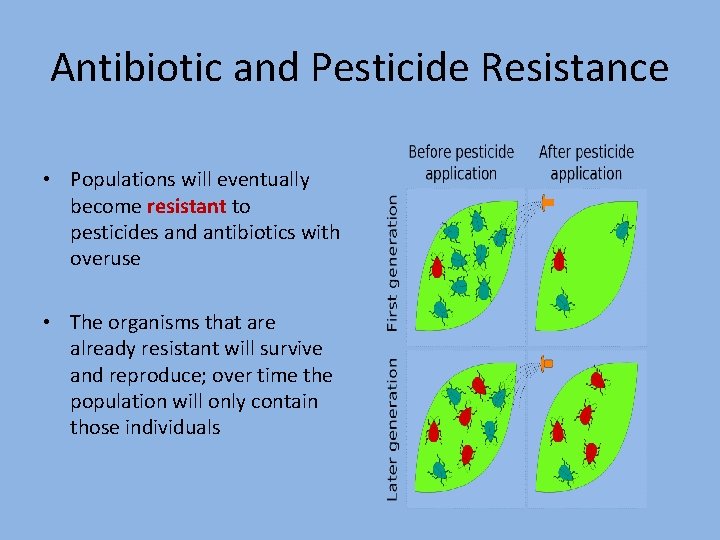
Antibiotic and Pesticide Resistance • Populations will eventually become resistant to pesticides and antibiotics with overuse • The organisms that are already resistant will survive and reproduce; over time the population will only contain those individuals
Question What type of adaptation would the spines on a cactus be considered: Structural, behavioral, or physiological? Structural What is the unequal success of survival and reproduction in organisms called? Natural Selection
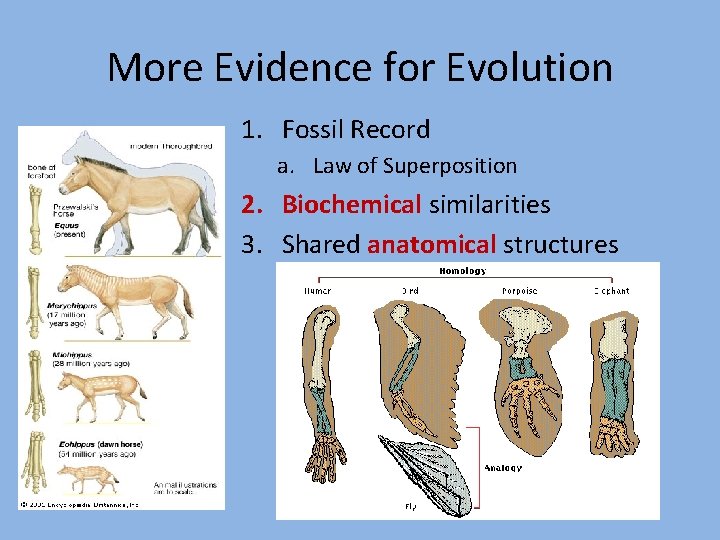
More Evidence for Evolution 1. Fossil Record a. Law of Superposition 2. Biochemical similarities 3. Shared anatomical structures
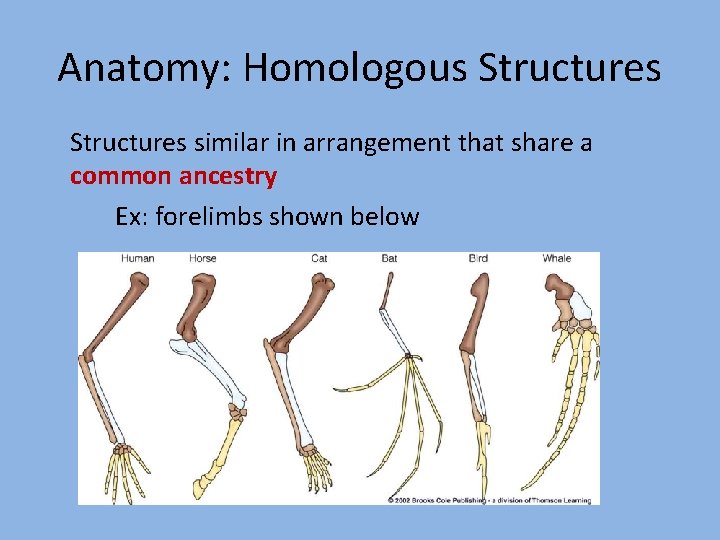
Anatomy: Homologous Structures similar in arrangement that share a common ancestry Ex: forelimbs shown below
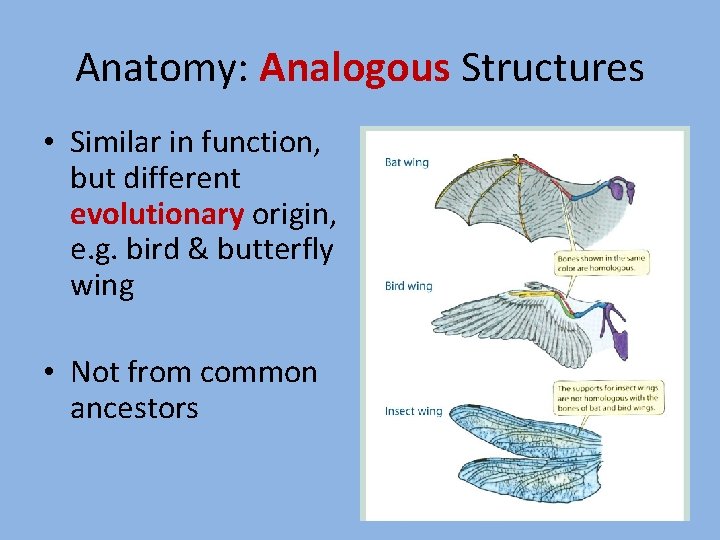
Anatomy: Analogous Structures • Similar in function, but different evolutionary origin, e. g. bird & butterfly wing • Not from common ancestors
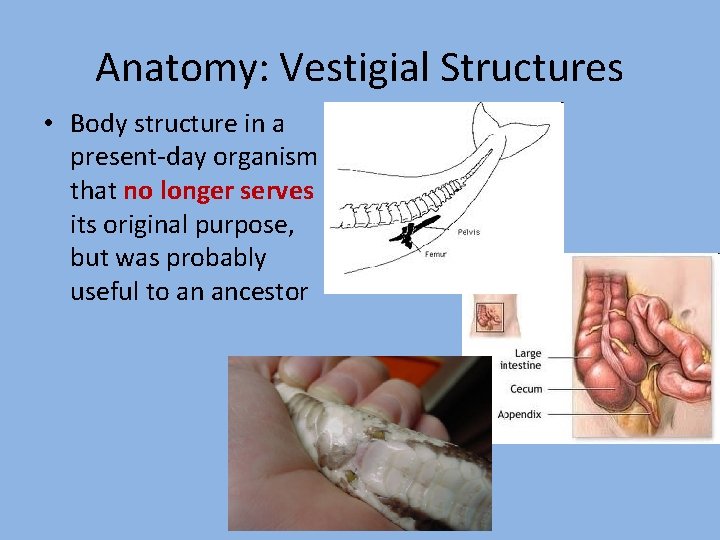
Anatomy: Vestigial Structures • Body structure in a present-day organism that no longer serves its original purpose, but was probably useful to an ancestor
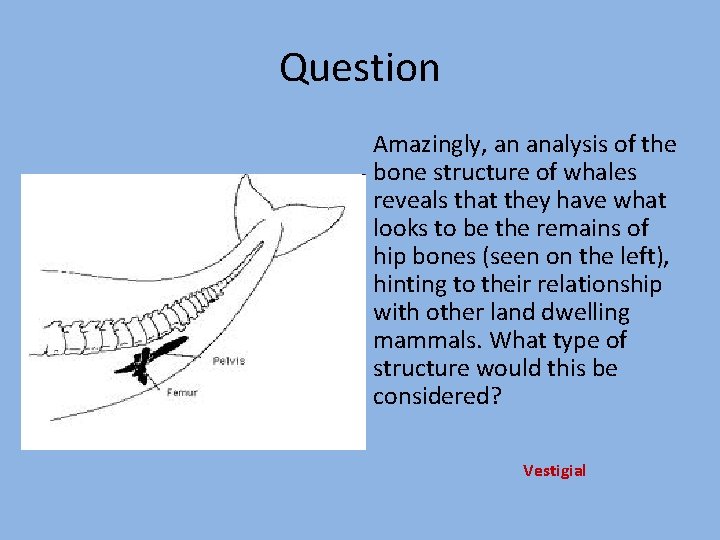
Question Amazingly, an analysis of the bone structure of whales reveals that they have what looks to be the remains of hip bones (seen on the left), hinting to their relationship with other land dwelling mammals. What type of structure would this be considered? Vestigial
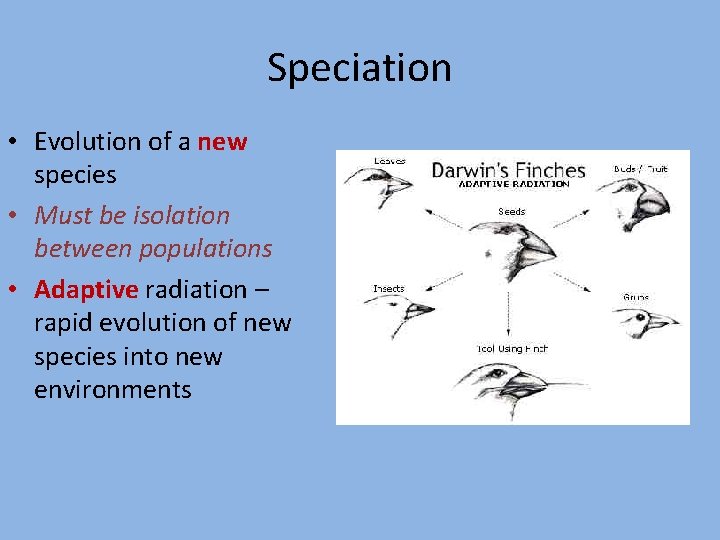
Speciation • Evolution of a new species • Must be isolation between populations • Adaptive radiation – rapid evolution of new species into new environments
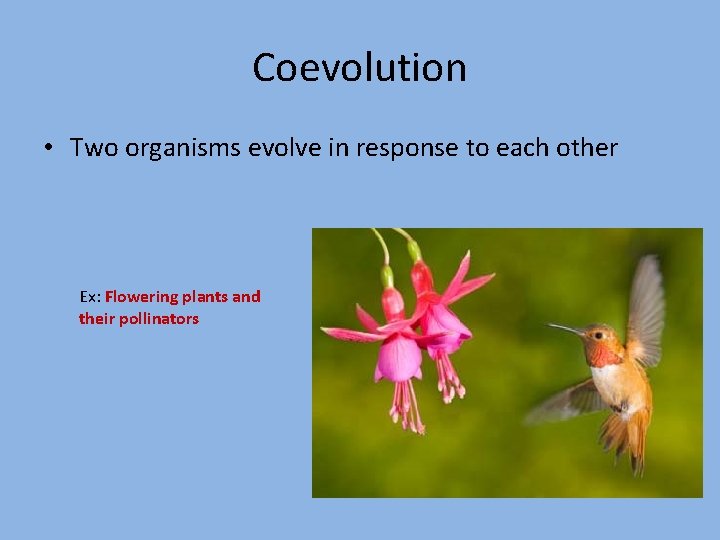
Coevolution • Two organisms evolve in response to each other Ex: Flowering plants and their pollinators
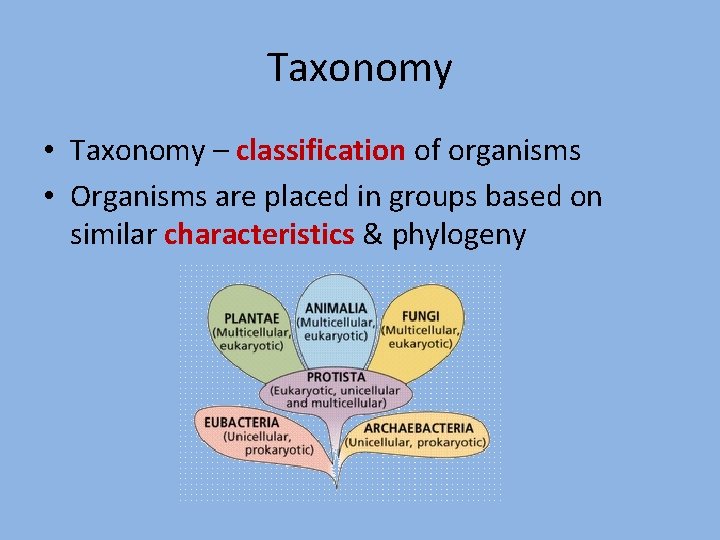
Taxonomy • Taxonomy – classification of organisms • Organisms are placed in groups based on similar characteristics & phylogeny
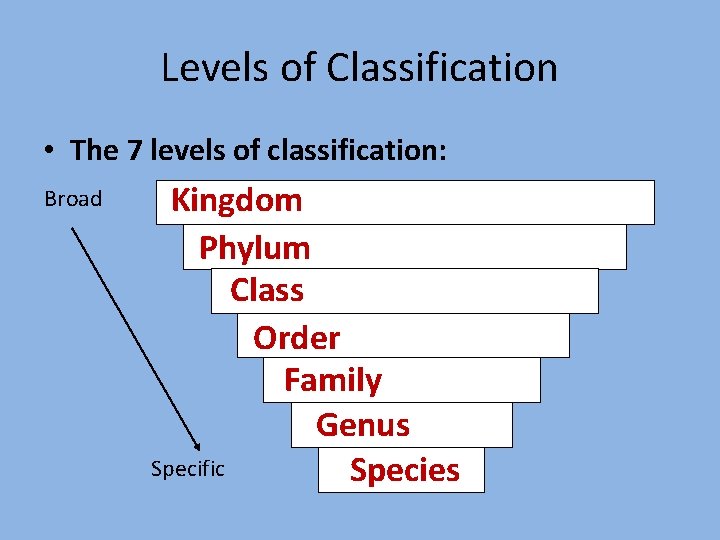
Levels of Classification • The 7 levels of classification: Broad Kingdom Phylum Class Order Family Genus Specific Species
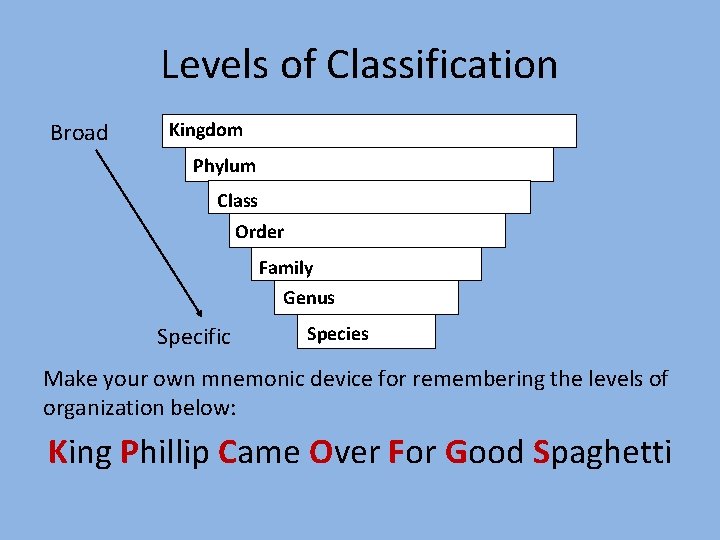
Levels of Classification Broad Kingdom Phylum Class Order Family Genus Specific Species Make your own mnemonic device for remembering the levels of organization below: King Phillip Came Over For Good Spaghetti
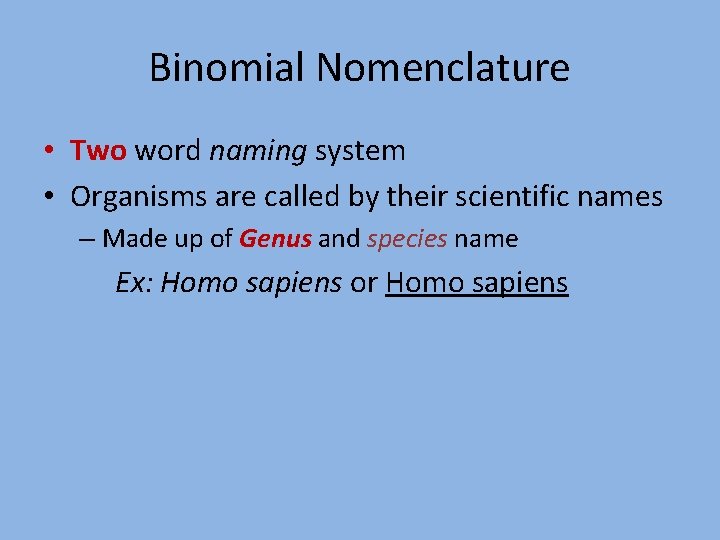
Binomial Nomenclature • Two word naming system • Organisms are called by their scientific names – Made up of Genus and species name Ex: Homo sapiens or Homo sapiens
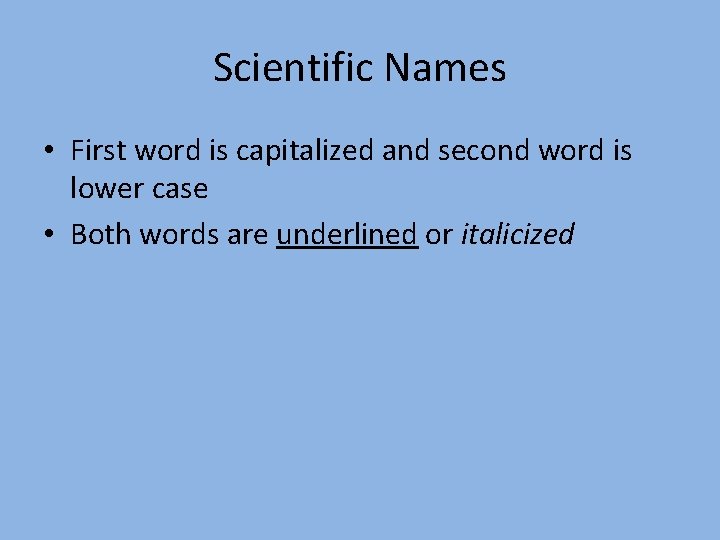
Scientific Names • First word is capitalized and second word is lower case • Both words are underlined or italicized
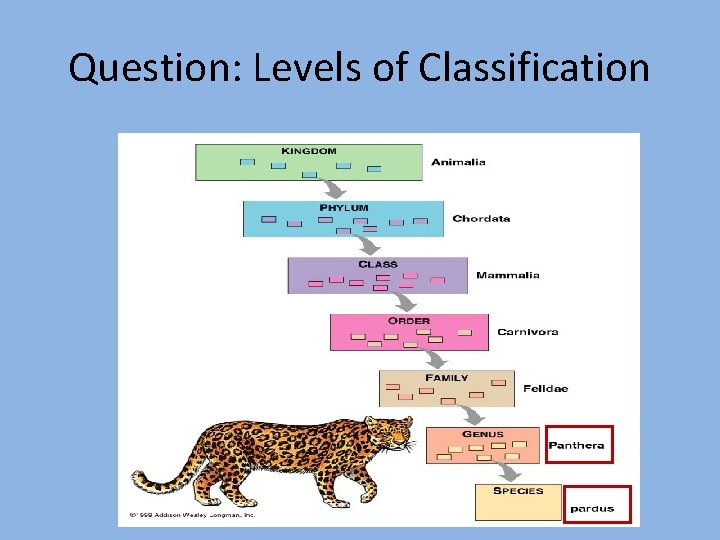
Question: Levels of Classification
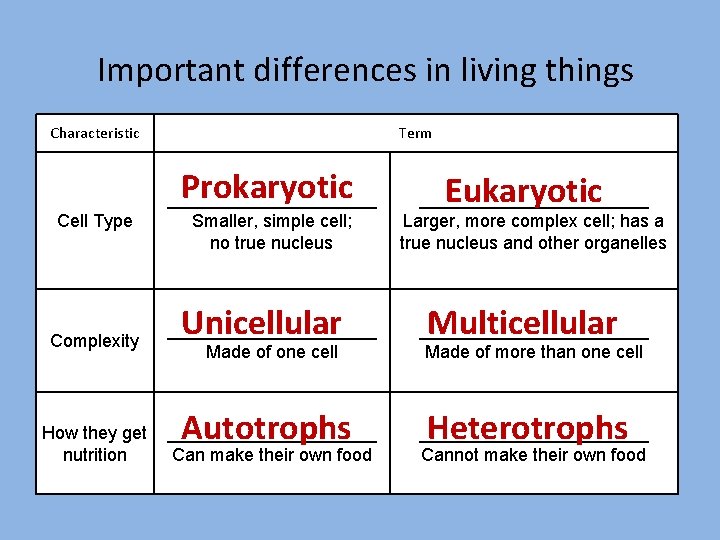
Important differences in living things Characteristic Term Prokaryotic Cell Type ___________ Smaller, simple cell; no true nucleus Complexity ___________ Made of one cell How they get nutrition ___________ Can make their own food Unicellular Autotrophs Eukaryotic ____________ Larger, more complex cell; has a true nucleus and other organelles Multicellular ____________ Made of more than one cell Heterotrophs ____________ Cannot make their own food
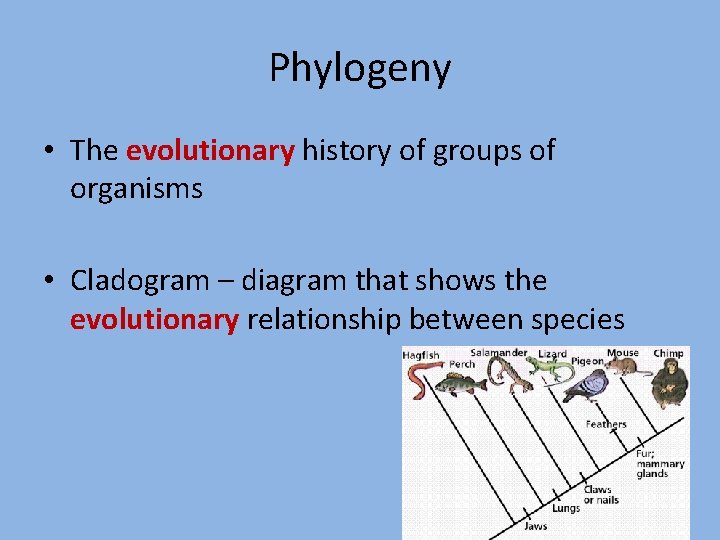
Phylogeny • The evolutionary history of groups of organisms • Cladogram – diagram that shows the evolutionary relationship between species
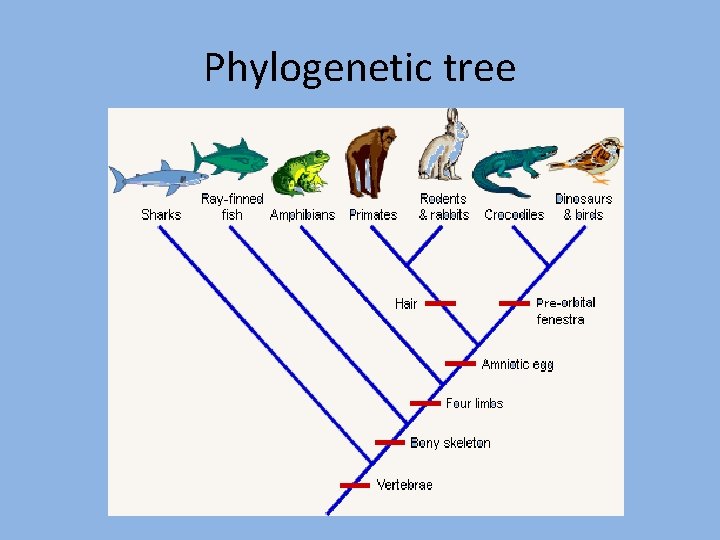
Phylogenetic tree
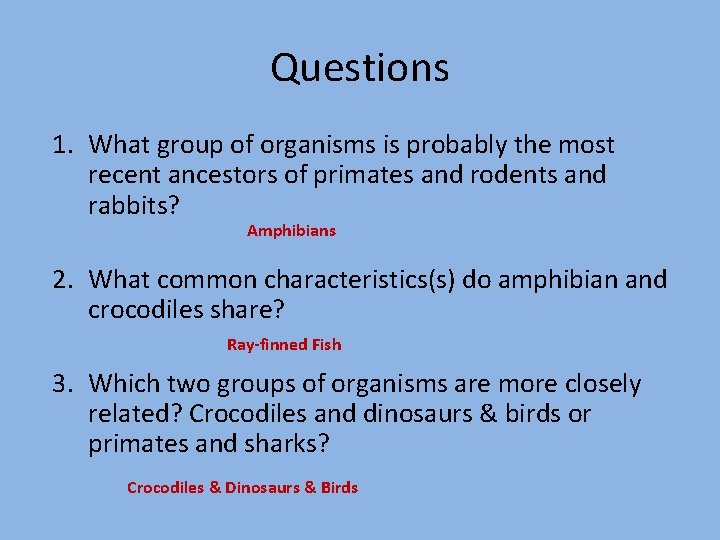
Questions 1. What group of organisms is probably the most recent ancestors of primates and rodents and rabbits? Amphibians 2. What common characteristics(s) do amphibian and crocodiles share? Ray-finned Fish 3. Which two groups of organisms are more closely related? Crocodiles and dinosaurs & birds or primates and sharks? Crocodiles & Dinosaurs & Birds
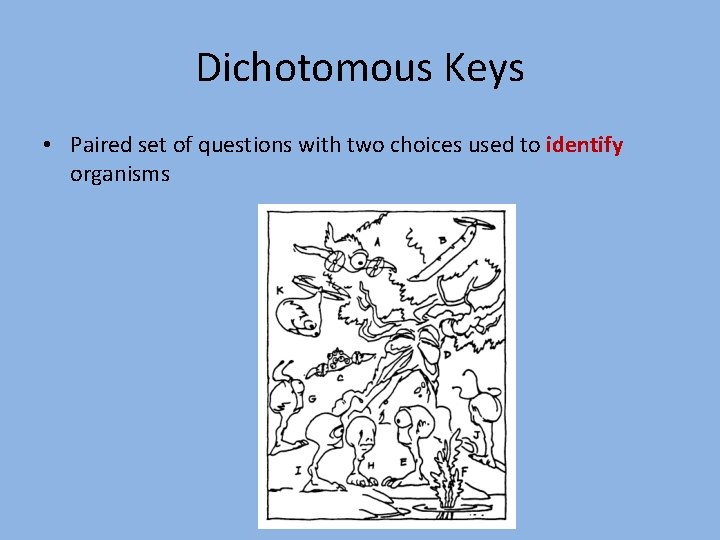
Dichotomous Keys • Paired set of questions with two choices used to identify organisms
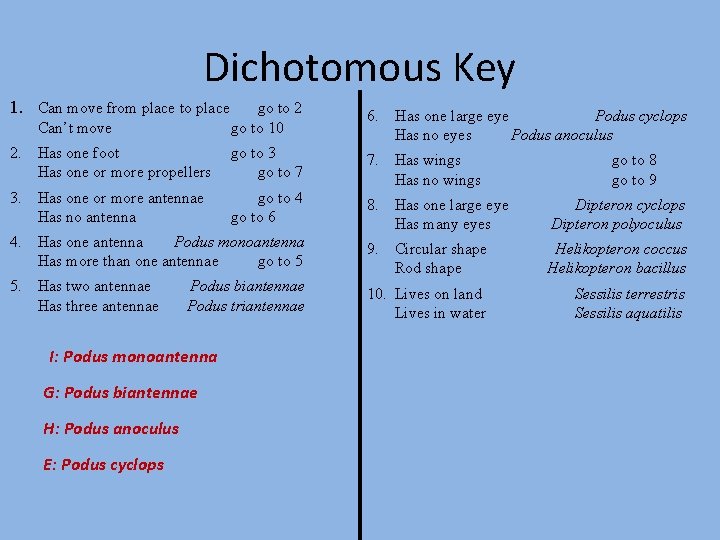
Dichotomous Key 1. Can move from place to place go to 2 go to 10 6. 2. Has one foot Has one or more propellers go to 3 go to 7 7. Has wings Has no wings 3. Has one or more antennae Has no antenna go to 4 go to 6 8. Has one large eye Has many eyes Dipteron cyclops Dipteron polyoculus 9. Circular shape Rod shape Helikopteron coccus Helikopteron bacillus 10. Lives on land Lives in water Sessilis terrestris Sessilis aquatilis Can’t move 4. Has one antenna Podus monoantenna Has more than one antennae go to 5 5. Has two antennae Has three antennae Podus biantennae Podus triantennae I: Podus monoantenna G: Podus biantennae H: Podus anoculus E: Podus cyclops Has one large eye Podus cyclops Has no eyes Podus anoculus go to 8 go to 9
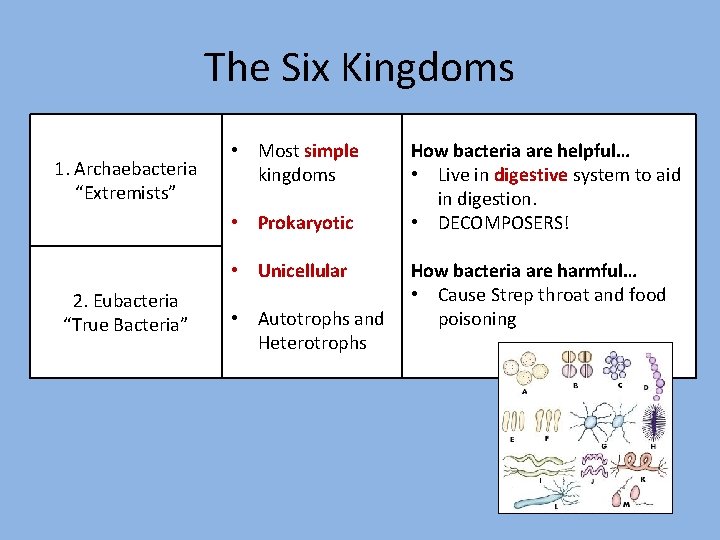
The Six Kingdoms 1. Archaebacteria “Extremists” • Most simple kingdoms • Prokaryotic • Unicellular 2. Eubacteria “True Bacteria” • Autotrophs and Heterotrophs How bacteria are helpful… • Live in digestive system to aid in digestion. • DECOMPOSERS! How bacteria are harmful… • Cause Strep throat and food poisoning
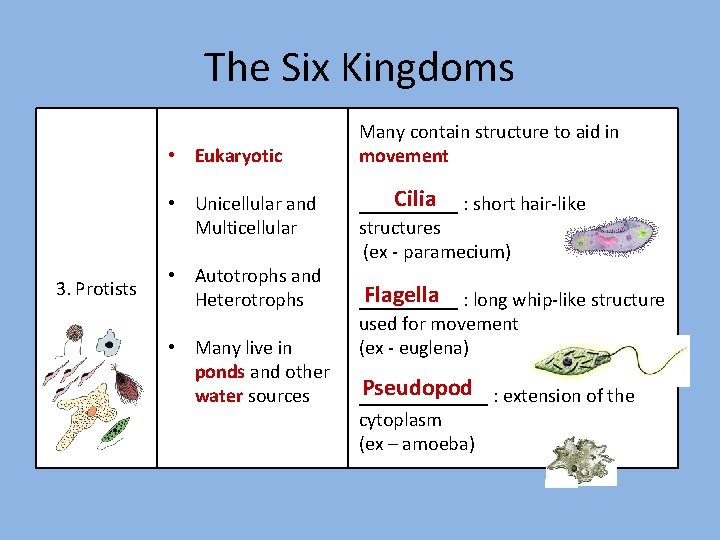
The Six Kingdoms • Eukaryotic • Unicellular and Multicellular 3. Protists • Autotrophs and Heterotrophs • Many live in ponds and other water sources Many contain structure to aid in movement Cilia _____ : short hair-like structures (ex - paramecium) Flagella _____ : long whip-like structure used for movement (ex - euglena) Pseudopod _______ : extension of the cytoplasm (ex – amoeba)
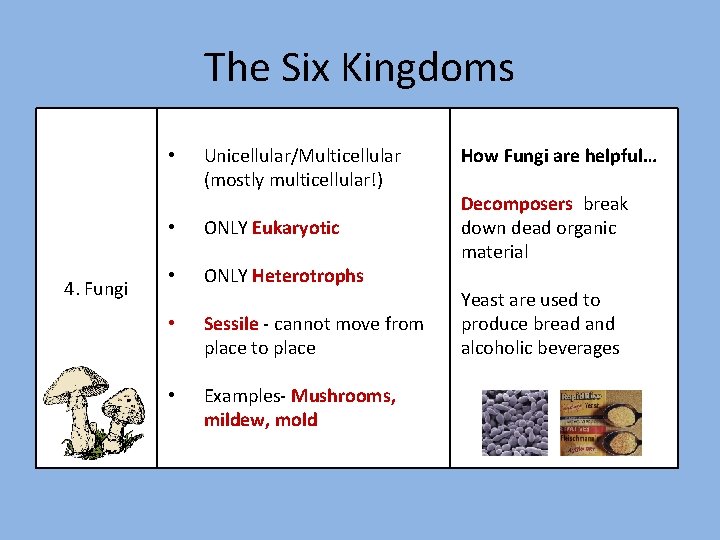
The Six Kingdoms • 4. Fungi Unicellular/Multicellular (mostly multicellular!) • ONLY Eukaryotic • ONLY Heterotrophs • Sessile - cannot move from place to place • Examples- Mushrooms, mildew, mold How Fungi are helpful… Decomposers break down dead organic material Yeast are used to produce bread and alcoholic beverages
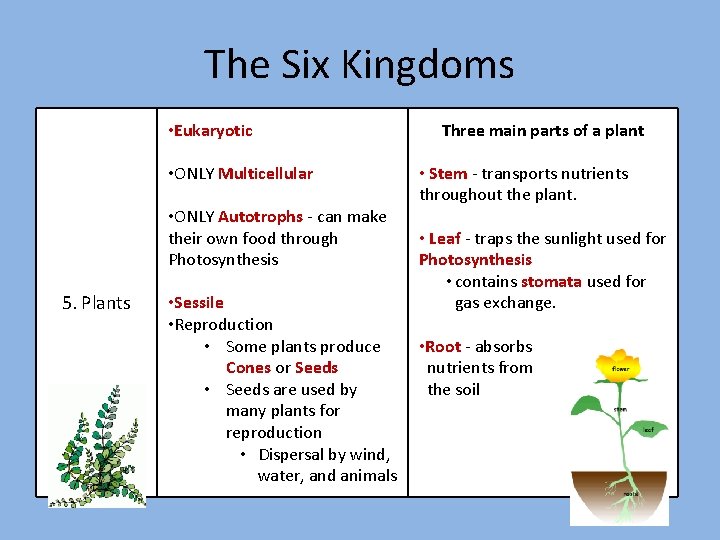
The Six Kingdoms • Eukaryotic • ONLY Multicellular • ONLY Autotrophs - can make their own food through Photosynthesis 5. Plants • Sessile • Reproduction • Some plants produce Cones or Seeds • Seeds are used by many plants for reproduction • Dispersal by wind, water, and animals Three main parts of a plant • Stem - transports nutrients throughout the plant. • Leaf - traps the sunlight used for Photosynthesis • contains stomata used for gas exchange. • Root - absorbs nutrients from the soil
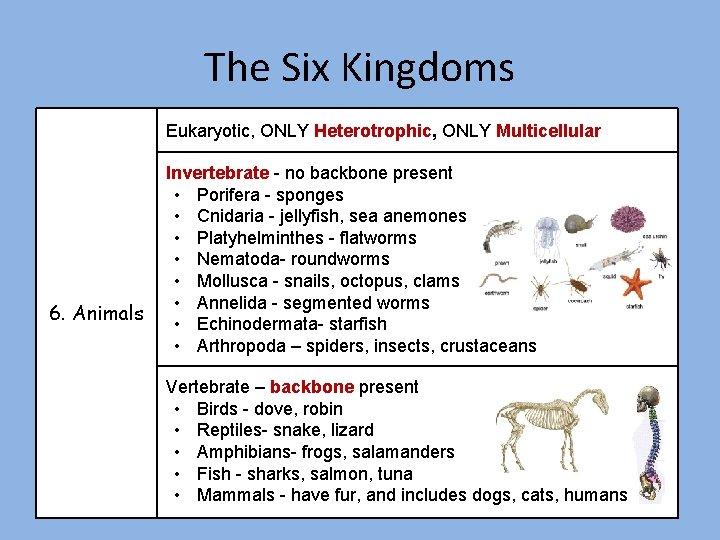
The Six Kingdoms Eukaryotic, ONLY Heterotrophic, ONLY Multicellular 6. Animals Invertebrate - no backbone present • Porifera - sponges • Cnidaria - jellyfish, sea anemones • Platyhelminthes - flatworms • Nematoda- roundworms • Mollusca - snails, octopus, clams • Annelida - segmented worms • Echinodermata- starfish • Arthropoda – spiders, insects, crustaceans Vertebrate – backbone present • Birds - dove, robin • Reptiles- snake, lizard • Amphibians- frogs, salamanders • Fish - sharks, salmon, tuna • Mammals - have fur, and includes dogs, cats, humans
Reporting Category 4 BIOLOGICAL PROCESSES
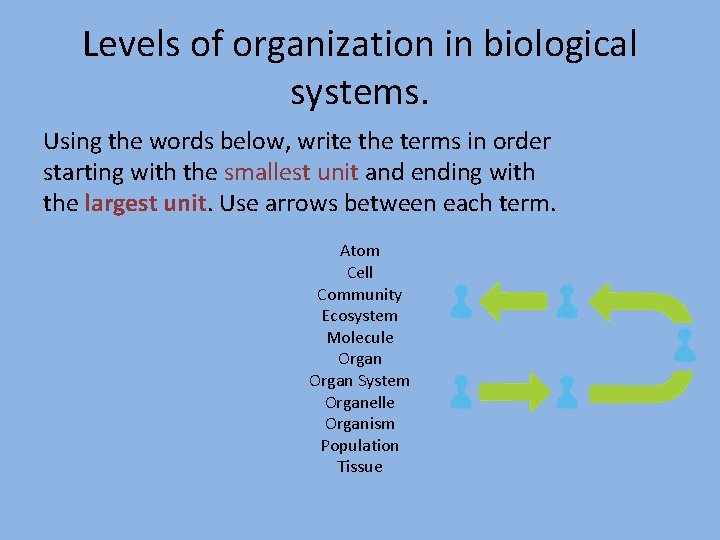
Levels of organization in biological systems. Using the words below, write the terms in order starting with the smallest unit and ending with the largest unit. Use arrows between each term. Atom Cell Community Ecosystem Molecule Organ System Organelle Organism Population Tissue
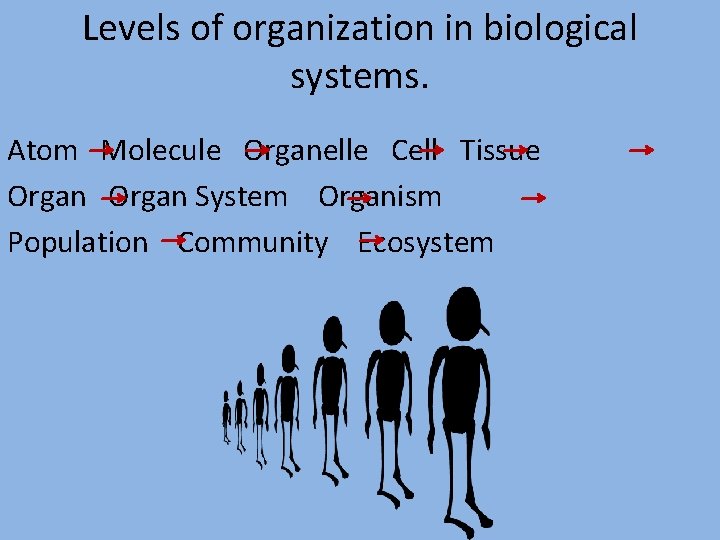
Levels of organization in biological systems. Atom Molecule Organelle Cell Tissue Organ System Organism Population Community Ecosystem
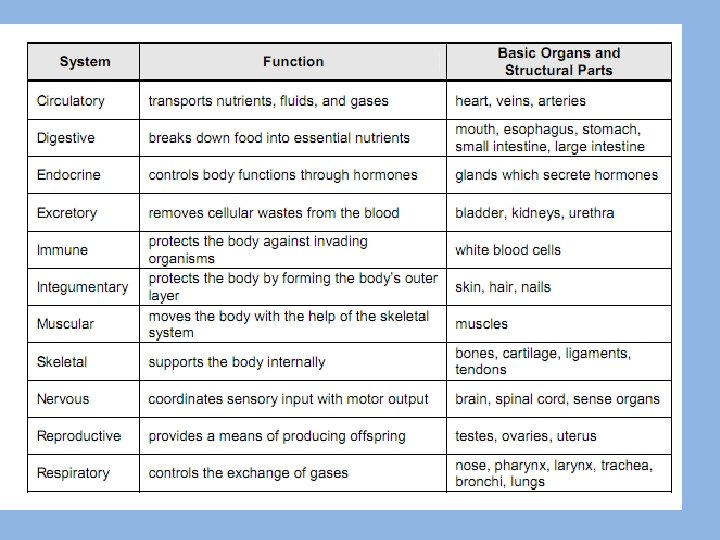
Activity The human body is made up of 11 systems. For this activity you will: 1. First start with putting the system names in alphabetical order. 2. Next, line up the system names (in alpha order) in a column on your desk 3. Match the system name to the function and then find the matching organ/structural part. 4. Set it up in chart formation on your desk. It should have 3 columns: System name, function, organs & structural parts. 5. Last, after a teacher check, copy the chart into your notes.
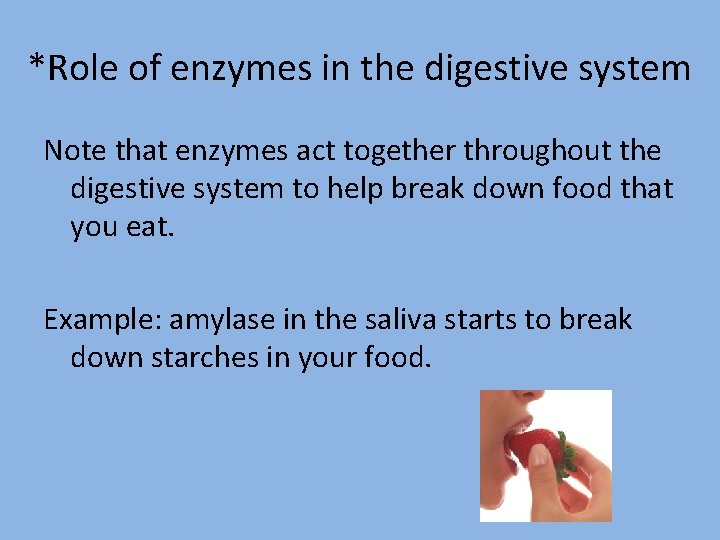
*Role of enzymes in the digestive system Note that enzymes act together throughout the digestive system to help break down food that you eat. Example: amylase in the saliva starts to break down starches in your food.
Homeostasis All the body systems work together to maintain homeostasis, which is a selfregulating mechanism that maintains internal conditions.
Read the example of homeostasis given below. Describe how it qualifies as an accurate example of homeostasis. During strenuous workout activities, your body begins to produce sweat.
Answer Your body responds to an increase in body temperature by producing sweat. Sweat acts to cool your body during times of increased heat. Homeostasis is maintained by cooling your body.
Internal Feedback Mechanism – controlling path in the body that may slow down or speed up a biological process. Helps maintain homeostasis. In the previous example what was the “feedback” your body received in order to maintain homeostasis?
Answer • The feedback was…. . It’s HOT!!
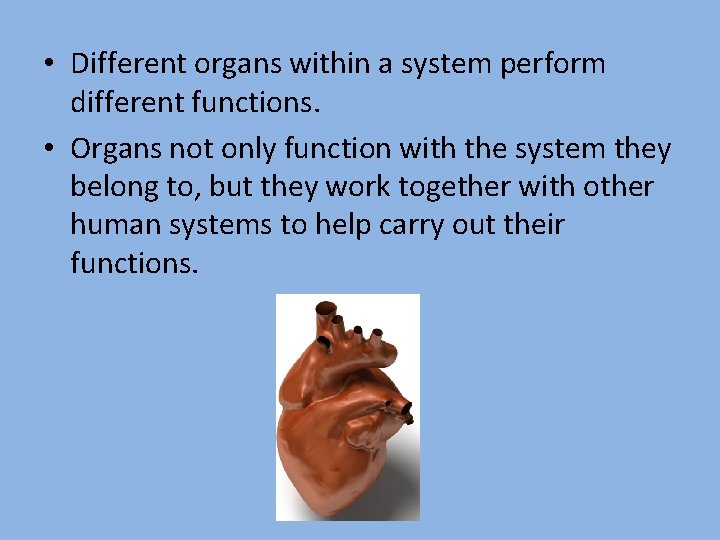
• Different organs within a system perform different functions. • Organs not only function with the system they belong to, but they work together with other human systems to help carry out their functions.
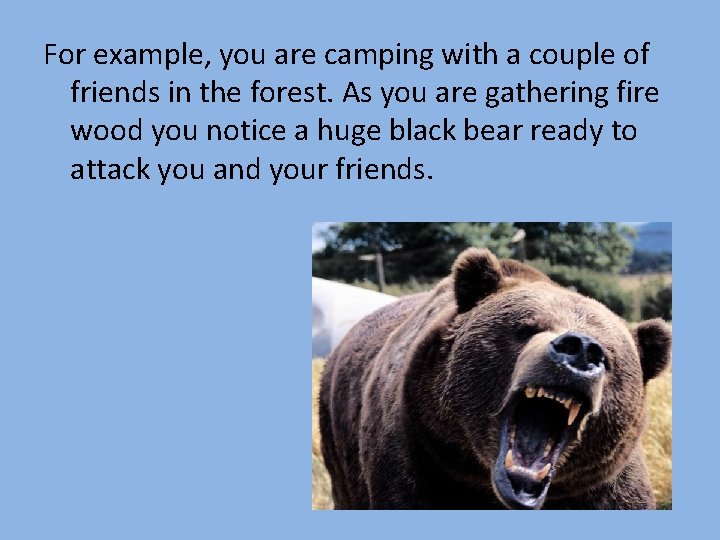
For example, you are camping with a couple of friends in the forest. As you are gathering fire wood you notice a huge black bear ready to attack you and your friends.
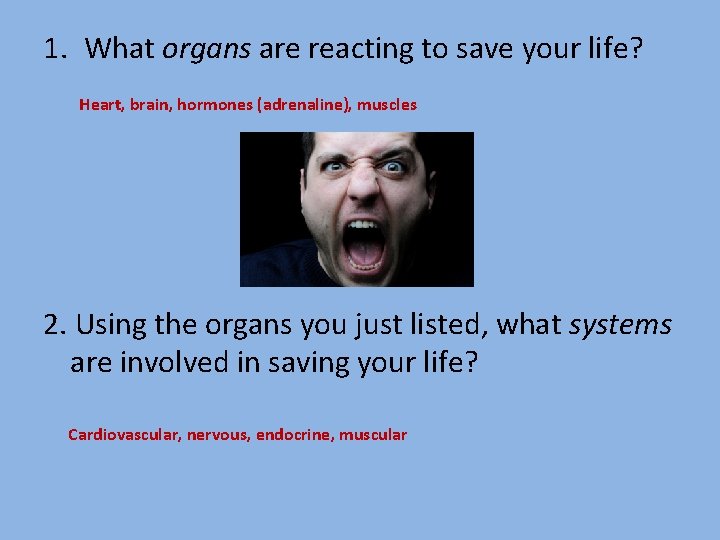
1. What organs are reacting to save your life? Heart, brain, hormones (adrenaline), muscles 2. Using the organs you just listed, what systems are involved in saving your life? Cardiovascular, nervous, endocrine, muscular
Chart • On your paper is a list of functions that involve more than one system. • After reading the function, list the system names that you think are involved with each function. • Give an example of how the system is interacting with the function.
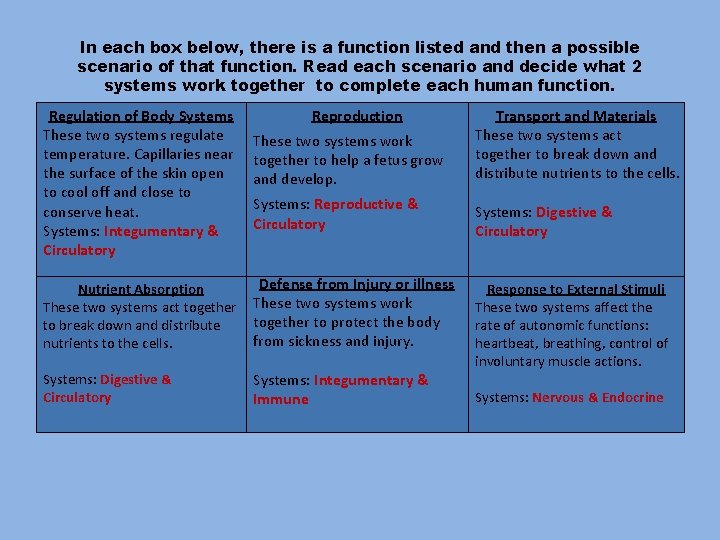
In each box below, there is a function listed and then a possible scenario of that function. Read each scenario and decide what 2 systems work together to complete each human function. Regulation of Body Systems These two systems regulate temperature. Capillaries near the surface of the skin open to cool off and close to conserve heat. Systems: Integumentary & Circulatory Reproduction These two systems work together to help a fetus grow and develop. Transport and Materials These two systems act together to break down and distribute nutrients to the cells. Systems: Reproductive & Circulatory Systems: Digestive & Circulatory Defense from Injury or illness Nutrient Absorption These two systems act together These two systems work together to protect the body to break down and distribute from sickness and injury. nutrients to the cells. Systems: Digestive & Circulatory Systems: Integumentary & Immune Response to External Stimuli These two systems affect the rate of autonomic functions: heartbeat, breathing, control of involuntary muscle actions. Systems: Nervous & Endocrine
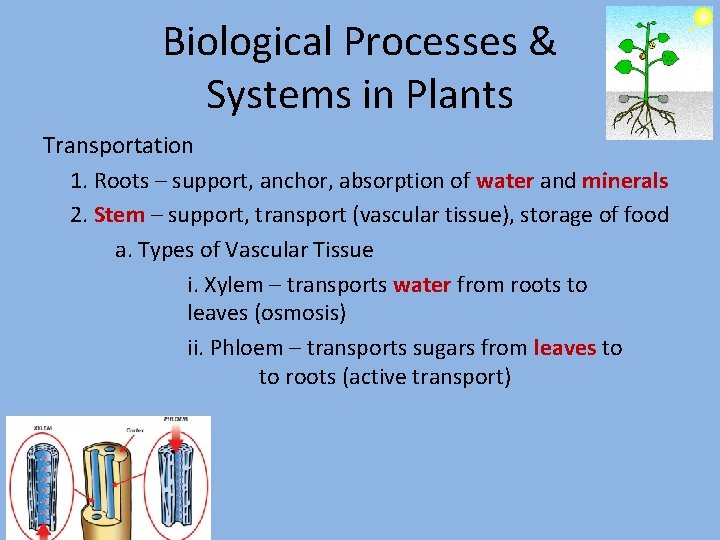
Biological Processes & Systems in Plants Transportation 1. Roots – support, anchor, absorption of water and minerals 2. Stem – support, transport (vascular tissue), storage of food a. Types of Vascular Tissue i. Xylem – transports water from roots to leaves (osmosis) ii. Phloem – transports sugars from leaves to to roots (active transport)
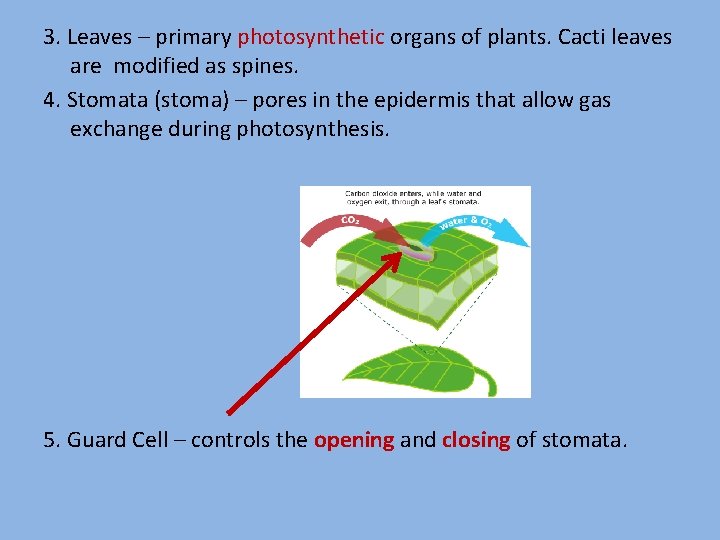
3. Leaves – primary photosynthetic organs of plants. Cacti leaves are modified as spines. 4. Stomata (stoma) – pores in the epidermis that allow gas exchange during photosynthesis. 5. Guard Cell – controls the opening and closing of stomata.
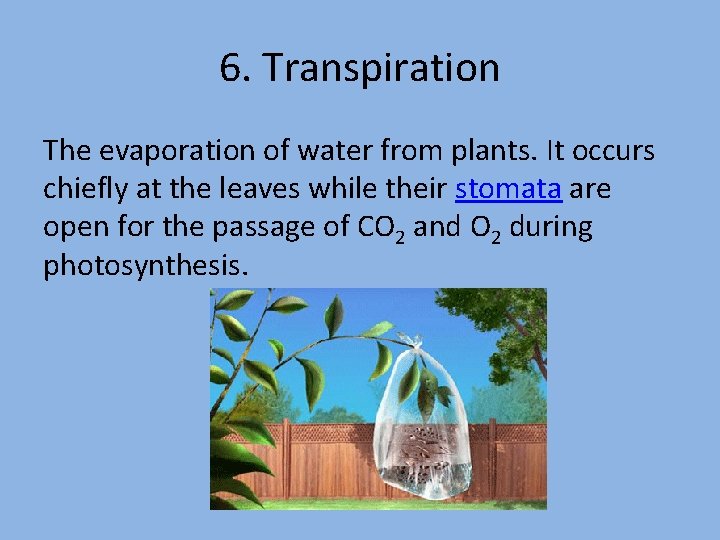
6. Transpiration The evaporation of water from plants. It occurs chiefly at the leaves while their stomata are open for the passage of CO 2 and O 2 during photosynthesis.
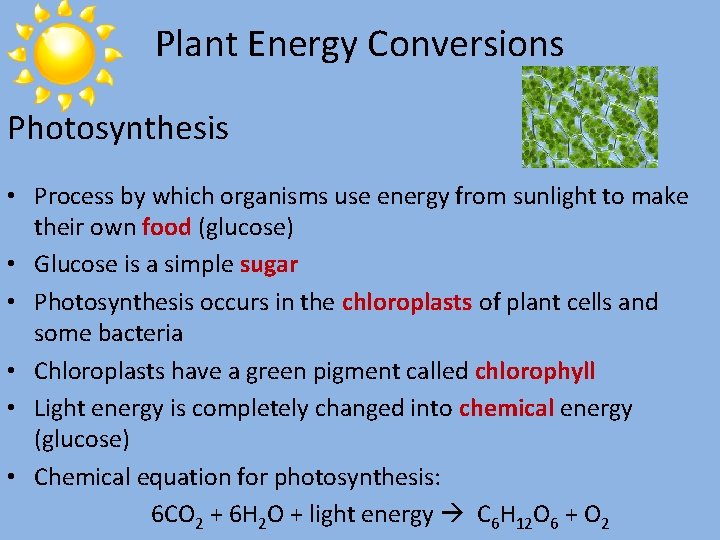
Plant Energy Conversions Photosynthesis • Process by which organisms use energy from sunlight to make their own food (glucose) • Glucose is a simple sugar • Photosynthesis occurs in the chloroplasts of plant cells and some bacteria • Chloroplasts have a green pigment called chlorophyll • Light energy is completely changed into chemical energy (glucose) • Chemical equation for photosynthesis: 6 CO 2 + 6 H 2 O + light energy C 6 H 12 O 6 + O 2
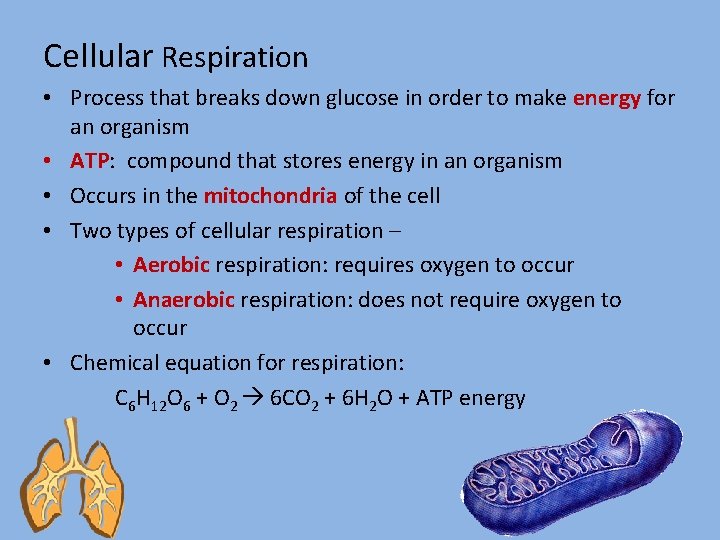
Cellular Respiration • Process that breaks down glucose in order to make energy for an organism • ATP: compound that stores energy in an organism • Occurs in the mitochondria of the cell • Two types of cellular respiration – • Aerobic respiration: requires oxygen to occur • Anaerobic respiration: does not require oxygen to occur • Chemical equation for respiration: C 6 H 12 O 6 + O 2 6 CO 2 + 6 H 2 O + ATP energy
Activity • Using the given pieces, put the equation for photosynthesis on your desk. – What are the products, reactants? • Using the given pieces, put the equation for cellular respiration on your desk. – What are the products, reactants?
Plant Response to Stimuli Some external factors that regulate the growth of plants are light intensity, day length, gravity, and temperature. • Light- Light is needed for photosynthesis. Through photosynthesis the plant makes its energy carrying molecules. It is also needed for the production of chlorophyll. • Day Length- Day length causes the plants to flower. Other roles of day length are fruit and seed germination, dormancy, and leaf loss.
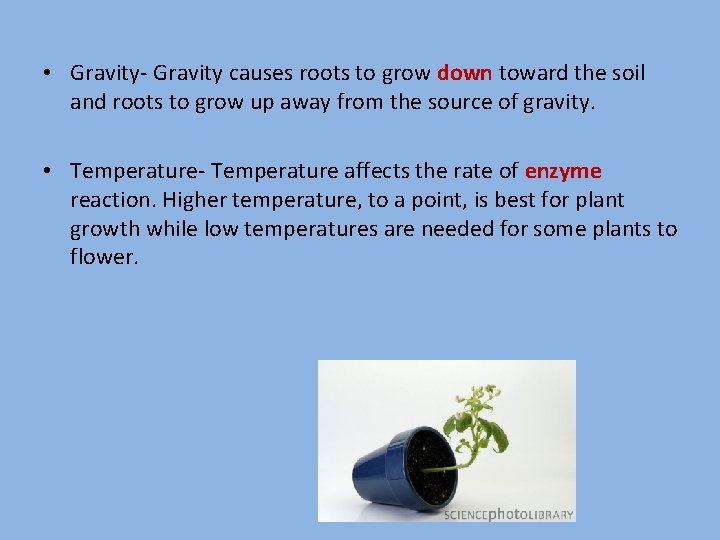
• Gravity- Gravity causes roots to grow down toward the soil and roots to grow up away from the source of gravity. • Temperature- Temperature affects the rate of enzyme reaction. Higher temperature, to a point, is best for plant growth while low temperatures are needed for some plants to flower.
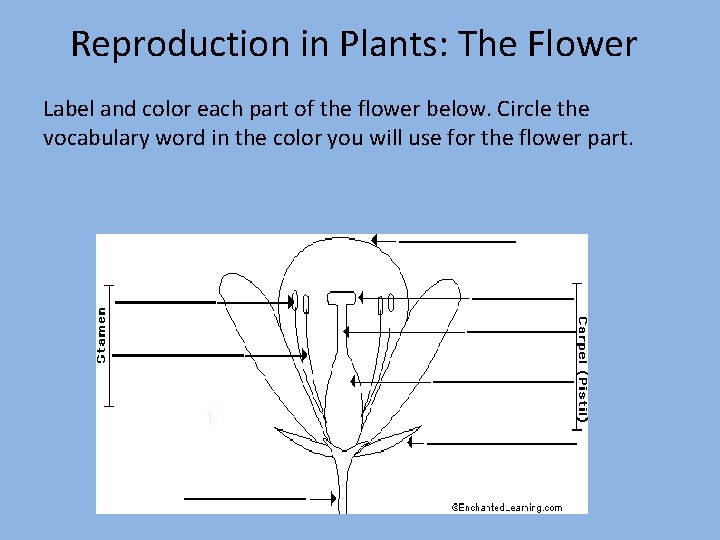
Reproduction in Plants: The Flower Label and color each part of the flower below. Circle the vocabulary word in the color you will use for the flower part.
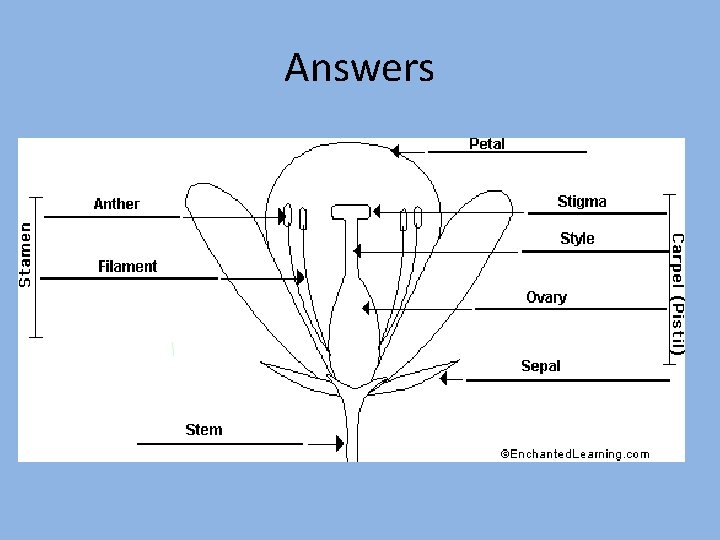
Answers
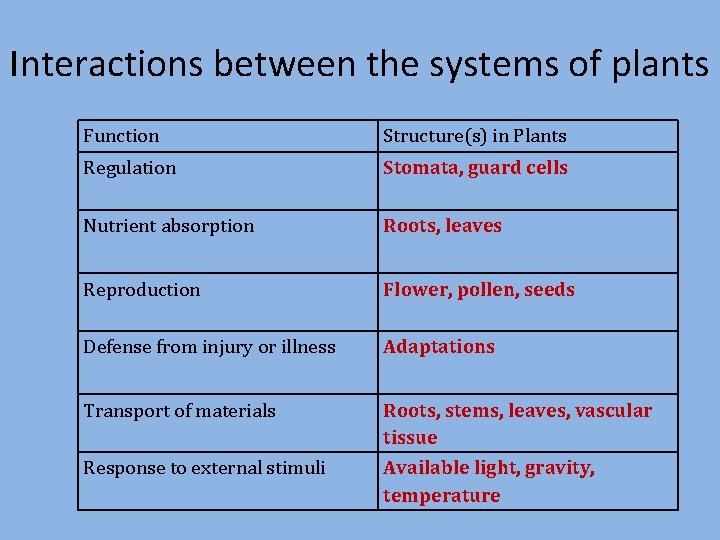
Interactions between the systems of plants Function Structure(s) in Plants Regulation Stomata, guard cells Nutrient absorption Roots, leaves Reproduction Flower, pollen, seeds Defense from injury or illness Adaptations Transport of materials Roots, stems, leaves, vascular tissue Response to external stimuli Available light, gravity, temperature
Reporting Category 5 INTERDEPENDENCE WITHIN ENVIRONMENTAL SYSTEMS
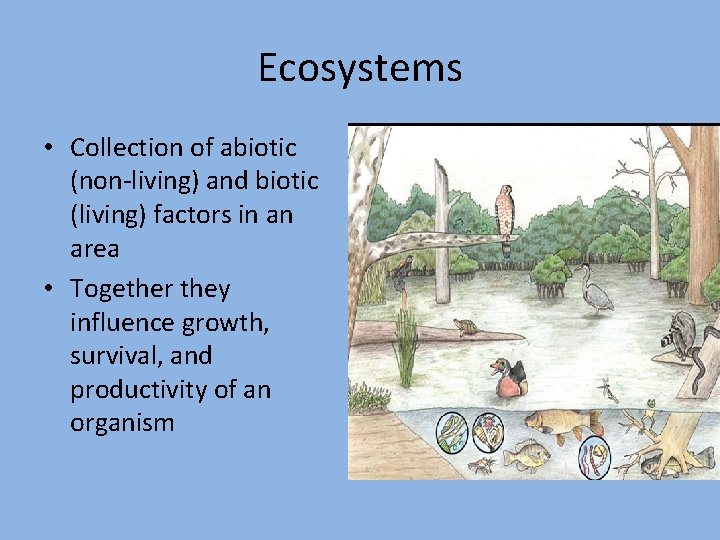
Ecosystems • Collection of abiotic (non-living) and biotic (living) factors in an area • Together they influence growth, survival, and productivity of an organism
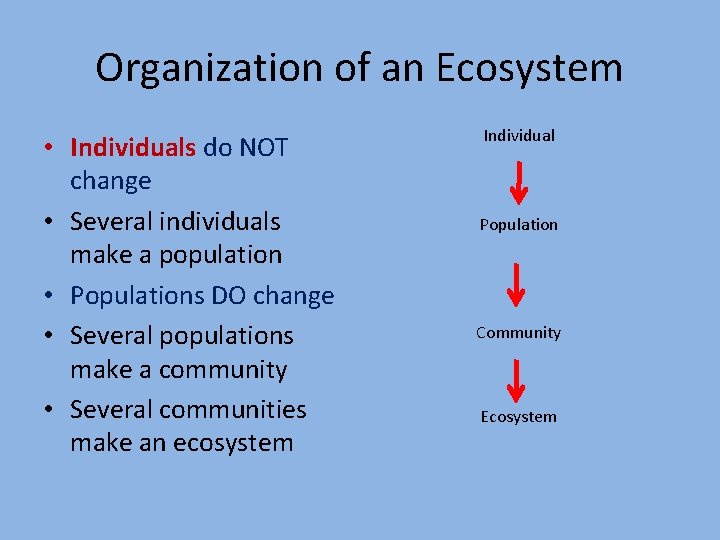
Organization of an Ecosystem • Individuals do NOT change • Several individuals make a population • Populations DO change • Several populations make a community • Several communities make an ecosystem Individual Population Community Ecosystem
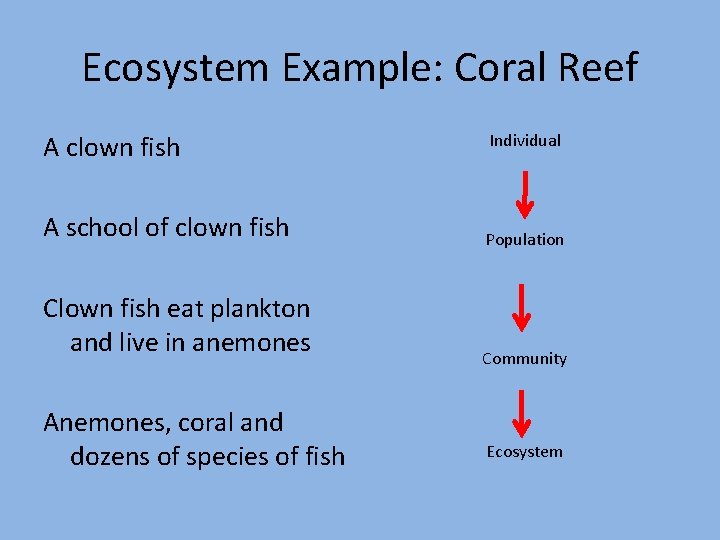
Ecosystem Example: Coral Reef A clown fish A school of clown fish Clown fish eat plankton and live in anemones Anemones, coral and dozens of species of fish Individual Population Community Ecosystem
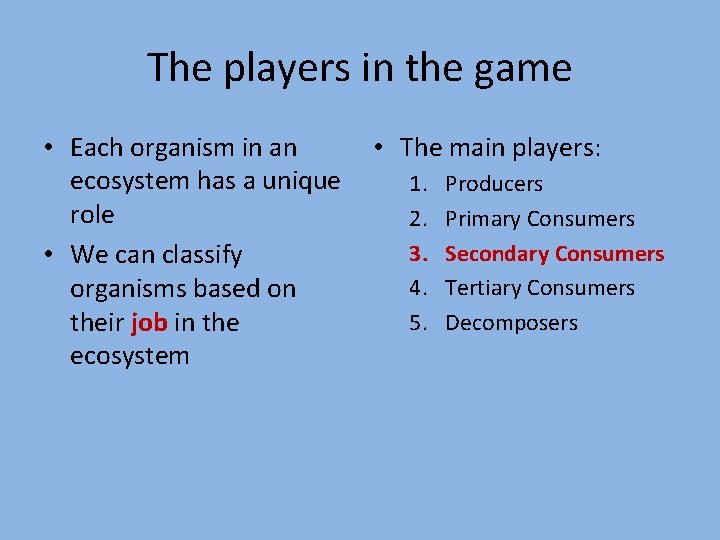
The players in the game • Each organism in an • The main players: ecosystem has a unique 1. Producers role 2. Primary Consumers 3. Secondary Consumers • We can classify 4. Tertiary Consumers organisms based on 5. Decomposers their job in the ecosystem
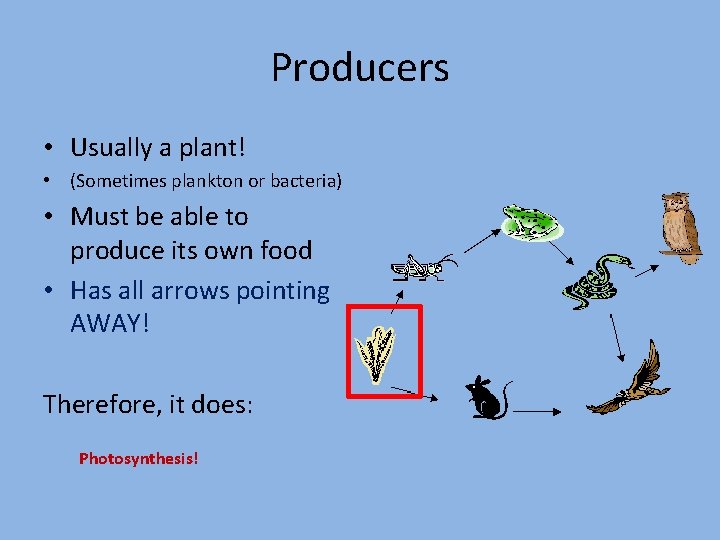
Producers • Usually a plant! • (Sometimes plankton or bacteria) • Must be able to produce its own food • Has all arrows pointing AWAY! Therefore, it does: Photosynthesis!
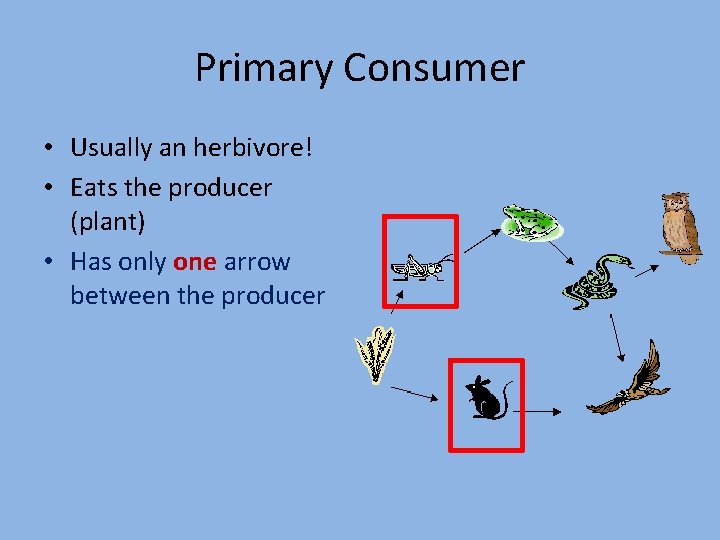
Primary Consumer • Usually an herbivore! • Eats the producer (plant) • Has only one arrow between the producer
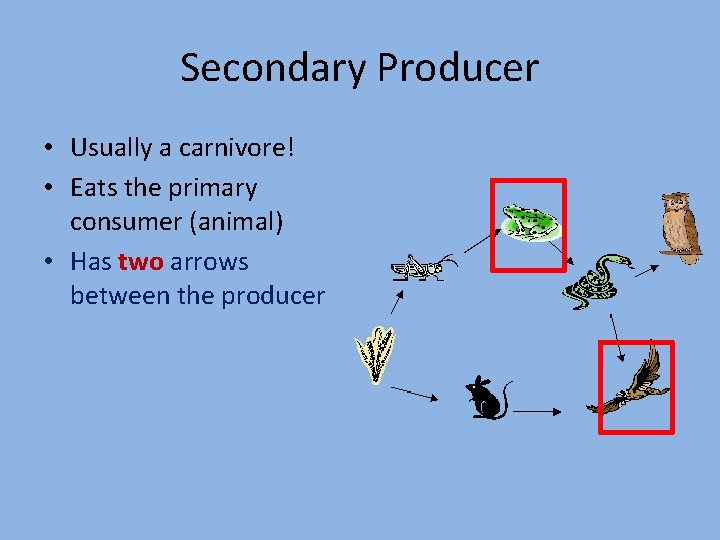
Secondary Producer • Usually a carnivore! • Eats the primary consumer (animal) • Has two arrows between the producer
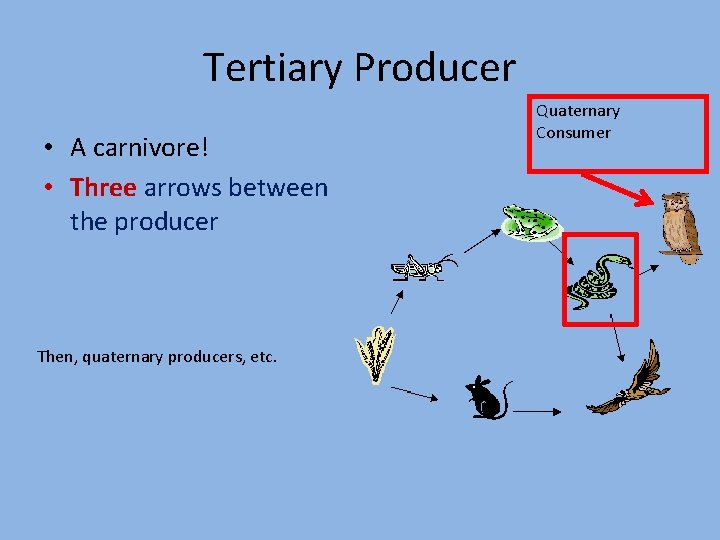
Tertiary Producer • A carnivore! • Three arrows between the producer Then, quaternary producers, etc. Quaternary Consumer
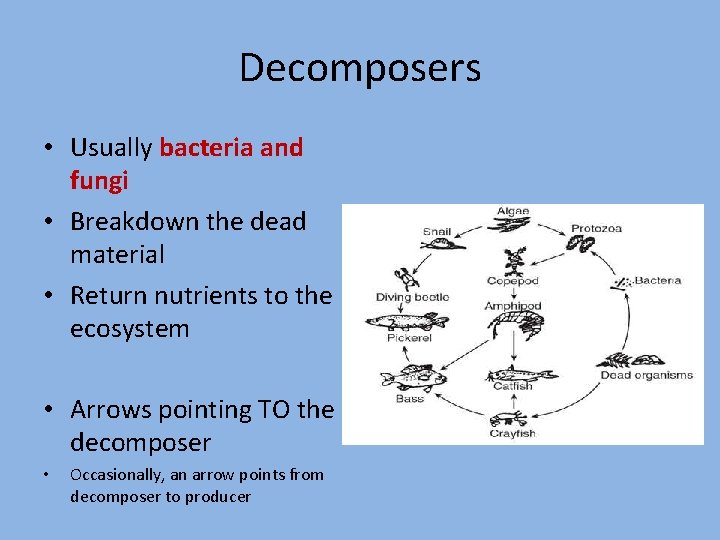
Decomposers • Usually bacteria and fungi • Breakdown the dead material • Return nutrients to the ecosystem • Arrows pointing TO the decomposer • Occasionally, an arrow points from decomposer to producer
Decomposers • Decomposers are a critical part of every ecosystem • Decomposers can also pose a threat when they become out of balance • Ex: Fungal infections, bacterial infection, • Ex: A dead fish is broken diseases down by bacteria. The nutrients are returned to be used by phytoplankton
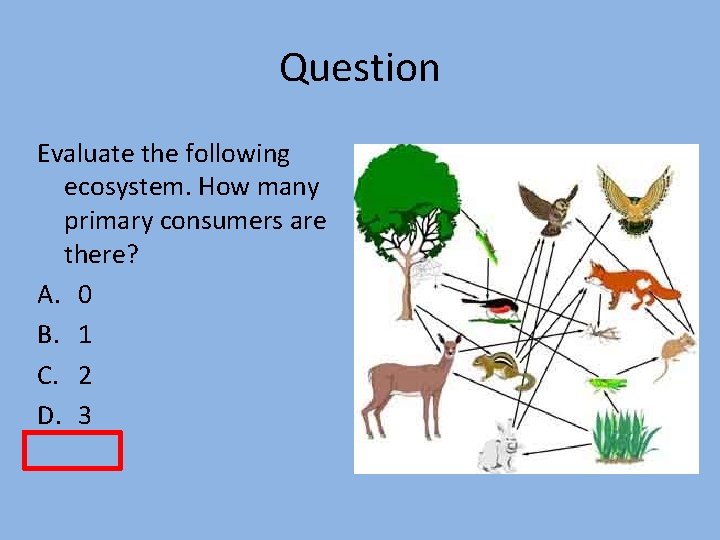
Question Evaluate the following ecosystem. How many primary consumers are there? A. 0 B. 1 C. 2 D. 3
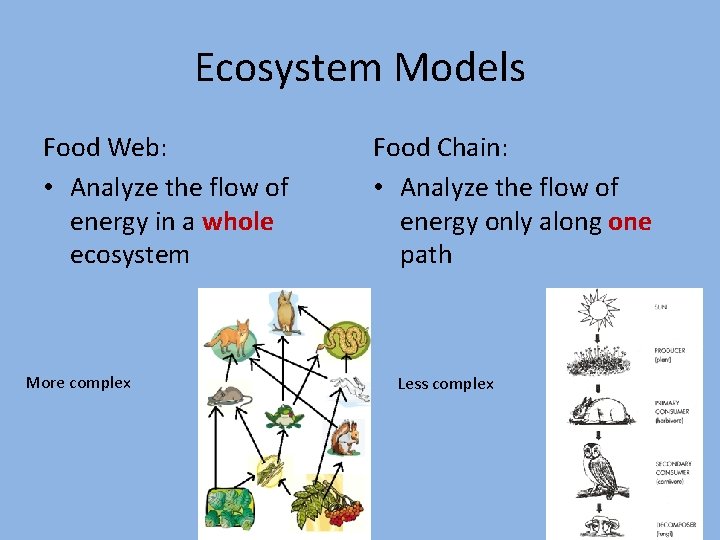
Ecosystem Models Food Web: • Analyze the flow of energy in a whole ecosystem More complex Food Chain: • Analyze the flow of energy only along one path Less complex
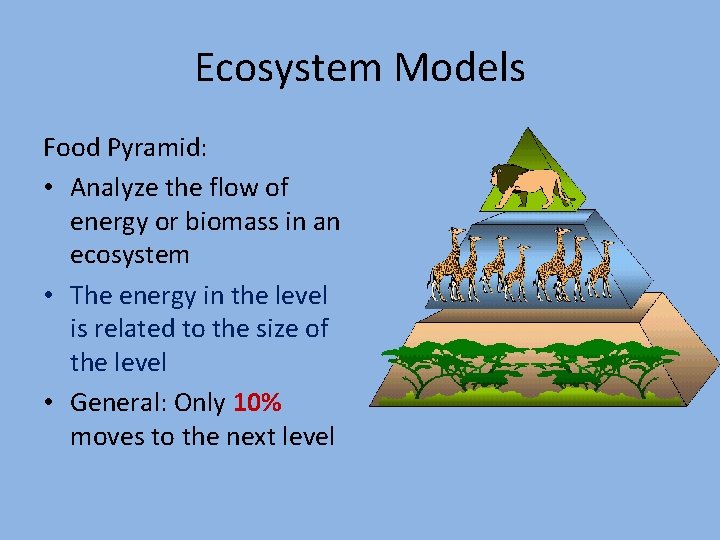
Ecosystem Models Food Pyramid: • Analyze the flow of energy or biomass in an ecosystem • The energy in the level is related to the size of the level • General: Only 10% moves to the next level
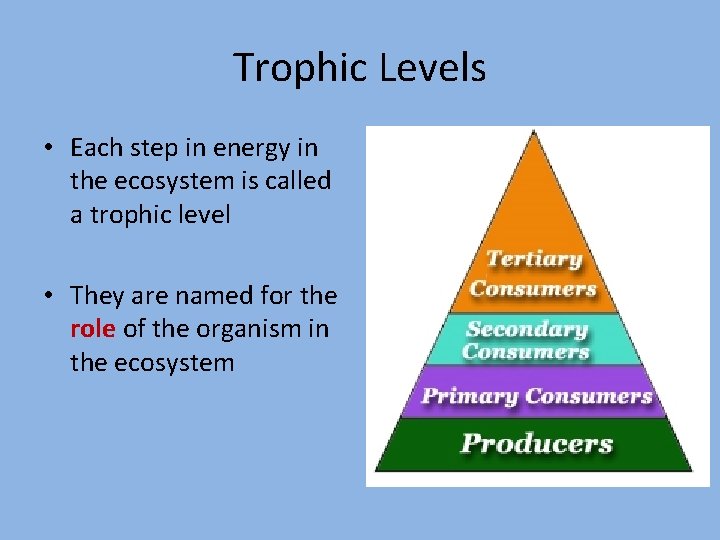
Trophic Levels • Each step in energy in the ecosystem is called a trophic level • They are named for the role of the organism in the ecosystem
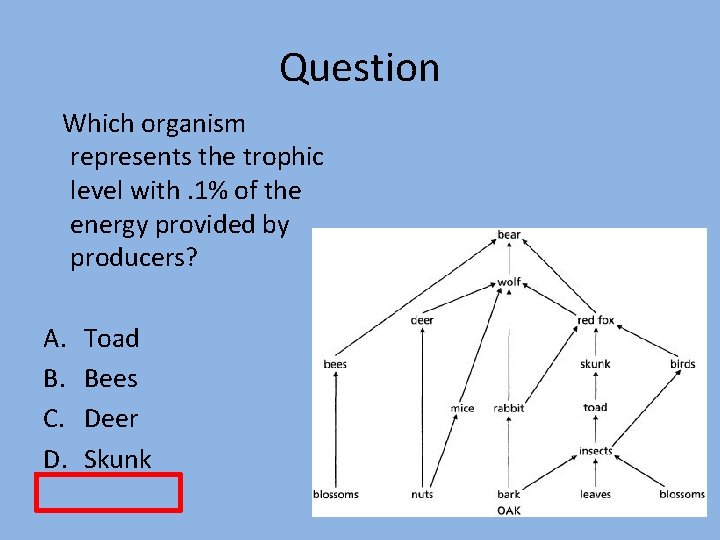
Question Which organism represents the trophic level with. 1% of the energy provided by producers? A. B. C. D. Toad Bees Deer Skunk
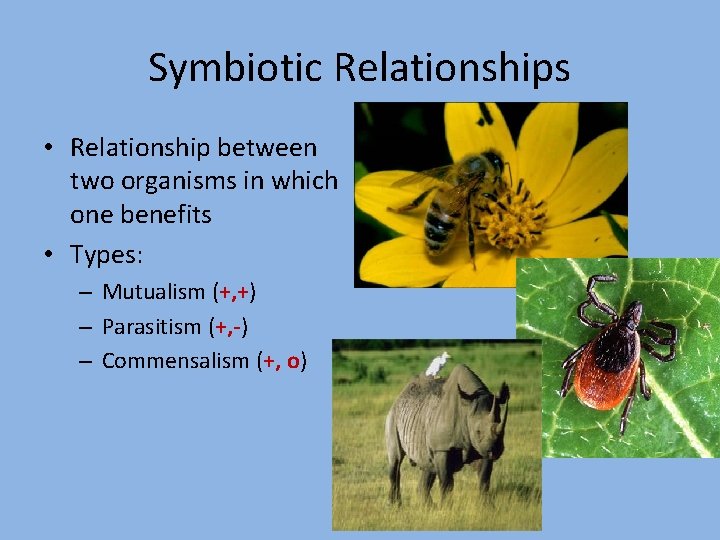
Symbiotic Relationships • Relationship between two organisms in which one benefits • Types: – Mutualism (+, +) – Parasitism (+, -) – Commensalism (+, o)
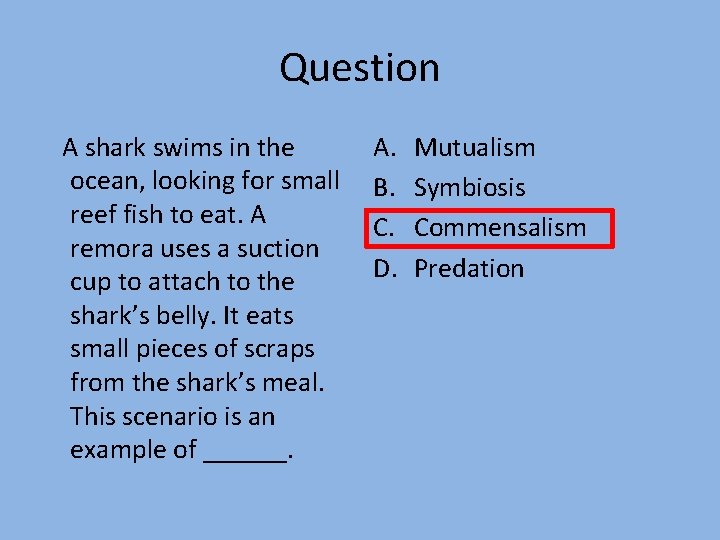
Question A shark swims in the ocean, looking for small reef fish to eat. A remora uses a suction cup to attach to the shark’s belly. It eats small pieces of scraps from the shark’s meal. This scenario is an example of ______. A. B. C. D. Mutualism Symbiosis Commensalism Predation
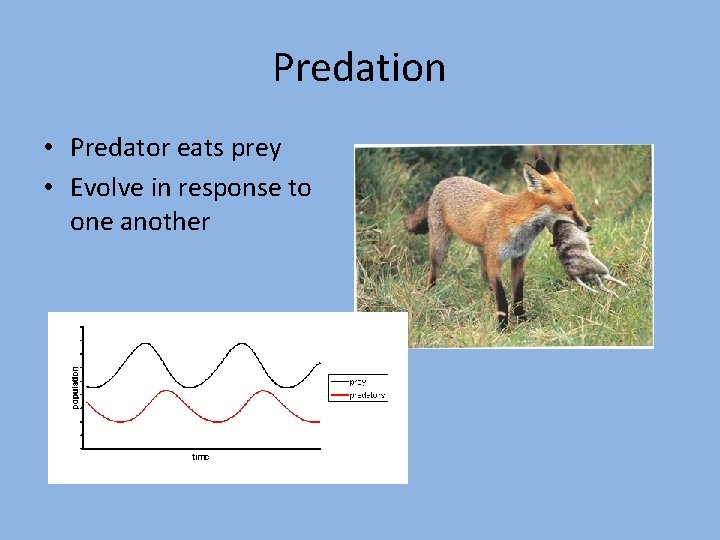
Predation • Predator eats prey • Evolve in response to one another
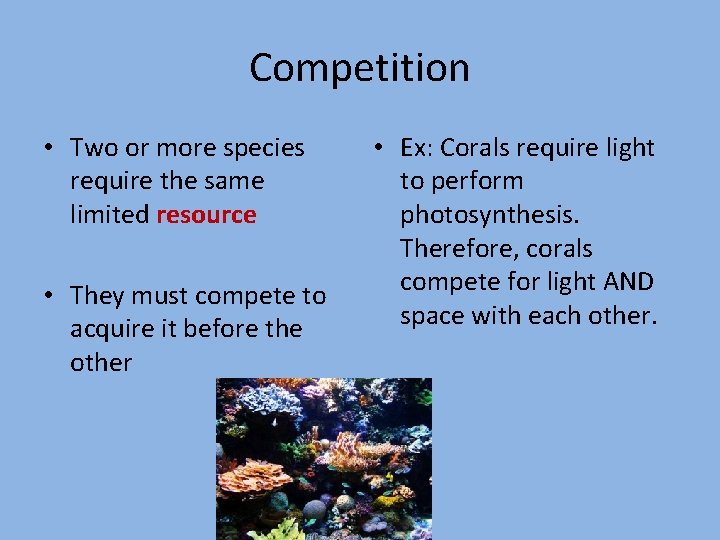
Competition • Two or more species require the same limited resource • They must compete to acquire it before the other • Ex: Corals require light to perform photosynthesis. Therefore, corals compete for light AND space with each other.
Ecosystem Relationships • No organism is completely self dependent • Organisms must respond to changes in environment and changes in other organisms in order to be successful
Ecosystem Relationships Ex: A summer is more sunny than usual. Marine algae bloom in response to increase solar energy. A population of blue crabs, herbivores, has lower death rate due to starvation. The population of blue crabs increases. The local population of nurse sharks increases with the higher availability of food.
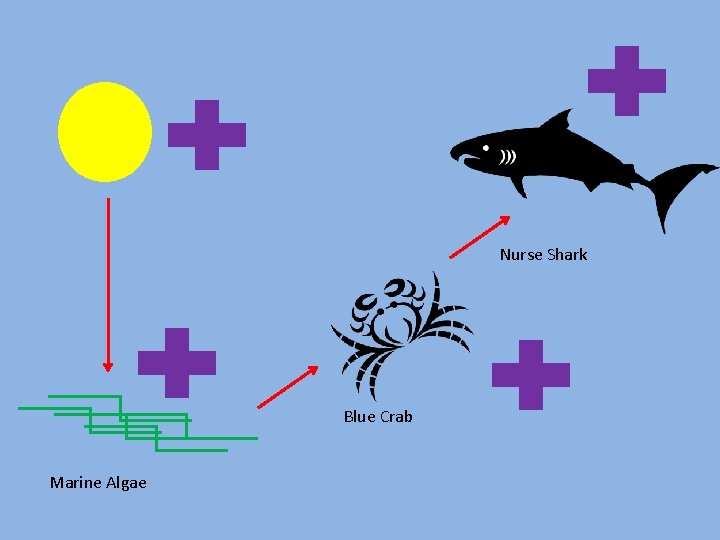
Nurse Shark Blue Crab Marine Algae
Ecosystem Relationships Ex: An ecosystem consists of sea otters and spinner dolphins which are both prey for orcas. Dolphin populations increase due to available food supplies. In response, orca populations also increase. Populations of local sea otters decrease due to increased predation. The clams that are food for otters increase in population due to decreased otter predation.
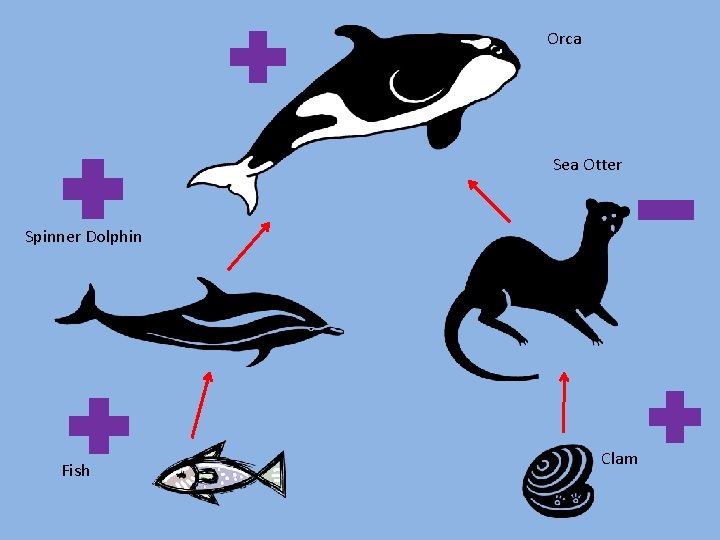
Orca Sea Otter Spinner Dolphin Fish Clam
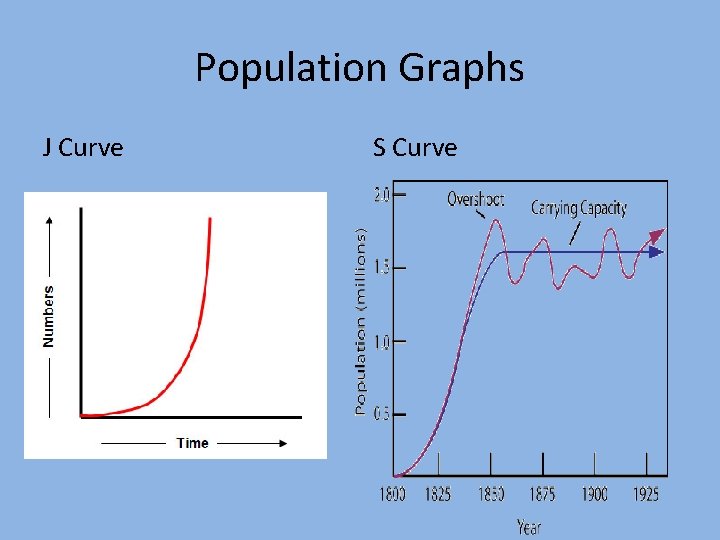
Population Graphs J Curve S Curve
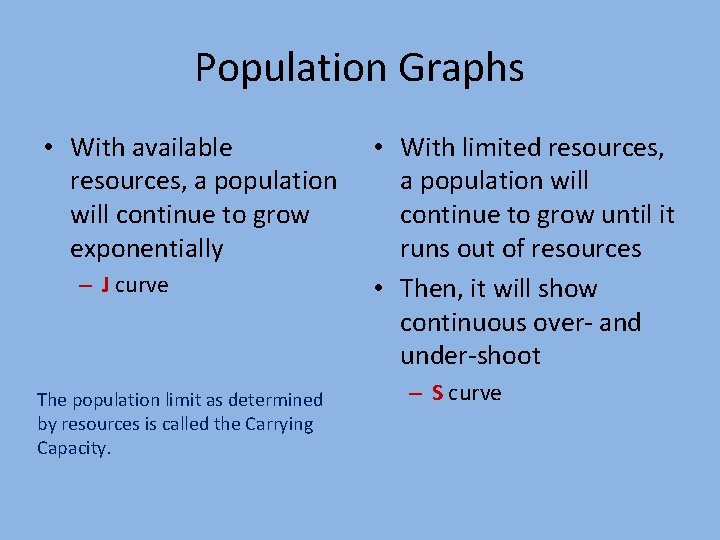
Population Graphs • With available resources, a population will continue to grow exponentially – J curve The population limit as determined by resources is called the Carrying Capacity. • With limited resources, a population will continue to grow until it runs out of resources • Then, it will show continuous over- and under-shoot – S curve
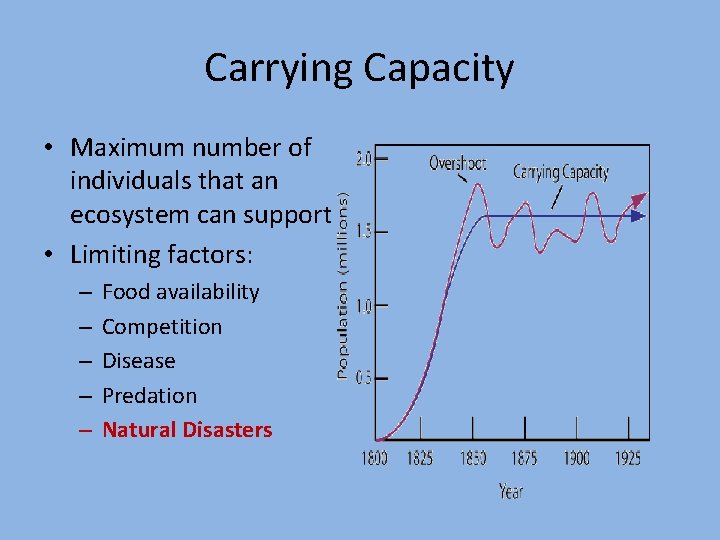
Carrying Capacity • Maximum number of individuals that an ecosystem can support • Limiting factors: – – – Food availability Competition Disease Predation Natural Disasters
Environmental Change A change in climate will result in a change in Food/Water/Shelter For Example: Cold climates begin to dominate a warm Changes in the limiting region. What happens factors in an environment to the plant will result in a change in populations? The the carrying capacity of primary consumers? all species in the The secondary ecosystem consumers?
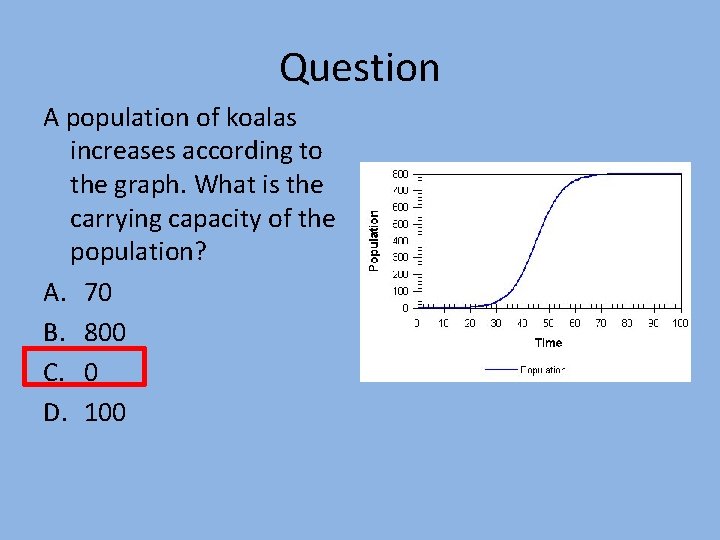
Question A population of koalas increases according to the graph. What is the carrying capacity of the population? A. 70 B. 800 C. 0 D. 100
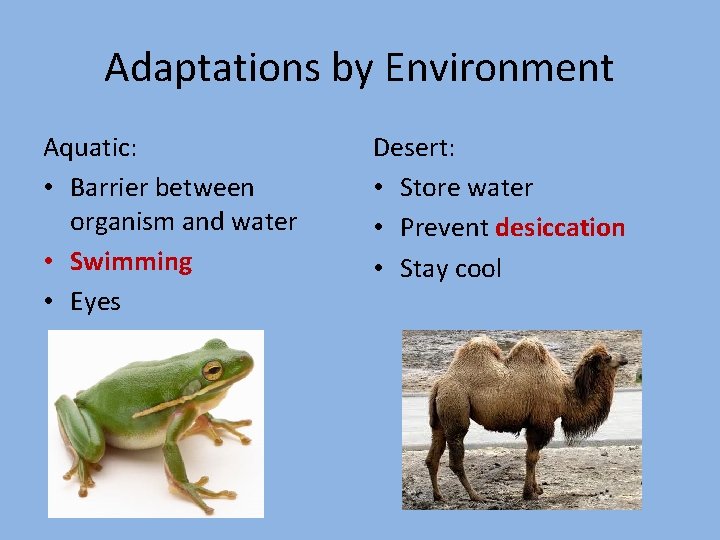
Adaptations by Environment Aquatic: • Barrier between organism and water • Swimming • Eyes Desert: • Store water • Prevent desiccation • Stay cool
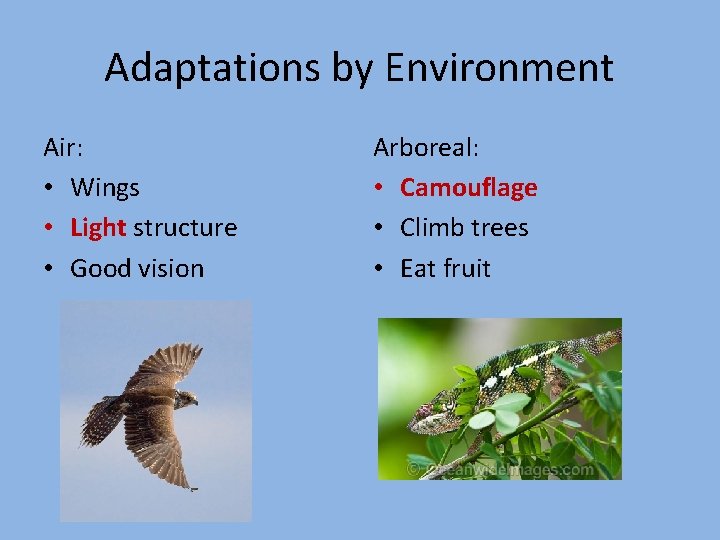
Adaptations by Environment Air: • Wings • Light structure • Good vision Arboreal: • Camouflage • Climb trees • Eat fruit
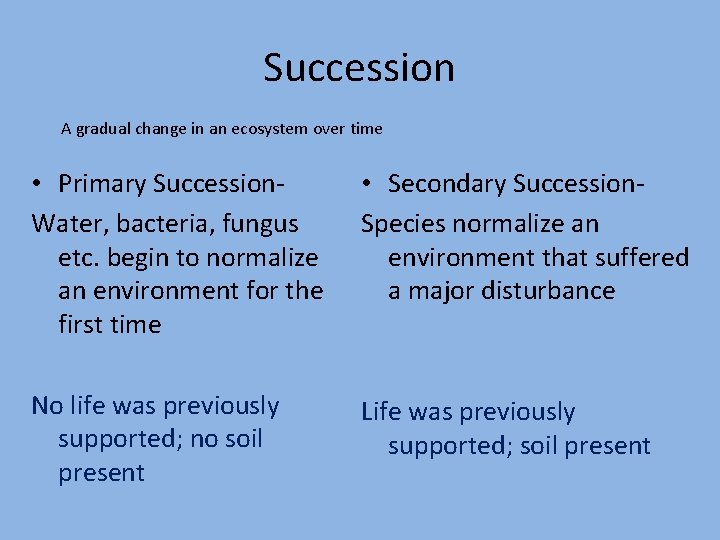
Succession A gradual change in an ecosystem over time • Primary Succession. Water, bacteria, fungus etc. begin to normalize an environment for the first time • Secondary Succession. Species normalize an environment that suffered a major disturbance No life was previously supported; no soil present Life was previously supported; soil present
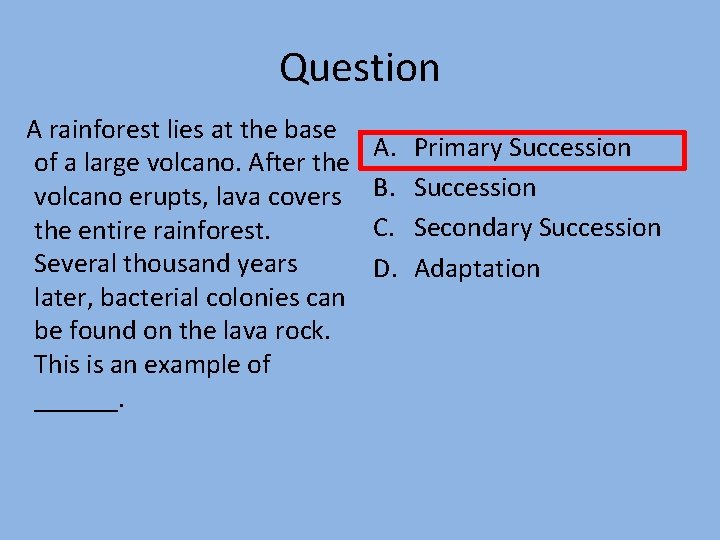
Question A rainforest lies at the base of a large volcano. After the volcano erupts, lava covers the entire rainforest. Several thousand years later, bacterial colonies can be found on the lava rock. This is an example of ______. A. B. C. D. Primary Succession Secondary Succession Adaptation
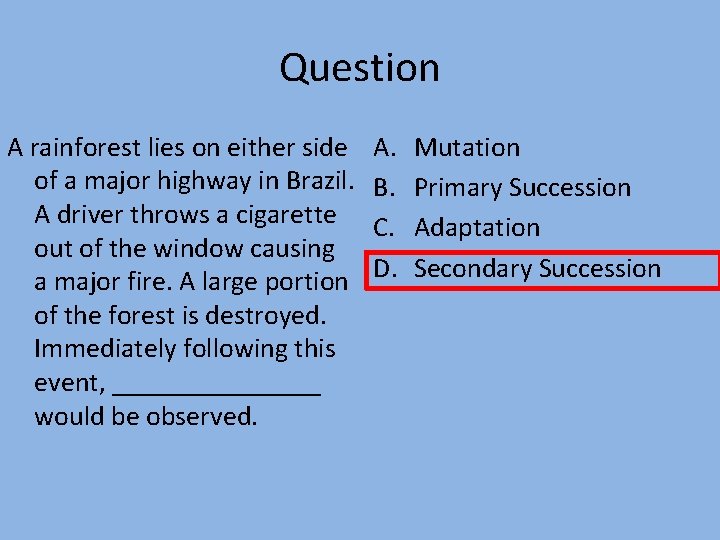
Question A rainforest lies on either side of a major highway in Brazil. A driver throws a cigarette out of the window causing a major fire. A large portion of the forest is destroyed. Immediately following this event, ________ would be observed. A. B. C. D. Mutation Primary Succession Adaptation Secondary Succession
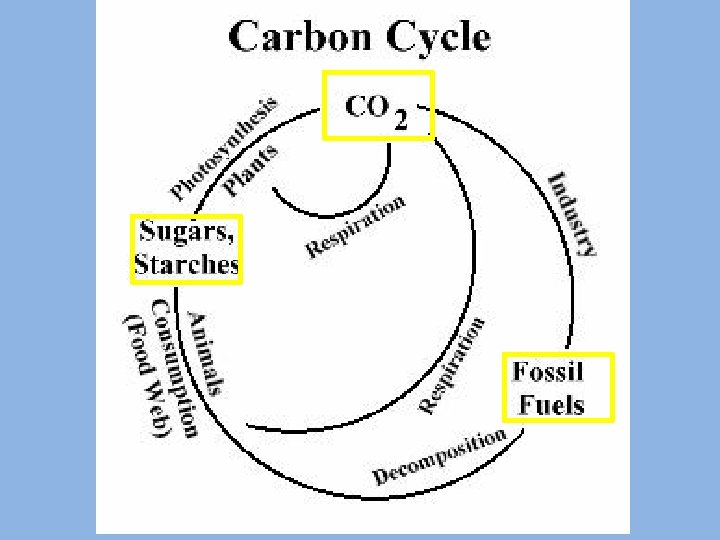
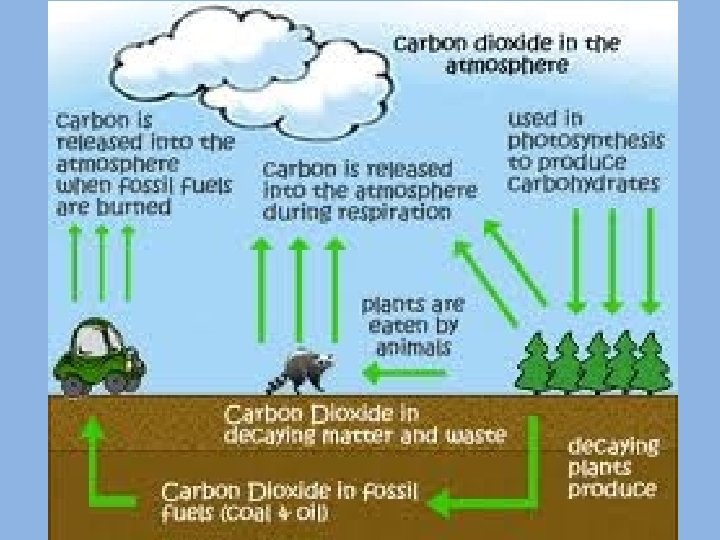
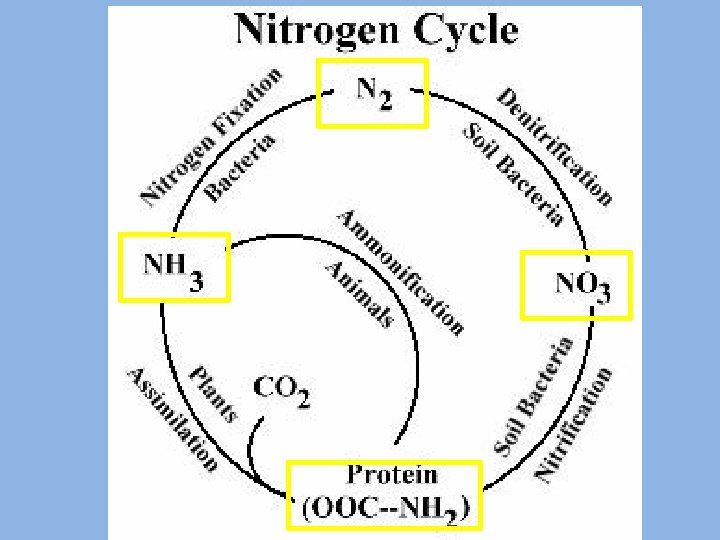
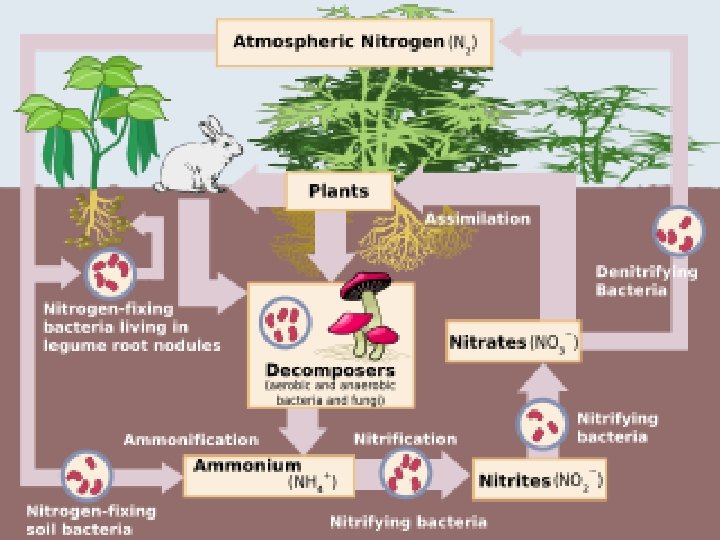
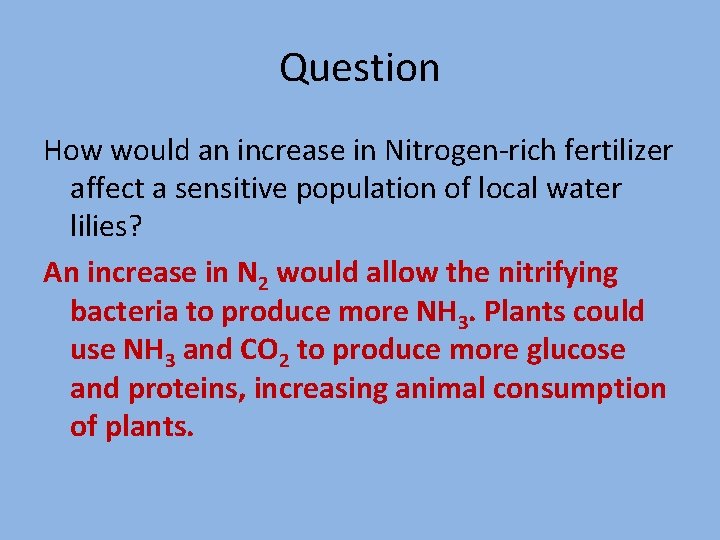
Question How would an increase in Nitrogen-rich fertilizer affect a sensitive population of local water lilies? An increase in N 2 would allow the nitrifying bacteria to produce more NH 3. Plants could use NH 3 and CO 2 to produce more glucose and proteins, increasing animal consumption of plants.
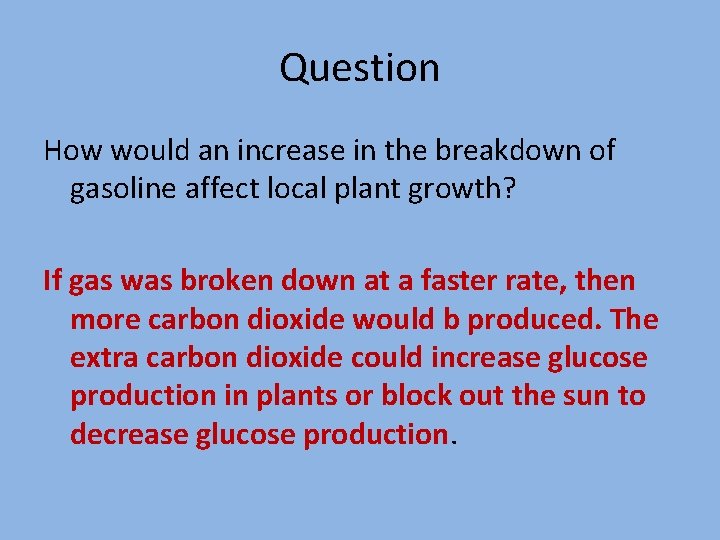
Question How would an increase in the breakdown of gasoline affect local plant growth? If gas was broken down at a faster rate, then more carbon dioxide would b produced. The extra carbon dioxide could increase glucose production in plants or block out the sun to decrease glucose production.
- Slides: 196