
Reporting Cash Flows Chapter 12 Wild and Shaw
- Slides: 46
Reporting Cash Flows Chapter 12 Wild and Shaw Financial and Managerial Accounting 8 th Edition © 2019 Mc. Graw-Hill Education. All rights reserved. Authorized only for instructor use in the classroom. No reproduction or further distribution permitted without the prior written consent of Mc. Graw-Hill Education.
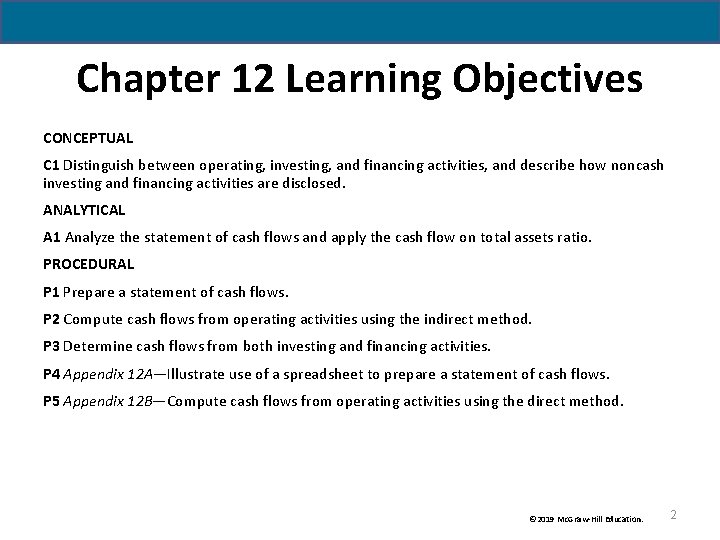
Chapter 12 Learning Objectives CONCEPTUAL C 1 Distinguish between operating, investing, and financing activities, and describe how noncash investing and financing activities are disclosed. ANALYTICAL A 1 Analyze the statement of cash flows and apply the cash flow on total assets ratio. PROCEDURAL P 1 Prepare a statement of cash flows. P 2 Compute cash flows from operating activities using the indirect method. P 3 Determine cash flows from both investing and financing activities. P 4 Appendix 12 A—Illustrate use of a spreadsheet to prepare a statement of cash flows. P 5 Appendix 12 B—Compute cash flows from operating activities using the direct method. © 2019 Mc. Graw-Hill Education. 2
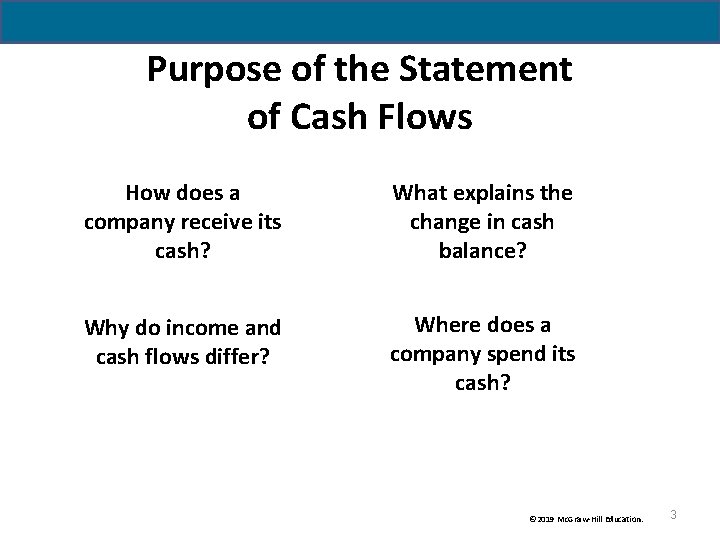
Purpose of the Statement of Cash Flows How does a company receive its cash? What explains the change in cash balance? Why do income and cash flows differ? Where does a company spend its cash? © 2019 Mc. Graw-Hill Education. 3
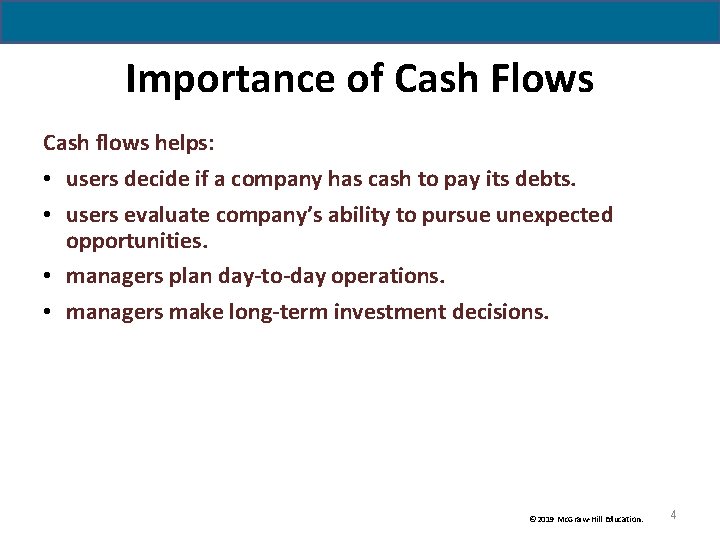
Importance of Cash Flows Cash flows helps: • users decide if a company has cash to pay its debts. • users evaluate company’s ability to pursue unexpected opportunities. • managers plan day-to-day operations. • managers make long-term investment decisions. © 2019 Mc. Graw-Hill Education. 4
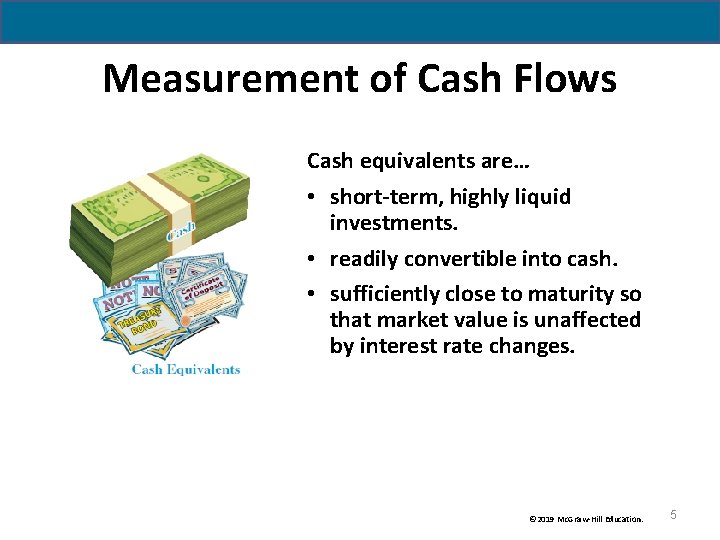
Measurement of Cash Flows Cash equivalents are… • short-term, highly liquid investments. • readily convertible into cash. • sufficiently close to maturity so that market value is unaffected by interest rate changes. © 2019 Mc. Graw-Hill Education. 5
Learning Objective C 1 Distinguish between operating, investing, and financing activities, and describe how noncash investing and financing activities are disclosed. © 2019 Mc. Graw-Hill Education. 6
Classification of Cash Flows The statement of cash flows includes the following three sections: • Operating Activities • Investing Activities • Financing Activities Learning Objective C 1: Distinguish between operating, investing, and financing activities, and describe how noncash investing and financing activities are disclosed. © 2019 Mc. Graw-Hill Education. 7
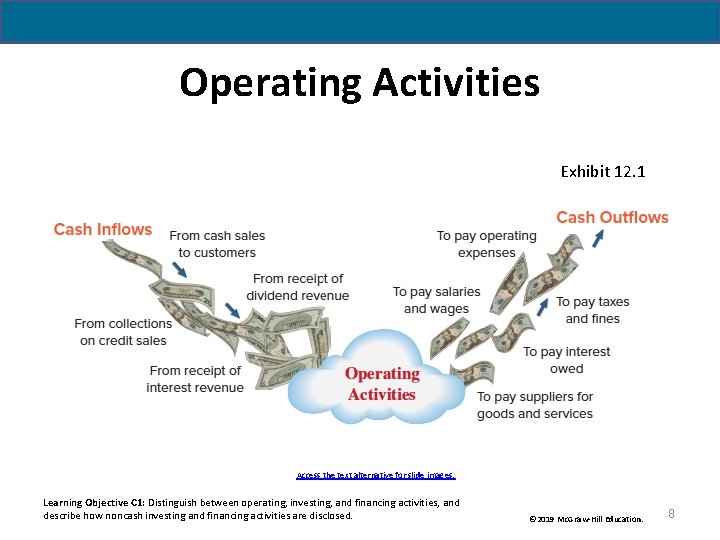
Operating Activities Exhibit 12. 1 Access the text alternative for slide images. Learning Objective C 1: Distinguish between operating, investing, and financing activities, and describe how noncash investing and financing activities are disclosed. © 2019 Mc. Graw-Hill Education. 8
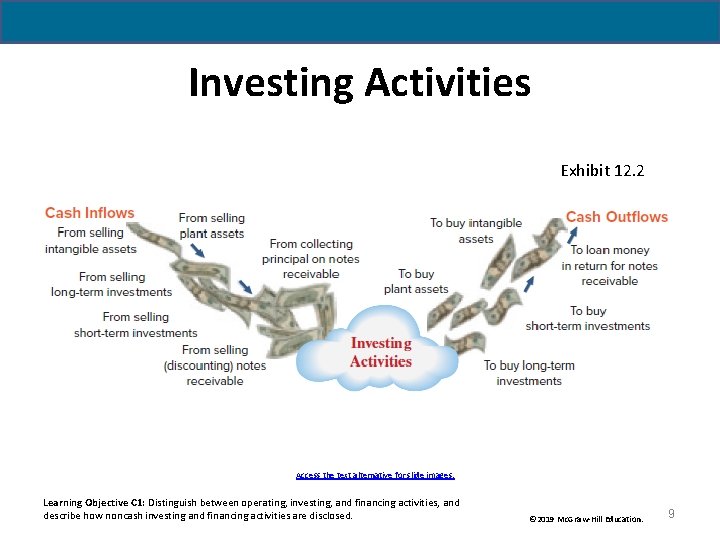
Investing Activities Exhibit 12. 2 Access the text alternative for slide images. Learning Objective C 1: Distinguish between operating, investing, and financing activities, and describe how noncash investing and financing activities are disclosed. © 2019 Mc. Graw-Hill Education. 9
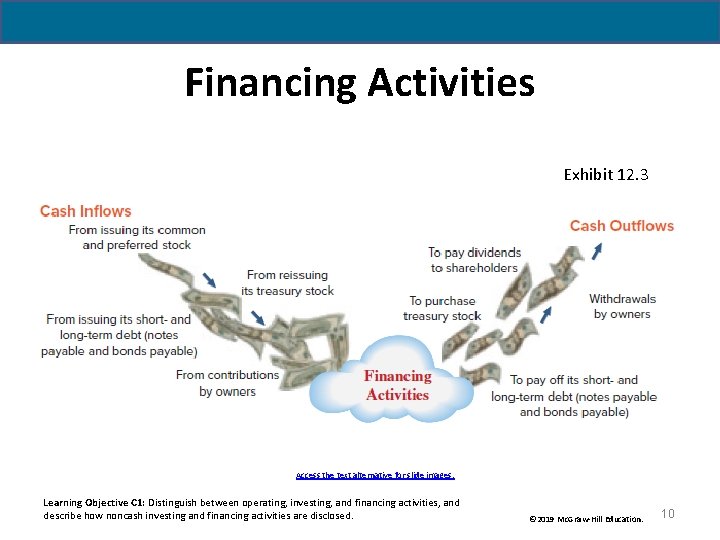
Financing Activities Exhibit 12. 3 Access the text alternative for slide images. Learning Objective C 1: Distinguish between operating, investing, and financing activities, and describe how noncash investing and financing activities are disclosed. © 2019 Mc. Graw-Hill Education. 10
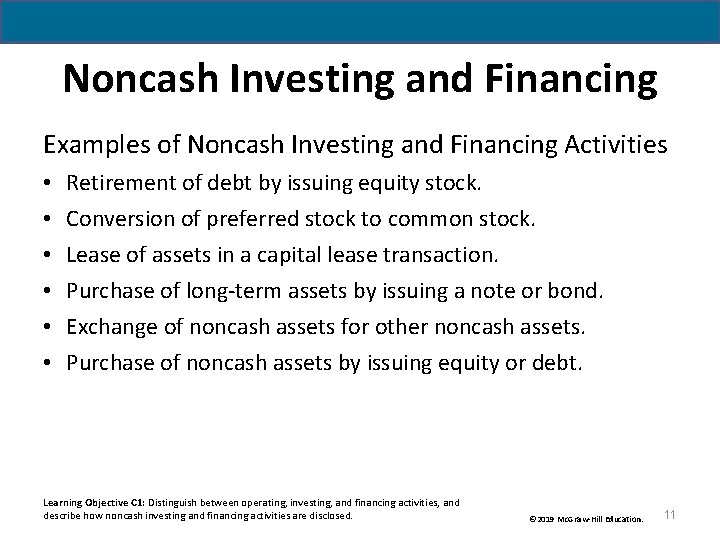
Noncash Investing and Financing Examples of Noncash Investing and Financing Activities • • • Retirement of debt by issuing equity stock. Conversion of preferred stock to common stock. Lease of assets in a capital lease transaction. Purchase of long-term assets by issuing a note or bond. Exchange of noncash assets for other noncash assets. Purchase of noncash assets by issuing equity or debt. Learning Objective C 1: Distinguish between operating, investing, and financing activities, and describe how noncash investing and financing activities are disclosed. © 2019 Mc. Graw-Hill Education. 11
Learning Objective P 1 Prepare a statement of cash flows. © 2019 Mc. Graw-Hill Education. 12
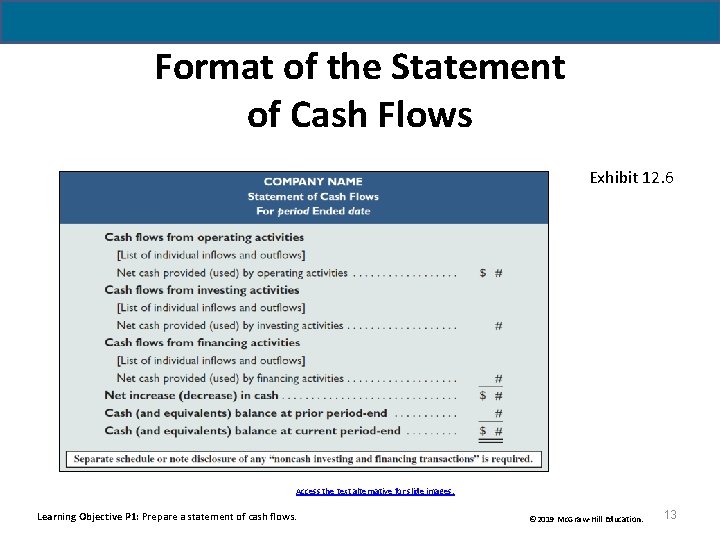
Format of the Statement of Cash Flows Exhibit 12. 6 Access the text alternative for slide images. Learning Objective P 1: Prepare a statement of cash flows. © 2019 Mc. Graw-Hill Education. 13
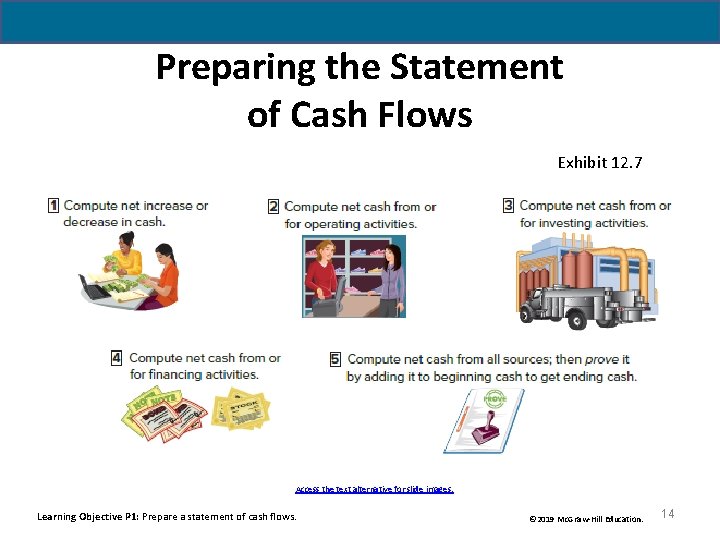
Preparing the Statement of Cash Flows Exhibit 12. 7 Access the text alternative for slide images. Learning Objective P 1: Prepare a statement of cash flows. © 2019 Mc. Graw-Hill Education. 14
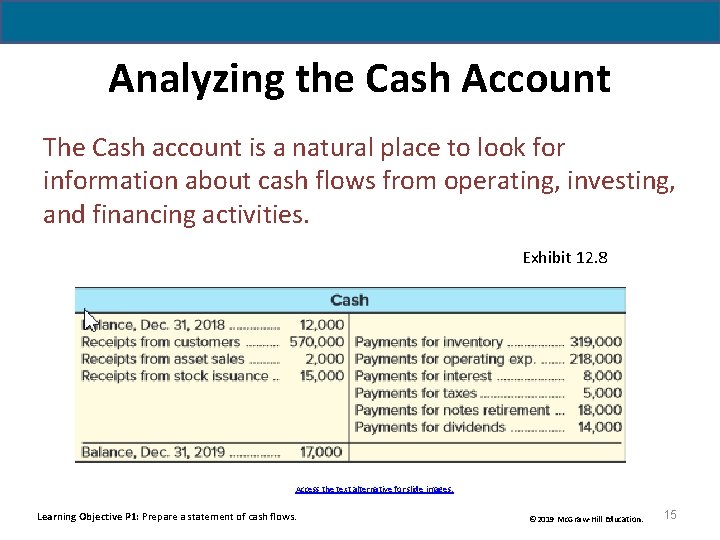
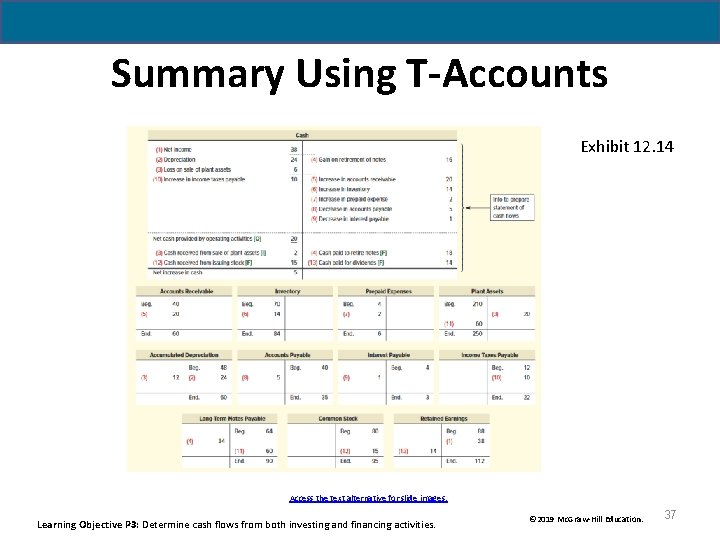
Analyzing the Cash Account The Cash account is a natural place to look for information about cash flows from operating, investing, and financing activities. Exhibit 12. 8 Access the text alternative for slide images. Learning Objective P 1: Prepare a statement of cash flows. © 2019 Mc. Graw-Hill Education. 15
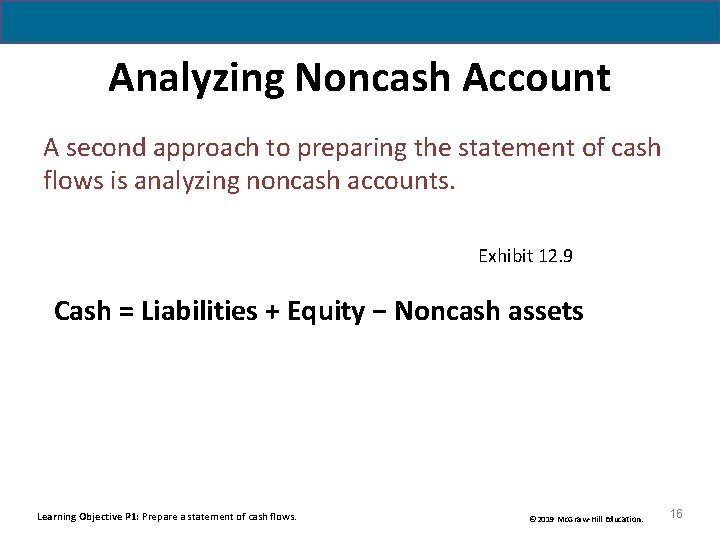
Analyzing Noncash Account A second approach to preparing the statement of cash flows is analyzing noncash accounts. Exhibit 12. 9 Cash = Liabilities + Equity − Noncash assets Learning Objective P 1: Prepare a statement of cash flows. © 2019 Mc. Graw-Hill Education. 16
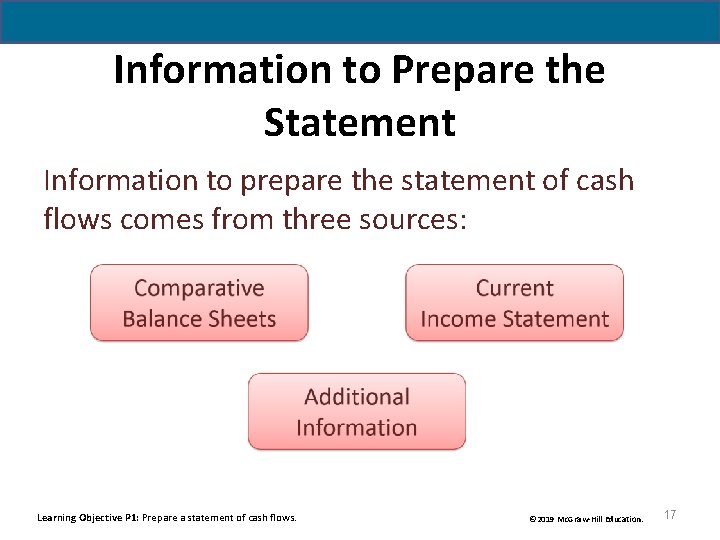
Information to Prepare the Statement Information to prepare the statement of cash flows comes from three sources: Learning Objective P 1: Prepare a statement of cash flows. © 2019 Mc. Graw-Hill Education. 17
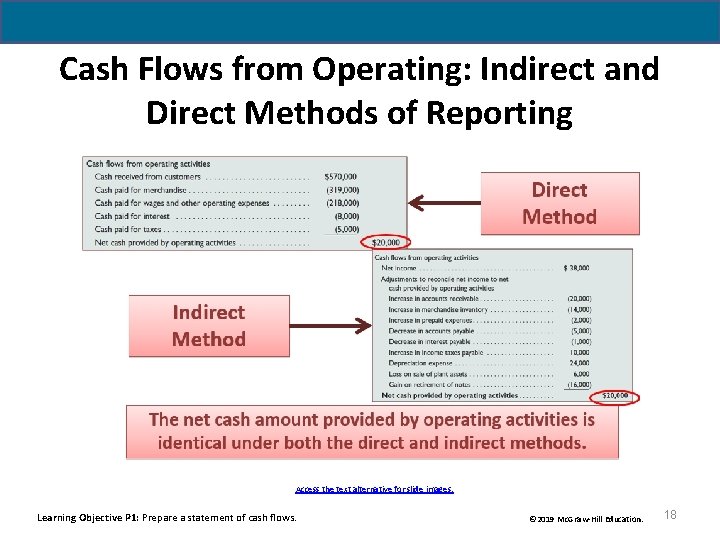
Cash Flows from Operating: Indirect and Direct Methods of Reporting Access the text alternative for slide images. Learning Objective P 1: Prepare a statement of cash flows. © 2019 Mc. Graw-Hill Education. 18
Learning Objective P 2 Compute cash flows from operating activities using the indirect method. © 2019 Mc. Graw-Hill Education. 19
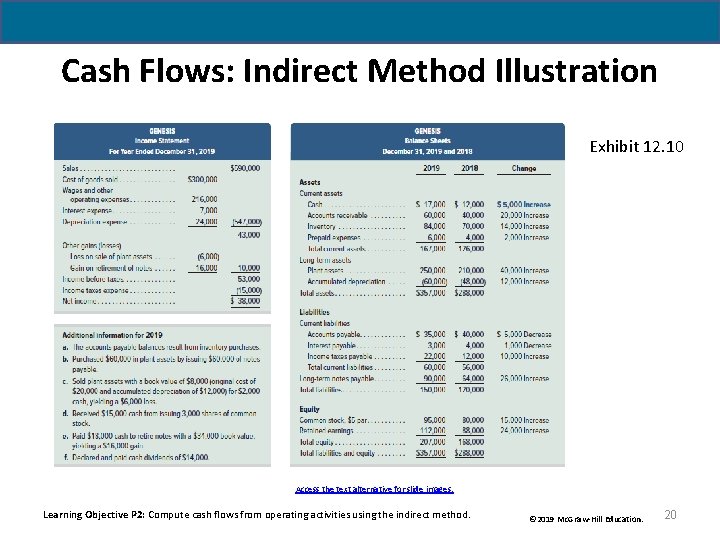
Cash Flows: Indirect Method Illustration Exhibit 12. 10 Access the text alternative for slide images. Learning Objective P 2: Compute cash flows from operating activities using the indirect method. © 2019 Mc. Graw-Hill Education. 20
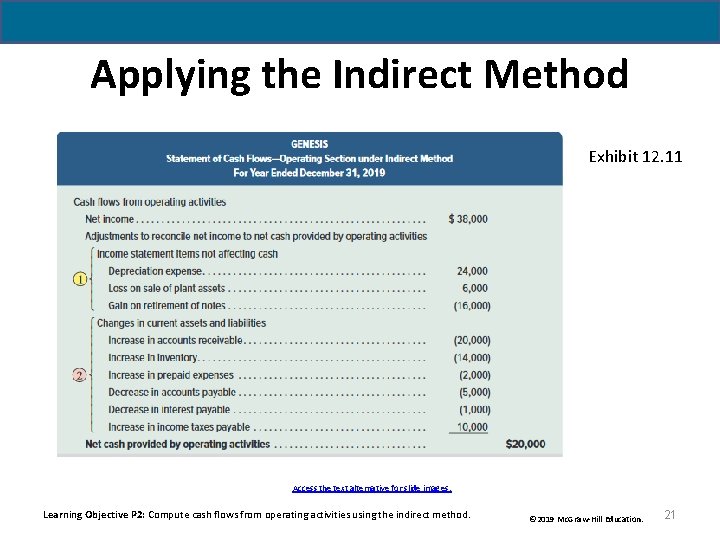
Applying the Indirect Method Exhibit 12. 11 Access the text alternative for slide images. Learning Objective P 2: Compute cash flows from operating activities using the indirect method. © 2019 Mc. Graw-Hill Education. 21
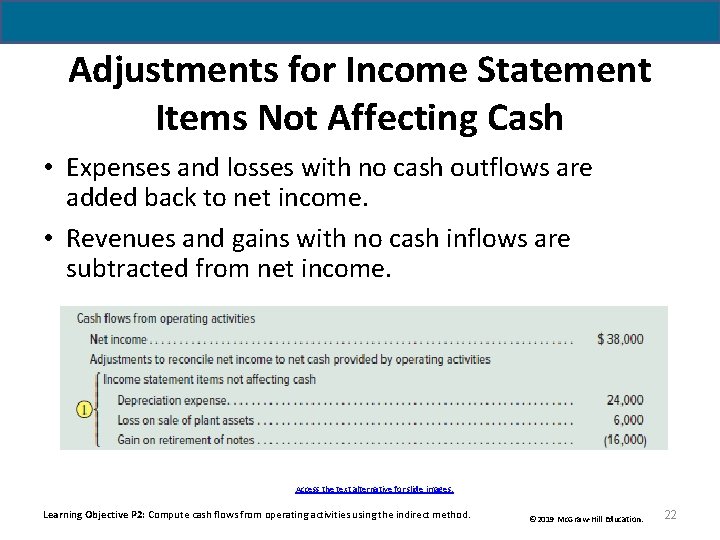
Adjustments for Income Statement Items Not Affecting Cash • Expenses and losses with no cash outflows are added back to net income. • Revenues and gains with no cash inflows are subtracted from net income. Access the text alternative for slide images. Learning Objective P 2: Compute cash flows from operating activities using the indirect method. © 2019 Mc. Graw-Hill Education. 22
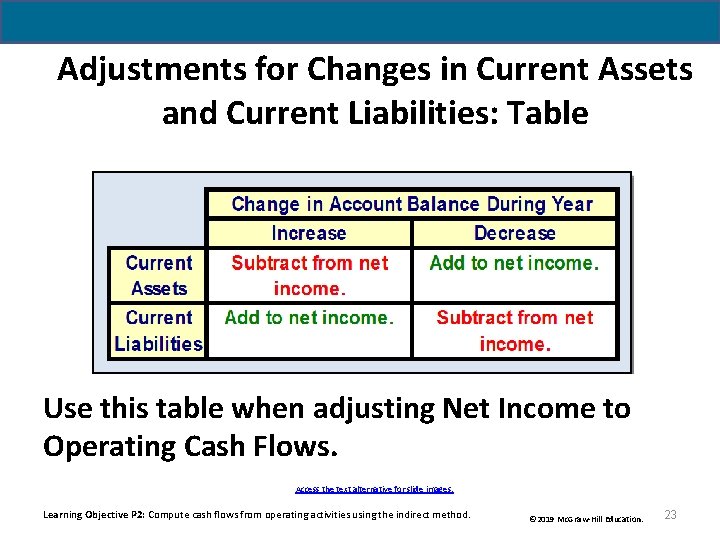
Adjustments for Changes in Current Assets and Current Liabilities: Table Use this table when adjusting Net Income to Operating Cash Flows. Access the text alternative for slide images. Learning Objective P 2: Compute cash flows from operating activities using the indirect method. © 2019 Mc. Graw-Hill Education. 23
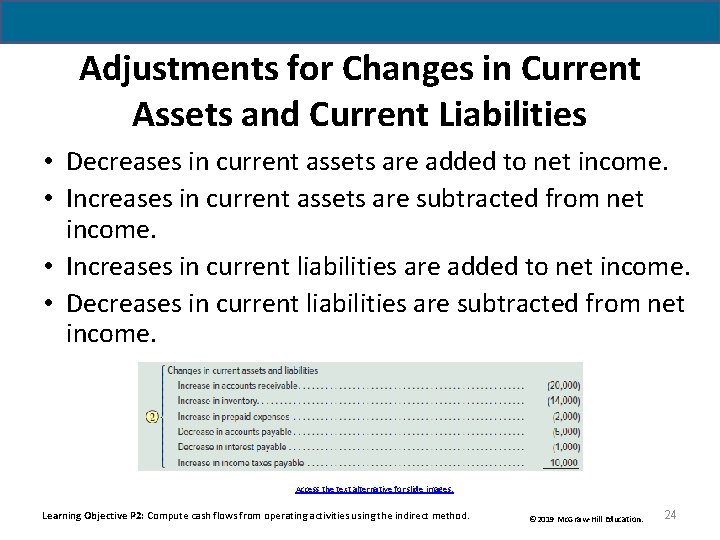
Adjustments for Changes in Current Assets and Current Liabilities • Decreases in current assets are added to net income. • Increases in current assets are subtracted from net income. • Increases in current liabilities are added to net income. • Decreases in current liabilities are subtracted from net income. Access the text alternative for slide images. Learning Objective P 2: Compute cash flows from operating activities using the indirect method. © 2019 Mc. Graw-Hill Education. 24
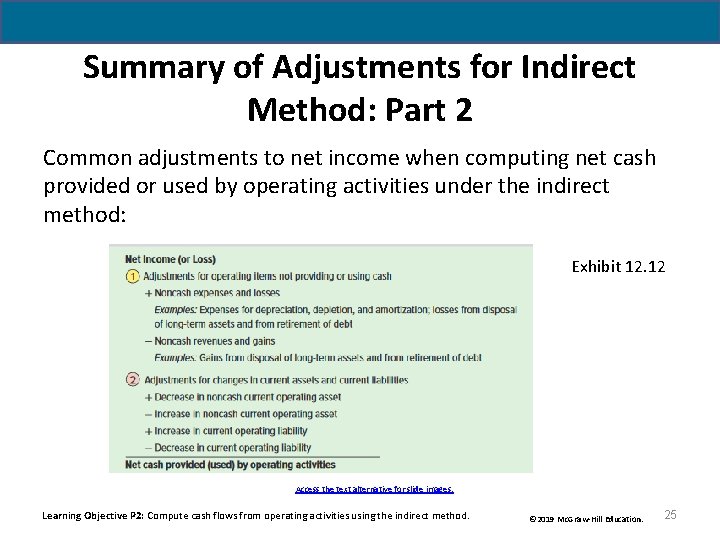
Summary of Adjustments for Indirect Method: Part 2 Common adjustments to net income when computing net cash provided or used by operating activities under the indirect method: Exhibit 12. 12 Access the text alternative for slide images. Learning Objective P 2: Compute cash flows from operating activities using the indirect method. © 2019 Mc. Graw-Hill Education. 25
Learning Objective P 3 Determine cash flows from both investing and financing activities. © 2019 Mc. Graw-Hill Education. 26
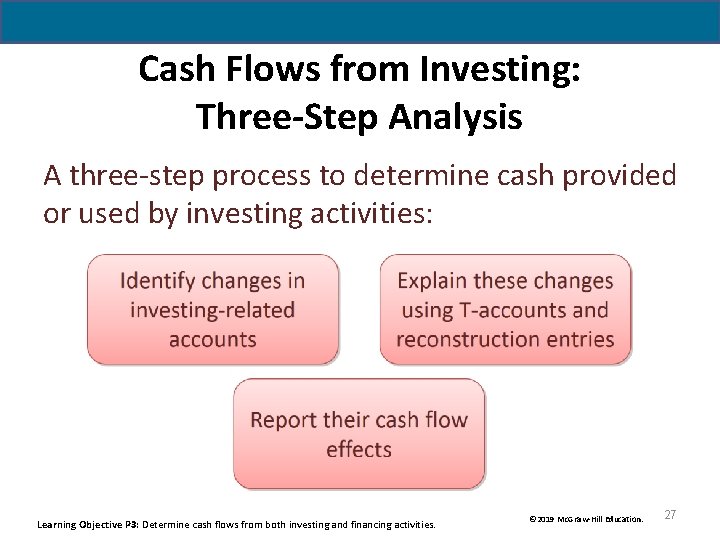
Cash Flows from Investing: Three-Step Analysis A three-step process to determine cash provided or used by investing activities: Learning Objective P 3: Determine cash flows from both investing and financing activities. © 2019 Mc. Graw-Hill Education. 27
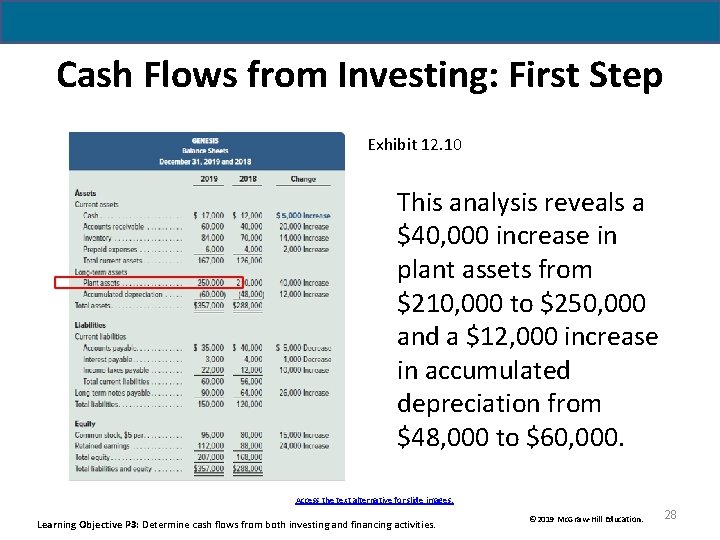
Cash Flows from Investing: First Step Exhibit 12. 10 This analysis reveals a $40, 000 increase in plant assets from $210, 000 to $250, 000 and a $12, 000 increase in accumulated depreciation from $48, 000 to $60, 000. Access the text alternative for slide images. Learning Objective P 3: Determine cash flows from both investing and financing activities. © 2019 Mc. Graw-Hill Education. 28
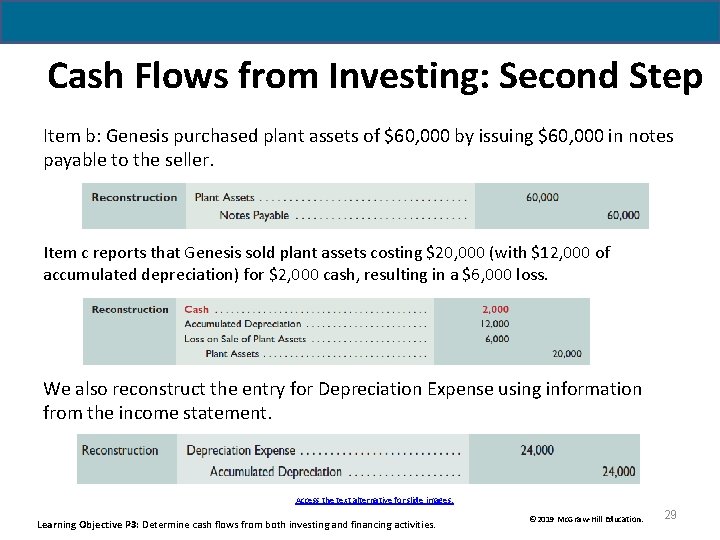
Cash Flows from Investing: Second Step Item b: Genesis purchased plant assets of $60, 000 by issuing $60, 000 in notes payable to the seller. Item c reports that Genesis sold plant assets costing $20, 000 (with $12, 000 of accumulated depreciation) for $2, 000 cash, resulting in a $6, 000 loss. We also reconstruct the entry for Depreciation Expense using information from the income statement. Access the text alternative for slide images. Learning Objective P 3: Determine cash flows from both investing and financing activities. © 2019 Mc. Graw-Hill Education. 29
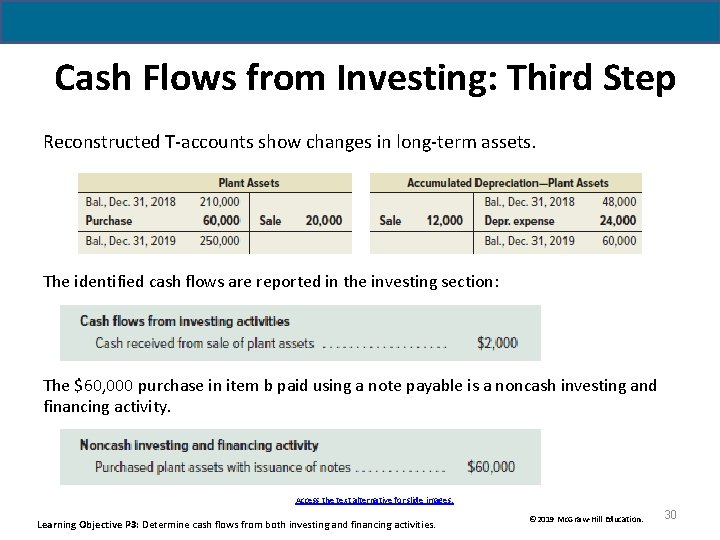
Cash Flows from Investing: Third Step Reconstructed T-accounts show changes in long-term assets. The identified cash flows are reported in the investing section: The $60, 000 purchase in item b paid using a note payable is a noncash investing and financing activity. Access the text alternative for slide images. Learning Objective P 3: Determine cash flows from both investing and financing activities. © 2019 Mc. Graw-Hill Education. 30
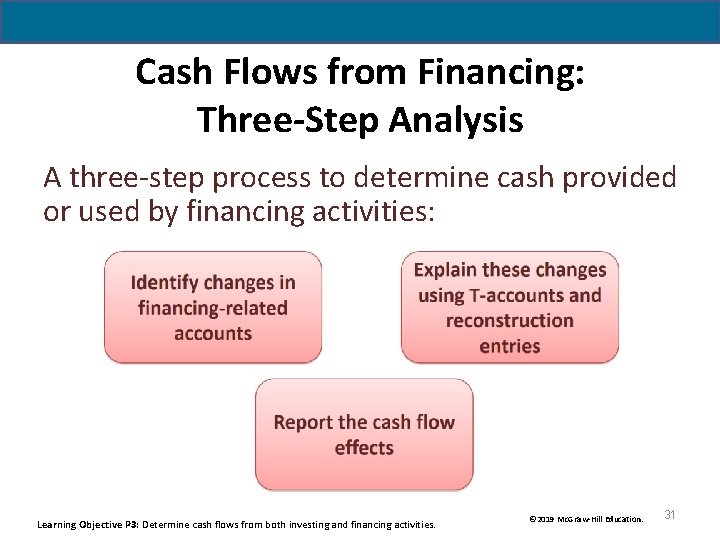
Cash Flows from Financing: Three-Step Analysis A three-step process to determine cash provided or used by financing activities: Learning Objective P 3: Determine cash flows from both investing and financing activities. © 2019 Mc. Graw-Hill Education. 31
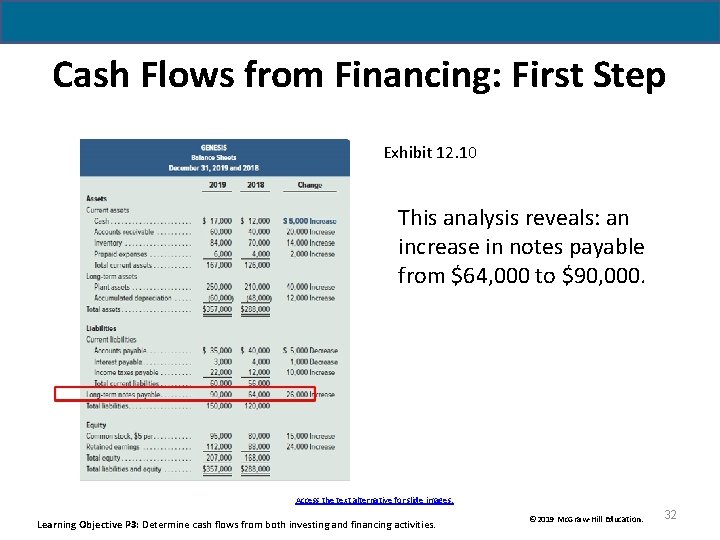
Cash Flows from Financing: First Step Exhibit 12. 10 This analysis reveals: an increase in notes payable from $64, 000 to $90, 000. Access the text alternative for slide images. Learning Objective P 3: Determine cash flows from both investing and financing activities. © 2019 Mc. Graw-Hill Education. 32
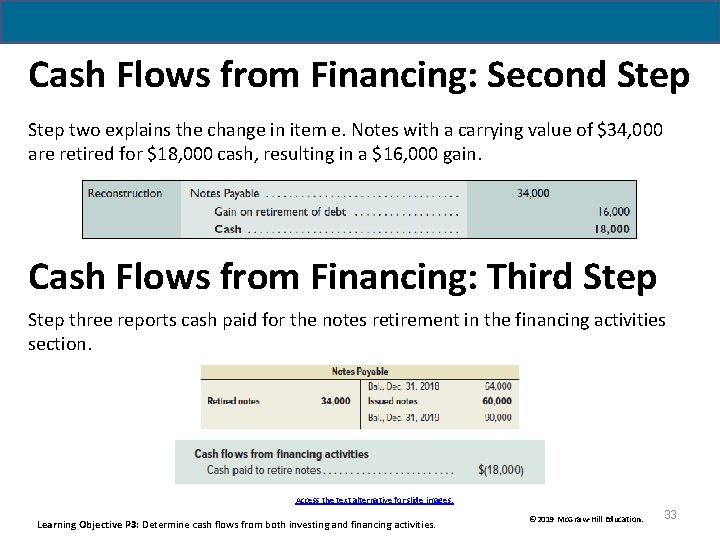
Cash Flows from Financing: Second Step two explains the change in item e. Notes with a carrying value of $34, 000 are retired for $18, 000 cash, resulting in a $16, 000 gain. Cash Flows from Financing: Third Step three reports cash paid for the notes retirement in the financing activities section. Access the text alternative for slide images. Learning Objective P 3: Determine cash flows from both investing and financing activities. © 2019 Mc. Graw-Hill Education. 33
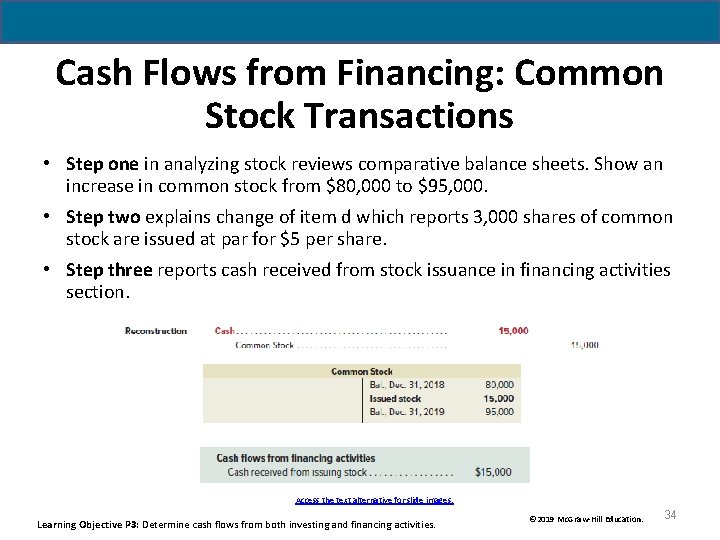
Cash Flows from Financing: Common Stock Transactions • Step one in analyzing stock reviews comparative balance sheets. Show an increase in common stock from $80, 000 to $95, 000. • Step two explains change of item d which reports 3, 000 shares of common stock are issued at par for $5 per share. • Step three reports cash received from stock issuance in financing activities section. Access the text alternative for slide images. Learning Objective P 3: Determine cash flows from both investing and financing activities. © 2019 Mc. Graw-Hill Education. 34
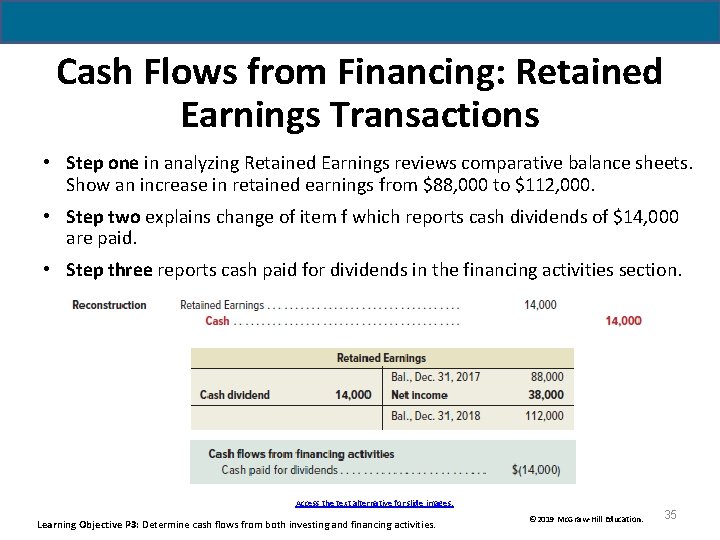
Cash Flows from Financing: Retained Earnings Transactions • Step one in analyzing Retained Earnings reviews comparative balance sheets. Show an increase in retained earnings from $88, 000 to $112, 000. • Step two explains change of item f which reports cash dividends of $14, 000 are paid. • Step three reports cash paid for dividends in the financing activities section. Access the text alternative for slide images. Learning Objective P 3: Determine cash flows from both investing and financing activities. © 2019 Mc. Graw-Hill Education. 35
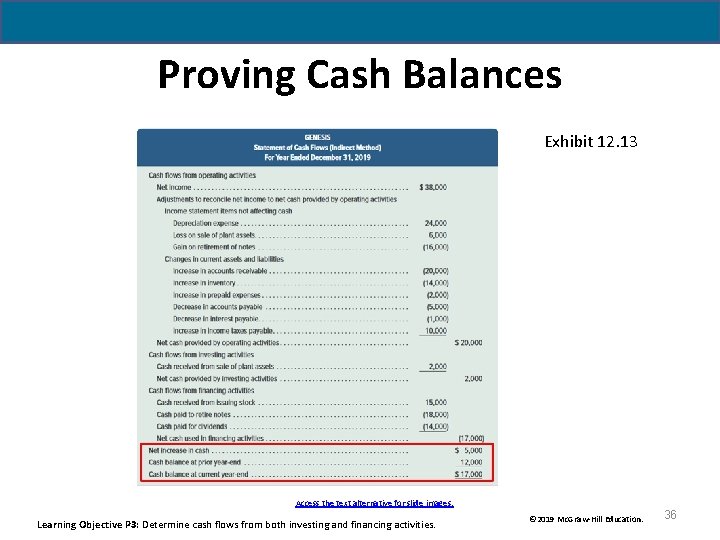
Proving Cash Balances Exhibit 12. 13 Access the text alternative for slide images. Learning Objective P 3: Determine cash flows from both investing and financing activities. © 2019 Mc. Graw-Hill Education. 36
Summary Using T-Accounts Exhibit 12. 14 Access the text alternative for slide images. Learning Objective P 3: Determine cash flows from both investing and financing activities. © 2019 Mc. Graw-Hill Education. 37
Learning Objective A 1 Analyze the statement of cash flows and apply the cash flow on total assets ratio. © 2019 Mc. Graw-Hill Education. 38
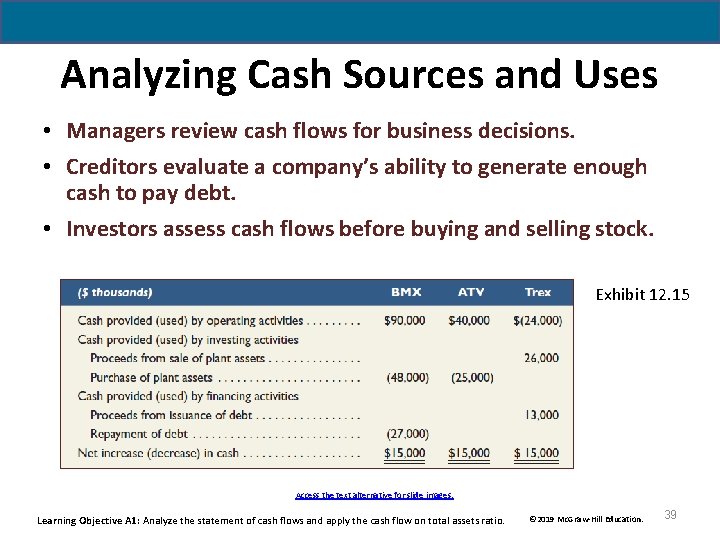
Analyzing Cash Sources and Uses • Managers review cash flows for business decisions. • Creditors evaluate a company’s ability to generate enough cash to pay debt. • Investors assess cash flows before buying and selling stock. Exhibit 12. 15 Access the text alternative for slide images. Learning Objective A 1: Analyze the statement of cash flows and apply the cash flow on total assets ratio. © 2019 Mc. Graw-Hill Education. 39
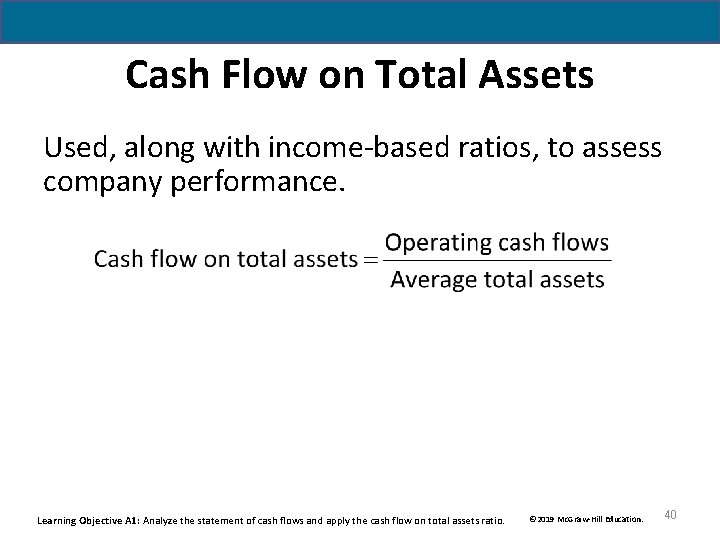
Cash Flow on Total Assets Used, along with income-based ratios, to assess company performance. Learning Objective A 1: Analyze the statement of cash flows and apply the cash flow on total assets ratio. © 2019 Mc. Graw-Hill Education. 40
Learning Objective P 4 Appendix 12 A Illustrate use of a spreadsheet to prepare a statement of cash flows. © 2019 Mc. Graw-Hill Education. 41
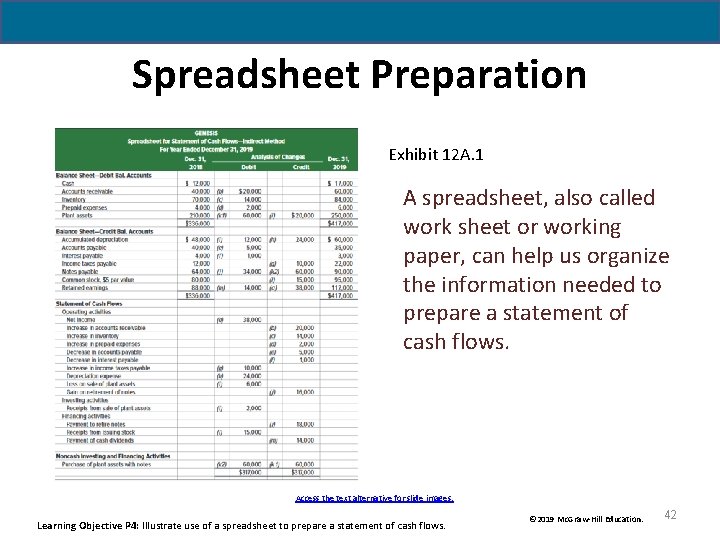
Spreadsheet Preparation Exhibit 12 A. 1 A spreadsheet, also called work sheet or working paper, can help us organize the information needed to prepare a statement of cash flows. Access the text alternative for slide images. Learning Objective P 4: Illustrate use of a spreadsheet to prepare a statement of cash flows. © 2019 Mc. Graw-Hill Education. 42
Learning Objective P 5 Appendix 12 B Compute cash flows from operating activities using the direct method. © 2019 Mc. Graw-Hill Education. 43
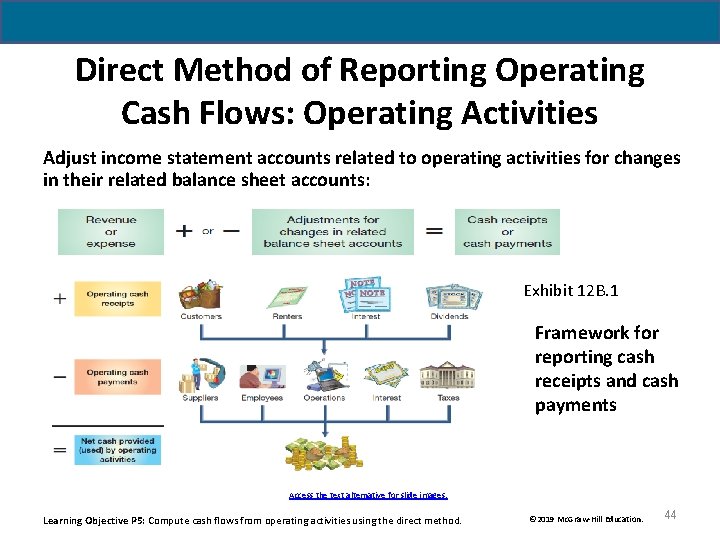
Direct Method of Reporting Operating Cash Flows: Operating Activities Adjust income statement accounts related to operating activities for changes in their related balance sheet accounts: Exhibit 12 B. 1 Framework for reporting cash receipts and cash payments Access the text alternative for slide images. Learning Objective P 5: Compute cash flows from operating activities using the direct method. © 2019 Mc. Graw-Hill Education. 44
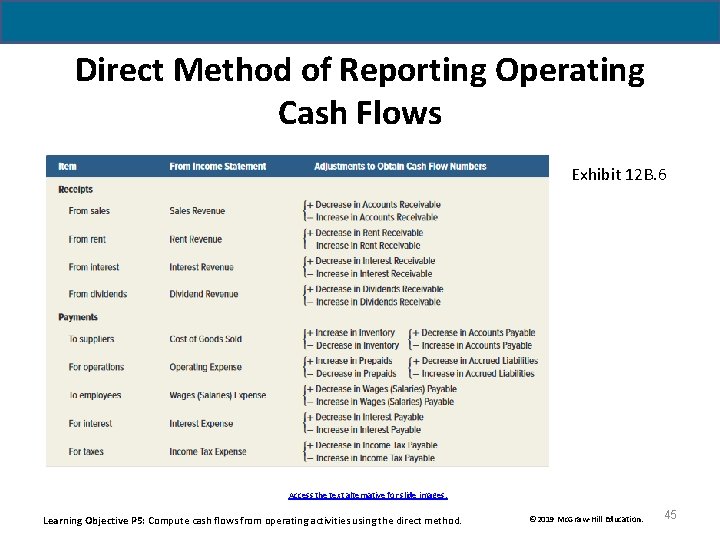
Direct Method of Reporting Operating Cash Flows Exhibit 12 B. 6 Access the text alternative for slide images. Learning Objective P 5: Compute cash flows from operating activities using the direct method. © 2019 Mc. Graw-Hill Education. 45
End of Chapter 12 © 2019 Mc. Graw-Hill Education. 46