
Reported Speech Indirect Speech n n n There
- Slides: 11
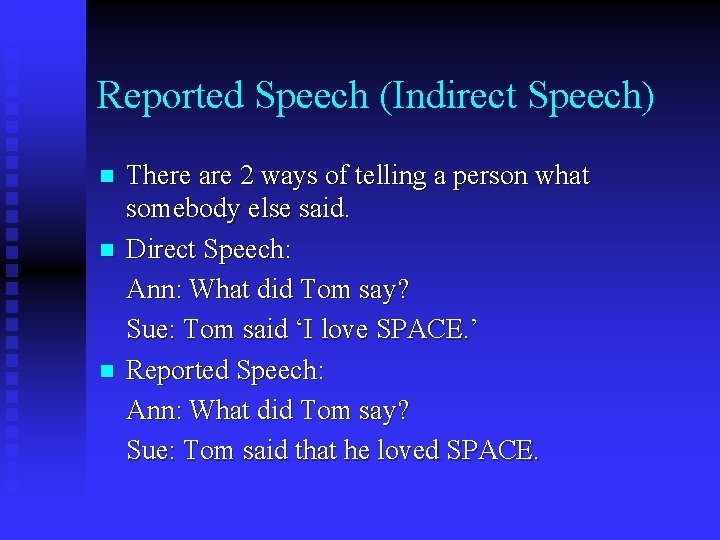
Reported Speech (Indirect Speech) n n n There are 2 ways of telling a person what somebody else said. Direct Speech: Ann: What did Tom say? Sue: Tom said ‘I love SPACE. ’ Reported Speech: Ann: What did Tom say? Sue: Tom said that he loved SPACE.
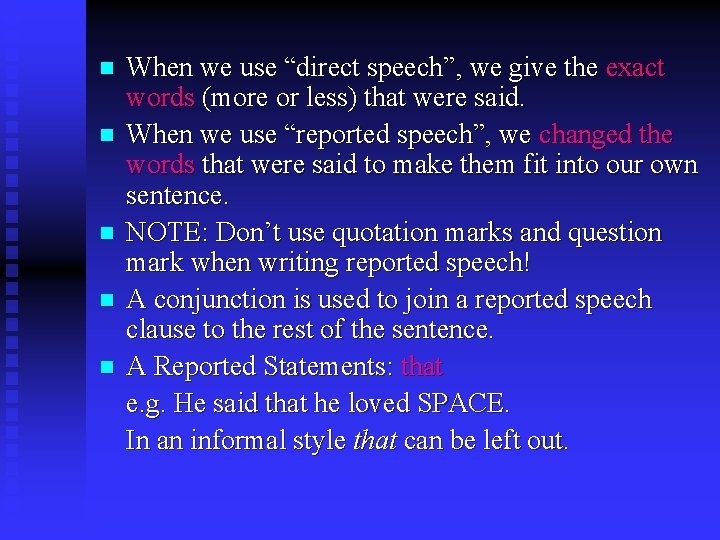
n n n When we use “direct speech”, we give the exact words (more or less) that were said. When we use “reported speech”, we changed the words that were said to make them fit into our own sentence. NOTE: Don’t use quotation marks and question mark when writing reported speech! A conjunction is used to join a reported speech clause to the rest of the sentence. A Reported Statements: that e. g. He said that he loved SPACE. In an informal style that can be left out.
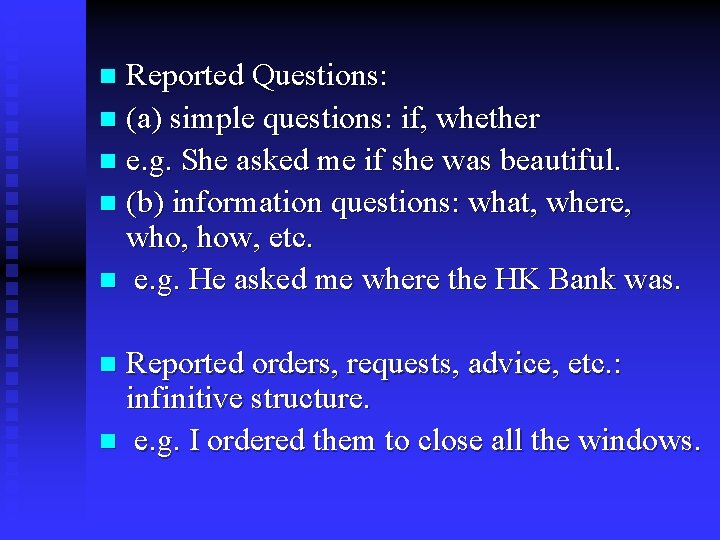
Reported Questions: n (a) simple questions: if, whether n e. g. She asked me if she was beautiful. n (b) information questions: what, where, who, how, etc. n e. g. He asked me where the HK Bank was. n Reported orders, requests, advice, etc. : infinitive structure. n e. g. I ordered them to close all the windows. n
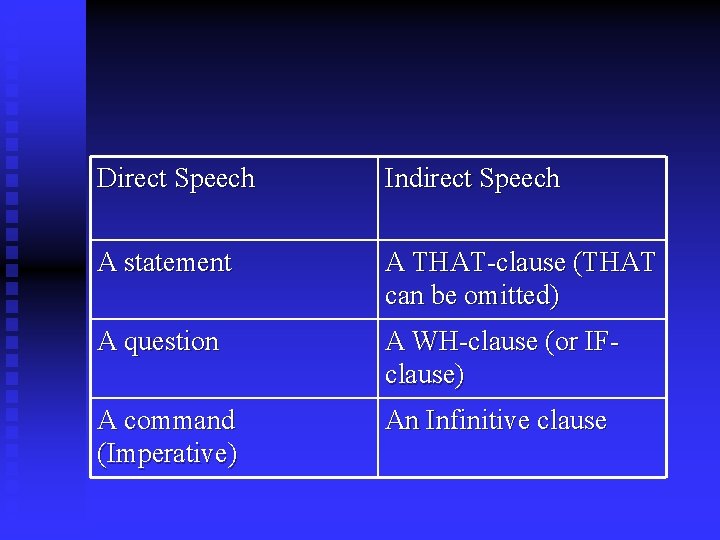
Direct Speech Indirect Speech A statement A THAT-clause (THAT can be omitted) A question A WH-clause (or IFclause) A command (Imperative) An Infinitive clause
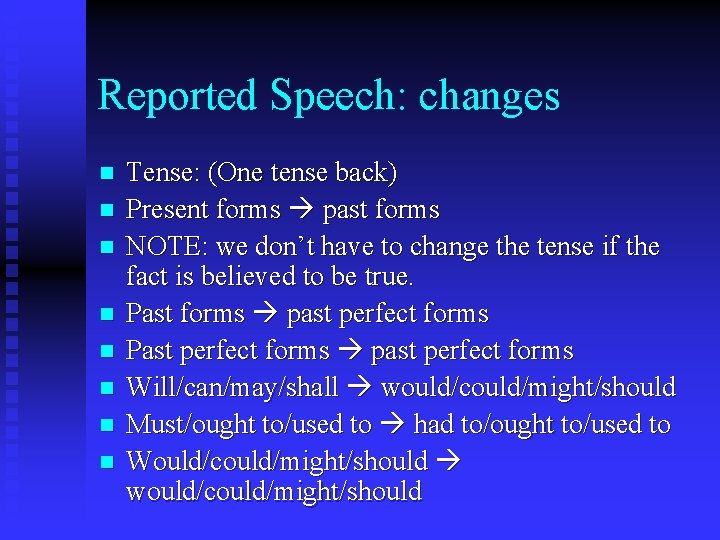
Reported Speech: changes n n n n Tense: (One tense back) Present forms past forms NOTE: we don’t have to change the tense if the fact is believed to be true. Past forms past perfect forms Past perfect forms past perfect forms Will/can/may/shall would/could/might/should Must/ought to/used to had to/ought to/used to Would/could/might/should would/could/might/should
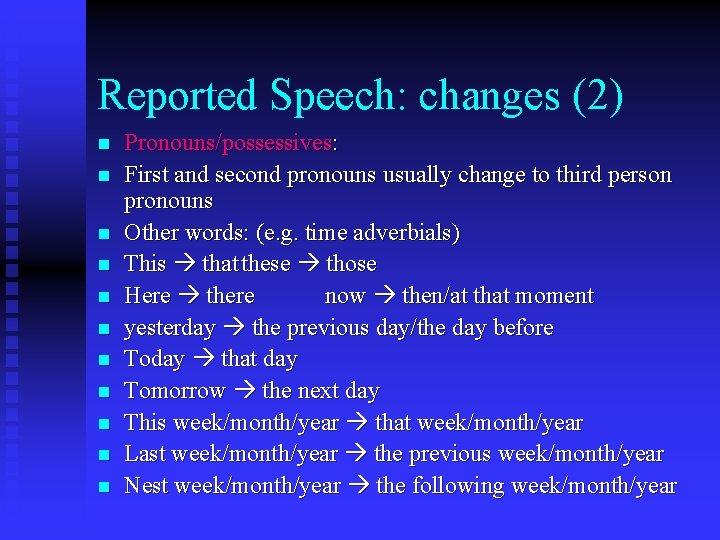
Reported Speech: changes (2) n n n Pronouns/possessives: First and second pronouns usually change to third person pronouns Other words: (e. g. time adverbials) This that these those Here there now then/at that moment yesterday the previous day/the day before Today that day Tomorrow the next day This week/month/year that week/month/year Last week/month/year the previous week/month/year Nest week/month/year the following week/month/year
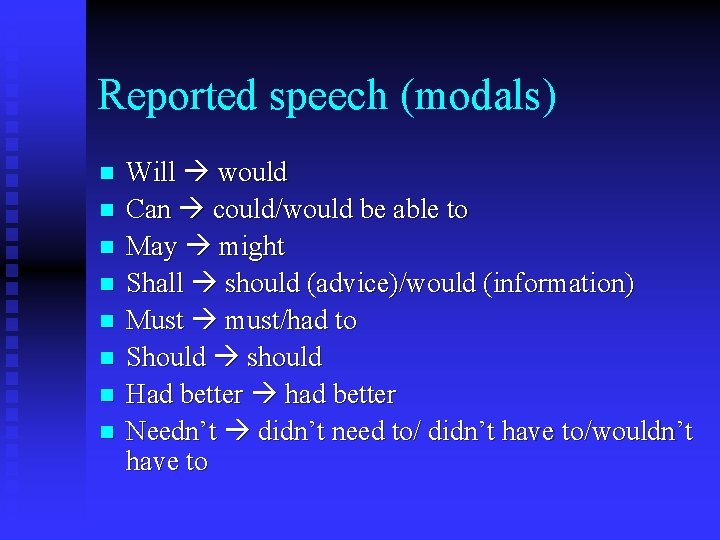
Reported speech (modals) n n n n Will would Can could/would be able to May might Shall should (advice)/would (information) Must must/had to Should should Had better had better Needn’t didn’t need to/ didn’t have to/wouldn’t have to
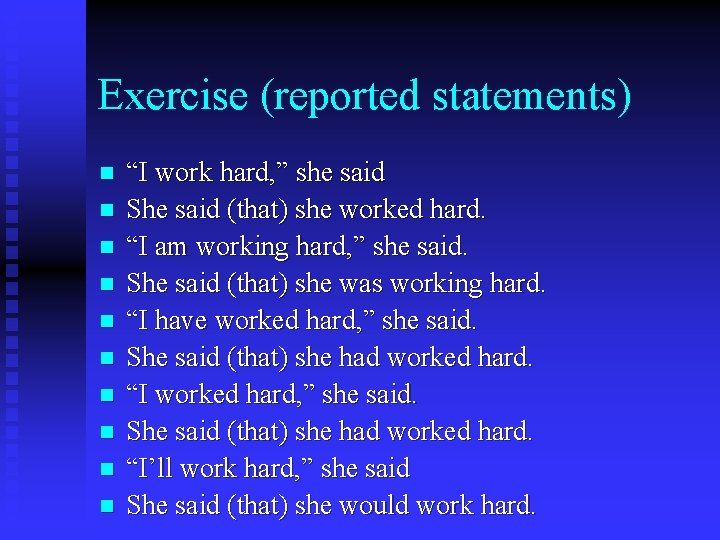
Exercise (reported statements) n n n n n “I work hard, ” she said She said (that) she worked hard. “I am working hard, ” she said. She said (that) she was working hard. “I have worked hard, ” she said. She said (that) she had worked hard. “I’ll work hard, ” she said She said (that) she would work hard.
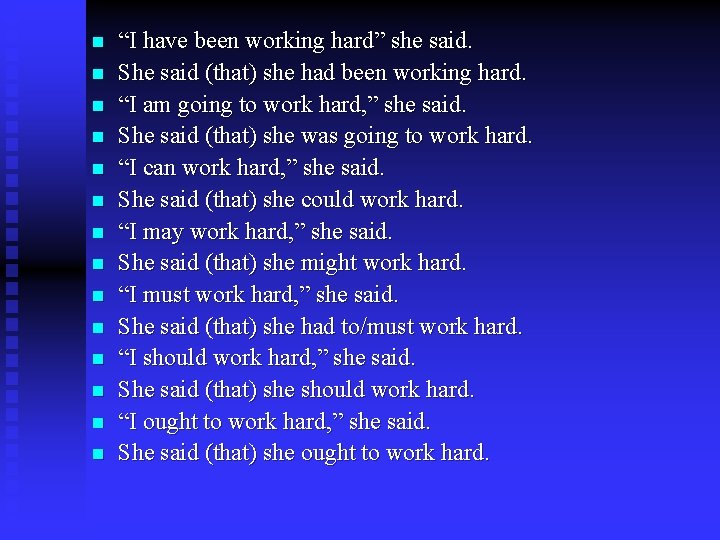
n n n n “I have been working hard” she said. She said (that) she had been working hard. “I am going to work hard, ” she said. She said (that) she was going to work hard. “I can work hard, ” she said. She said (that) she could work hard. “I may work hard, ” she said. She said (that) she might work hard. “I must work hard, ” she said. She said (that) she had to/must work hard. “I should work hard, ” she said. She said (that) she should work hard. “I ought to work hard, ” she said. She said (that) she ought to work hard.
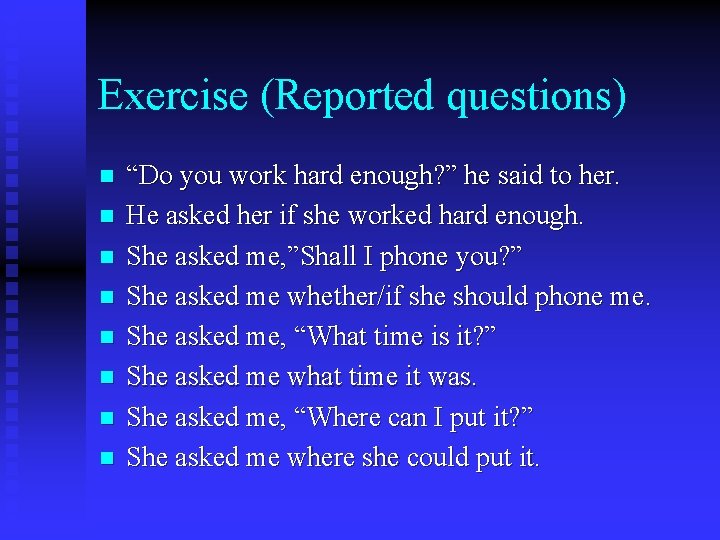
Exercise (Reported questions) n n n n “Do you work hard enough? ” he said to her. He asked her if she worked hard enough. She asked me, ”Shall I phone you? ” She asked me whether/if she should phone me. She asked me, “What time is it? ” She asked me what time it was. She asked me, “Where can I put it? ” She asked me where she could put it.
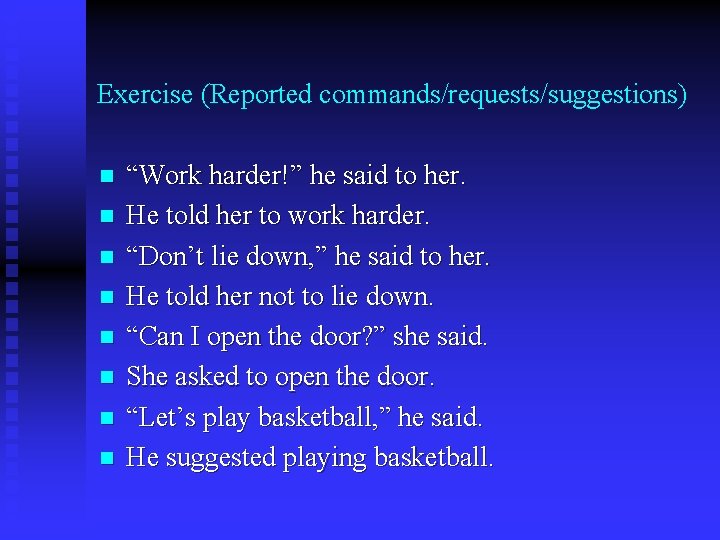
Exercise (Reported commands/requests/suggestions) n n n n “Work harder!” he said to her. He told her to work harder. “Don’t lie down, ” he said to her. He told her not to lie down. “Can I open the door? ” she said. She asked to open the door. “Let’s play basketball, ” he said. He suggested playing basketball.