
Reported speech February 25 th March 4 th
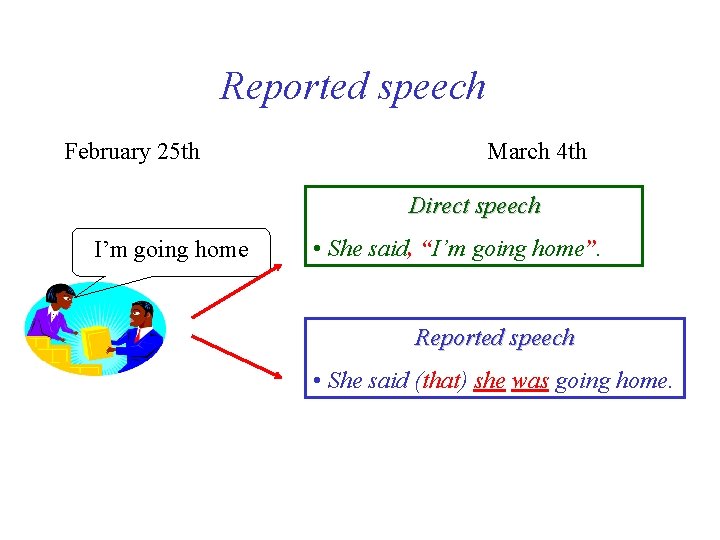
Reported speech February 25 th March 4 th Direct speech I’m going home • She said, “I’m going home”. Reported speech • She said (that) she was going home.
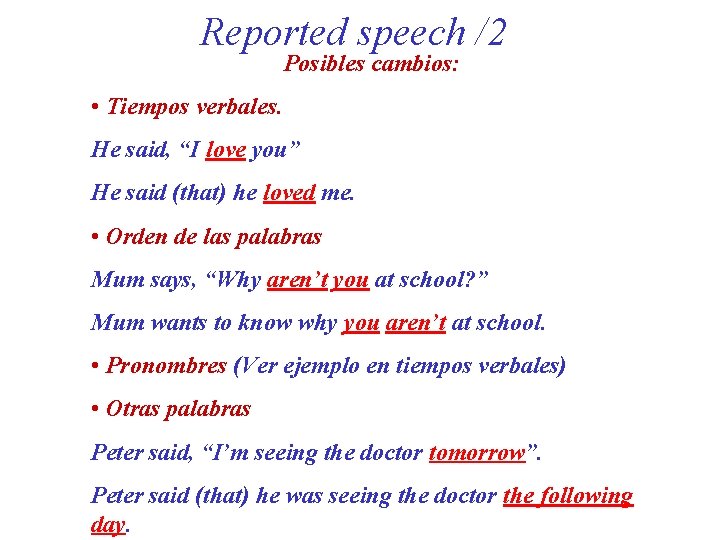
Reported speech /2 Posibles cambios: • Tiempos verbales. He said, “I love you” He said (that) he loved me. • Orden de las palabras Mum says, “Why aren’t you at school? ” Mum wants to know why you aren’t at school. • Pronombres (Ver ejemplo en tiempos verbales) • Otras palabras Peter said, “I’m seeing the doctor tomorrow”. Peter said (that) he was seeing the doctor the following day.
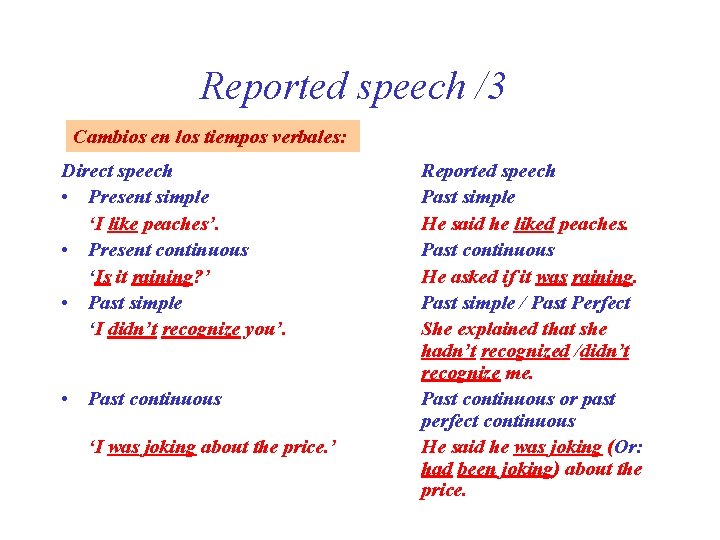
Reported speech /3 Cambios en los tiempos verbales: Direct speech • Present simple ‘I like peaches’. • Present continuous ‘Is it raining? ’ • Past simple ‘I didn’t recognize you’. • Past continuous ‘I was joking about the price. ’ Reported speech Past simple He said he liked peaches. Past continuous He asked if it was raining. Past simple / Past Perfect She explained that she hadn’t recognized /didn’t recognize me. Past continuous or past perfect continuous He said he was joking (Or: had been joking) about the price.
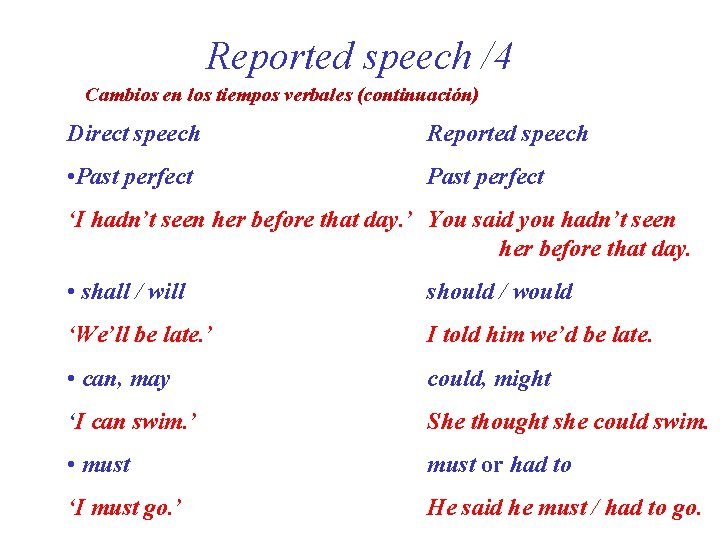
Reported speech /4 Cambios en los tiempos verbales (continuación) Direct speech Reported speech • Past perfect ‘I hadn’t seen her before that day. ’ You said you hadn’t seen her before that day. • shall / will should / would ‘We’ll be late. ’ I told him we’d be late. • can, may could, might ‘I can swim. ’ She thought she could swim. • must or had to ‘I must go. ’ He said he must / had to go.
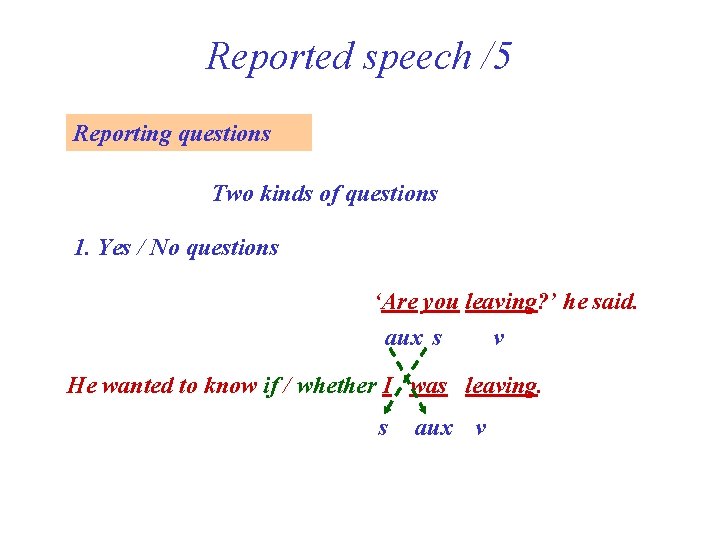
Reported speech /5 Reporting questions Two kinds of questions 1. Yes / No questions ‘Are you leaving? ’ he said. aux s v He wanted to know if / whether I was leaving. s aux v
QUESTIONS IN INDIRECT SPEECH • Tenses, pronouns and possessive adjectives, and adverbs of time and place change like in statements. • The interrogative form of the verb changes to the affirmative form. The question mark (? ) is therefore omitted in indirect questions. • If the introductory verb is “say”, it must be changed to a verb of inquiry, e. g. Ask, inquire, wonder, want to know etc.
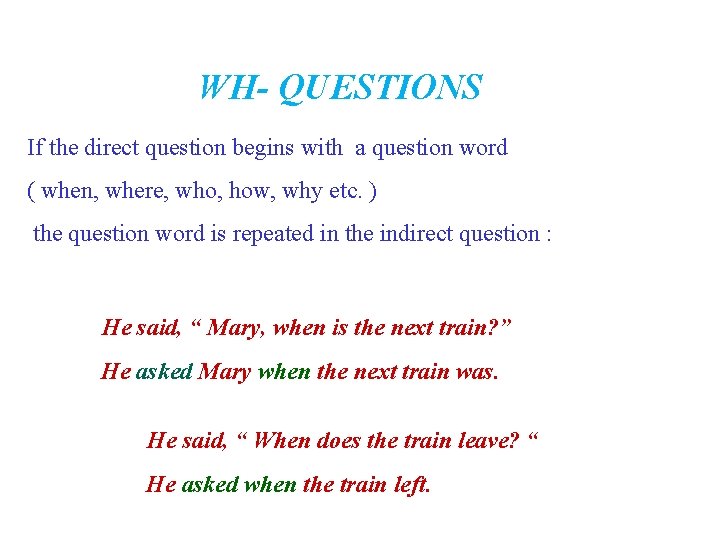
WH- QUESTIONS If the direct question begins with a question word ( when, where, who, how, why etc. ) the question word is repeated in the indirect question : He said, “ Mary, when is the next train? ” He asked Mary when the next train was. He said, “ When does the train leave? “ He asked when the train left.
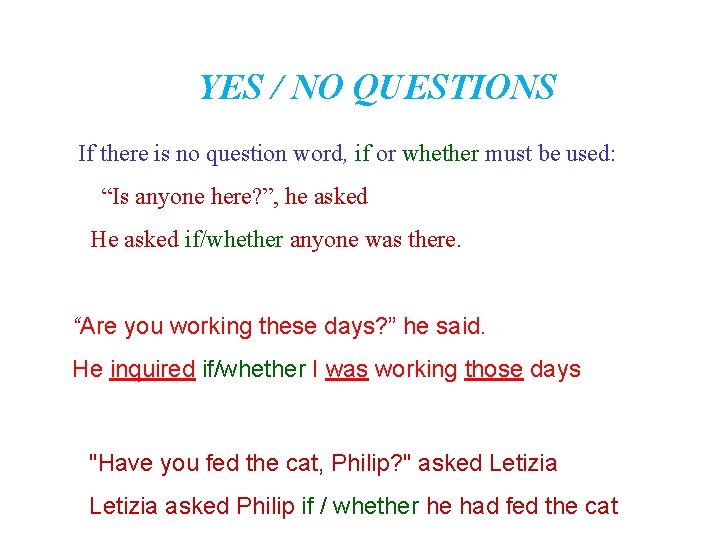
YES / NO QUESTIONS If there is no question word, if or whether must be used: “Is anyone here? ”, he asked He asked if/whether anyone was there. “Are you working these days? ” he said. He inquired if/whether I was working those days "Have you fed the cat, Philip? " asked Letizia asked Philip if / whether he had fed the cat
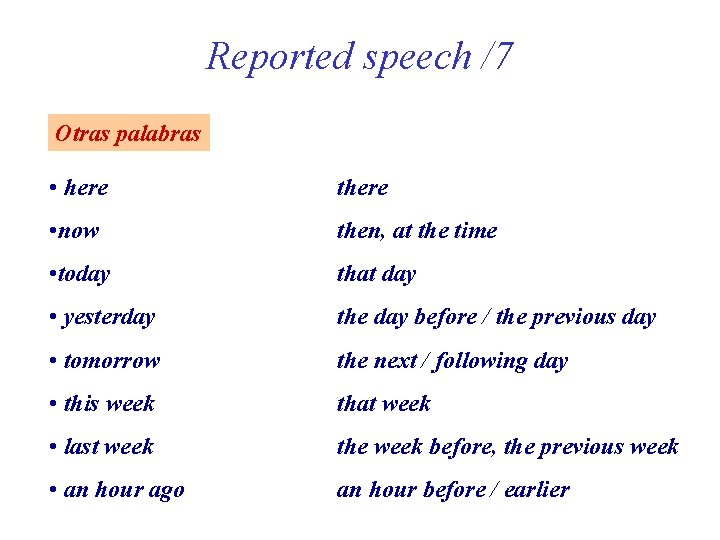
Reported speech /7 Otras palabras • here there • now then, at the time • today that day • yesterday the day before / the previous day • tomorrow the next / following day • this week that week • last week the week before, the previous week • an hour ago an hour before / earlier
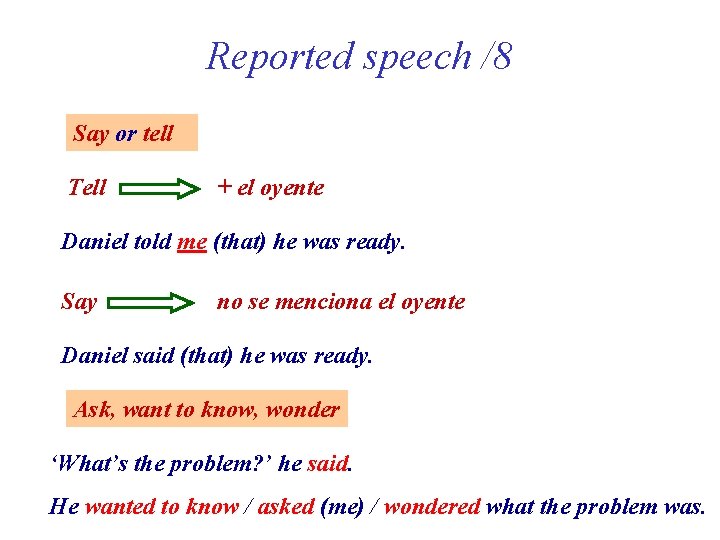
Reported speech /8 Say or tell Tell + el oyente Daniel told me (that) he was ready. Say no se menciona el oyente Daniel said (that) he was ready. Ask, want to know, wonder ‘What’s the problem? ’ he said. He wanted to know / asked (me) / wondered what the problem was.
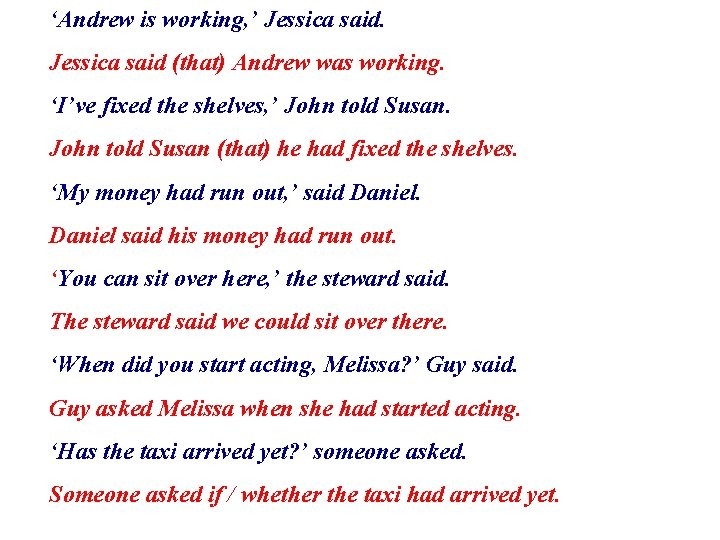
‘Andrew is working, ’ Jessica said (that) Andrew was working. ‘I’ve fixed the shelves, ’ John told Susan (that) he had fixed the shelves. ‘My money had run out, ’ said Daniel said his money had run out. ‘You can sit over here, ’ the steward said. The steward said we could sit over there. ‘When did you start acting, Melissa? ’ Guy said. Guy asked Melissa when she had started acting. ‘Has the taxi arrived yet? ’ someone asked. Someone asked if / whether the taxi had arrived yet.
- Slides: 11