
Report writing What is a report A well
- Slides: 13
Report writing
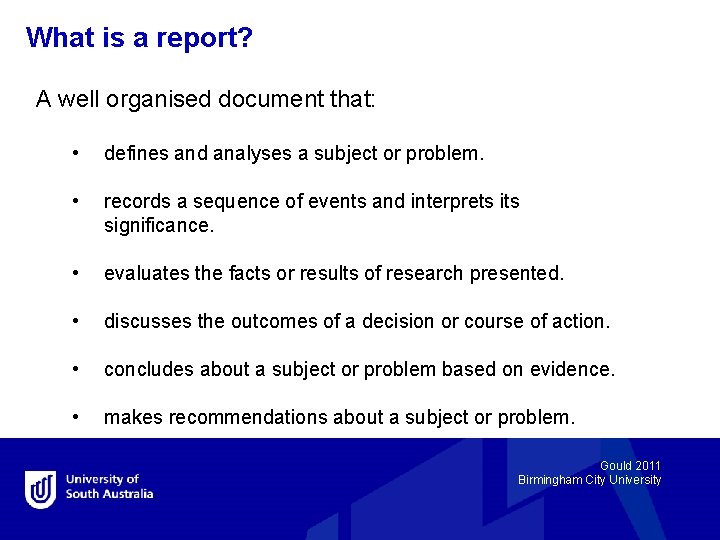
What is a report? A well organised document that: • defines and analyses a subject or problem. • records a sequence of events and interprets its significance. • evaluates the facts or results of research presented. • discusses the outcomes of a decision or course of action. • concludes about a subject or problem based on evidence. • makes recommendations about a subject or problem. Gould 2011 Birmingham City University
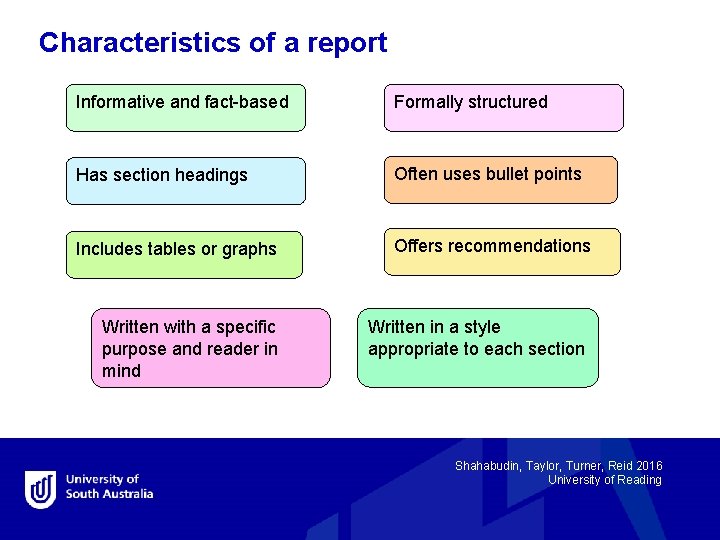
Characteristics of a report Informative and fact-based Formally structured Has section headings Often uses bullet points Includes tables or graphs Offers recommendations Written with a specific purpose and reader in mind Written in a style appropriate to each section Shahabudin, Taylor, Turner, Reid 2016 University of Reading
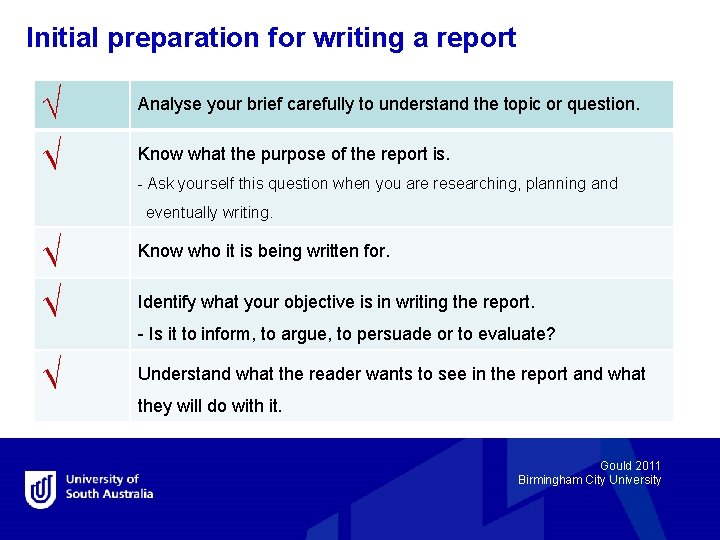
Initial preparation for writing a report √ √ Analyse your brief carefully to understand the topic or question. Know what the purpose of the report is. - Ask yourself this question when you are researching, planning and eventually writing. √ √ Know who it is being written for. √ Understand what the reader wants to see in the report and what Identify what your objective is in writing the report. - Is it to inform, to argue, to persuade or to evaluate? they will do with it. Gould 2011 Birmingham City University
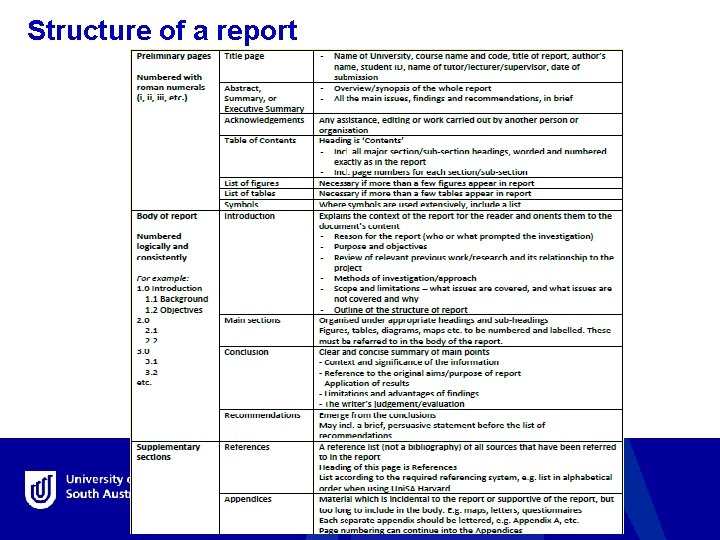
Structure of a report
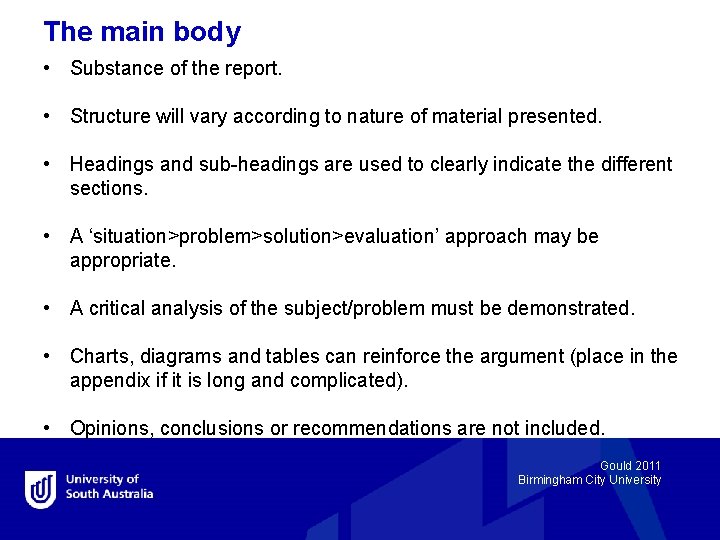
The main body • Substance of the report. • Structure will vary according to nature of material presented. • Headings and sub-headings are used to clearly indicate the different sections. • A ‘situation>problem>solution>evaluation’ approach may be appropriate. • A critical analysis of the subject/problem must be demonstrated. • Charts, diagrams and tables can reinforce the argument (place in the appendix if it is long and complicated). • Opinions, conclusions or recommendations are not included. Gould 2011 Birmingham City University
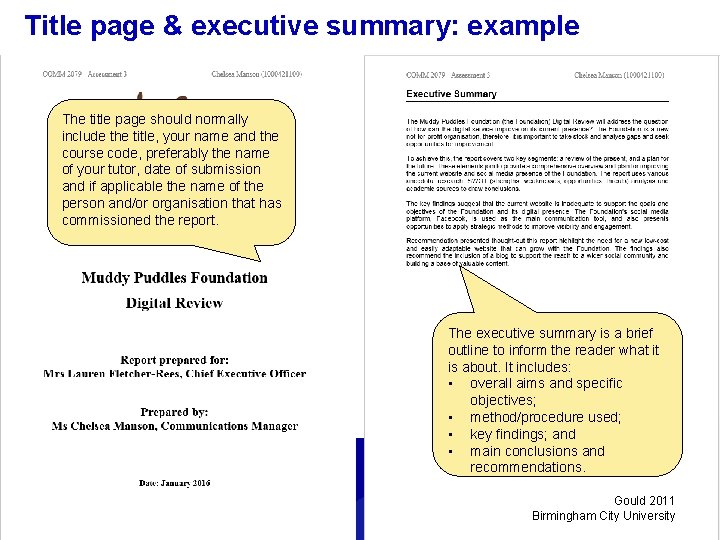
Title page & executive summary: example The title page should normally include the title, your name and the course code, preferably the name of your tutor, date of submission and if applicable the name of the person and/or organisation that has commissioned the report. The executive summary is a brief outline to inform the reader what it is about. It includes: • overall aims and specific objectives; • method/procedure used; • key findings; and • main conclusions and recommendations. Gould 2011 Birmingham City University
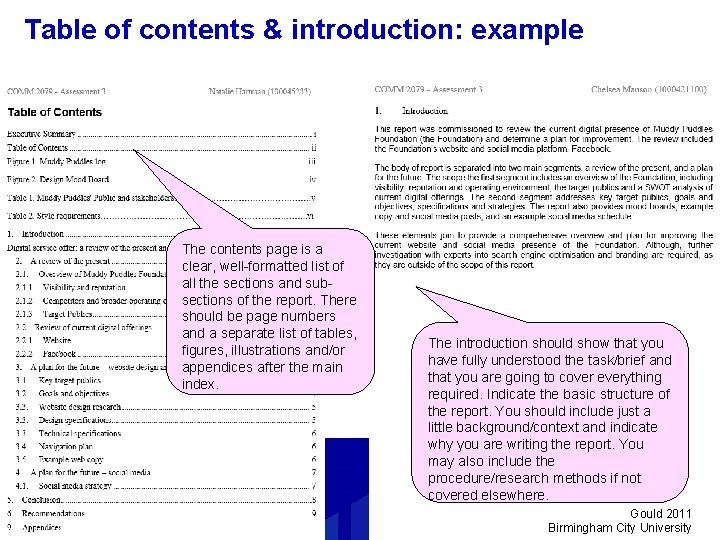
Table of contents & introduction: example The contents page is a clear, well-formatted list of all the sections and subsections of the report. There should be page numbers and a separate list of tables, figures, illustrations and/or appendices after the main index. The introduction should show that you have fully understood the task/brief and that you are going to cover everything required. Indicate the basic structure of the report. You should include just a little background/context and indicate why you are writing the report. You may also include the procedure/research methods if not covered elsewhere. Gould 2011 Birmingham City University
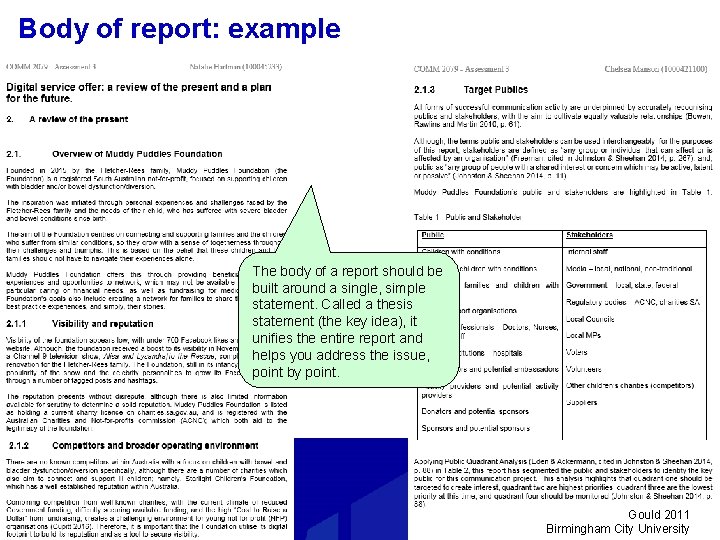
Body of report: example The body of a report should be built around a single, simple statement. Called a thesis statement (the key idea), it unifies the entire report and helps you address the issue, point by point. Gould 2011 Birmingham City University
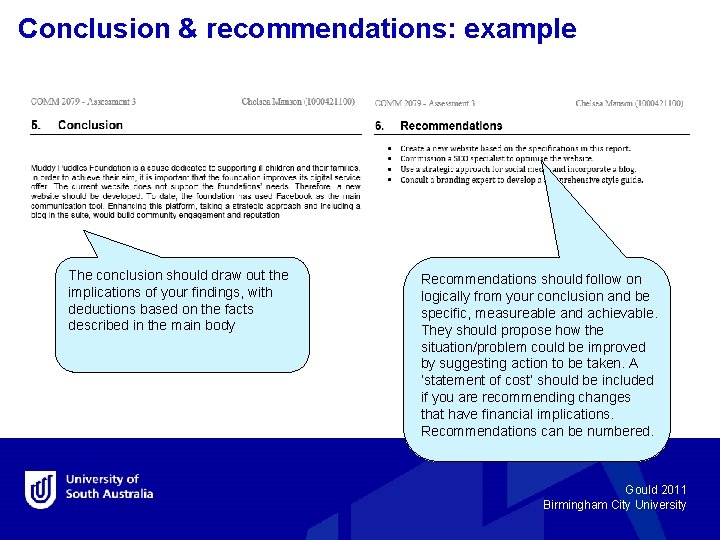
Conclusion & recommendations: example The conclusion should draw out the implications of your findings, with deductions based on the facts described in the main body Recommendations should follow on logically from your conclusion and be specific, measureable and achievable. They should propose how the situation/problem could be improved by suggesting action to be taken. A ‘statement of cost’ should be included if you are recommending changes that have financial implications. Recommendations can be numbered. Gould 2011 Birmingham City University
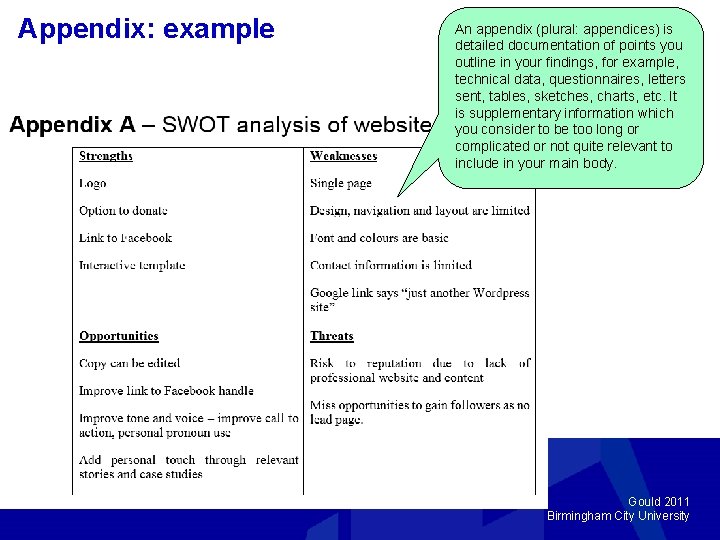
Appendix: example An appendix (plural: appendices) is detailed documentation of points you outline in your findings, for example, technical data, questionnaires, letters sent, tables, sketches, charts, etc. It is supplementary information which you consider to be too long or complicated or not quite relevant to include in your main body. Gould 2011 Birmingham City University
Style • Use clear, concise and formal language. • Develop each paragraph sufficiently. • Avoid using impersonal (I, my, we, etc. ) language • Avoid using colloquial language or slang (go bananas, wanna, etc. ). • Use passive verbs (this phenomenon was examined). • Use connecting words where appropriate to make to writing clear. • Check your grammar and spelling. Gould 2011 Birmingham City University
References Gould, S 2011, ‘How to write a report’, Birmingham City University, viewed 12 November 2016, <http: //library. bcu. ac. uk/learner/writingguides/1. 02%20 Reports. htm> Newsom, D & Haynes, J 2014, Public relations writing: form and style, 10 th edn, Wadsworth Cengage Learning, Boston, Massachusetts. Shahabudin, K, Taylor, A, Turner, J & Reid, M 2016, ‘Features of good reports’, viewed 12 November 2016, http: //libguides. reading. ac. uk/reports Additional resources for report writing: Reports: https: //lo. unisa. edu. au/mod/resource/view. php? id=1156844 Technical writing: Features and conventions: https: //lo. unisa. edu. au/mod/resource/view. php? id=1156845