
REPORT WRITING Key Skills Communication Level 3 Aims
- Slides: 33
REPORT WRITING Key Skills Communication Level 3
Aims n By the end of this session, students will be able to: n Recognise the process involved in producing a report.
WHY WRITE A REPORT? n A report is a piece of structured writing produced after investigation and thought. n It is written for a particular person or group.
WRITING A REPORT A report is based upon: FACT AND DESCRIPTION But may also contain OPINION AND RECOMMENDATIONS
STYLE/LANGUAGE n Styles of reports can vary quite a lot. At one end of the scale there are elaborate, complicated ones like those produced by Government committees and at the other end are those drawn up by someone as part of their job or by community groups to raise a particular issue.
n We are going to look at a conventional report n This can then be adapted to suit the needs of your own report writing task.
What we are going to look at n The areas covered are: n Gathering/Researching Information n Layout n Brainstorming n Using headings n Organising Information n Example of a completed Report n Proofreading, editing and re-drafting
GATHERING/RESEARCHING INFORMATION n Before you write your report you will need to make sure you have all the relevant information. There are various ways of doing this: n Using the Internet n Using non ICT sources such as books, journals, magazine articles n Asking questions/using a questionnaire
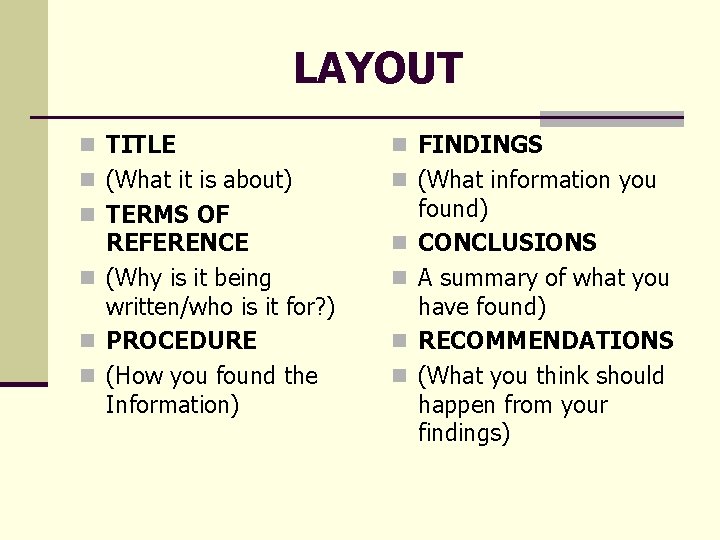
LAYOUT n TITLE n FINDINGS n (What it is about) n (What information you n TERMS OF REFERENCE n (Why is it being written/who is it for? ) n PROCEDURE n (How you found the Information) n n found) CONCLUSIONS A summary of what you have found) RECOMMENDATIONS (What you think should happen from your findings)
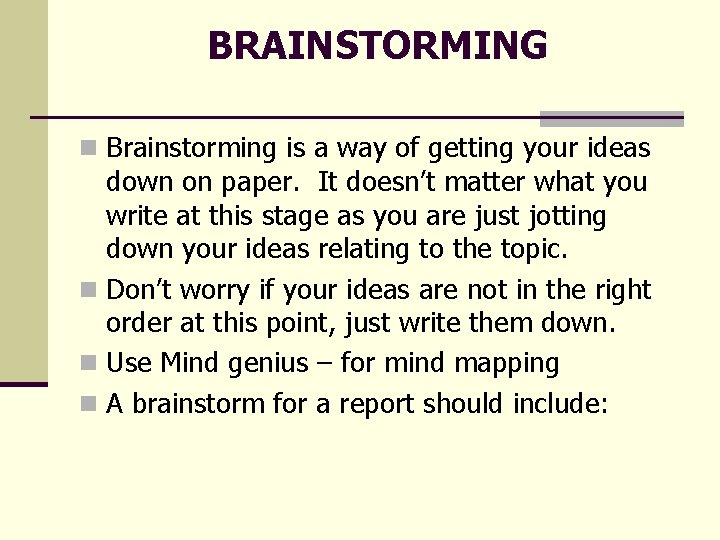
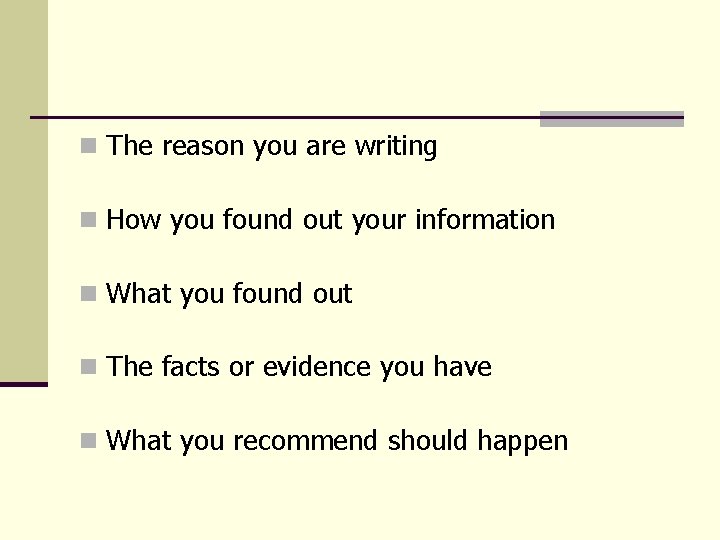
BRAINSTORMING n Brainstorming is a way of getting your ideas down on paper. It doesn’t matter what you write at this stage as you are just jotting down your ideas relating to the topic. n Don’t worry if your ideas are not in the right order at this point, just write them down. n Use Mind genius – for mind mapping n A brainstorm for a report should include:
n The reason you are writing n How you found out your information n What you found out n The facts or evidence you have n What you recommend should happen
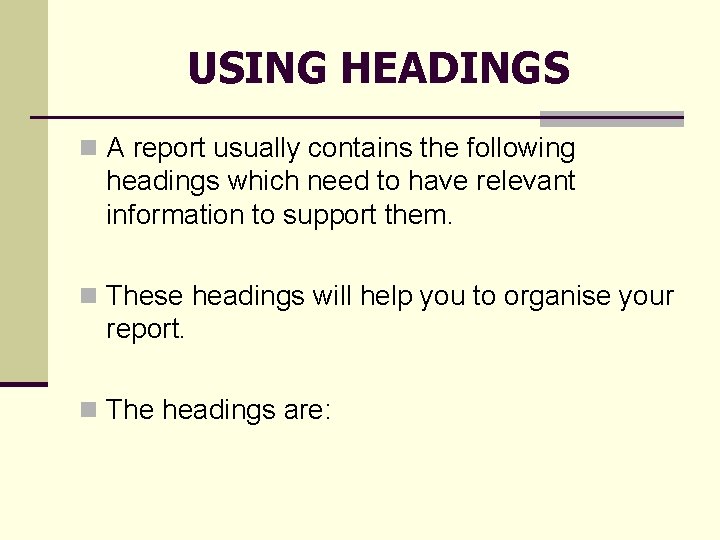
USING HEADINGS n A report usually contains the following headings which need to have relevant information to support them. n These headings will help you to organise your report. n The headings are:
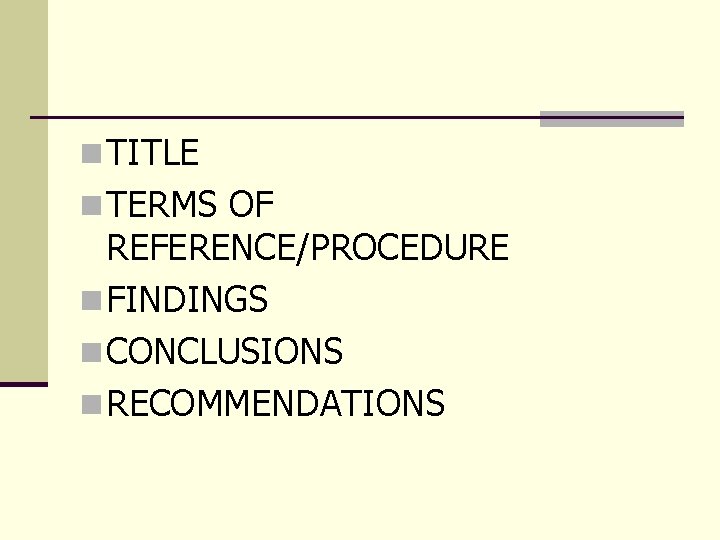
n TITLE n TERMS OF REFERENCE/PROCEDURE n FINDINGS n CONCLUSIONS n RECOMMENDATIONS
ORGANISING INFORMATION n Now you will have to think about the order of your information. n You will need to decide what information you want to put under each heading. n The order or sequence of your report will always be the same. n It will just be the information that changes. n A report will contain:
A TITLE n The first thing you need to give the report is a title. This is a brief statement of what the report is about. n Usually the report will start: n A Report on…… (whatever subject your report is on)
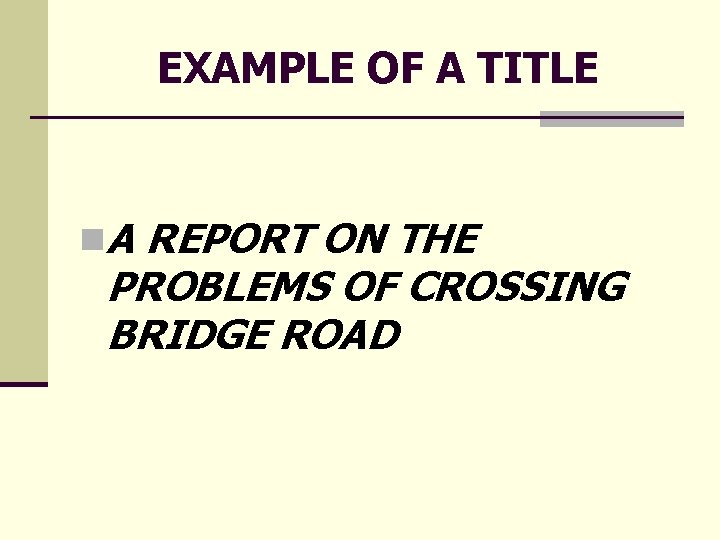
EXAMPLE OF A TITLE n. A REPORT ON THE PROBLEMS OF CROSSING BRIDGE ROAD
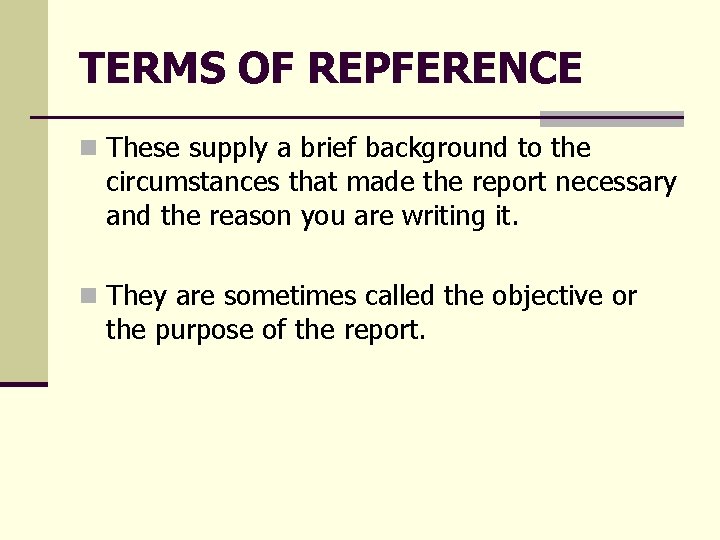
TERMS OF REPFERENCE n These supply a brief background to the circumstances that made the report necessary and the reason you are writing it. n They are sometimes called the objective or the purpose of the report.
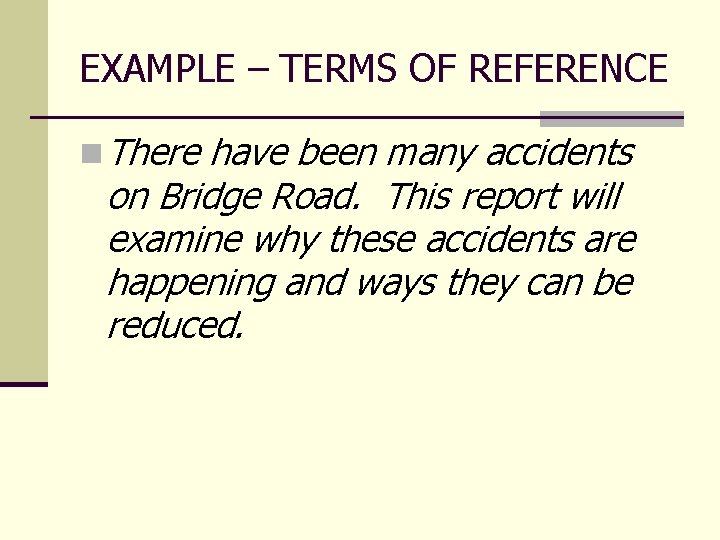
EXAMPLE – TERMS OF REFERENCE n There have been many accidents on Bridge Road. This report will examine why these accidents are happening and ways they can be reduced.
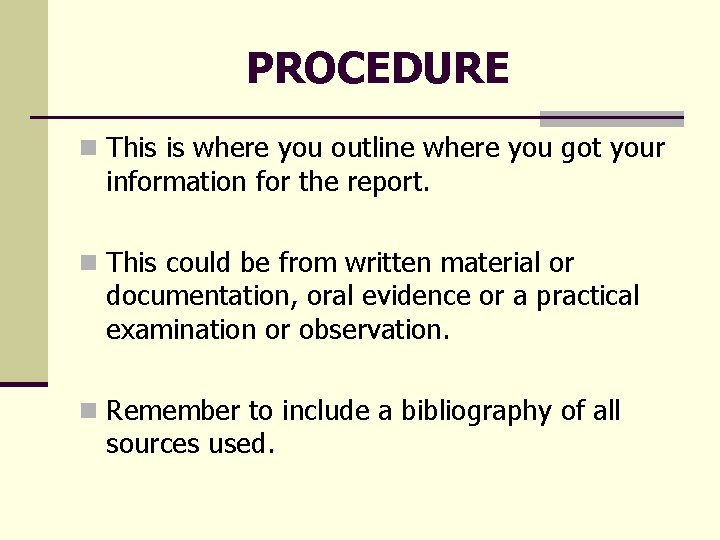
PROCEDURE n This is where you outline where you got your information for the report. n This could be from written material or documentation, oral evidence or a practical examination or observation. n Remember to include a bibliography of all sources used.
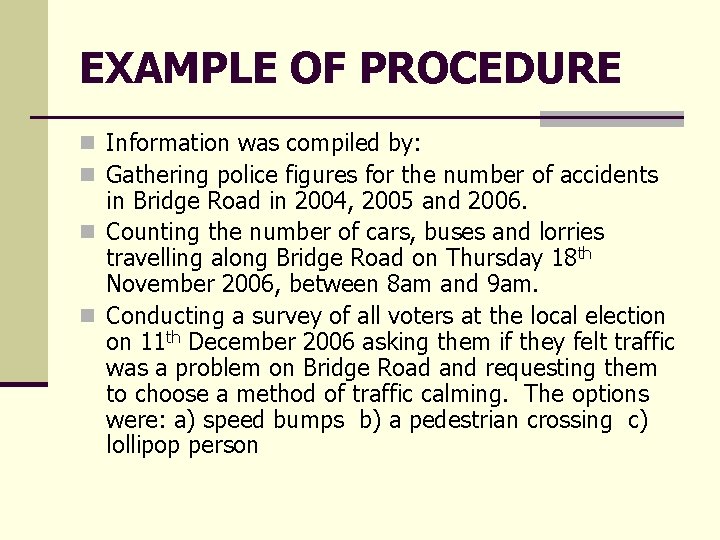
EXAMPLE OF PROCEDURE n Information was compiled by: n Gathering police figures for the number of accidents in Bridge Road in 2004, 2005 and 2006. n Counting the number of cars, buses and lorries travelling along Bridge Road on Thursday 18 th November 2006, between 8 am and 9 am. n Conducting a survey of all voters at the local election on 11 th December 2006 asking them if they felt traffic was a problem on Bridge Road and requesting them to choose a method of traffic calming. The options were: a) speed bumps b) a pedestrian crossing c) lollipop person
FINDINGS n This is where you outline the facts or evidence you have found. Facts must be presented in an ordered, logical way. n Only include relevant material – the facts that the reader needs to know and the things that will support your opinions and recommendations.
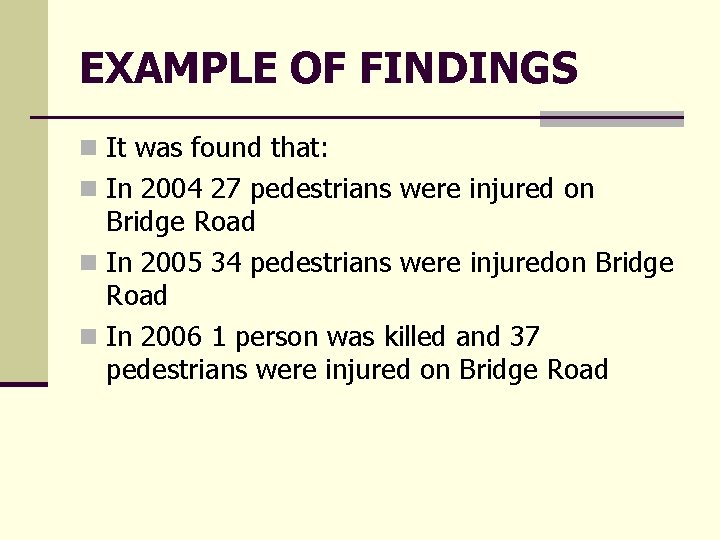
EXAMPLE OF FINDINGS n It was found that: n In 2004 27 pedestrians were injured on Bridge Road n In 2005 34 pedestrians were injuredon Bridge Road n In 2006 1 person was killed and 37 pedestrians were injured on Bridge Road
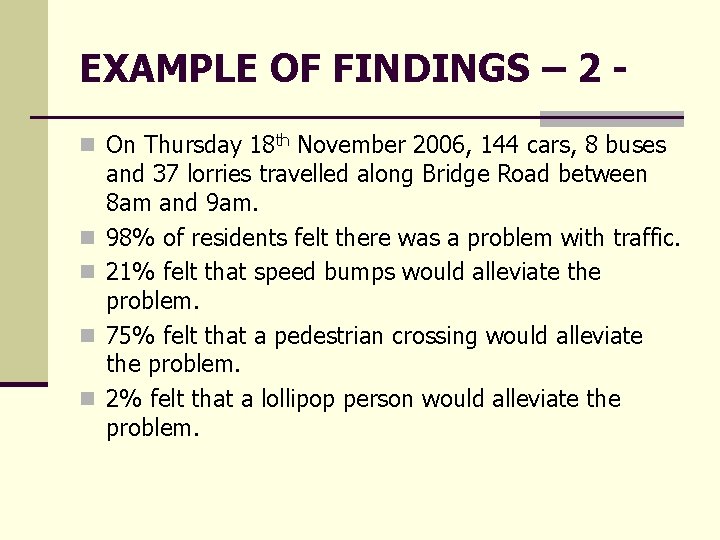
EXAMPLE OF FINDINGS – 2 n On Thursday 18 th November 2006, 144 cars, 8 buses n n and 37 lorries travelled along Bridge Road between 8 am and 9 am. 98% of residents felt there was a problem with traffic. 21% felt that speed bumps would alleviate the problem. 75% felt that a pedestrian crossing would alleviate the problem. 2% felt that a lollipop person would alleviate the problem.
CONCLUSIONS n This should follow logically from the findings. n It should conclude your findings.
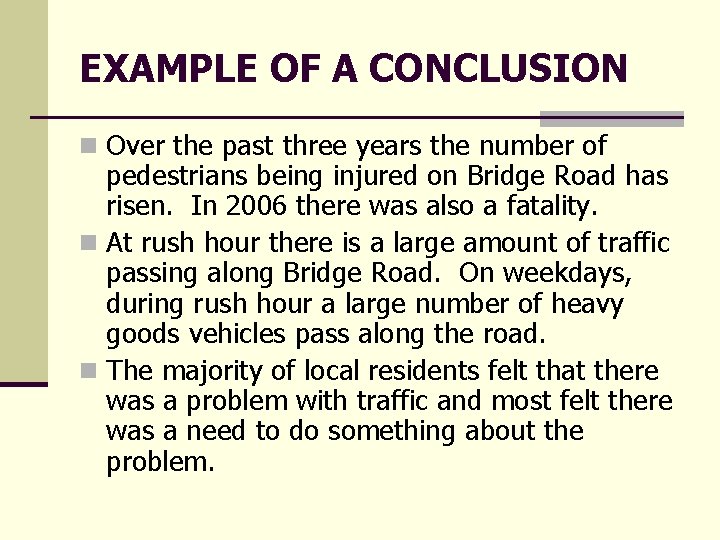
EXAMPLE OF A CONCLUSION n Over the past three years the number of pedestrians being injured on Bridge Road has risen. In 2006 there was also a fatality. n At rush hour there is a large amount of traffic passing along Bridge Road. On weekdays, during rush hour a large number of heavy goods vehicles pass along the road. n The majority of local residents felt that there was a problem with traffic and most felt there was a need to do something about the problem.
RECOMMENDATIONS n It is useful to look back at your Terms of Reference and your Conclusion to help you make practical suggestions or recommendations. n This means you outline what you think would be the best thing to do.
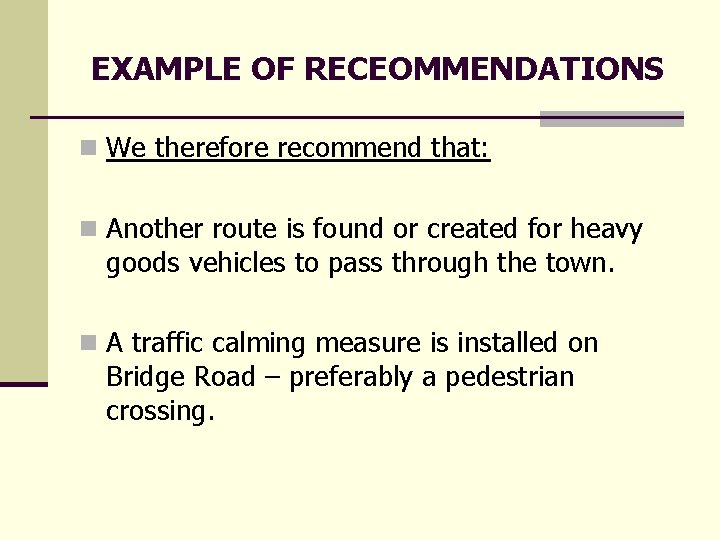
EXAMPLE OF RECEOMMENDATIONS n We therefore recommend that: n Another route is found or created for heavy goods vehicles to pass through the town. n A traffic calming measure is installed on Bridge Road – preferably a pedestrian crossing.
ENDING YOUR REPORT n You should now put: n Your name and/or your organisation’s name n The date
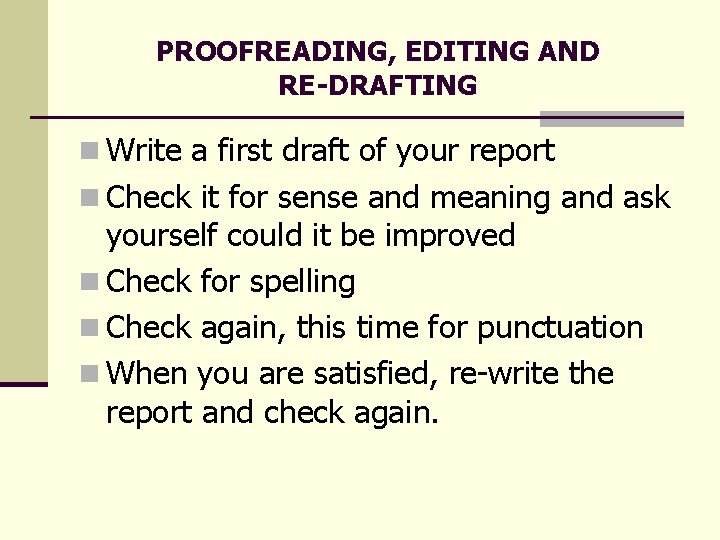
PROOFREADING, EDITING AND RE-DRAFTING n Write a first draft of your report n Check it for sense and meaning and ask yourself could it be improved n Check for spelling n Check again, this time for punctuation n When you are satisfied, re-write the report and check again.
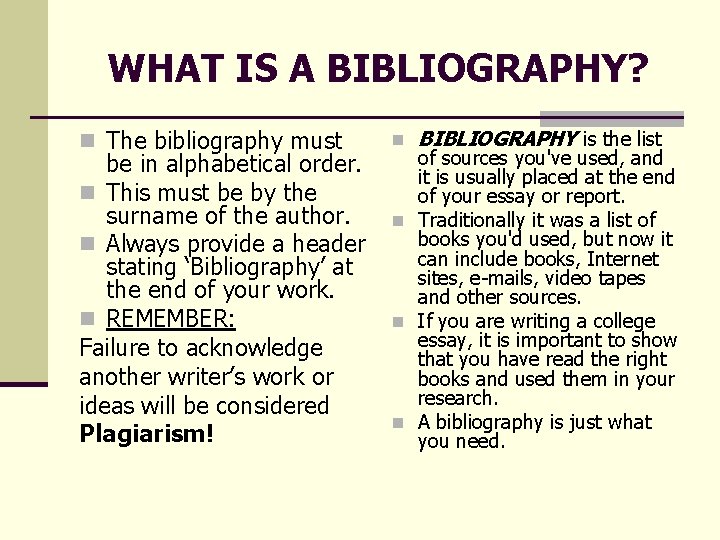
WHAT IS A BIBLIOGRAPHY? n The bibliography must be in alphabetical order. n This must be by the surname of the author. n Always provide a header stating ‘Bibliography’ at the end of your work. n REMEMBER: Failure to acknowledge another writer’s work or ideas will be considered Plagiarism! n BIBLIOGRAPHY is the list of sources you've used, and it is usually placed at the end of your essay or report. n Traditionally it was a list of books you'd used, but now it can include books, Internet sites, e-mails, video tapes and other sources. n If you are writing a college essay, it is important to show that you have read the right books and used them in your research. n A bibliography is just what you need.
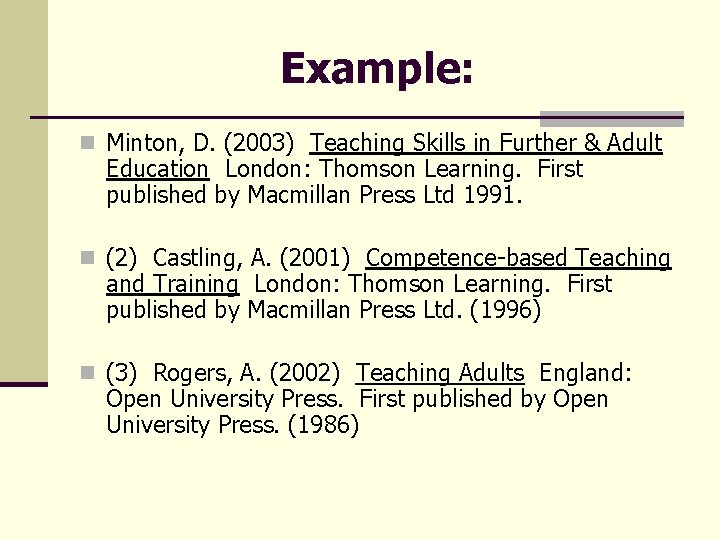
Example: n Minton, D. (2003) Teaching Skills in Further & Adult Education London: Thomson Learning. First published by Macmillan Press Ltd 1991. n (2) Castling, A. (2001) Competence-based Teaching and Training London: Thomson Learning. First published by Macmillan Press Ltd. (1996) n (3) Rogers, A. (2002) Teaching Adults England: Open University Press. First published by Open University Press. (1986)
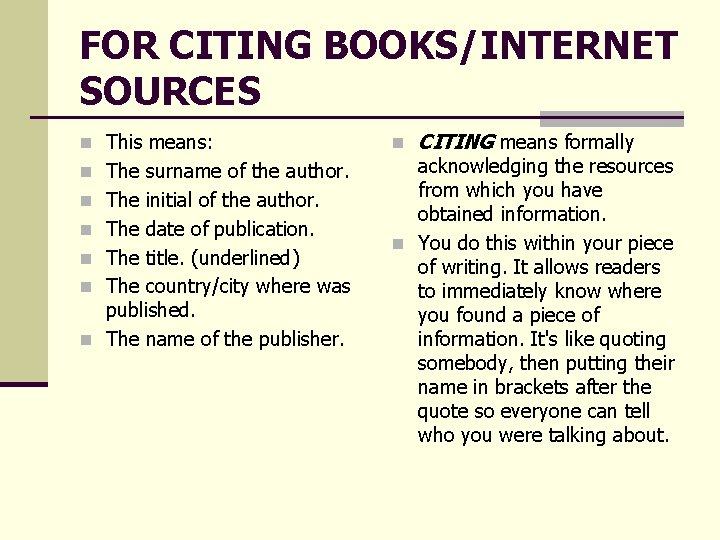
FOR CITING BOOKS/INTERNET SOURCES n This means: n The surname of the author. n The initial of the author. n The date of publication. n The title. (underlined) n The country/city where was published. n The name of the publisher. n CITING means formally acknowledging the resources from which you have obtained information. n You do this within your piece of writing. It allows readers to immediately know where you found a piece of information. It's like quoting somebody, then putting their name in brackets after the quote so everyone can tell who you were talking about.
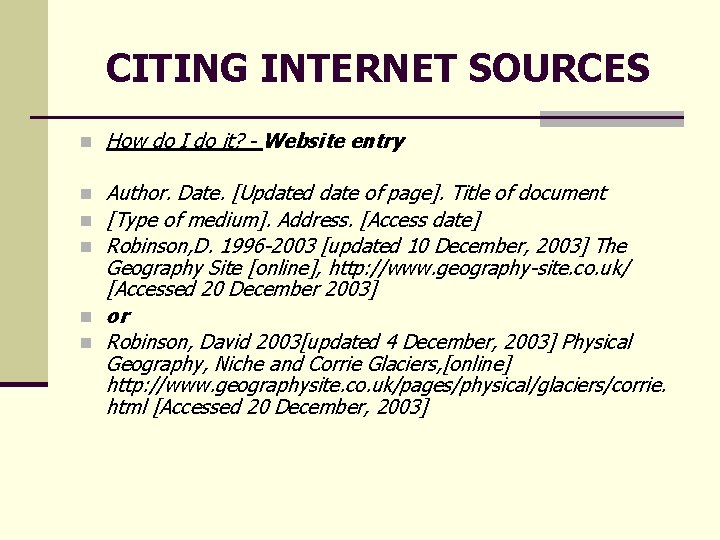
CITING INTERNET SOURCES n How do I do it? - Website entry n Author. Date. [Updated date of page]. Title of document n [Type of medium]. Address. [Access date] n Robinson, D. 1996 -2003 [updated 10 December, 2003] The Geography Site [online], http: //www. geography-site. co. uk/ [Accessed 20 December 2003] n or n Robinson, David 2003[updated 4 December, 2003] Physical Geography, Niche and Corrie Glaciers, [online] http: //www. geographysite. co. uk/pages/physical/glaciers/corrie. html [Accessed 20 December, 2003]