
Report writing Introduction A report is a communication

- Slides: 8
Report writing
Introduction §A report is a communication or advice, from a person who has collected and studied the facts, to a person who has asked for the report because they need it for a specific purpose. §According to C. A Brown, a report is a communication from someone who has some information to someone who wants to use that information. §Reporting is an essential part of project management. However the level of detail should be appropriate to the risks associated with the project.
Characteristics of a good report §Completeness §Accuracy §Brevity, yet clarity §Reader orientation §Planned §Simplicity §Objective recommendations
Types of reports §Formal and informal reports: Formal reports are prepared according to an established procedure to a prescribed authority. On the other hand informal reports are the ones that are more of a person to person rather than person to organisation kind of communication. It is usually in the form of a letter or a memorandum. §Informational reports: It entails provisions of all details and facts pertaining to all problem. As the presentation of information is the basic purpose of the report, details are worked out in a systematic and coherent manner. §Summary and detailed reports: Summary report is a report that presents a summary of important parts of the reports. Detailed reports on the other hand is a report in which every transaction or record is listed.
§Schedules report and on-demand report: Schedules report is produced on a specific time schedule for ex. Daily, weekly, monthly etc. on –demand reports are delivered only when needed or requested. §Proposals, progress reports and technical reports: Proposal is a plan for solving a problem; a specific solution for a specific problem. Progress reports generally update the reader on the state of a project so as to enable him to make executive decisions. Technical reports are submitted at the end of a project. These reports are detail rich and evaluative of the project as a whole. §Popular reports: it lay emphasis on simplicity and attractiveness. These reports try to minimize technicalities and are more liberal than the technical reports.
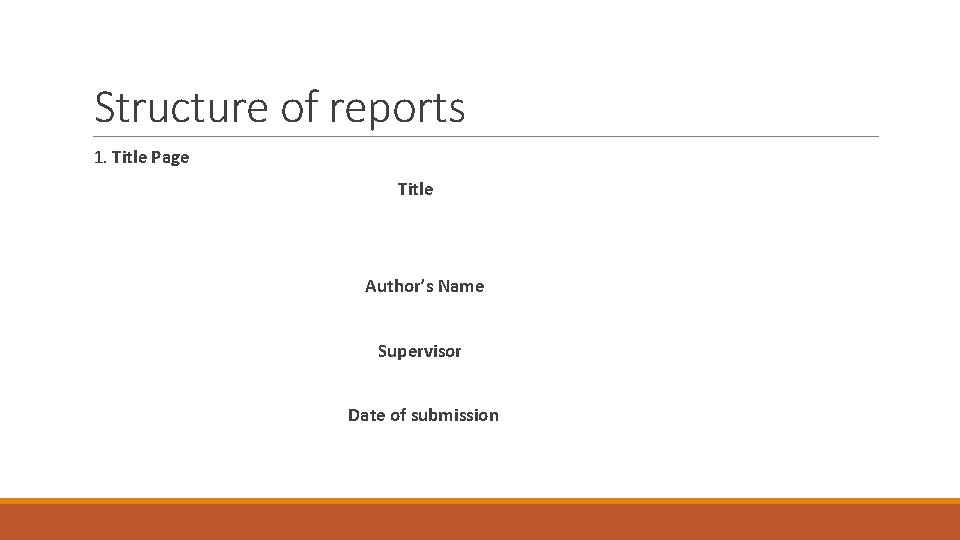
Structure of reports 1. Title Page Title Author’s Name Supervisor Date of submission
2. Acknowledgements: In this part, the person submitting the report acknowledges any help received in collecting the information in the course of preparing the report. 3. Contents: In this section, all the main sections of the report are listed, in sequence with the page numbers they begin on. 4. Abstract or Summary: This shall be a short paragraph presenting the summary of the main contents of the report. It cover main tasks of the report, methodology, conclusion and recommendations. 5. Introduction: It is a clear unambiguous statement of the real subject. It shall clearly state the objectives, define the limits of the report, describe the methods to be used, give a brief background to the subject of the report. 6. Methodology: It states the method by which the study/ project was carried out. It broadly include the form of enquiry, method of data collection, method of presentation etc. 7. Discussion: It analyses and interprets the results drawn from the information collected. 8. Conclusion and Recommendation 9. References: This section gives the notes regarding the work done by other authors and referred to within the report. It shall be in the alphabetical order of the names of the authors.
10. Appendices: It contain additional information related to the report. It is used to present auxiliary figures, tables, equations, explanations, derivations, questionnaires etc. 11. Bibliography: It is a serially numbered list of published and unpublished works which are consulted before or during the preparation of a report. 12. Glossary: It is a list of technical words used in the report and their explanations. If however, the number of such words is small, they are generally explained in the footnotes. 13. Index: It is intended to serve as a quick guide to the material in the report. It enables the reader to locate easily any topic, sub topic or important aspect of the contents.