
Report Writing for Law Enforcement and Corrections Professionals
- Slides: 20
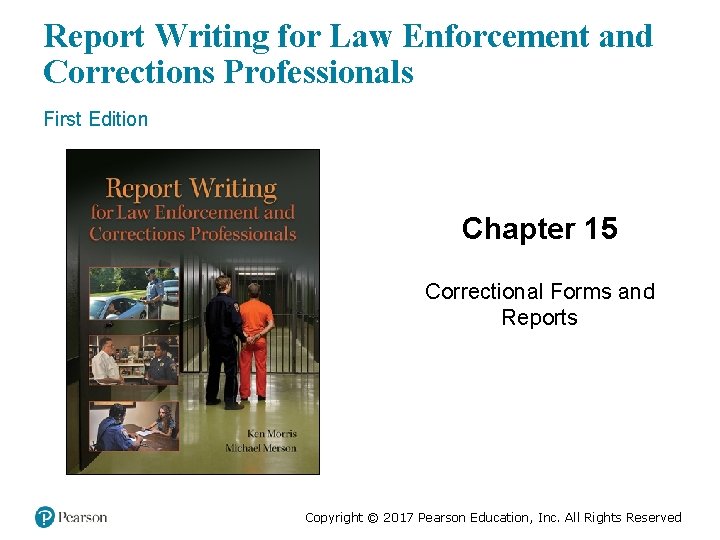
Report Writing for Law Enforcement and Corrections Professionals First Edition Chapter 15 Correctional Forms and Reports Copyright © 2017 Pearson Education, Inc. All Rights Reserved
Introduction • This chapter is intended to acquaint the student with the various forms and procedures in the field of corrections. • The real operational differences of corrections vs. patrol paperwork are minimal. Copyright © 2017 Pearson Education, Inc. All Rights Reserved
Correctional Incident Report (1 of 4) • The incident report is a written narrative that can be applied to a variety of incidents: – Escape attempts – Inmate disciplinary infractions – Hunger strikes – Inmate/staff injuries Copyright © 2017 Pearson Education, Inc. All Rights Reserved
Correctional Incident Report (2 of 4) • The incident report is a written narrative that can be applied to a variety of incidents: – Discovery of contraband – Visitor infractions – Intelligence information – Building maintenance concerns – Damage to jail/prison property • The incident report is the most common form that will be used in any correctional setting. Copyright © 2017 Pearson Education, Inc. All Rights Reserved
Correctional Incident Report (3 of 4) • The incident report serves a variety of purposes: – Use of less-than-lethal devises to control inmates – Discharge of a firearm or other weapon – Use of force to control inmates – Staff or inmate injury – Inmate suicide or suicide attempt Copyright © 2017 Pearson Education, Inc. All Rights Reserved
Correctional Incident Report (4 of 4) • Instead of the elements of a crime, the incident report would document the rule infraction violated. • The same techniques and procedures for the narrative of the law enforcement case report apply to the correctional incident report. • Documenting an incident in a correctional facility is very important, as this report could be used later to charge an inmate for a criminal offense. • Therefore, the incident report must be accurate and free of any grammar, spelling, or word use errors. Copyright © 2017 Pearson Education, Inc. All Rights Reserved
Inmate Disciplinary Form (1 of 3) • For anyone working in a correctional facility, the inmate disciplinary form will probably be the second most common form used on a regular basis. • The inmate disciplinary process is an administrative process, not a judicial process. • The purpose of this administrative process is to secure the good order of the institution. Copyright © 2017 Pearson Education, Inc. All Rights Reserved
Inmate Disciplinary Form (2 of 3) • In all correctional incidents resulting in a request for disciplinary action, documentation must include, but not be limited to, the following information: – Specific institutional rule violated – A formal statement of the charge – Any usual inmate behavior – Any staff witness Copyright © 2017 Pearson Education, Inc. All Rights Reserved
Inmate Disciplinary Form (3 of 3) • An explanation of the events that includes: – People involved and events that transpired – Time and location of the occurrence – Any physical evidence and its disposition – Any immediate actions taken – Staff signature, date, and time of report Copyright © 2017 Pearson Education, Inc. All Rights Reserved
The Pre Sentence Investigation Report (PSI R) (1 of 4) • When an offender is found guilty or pleads guilty to an offense, the court of jurisdiction will usually have a PSIR completed by an officer of the court or a parole officer. • The PSIR is the history of the offender that may be used by the judge in determining whether or not other factors influenced the offender during the commission of the crime. Copyright © 2017 Pearson Education, Inc. All Rights Reserved
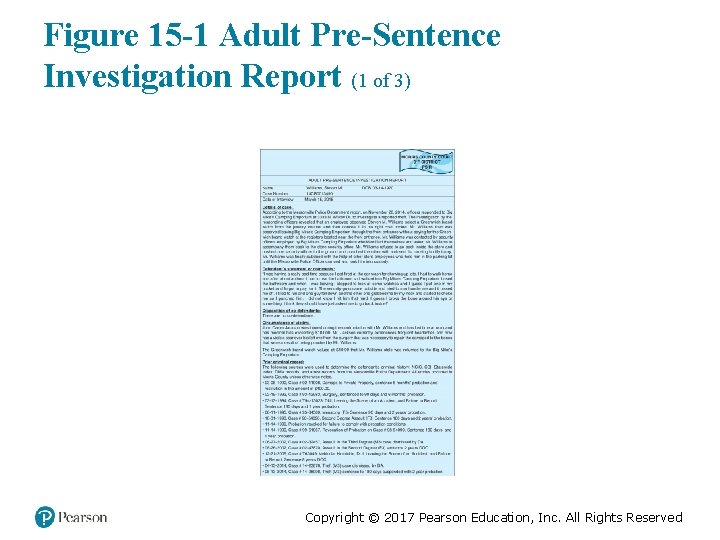
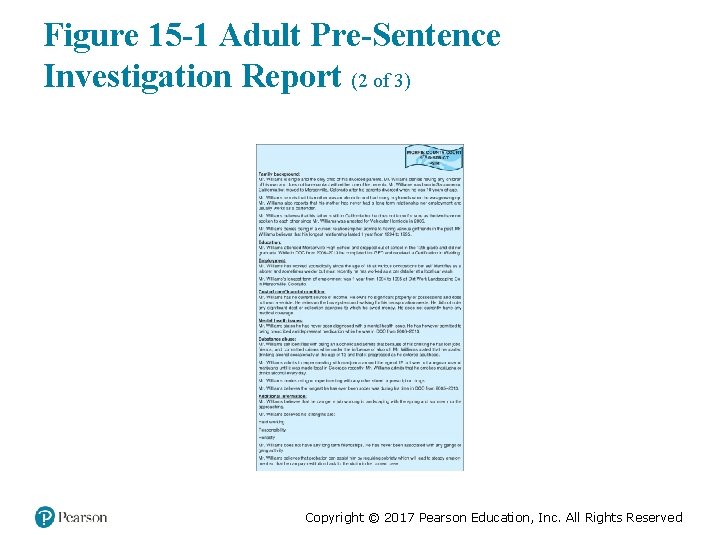
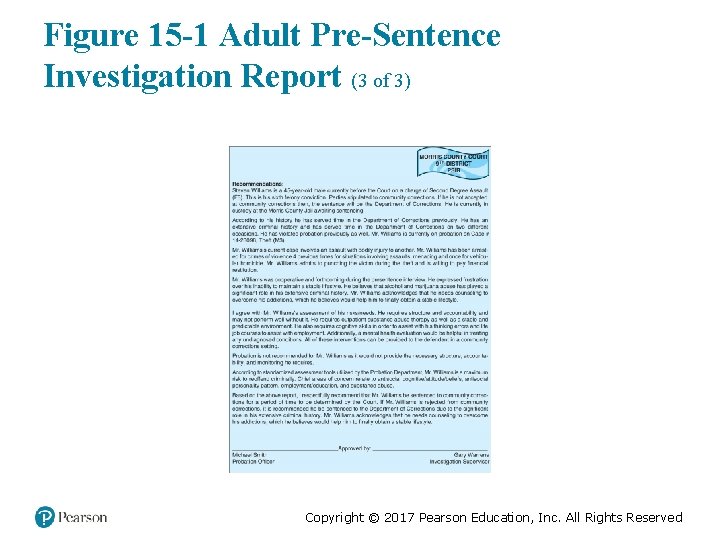
The Pre Sentence Investigation Report (PSI R) (2 of 4) • The PSIR will usually have the following information: – Age – Social information – Personal information – County of conviction – Evaluation of recommendation – Description of the current event Copyright © 2017 Pearson Education, Inc. All Rights Reserved
The Pre Sentence Investigation Report (PSI R) (3 of 4) • The PSIR will usually have the following information: – Criminal history – Summaries of all previous community placements and terminations – Victim impact statements – Initial needs assessments – Level of supervision inventory – Any other documents that may be needed in determining decision Copyright © 2017 Pearson Education, Inc. All Rights Reserved
The Pre Sentence Investigation Report (PSI R) (4 of 4) • Some PSIRs are completed with the help of the original police report. • The case report may be helpful in completing the PSIR, but do not copy and paste it directly from the report into the PSIR without proofreading it for the accuracy. Copyright © 2017 Pearson Education, Inc. All Rights Reserved
Figure 15 -1 Adult Pre-Sentence Investigation Report (1 of 3) Copyright © 2017 Pearson Education, Inc. All Rights Reserved
Figure 15 -1 Adult Pre-Sentence Investigation Report (2 of 3) Copyright © 2017 Pearson Education, Inc. All Rights Reserved
Figure 15 -1 Adult Pre-Sentence Investigation Report (3 of 3) Copyright © 2017 Pearson Education, Inc. All Rights Reserved
The Right Way to Write • Correctional forms and reports are very similar to law enforcement documents. • The same general principles describing law enforcement report writing apply to correctional officers. Copyright © 2017 Pearson Education, Inc. All Rights Reserved
Tips for Correctional Forms (1 of 2) • In most instances, correctional paperwork and forms will resemble law enforcement paperwork and forms. • The same basic principles and writing style presented for law enforcement report writing in this textbook apply to correctional paperwork. Copyright © 2017 Pearson Education, Inc. All Rights Reserved
Tips for Correctional Forms (2 of 2) • Every correctional, probation, or parole agency will have some minor modifications regarding their specific paperwork. • Review and be familiar with your agency’s policy and procedure manual and standard operating procedures regarding all professional written correspondence. • Remember, anything written that involves someone under custodial/correctional care can be subpoenaed into a court of law. Copyright © 2017 Pearson Education, Inc. All Rights Reserved
Copyright © 2017 Pearson Education, Inc. All Rights Reserved