
Report Concept Communication Non written communication Verbal communication
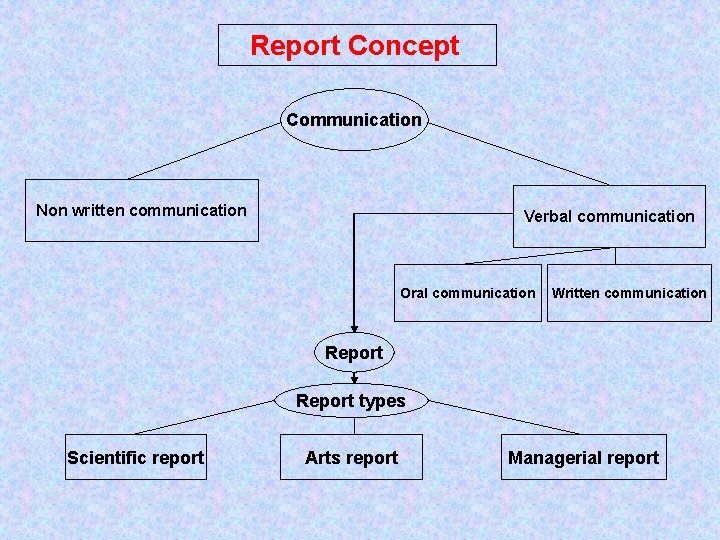
Report Concept Communication Non written communication Verbal communication Oral communication Written communication Report types Scientific report Arts report Managerial report
Elements of Communication in Reports • Diversity of report according to the target and reader. • The report is the media of communication between both writer and reader. • The use of an adequate language in a report by the writer. • The report should always meaningful and deals with a defined problem.
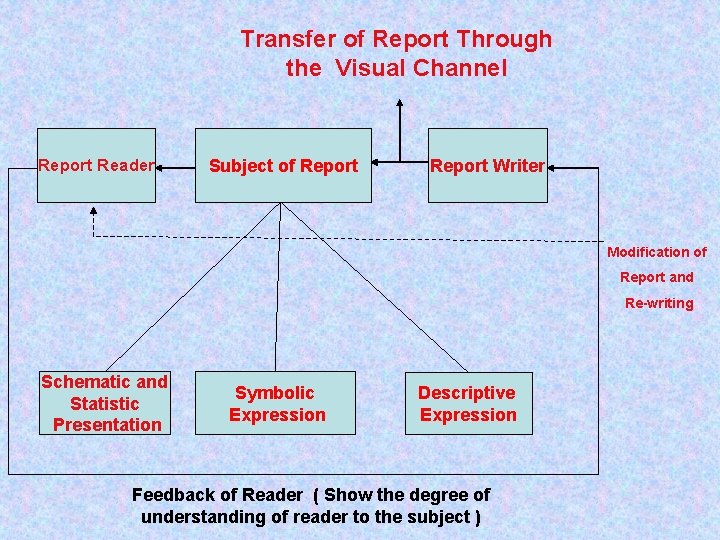
Transfer of Report Through the Visual Channel Report Reader Subject of Report Writer Modification of Report and Re-writing Schematic and Statistic Presentation Symbolic Expression Descriptive Expression Feedback of Reader ( Show the degree of understanding of reader to the subject )
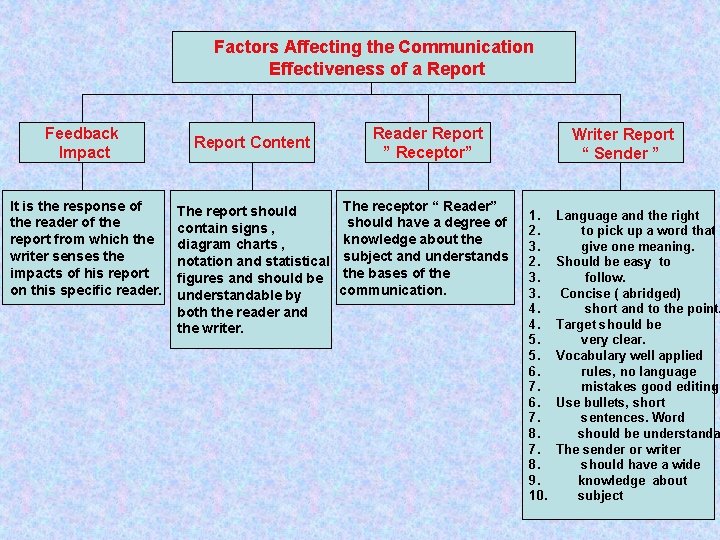
Factors Affecting the Communication Effectiveness of a Report Feedback Impact It is the response of the reader of the report from which the writer senses the impacts of his report on this specific reader. Report Content The report should contain signs , diagram charts , notation and statistical figures and should be understandable by both the reader and the writer. Reader Report ” Receptor” The receptor “ Reader” should have a degree of knowledge about the subject and understands the bases of the communication. Writer Report “ Sender ” 1. 2. 3. 3. 4. 4. 5. 5. 6. 7. 8. 9. 10. Language and the right to pick up a word that give one meaning. Should be easy to follow. Concise ( abridged) short and to the point. Target should be very clear. Vocabulary well applied rules, no language mistakes good editing Use bullets, short sentences. Word should be understanda The sender or writer should have a wide knowledge about subject
IMPORTANCE OF A REPORT -The report will help the "management" to identify how to have an oversight on the premises status it regarded as an important tool of control and follow-up of the actual delivery at the level of -it also helps management evaluation of the magnitude of achievements. -To identify deficiencies and weaknesses. -Helps management to plan objectively. -Helps to connect work of the institution with the external business -Helps to connect business and the activities within the institution or within the branches of the institution.
The Report is a Form of Communication in Either Horizontal or Vertical Levels • It facilitates the flow of plans – decisions – instructions from management levels to executive level. • it facilities the flow of new ideas – proposals – complaints – implementation rates from lower levels to higher ones. • It ease the coordination between different departments in a premises. • A report should help in the transfer of suggestions derived of consultation units in a certain department to the executive management system.
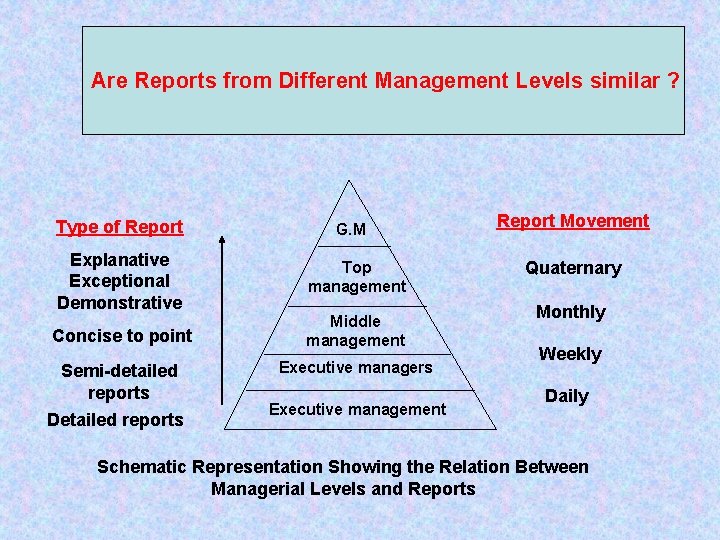
Are Reports from Different Management Levels similar ? Type of Report G. M Explanative Exceptional Demonstrative Top management Concise to point Middle management Semi-detailed reports Detailed reports Executive managers Executive management Report Movement Quaternary Monthly Weekly Daily Schematic Representation Showing the Relation Between Managerial Levels and Reports
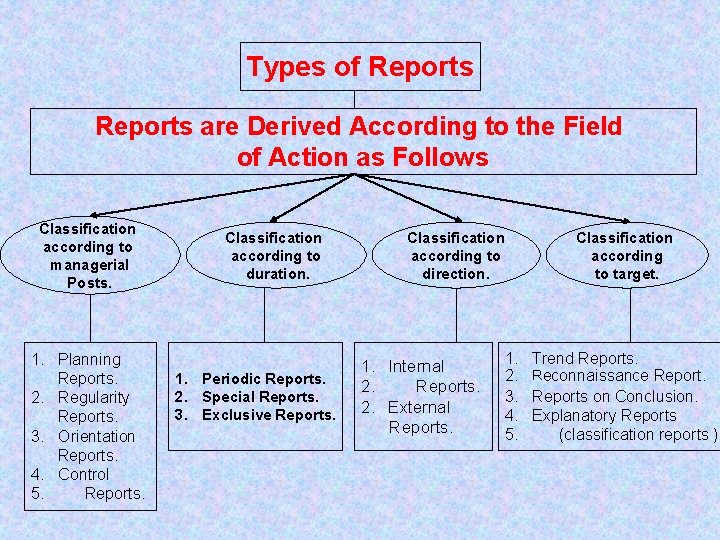
Types of Reports are Derived According to the Field of Action as Follows Classification according to managerial Posts. 1. Planning Reports. 2. Regularity Reports. 3. Orientation Reports. 4. Control 5. Reports. Classification according to duration. 1. Periodic Reports. 2. Special Reports. 3. Exclusive Reports. Classification according to direction. 1. Internal 2. Reports. 2. External Reports. Classification according to target. 1. 2. 3. 4. 5. Trend Reports. Reconnaissance Reports on Conclusion. Explanatory Reports (classification reports ).
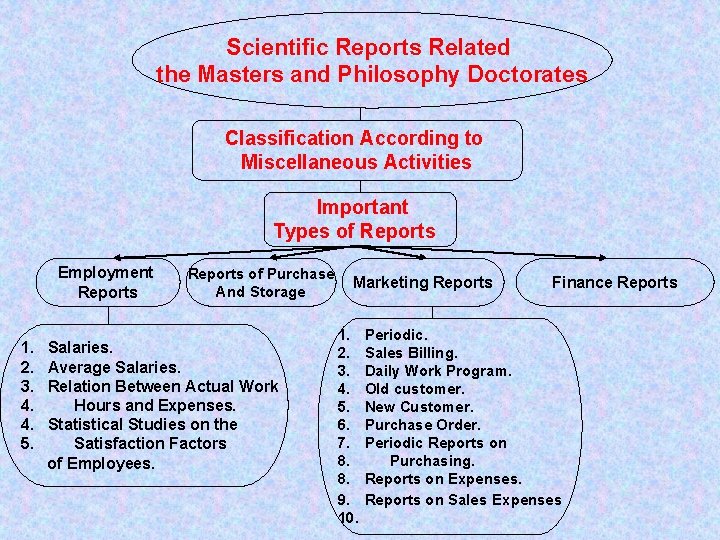
Scientific Reports Related the Masters and Philosophy Doctorates Classification According to Miscellaneous Activities Important Types of Reports Employment Reports 1. 2. 3. 4. 4. 5. Reports of Purchase And Storage Salaries. Average Salaries. Relation Between Actual Work Hours and Expenses. Statistical Studies on the Satisfaction Factors of Employees. Marketing Reports 1. 2. 3. 4. 5. 6. 7. 8. 8. 9. 10. Finance Reports Periodic. Sales Billing. Daily Work Program. Old customer. New Customer. Purchase Order. Periodic Reports on Purchasing. Reports on Expenses. Reports on Sales Expenses
The definition of scientific research 1 -Careful examination of the information or the discovery of new relationships and the growth of current knowledge and verified. 2 -It is the attempt to find solutions for to the problems that affect and worry the human being and the society. 3 -The collection, recording and analysis of data and information and facts about a particular problem and identifying alternative solutions and to selection of the best solution in light of surrounding circumstances. 4 -The definition of scientific research varies according to the types of research domains, and goals and the means and tools and therefore it is preferable not to worry in finding or deducing definitions but one should confine itself on the quality of research and new characteristics.
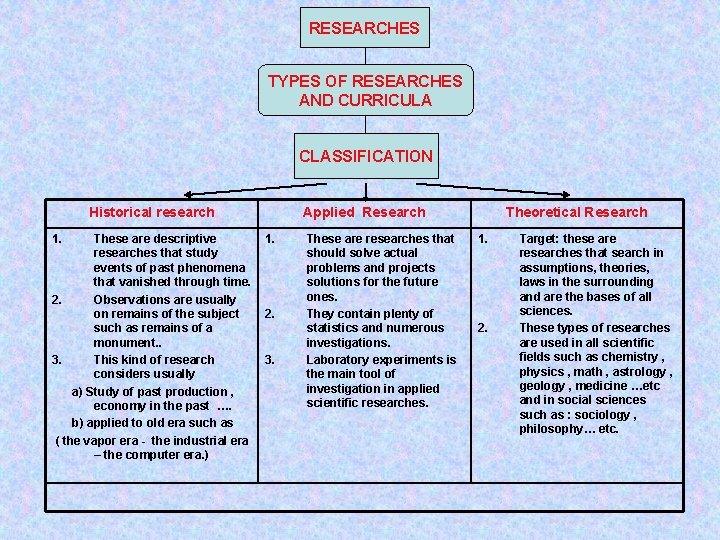
RESEARCHES TYPES OF RESEARCHES AND CURRICULA CLASSIFICATION Historical research 1. These are descriptive researches that study events of past phenomena that vanished through time. 2. Observations are usually on remains of the subject such as remains of a monument. . 3. This kind of research considers usually a) Study of past production , economy in the past …. b) applied to old era such as ( the vapor era - the industrial era – the computer era. ) Applied Research 1. 2. 3. These are researches that should solve actual problems and projects solutions for the future ones. They contain plenty of statistics and numerous investigations. Laboratory experiments is the main tool of investigation in applied scientific researches. Theoretical Research 1. 2. Target: these are researches that search in assumptions, theories, laws in the surrounding and are the bases of all sciences. These types of researches are used in all scientific fields such as chemistry , physics , math , astrology , geology , medicine …etc and in social sciences such as : sociology , philosophy… etc.
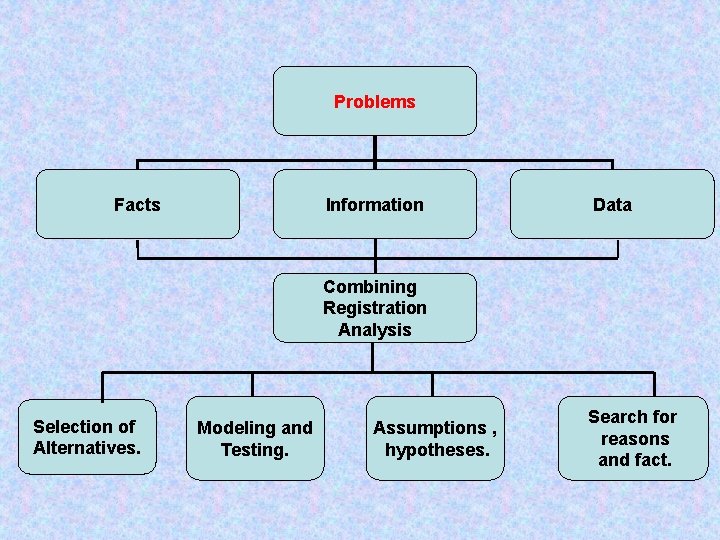
Problems Facts Information Data Combining Registration Analysis Selection of Alternatives. Modeling and Testing. Assumptions , hypotheses. Search for reasons and fact.
The characteristics of scientific research • • Accuracy Objectivity Forecasting The possibility of proofing or verification of the validity of the results • The adequacy of controlling conditions and factors influencing variables in the search and results
The specifications and characteristics of scientific research • The exact diagnosis and the proper description of the situation or problem, then to deduce assumptions and hypotheses to overcome the problem. • The use of scientific methods to test the validity of these assumptions and find solutions to this problem. • To explanation and the justifications (rationale) of the solutions that have been reached to solve the problem using the logic of reason and without prejudice • To prove the validity of these justifications in reaching a solution and, if possible, to develop a model of the problem and to apply the results and examine their validity.
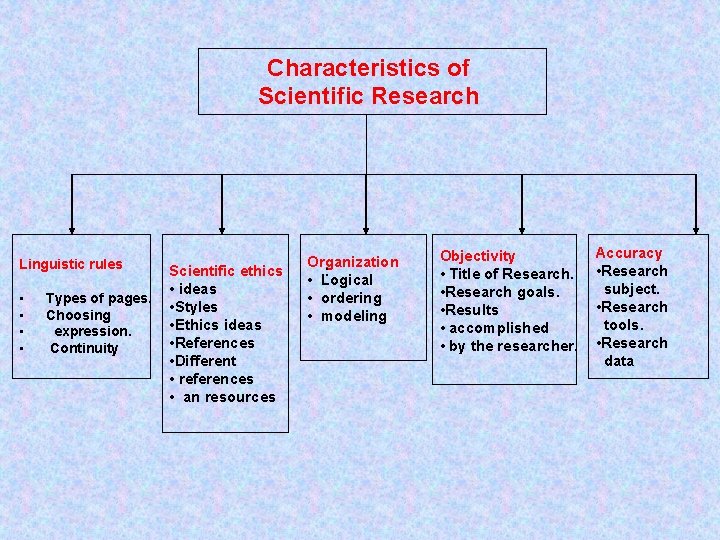
Characteristics of Scientific Research Linguistic rules • • Types of pages. Choosing expression. Continuity Scientific ethics • ideas • Styles • Ethics ideas • References • Different • references • an resources Organization : • Logical • ordering • modeling Objectivity • Title of Research. • Research goals. • Results • accomplished • by the researcher. Accuracy • Research subject. • Research tools. • Research data
The advantages of the scientific method in the search 1 -The prompt investigation behind the real causes of the events and phenomena. 2 -The high accuracy in the collection of information from multiple reliable sources and not to rush into decision making without obtaining reliable and results of well identified sources. 3 -Sufficiency of the evidences to reach decisions or the right solutions, using defined standards, and appropriate and substantive methods for the evaluation of the collected data. 4 - Scientific research relies on the use of experimental tools , modern techniques and statistics for supporting the findings.
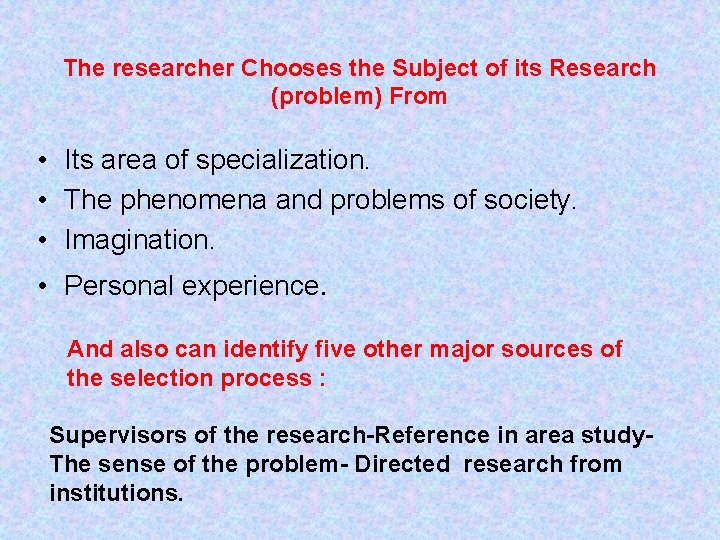
The researcher Chooses the Subject of its Research (problem) From • Its area of specialization. • The phenomena and problems of society. • Imagination. • Personal experience. And also can identify five other major sources of the selection process : Supervisors of the research-Reference in area study. The sense of the problem- Directed research from institutions.
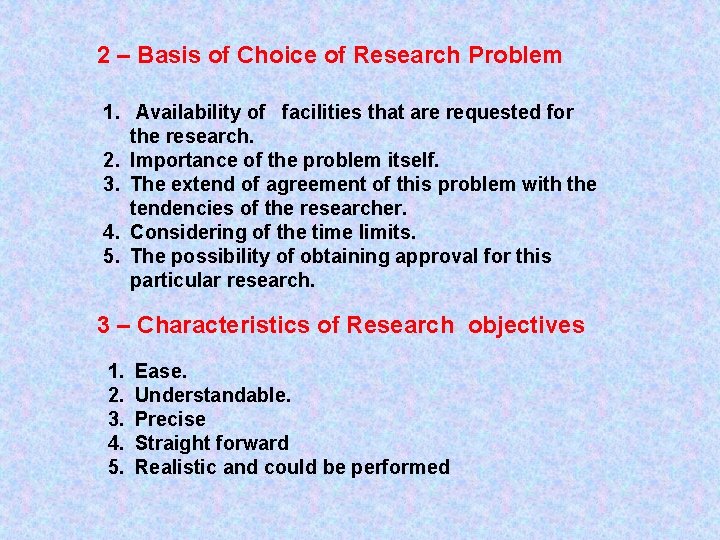
2 – Basis of Choice of Research Problem 1. Availability of facilities that are requested for the research. 2. Importance of the problem itself. 3. The extend of agreement of this problem with the tendencies of the researcher. 4. Considering of the time limits. 5. The possibility of obtaining approval for this particular research. 3 – Characteristics of Research objectives 1. 2. 3. 4. 5. Ease. Understandable. Precise Straight forward Realistic and could be performed
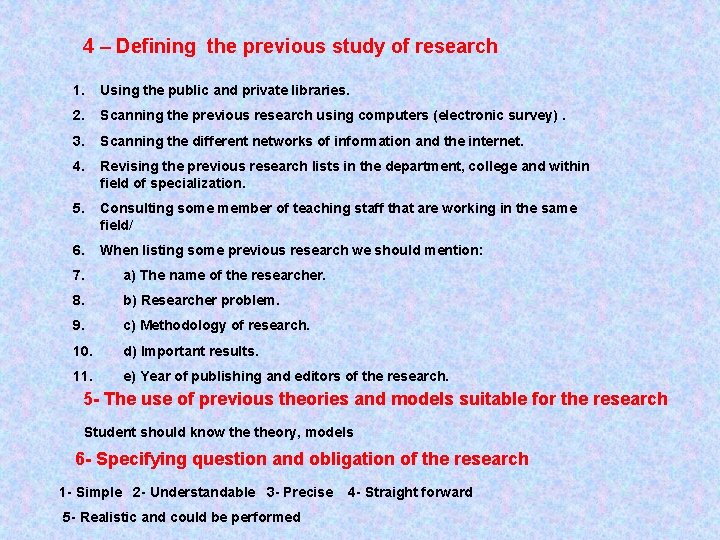
4 – Defining the previous study of research 1. Using the public and private libraries. 2. Scanning the previous research using computers (electronic survey). 3. Scanning the different networks of information and the internet. 4. Revising the previous research lists in the department, college and within field of specialization. 5. Consulting some member of teaching staff that are working in the same field/ 6. When listing some previous research we should mention: 7. a) The name of the researcher. 8. b) Researcher problem. 9. c) Methodology of research. 10. d) Important results. 11. e) Year of publishing and editors of the research. 5 - The use of previous theories and models suitable for the research Student should know theory, models 6 - Specifying question and obligation of the research 1 - Simple 2 - Understandable 3 - Precise 5 - Realistic and could be performed 4 - Straight forward
- Slides: 19