
Repo Sync Combined ActionBased and DataBased Synchronization Model
Repo. Sync: Combined Action-Based and Data-Based Synchronization Model in Named Data Network Weiqi Shi (Tsinghua University) Alexander Afanasyev (University of California, Los Angeles) 18 th IEEE Global Internet Symposium (GI 2015) April 27, 2015
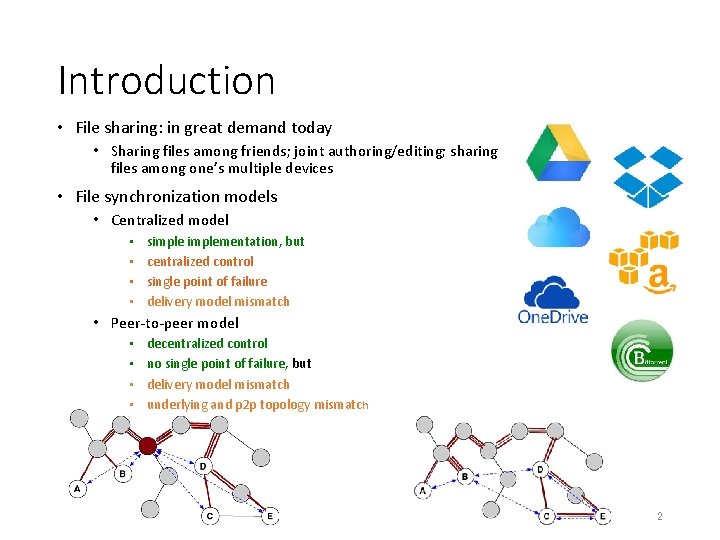
Introduction • File sharing: in great demand today • Sharing files among friends; joint authoring/editing; sharing files among one’s multiple devices • File synchronization models • Centralized model • • simplementation, but centralized control single point of failure delivery model mismatch • Peer-to-peer model • • decentralized control no single point of failure, but delivery model mismatch underlying and p 2 p topology mismatch 2
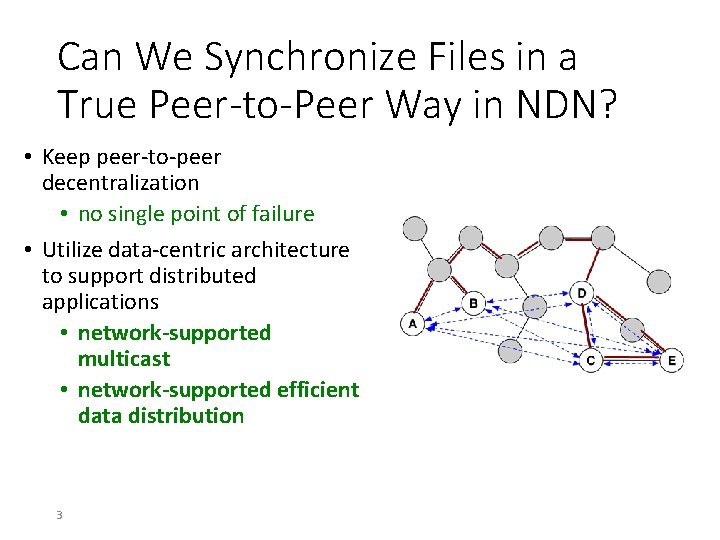
Can We Synchronize Files in a True Peer-to-Peer Way in NDN? • Keep peer-to-peer decentralization • no single point of failure • Utilize data-centric architecture to support distributed applications • network-supported multicast • network-supported efficient data distribution 3
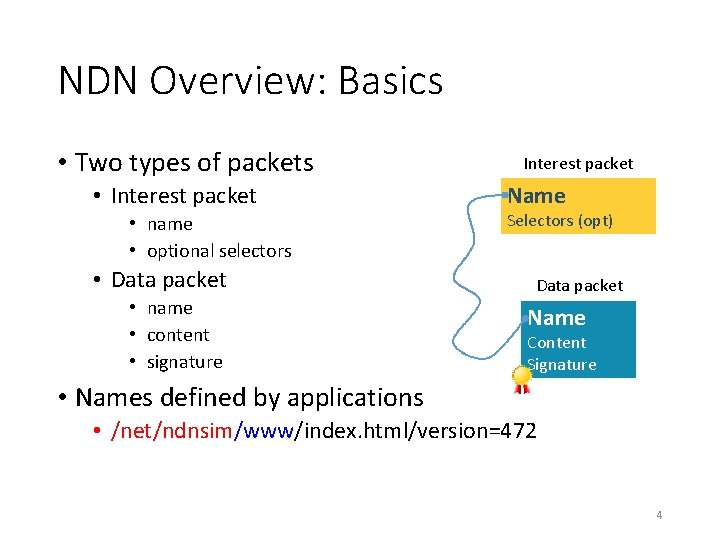
NDN Overview: Basics • Two types of packets • Interest packet • name • optional selectors • Data packet • name • content • signature Interest packet Name Selectors (opt) Data packet Name Content Signature • Names defined by applications • /net/ndnsim/www/index. html/version=472 4
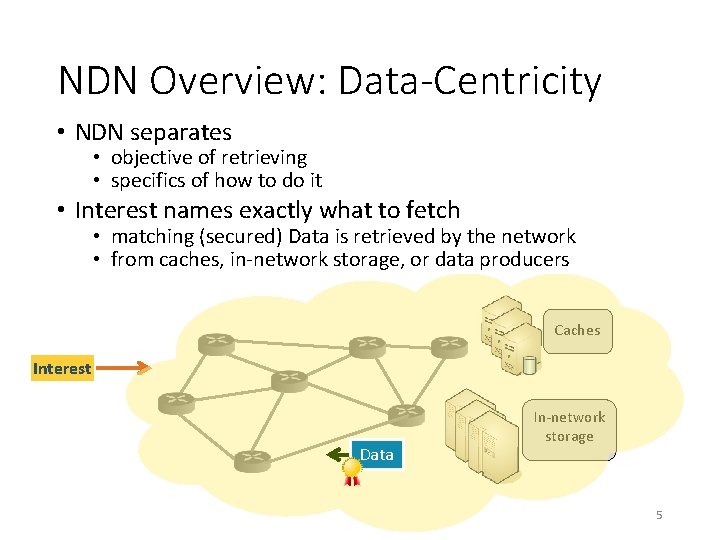
NDN Overview: Data-Centricity • NDN separates • objective of retrieving • specifics of how to do it • Interest names exactly what to fetch • matching (secured) Data is retrieved by the network • from caches, in-network storage, or data producers Caches Interest Data In-network storage 5
Features Made Possible by NDN • NDN name-based data retrieval • expressed Interest for the can bring data • • from the local database from the local environment (Wi. Fi, LAN) from the producer from any other user sharing the same folder • Completely distributed, no need for central server ♢ Can have backup storage which works just like any other device • Local communication is kept local • Data shared in multicast fashion • “Multi-peer-to-multi-peer” file sharing • NDN’s built-in security block to achieve app specific security goals 6
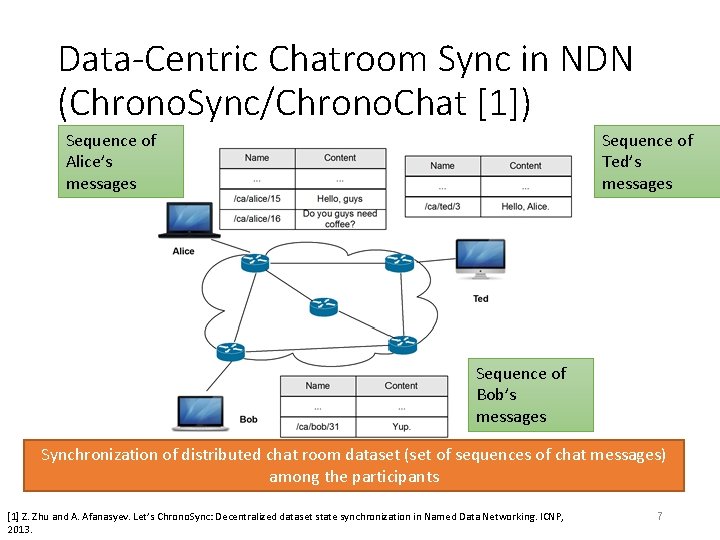
Data-Centric Chatroom Sync in NDN (Chrono. Sync/Chrono. Chat [1]) Sequence of Alice’s messages Sequence of Ted’s messages Sequence of Bob’s messages Synchronization of distributed chat room dataset (set of sequences of chat messages) among the participants [1] Z. Zhu and A. Afanasyev. Let’s Chrono. Sync: Decentralized dataset state synchronization in Named Data Networking. ICNP, 2013. 7
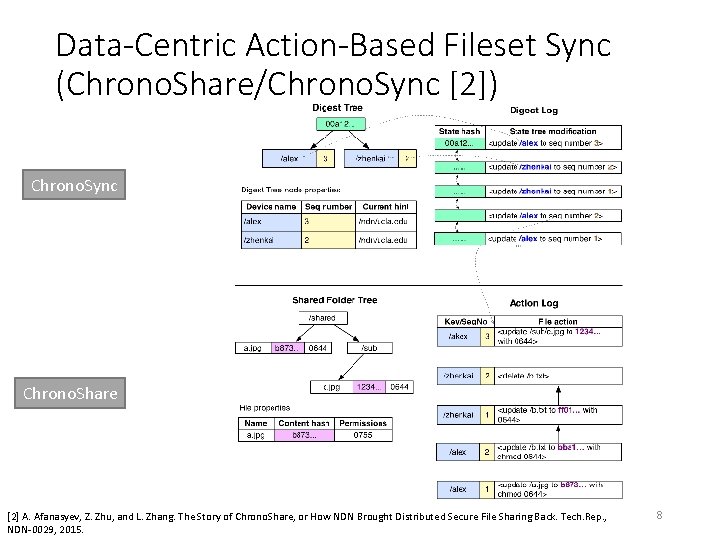
Data-Centric Action-Based Fileset Sync (Chrono. Share/Chrono. Sync [2]) Chrono. Sync Chrono. Share [2] A. Afanasyev, Z. Zhu, and L. Zhang. The Story of Chrono. Share, or How NDN Brought Distributed Secure File Sharing Back. Tech. Rep. , NDN-0029, 2015. 8
Synchronization Contradictions • Synchronizing directly on dataset • efficient for bulk changes • high overhead for small changes • Synchronizing action dataset • efficient for small changes • high overhead for large changes or changes with long history 9
Repo. Sync: Hybrid Action-Based and Data-Based Sync • Action-Based Synchronization • sync operations on the dataset • insert file • remove file • efficient for small modifications • Data-Based Synchronization • sync operations on dataset itself • snapshots of fileset state • sync fileset views • efficient for large amount of modifications 10
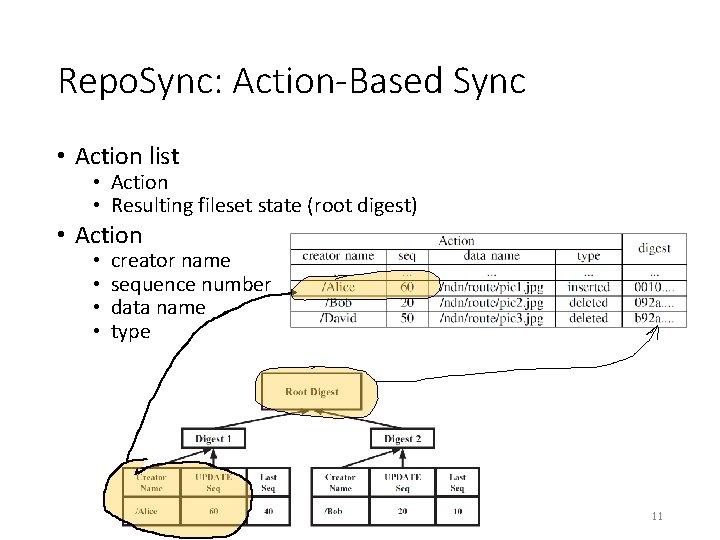
Repo. Sync: Action-Based Sync • Action list • Action • Resulting fileset state (root digest) • Action • • creator name sequence number data name type 11
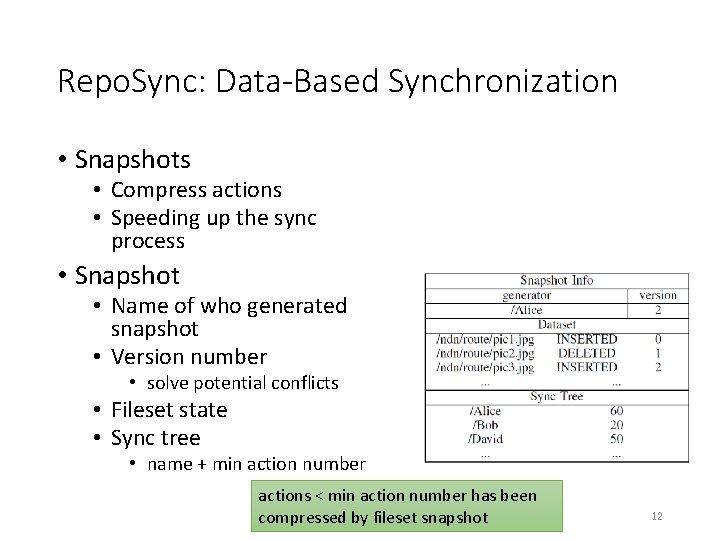
Repo. Sync: Data-Based Synchronization • Snapshots • Compress actions • Speeding up the sync process • Snapshot • Name of who generated snapshot • Version number • solve potential conflicts • Fileset state • Sync tree • name + min action number actions < min action number has been compressed by fileset snapshot 12
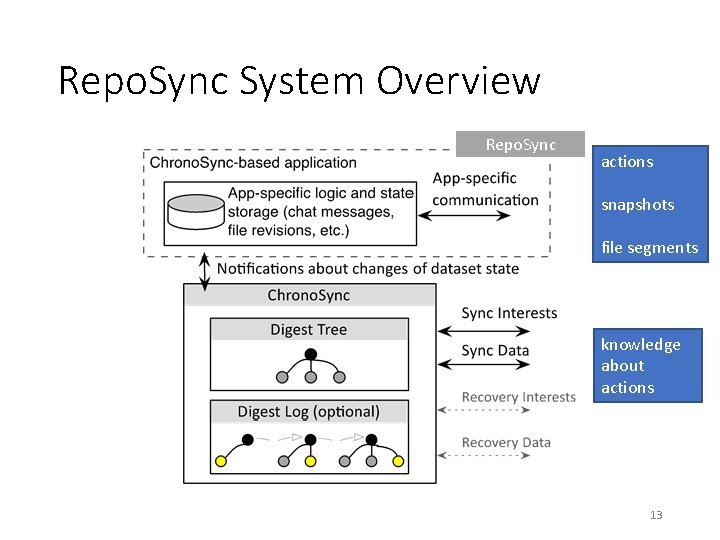
Repo. Sync System Overview Repo. Sync actions snapshots file segments knowledge about actions 13
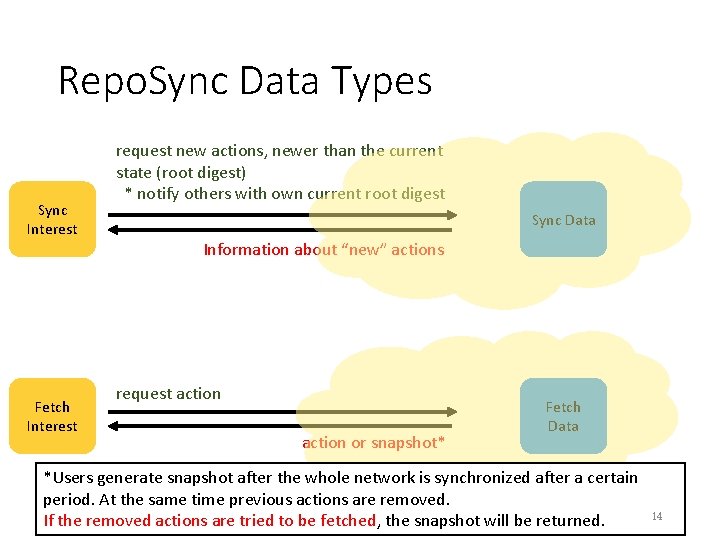
Repo. Sync Data Types Sync Interest Fetch Interest request new actions, newer than the current state (root digest) * notify others with own current root digest Sync Data Information about “new” actions request action or snapshot* Fetch Data *Users generate snapshot after the whole network is synchronized after a certain period. At the same time previous actions are removed. If the removed actions are tried to be fetched, the snapshot will be returned. 14
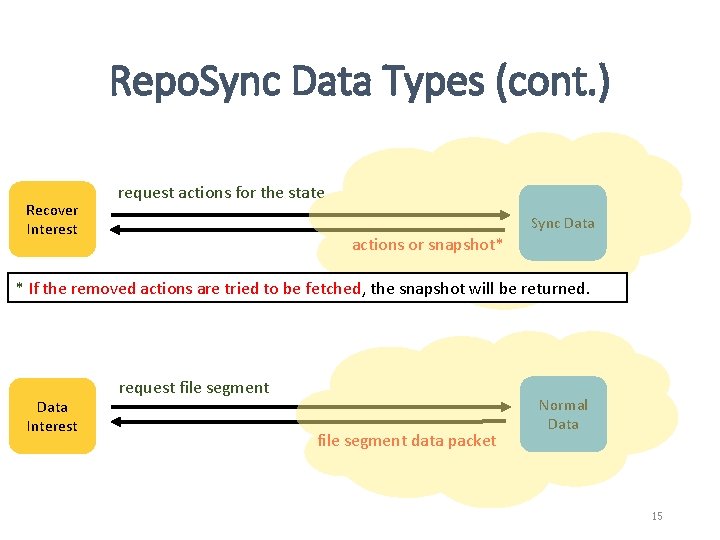
Repo. Sync Data Types (cont. ) Recover Interest request actions for the state Sync Data actions or snapshot* * If the removed actions are tried to be fetched, the snapshot will be returned. Data Interest request file segment data packet Normal Data 15
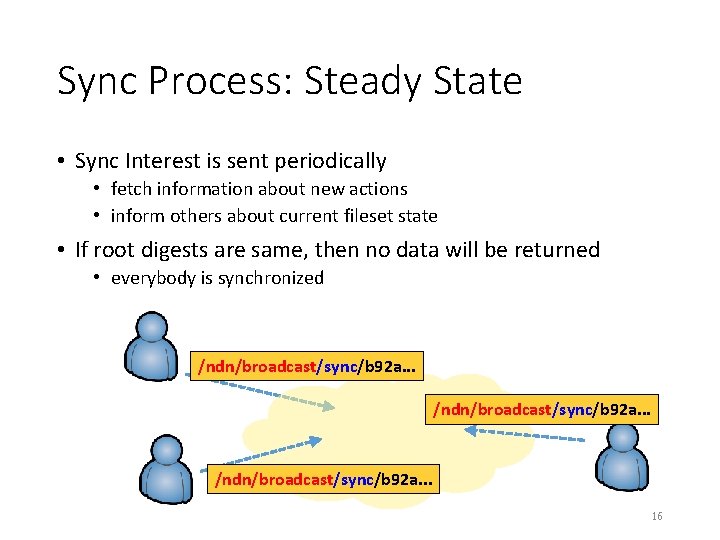
Sync Process: Steady State • Sync Interest is sent periodically • fetch information about new actions • inform others about current fileset state • If root digests are same, then no data will be returned • everybody is synchronized /ndn/broadcast/sync/b 92 a. . . 16
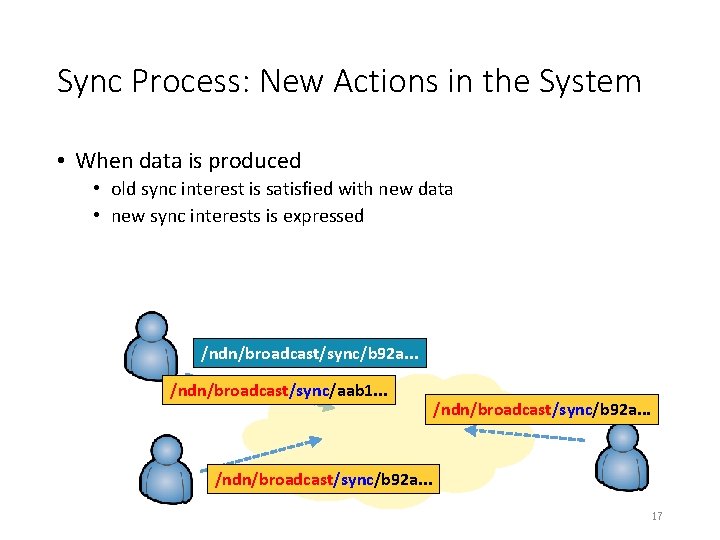
Sync Process: New Actions in the System • When data is produced • old sync interest is satisfied with new data • new sync interests is expressed /ndn/broadcast/sync/b 92 a. . . /ndn/broadcast/sync/aab 1. . . /ndn/broadcast/sync/b 92 a. . . 17
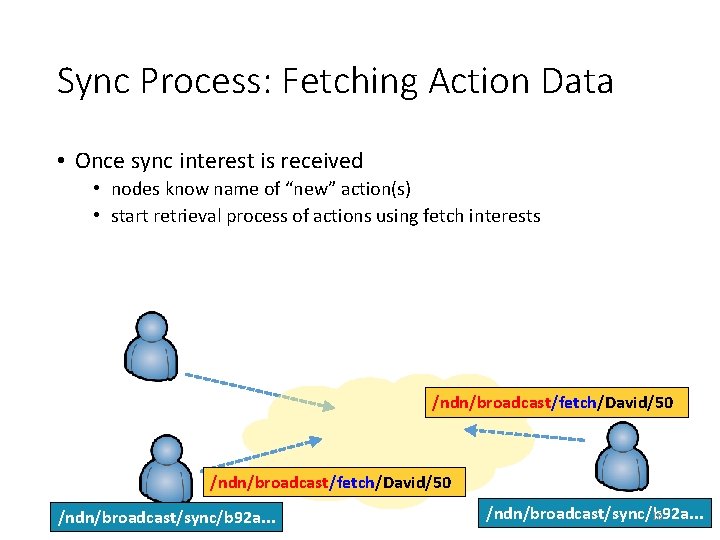
Sync Process: Fetching Action Data • Once sync interest is received • nodes know name of “new” action(s) • start retrieval process of actions using fetch interests /ndn/broadcast/fetch/David/50 /ndn/broadcast/sync/b 92 a. . . 18
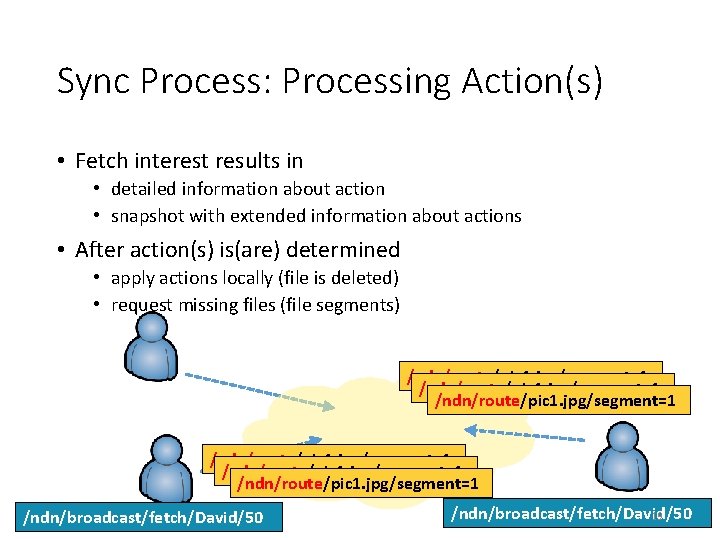
Sync Process: Processing Action(s) • Fetch interest results in • detailed information about action • snapshot with extended information about actions • After action(s) is(are) determined • apply actions locally (file is deleted) • request missing files (file segments) /ndn/route/pic 1. jpg/segment=1 /ndn/broadcast/fetch/David/50 19
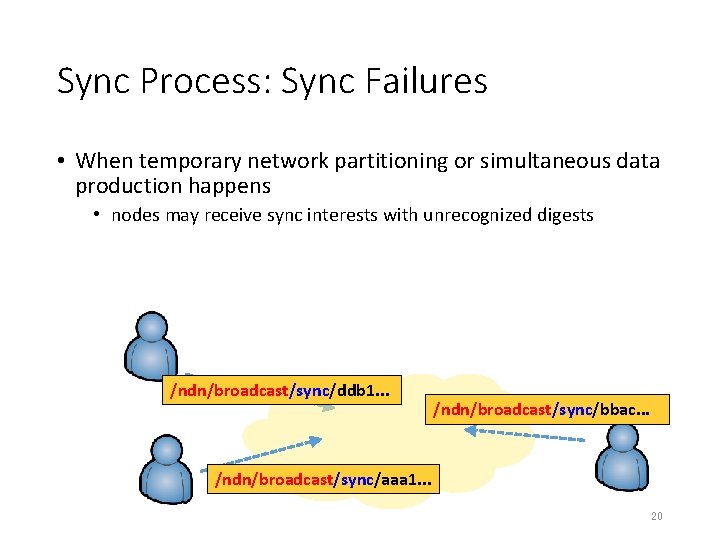
Sync Process: Sync Failures • When temporary network partitioning or simultaneous data production happens • nodes may receive sync interests with unrecognized digests /ndn/broadcast/sync/ddb 1. . . /ndn/broadcast/sync/bbac. . . /ndn/broadcast/sync/aaa 1. . . 20
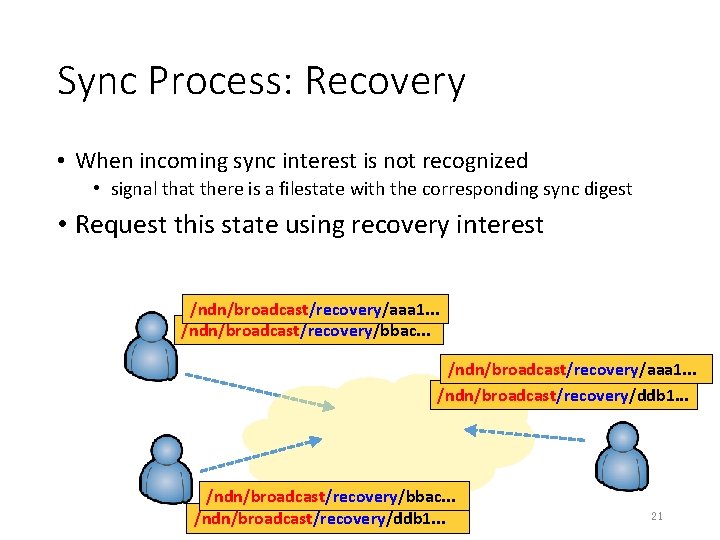
Sync Process: Recovery • When incoming sync interest is not recognized • signal that there is a filestate with the corresponding sync digest • Request this state using recovery interest /ndn/broadcast/recovery/aaa 1. . . /ndn/broadcast/recovery/bbac. . . /ndn/broadcast/recovery/aaa 1. . . /ndn/broadcast/recovery/ddb 1. . . /ndn/broadcast/recovery/bbac. . . /ndn/broadcast/recovery/ddb 1. . . 21
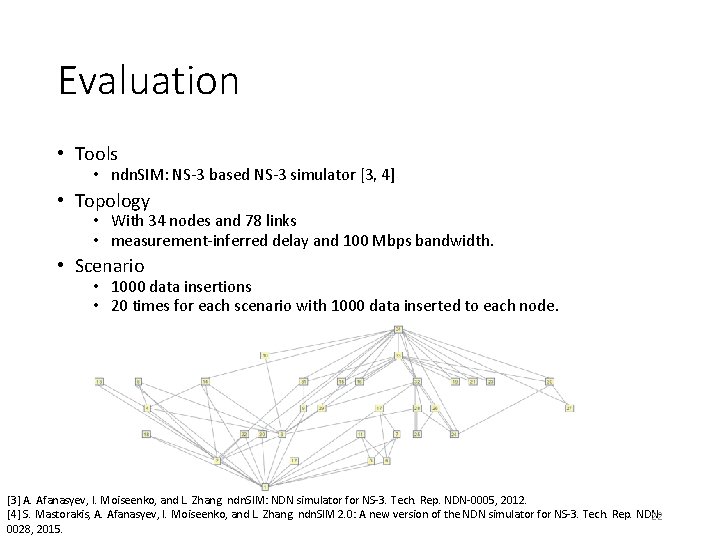
Evaluation • Tools • ndn. SIM: NS-3 based NS-3 simulator [3, 4] • Topology • With 34 nodes and 78 links • measurement-inferred delay and 100 Mbps bandwidth. • Scenario • 1000 data insertions • 20 times for each scenario with 1000 data inserted to each node. [3] A. Afanasyev, I. Moiseenko, and L. Zhang. ndn. SIM: NDN simulator for NS-3. Tech. Rep. NDN-0005, 2012. [4] S. Mastorakis, A. Afanasyev, I. Moiseenko, and L. Zhang. ndn. SIM 2. 0: A new version of the NDN simulator for NS-3. Tech. Rep. NDN 22 0028, 2015.
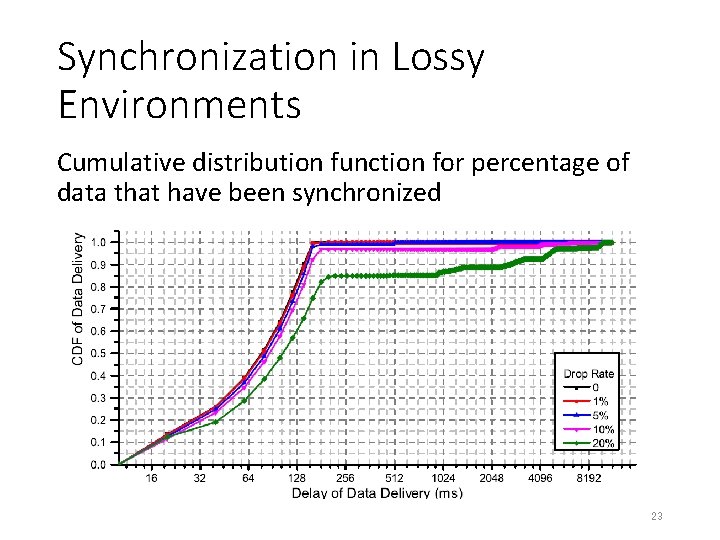
Synchronization in Lossy Environments Cumulative distribution function for percentage of data that have been synchronized 23
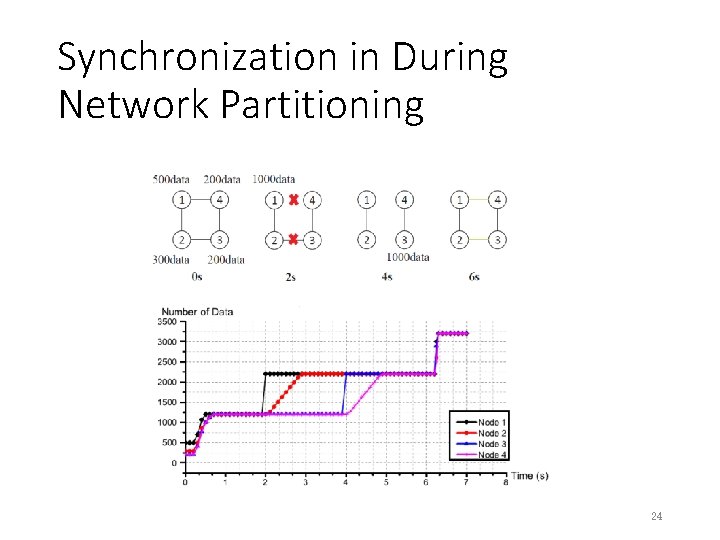
Synchronization in During Network Partitioning 24
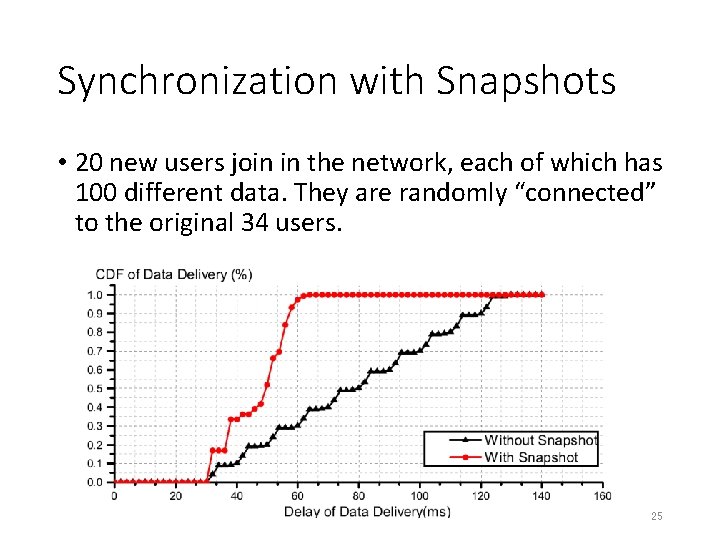
Synchronization with Snapshots • 20 new users join in the network, each of which has 100 different data. They are randomly “connected” to the original 34 users. 25
Conclusion • Repo. Sync provides distributed and efficient synchronization model • Combines action-based and data-based synchronization • Small editions to the dataset can be propagated via actions • big changes can be directly synced by snapshot • Repo. Sync support data removal during sync process 26

Thanks! 27
- Slides: 27