
Replication Transaction Processing Concepts and Techniques Western Institute
- Slides: 33
Replication Transaction Processing Concepts and Techniques Western Institute for Computer Science at Stanford Univ. Philip A. Bernstein Copyright © 1999 Philip A. Bernstein Mon Tue Wed Thur Fri 9: 00 Overview TP mons Log Files &Buffers B-tree 11: 00 Faults Lock Theory Res. Mgr COM+ Access Paths 1: 30 Tolerance Lock Techniq CICS & Inet Corba Groupware 3: 30 T Models Queues Adv TM Replication Benchmark 7: 00 7/22/99 Party Workflow Cyberbrick Party 1
Outline 1. Introduction 2. Primary-Copy Replication 3. Multi-Master Replication 4. Other Approaches 7/22/99 2
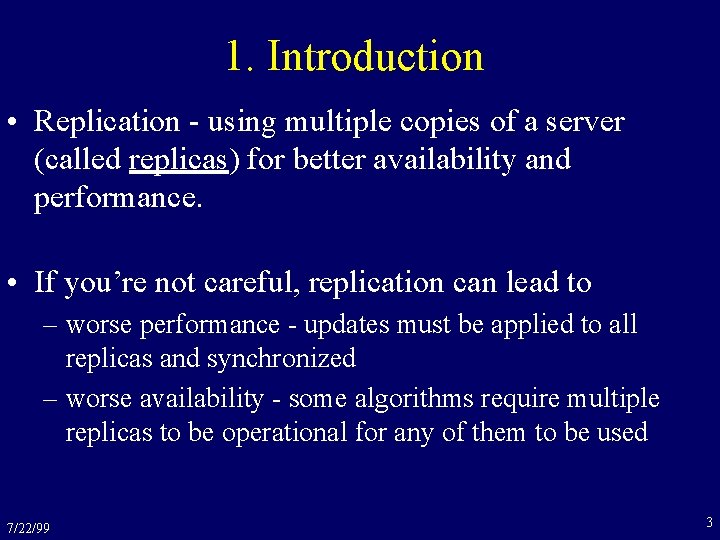
1. Introduction • Replication - using multiple copies of a server (called replicas) for better availability and performance. • If you’re not careful, replication can lead to – worse performance - updates must be applied to all replicas and synchronized – worse availability - some algorithms require multiple replicas to be operational for any of them to be used 7/22/99 3
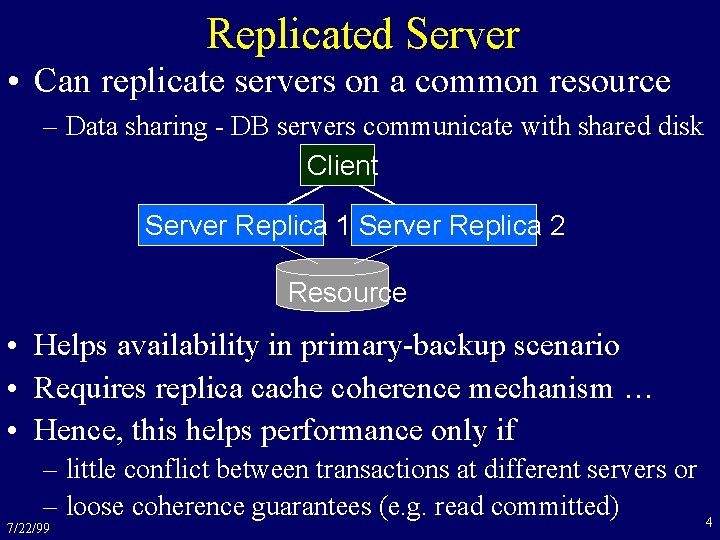
Replicated Server • Can replicate servers on a common resource – Data sharing - DB servers communicate with shared disk Client Server Replica 1 Server Replica 2 Resource • Helps availability in primary-backup scenario • Requires replica cache coherence mechanism … • Hence, this helps performance only if – little conflict between transactions at different servers or – loose coherence guarantees (e. g. read committed) 7/22/99 4
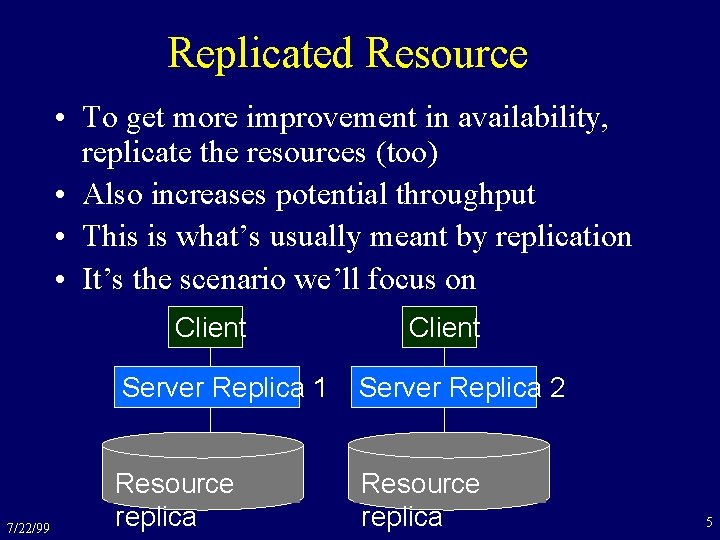
Replicated Resource • To get more improvement in availability, replicate the resources (too) • Also increases potential throughput • This is what’s usually meant by replication • It’s the scenario we’ll focus on Client 7/22/99 Client Server Replica 1 Server Replica 2 Resource replica 5
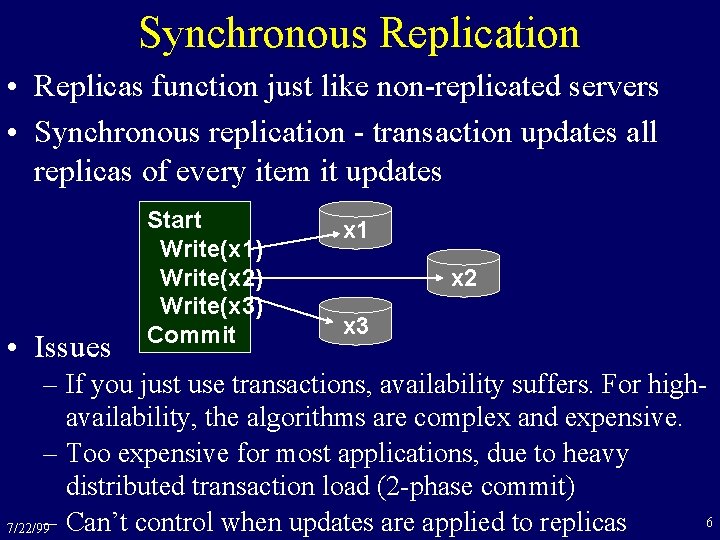
Synchronous Replication • Replicas function just like non-replicated servers • Synchronous replication - transaction updates all replicas of every item it updates • Issues Start Write(x 1) Write(x 2) Write(x 3) Commit x 1 x 2 x 3 – If you just use transactions, availability suffers. For highavailability, the algorithms are complex and expensive. – Too expensive for most applications, due to heavy distributed transaction load (2 -phase commit) 6 7/22/99– Can’t control when updates are applied to replicas
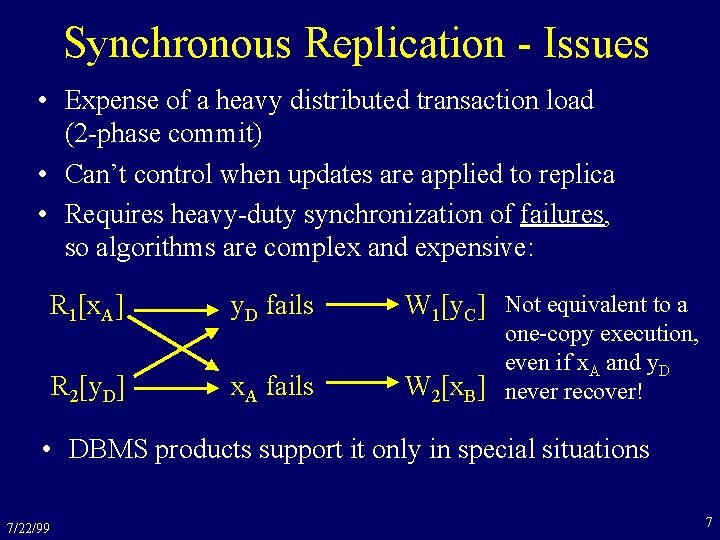
Synchronous Replication - Issues • Expense of a heavy distributed transaction load (2 -phase commit) • Can’t control when updates are applied to replica • Requires heavy-duty synchronization of failures, so algorithms are complex and expensive: R 1[x. A] y. D fails R 2[y. D] x. A fails W 1[y. C] Not equivalent to a one-copy execution, even if x. A and y. D W 2[x. B] never recover! • DBMS products support it only in special situations 7/22/99 7
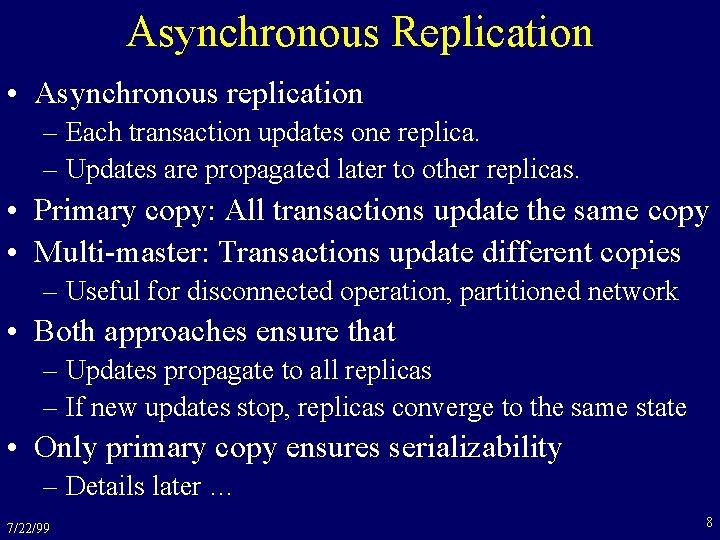
Asynchronous Replication • Asynchronous replication – Each transaction updates one replica. – Updates are propagated later to other replicas. • Primary copy: All transactions update the same copy • Multi-master: Transactions update different copies – Useful for disconnected operation, partitioned network • Both approaches ensure that – Updates propagate to all replicas – If new updates stop, replicas converge to the same state • Only primary copy ensures serializability – Details later … 7/22/99 8
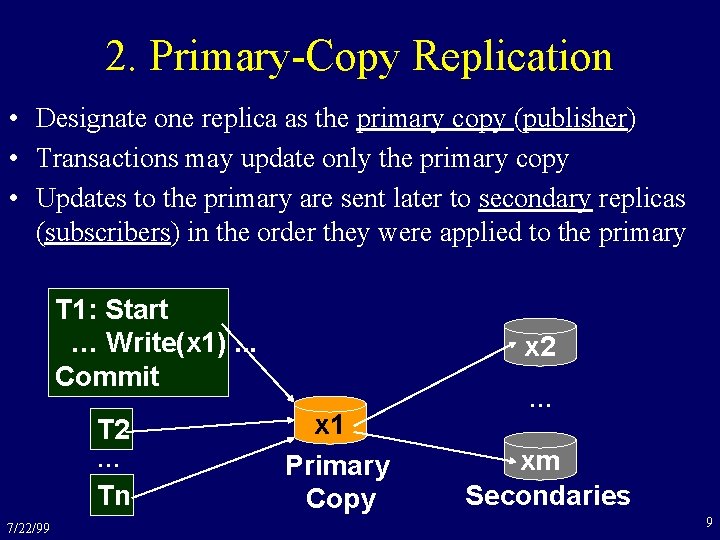
2. Primary-Copy Replication • Designate one replica as the primary copy (publisher) • Transactions may update only the primary copy • Updates to the primary are sent later to secondary replicas (subscribers) in the order they were applied to the primary T 1: Start … Write(x 1). . . Commit T 2 . . . Tn 7/22/99 x 2 x 1 Primary Copy . . . xm Secondaries 9
Asynchronous Update Propagation • Collect updates at primary using triggers or the log • Triggers (Oracle 8, Rdb, SQL Server, DB 2, …) – On every update at primary, a trigger fires to store the update in the update propagation table. • Post-process the log to generate update propagations (SQL Server, DB 2, Tandem Non-Stop SQL) – Off-line, so saves trigger and triggered update overhead, though R/W log synchronization also has a cost – Requires admin (what if log reader fails? ) • Optionally identify updated fields to compress log • Most DB systems support this today. – First in IBM IMS, Tandem NS SQL, DEC/Rdb, & ad hoc 7/22/99 10
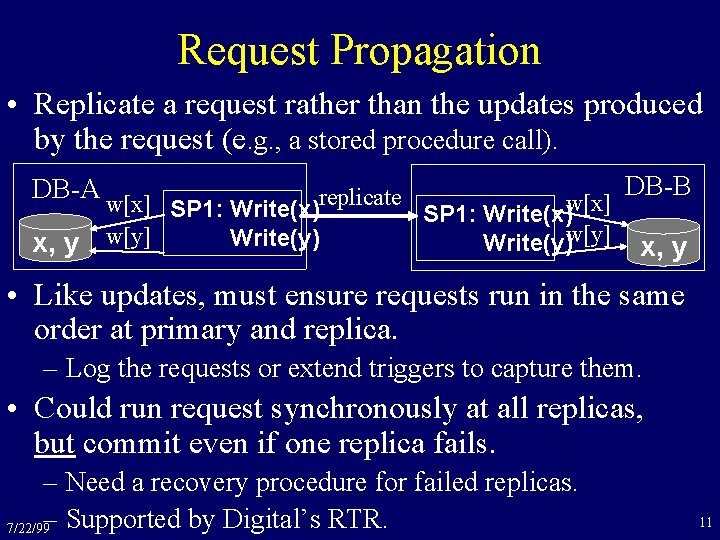
Request Propagation • Replicate a request rather than the updates produced by the request (e. g. , a stored procedure call). DB-B replicate SP 1: Write(x)w[x] w[y] Write(y)w[y] x, y DB-A w[x] x, y • Like updates, must ensure requests run in the same order at primary and replica. – Log the requests or extend triggers to capture them. • Could run request synchronously at all replicas, but commit even if one replica fails. – Need a recovery procedure for failed replicas. 7/22/99– Supported by Digital’s RTR. 11
Products • All major DBMS products have a rich primarycopy replication mechanism • Differences are in detailed features – performance – ease of management – richness of filtering predicates – push vs. pull propagation – stored procedure support – transports (e. g. Sybase SQLanywhere can use email!) –… • The following summary is necessarily incomplete 7/22/99 12
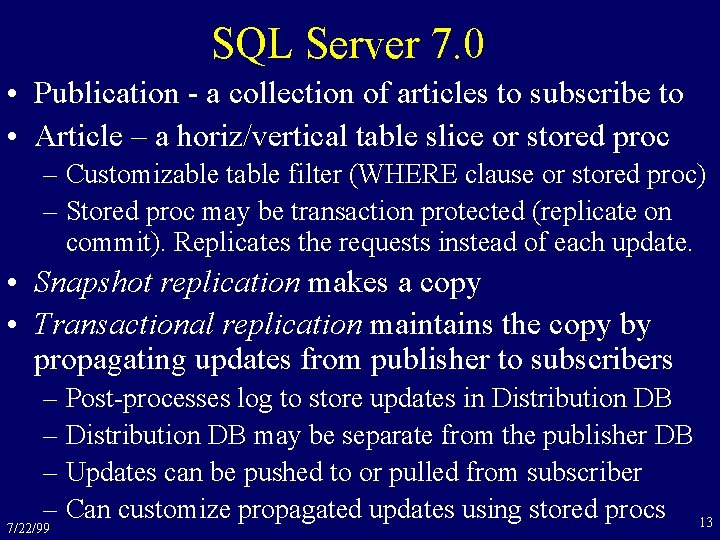
SQL Server 7. 0 • Publication - a collection of articles to subscribe to • Article – a horiz/vertical table slice or stored proc – Customizable table filter (WHERE clause or stored proc) – Stored proc may be transaction protected (replicate on commit). Replicates the requests instead of each update. • Snapshot replication makes a copy • Transactional replication maintains the copy by propagating updates from publisher to subscribers – Post-processes log to store updates in Distribution DB – Distribution DB may be separate from the publisher DB – Updates can be pushed to or pulled from subscriber – Can customize propagated updates using stored procs 13 7/22/99
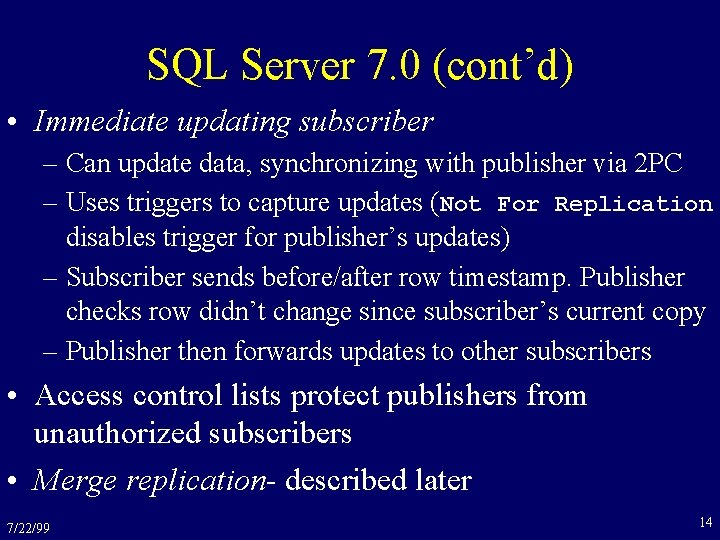
SQL Server 7. 0 (cont’d) • Immediate updating subscriber – Can update data, synchronizing with publisher via 2 PC – Uses triggers to capture updates (Not For Replication disables trigger for publisher’s updates) – Subscriber sends before/after row timestamp. Publisher checks row didn’t change since subscriber’s current copy – Publisher then forwards updates to other subscribers • Access control lists protect publishers from unauthorized subscribers • Merge replication- described later 7/22/99 14
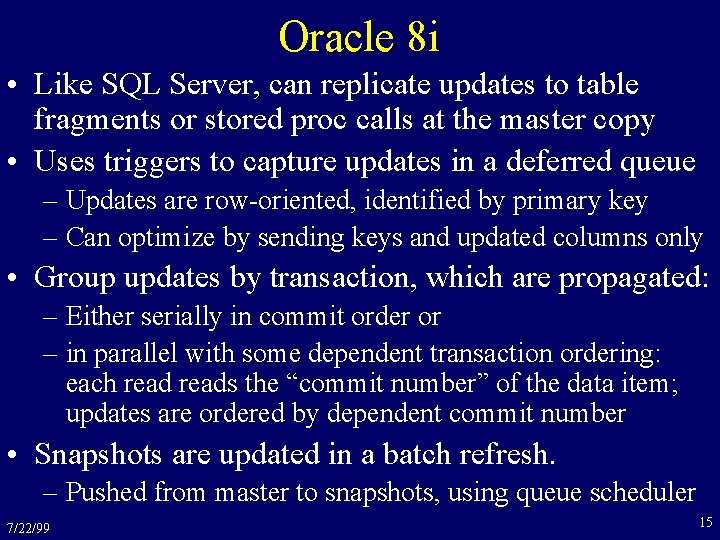
Oracle 8 i • Like SQL Server, can replicate updates to table fragments or stored proc calls at the master copy • Uses triggers to capture updates in a deferred queue – Updates are row-oriented, identified by primary key – Can optimize by sending keys and updated columns only • Group updates by transaction, which are propagated: – Either serially in commit order or – in parallel with some dependent transaction ordering: each reads the “commit number” of the data item; updates are ordered by dependent commit number • Snapshots are updated in a batch refresh. – Pushed from master to snapshots, using queue scheduler 7/22/99 15
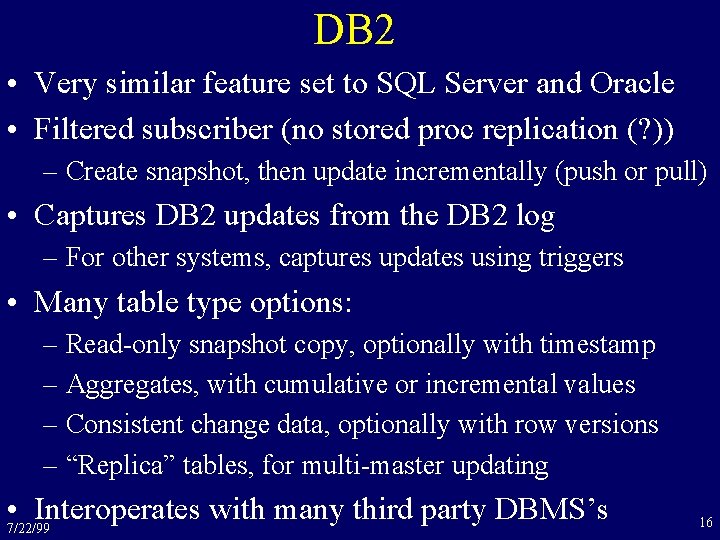
DB 2 • Very similar feature set to SQL Server and Oracle • Filtered subscriber (no stored proc replication (? )) – Create snapshot, then update incrementally (push or pull) • Captures DB 2 updates from the DB 2 log – For other systems, captures updates using triggers • Many table type options: – Read-only snapshot copy, optionally with timestamp – Aggregates, with cumulative or incremental values – Consistent change data, optionally with row versions – “Replica” tables, for multi-master updating • 7/22/99 Interoperates with many third party DBMS’s 16
Failure Handling • Secondary failure - nothing to do till it recovers – At recovery, apply the updates it missed while down – Needs to determine which updates it missed, but this is no different than log-based recovery – If down for too long, may be faster to get a whole copy • Primary failure – Products just wait till it recovers – Can get higher availability by electing a new primary – A secondary that detects primary’s failure announces a new election by broadcasting its unique replica identifier – Other secondaries reply with their replica identifier – The largest replica identifier wins 7/22/99 17
Failure Handling (cont’d) • Primary failure (cont’d) • All replicas must now check that they have the same updates from the failed primary – During the election, each replica reports the id of the last log record it received from the primary – The most up-to-date replica sends its latest updates to (at least) the new primary. – Could still lose an update that committed at the primary and wasn’t forwarded before the primary failed … but solving it requires synchronous replication (2 -phase commit to propagate updates to replicas) 7/22/99 18
Communications Failures • Secondaries can’t distinguish a primary failure from a communication failure that partitions the network. • If the secondaries elect a new primary and the old primary is still running, there will be a reconciliation problem when they’re reunited. This is multi-master. • To avoid this, one partition must know it’s the only one that can operate, and can’t communicate with other partitions to figure this out. • Could make a static decision. The partition that has the primary wins. • Dynamic solutions are based on Majority Consensus 7/22/99 19
Majority Consensus • Whenever a set of communicating replicas detects a replica failure or recovery, they test if they have a majority (more than half) of the replicas. • If so, they can elect a primary • Only one set of replicas can have a majority. • Doesn’t work well with even number of copies. – Useless with 2 copies • Quorum consensus – Give a weight to each replica – The replica set that has a majority of the weight wins – E. g. 2 replicas, one has weight 1, the other weight 2 7/22/99 20
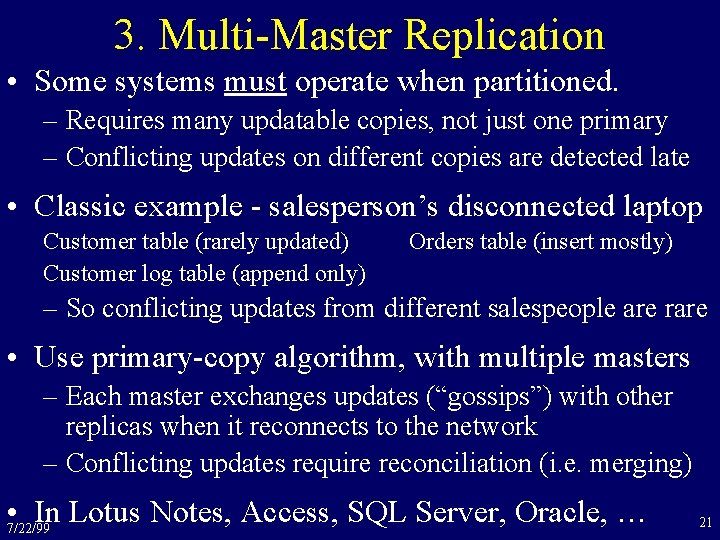
3. Multi-Master Replication • Some systems must operate when partitioned. – Requires many updatable copies, not just one primary – Conflicting updates on different copies are detected late • Classic example - salesperson’s disconnected laptop Customer table (rarely updated) Customer log table (append only) Orders table (insert mostly) – So conflicting updates from different salespeople are rare • Use primary-copy algorithm, with multiple masters – Each master exchanges updates (“gossips”) with other replicas when it reconnects to the network – Conflicting updates require reconciliation (i. e. merging) • In Lotus Notes, Access, SQL Server, Oracle, … 7/22/99 21
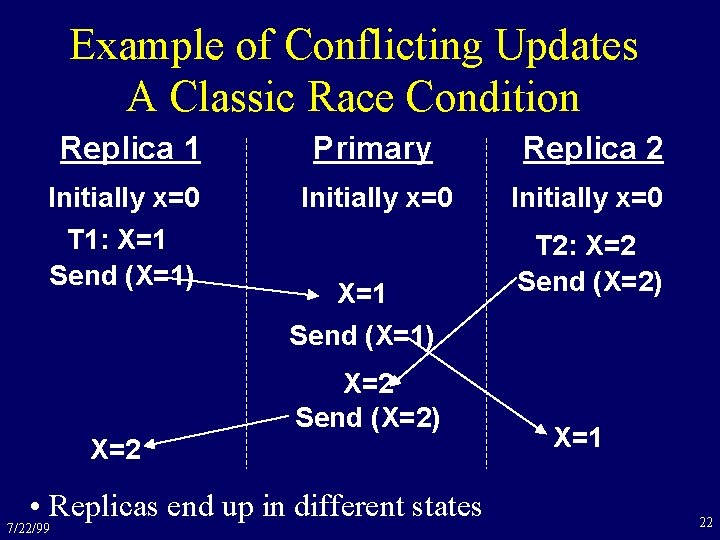
Example of Conflicting Updates A Classic Race Condition Replica 1 Primary Replica 2 Initially x=0 T 1: X=1 Send (X=1) X=2 Send (X=2) X=2 • Replicas end up in different states 7/22/99 T 2: X=2 Send (X=2) X=1 22
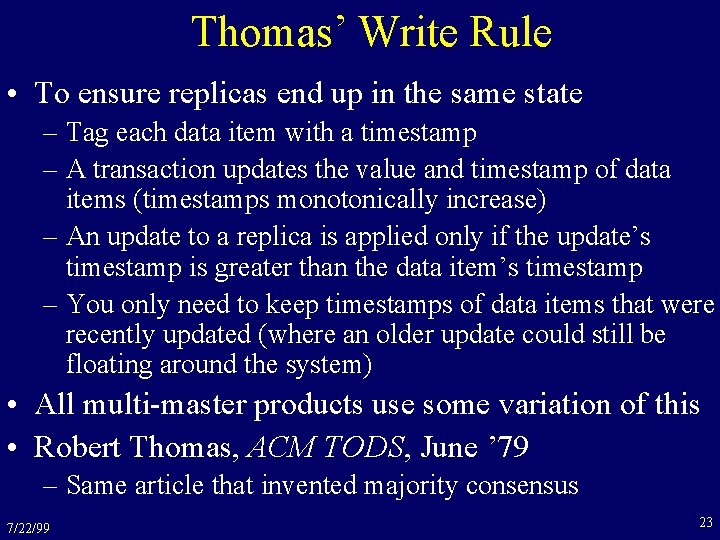
Thomas’ Write Rule • To ensure replicas end up in the same state – Tag each data item with a timestamp – A transaction updates the value and timestamp of data items (timestamps monotonically increase) – An update to a replica is applied only if the update’s timestamp is greater than the data item’s timestamp – You only need to keep timestamps of data items that were recently updated (where an older update could still be floating around the system) • All multi-master products use some variation of this • Robert Thomas, ACM TODS, June ’ 79 – Same article that invented majority consensus 7/22/99 23
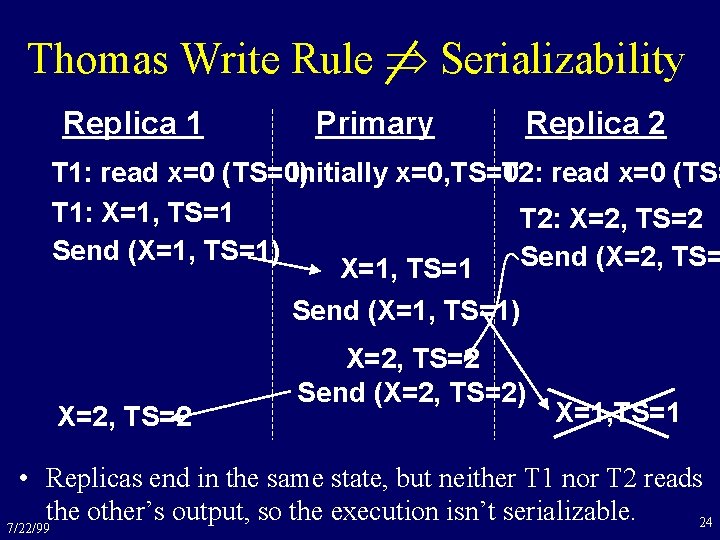
Thomas Write Rule Serializability Replica 1 Primary Replica 2 T 1: read x=0 (TS=0) Initially x=0, TS=0 T 2: read x=0 (TS= T 1: X=1, TS=1 T 2: X=2, TS=2 Send (X=1, TS=1) Send (X=2, TS= X=1, TS=1 Send (X=1, TS=1) X=2, TS=2 Send (X=2, TS=2) X=1, TS=1 • Replicas end in the same state, but neither T 1 nor T 2 reads the other’s output, so the execution isn’t serializable. 24 7/22/99
Multi-Master Performance • The longer a replica is disconnected and performing updates, the more likely it will need reconciliation • The amount of propagation activity increases with more replicas – If each replica is performing updates, the effect is quadratic 7/22/99 25
Microsoft Access and SQL Server • Multi-master replication without a primary • Each row R of a table has 4 additional columns – globally unique id (GUID) – generation number, to determine which updates from other replicas have been applied – version number = the number of updates to R – array of [replica, version number] pairs, identifies the largest version number it got for R from other replicas • Uses Thomas’ write rule, based on version numbers – Access uses replica id to break ties. SQL Server 7 uses subscriber priority or custom conflict resolution. 7/22/99 26
Generation Numbers (Access/SQL cont’d) • Each replica has a current generation number • A replica updates a row’s generation number whenever it updates the row • A replica knows the generat’n number it had when it last exchanged updates with R´, for every replica R´. • A replica increments its generation number every time it exchanges updates with another replica. • So, when exchanging updates with R , it should send all rows with a generation number larger than what it had when last exchanging updates with R. 7/22/99 27
Duplicate Updates (Access/SQL cont’d) • Some rejected updates are saved for later analysis • To identify duplicate updates to discard them – When applying an update to x, replace x’s array of [replica, version#] pairs by the update’s array. – To avoid processing the same update via many paths, check version number of arriving update against the array • Consider a rejected update to x at R from R´, where – [R´, V] describes R´ in x’s array, and – V´ is the version number sent by R´. – If V V´, then R saw R´’s updates – If V < V´, then R didn’t see R´’s updates, so store it in the conflict table for later reconciliation 7/22/99 28
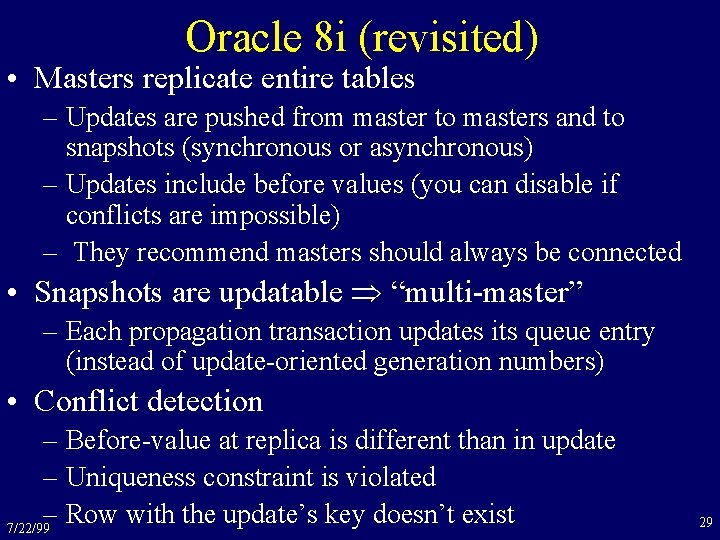
Oracle 8 i (revisited) • Masters replicate entire tables – Updates are pushed from master to masters and to snapshots (synchronous or asynchronous) – Updates include before values (you can disable if conflicts are impossible) – They recommend masters should always be connected • Snapshots are updatable “multi-master” – Each propagation transaction updates its queue entry (instead of update-oriented generation numbers) • Conflict detection – Before-value at replica is different than in update – Uniqueness constraint is violated – Row with the update’s key doesn’t exist 7/22/99 29
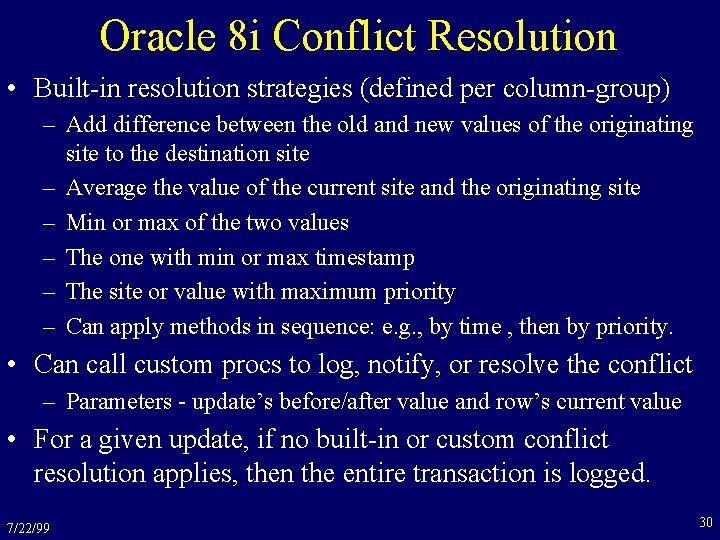
Oracle 8 i Conflict Resolution • Built-in resolution strategies (defined per column-group) – Add difference between the old and new values of the originating site to the destination site – Average the value of the current site and the originating site – Min or max of the two values – The one with min or max timestamp – The site or value with maximum priority – Can apply methods in sequence: e. g. , by time , then by priority. • Can call custom procs to log, notify, or resolve the conflict – Parameters - update’s before/after value and row’s current value • For a given update, if no built-in or custom conflict resolution applies, then the entire transaction is logged. 7/22/99 30
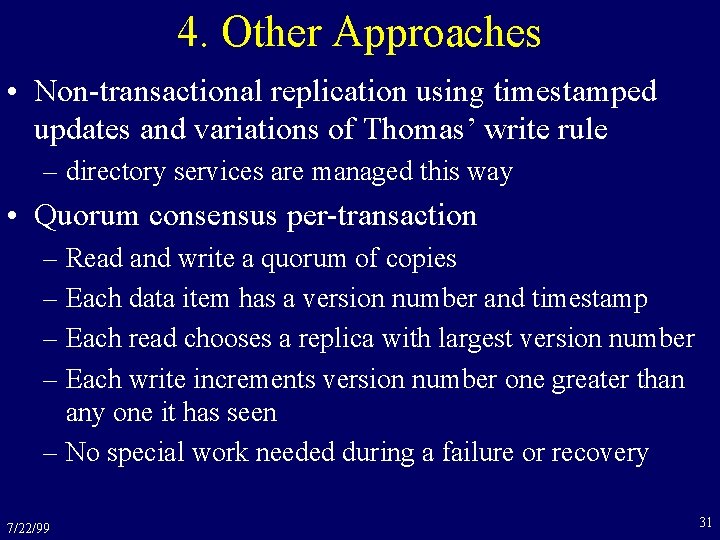
4. Other Approaches • Non-transactional replication using timestamped updates and variations of Thomas’ write rule – directory services are managed this way • Quorum consensus per-transaction – Read and write a quorum of copies – Each data item has a version number and timestamp – Each read chooses a replica with largest version number – Each write increments version number one greater than any one it has seen – No special work needed during a failure or recovery 7/22/99 31
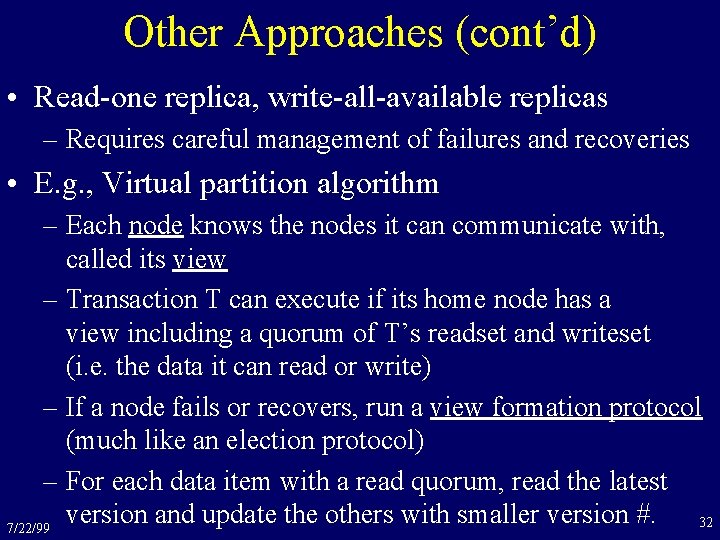
Other Approaches (cont’d) • Read-one replica, write-all-available replicas – Requires careful management of failures and recoveries • E. g. , Virtual partition algorithm – Each node knows the nodes it can communicate with, called its view – Transaction T can execute if its home node has a view including a quorum of T’s readset and writeset (i. e. the data it can read or write) – If a node fails or recovers, run a view formation protocol (much like an election protocol) – For each data item with a read quorum, read the latest version and update the others with smaller version #. 32 7/22/99
Summary • State-of-the-art products have rich functionality. – It’s a complicated world for app designers – Lots of options to choose from • Most failover stories are weak – Fine for data warehousing – For 24 7 TP, need better integration with cluster node failover 7/22/99 33