
Replica Management Mansi Radke mansir 1umbc edu What
Replica Management Mansi Radke mansir 1@umbc. edu
What is replication? ? & why replication? l Replication is having multiple copies of data and services in a distributed system l Reasons: ¡ ¡ Reliability of the system Better protection against corrupted data Improved Performance and faster response time Facilitates scaling in numbers and geographical area.
Key Issues: l Where, when and by whom replicas should be placed. l Mechanisms to keep them consistent. l Two main sub-problems: ¡ Replica-server l Finding best location or placed where a server can be placed. ¡ Content l Placement Finding out which server is best for storing a particular content.
Replica Server Placement l Based on Distance between clients and locations as starting point. (latency , bandwidth) ¡ Best K out of N locations (K<N) are selected l By applying Clustering ¡ Group nodes accessing the same content and with low inter-nodal latencies into groups or clusters and place a replica on the k largest clusters.

Content Replication and Placement l Permanent Replicas ¡ Geographically distributed - Mirroring ¡ Same location – Round Robin l Server Initiated Replicas l Client Initiated Replicas
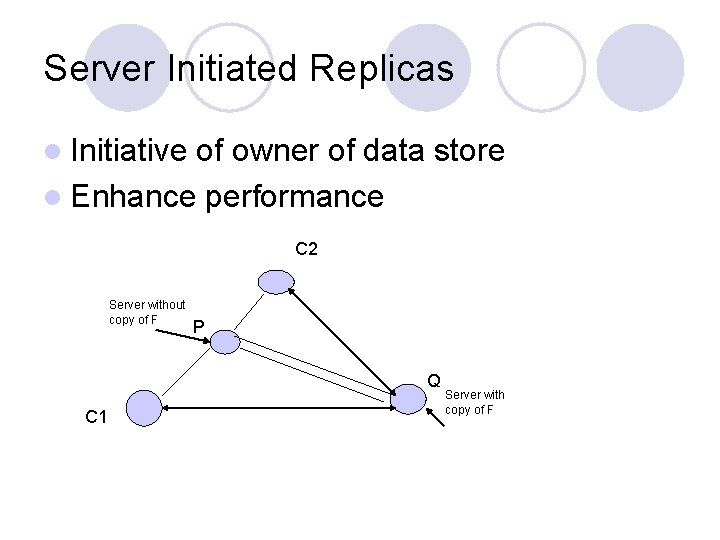
Server Initiated Replicas l Initiative of owner of data store l Enhance performance C 2 Server without copy of F P Q C 1 Server with copy of F
Client Initiated Replicas l Client caches l Managing is entirely by client l Improve access time l Placement ¡ Same ¡ LAN ¡ WAN machine
Content Distribution l Propagation ¡ Propagate l of Updated content only notification of an update Invalidation Protocols ¡ Transfer data from one copy to another ¡ Propagate the update operation to other copies
Push Vs Pull Protocols l Push ¡ ¡ l Pull ¡ ¡ ¡ l Server based Read to update ratio is high High degree of consistency Multicasting Client based Read to update ratio is low Unicasting Lease
What next ? l Consistency Protocols ¡ ¡ Continuous consistency Primary based protocols l l ¡ Replicated write protocols l l ¡ Active Replication Quorum-based protocols Cache coherence Protocols l l l ¡ Remote write protocols Local write protocols Coherence detection strategy Coherence enforcement strategy Write through and write back caches Client centric consistency implementation
Algorithms for replica Placement l Greedy Approach ¡ Places replicas one by one each time exhaustively evaluating all possible locations. It produces very good replica placements but the computational cost is very high. O(KN^2). l Hot Spot ¡ Places replicas on nodes that along with their neighbors generate greatest load. o(N^2 + min (N. Log N + N. K)).
Hot zone – Michal szymaniak, Marteen Steen l Two step algorithm: ¡ Identify network region where replica is to be placed. ¡ Once a n/w region is identified then a replica holding node is chosen from each group.
Hot zone – Latency Driven Replica Placement Algorithm l GNP ( Global netwrork positioning) represents the complex structure of the internet by simple geometric space. It approximates the latency between two nodes based on the coordinates in an M – dimensional Euclidean space. l Network regions are identified by determining the clusters of node coordinates in Euclidean space.
For identifying and measuring the coordinate clusters, split the M-dimensional space into cells of identical size. l Each cell is uniquely defined by its center point. l The density of the cell is defined by the number of nodes whose coordinates fall within that cell. Coordinates of the node are mapped to the cell. l The replicas are then placed in the most dense cells. l
Split clusters l The clusters may span multiple cells. This hampers the optimal performance of the algorithm. Hence zones were introduced. l Zone: l Each zone consists of the cell and its neighbors. i. e 3^m cells in total
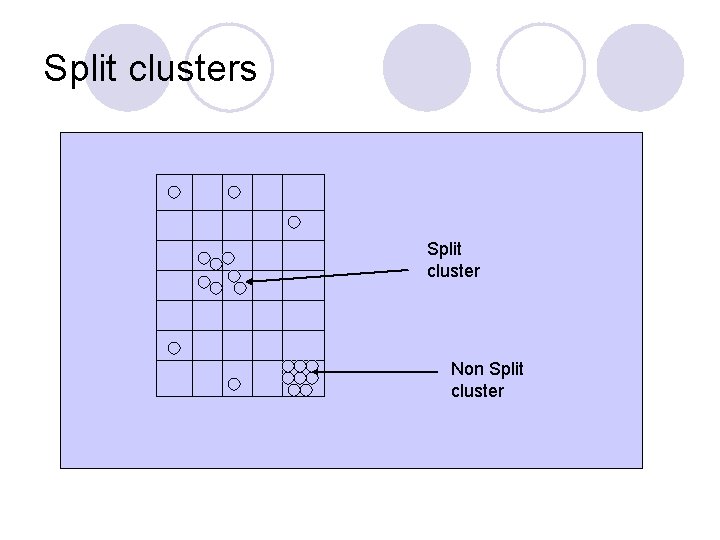
Split clusters Split cluster Non Split cluster
Complexity Analysis of the Algorithm l. N - No of nodes l K - No of replicas l M - GNP space dimension. l Step 1 – To determine the Average distance between nodes – This is computed with fixed number of randomly selected nodes. This step has constant cost.
l Step 2 Construct the zones. ¡ Assign nodes to their corresponding cells. O(N) ¡ Set of non empty cells is translated to zones by identifying the neighboring cells of each cell and sum their densities. Each zone = 3^m cells and no of cells = N , so O(N) cell accesses. l Sort the cells according to their centre points using Radix sort O(N) and then indivisual cells accessed using binary search , so O(log N). l ¡ So total cost of step 2 = O( N. log. N)
l Step 3 Placing replicas ¡ For each replica we identify the most dense zones which needs inspecting all the zones O(N). ¡ The same operation performed on all replicas. So O(K. N). l Total cost of Hot zone = O(1) + O(N. log. N) + O(K. N) = O(N. max(log N, K))
Replication Criteria to be considered for a Replica Management system Openness. The replicas should be useful to many requesters, not only a single user. l Locality. Obtaining a “nearby” replica is preferable. The actual distance (or cost) metric used may include dynamic parameters such as network and server load. l Addressability. For management, control, and updates, support should be provided for enumeration and individual or group-wise addressing of replicas. l
Freshness. The replicas should be the most up to date version of the document. l Adaptivity. The number of replicas for a resource should be adaptable to demand, as a tradeoff between storage requirement and server load. l Flexibility. The number of replicas for one resource should not depend on the number of replicas for another resource l Variability. The locations of replicas should be selectable. l
State size. The amount of additional state required for maintaining and using the replicas should be minimum. This applies to both distributed and centralized state. l Resilience. As DHTs themselves are completely distributed and resilient to outages, centralized state or other single points of failure should be avoided. l Independence. The introduction of a new replica (respectively, the removal of an existing replica) on a node should depend on as few other nodes as possible. l Performance. Locating a replica should not cause excessive traffic or delays. l
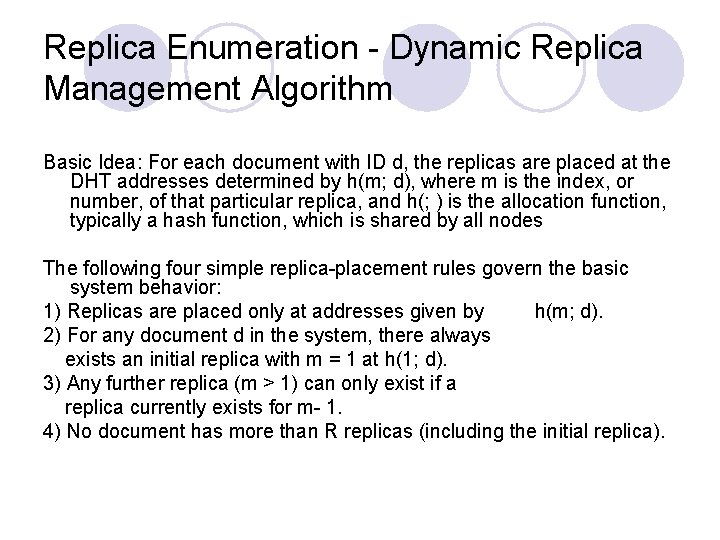
Replica Enumeration - Dynamic Replica Management Algorithm Basic Idea: For each document with ID d, the replicas are placed at the DHT addresses determined by h(m; d), where m is the index, or number, of that particular replica, and h(; ) is the allocation function, typically a hash function, which is shared by all nodes The following four simple replica-placement rules govern the basic system behavior: 1) Replicas are placed only at addresses given by h(m; d). 2) For any document d in the system, there always exists an initial replica with m = 1 at h(1; d). 3) Any further replica (m > 1) can only exist if a replica currently exists for m- 1. 4) No document has more than R replicas (including the initial replica).
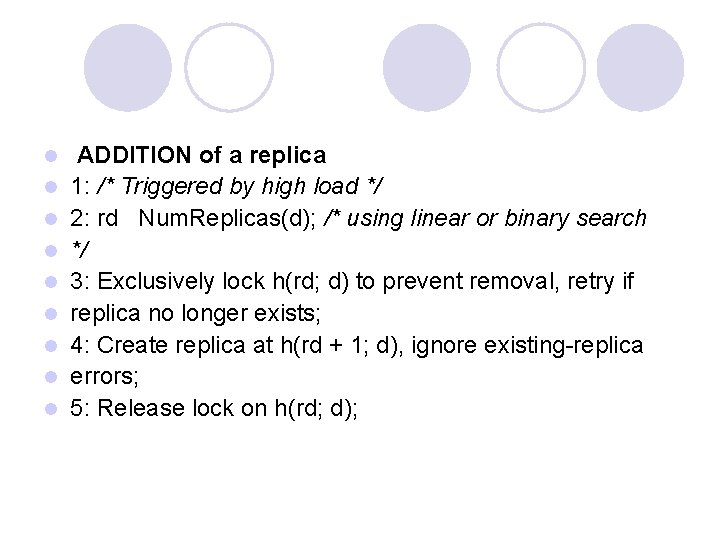
l l l l l ADDITION of a replica 1: /* Triggered by high load */ 2: rd Num. Replicas(d); /* using linear or binary search */ 3: Exclusively lock h(rd; d) to prevent removal, retry if replica no longer exists; 4: Create replica at h(rd + 1; d), ignore existing-replica errors; 5: Release lock on h(rd; d);
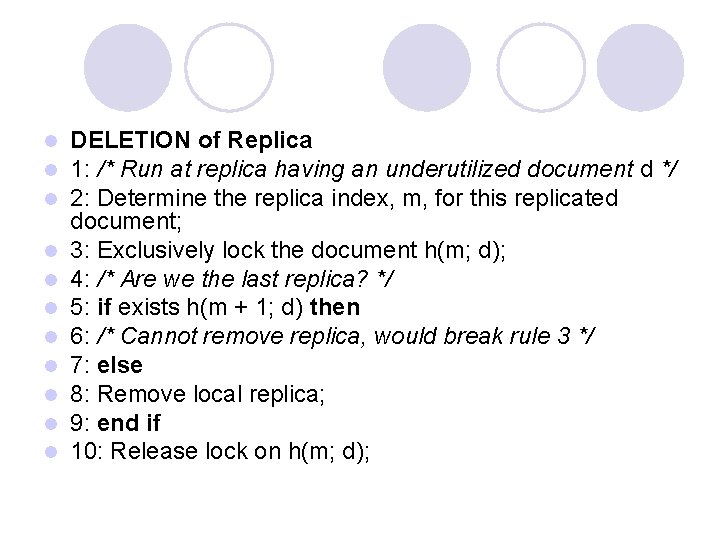
l l l DELETION of Replica 1: /* Run at replica having an underutilized document d */ 2: Determine the replica index, m, for this replicated document; 3: Exclusively lock the document h(m; d); 4: /* Are we the last replica? */ 5: if exists h(m + 1; d) then 6: /* Cannot remove replica, would break rule 3 */ 7: else 8: Remove local replica; 9: end if 10: Release lock on h(m; d);
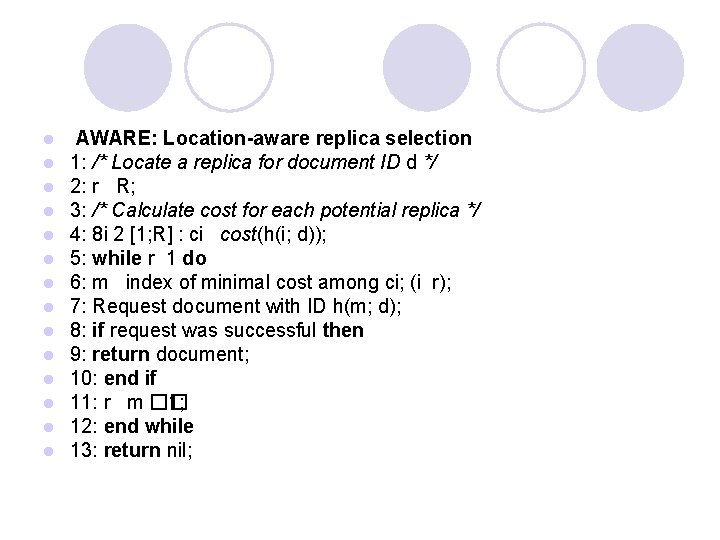
l l l l AWARE: Location-aware replica selection 1: /* Locate a replica for document ID d */ 2: r R; 3: /* Calculate cost for each potential replica */ 4: 8 i 2 [1; R] : ci cost(h(i; d)); 5: while r 1 do 6: m index of minimal cost among ci; (i r); 7: Request document with ID h(m; d); 8: if request was successful then 9: return document; 10: end if 11: r m �� 1; 12: end while 13: return nil;
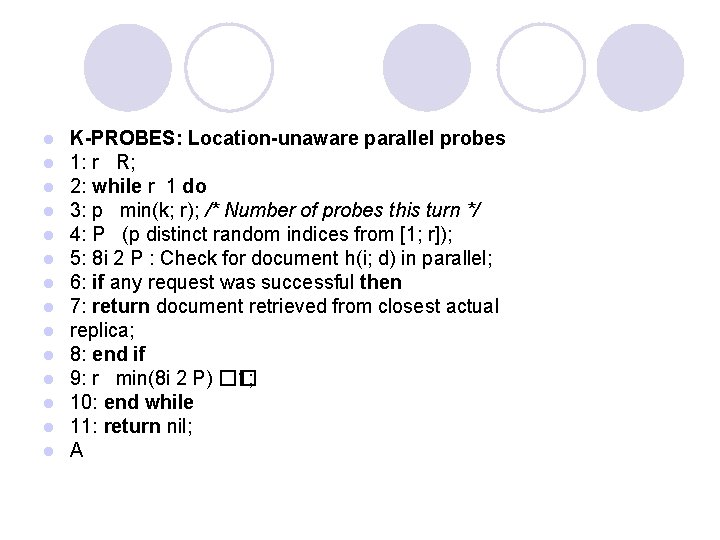
l l l l K-PROBES: Location-unaware parallel probes 1: r R; 2: while r 1 do 3: p min(k; r); /* Number of probes this turn */ 4: P (p distinct random indices from [1; r]); 5: 8 i 2 P : Check for document h(i; d) in parallel; 6: if any request was successful then 7: return document retrieved from closest actual replica; 8: end if 9: r min(8 i 2 P) �� 1; 10: end while 11: return nil; A
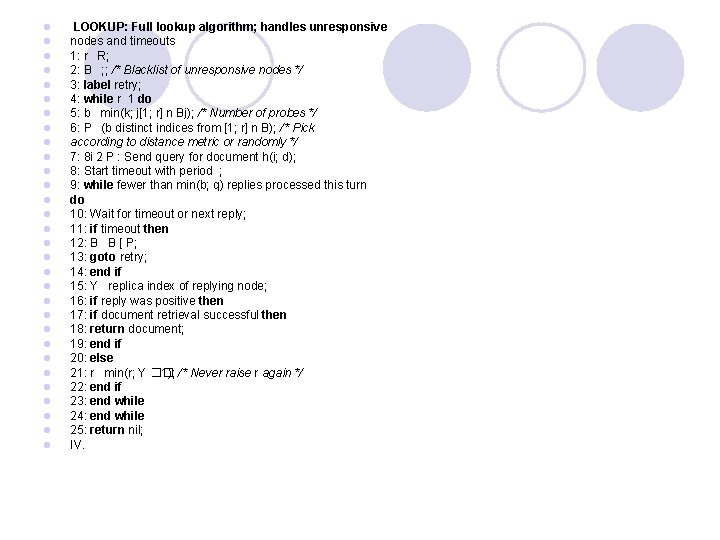
l l l l l l l l LOOKUP: Full lookup algorithm; handles unresponsive nodes and timeouts 1: r R; 2: B ; ; /* Blacklist of unresponsive nodes */ 3: label retry; 4: while r 1 do 5: b min(k; j[1; r] n Bj); /* Number of probes */ 6: P (b distinct indices from [1; r] n B); /* Pick according to distance metric or randomly */ 7: 8 i 2 P : Send query for document h(i; d); 8: Start timeout with period ; 9: while fewer than min(b; q) replies processed this turn do 10: Wait for timeout or next reply; 11: if timeout then 12: B B [ P; 13: goto retry; 14: end if 15: Y replica index of replying node; 16: if reply was positive then 17: if document retrieval successful then 18: return document; 19: end if 20: else 21: r min(r; Y �� 1); /* Never raise r again */ 22: end if 23: end while 24: end while 25: return nil; IV.
Some Examples of Replica Management systems: l Globe. DB: Automatic Data replication for web applications. l GReplica: Web based data grid replica management system.
References [1]Andrew S. Tanenbaum & Maarten van Steen. (2007) Distributed Systems Principles and Paradigms (2 nd Edition) Prentice Hall. [2]Swaminathan Sivasubramanian, Gustavo Alonso, Guillaume Pierre, and Maarten van Steen. Globe. DB: Autonomic data replication for Web applications. In 14 th International World-Wide Web Conference, Chiba, Japan, May 2005. [3]T. Loukopoulos, P. Lampsas, and I. Ahmad, “Continuous replica placement schemes in distributed systems, ” in Proceedings of the 19 th ACM International Conference on Supercomputing (ACM ICS), Boston, MA, June 2005
References (continued) [4] Micha l Szymaniak, Guillaume Pierre, and Maarten van Steen. Latency-driven replica placement. In IEEE Symposium on Applications and the Internet, Trento, Italy, January 2005. [5] L. Qiu, V. Padmanabhan, and G. Voelker. On the Placement of Web Server Replicas. in Proceedings of IEEE INFOCOM, April 2001, pp. 1587– 1596. [6] P. Radoslavov, R. Govindan, and D. Estrin, “Topology-Informed Internet Replica Placement, ” Computer Communications, vol. 25, no. 4, pp. 384– 392, March 2002. [7] Waldvogel, M. , Hurley, P. , and Bauer, D. Dynamic Replica Management in Distributed Hash Tables. IBM Research Report RZ 3502, July 2003.

l THANK YOU !
- Slides: 32