
Replacing Dimethicone as a binder in pressed powders
Replacing Dimethicone as a binder in pressed powders with vegetable-derived alternatives Diogo Baltazar, Elise Velkeneers and Slobodanka Tamburic Cosmetic Science Research Group, London College of Fashion, London, UK
Introduction and Aim Growing consumer scepticism regarding silicones has prompted the of demand silicone-free products formulated with materials from natural and sustainable sources; The industry has extracted and refined natural vegetablebased emollients as alternatives, but there is a lack of comparative data in the literature. Aim of this project: To evaluate the use of sustainable, vegetable-derived binders in pressed powders against a silicone standard, via an interand intra-formulary study using different binders and press strengths.
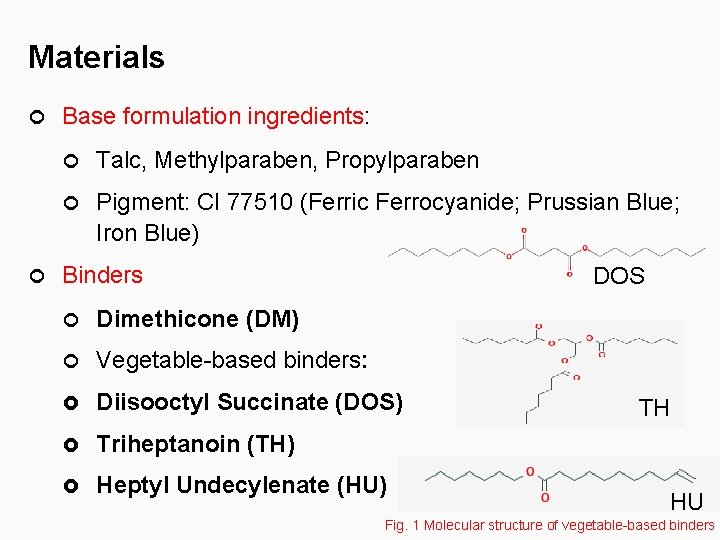
Materials Base formulation ingredients: Talc, Methylparaben, Propylparaben Pigment: CI 77510 (Ferric Ferrocyanide; Prussian Blue; Iron Blue) Binders DOS Dimethicone (DM) Vegetable-based binders: Diisooctyl Succinate (DOS) Triheptanoin (TH) Heptyl Undecylenate (HU) TH HU Fig. 1 Molecular structure of vegetable-based binders
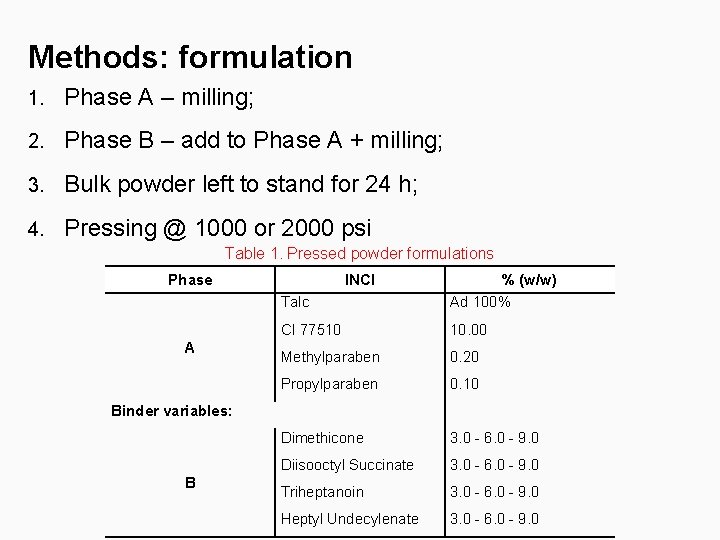
Methods: formulation 1. Phase A – milling; 2. Phase B – add to Phase A + milling; 3. Bulk powder left to stand for 24 h; 4. Pressing @ 1000 or 2000 psi Table 1. Pressed powder formulations Phase A INCI % (w/w) Talc Ad 100% CI 77510 10. 00 Methylparaben 0. 20 Propylparaben 0. 10 Dimethicone 3. 0 - 6. 0 - 9. 0 Diisooctyl Succinate 3. 0 - 6. 0 - 9. 0 Triheptanoin 3. 0 - 6. 0 - 9. 0 Heptyl Undecylenate 3. 0 - 6. 0 - 9. 0 Binder variables: B
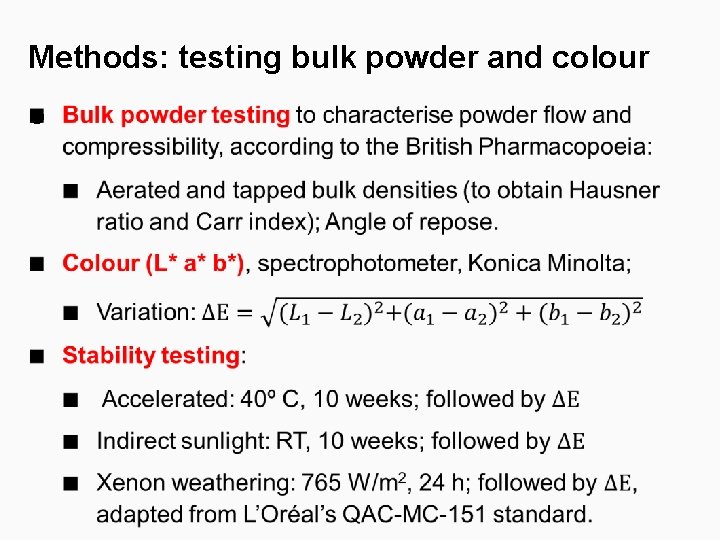
Methods: testing bulk powder and colour

Methods: testing compact powder Drop test: 30 cm drop onto a flat surface, 3 times; adapted from ASTM D 5276; Hardness: 2 mm probe with a TA. XTplus Texture Analyser (Stable Micro Systems, UK); Eyeshadow Test Protocol and using the Exponent software. Payoff – new method: Weighing, followed by testing: TA. XTplus Texture Analyser; Lipstick cantilever rig; Makeup brush; 10 passes, followed by weighing. Fig. 2 Payoff method with a cantilever rig on the TA. XTplus
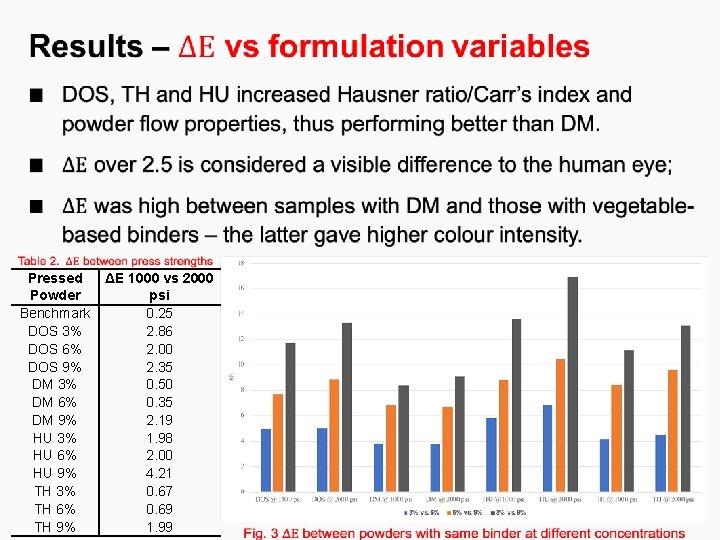
Pressed Powder Benchmark DOS 3% DOS 6% DOS 9% DM 3% DM 6% DM 9% HU 3% HU 6% HU 9% TH 3% TH 6% TH 9% ΔE 1000 vs 2000 psi 0. 25 2. 86 2. 00 2. 35 0. 50 0. 35 2. 19 1. 98 2. 00 4. 21 0. 67 0. 69 1. 99
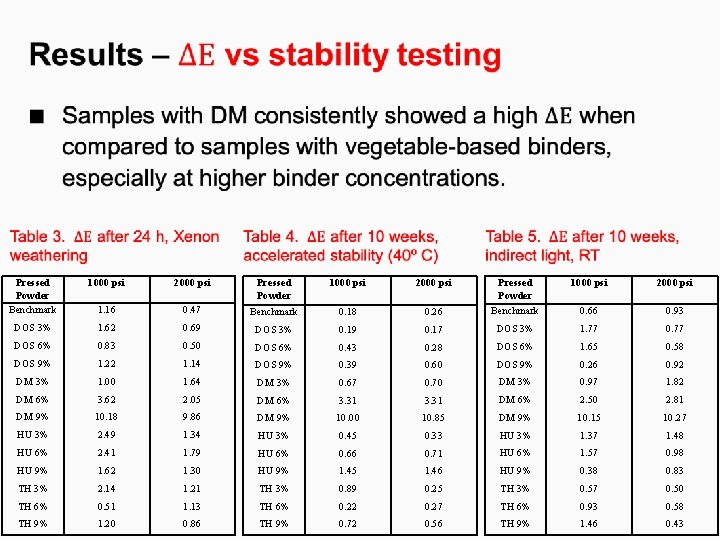
Pressed Powder Benchmark 1000 psi 2000 psi Pressed Powder 1000 psi 2000 psi 1. 16 0. 47 Benchmark 0. 18 DOS 3% 1. 62 0. 69 DOS 3% DOS 6% 0. 83 0. 50 DOS 9% 1. 22 DM 3% 1000 psi 2000 psi 0. 26 Pressed Powder Benchmark 0. 66 0. 93 0. 19 0. 17 DOS 3% 1. 77 0. 77 DOS 6% 0. 43 0. 28 DOS 6% 1. 65 0. 58 1. 14 DOS 9% 0. 39 0. 60 DOS 9% 0. 26 0. 92 1. 00 1. 64 DM 3% 0. 67 0. 70 DM 3% 0. 97 1. 82 DM 6% 3. 62 2. 05 DM 6% 3. 31 DM 6% 2. 50 2. 81 DM 9% 10. 18 9. 86 DM 9% 10. 00 10. 85 DM 9% 10. 15 10. 27 HU 3% 2. 49 1. 34 HU 3% 0. 45 0. 33 HU 3% 1. 37 1. 48 HU 6% 2. 41 1. 79 HU 6% 0. 66 0. 71 HU 6% 1. 57 0. 98 HU 9% 1. 62 1. 30 HU 9% 1. 45 1. 46 HU 9% 0. 38 0. 83 TH 3% 2. 14 1. 21 TH 3% 0. 89 0. 25 TH 3% 0. 57 0. 50 TH 6% 0. 51 1. 13 TH 6% 0. 22 0. 27 TH 6% 0. 93 0. 58 TH 9% 1. 20 0. 86 TH 9% 0. 72 0. 56 TH 9% 1. 46 0. 43
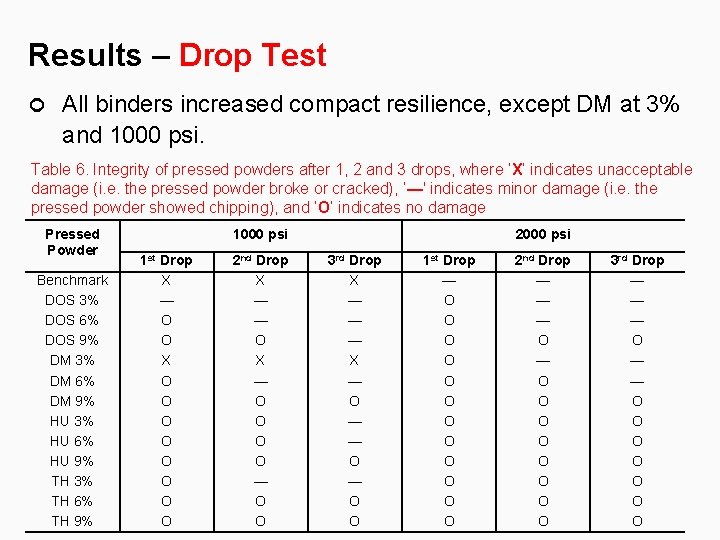
Results – Drop Test All binders increased compact resilience, except DM at 3% and 1000 psi. Table 6. Integrity of pressed powders after 1, 2 and 3 drops, where ‘X’ indicates unacceptable damage (i. e. the pressed powder broke or cracked), ‘—' indicates minor damage (i. e. the pressed powder showed chipping), and ‘O’ indicates no damage Pressed Powder Benchmark DOS 3% DOS 6% DOS 9% DM 3% DM 6% DM 9% HU 3% HU 6% HU 9% TH 3% TH 6% TH 9% 1000 psi 1 st Drop X — O O X O O O O 2 nd Drop X — — O X — O O 2000 psi 3 rd Drop X — — — X — O — O O 1 st Drop — O O O 2 nd Drop — — — O O O O O 3 rd Drop — — — O O O O
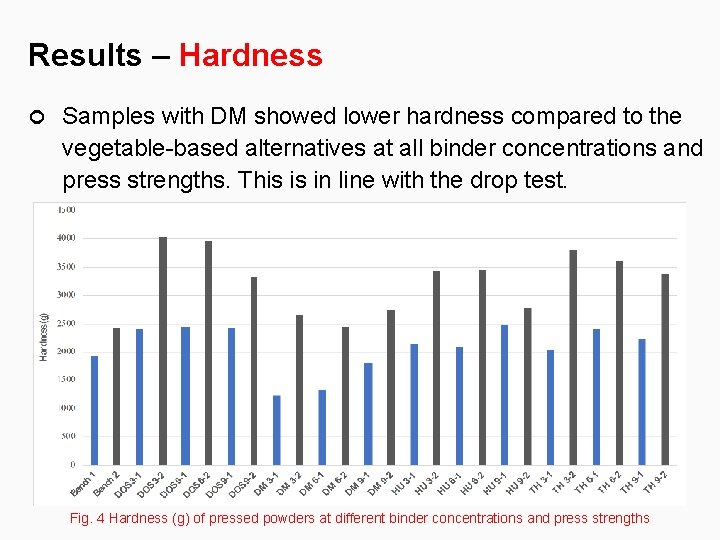
Results – Hardness Samples with DM showed lower hardness compared to the vegetable-based alternatives at all binder concentrations and press strengths. This is in line with the drop test. Fig. 4 Hardness (g) of pressed powders at different binder concentrations and press strengths
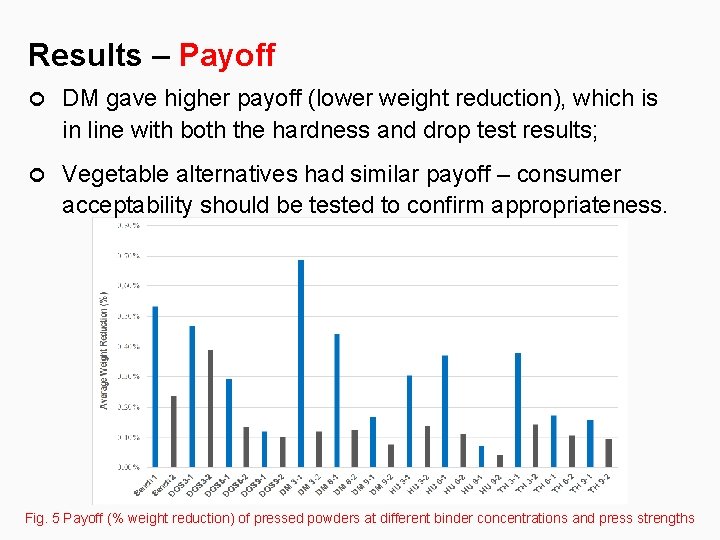
Results – Payoff DM gave higher payoff (lower weight reduction), which is in line with both the hardness and drop test results; Vegetable alternatives had similar payoff – consumer acceptability should be tested to confirm appropriateness. Fig. 5 Payoff (% weight reduction) of pressed powders at different binder concentrations and press strengths
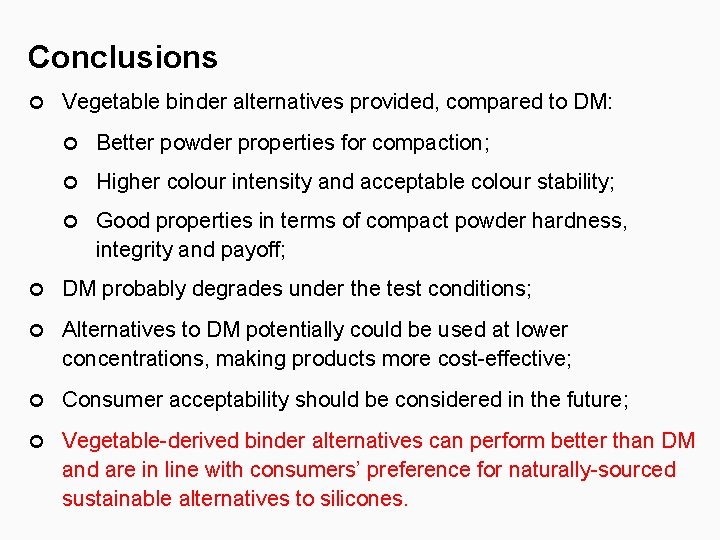
Conclusions Vegetable binder alternatives provided, compared to DM: Better powder properties for compaction; Higher colour intensity and acceptable colour stability; Good properties in terms of compact powder hardness, integrity and payoff; DM probably degrades under the test conditions; Alternatives to DM potentially could be used at lower concentrations, making products more cost-effective; Consumer acceptability should be considered in the future; Vegetable-derived binder alternatives can perform better than DM and are in line with consumers’ preference for naturally-sourced sustainable alternatives to silicones.
References Mintel, Human ethics can boost palm oil’s profile (2018) Mintel, Natural, Organic and Ethical Toiletries – UK (2017) British Pharmacopoeia, Stationery Office (2014) L’Óreal QAC-MC-151 ASTM D 5276 E. F. C. Griessbach, R. G. Lehmann, Chemosphere, 38(6), 1461 -1468 (1999)
- Slides: 13