
Repeated Reading Strategies to Increase Reading Comprehension in
- Slides: 1
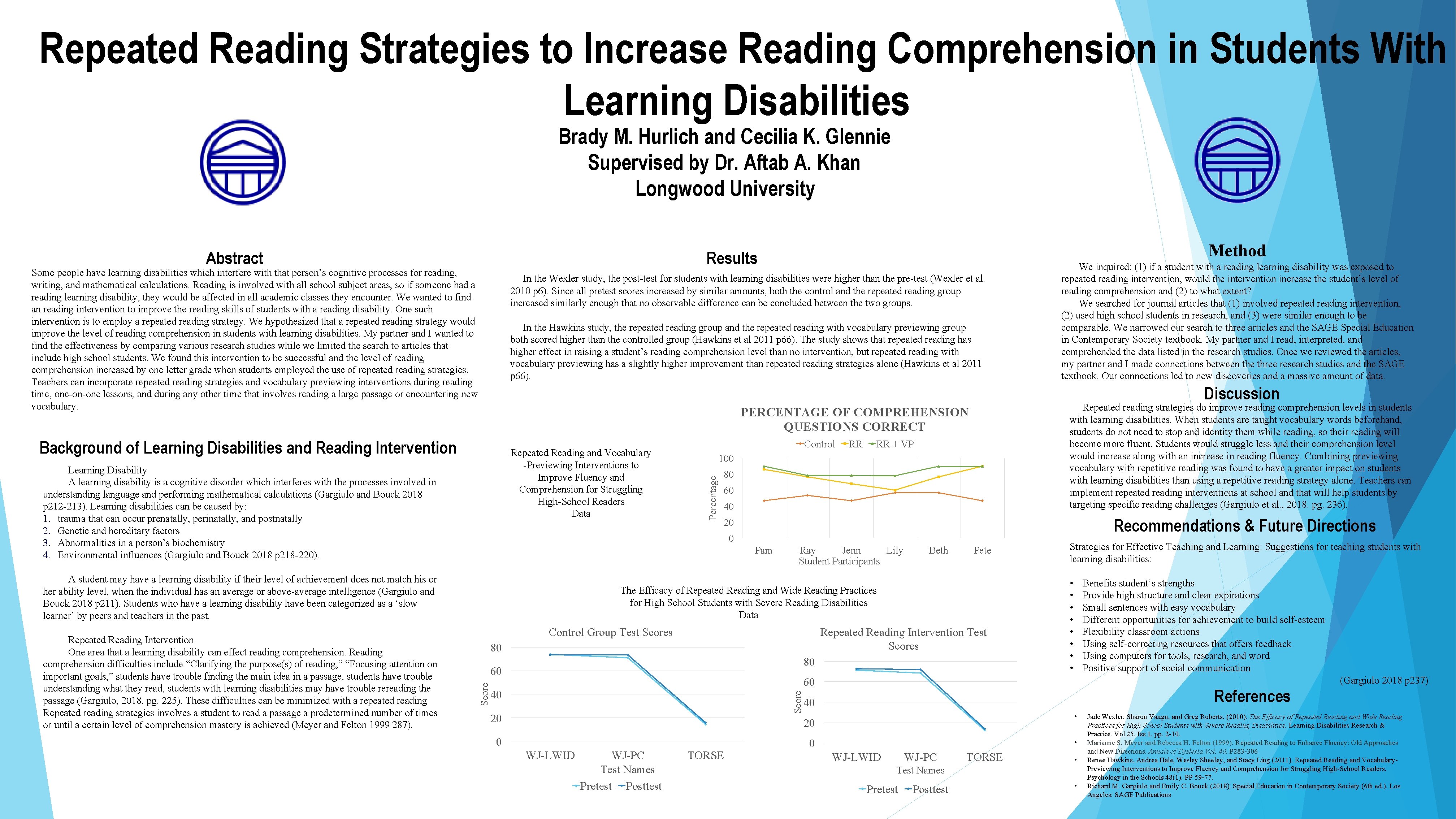
Repeated Reading Strategies to Increase Reading Comprehension in Students With Learning Disabilities Brady M. Hurlich and Cecilia K. Glennie Supervised by Dr. Aftab A. Khan Longwood University Results Abstract Some people have learning disabilities which interfere with that person’s cognitive processes for reading, writing, and mathematical calculations. Reading is involved with all school subject areas, so if someone had a reading learning disability, they would be affected in all academic classes they encounter. We wanted to find an reading intervention to improve the reading skills of students with a reading disability. One such intervention is to employ a repeated reading strategy. We hypothesized that a repeated reading strategy would improve the level of reading comprehension in students with learning disabilities. My partner and I wanted to find the effectiveness by comparing various research studies while we limited the search to articles that include high school students. We found this intervention to be successful and the level of reading comprehension increased by one letter grade when students employed the use of repeated reading strategies. Teachers can incorporate repeated reading strategies and vocabulary previewing interventions during reading time, one-on-one lessons, and during any other time that involves reading a large passage or encountering new vocabulary. In the Wexler study, the post-test for students with learning disabilities were higher than the pre-test (Wexler et al. 2010 p 6). Since all pretest scores increased by similar amounts, both the control and the repeated reading group increased similarly enough that no observable difference can be concluded between the two groups. In the Hawkins study, the repeated reading group and the repeated reading with vocabulary previewing group both scored higher than the controlled group (Hawkins et al 2011 p 66). The study shows that repeated reading has higher effect in raising a student’s reading comprehension level than no intervention, but repeated reading with vocabulary previewing has a slightly higher improvement than repeated reading strategies alone (Hawkins et al 2011 p 66). We inquired: (1) if a student with a reading learning disability was exposed to repeated reading intervention, would the intervention increase the student’s level of reading comprehension and (2) to what extent? We searched for journal articles that (1) involved repeated reading intervention, (2) used high school students in research, and (3) were similar enough to be comparable. We narrowed our search to three articles and the SAGE Special Education in Contemporary Society textbook. My partner and I read, interpreted, and comprehended the data listed in the research studies. Once we reviewed the articles, my partner and I made connections between the three research studies and the SAGE textbook. Our connections led to new discoveries and a massive amount of data. Discussion Repeated reading strategies do improve reading comprehension levels in students with learning disabilities. When students are taught vocabulary words beforehand, students do not need to stop and identity them while reading, so their reading will become more fluent. Students would struggle less and their comprehension level would increase along with an increase in reading fluency. Combining previewing vocabulary with repetitive reading was found to have a greater impact on students with learning disabilities than using a repetitive reading strategy alone. Teachers can implement repeated reading interventions at school and that will help students by targeting specific reading challenges (Gargiulo et al. , 2018. pg. 236). PERCENTAGE OF COMPREHENSION QUESTIONS CORRECT Repeated Reading and Vocabulary -Previewing Interventions to Improve Fluency and Comprehension for Struggling High-School Readers Data Learning Disability A learning disability is a cognitive disorder which interferes with the processes involved in understanding language and performing mathematical calculations (Gargiulo and Bouck 2018 p 212 -213). Learning disabilities can be caused by: 1. trauma that can occur prenatally, perinatally, and postnatally 2. Genetic and hereditary factors 3. Abnormalities in a person’s biochemistry 4. Environmental influences (Gargiulo and Bouck 2018 p 218 -220). Control RR RR + VP 100 Percentage Background of Learning Disabilities and Reading Intervention 80 60 40 Recommendations & Future Directions 20 0 Pam A student may have a learning disability if their level of achievement does not match his or her ability level, when the individual has an average or above-average intelligence (Gargiulo and Bouck 2018 p 211). Students who have a learning disability have been categorized as a ‘slow learner’ by peers and teachers in the past. Ray Jenn Lily Student Participants Beth Pete The Efficacy of Repeated Reading and Wide Reading Practices for High School Students with Severe Reading Disabilities Data Repeated Reading Intervention Test Scores Control Group Test Scores 80 80 60 Strategies for Effective Teaching and Learning: Suggestions for teaching students with learning disabilities: • • Benefits student’s strengths Provide high structure and clear expirations Small sentences with easy vocabulary Different opportunities for achievement to build self-esteem Flexibility classroom actions Using self-correcting resources that offers feedback Using computers for tools, research, and word Positive support of social communication (Gargiulo 2018 p 237) 60 40 Score Repeated Reading Intervention One area that a learning disability can effect reading comprehension. Reading comprehension difficulties include “Clarifying the purpose(s) of reading, ” “Focusing attention on important goals, ” students have trouble finding the main idea in a passage, students have trouble understanding what they read, students with learning disabilities may have trouble rereading the passage (Gargiulo, 2018. pg. 225). These difficulties can be minimized with a repeated reading Repeated reading strategies involves a student to read a passage a predetermined number of times or until a certain level of comprehension mastery is achieved (Meyer and Felton 1999 287). Method 20 References 40 • 20 0 WJ-LWID WJ-PC Test Names Pretest Posttest TORSE 0 • WJ-LWID WJ-PC TORSE • Test Names Pretest Posttest • Jade Wexler, Sharon Vaugn, and Greg Roberts. (2010). The Efficacy of Repeated Reading and Wide Reading Practices for High School Students with Severe Reading Disabilities. Learning Disabilities Research & Practice. Vol 25. Iss 1. pp. 2 -10. Marianne S. Meyer and Rebecca H. Felton (1999). Repeated Reading to Enhance Fluency: Old Approaches and New Directions. Annals of Dyslexia Vol. 49. P 283 -306 Renee Hawkins, Andrea Hale, Wesley Sheeley, and Stacy Ling (2011). Repeated Reading and Vocabulary. Previewing Interventions to Improve Fluency and Comprehension for Struggling High-School Readers. Psychology in the Schools 48(1). PP 59 -77. Richard M. Gargiulo and Emily C. Bouck (2018). Special Education in Contemporary Society (6 th ed. ). Los Angeles: SAGE Publications