
Repeated percentage change In a sale all the
- Slides: 8
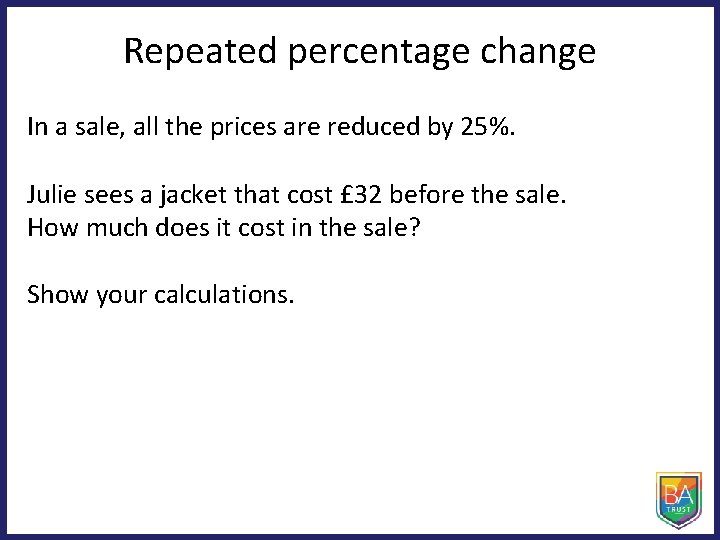
Repeated percentage change In a sale, all the prices are reduced by 25%. Julie sees a jacket that cost £ 32 before the sale. How much does it cost in the sale? Show your calculations.
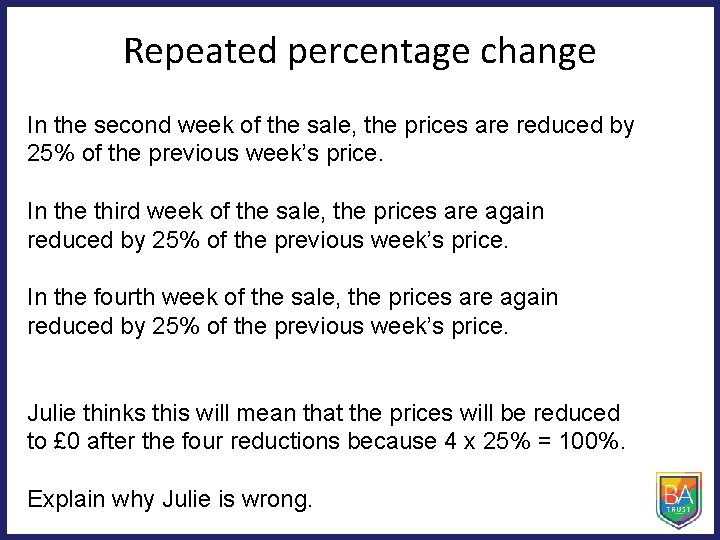
Repeated percentage change In the second week of the sale, the prices are reduced by 25% of the previous week’s price. In the third week of the sale, the prices are again reduced by 25% of the previous week’s price. In the fourth week of the sale, the prices are again reduced by 25% of the previous week’s price. Julie thinks this will mean that the prices will be reduced to £ 0 after the four reductions because 4 x 25% = 100%. Explain why Julie is wrong.
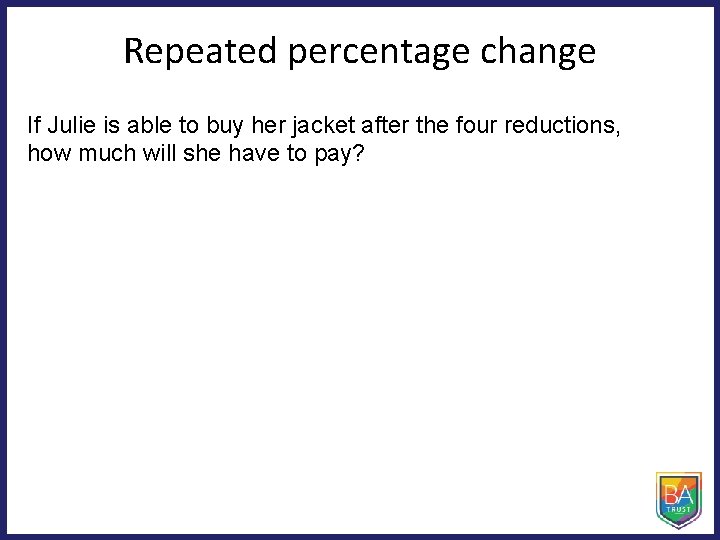
Repeated percentage change If Julie is able to buy her jacket after the four reductions, how much will she have to pay?
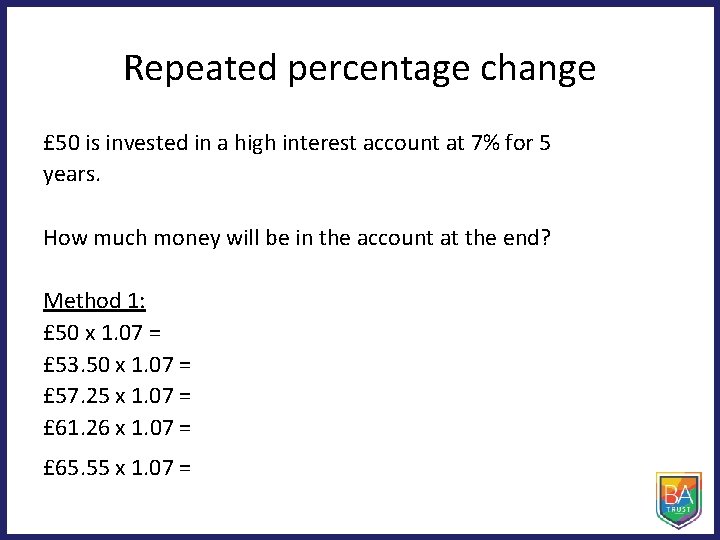
Repeated percentage change £ 50 is invested in a high interest account at 7% for 5 years. How much money will be in the account at the end? Method 1: £ 50 x 1. 07 = £ 53. 50 x 1. 07 = £ 57. 25 x 1. 07 = £ 61. 26 x 1. 07 = £ 65. 55 x 1. 07 =
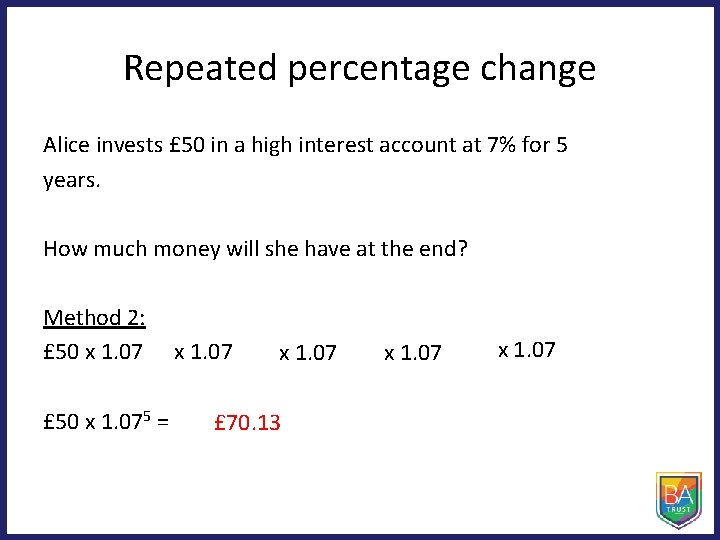
Repeated percentage change Alice invests £ 50 in a high interest account at 7% for 5 years. How much money will she have at the end? Method 2: £ 50 x 1. 075 = x 1. 07 £ 70. 13 x 1. 07
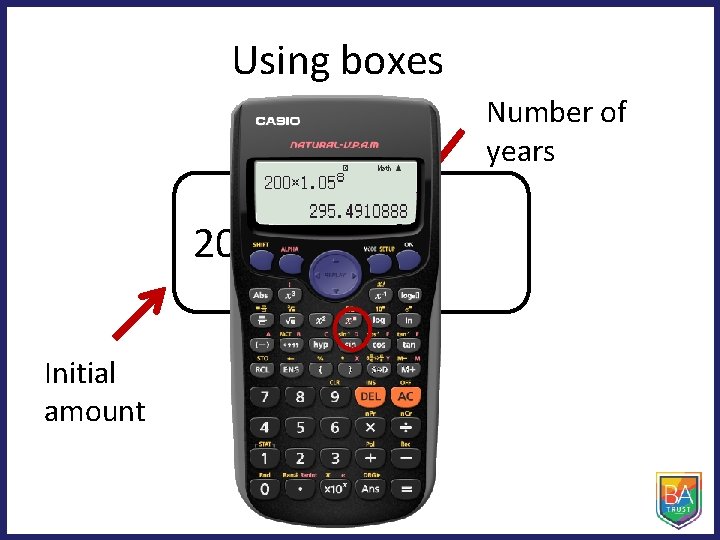
Using boxes Number of years 200 Initial amount Percentage increase or decrease
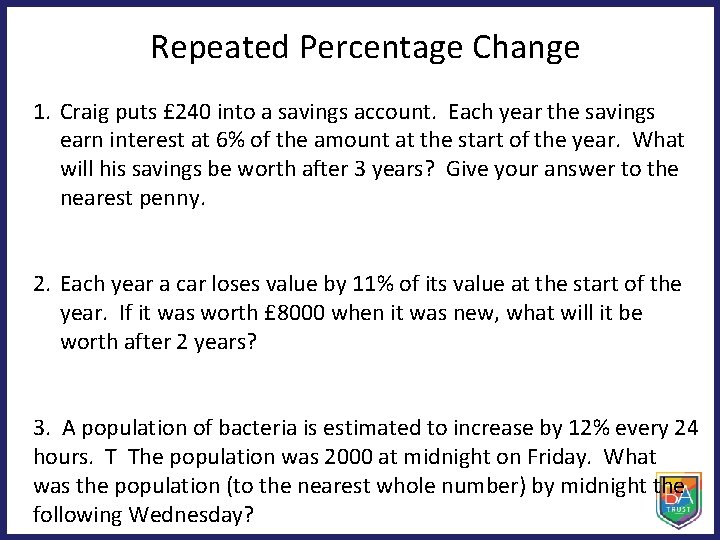
Repeated Percentage Change 1. Craig puts £ 240 into a savings account. Each year the savings earn interest at 6% of the amount at the start of the year. What will his savings be worth after 3 years? Give your answer to the nearest penny. 2. Each year a car loses value by 11% of its value at the start of the year. If it was worth £ 8000 when it was new, what will it be worth after 2 years? 3. A population of bacteria is estimated to increase by 12% every 24 hours. T The population was 2000 at midnight on Friday. What was the population (to the nearest whole number) by midnight the following Wednesday?
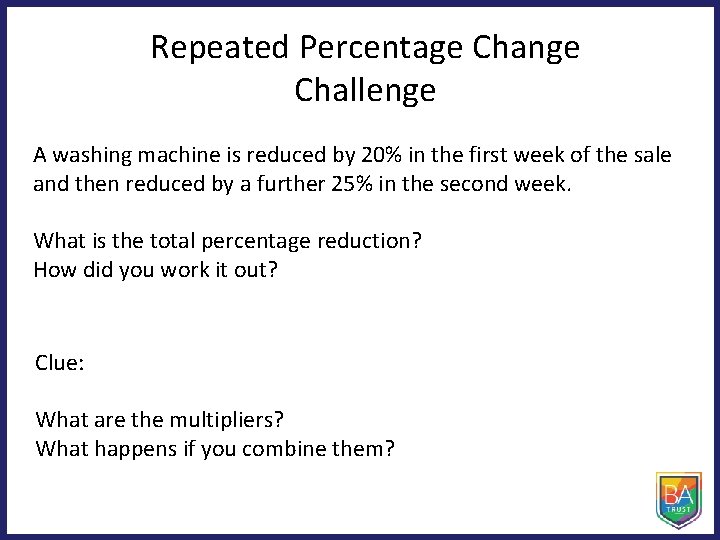
Repeated Percentage Change Challenge A washing machine is reduced by 20% in the first week of the sale and then reduced by a further 25% in the second week. What is the total percentage reduction? How did you work it out? Clue: What are the multipliers? What happens if you combine them?