
Repaso 2013 Definite and indefinite articles El la


- Slides: 27
Repaso 2013
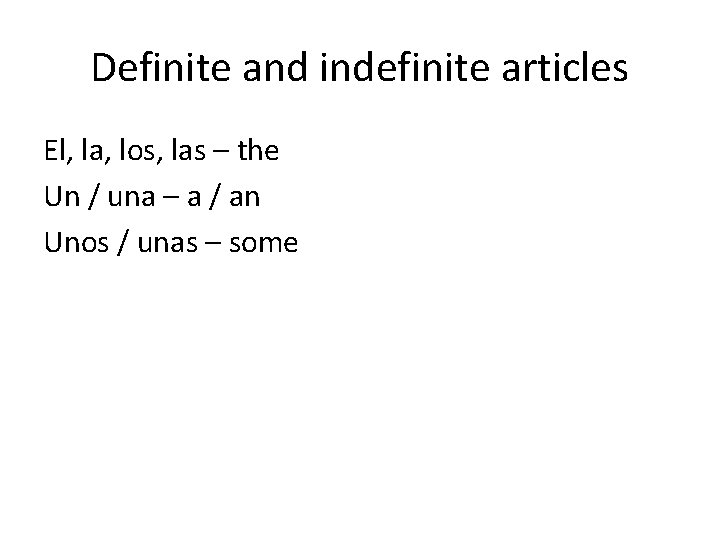
Definite and indefinite articles El, la, los, las – the Un / una – a / an Unos / unas – some
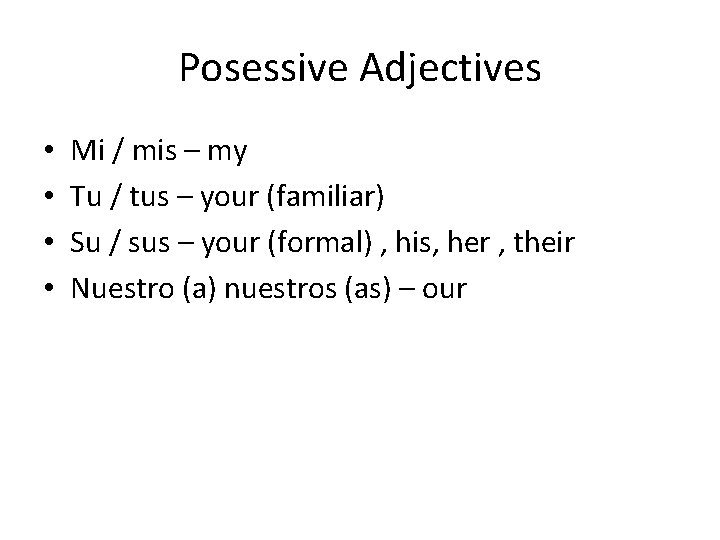
Posessive Adjectives • • Mi / mis – my Tu / tus – your (familiar) Su / sus – your (formal) , his, her , their Nuestro (a) nuestros (as) – our
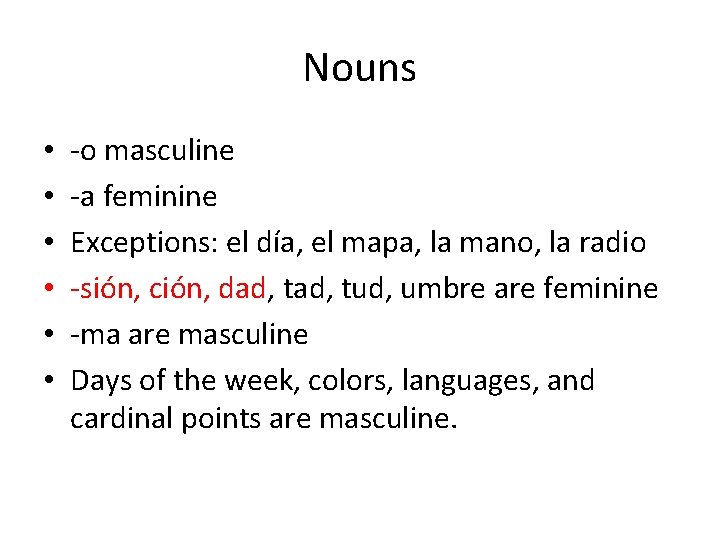
Nouns • • • -o masculine -a feminine Exceptions: el día, el mapa, la mano, la radio -sión, ción, dad, tud, umbre are feminine -ma are masculine Days of the week, colors, languages, and cardinal points are masculine.
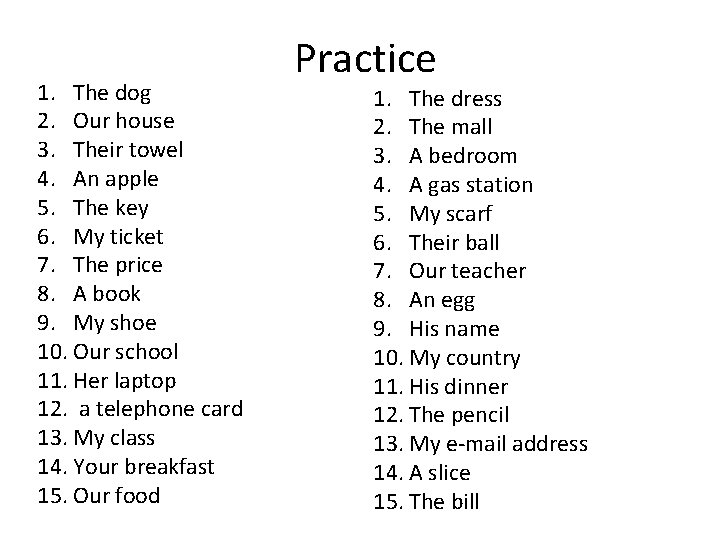
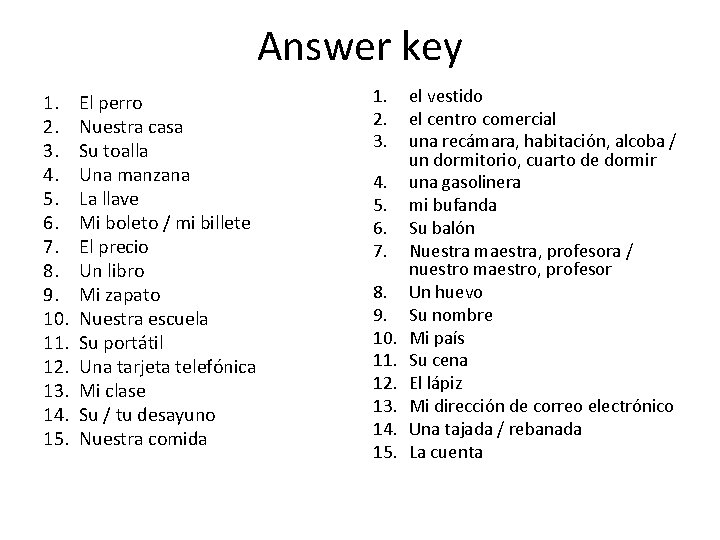
1. The dog 2. Our house 3. Their towel 4. An apple 5. The key 6. My ticket 7. The price 8. A book 9. My shoe 10. Our school 11. Her laptop 12. a telephone card 13. My class 14. Your breakfast 15. Our food Practice 1. The dress 2. The mall 3. A bedroom 4. A gas station 5. My scarf 6. Their ball 7. Our teacher 8. An egg 9. His name 10. My country 11. His dinner 12. The pencil 13. My e-mail address 14. A slice 15. The bill
Answer key 1. 2. 3. 4. 5. 6. 7. 8. 9. 10. 11. 12. 13. 14. 15. El perro Nuestra casa Su toalla Una manzana La llave Mi boleto / mi billete El precio Un libro Mi zapato Nuestra escuela Su portátil Una tarjeta telefónica Mi clase Su / tu desayuno Nuestra comida 1. 2. 3. 4. 5. 6. 7. 8. 9. 10. 11. 12. 13. 14. 15. el vestido el centro comercial una recámara, habitación, alcoba / un dormitorio, cuarto de dormir una gasolinera mi bufanda Su balón Nuestra maestra, profesora / nuestro maestro, profesor Un huevo Su nombre Mi país Su cena El lápiz Mi dirección de correo electrónico Una tajada / rebanada La cuenta
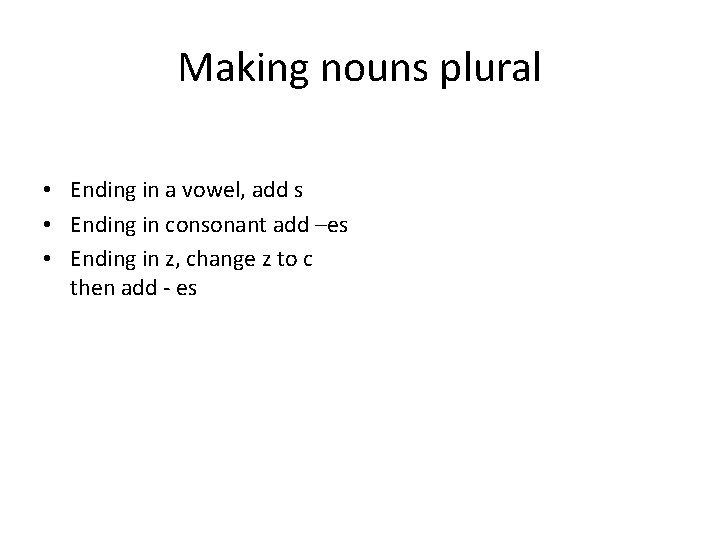
Making nouns plural • Ending in a vowel, add s • Ending in consonant add –es • Ending in z, change z to c then add - es
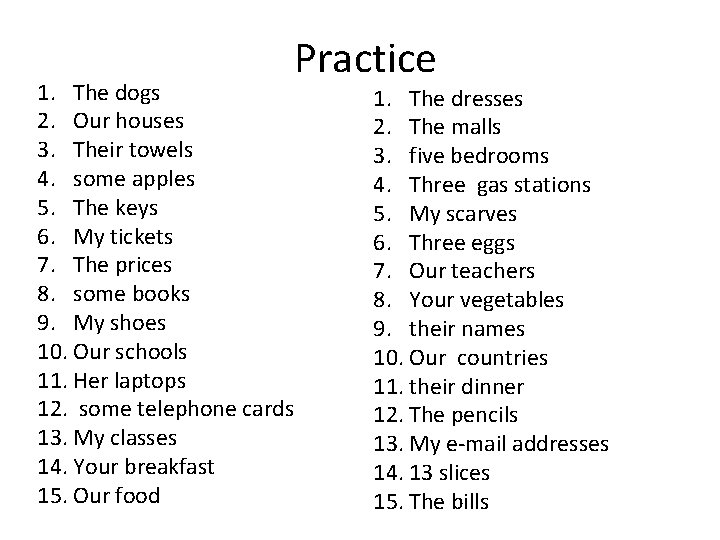
1. The dogs 2. Our houses 3. Their towels 4. some apples 5. The keys 6. My tickets 7. The prices 8. some books 9. My shoes 10. Our schools 11. Her laptops 12. some telephone cards 13. My classes 14. Your breakfast 15. Our food Practice 1. The dresses 2. The malls 3. five bedrooms 4. Three gas stations 5. My scarves 6. Three eggs 7. Our teachers 8. Your vegetables 9. their names 10. Our countries 11. their dinner 12. The pencils 13. My e-mail addresses 14. 13 slices 15. The bills
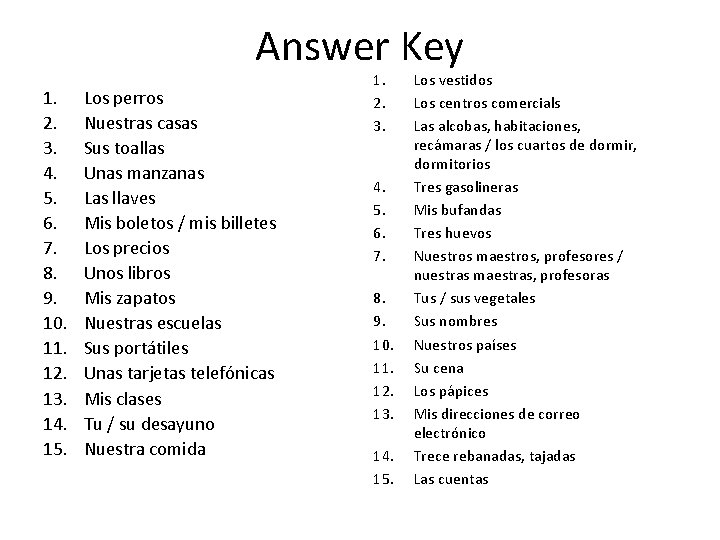
Answer Key 1. 2. 3. 4. 5. 6. 7. 8. 9. 10. 11. 12. 13. 14. 15. Los perros Nuestras casas Sus toallas Unas manzanas Las llaves Mis boletos / mis billetes Los precios Unos libros Mis zapatos Nuestras escuelas Sus portátiles Unas tarjetas telefónicas Mis clases Tu / su desayuno Nuestra comida 1. 2. 3. 4. 5. 6. 7. 8. 9. 10. 11. 12. 13. 14. 15. Los vestidos Los centros comercials Las alcobas, habitaciones, recámaras / los cuartos de dormir, dormitorios Tres gasolineras Mis bufandas Tres huevos Nuestros maestros, profesores / nuestras maestras, profesoras Tus / sus vegetales Sus nombres Nuestros países Su cena Los pápices Mis direcciones de correo electrónico Trece rebanadas, tajadas Las cuentas
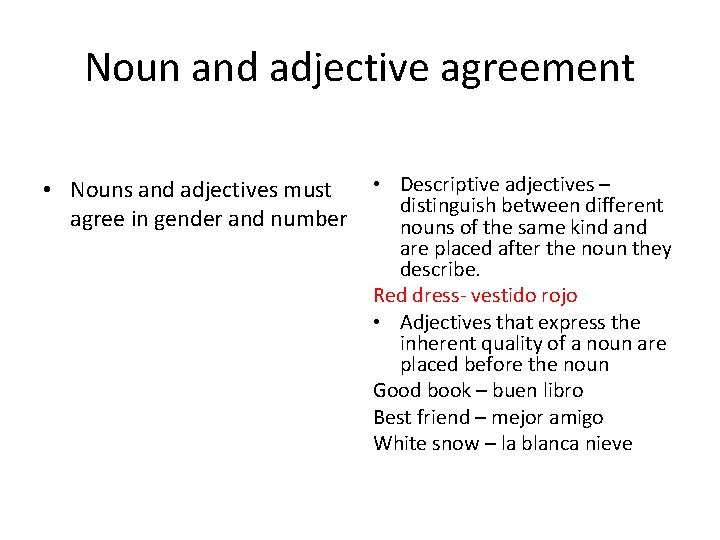
Noun and adjective agreement • Nouns and adjectives must agree in gender and number • Descriptive adjectives – distinguish between different nouns of the same kind are placed after the noun they describe. Red dress- vestido rojo • Adjectives that express the inherent quality of a noun are placed before the noun Good book – buen libro Best friend – mejor amigo White snow – la blanca nieve
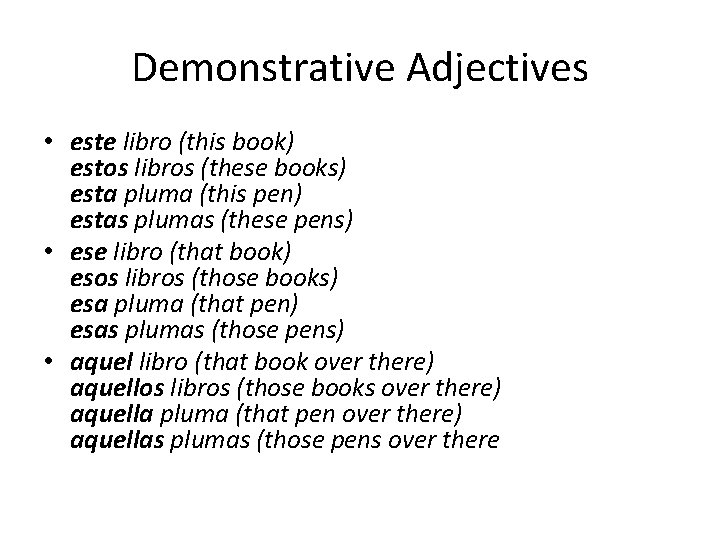
Demonstrative Adjectives • este libro (this book) estos libros (these books) esta pluma (this pen) estas plumas (these pens) • ese libro (that book) esos libros (those books) esa pluma (that pen) esas plumas (those pens) • aquel libro (that book over there) aquellos libros (those books over there) aquella pluma (that pen over there) aquellas plumas (those pens over there
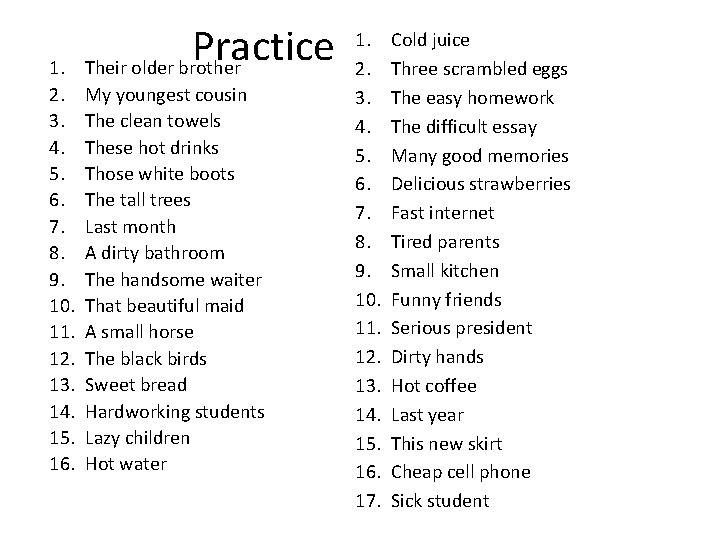
1. 2. 3. 4. 5. 6. 7. 8. 9. 10. 11. 12. 13. 14. 15. 16. Practice Their older brother My youngest cousin The clean towels These hot drinks Those white boots The tall trees Last month A dirty bathroom The handsome waiter That beautiful maid A small horse The black birds Sweet bread Hardworking students Lazy children Hot water 1. 2. 3. 4. 5. 6. 7. 8. 9. 10. 11. 12. 13. 14. 15. 16. 17. Cold juice Three scrambled eggs The easy homework The difficult essay Many good memories Delicious strawberries Fast internet Tired parents Small kitchen Funny friends Serious president Dirty hands Hot coffee Last year This new skirt Cheap cell phone Sick student
1. 2. 3. 4. 5. 6. 7. 8. 9. 10. 11. 12. 13. 14. 15. 16. Practice Their older brother My youngest cousin The clean towels These hot drinks Those white boots The tall trees Last month A dirty bathroom The handsome waiter That beautiful maid A small horse The black birds Sweet bread Hardworking students Lazy children Hot water 1. 2. 3. 4. 5. 6. 7. 8. 9. 10. 11. 12. 13. 14. 15. 16. 17. Cold juice Three scrambled eggs The easy homework The difficult essay Many good memories Delicious strawberries Fast internet Tired parents Small kitchen Funny friends Serious president Dirty hands Hot coffee Last year This new skirt Cheap cell phone Sick student
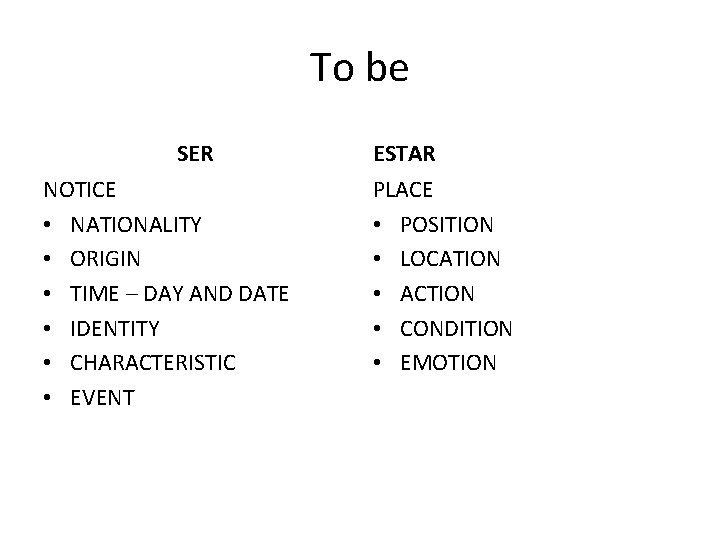
To be SER NOTICE • NATIONALITY • ORIGIN • TIME – DAY AND DATE • IDENTITY • CHARACTERISTIC • EVENT ESTAR PLACE • POSITION • LOCATION • ACTION • CONDITION • EMOTION
1. My parents are here. 2. Our teachers are very smart and hardworking. 3. We were in the attic. 4. I will be sick this week. 5. The party is at the pool. 6. The students are French. 7. My parents are happy with me. 8. It was midnight. 9. The international airport is in Columbus. 10. I am going to the library. 1. His best friend is from Ghana. 2. The pencils are on your desk. 3. We were at the beach for three hours today. 4. It is 2: 00 o’clock.
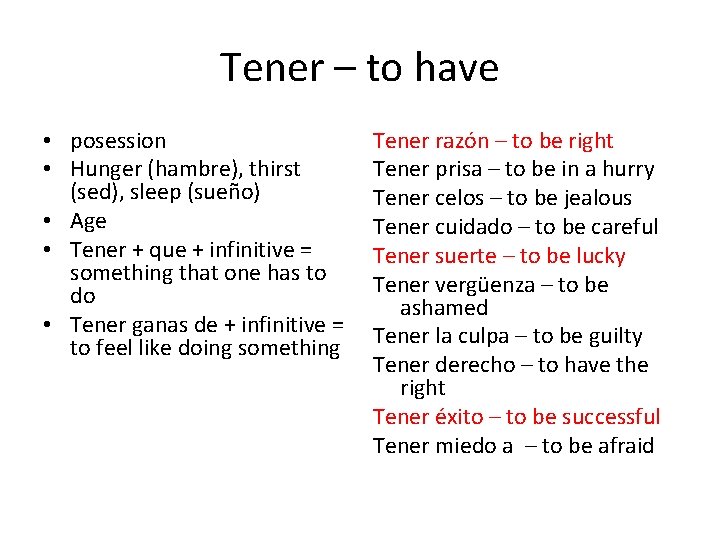
Tener – to have • posession • Hunger (hambre), thirst (sed), sleep (sueño) • Age • Tener + que + infinitive = something that one has to do • Tener ganas de + infinitive = to feel like doing something Tener razón – to be right Tener prisa – to be in a hurry Tener celos – to be jealous Tener cuidado – to be careful Tener suerte – to be lucky Tener vergüenza – to be ashamed Tener la culpa – to be guilty Tener derecho – to have the right Tener éxito – to be successful Tener miedo a – to be afraid
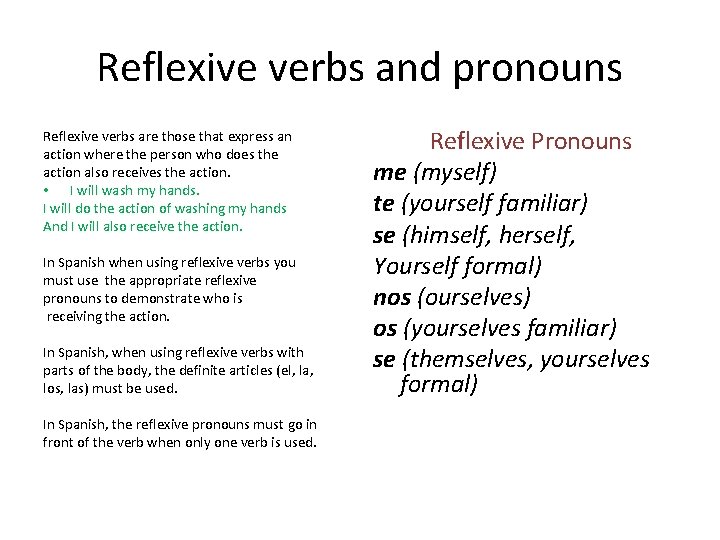
Reflexive verbs and pronouns Reflexive verbs are those that express an action where the person who does the action also receives the action. • I will wash my hands. I will do the action of washing my hands And I will also receive the action. In Spanish when using reflexive verbs you must use the appropriate reflexive pronouns to demonstrate who is receiving the action. In Spanish, when using reflexive verbs with parts of the body, the definite articles (el, la, los, las) must be used. In Spanish, the reflexive pronouns must go in front of the verb when only one verb is used. Reflexive Pronouns me (myself) te (yourself familiar) se (himself, herself, Yourself formal) nos (ourselves) os (yourselves familiar) se (themselves, yourselves formal)
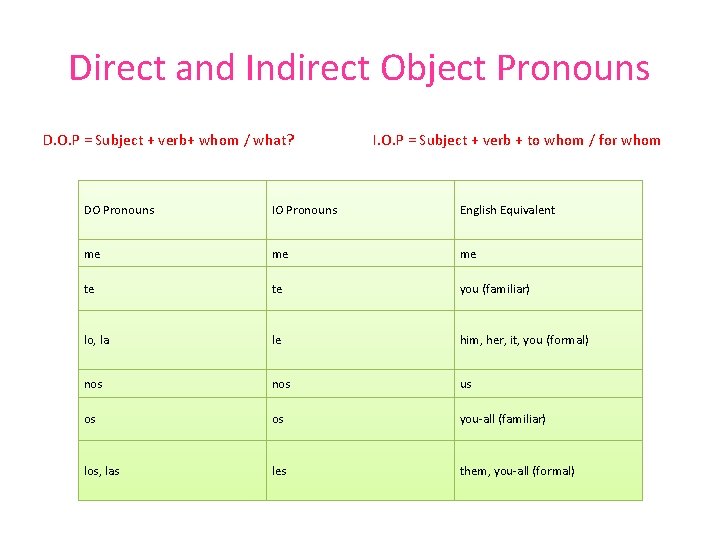
Direct and Indirect Object Pronouns D. O. P = Subject + verb+ whom / what? I. O. P = Subject + verb + to whom / for whom DO Pronouns IO Pronouns English Equivalent me me me te te you (familiar) lo, la le him, her, it, you (formal) nos us os os you-all (familiar) los, las les them, you-all (formal)
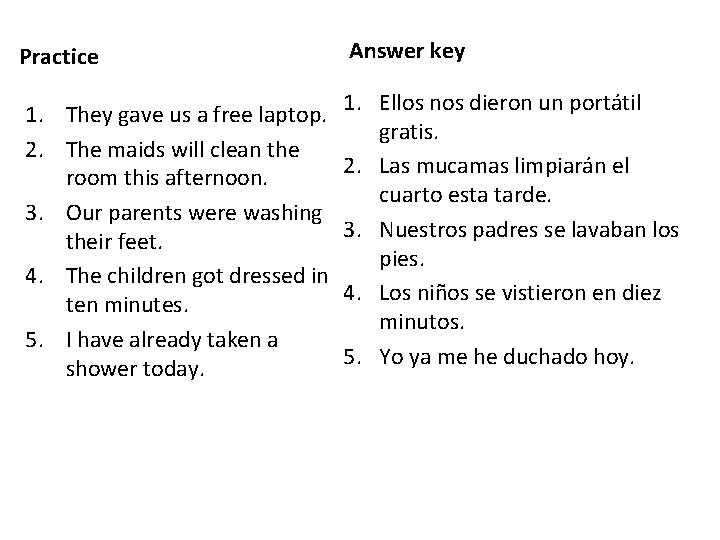
Practice Answer key 1. They gave us a free laptop. 2. The maids will clean the room this afternoon. 3. Our parents were washing their feet. 4. The children got dressed in ten minutes. 5. I have already taken a shower today. 1. Ellos nos dieron un portátil gratis. 2. Las mucamas limpiarán el cuarto esta tarde. 3. Nuestros padres se lavaban los pies. 4. Los niños se vistieron en diez minutos. 5. Yo ya me he duchado hoy.
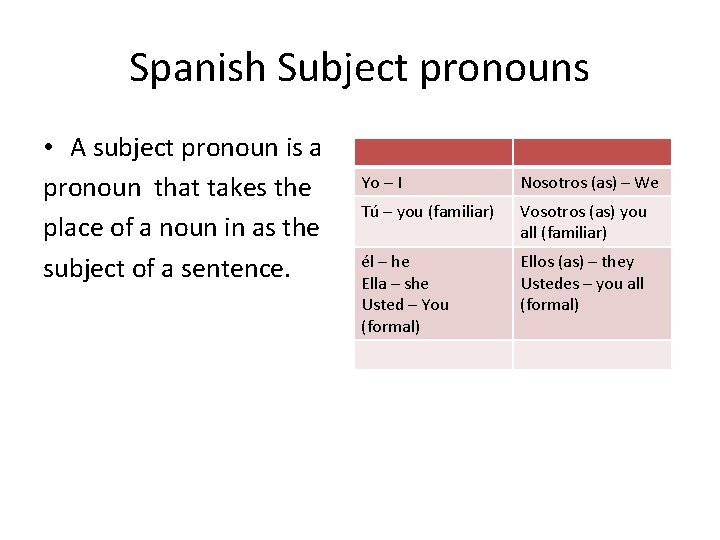
Spanish Subject pronouns • A subject pronoun is a pronoun that takes the place of a noun in as the subject of a sentence. Yo – I Nosotros (as) – We Tú – you (familiar) Vosotros (as) you all (familiar) él – he Ella – she Usted – You (formal) Ellos (as) – they Ustedes – you all (formal)
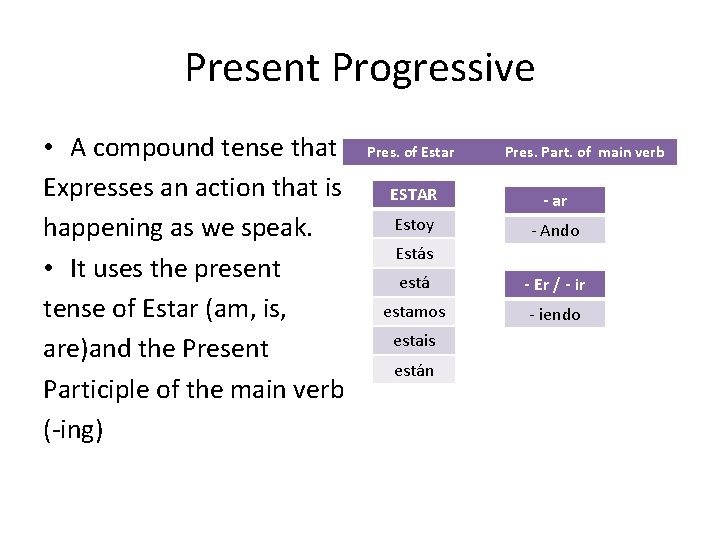
Present Progressive • A compound tense that Expresses an action that is happening as we speak. • It uses the present tense of Estar (am, is, are)and the Present Participle of the main verb (-ing) Pres. of Estar Pres. Part. of main verb ESTAR - ar Estoy - Ando Estás está - Er / - ir estamos - iendo estais están
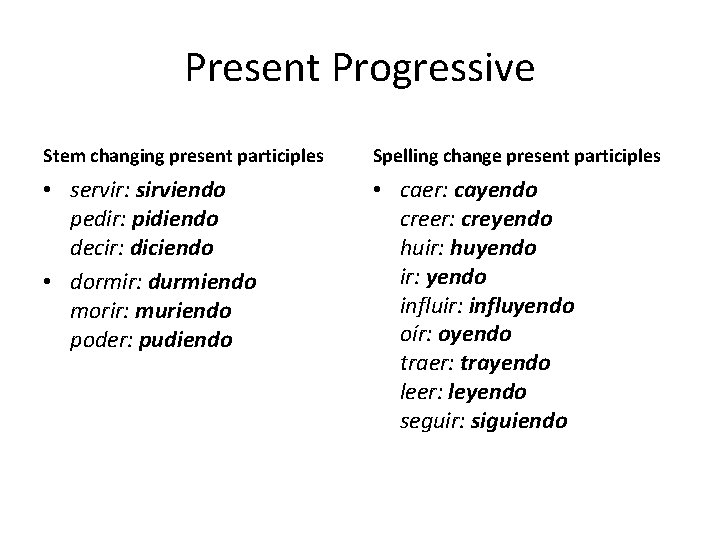
Present Progressive Stem changing present participles Spelling change present participles • servir: sirviendo pedir: pidiendo decir: diciendo • dormir: durmiendo morir: muriendo poder: pudiendo • caer: cayendo creer: creyendo huir: huyendo ir: yendo influir: influyendo oír: oyendo traer: trayendo leer: leyendo seguir: siguiendo
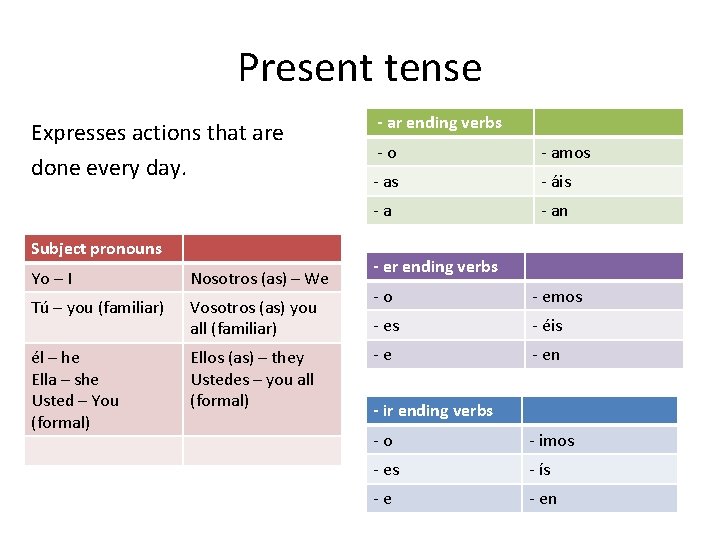
Present tense Expresses actions that are done every day. Subject pronouns Yo – I Nosotros (as) – We Tú – you (familiar) Vosotros (as) you all (familiar) él – he Ella – she Usted – You (formal) Ellos (as) – they Ustedes – you all (formal) - ar ending verbs -o - amos - as - áis -a - an - er ending verbs -o - emos - es - éis -e - en - ir ending verbs -o - imos - es - ís -e - en
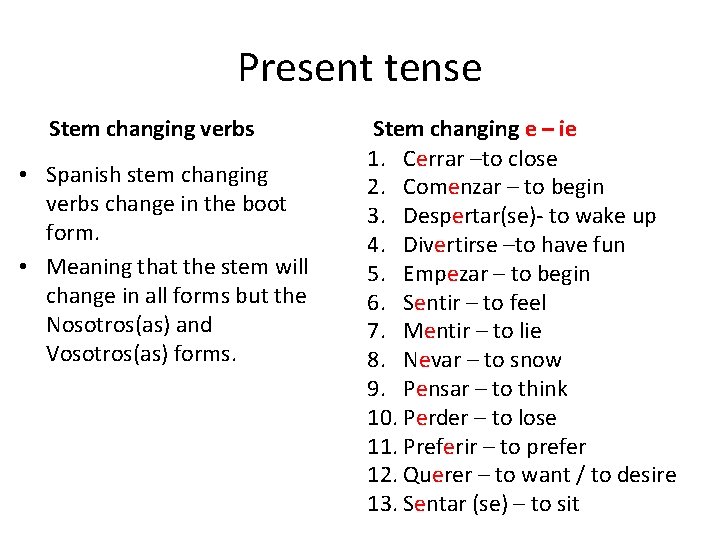
Present tense Stem changing verbs • Spanish stem changing verbs change in the boot form. • Meaning that the stem will change in all forms but the Nosotros(as) and Vosotros(as) forms. Stem changing e – ie 1. Cerrar –to close 2. Comenzar – to begin 3. Despertar(se)- to wake up 4. Divertirse –to have fun 5. Empezar – to begin 6. Sentir – to feel 7. Mentir – to lie 8. Nevar – to snow 9. Pensar – to think 10. Perder – to lose 11. Preferir – to prefer 12. Querer – to want / to desire 13. Sentar (se) – to sit
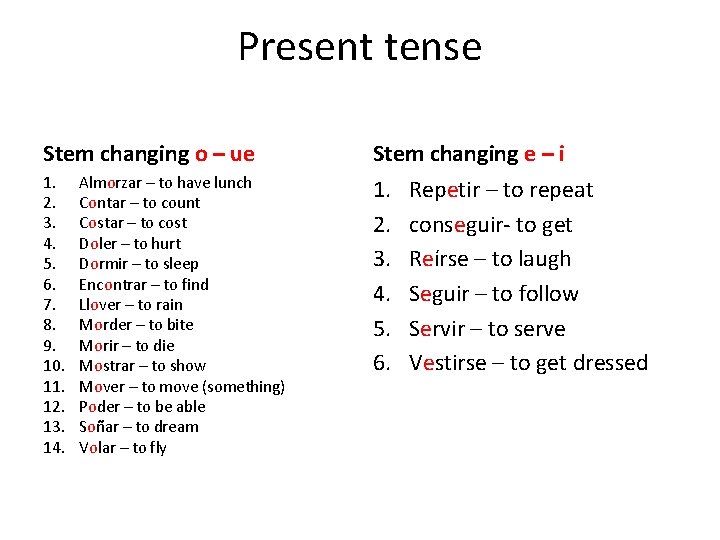
Present tense Stem changing o – ue Stem changing e – i 1. 2. 3. 4. 5. 6. 7. 8. 9. 10. 11. 12. 13. 14. 1. 2. 3. 4. 5. 6. Almorzar – to have lunch Contar – to count Costar – to cost Doler – to hurt Dormir – to sleep Encontrar – to find Llover – to rain Morder – to bite Morir – to die Mostrar – to show Mover – to move (something) Poder – to be able Soñar – to dream Volar – to fly Repetir – to repeat conseguir- to get Reírse – to laugh Seguir – to follow Servir – to serve Vestirse – to get dressed
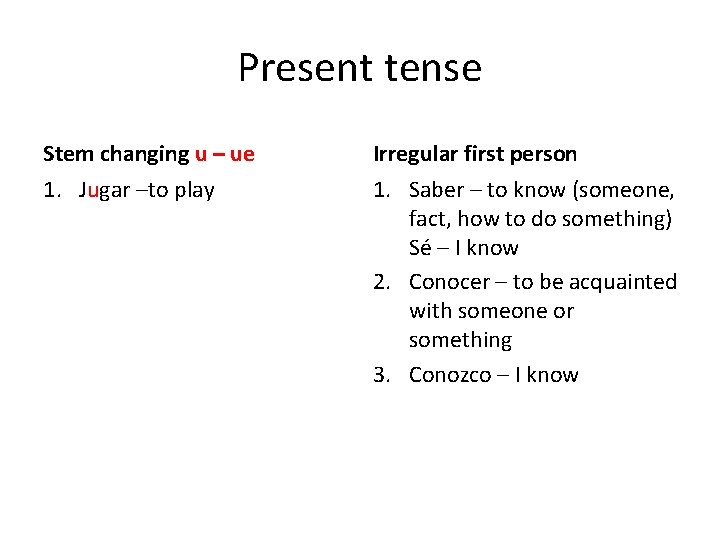
Present tense Stem changing u – ue Irregular first person 1. Jugar –to play 1. Saber – to know (someone, fact, how to do something) Sé – I know 2. Conocer – to be acquainted with someone or something 3. Conozco – I know
Present tense -go –go verbs – Irregular first person 1. Salir – to leave / to go out ~ salgo 2. Poner – to put ~ pongo