
RENTAL HOUSING Learning Outcomes Participants will be able
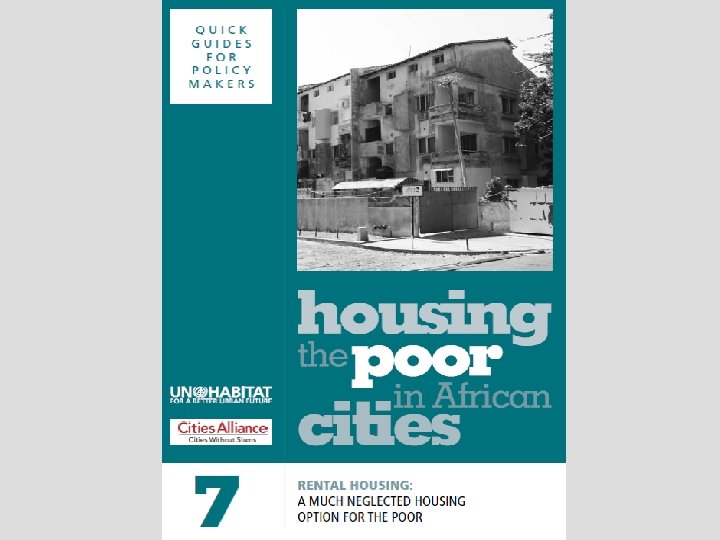
RENTAL HOUSING
Learning Outcomes Participants will be able to: • Explain what rental housing is and why people rent • Understand informal rental markets • Discuss key aspects of rental housing, such as access, supply and landlords • Assess to which needs rental housing should respond • Understand challenges of rental housing regulation • Identify policies to promote rental housing 2
Structure of the Module • Types of and prevalence of rental housing • Reasons for renting • Informal rental housing • Access to and supply of rental housing • Landlords • Factors for good rental housing • Level of rent • Challenges faced by rental housing regulation • Policies to promote rental housing 3
Extent of Rental Housing ‘Rental housing today makes up a large proportion of the urban housing stock in many African countries’ • In Kisumu, Kenya, 82 per cent of households were living in rental accommodation in 1998 • In Addis Ababa, Ethiopia, the figure was 60 per cent of households • In Kumasi, Ghana, the figure was 57 per cent of households >>Questions: What is the situation in your country? Is the percentage increasing? If yes, why? 4
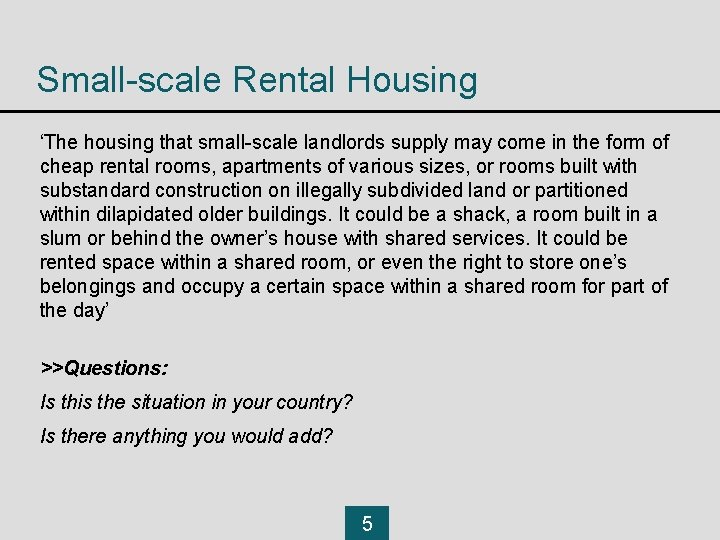
Small-scale Rental Housing ‘The housing that small-scale landlords supply may come in the form of cheap rental rooms, apartments of various sizes, or rooms built with substandard construction on illegally subdivided land or partitioned within dilapidated older buildings. It could be a shack, a room built in a slum or behind the owner’s house with shared services. It could be rented space within a shared room, or even the right to store one’s belongings and occupy a certain space within a shared room for part of the day’ >>Questions: Is this the situation in your country? Is there anything you would add? 5
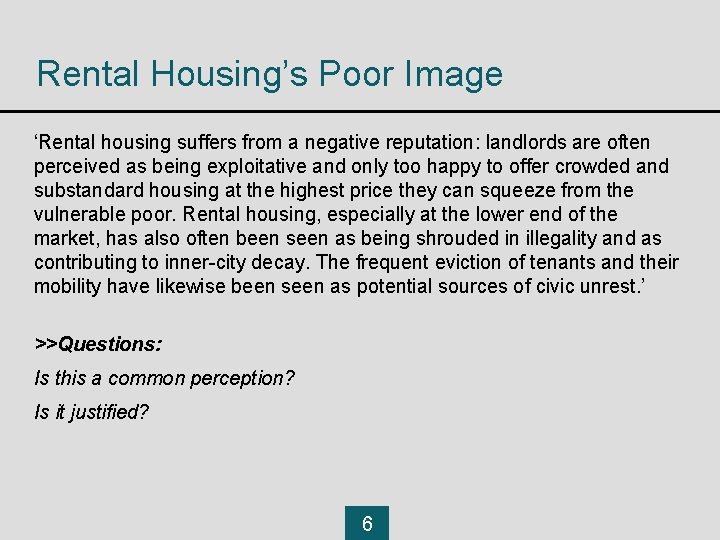
Rental Housing’s Poor Image ‘Rental housing suffers from a negative reputation: landlords are often perceived as being exploitative and only too happy to offer crowded and substandard housing at the highest price they can squeeze from the vulnerable poor. Rental housing, especially at the lower end of the market, has also often been seen as being shrouded in illegality and as contributing to inner-city decay. The frequent eviction of tenants and their mobility have likewise been seen as potential sources of civic unrest. ’ >>Questions: Is this a common perception? Is it justified? 6
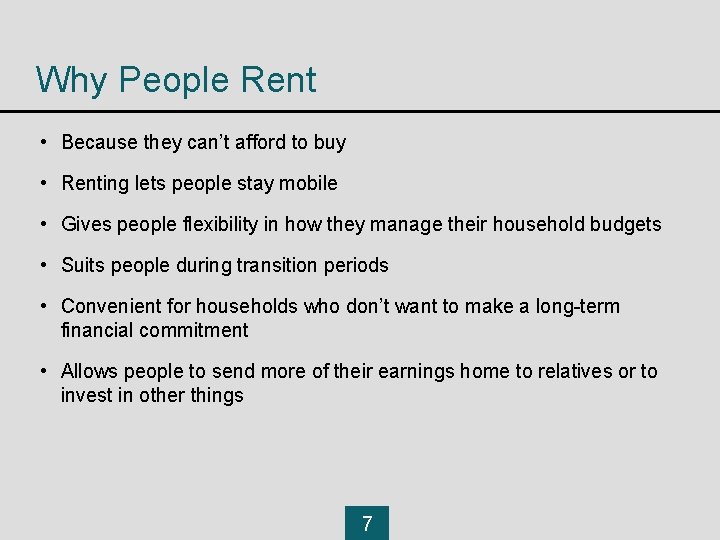
Why People Rent • Because they can’t afford to buy • Renting lets people stay mobile • Gives people flexibility in how they manage their household budgets • Suits people during transition periods • Convenient for households who don’t want to make a long-term financial commitment • Allows people to send more of their earnings home to relatives or to invest in other things 7
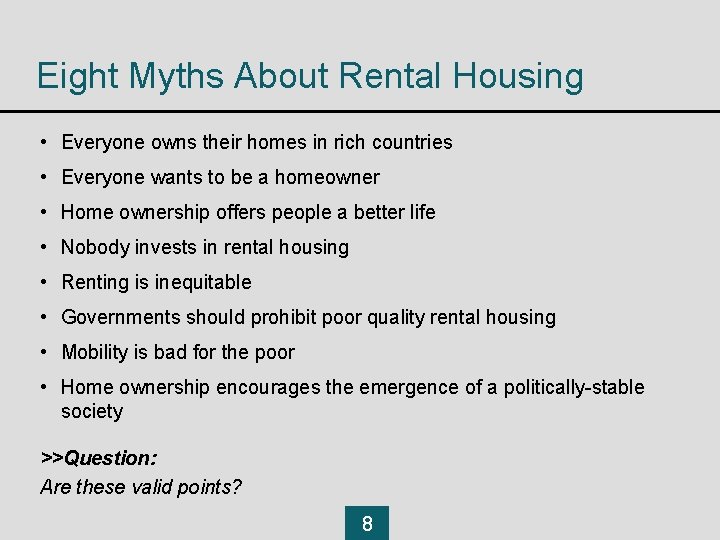
Eight Myths About Rental Housing • Everyone owns their homes in rich countries • Everyone wants to be a homeowner • Home ownership offers people a better life • Nobody invests in rental housing • Renting is inequitable • Governments should prohibit poor quality rental housing • Mobility is bad for the poor • Home ownership encourages the emergence of a politically-stable society >>Question: Are these valid points? 8
Unreliable Urban Rental Statistics ’It is difficult to collect and compile comparable data on rental housing’ >>Questions: Why is the case and what is the role of informal rentals? How does this affect policy decisions and what can be done to improve statistics? 9
The Contribution of Family Houses ‘Policy makers…should be mindful of the major contribution which family houses make in housing those on low incomes, and act to encourage and enable maintenance and provision of such housing rather than acting as if it is a vestige of a bygone age, of little relevance to the modern city’ >>Questions: What are the advantages of family houses? What is the attitude of policy makers in your country? What can/should policy makers do to encourage and enable the provision of family houses? 10
Why Rental Housing Tends to be Invisible • It is often hard to distinguish rental housing from owner-occupied housing • Rental housing is dispersed all over the city • It is hard to distinguish landlords from their tenants • Both landlords and tenants often keep their rental relationships quiet 11
Supply of Rental Housing ‘Large-scale government-built housing has generally been negligible in African countries’ ‘The private sector…has come to be the major producer of most urban rental housing…sometimes supported by the state’ >>Questions: Is this so in your country? What are the reasons for little public rental housing? What are the consequences? 12
How People Access Rental Housing • Through open markets: accessed directly by anybody who can afford the stated rent and is willing to abide by the landlords’ conditions • Through relationships: providing temporary, often rent-free housing to relatives from the village • Through occupation: such as provision of basic housing to construction workers, domestic workers, factory workers and so on 13
Migrants From Rural Areas and Rental Housing • Sharing of rented rooms • Renting out sleeping spaces in storerooms, guest houses and hostels • Building additional and unauthorized rooms in backyards of sites and services schemes • Sharing with relatives • Moving to peripheral villages and towns • Land invasions >>Question: Any other ways? 14
Who are the Landlords? • Household landlords: often for extra cash • Commercial landlords: operating in a more professional way, but include ‘slum landlords’ • Public sector landlords: including government departments and landowning agencies, often covering purpose-built social housing for lowincome tenants • Employer landlords: providing rental rooms for their workers, or nurses or students, usually not for profit 15
Women as Landlords ‘Whether male or female landlords dominate the rental housing market depends greatly on local custom and on the demography of the city. ’ >>Questions: What is the situation in your city? Why is that so? Does landlordism offer income opportunities for women? 16
Tenants as Landlords ‘A housing cooperative is an association that collectively owns and/or rents and governs their housing on a not-for-profit basis. Ideally, it works on the basis of providing affordable ownership of housing for its members. Credit and reference checks are carried out on all prospective members. They are required to attend information and training sessions before they can become members. Their membership gives them a share in the housing cooperative and they share the costs of financing and managing it. They have a right to live in housing owned by the cooperative. . . ’ >>Questions: Is this a good idea for the urban poor? Why do you think such cooperatives have not been widespread in Africa? 17
Accommodation Needs: Quality of Rental Housing • Durability of the building materials: often housing for the urban poor is low-quality, weak and prone to maintenance problems • Level of maintenance: absentee landlords tend to take less care of maintenance • Level of crowding: low rental units have people squeezed in tight spaces >>Question: Are there other factors you can think of? 18
Accommodation Needs: Access to Jobs and Public Services • Proximity to places of employment, transport, markets, places of worship etc • Usually more available and more varied in inner-city locations • For urban poor, probably the most important factor • But commercial pressure is also greater in such inner-city locations • Informal settlements in peripheral areas tend to be close to growth centres, with eventual opportunities for jobs and services >>Question: Do you agree that location is the most important quality factor? 19
Accommodation Needs: Access to Basic Infrastructure • Access to utilities such as electricity, water and sanitation • Rental units in slums, squatter settlements and illegally subdivided tenement structures tend to have the greater access to basic services problems • Because such access usually depends on having legal status and house registration • So tenants are likely to have to share facilities, such as toilets and washing and cooking spaces >>Question: How valid are these points? 20
Accommodation Needs: Location and Social Support Systems ‘Uncertain and irregular employment, varying sources of income and unexpected expenditures can all force poor tenants to rely extensively on their families and on the informal support networks in their communities when crises occur. . . it is clear that the best place for the poor to live is near their social support networks. ’ >>Question: Do you agree with this argument? If so, why? If not, why not? 21
Accommodation Needs: Tenants’ Mobility Patterns ‘Moving in and out of cities has become an inherent part of life for many Africans – people move constantly between the city and the rural areas, or between different cities. Whether they come for higher education, to find a job, or to seek health care, most people will need flexible accommodation in the city which, most frequently, is provided in the form of rental housing. ’ >>Questions: Is this true? If so, what are the consequences? 22
Accommodation Needs: Tenants’ Circumstances • Income level: when there is no long-term financial security, people tend to set aside money for investments other than in housing – such as paying for children’s education • Stage in life cycle: rental and sharing feature more often in early stages of people’s lives • Increase in female-headed households: often means more households that require flexible and affordable rental housing 23
Levels of Rent ‘Sometimes, rents make up a very high proportion of the tenant’s income but are nonetheless still too low for landlords to make a profit or even pay for maintenance of the property. ’ >>Questions: If there is such a mismatch, what are the consequences for individuals, housing supply, and maintenance of rental properties? Are high rental deposits an issue in your countries? 24
Landlord-tenant Relationships ‘The landlords complain that their tenants don’t take good care of the rental housing, pay their rent late, misbehave in general and don’t understand that rising costs of utilities, maintenance and repairs make it necessary to raise the rent. The tenants complain that their landlords fail to maintain the housing properly, don’t repair things when they break, charge unfairly high fees for utilities, increase the rent without warning, turn hostile when the rent is paid a little late, threaten eviction or fail to return security deposits when they move out. ’ >>Questions: Is such tension inevitable? What can be done to improve the relationship? 25
How Much to Charge? ‘The 25 per cent rule: Some housing specialists suggest that rental housing is affordable if a household spends no more than 25 per cent of its monthly income on rent. This rule of thumb loses its meaning as you go down the economic ladder, where the only rule is that the poorer you are, the greater proportion of your monthly income you are likely to pay for housing and basic services. ’ >>Questions: What are the consequences? Why is informal rental housing so prevalent in African cities? 26
Problems of Rent Controls • Equity: Some tenants are favoured at the expense of others – especially favouring long-term tenants over newcomers No guarantee that those covered by rent controls are genuinely poor Tenants gain at the expense of landlords • Efficiency: Landlords are discouraged from investing in rental property • Maintenance: Landlords fail to maintain the property- and houses deteriorate to slum conditions 27
Problems With Rental Regulations • Housing policies are often biased in favour of homeowners and fail to take needs of tenants into account • When rental housing conditions are poor, the problem is usually more to do with poor living conditions in general than with rental arrangements • Because much rental housing is invisible, it falls outside government regulations • Absence of enforceable written contracts and efficient arbitration systems leads to high costs of going to court for both tenants and landlords 28
Five Policy Options for Promoting Rental Housing • Acknowledge and understand existing rental practices • Get rental housing on the larger urban policy agenda • Work out practical, flexible rental policies and negotiations • Mobilize finance to improve and expand rental housing • Encourage large-scale and small-scale investment in rental housing 29
Conclusions • Rental housing is an important policy option in African cities • There are both formal and informal rental housing markets • There are problems with rental regulations • Governments can promote rental housing in different ways 30
- Slides: 30