
RENTAL ASSISTANCE DEMONSTRATION RAD Preparing for the Conversion
- Slides: 49
RENTAL ASSISTANCE DEMONSTRATION (RAD) Preparing for the Conversion National Housing Compliance In Partnership With Macon-Bibb County Housing Authority August 18, 2015
TYPICAL RAD PROFORMA CONSIDERATIONS WHEN CONVERTING TO RAD Mike Austin, CPM® Director of Asset Management/Housing Assistance Macon Housing Authority maustin@maconhousing. com
RAD: What is it? (Notice 2012 -32 -REV 2) • A Demonstration (started with 60 K units, now capped at 185 K and some are talking pushing to 200 K and beyond) • • • A Housing preservation program A very flexible tool to allow HAs to monetize PBRA/PBV contracts With new capital, immediate repairs can be made RADOMETER: $1, 062, 105, 832 Billion in construction leveraged activity A tool to allow residents choice (through HCV in two years) on limited yearly basis • It can be expensive! In developing your conversion, budget for: o Legal Fees, Surveys, PCNA, environmental, financing, consulting, architectural, etc. 3
MHA RAD Overview • Among first in the Nation as early adopters in 2013 o Closed 5 RAD Deals, consisting of: • • 1 Senior High Rise with 199 units, RAD PBRA 1 Existing TC with 8 ACC units, RAD PBV (ARRA) 1 Existing TC with 100 ACC units , RAD PBRA (ARRA) 2 Existing multi-family sites (3 sites combined into 2) with 625 units • Utilized 223 (f) loans for $7+mil in new capital • Helped close a RAD CII RAP expiration conversion (Section III of the Notice with a 90 -unit RAD PBV contract • In process of closing a 104 units PBRA HOPE VI TC 4
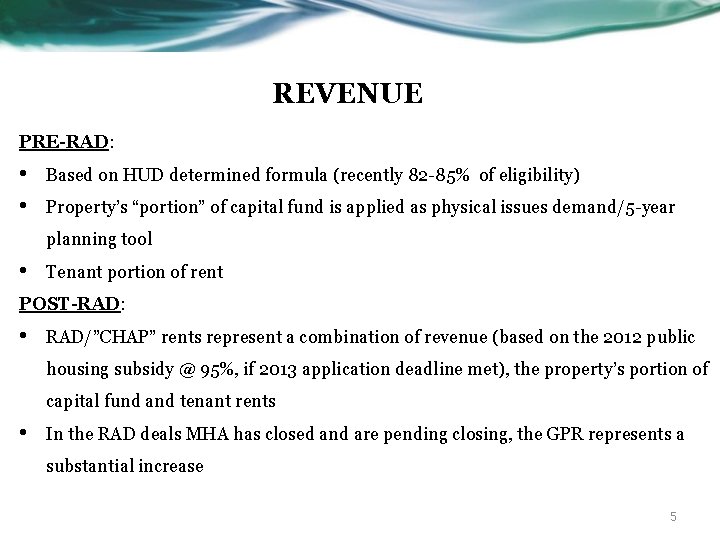
REVENUE PRE-RAD: • • Based on HUD determined formula (recently 82 -85% of eligibility) Property’s “portion” of capital fund is applied as physical issues demand/5 -year planning tool • Tenant portion of rent POST-RAD: • RAD/”CHAP” rents represent a combination of revenue (based on the 2012 public housing subsidy @ 95%, if 2013 application deadline met), the property’s portion of capital fund and tenant rents • In the RAD deals MHA has closed and are pending closing, the GPR represents a substantial increase 5
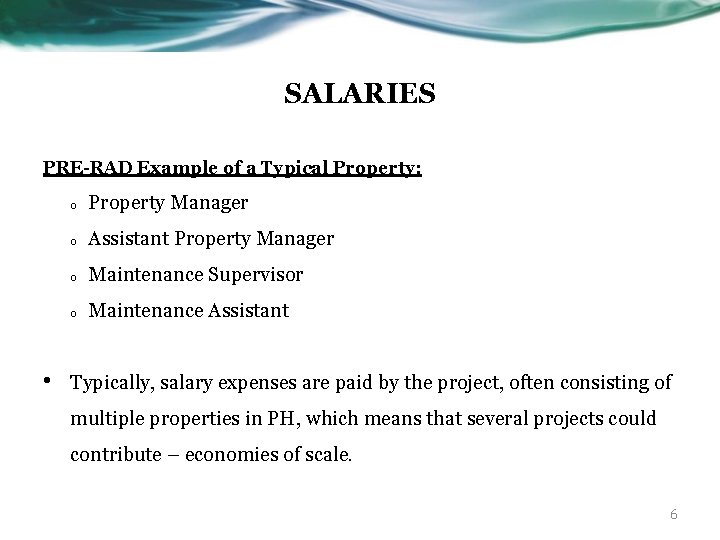
SALARIES PRE-RAD Example of a Typical Property: • o Property Manager o Assistant Property Manager o Maintenance Supervisor o Maintenance Assistant Typically, salary expenses are paid by the project, often consisting of multiple properties in PH, which means that several projects could contribute – economies of scale. 6
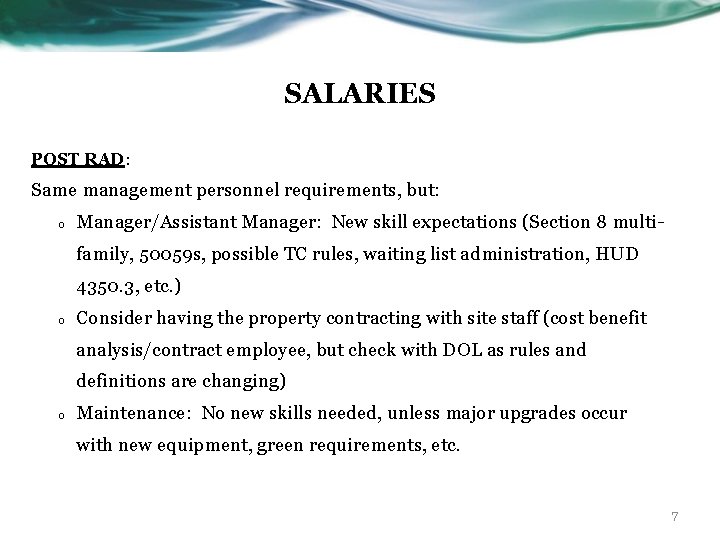
SALARIES POST RAD: Same management personnel requirements, but: o Manager/Assistant Manager: New skill expectations (Section 8 multifamily, 50059 s, possible TC rules, waiting list administration, HUD 4350. 3, etc. ) o Consider having the property contracting with site staff (cost benefit analysis/contract employee, but check with DOL as rules and definitions are changing) o Maintenance: No new skills needed, unless major upgrades occur with new equipment, green requirements, etc. 7
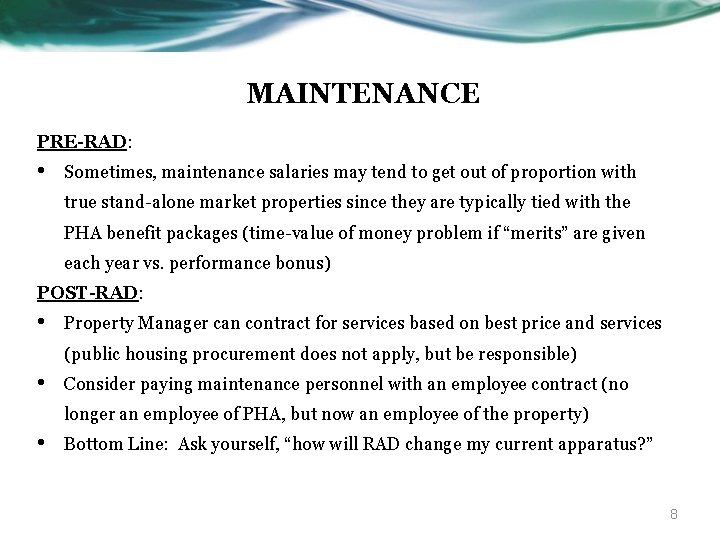
MAINTENANCE PRE-RAD: • Sometimes, maintenance salaries may tend to get out of proportion with true stand-alone market properties since they are typically tied with the PHA benefit packages (time-value of money problem if “merits” are given each year vs. performance bonus) POST-RAD: • Property Manager can contract for services based on best price and services (public housing procurement does not apply, but be responsible) • Consider paying maintenance personnel with an employee contract (no longer an employee of PHA, but now an employee of the property) • Bottom Line: Ask yourself, “how will RAD change my current apparatus? ” 8
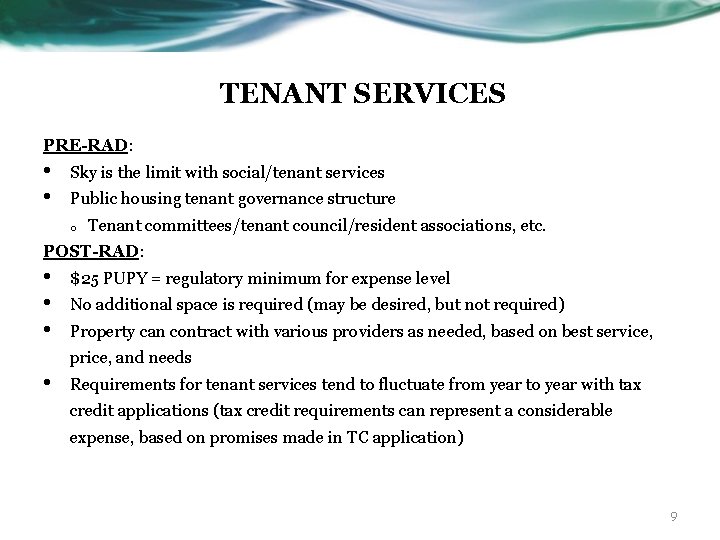
TENANT SERVICES PRE-RAD: • • Sky is the limit with social/tenant services Public housing tenant governance structure o Tenant committees/tenant council/resident associations, etc. POST-RAD: • • • $25 PUPY = regulatory minimum for expense level No additional space is required (may be desired, but not required) Property can contract with various providers as needed, based on best service, price, and needs • Requirements for tenant services tend to fluctuate from year to year with tax credit applications (tax credit requirements can represent a considerable expense, based on promises made in TC application) 9
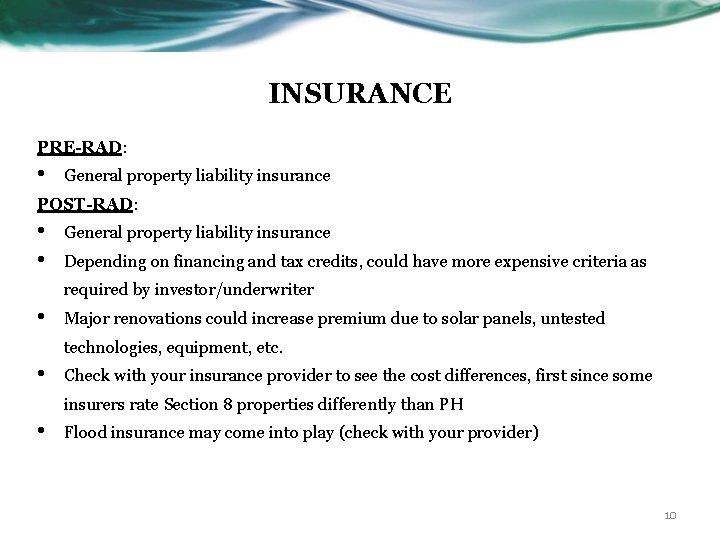
INSURANCE PRE-RAD: • General property liability insurance POST-RAD: • • General property liability insurance Depending on financing and tax credits, could have more expensive criteria as required by investor/underwriter • Major renovations could increase premium due to solar panels, untested technologies, equipment, etc. • Check with your insurance provider to see the cost differences, first since some insurers rate Section 8 properties differently than PH • Flood insurance may come into play (check with your provider) 10
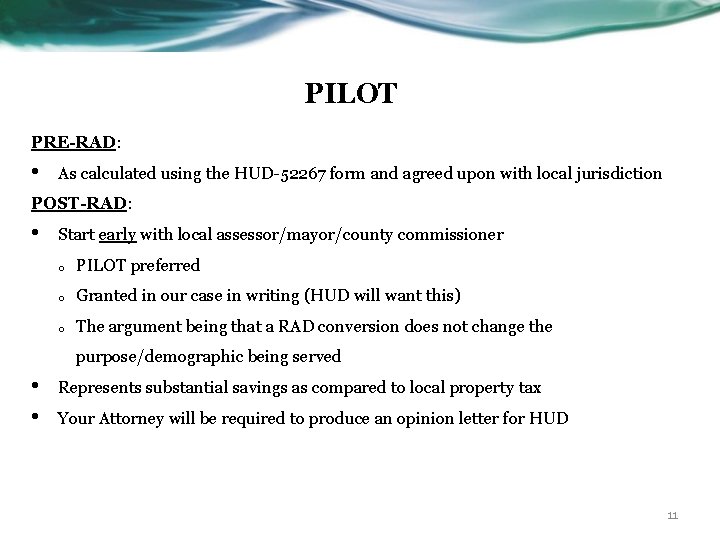
PILOT PRE-RAD: • As calculated using the HUD-52267 form and agreed upon with local jurisdiction POST-RAD: • Start early with local assessor/mayor/county commissioner o PILOT preferred o Granted in our case in writing (HUD will want this) o The argument being that a RAD conversion does not change the purpose/demographic being served • • Represents substantial savings as compared to local property tax Your Attorney will be required to produce an opinion letter for HUD 11
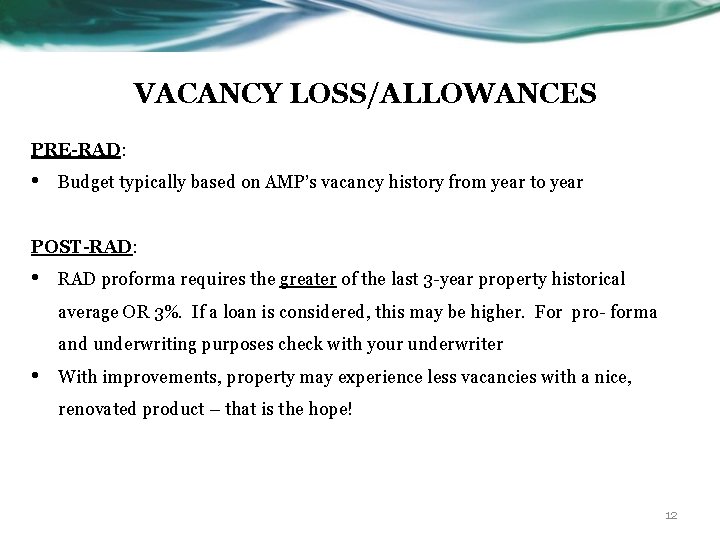
VACANCY LOSS/ALLOWANCES PRE-RAD: • Budget typically based on AMP’s vacancy history from year to year POST-RAD: • RAD proforma requires the greater of the last 3 -year property historical average OR 3%. If a loan is considered, this may be higher. For pro- forma and underwriting purposes check with your underwriter • With improvements, property may experience less vacancies with a nice, renovated product – that is the hope! 12
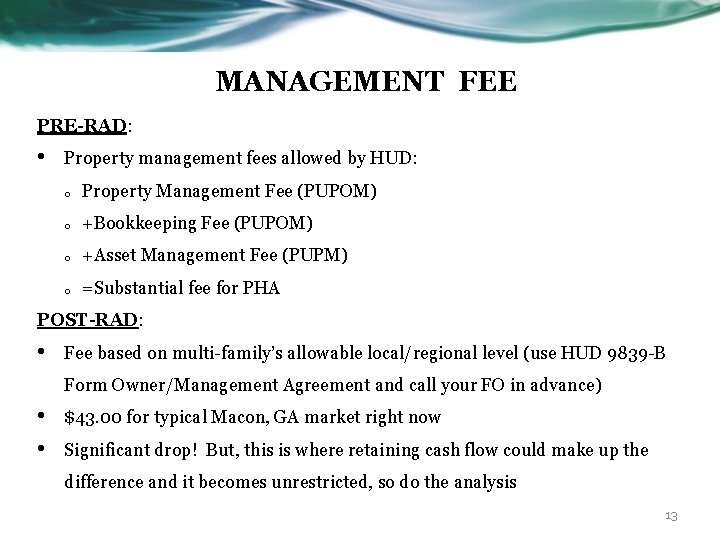
MANAGEMENT FEE PRE-RAD: • Property management fees allowed by HUD: o Property Management Fee (PUPOM) o +Bookkeeping Fee (PUPOM) o +Asset Management Fee (PUPM) o =Substantial fee for PHA POST-RAD: • Fee based on multi-family’s allowable local/regional level (use HUD 9839 -B Form Owner/Management Agreement and call your FO in advance) • • $43. 00 for typical Macon, GA market right now Significant drop! But, this is where retaining cash flow could make up the difference and it becomes unrestricted, so do the analysis 13
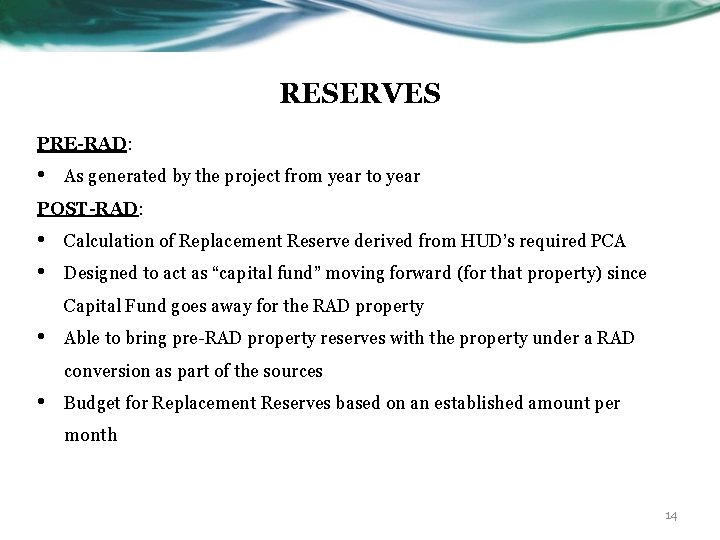
RESERVES PRE-RAD: • As generated by the project from year to year POST-RAD: • • Calculation of Replacement Reserve derived from HUD’s required PCA Designed to act as “capital fund” moving forward (for that property) since Capital Fund goes away for the RAD property • Able to bring pre-RAD property reserves with the property under a RAD conversion as part of the sources • Budget for Replacement Reserves based on an established amount per month 14
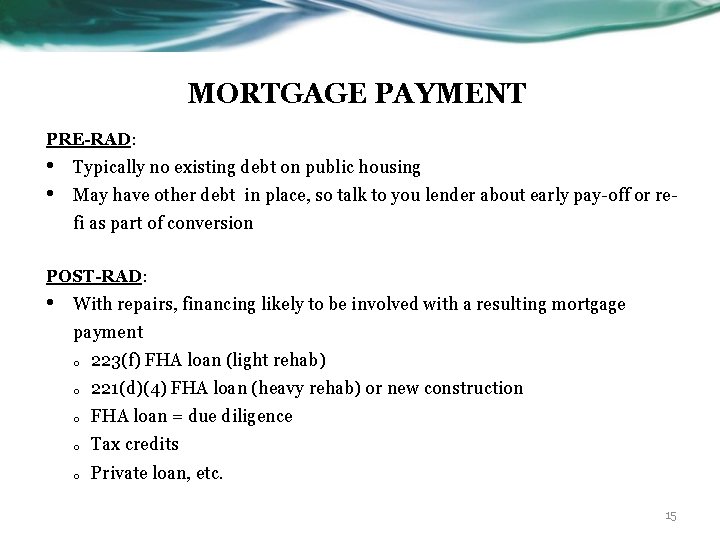
MORTGAGE PAYMENT PRE-RAD: • • Typically no existing debt on public housing May have other debt in place, so talk to you lender about early pay-off or refi as part of conversion POST-RAD: • With repairs, financing likely to be involved with a resulting mortgage payment o 223(f) FHA loan (light rehab) o 221(d)(4) FHA loan (heavy rehab) or new construction o FHA loan = due diligence o Tax credits o Private loan, etc. 15
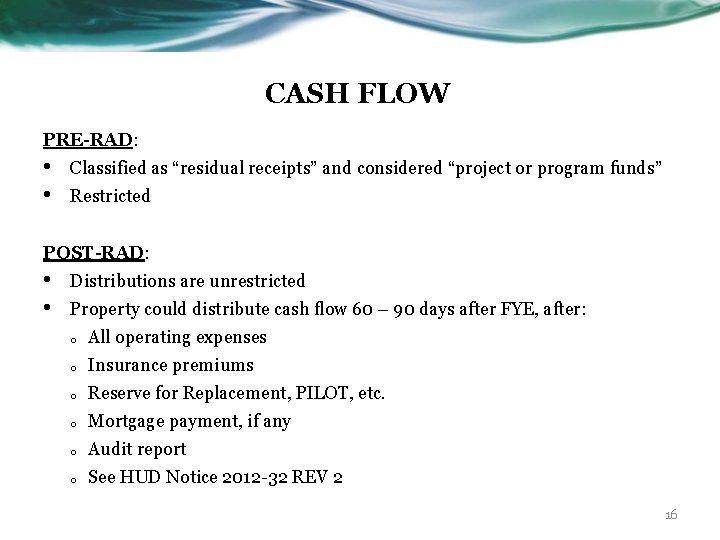
CASH FLOW PRE-RAD: • • Classified as “residual receipts” and considered “project or program funds” Restricted POST-RAD: • • Distributions are unrestricted Property could distribute cash flow 60 – 90 days after FYE, after: o All operating expenses o Insurance premiums o Reserve for Replacement, PILOT, etc. o Mortgage payment, if any o Audit report o See HUD Notice 2012 -32 REV 2 16
SUMMARY • Make sure the property can sustain the reserve requirement and debt service long term (of course, FHA, private underwriting will require this) • Once a property converts, the majority of public housing rules/way of doing things goes away, but not ALL requirements • General Reminders: o Get Board, local Government and Residents on board early o Dedicate appropriate staff time – it will take a lot of time o Hire a reputable PCA Consultant who has completed RAD PCAs o Look at possible rebates with local utility providers if upgrading envelope, HV/HWH o Don’t forget! If repairs are made, HUD allows a 10% Dev. Fee (non-federal) o A RAD closing is a recordable real estate transaction – secure an experienced attorney early! By now, there are several who have RAD experience 17
RAD CONVERSION PROCESS Jan E. Beall, SCHM, COS, BOS, PHM Property Compliance Manager Macon Housing Authority jbeall@maconhousing. com
THINGS TO CONSIDER AS YOU TRANSITION FROM PH – PBRA • Must Develop A New Mind Set - Get out of PH mode; • RAD/PBRA/PH and Possibly Section 42 LIHTC Rules Apply; • Some Section 8 Rules Are Waived , most Public Housing rules go away, but not all; • Ensure Employees Receive Training (HUD 4350. 3) 19
HUD OFFICES/CONTACTS PUBLIC HOUSING • • • HUD Office of Public and Indian Housing (PIH) HUD Program Analyst PIC/EIV Coach REAC HUD Office of Fair Housing PBRA (RAD) • • • HUD Office of Multifamily Housing (Housing) HUD Asset Manager TRACS Help Desk REAC HUD Office of Fair Housing RAD Transaction Manager 20
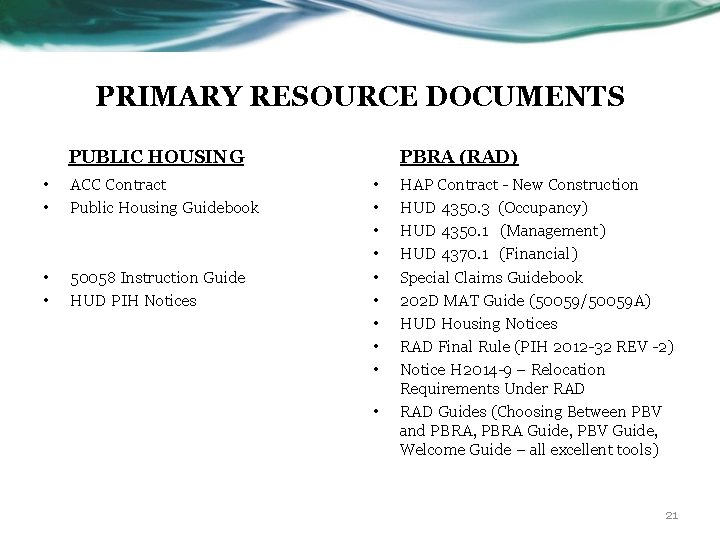
PRIMARY RESOURCE DOCUMENTS PUBLIC HOUSING • • ACC Contract Public Housing Guidebook • • 50058 Instruction Guide HUD PIH Notices PBRA (RAD) • • • HAP Contract - New Construction HUD 4350. 3 (Occupancy) HUD 4350. 1 (Management) HUD 4370. 1 (Financial) Special Claims Guidebook 202 D MAT Guide (50059/50059 A) HUD Housing Notices RAD Final Rule (PIH 2012 -32 REV -2) Notice H 2014 -9 – Relocation Requirements Under RAD Guides (Choosing Between PBV and PBRA, PBRA Guide, PBV Guide, Welcome Guide – all excellent tools) 21
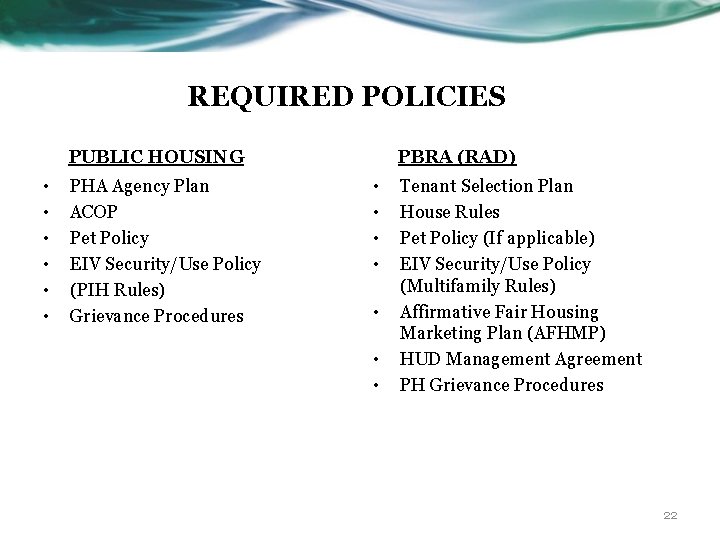
REQUIRED POLICIES PUBLIC HOUSING • • • PHA Agency Plan ACOP Pet Policy EIV Security/Use Policy (PIH Rules) Grievance Procedures PBRA (RAD) • • Tenant Selection Plan House Rules Pet Policy (If applicable) EIV Security/Use Policy (Multifamily Rules) Affirmative Fair Housing Marketing Plan (AFHMP) HUD Management Agreement PH Grievance Procedures 22
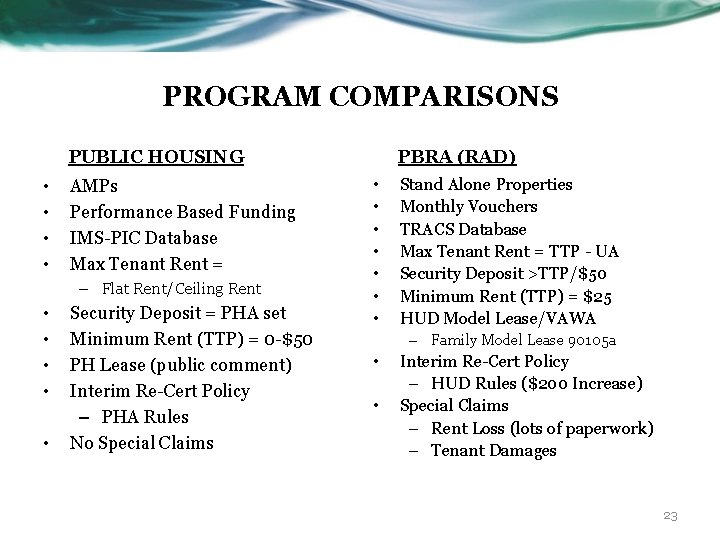
PROGRAM COMPARISONS PUBLIC HOUSING • • AMPs Performance Based Funding IMS-PIC Database Max Tenant Rent = – Flat Rent/Ceiling Rent • • • Security Deposit = PHA set Minimum Rent (TTP) = 0 -$50 PH Lease (public comment) Interim Re-Cert Policy – PHA Rules No Special Claims PBRA (RAD) • • Stand Alone Properties Monthly Vouchers TRACS Database Max Tenant Rent = TTP - UA Security Deposit >TTP/$50 Minimum Rent (TTP) = $25 HUD Model Lease/VAWA – Family Model Lease 90105 a • • Interim Re-Cert Policy – HUD Rules ($200 Increase) Special Claims – Rent Loss (lots of paperwork) – Tenant Damages 23
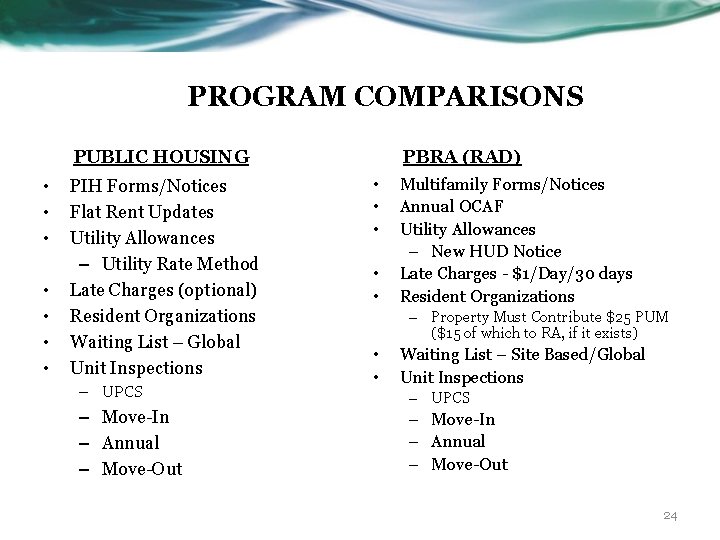
PROGRAM COMPARISONS PUBLIC HOUSING • • PIH Forms/Notices Flat Rent Updates Utility Allowances – Utility Rate Method Late Charges (optional) Resident Organizations Waiting List – Global Unit Inspections – UPCS – Move-In – Annual – Move-Out PBRA (RAD) • • • Multifamily Forms/Notices Annual OCAF Utility Allowances – New HUD Notice Late Charges - $1/Day/30 days Resident Organizations – Property Must Contribute $25 PUM ($15 of which to RA, if it exists) • • Waiting List – Site Based/Global Unit Inspections – UPCS – Move-In – Annual – Move-Out 24
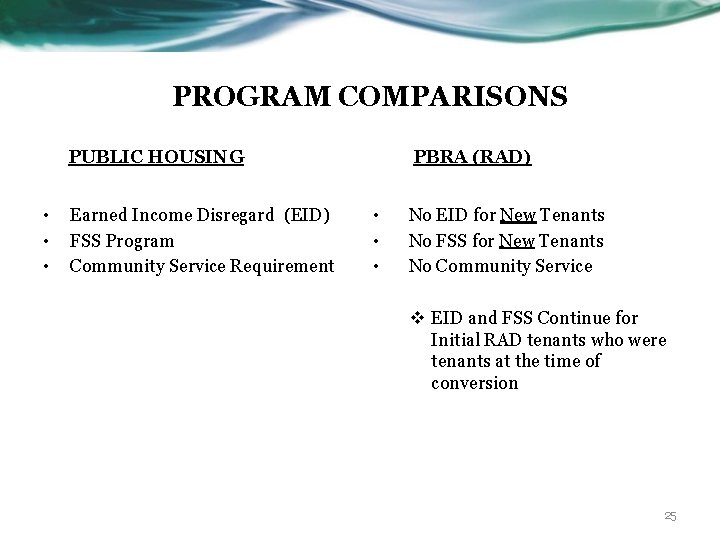
PROGRAM COMPARISONS PUBLIC HOUSING • • • Earned Income Disregard (EID) FSS Program Community Service Requirement PBRA (RAD) • • • No EID for New Tenants No FSS for New Tenants No Community Service v EID and FSS Continue for Initial RAD tenants who were tenants at the time of conversion 25
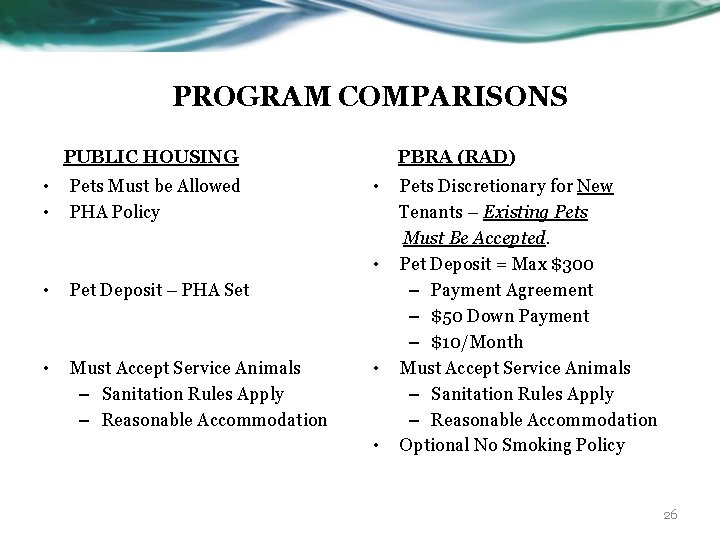
PROGRAM COMPARISONS PUBLIC HOUSING • • Pets Must be Allowed PHA Policy PBRA (RAD) • • • Pet Deposit – PHA Set • Must Accept Service Animals – Sanitation Rules Apply – Reasonable Accommodation • • Pets Discretionary for New Tenants – Existing Pets Must Be Accepted. Pet Deposit = Max $300 – Payment Agreement – $50 Down Payment – $10/Month Must Accept Service Animals – Sanitation Rules Apply – Reasonable Accommodation Optional No Smoking Policy 26
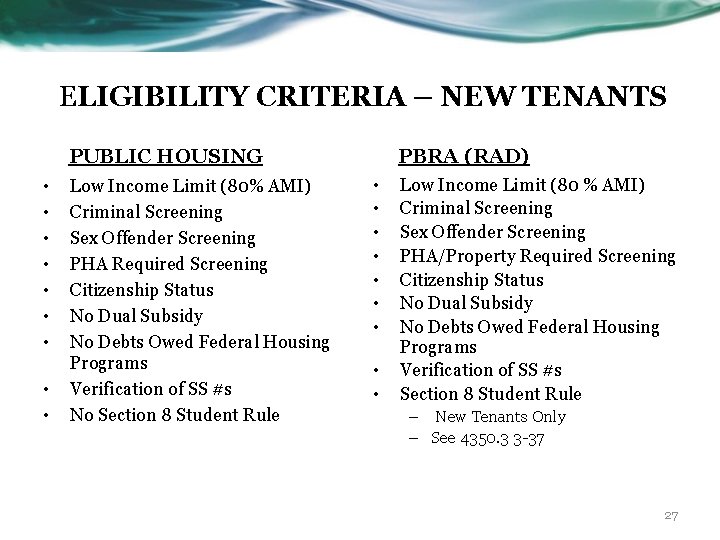
ELIGIBILITY CRITERIA – NEW TENANTS PUBLIC HOUSING • • • Low Income Limit (80% AMI) Criminal Screening Sex Offender Screening PHA Required Screening Citizenship Status No Dual Subsidy No Debts Owed Federal Housing Programs Verification of SS #s No Section 8 Student Rule PBRA (RAD) • • • Low Income Limit (80 % AMI) Criminal Screening Sex Offender Screening PHA/Property Required Screening Citizenship Status No Dual Subsidy No Debts Owed Federal Housing Programs Verification of SS #s Section 8 Student Rule – New Tenants Only – See 4350. 3 3 -37 27
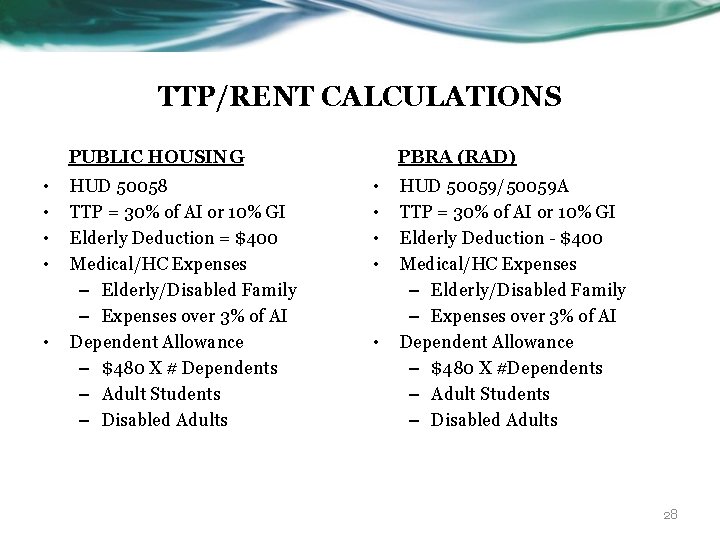
TTP/RENT CALCULATIONS PUBLIC HOUSING • • • HUD 50058 TTP = 30% of AI or 10% GI Elderly Deduction = $400 Medical/HC Expenses – Elderly/Disabled Family – Expenses over 3% of AI Dependent Allowance – $480 X # Dependents – Adult Students – Disabled Adults PBRA (RAD) • • • HUD 50059/50059 A TTP = 30% of AI or 10% GI Elderly Deduction - $400 Medical/HC Expenses – Elderly/Disabled Family – Expenses over 3% of AI Dependent Allowance – $480 X #Dependents – Adult Students – Disabled Adults 28
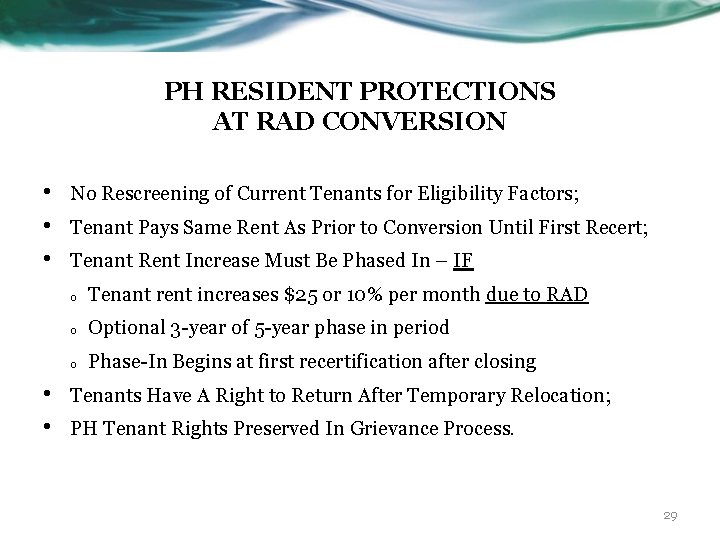
PH RESIDENT PROTECTIONS AT RAD CONVERSION • • • No Rescreening of Current Tenants for Eligibility Factors; Tenant Pays Same Rent As Prior to Conversion Until First Recert; Tenant Rent Increase Must Be Phased In – IF o Tenant rent increases $25 or 10% per month due to RAD o Optional 3 -year of 5 -year phase in period o Phase-In Begins at first recertification after closing Tenants Have A Right to Return After Temporary Relocation; PH Tenant Rights Preserved In Grievance Process. 29
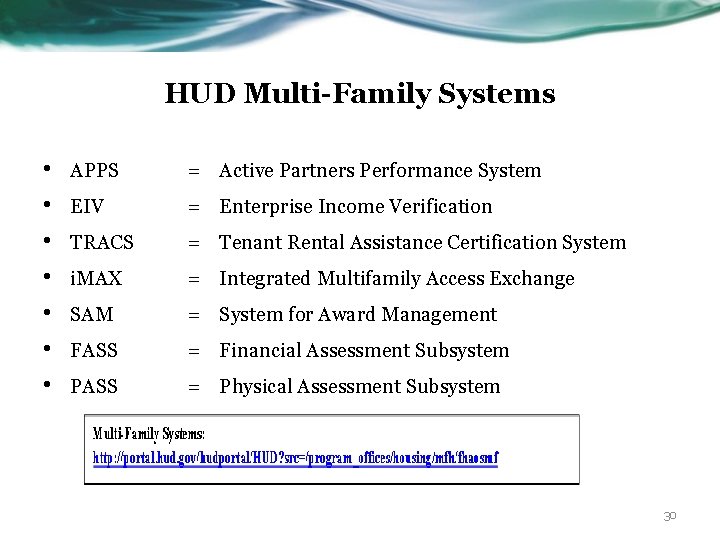
HUD Multi-Family Systems • • APPS = Active Partners Performance System EIV = Enterprise Income Verification TRACS = Tenant Rental Assistance Certification System i. MAX = Integrated Multifamily Access Exchange SAM = System for Award Management FASS = Financial Assessment Subsystem PASS = Physical Assessment Subsystem 30
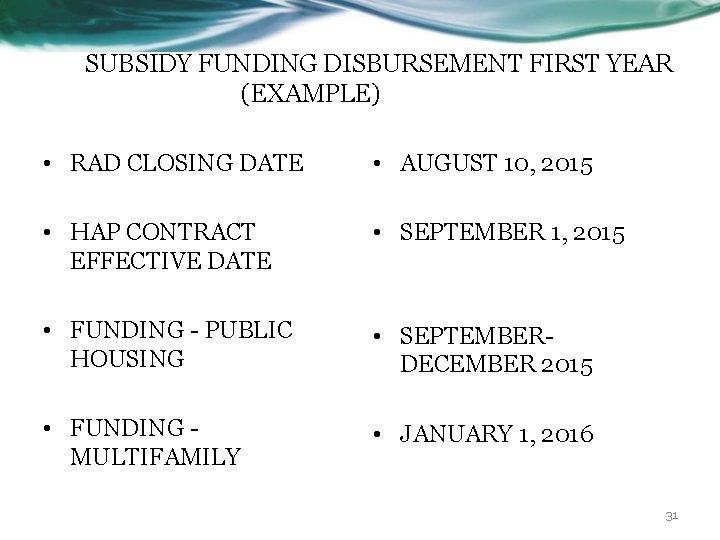
SUBSIDY FUNDING DISBURSEMENT FIRST YEAR (EXAMPLE) • RAD CLOSING DATE • AUGUST 10, 2015 • HAP CONTRACT EFFECTIVE DATE • SEPTEMBER 1, 2015 • FUNDING - PUBLIC HOUSING • SEPTEMBERDECEMBER 2015 • FUNDING MULTIFAMILY • JANUARY 1, 2016 31
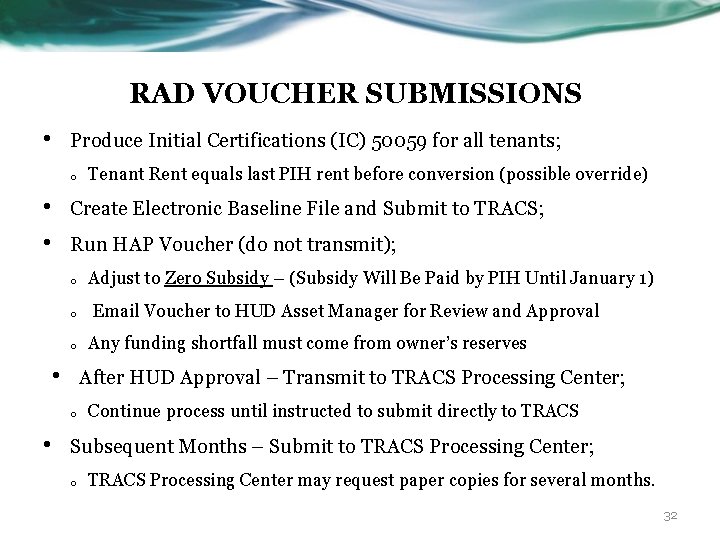
RAD VOUCHER SUBMISSIONS • Produce Initial Certifications (IC) 50059 for all tenants; o • • Create Electronic Baseline File and Submit to TRACS; Run HAP Voucher (do not transmit); o o o • Adjust to Zero Subsidy – (Subsidy Will Be Paid by PIH Until January 1) Email Voucher to HUD Asset Manager for Review and Approval Any funding shortfall must come from owner’s reserves After HUD Approval – Transmit to TRACS Processing Center; o • Tenant Rent equals last PIH rent before conversion (possible override) Continue process until instructed to submit directly to TRACS Subsequent Months – Submit to TRACS Processing Center; o TRACS Processing Center may request paper copies for several months. 32
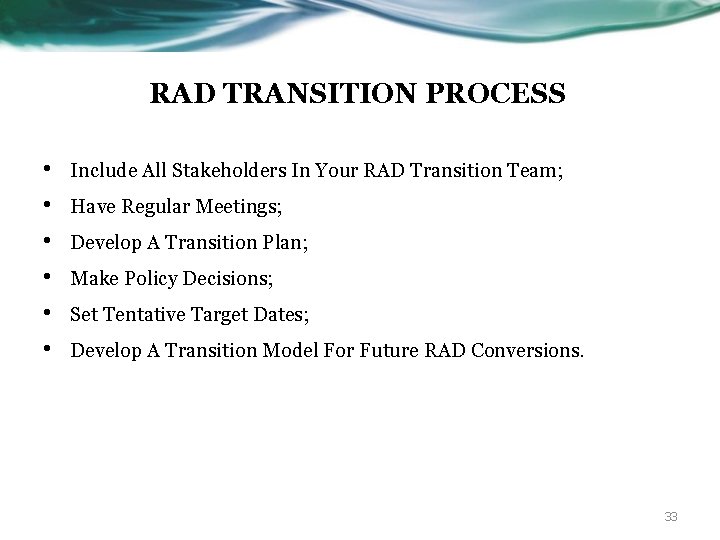
RAD TRANSITION PROCESS • • • Include All Stakeholders In Your RAD Transition Team; Have Regular Meetings; Develop A Transition Plan; Make Policy Decisions; Set Tentative Target Dates; Develop A Transition Model For Future RAD Conversions. 33
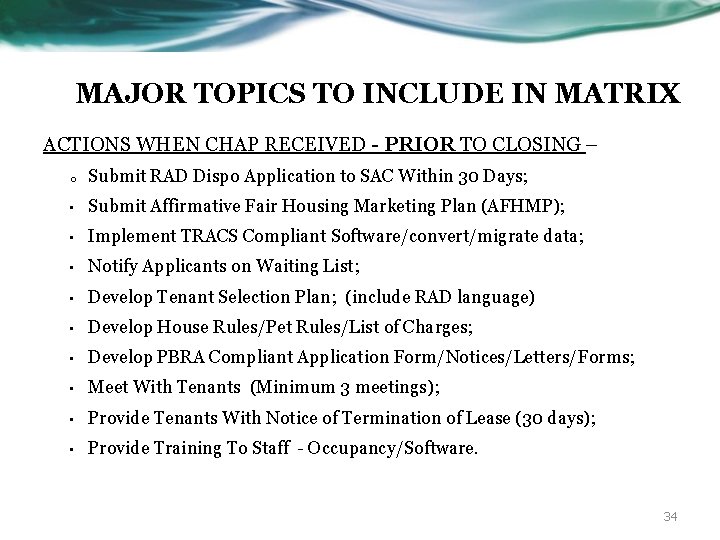
MAJOR TOPICS TO INCLUDE IN MATRIX ACTIONS WHEN CHAP RECEIVED - PRIOR TO CLOSING – o Submit RAD Dispo Application to SAC Within 30 Days; • Submit Affirmative Fair Housing Marketing Plan (AFHMP); • Implement TRACS Compliant Software/convert/migrate data; • Notify Applicants on Waiting List; • Develop Tenant Selection Plan; (include RAD language) • Develop House Rules/Pet Rules/List of Charges; • Develop PBRA Compliant Application Form/Notices/Letters/Forms; • Meet With Tenants (Minimum 3 meetings); • Provide Tenants With Notice of Termination of Lease (30 days); • Provide Training To Staff - Occupancy/Software. 34
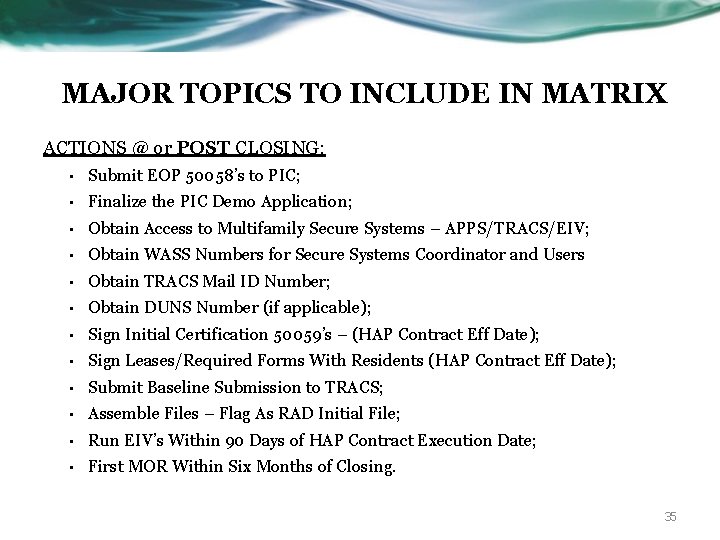
MAJOR TOPICS TO INCLUDE IN MATRIX ACTIONS @ or POST CLOSING: • Submit EOP 50058’s to PIC; • Finalize the PIC Demo Application; • Obtain Access to Multifamily Secure Systems – APPS/TRACS/EIV; • Obtain WASS Numbers for Secure Systems Coordinator and Users • Obtain TRACS Mail ID Number; • Obtain DUNS Number (if applicable); • Sign Initial Certification 50059’s – (HAP Contract Eff Date); • Sign Leases/Required Forms With Residents (HAP Contract Eff Date); • Submit Baseline Submission to TRACS; • Assemble Files – Flag As RAD Initial File; • Run EIV’s Within 90 Days of HAP Contract Execution Date; • First MOR Within Six Months of Closing. 35
RAD Q & A’s Julie Fawcett, PHM, COS, SHCM Senior Compliance Manager National Housing Compliance
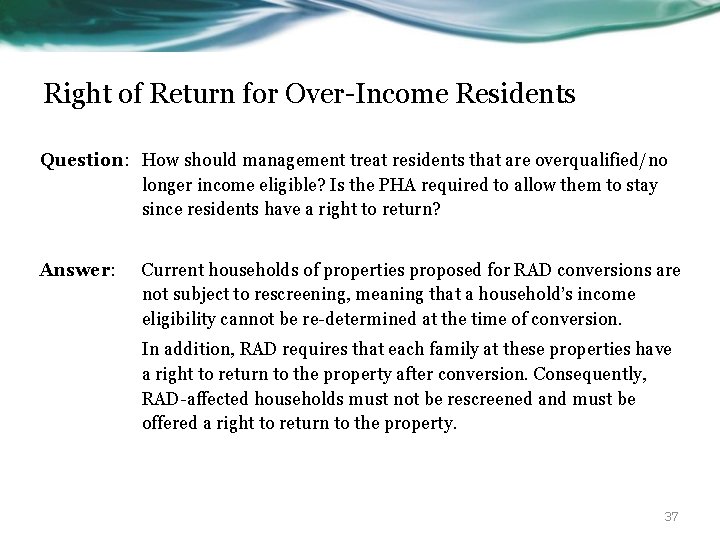
Right of Return for Over-Income Residents Question: How should management treat residents that are overqualified/no longer income eligible? Is the PHA required to allow them to stay since residents have a right to return? Answer: Current households of properties proposed for RAD conversions are not subject to rescreening, meaning that a household’s income eligibility cannot be re-determined at the time of conversion. In addition, RAD requires that each family at these properties have a right to return to the property after conversion. Consequently, RAD-affected households must not be rescreened and must be offered a right to return to the property. 37
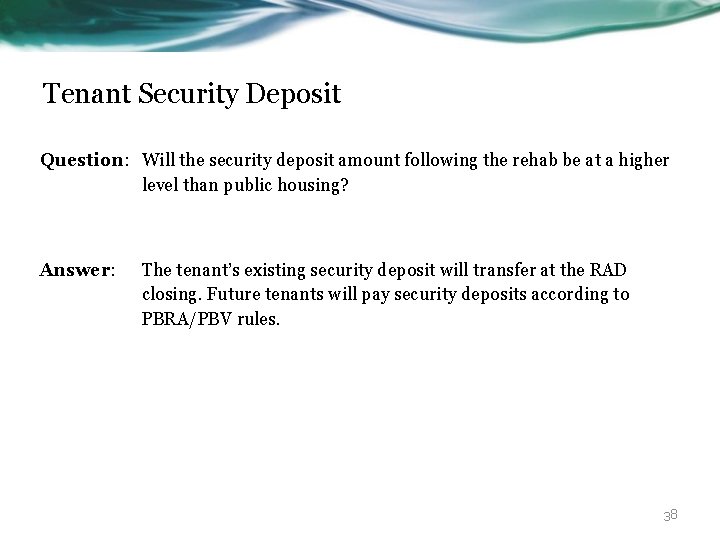
Tenant Security Deposit Question: Will the security deposit amount following the rehab be at a higher level than public housing? Answer: The tenant’s existing security deposit will transfer at the RAD closing. Future tenants will pay security deposits according to PBRA/PBV rules. 38
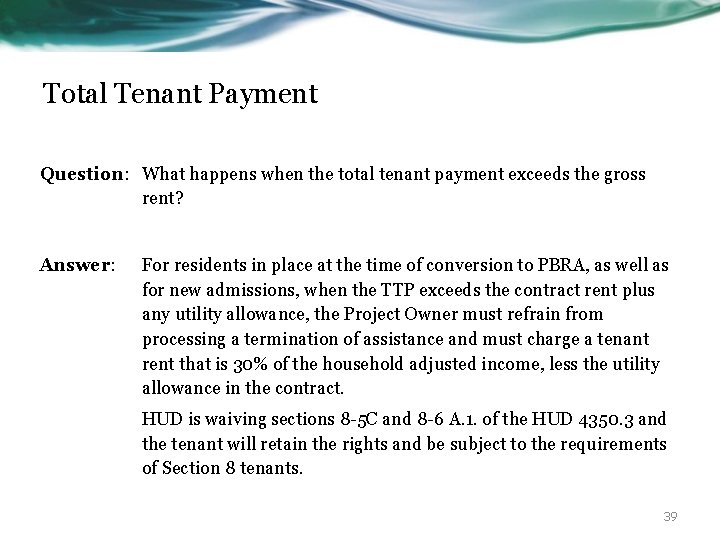
Total Tenant Payment Question: What happens when the total tenant payment exceeds the gross rent? Answer: For residents in place at the time of conversion to PBRA, as well as for new admissions, when the TTP exceeds the contract rent plus any utility allowance, the Project Owner must refrain from processing a termination of assistance and must charge a tenant rent that is 30% of the household adjusted income, less the utility allowance in the contract. HUD is waiving sections 8 -5 C and 8 -6 A. 1. of the HUD 4350. 3 and the tenant will retain the rights and be subject to the requirements of Section 8 tenants. 39
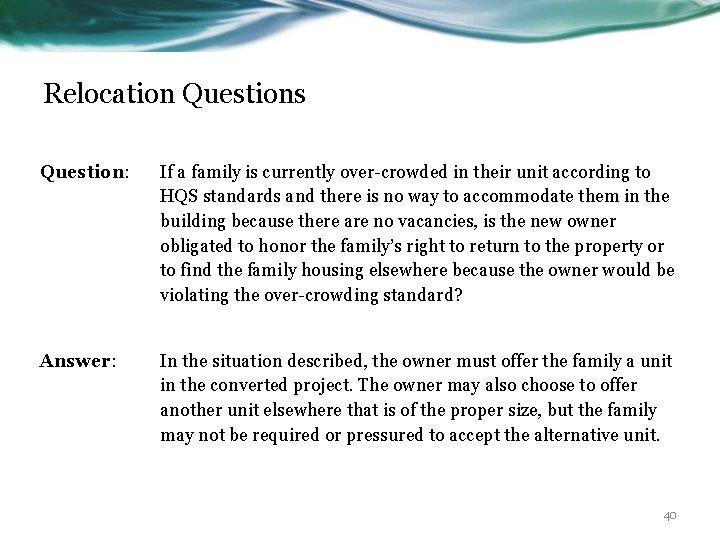
Relocation Questions Question: If a family is currently over-crowded in their unit according to HQS standards and there is no way to accommodate them in the building because there are no vacancies, is the new owner obligated to honor the family’s right to return to the property or to find the family housing elsewhere because the owner would be violating the over-crowding standard? Answer: In the situation described, the owner must offer the family a unit in the converted project. The owner may also choose to offer another unit elsewhere that is of the proper size, but the family may not be required or pressured to accept the alternative unit. 40
Risk/Benefit of RAD Question: Does RAD conversion increase the risk of losing affordable housing units through foreclosure? Answer: In HUD’s view, RAD conversions reduce the risk of losing affordable housing units. The risk (outside RAD) of losing public housing units as a result of inadequate funding is quite high; in a typical year, 10, 000 to 15, 000 units are removed from the public housing inventory because funding is inadequate. 41
Timing of RAD Application for In-Process Mixed Finance Transaction Question: A project that was on the RAD waiting list decided to pursue Mixed Finance and will complete construction in December 2015. Can the Owner convert to RAD this year, or do they have to wait until rehab is complete and the units are re-occupied? Answer: The Owner can convert sooner than completion of construction, provided their lenders and investors sign-off on the conversion to RAD. 42
New Development Using RAD Question: Under the RAD program can the PHA build/develop new and/or additional units? Answer: A RAD conversion involves removing a specified number of units from a PHA’s ACC and replacing them with the same number of units under a PBRA or PBV contract. RAD does not result in an increase in the total number of units with PBRA or PBV rental assistance. Accordingly, in RAD, new construction would typically be limited to situations in which the PHA wants to create new units to replace existing ACC units. 43
Utility Allowance Amount Question: What utility allowance should be used at conversion, the utility allowance that was in the RAD application (2012) or the utility allowance in effect at the time of conversion? Answer: The PHA should use the most recent utility allowance at the time of conversion. 44
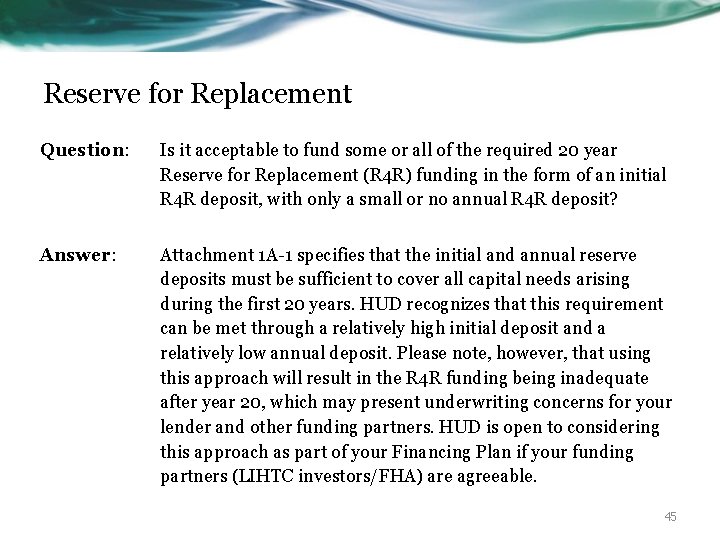
Reserve for Replacement Question: Is it acceptable to fund some or all of the required 20 year Reserve for Replacement (R 4 R) funding in the form of an initial R 4 R deposit, with only a small or no annual R 4 R deposit? Answer: Attachment 1 A-1 specifies that the initial and annual reserve deposits must be sufficient to cover all capital needs arising during the first 20 years. HUD recognizes that this requirement can be met through a relatively high initial deposit and a relatively low annual deposit. Please note, however, that using this approach will result in the R 4 R funding being inadequate after year 20, which may present underwriting concerns for your lender and other funding partners. HUD is open to considering this approach as part of your Financing Plan if your funding partners (LIHTC investors/FHA) are agreeable. 45
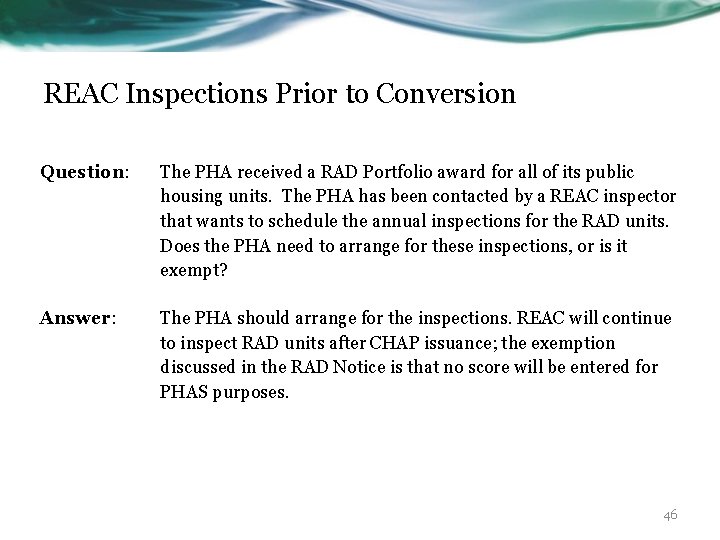
REAC Inspections Prior to Conversion Question: The PHA received a RAD Portfolio award for all of its public housing units. The PHA has been contacted by a REAC inspector that wants to schedule the annual inspections for the RAD units. Does the PHA need to arrange for these inspections, or is it exempt? Answer: The PHA should arrange for the inspections. REAC will continue to inspect RAD units after CHAP issuance; the exemption discussed in the RAD Notice is that no score will be entered for PHAS purposes. 46
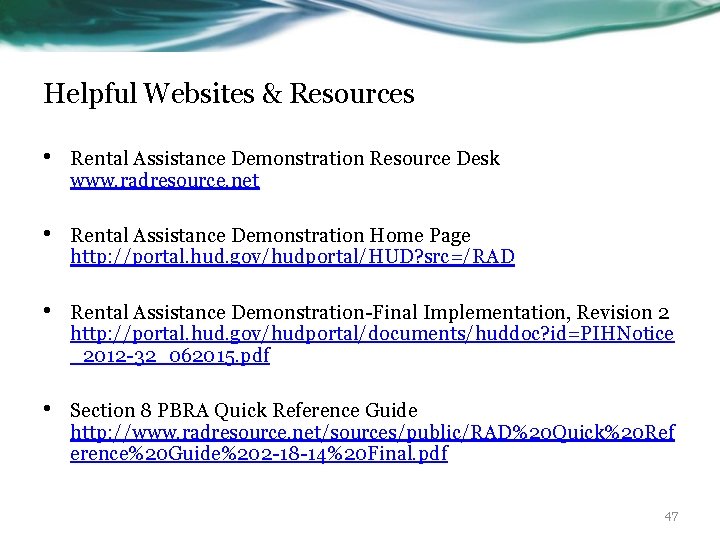
Helpful Websites & Resources • Rental Assistance Demonstration Resource Desk www. radresource. net • Rental Assistance Demonstration Home Page http: //portal. hud. gov/hudportal/HUD? src=/RAD • Rental Assistance Demonstration-Final Implementation, Revision 2 http: //portal. hud. gov/hudportal/documents/huddoc? id=PIHNotice _2012 -32_062015. pdf • Section 8 PBRA Quick Reference Guide http: //www. radresource. net/sources/public/RAD%20 Quick%20 Ref erence%20 Guide%202 -18 -14%20 Final. pdf 47
Contact Information Macon Housing Authority National Housing Compliance Mike Austin, CPM, PHM, COS Director Of Asset Management maustin@maconhousing. com (478) 752 -5080 Jeff Wirrick, CPM, SHCM Chief Asset Management Officer jeff. wirrick@nhcinc. org (770) 543 -0712 Jan Beall, COS, BOS, SHCM Compliance Manager jbeall@maconhousing. com (478) 752 -5157 Julie Fawcett, COS, SHCM, PHM Senior Compliance Manager julie. fawcett@nhcinc. org 770 -543 -0709 www. maconhousing. com www. nhcinc. org 48
Questions? Thank You! 49