
Rental Assistance Demonstration RAD National Low Income Housing

- Slides: 44
Rental Assistance Demonstration (RAD) National Low Income Housing Coalition March 17, 2013
AGENDA • RAD Basics (5 min) • Initial Public Housing Award Characteristics (5 min) • Key Resident Provisions (10 min) • Toolkit Overview (5 minutes) • Q & A (35 minutes) 2
RAD Basics
GOALS Rental Assistance Demonstration (RAD) Allows selected Public Housing & some at-risk assisted Multifamily housing programs to convert to long-term, project-based Section 8 voucher Housing Assistance Payment (HAP) contracts Goals • Improve and preserve public housing units • Provide more stable funding to public housing units • Offer residents greater choice & mobility in where they live 4
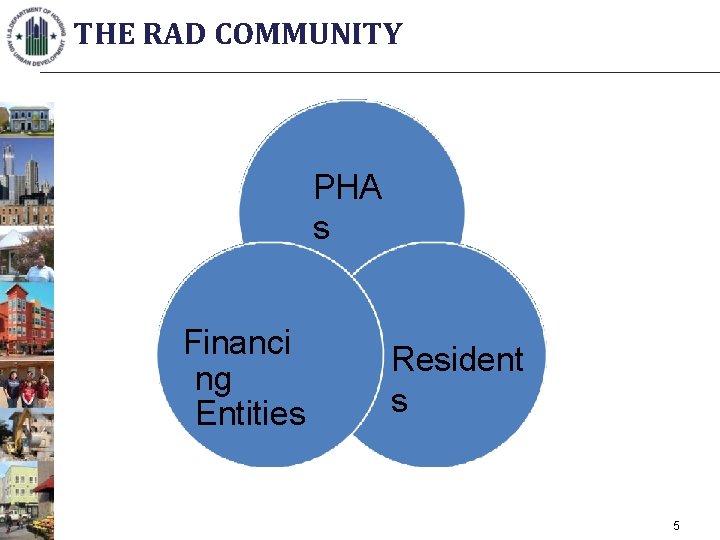
THE RAD COMMUNITY PHA s Financi ng Entities Resident s 5
ROLE OF RESIDENTS IN DEVELOPING RAD • Resident input a key driver in the evolution of TRA PETRA RAD – – – • Partnered with National Housing Law Project (NHLP) to conduct nationwide resident outreach for TRA Resident Engagement Group (REG) Historic resident convenings at HUD Meetings with Secretary Donovan and senior HUD staff Continued meetings with residents and advocates during RAD development RAD is not TRA or PETRA – A limited demonstration which reflects input from residents and advocates that were part of the process from the start 6
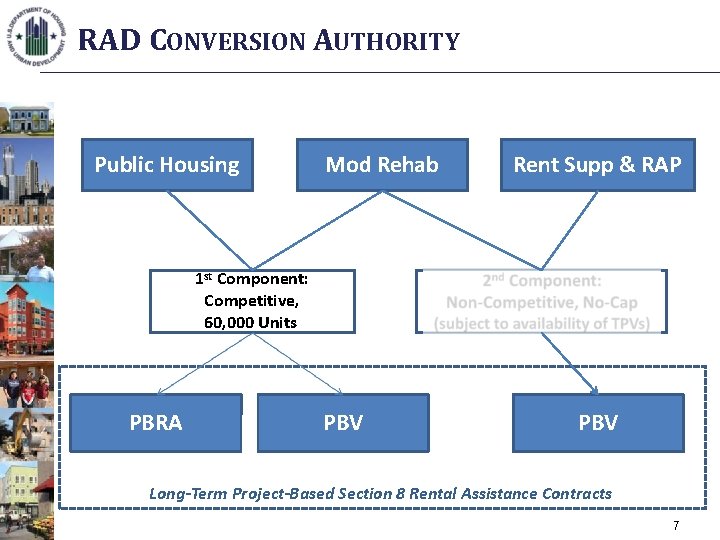
RAD CONVERSION AUTHORITY Public Housing Mod Rehab Rent Supp & RAP 1 st Component: Competitive, 60, 000 Units PBRA PBV Long-Term Project-Based Section 8 Rental Assistance Contracts 7
RAD CONVERSION AUTHORITY • RAD is voluntary – PHAs choose to apply • Up to 60, 000 Public Housing units can convert assistance • Assistance converts to long-term, property-based Section 8 contracts, either – Project Based Voucher (PBV) Contracts, administered by HUD’s Office Public and Indian Housing (PIH) – Project Based Rental Assistance (PBRA) Contracts, administered by HUD’s Office Multifamily Programs (OMFP) 8
Initial Public Housing Award Characteristics
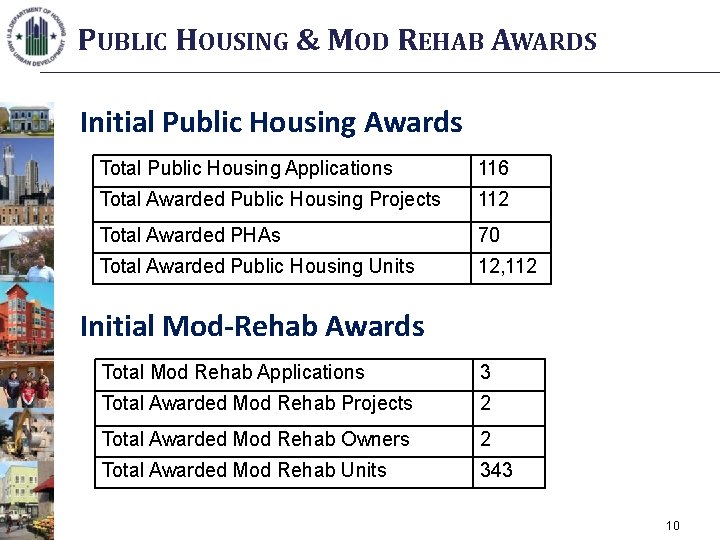
PUBLIC HOUSING & MOD REHAB AWARDS Initial Public Housing Awards Total Public Housing Applications 116 Total Awarded Public Housing Projects 112 Total Awarded PHAs 70 Total Awarded Public Housing Units 12, 112 Initial Mod-Rehab Awards Total Mod Rehab Applications 3 Total Awarded Mod Rehab Projects 2 Total Awarded Mod Rehab Owners 2 Total Awarded Mod Rehab Units 343 10
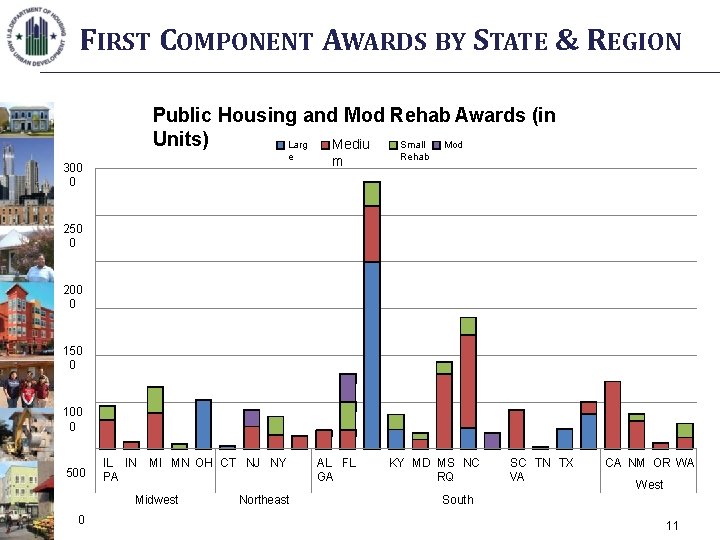
FIRST COMPONENT AWARDS BY STATE & REGION Public Housing and Mod Rehab Awards (in Units) Larg Small Mod Mediu e 300 0 m Rehab 250 0 200 0 150 0 100 0 500 IL IN PA MI MN OH CT NJ NY Midwest 0 Northeast AL FL GA KY MD MS NC RQ SC TN TX VA CA NM OR WA West South 11
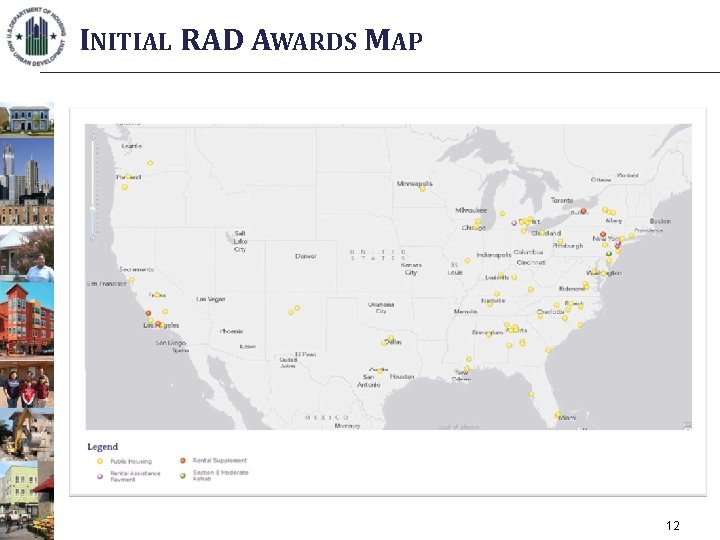
INITIAL RAD AWARDS MAP 12
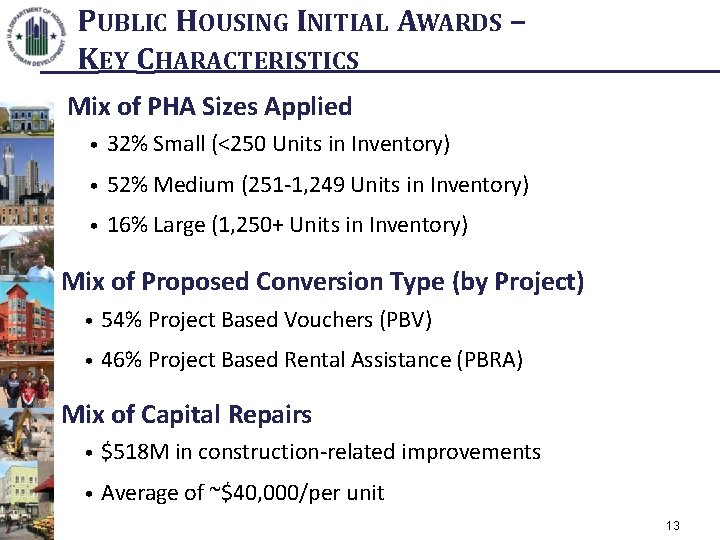
PUBLIC HOUSING INITIAL AWARDS – KEY CHARACTERISTICS Mix of PHA Sizes Applied • 32% Small (<250 Units in Inventory) • 52% Medium (251 -1, 249 Units in Inventory) • 16% Large (1, 250+ Units in Inventory) Mix of Proposed Conversion Type (by Project) • 54% Project Based Vouchers (PBV) • 46% Project Based Rental Assistance (PBRA) Mix of Capital Repairs • $518 M in construction-related improvements • Average of ~$40, 000/per unit 13
Key RAD Provisions
RESIDENT NOTIFICATION & CONSULTATION PHAs must notify and consult with residents in advance of, and throughout, a RAD conversion • Prior to Application – Conduct at least two meetings with residents of affected projects – Provide opportunity for residents of proposed projects to comment – Address resident comments in writing • Upon initial approval (PHA receives a Commitment to Enter into HAP, or CHAP), conduct at least one more resident meeting • Upon Issuance of RAD Conversion Commitment (RCC) – Notify each affected household of conversion approval – Inform households of specific conversion plans/impacts • Affected households that do not want to transition to new program can be offered transfer to other Public Housing as available 15
SIGNIFICANT AMENDMENT CHANGE RAD conversions are a “Significant Amendment” to a PHA Plan • Discussions with resident organizations and other residents can begin at any time • HUD requires that the Significant Amendment be made after initial approval is granted (CHAP) – Can be 2 months after a conversion application is submitted – Well before final conversion is approved (HAP) • RAB involvement, PHA-wide notice, broad public outreach & public hearing required as part of Significant Amendment 16
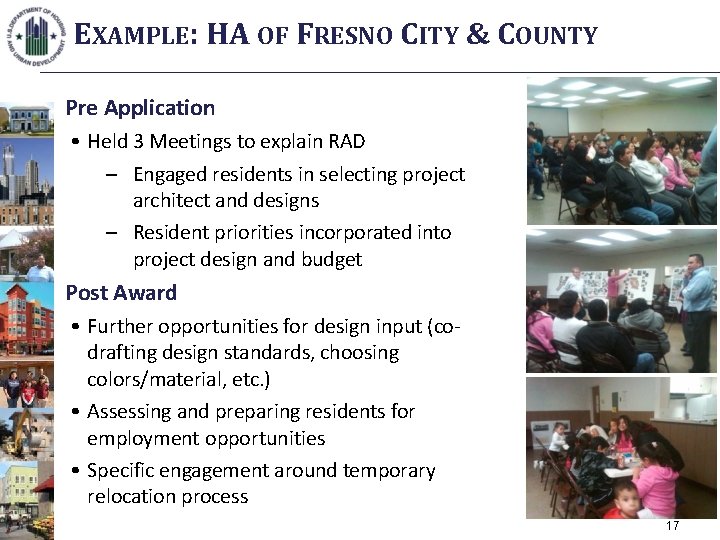
EXAMPLE: HA OF FRESNO CITY & COUNTY Pre Application • Held 3 Meetings to explain RAD – Engaged residents in selecting project architect and designs – Resident priorities incorporated into project design and budget Post Award • Further opportunities for design input (codrafting design standards, choosing colors/material, etc. ) • Assessing and preparing residents for employment opportunities • Specific engagement around temporary relocation process 17
PUBLIC HOUSING PROVISIONS PHAs must maintain same # of deeply affordable units • Must convert all or substantially all units in covered project No Permanent involuntary displacement of residents as a result of conversion Long-Term Affordability • Initial Contract Terms: 20 (PBRA) and 15 (PBV) years • Contract Renewal: Secretary must offer, and PHA must accept • Use Agreement: Long-term use agreement extended with each contract renewal Conversion will not require a change in ownership • Public or non-profit ownership or control, two exceptions 18
RESIDENT CHOICE-MOBILITY PBV—adheres to current program rules • Minimum residency: 1 year • Waitlist priority if tenant-based assistance is not immediately available PBRA—different rules • Minimum residency: 2 years • PHA may limit Choice-Mobility vouchers to 1/3 of turnover vouchers, or moves to 15% of the project’s assisted units – If limited, resident wait-list policy for HCVs to exercise choice-mobility option • HUD may exempt up to 10% of converted units under RAD from this requirement where no vouchers are available 19
RENT & TENANCY PROVISIONS Residents will continue to pay 30% adjusted income – If monthly rent increases by more than greater of 10% or $25 purely as a result of conversion (only likely in “flat rent” scenarios), rent increases will be phased in over 3 years (or 5 years if PHA elects) No rescreening of residents upon conversion – will not affect continued residency Residents will have the right to return if rehab or construction requires temporary relocation Permanent involuntary displacement of residents may not occur as a result of RAD 20
RESIDENT PROVISIONS • Family Self-Sufficiency (FSS) & Resident Opportunities and Self-Sufficiency (ROSS-SC) – FSS & ROSS-SC participants may continue in programs • Resident Participation & Funding – – – Residents can establish & operate legitimate resident organizations PHAs must recognize legitimate resident organizations PHAs must provide $25 per occupied unit annually for resident participation per current PH program rules • Resident Procedural Rights – PHAs must abide by additional (to PBV & PBRA) grievance and termination provisions to be consistent with rights afforded by Section 6 of the Housing Act 21
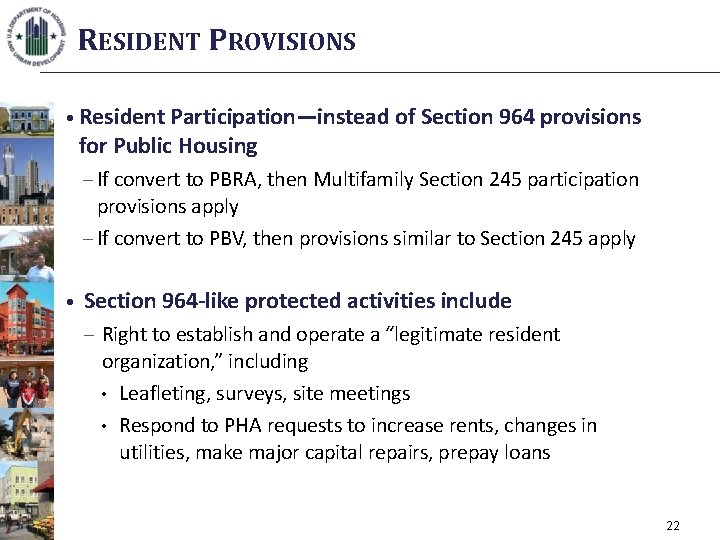
RESIDENT PROVISIONS • Resident Participation—instead of Section 964 provisions for Public Housing – If convert to PBRA, then Multifamily Section 245 participation provisions apply – If convert to PBV, then provisions similar to Section 245 apply • Section 964 -like protected activities include – Right to establish and operate a “legitimate resident organization, ” including • Leafleting, surveys, site meetings • Respond to PHA requests to increase rents, changes in utilities, make major capital repairs, prepay loans 22
Resident Education Toolkit
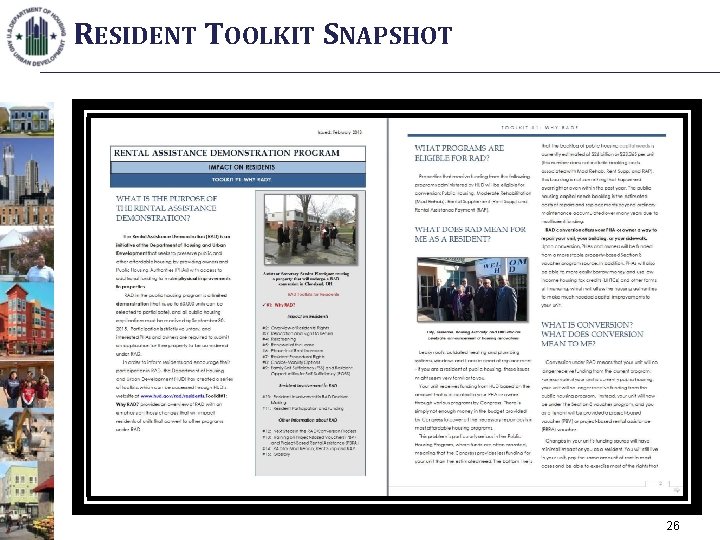
PURPOSE OF RESIDENT TOOLKIT • Provide a set of resources to residents of participating (and potentially participating) Public Housing projects – – Cover many topics relevant to residents Easy to understand • Encourage broader participation and information sharing • Clarify where to go for certain types of information (e. g. leases, handbooks, Notices, etc. ) 24
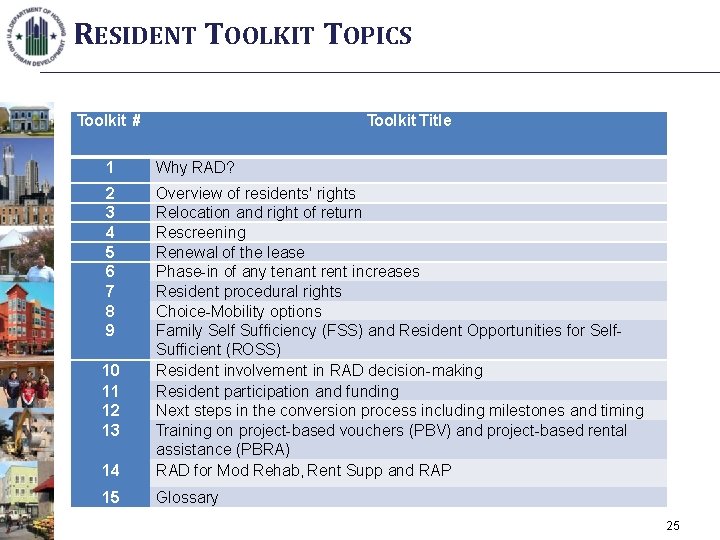
RESIDENT TOOLKIT TOPICS Toolkit # Toolkit Title 1 Why RAD? 2 3 4 5 6 7 8 9 14 Overview of residents' rights Relocation and right of return Rescreening Renewal of the lease Phase-in of any tenant rent increases Resident procedural rights Choice-Mobility options Family Self Sufficiency (FSS) and Resident Opportunities for Self. Sufficient (ROSS) Resident involvement in RAD decision-making Resident participation and funding Next steps in the conversion process including milestones and timing Training on project-based vouchers (PBV) and project-based rental assistance (PBRA) RAD for Mod Rehab, Rent Supp and RAP 15 Glossary 10 11 12 13 25
RESIDENT TOOLKIT SNAPSHOT 26
RESIDENT TOOLKIT DISSEMINATION • Publication on RAD website – • Toolkit topical Webinars – • Including re-design of website and a page just for residents With participation from advocates and other leaders Possible regional or HQ training HUD is also in process of collecting resident contact information from each awarded PHA for information sharing purposes 27
RAD EVALUATION 3 Year Authority (to September 30, 2015) for Public Housing & Mod Rehab Asses for Public Housing conversions: • Impact on preservation and improvement of covered projects • Impact of conversions on residents • Amount of private capital leveraged as a result of conversion Asses for Mod Rehab, Rent Supp & RAP conversions: • FY 2006 -2014 Authority • Comptroller General of US to conduct study of long-term impact on ratio of tenant-based vouchers to project-based vouchers. 28
RAD WEB PAGE RAD Notice, application materials, and additional resources can be found at www. hud. gov/rad Email questions to rad@hud. gov My Email: Leila. Bozorg@hud. gov 29
APPENDIX
WHY RAD—PUBLIC HOUSING? Public Housing Inventory • ~ 1. 15 million units across 3, 100+ PHAs • Capital repair needs in excess of $25. 6 B across portfolio ($23, 365/unit) • Section 9 funding platform unreliable (pro-rations, appropriation cuts), limited access to debt/equity capital (declaration of trust) • Losing 10, 000 -15, 000 hard units/year 31
WHY RAD—MULTIFAMILY HOUSING? HUD’s Legacy Programs (the Orphans) • Section 8 Moderate Rehabilitation (Mod Rehab) ~ 23, 000 units – Cannot renew on terms needed to secure financing • Rent Supplement (Rent Supp) & Rental Assistance Payment (RAP) ~ 22, 500 units – No option to renew when contracts expire 32
RAD LEGISLATIVE HISTORY • February 2010: FY 11 Budget requests $350 M for Transforming Rental Assistance (TRA) initiative • May 2010: “Preservation, Enhancement, and Transformation of Rental Assistance Act of 2010” (PETRA) - Administration’s bill • December 2010: “Rental Housing Revitalization Act” (RHRA) introduced by Rep. Ellison and co-sponsors • February 2011: FY 12 Budget requests $200 M for a “Rental Assistance Demonstration” (RAD) • August 2011: RAD language submitted as “Technical Drafting Service” (TDS) to Rep. Ellison, Rep. Bachus, and Senator Shelby • November 2011: FY 12 Appropriations minibus authorized RAD 33
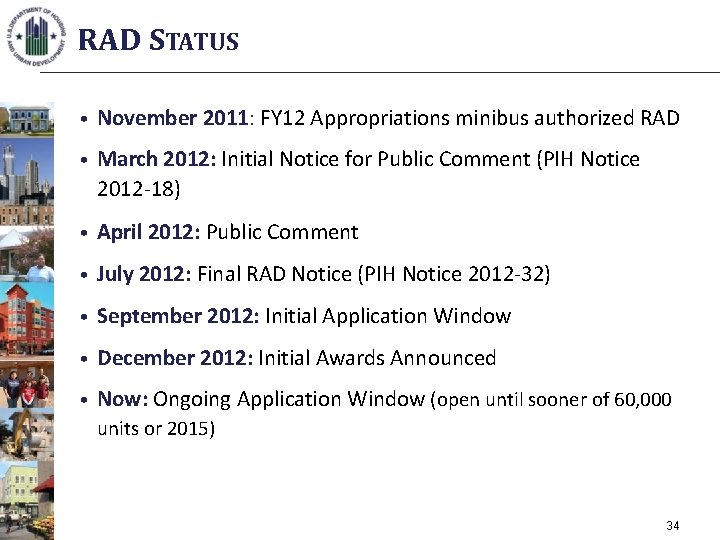
RAD STATUS • November 2011: FY 12 Appropriations minibus authorized RAD • March 2012: Initial Notice for Public Comment (PIH Notice 2012 -18) • April 2012: Public Comment • July 2012: Final RAD Notice (PIH Notice 2012 -32) • September 2012: Initial Application Window • December 2012: Initial Awards Announced • Now: Ongoing Application Window (open until sooner of 60, 000 units or 2015) 34
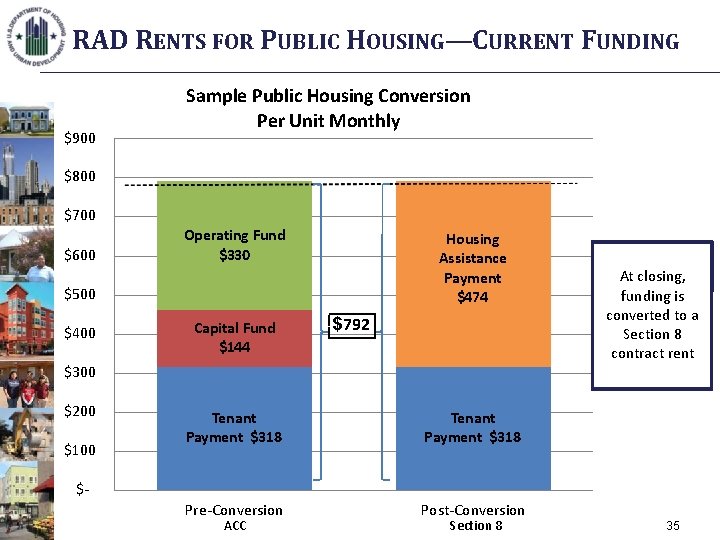
RAD RENTS FOR PUBLIC HOUSING—CURRENT FUNDING $900 Sample Public Housing Conversion Per Unit Monthly $800 $700 $600 Operating Fund $330 Housing Assistance Payment $474 $500 $400 Capital Fund $144 $792 $300 $200 $100 Tenant Payment $318 Pre-Conversion Post-Conversion At closing, funding is converted to a Section 8 contract rent $ACC Section 8 35
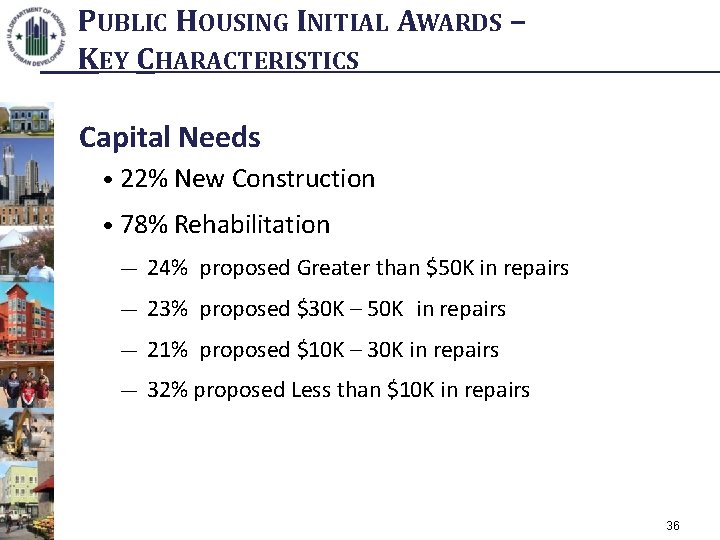
PUBLIC HOUSING INITIAL AWARDS – KEY CHARACTERISTICS Capital Needs • 22% New Construction • 78% Rehabilitation — 24% proposed Greater than $50 K in repairs — 23% proposed $30 K – 50 K in repairs — 21% proposed $10 K – 30 K in repairs — 32% proposed Less than $10 K in repairs 36
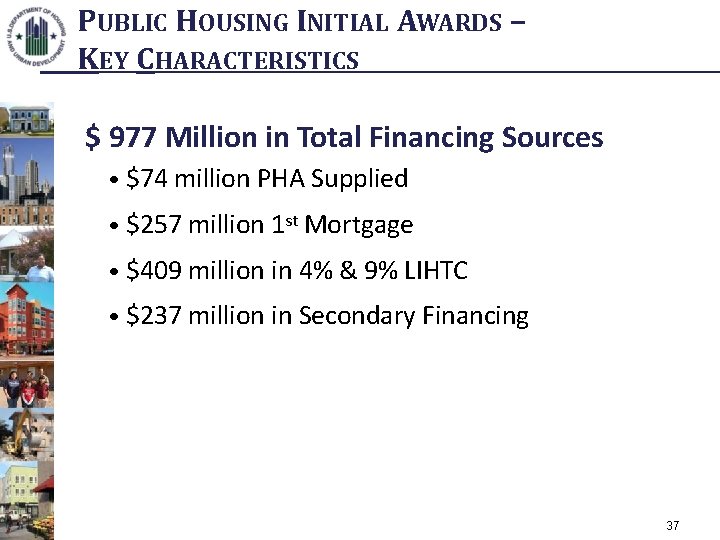
PUBLIC HOUSING INITIAL AWARDS – KEY CHARACTERISTICS $ 977 Million in Total Financing Sources • $74 million PHA Supplied • $257 million 1 st Mortgage • $409 million in 4% & 9% LIHTC • $237 million in Secondary Financing 37
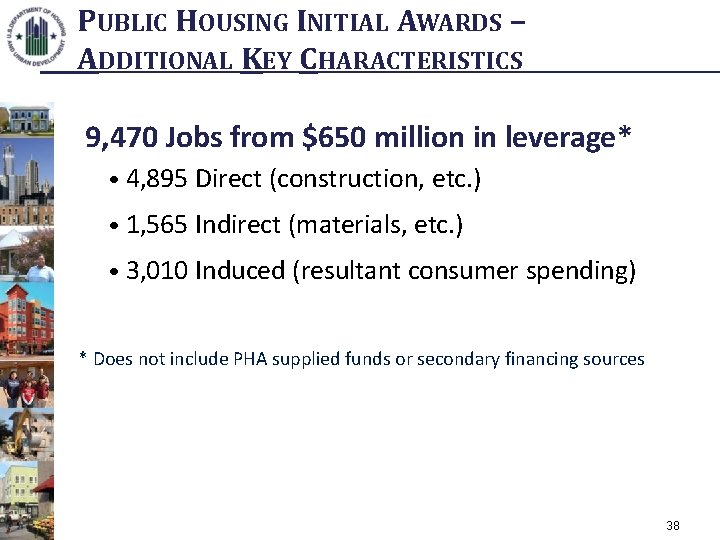
PUBLIC HOUSING INITIAL AWARDS – ADDITIONAL KEY CHARACTERISTICS 9, 470 Jobs from $650 million in leverage* • 4, 895 Direct (construction, etc. ) • 1, 565 Indirect (materials, etc. ) • 3, 010 Induced (resultant consumer spending) * Does not include PHA supplied funds or secondary financing sources 38
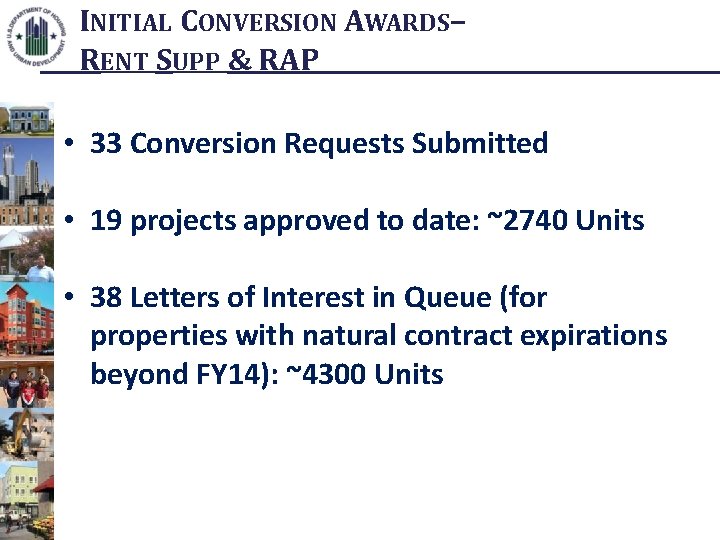
INITIAL CONVERSION AWARDS– RENT SUPP & RAP • 33 Conversion Requests Submitted • 19 projects approved to date: ~2740 Units • 38 Letters of Interest in Queue (for properties with natural contract expirations beyond FY 14): ~4300 Units
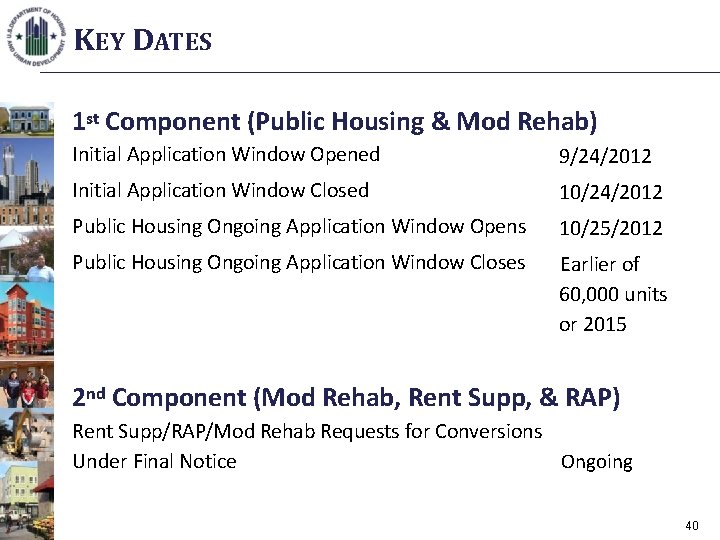
KEY DATES 1 st Component (Public Housing & Mod Rehab) Initial Application Window Opened 9/24/2012 Initial Application Window Closed 10/24/2012 Public Housing Ongoing Application Window Opens 10/25/2012 Public Housing Ongoing Application Window Closes Earlier of 60, 000 units or 2015 2 nd Component (Mod Rehab, Rent Supp, & RAP) Rent Supp/RAP/Mod Rehab Requests for Conversions Under Final Notice Ongoing 40
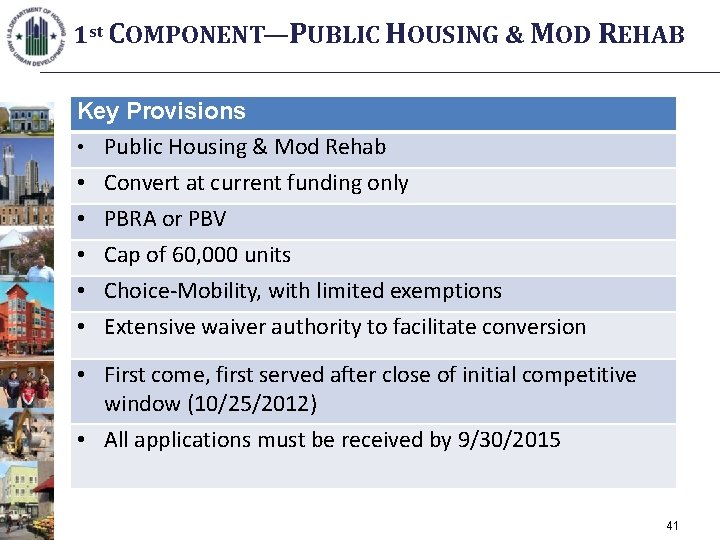
1 st COMPONENT—PUBLIC HOUSING & MOD REHAB Key Provisions • Public Housing & Mod Rehab • Convert at current funding only • PBRA or PBV • Cap of 60, 000 units • Choice-Mobility, with limited exemptions • Extensive waiver authority to facilitate conversion • First come, first served after close of initial competitive window (10/25/2012) • All applications must be received by 9/30/2015 41
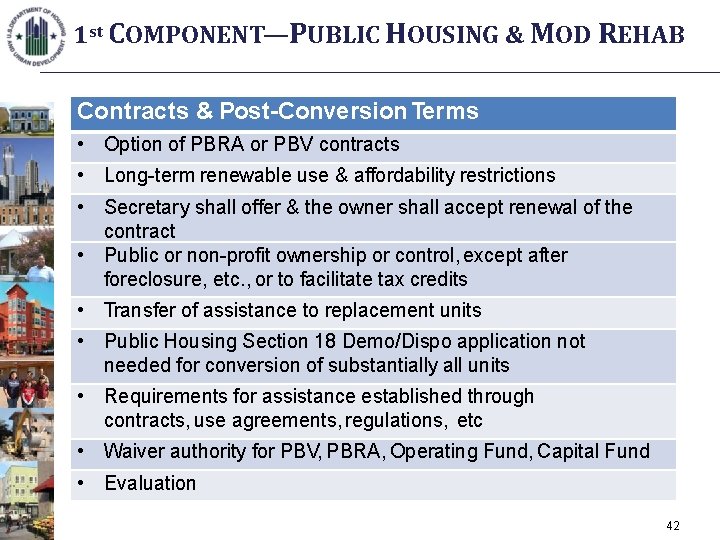
1 st COMPONENT—PUBLIC HOUSING & MOD REHAB Contracts & Post-Conversion Terms • Option of PBRA or PBV contracts • Long-term renewable use & affordability restrictions • Secretary shall offer & the owner shall accept renewal of the contract • Public or non-profit ownership or control, except after foreclosure, etc. , or to facilitate tax credits • Transfer of assistance to replacement units • Public Housing Section 18 Demo/Dispo application not needed for conversion of substantially all units • Requirements for assistance established through contracts, use agreements, regulations, etc • Waiver authority for PBV, PBRA, Operating Fund, Capital Fund • Evaluation 42
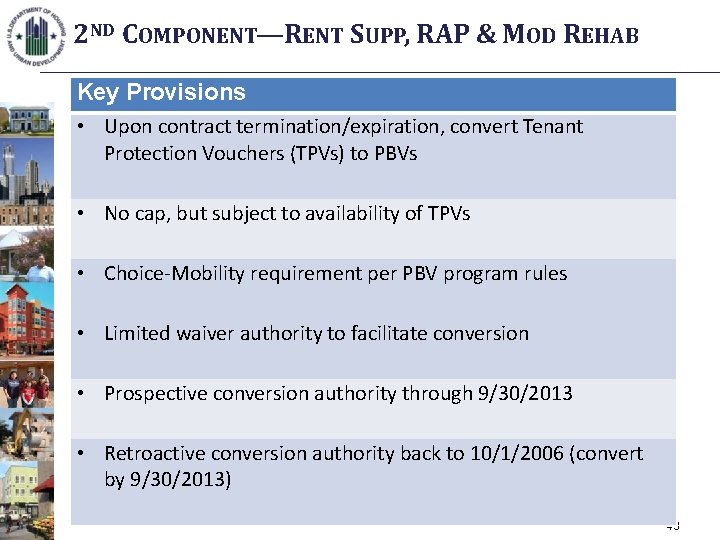
2 ND COMPONENT—RENT SUPP, RAP & MOD REHAB Key Provisions • Upon contract termination/expiration, convert Tenant Protection Vouchers (TPVs) to PBVs • No cap, but subject to availability of TPVs • Choice-Mobility requirement per PBV program rules • Limited waiver authority to facilitate conversion • Prospective conversion authority through 9/30/2013 • Retroactive conversion authority back to 10/1/2006 (convert by 9/30/2013) 43
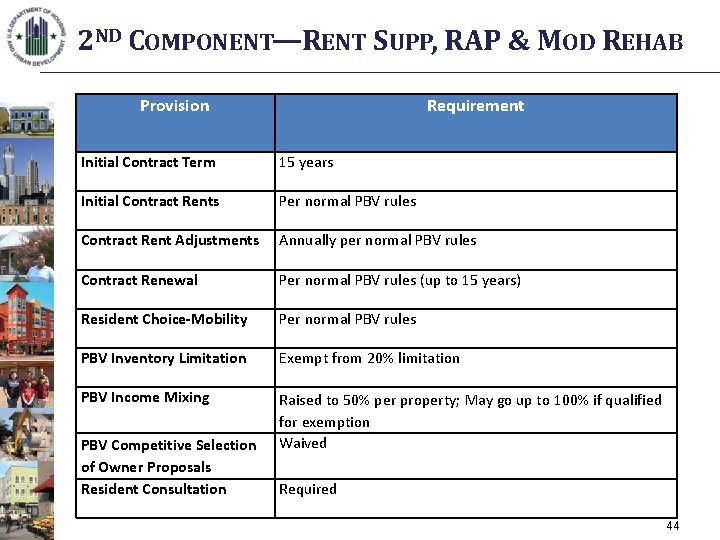
2 ND COMPONENT—RENT SUPP, RAP & MOD REHAB Provision Requirement Initial Contract Term 15 years Initial Contract Rents Per normal PBV rules Contract Rent Adjustments Annually per normal PBV rules Contract Renewal Per normal PBV rules (up to 15 years) Resident Choice-Mobility Per normal PBV rules PBV Inventory Limitation Exempt from 20% limitation PBV Income Mixing Raised to 50% per property; May go up to 100% if qualified for exemption Waived PBV Competitive Selection of Owner Proposals Resident Consultation Required 44