
Rental Assistance Demonstration RAD Best Practices for Today
Rental Assistance Demonstration (RAD): Best Practices for Today and Tips for the Future Thursday March 9, 2017 2: 00 pm – 3: 00 pm EST Thanks to our sponsor:
RAD & Tax Credits

Show me the closing numbers! 38% Closed RAD units as a percentage of total units in program $3. 8 B $2. 8 B Construction activity leveraged As of 3/6/2017 - via HUD 10/26/2020 Page 3 tax credit equity leveraged for 153 RAD transactions
Impact of LIHTCs on RAD • Responsible for almost 75% of the construction costs leveraged by RAD • Multiple housing finance agencies leaning into RAD • AL, AZ, CA, CO, CT, FL, GA, IL, IN, LA, MD, MI, MO, MS, NC, NJ, NM, NV, NY, OH, PA, SC, SD, TN, TX, VA, WI • High pricing + real estate tax exemption + (usually) QCTs = success • LIHTC market uncertainty in 2017+
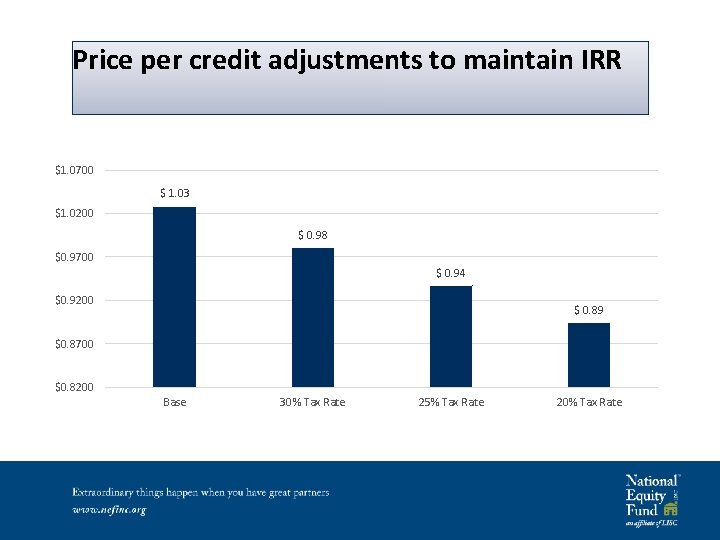
Price per credit adjustments to maintain IRR $1. 0700 $ 1. 03 $1. 0200 $ 0. 98 $0. 9700 $ 0. 94 $0. 9200 $ 0. 89 $0. 8700 $0. 8200 Base 30% Tax Rate 25% Tax Rate 20% Tax Rate
Other Potential Impacts for PHAs • Strained resources on an already strained entity • Federal resources limited… and likely more limiting in 2017+ • Generally: • • • Rural Reliant on federal subsidy Limited capacity
Tools for RAD participants • RAD I: • • Flexibility from HUD on timing, esp. for LIHTC issues PBRA- ability to translate utility savings into contract rent • RAD II: • • New PBRA allowance under Mod-Rehab Generally located in urban areas- slightly protected from LIHTC concerns • Investors and CRA need
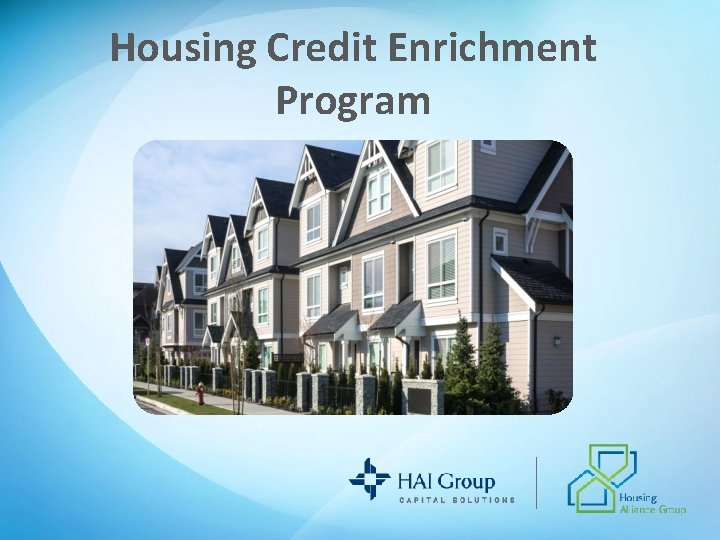
Housing Credit Enrichment Program
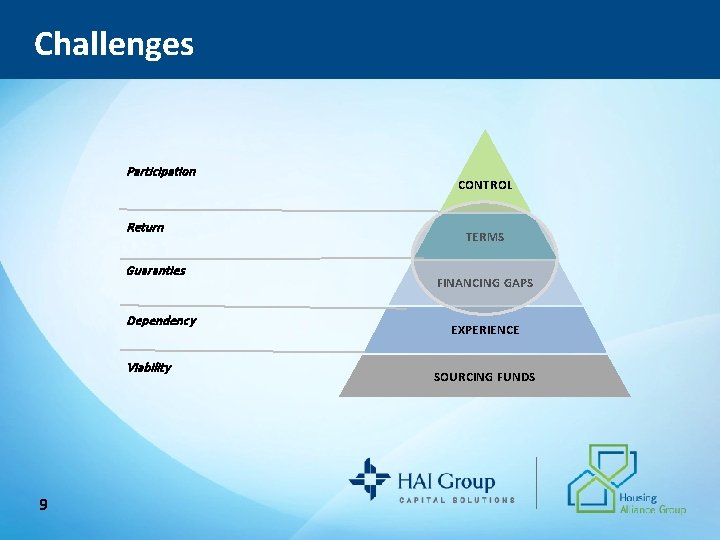
Challenges Participation Return Guaranties Dependency Viability 9 CONTROL TERMS FINANCING GAPS EXPERIENCE SOURCING FUNDS
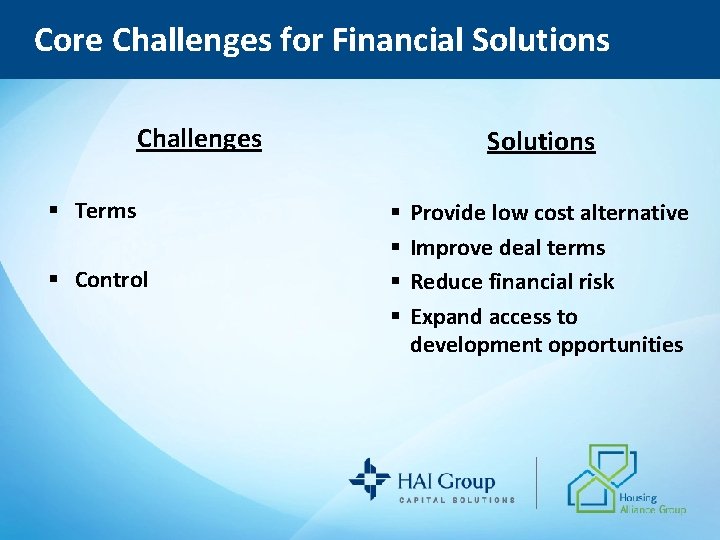
Core Challenges for Financial Solutions Challenges § Terms § Control Solutions § § Provide low cost alternative Improve deal terms Reduce financial risk Expand access to development opportunities
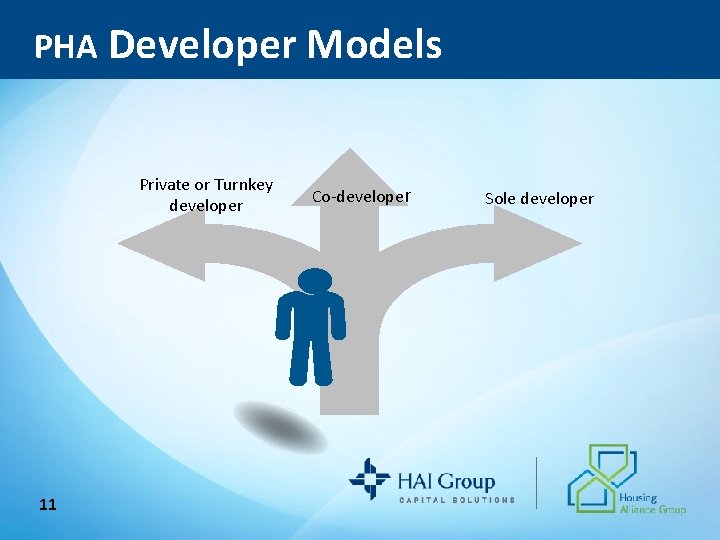
PHA Developer Models Private or Turnkey developer 11 Co-developer Sole developer
Housing Credit Enrichment Product “ The Housing Credit Enrichment Program is an HAI Group Partner Program with RBC Capital Markets designed for PHAs who sponsor Low-income Housing Tax Credit (LIHTC) transactions to be able to operate and compete more successfully in the private financial market. The Housing Credit Enrichment Program builds capacity by sharing a portion of LIHTC guaranty risks, enabling better deal terms and financial returns to be structured for maximum PHA participation and control. ” 12
Program Terms § One project at a time § Two to eight years project funding § Benefits at each phase • Construction • Pre-Stabilization • Post-Stabilization 13
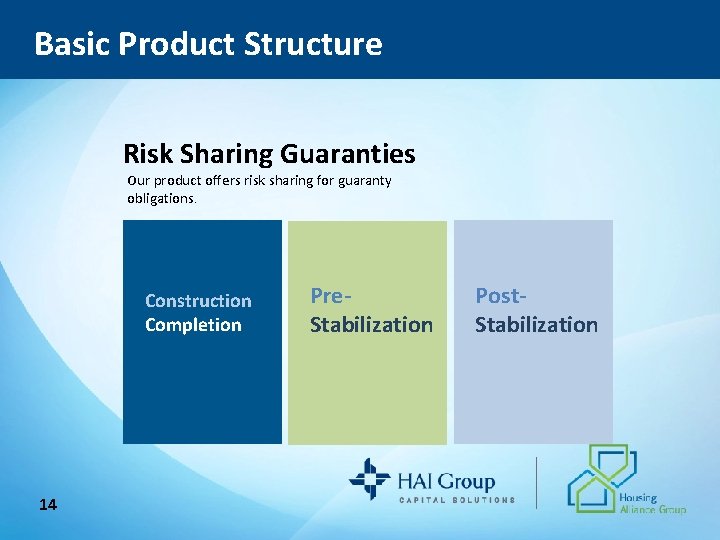
Basic Product Structure Risk Sharing Guaranties Our product offers risk sharing for guaranty obligations. Construction Completion 14 Pre. Stabilization Post. Stabilization
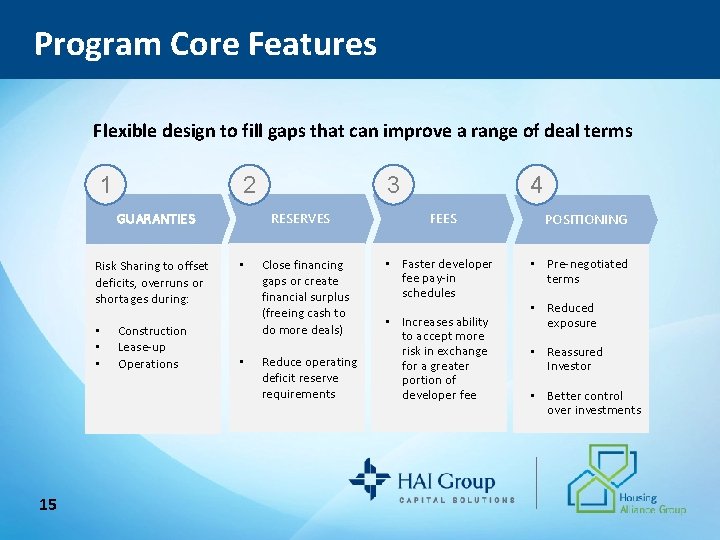
Program Core Features Flexible design to fill gaps that can improve a range of deal terms 1 2 RESERVES GUARANTIES Risk Sharing to offset deficits, overruns or shortages during: • • • 15 Construction Lease-up Operations 3 • • Close financing gaps or create financial surplus (freeing cash to do more deals) Reduce operating deficit reserve requirements 4 FEES POSITIONING • Faster developer fee pay-in schedules • Pre-negotiated terms • Increases ability to accept more risk in exchange for a greater portion of developer fee • Reassured Investor • Reduced exposure • Better control over investments
189 Commerce Court Cheshire, CT 06410 -0189 www. housingcenter. com Includes copyrighted material from a company under the HAI Group ® family, with its permission.
The Community Development Trust February 2017
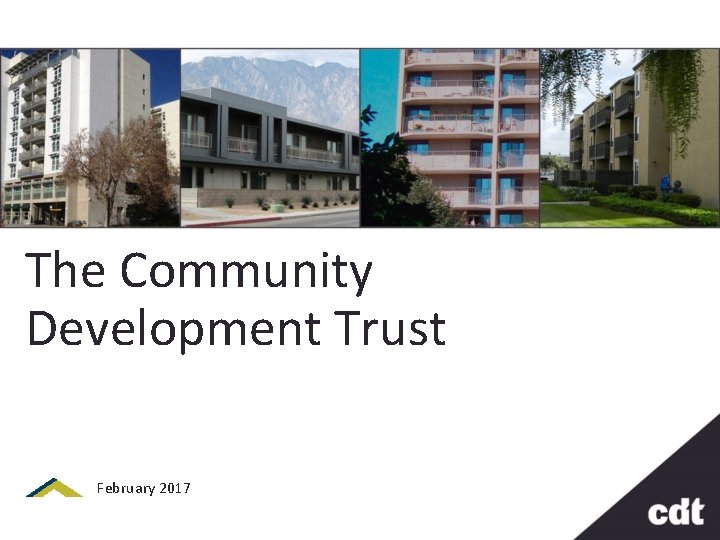
18 Who We Are / What We Do § CDT is a national investor in affordable housing. Working with a variety of partners, we make long-term equity investments and originate and acquire long-term mortgages. § CDT is a double bottom-line organization: we provide capital to preserve and create affordable housing and also seek to generate market-rate returns for our investors. § In our 18 years of operations, CDT has invested more than $1. 25 billion in debt and equity capital to properties in 44 states and regions – helping to preserve and create more than 44, 000 units of affordable housing. § CDT provides long-term capital which contributes to the stability of affordable housing and enhances the quality of life for residents.
19 Debt Business § CDT’s Debt Portfolio has grown to over $500 million (including forward commitments) and more than 18, 500 units. § Origination Focus: • Forward commitments on LIHTC transactions • Portfolio acquisitions from CDFI’s and banks § CDT has relationships with a wide network of industry players including developers, banks, CDFI’s, housing finance agencies, and affordable housing operators throughout the country. § CDT has provided permanent financing for nine RAD transactions across the country totaling over 900 units and $30 million
20 Equity Investment Business § CDT owns more than 6, 000 affordable units throughout the country. § CDT’s objective is to invest capital to preserve long-term affordability and generate cash flow. § Investment Focus: • Properties with Section 8 project-based contracts and other HUD subsidies such as RAD • LIHTC properties nearing the end of their initial compliance period • Properties with local subsidies such as tax abatements § Recent transactions include a joint venture with the Housing Authority of the City of Austin on a mixed-income property acquisition and a component two RAD conversion of a 553 -unit property in Rochester, NY
Rental Assistance Demonstration (RAD): Best Practices for Today and Tips for the Future CASE STUDIES Thanks to our sponsor:
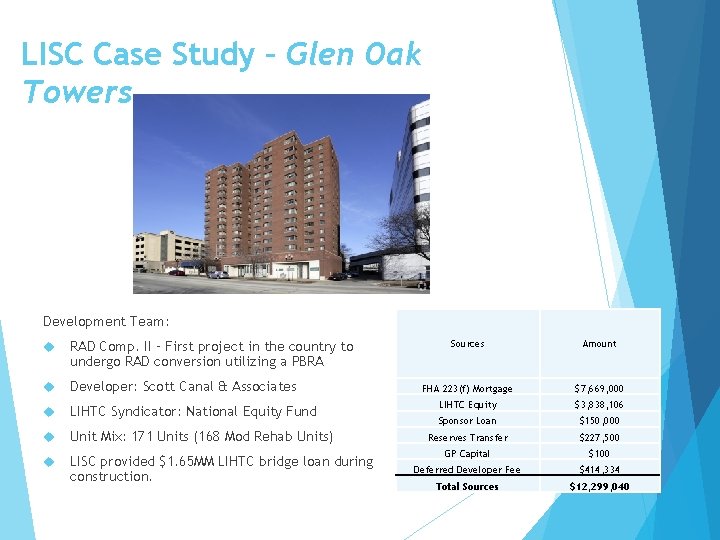
LISC Case Study – Glen Oak Towers Development Team: RAD Comp. II – First project in the country to undergo RAD conversion utilizing a PBRA Developer: Scott Canal & Associates LIHTC Syndicator: National Equity Fund Unit Mix: 171 Units (168 Mod Rehab Units) LISC provided $1. 65 MM LIHTC bridge loan during construction. Sources Amount FHA 223(f) Mortgage $7, 669, 000 LIHTC Equity $3, 838, 106 Sponsor Loan $150, 000 Reserves Transfer $227, 500 GP Capital $100 Deferred Developer Fee $414, 334 Total Sources 22 $12, 299, 040
Case Study Situation: A private developer and a housing authority want to partner to redevelop an existing housing authority property Issue: The private developer is only willing to be the project’s financial guarantor until the project’s stabilization period. The housing authority is unable to take over as financial guarantor after the project’s stabilization period. Solution: 23 HCEP product allows housing authority to assume role as financial guarantor after project’s stabilization and the private developer are relieved of their financial guarantees.
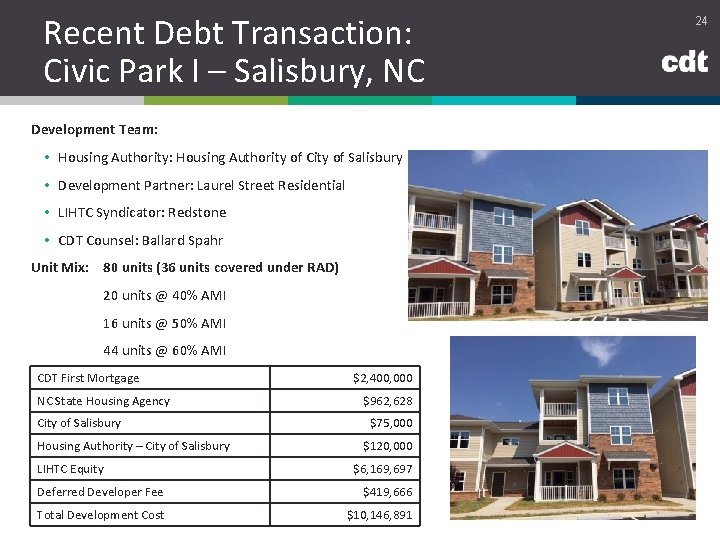
Recent Debt Transaction: Civic Park I – Salisbury, NC Development Team: • Housing Authority: Housing Authority of City of Salisbury • Development Partner: Laurel Street Residential • LIHTC Syndicator: Redstone • CDT Counsel: Ballard Spahr Unit Mix: 80 units (36 units covered under RAD) 20 units @ 40% AMI 16 units @ 50% AMI 44 units @ 60% AMI CDT First Mortgage NC State Housing Agency City of Salisbury Housing Authority – City of Salisbury LIHTC Equity $2, 400, 000 $962, 628 $75, 000 $120, 000 $6, 169, 697 Deferred Developer Fee $419, 666 Total Development Cost $10, 146, 891 24
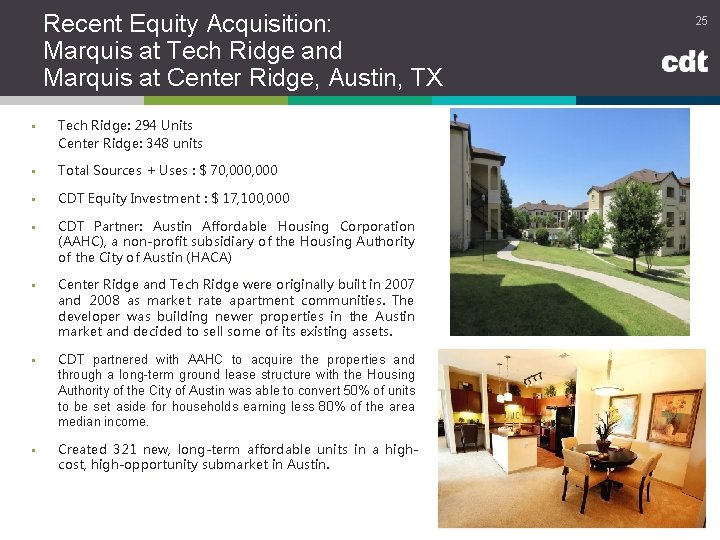
Recent Equity Acquisition: Marquis at Tech Ridge and Marquis at Center Ridge, Austin, TX § Tech Ridge: 294 Units Center Ridge: 348 units § Total Sources + Uses : $ 70, 000 § CDT Equity Investment : $ 17, 100, 000 § CDT Partner: Austin Affordable Housing Corporation (AAHC), a non-profit subsidiary of the Housing Authority of the City of Austin (HACA) § Center Ridge and Tech Ridge were originally built in 2007 and 2008 as market rate apartment communities. The developer was building newer properties in the Austin market and decided to sell some of its existing assets. § CDT partnered with AAHC to acquire the properties and through a long-term ground lease structure with the Housing Authority of the City of Austin was able to convert 50% of units to be set aside for households earning less 80% of the area median income. § Created 321 new, long-term affordable units in a highcost, high-opportunity submarket in Austin. 25
Rental Assistance Demonstration (RAD): Best Practices for Today and Tips for the Future QUESTIONS? Thanks to our sponsor:
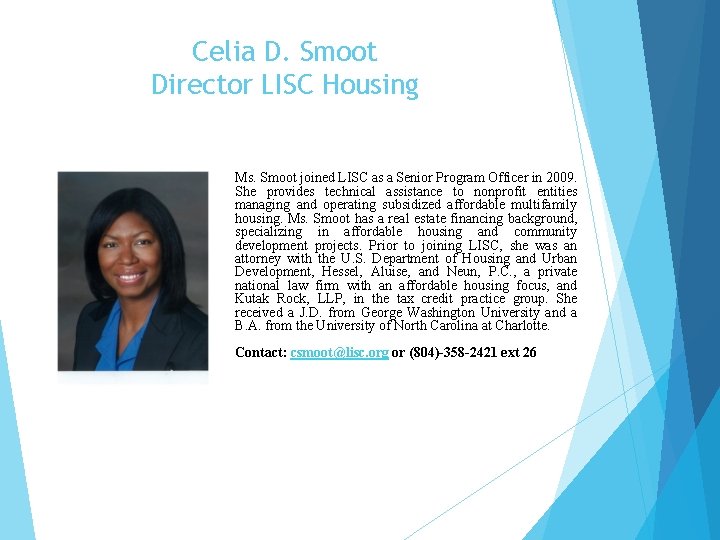
Celia D. Smoot Director LISC Housing Ms. Smoot joined LISC as a Senior Program Officer in 2009. She provides technical assistance to nonprofit entities managing and operating subsidized affordable multifamily housing. Ms. Smoot has a real estate financing background, specializing in affordable housing and community development projects. Prior to joining LISC, she was an attorney with the U. S. Department of Housing and Urban Development, Hessel, Aluise, and Neun, P. C. , a private national law firm with an affordable housing focus, and Kutak Rock, LLP, in the tax credit practice group. She received a J. D. from George Washington University and a B. A. from the University of North Carolina at Charlotte. Contact: csmoot@lisc. org or (804)-358 -2421 ext 26
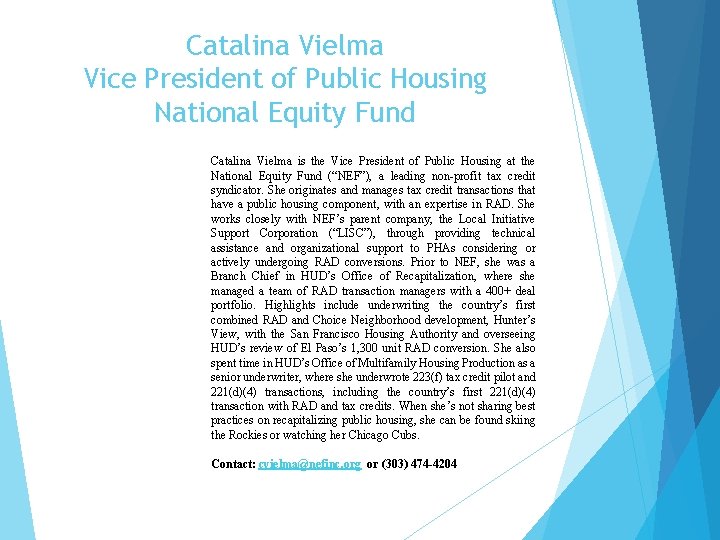
Catalina Vielma Vice President of Public Housing National Equity Fund Catalina Vielma is the Vice President of Public Housing at the National Equity Fund (“NEF”), a leading non-profit tax credit syndicator. She originates and manages tax credit transactions that have a public housing component, with an expertise in RAD. She works closely with NEF’s parent company, the Local Initiative Support Corporation (“LISC”), through providing technical assistance and organizational support to PHAs considering or actively undergoing RAD conversions. Prior to NEF, she was a Branch Chief in HUD’s Office of Recapitalization, where she managed a team of RAD transaction managers with a 400+ deal portfolio. Highlights include underwriting the country’s first combined RAD and Choice Neighborhood development, Hunter’s View, with the San Francisco Housing Authority and overseeing HUD’s review of El Paso’s 1, 300 unit RAD conversion. She also spent time in HUD’s Office of Multifamily Housing Production as a senior underwriter, where she underwrote 223(f) tax credit pilot and 221(d)(4) transactions, including the country’s first 221(d)(4) transaction with RAD and tax credits. When she’s not sharing best practices on recapitalizing public housing, she can be found skiing the Rockies or watching her Chicago Cubs. Contact: cvielma@nefinc. org or (303) 474 -4204
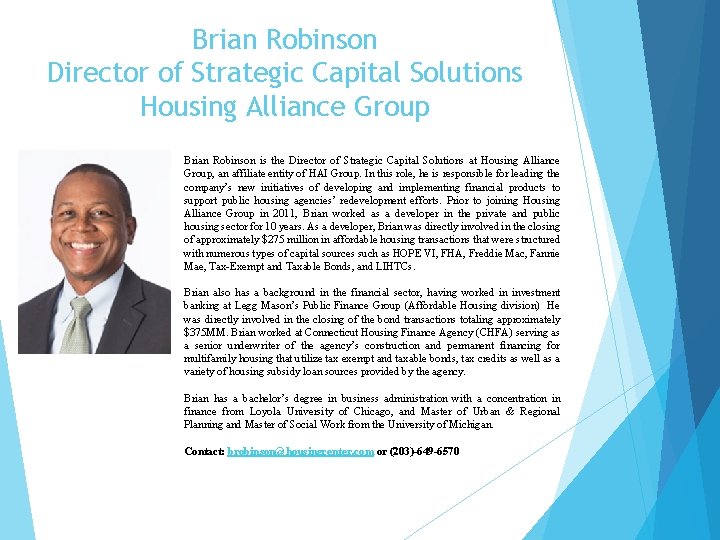
Brian Robinson Director of Strategic Capital Solutions Housing Alliance Group Brian Robinson is the Director of Strategic Capital Solutions at Housing Alliance Group, an affiliate entity of HAI Group. In this role, he is responsible for leading the company’s new initiatives of developing and implementing financial products to support public housing agencies’ redevelopment efforts. Prior to joining Housing Alliance Group in 2011, Brian worked as a developer in the private and public housing sector for 10 years. As a developer, Brian was directly involved in the closing of approximately $275 million in affordable housing transactions that were structured with numerous types of capital sources such as HOPE VI, FHA, Freddie Mac, Fannie Mae, Tax-Exempt and Taxable Bonds, and LIHTCs. Brian also has a background in the financial sector, having worked in investment banking at Legg Mason’s Public Finance Group (Affordable Housing division) He was directly involved in the closing of the bond transactions totaling approximately $375 MM. Brian worked at Connecticut Housing Finance Agency (CHFA) serving as a senior underwriter of the agency’s construction and permanent financing for multifamily housing that utilize tax exempt and taxable bonds, tax credits as well as a variety of housing subsidy loan sources provided by the agency. Brian has a bachelor’s degree in business administration with a concentration in finance from Loyola University of Chicago, and Master of Urban & Regional Planning and Master of Social Work from the University of Michigan. Contact: brobinson@housingcenter. com or (203)-649 -6570
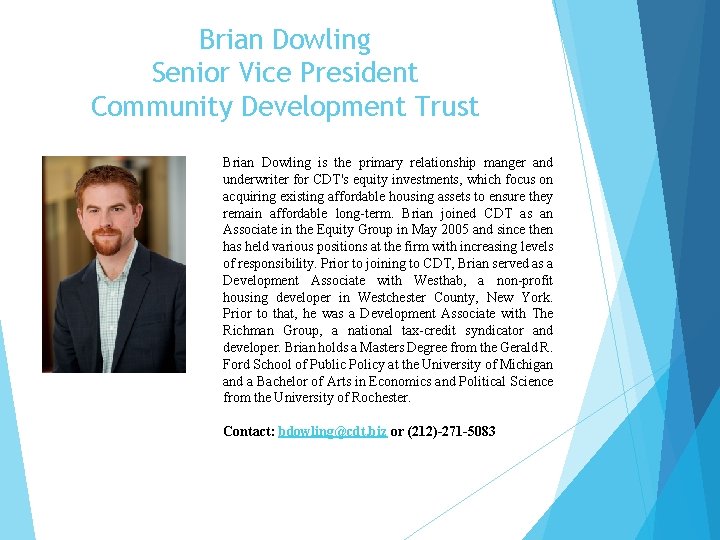
Brian Dowling Senior Vice President Community Development Trust Brian Dowling is the primary relationship manger and underwriter for CDT's equity investments, which focus on acquiring existing affordable housing assets to ensure they remain affordable long-term. Brian joined CDT as an Associate in the Equity Group in May 2005 and since then has held various positions at the firm with increasing levels of responsibility. Prior to joining to CDT, Brian served as a Development Associate with Westhab, a non-profit housing developer in Westchester County, New York. Prior to that, he was a Development Associate with The Richman Group, a national tax-credit syndicator and developer. Brian holds a Masters Degree from the Gerald R. Ford School of Public Policy at the University of Michigan and a Bachelor of Arts in Economics and Political Science from the University of Rochester. Contact: bdowling@cdt. biz or (212)-271 -5083
- Slides: 30