
Renju Presented by Jung Yun Lo National Dong

Renju Presented by Jung. Yun Lo National Dong Hwa University Department of Computer Science and Information Engineering Artificial Intelligence Laboratory 2004/12/02 2004. 12. 02 Renju
Outline • • The rules of Renju Threat-Space Search Proof-Number Search Reference 2004. 12. 02 Renju 2
The rules of Renju (1) • Opening – the players are preliminary black and preliminary white – The player who is preliminary black puts three stones on the board - two black ones and one white stone. This start of the game is called the opening 2004. 12. 02 Renju 3
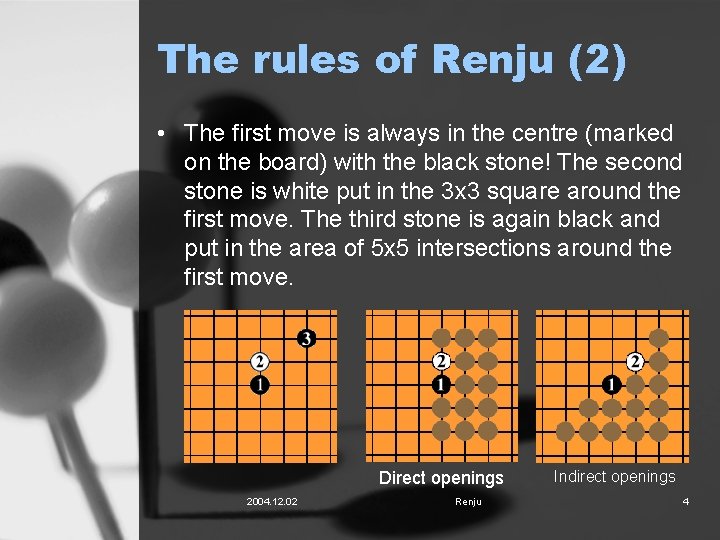
The rules of Renju (2) • The first move is always in the centre (marked on the board) with the black stone! The second stone is white put in the 3 x 3 square around the first move. The third stone is again black and put in the area of 5 x 5 intersections around the first move. Direct openings 2004. 12. 02 Renju Indirect openings 4
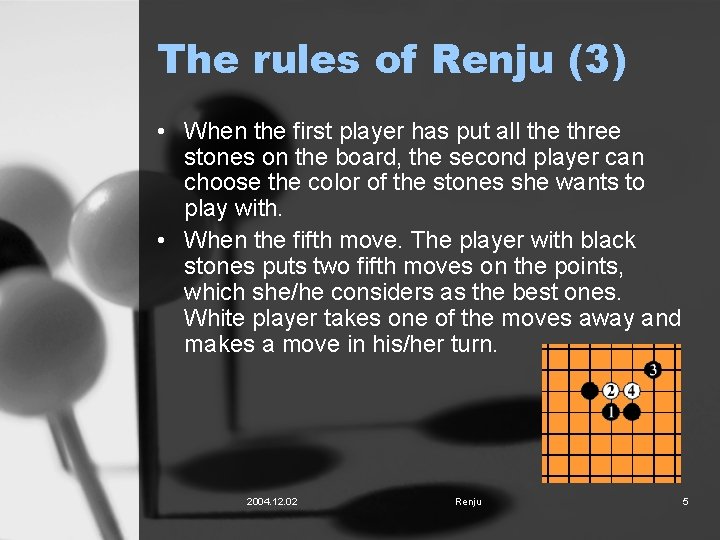
The rules of Renju (3) • When the first player has put all the three stones on the board, the second player can choose the color of the stones she wants to play with. • When the fifth move. The player with black stones puts two fifth moves on the points, which she/he considers as the best ones. White player takes one of the moves away and makes a move in his/her turn. 2004. 12. 02 Renju 5
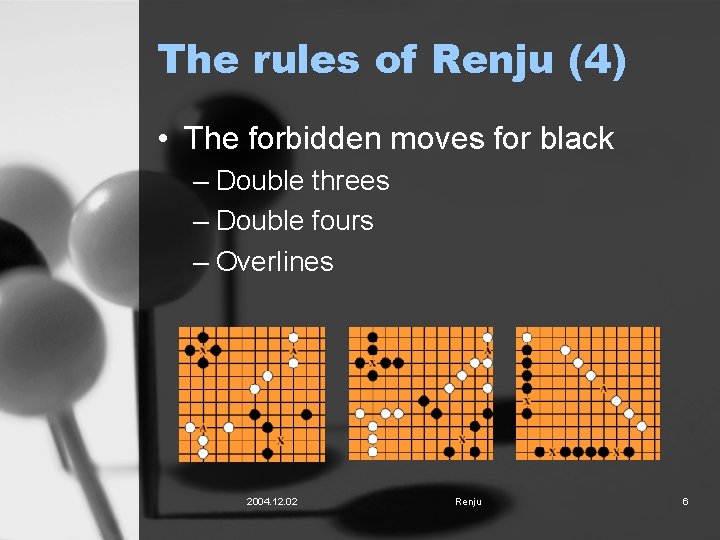
The rules of Renju (4) • The forbidden moves for black – Double threes – Double fours – Overlines 2004. 12. 02 Renju 6
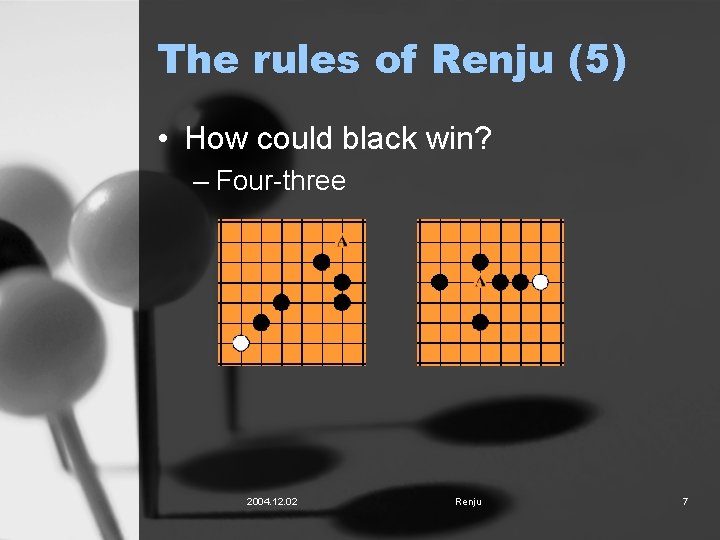
The rules of Renju (5) • How could black win? – Four-three 2004. 12. 02 Renju 7
Proof-Number Search • Proving the true value of the root • Using two criteria to expand next node – The potential range of subtree values – The number of nodes which must conspire to prove or disprove that range of potential values • Enable pn-search to treat efficiently game trees with a non-uniform branching factor. 2004. 12. 02 Renju 8
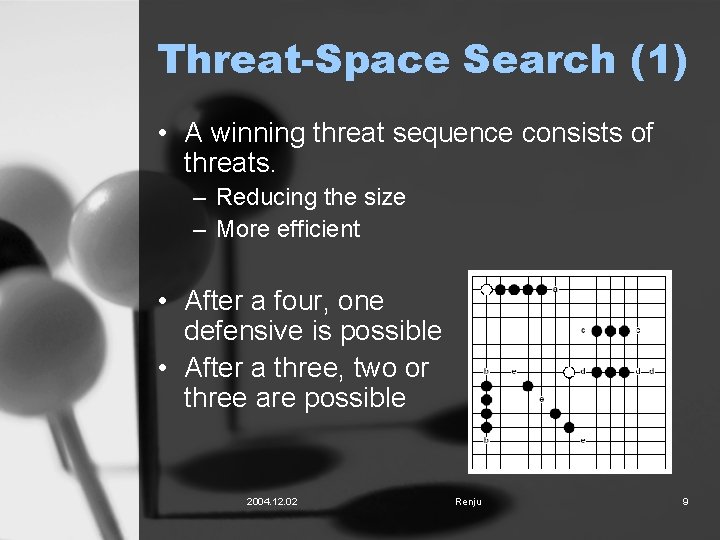
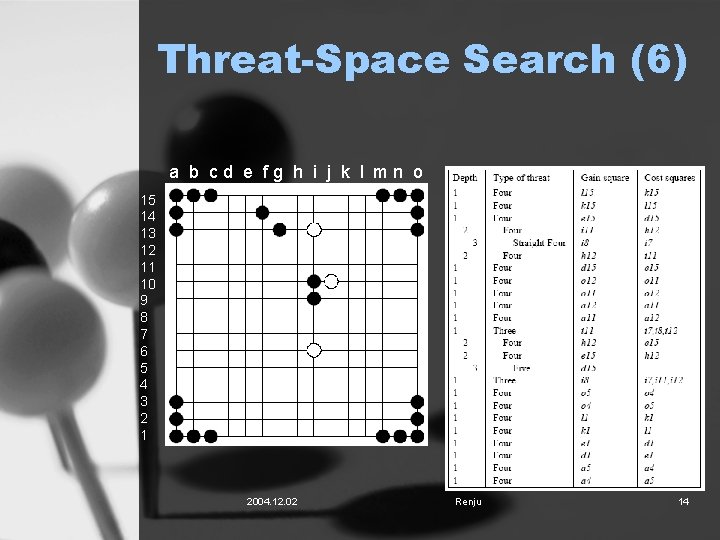
Threat-Space Search (1) • A winning threat sequence consists of threats. – Reducing the size – More efficient • After a four, one defensive is possible • After a three, two or three are possible 2004. 12. 02 Renju 9
Threat-Space Search (2) • Definitions – The gain square of a threat is the square played by the attacker – The cost squares of a threat are the squares played by the defender, in response to the threat – The rest squares of a threat are the squares containing a threat possibility; the gain square expected – Threat A is dependency on threat B, if a rest square of A is the gain square of B 2004. 12. 02 Renju 10
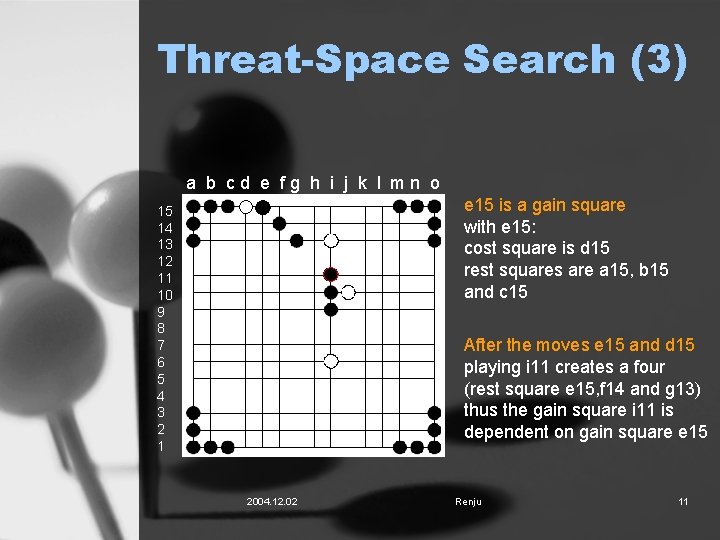
Threat-Space Search (3) a b cd e fg h i j k l mn o e 15 is a gain square with e 15: cost square is d 15 rest squares are a 15, b 15 and c 15 15 14 13 12 11 10 9 8 7 6 5 4 3 2 1 After the moves e 15 and d 15 playing i 11 creates a four (rest square e 15, f 14 and g 13) thus the gain square i 11 is dependent on gain square e 15 2004. 12. 02 Renju 11
Threat-Space Search (4) • Definitions – The dependency tree of a threat A is the three with root A and consisting of dependent nodes only – Two dependency trees P and Q are conflict, if within dependency tree P a threat A exists and within dependency tree Q a threat B, in such a way that • The gain square of A is cost square in B • Vice versa • A cost square in A is also cost square in B 2004. 12. 02 Renju 12
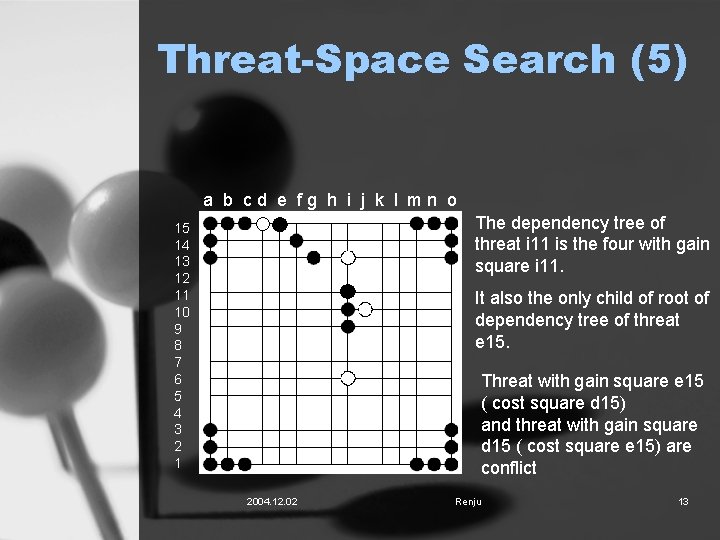
Threat-Space Search (5) a b cd e fg h i j k l mn o The dependency tree of threat i 11 is the four with gain square i 11. 15 14 13 12 11 10 9 8 7 6 5 4 3 2 1 It also the only child of root of dependency tree of threat e 15. Threat with gain square e 15 ( cost square d 15) and threat with gain square d 15 ( cost square e 15) are conflict 2004. 12. 02 Renju 13
Threat-Space Search (6) a b cd e fg h i j k l mn o 15 14 13 12 11 10 9 8 7 6 5 4 3 2 1 2004. 12. 02 Renju 14
Reference • Renju International Federation – http: //www. renju. nu/ • Go-moku and Threat-Space Search (1993) – L. V. Allis, H. J. van den Herik, M. P. H. Huntjens – Report CS 93 -02, Department of Computer Science, Faculty of General Science, University of Limburg. Maastricht, The Netherlands • Solving Renju (2001) – Janos Wagner, Istvan Virag – ICGA march 2001 • Combining Proof-Number Search with Alpha-Beta Search (2001) – Mark H. M. Winands, Jos W. H. M. Uiterwijk – http: //www. cs. unimaas. nl/m. winands/ • Proof-number search (1994) – L. V. Allis, Maarten van der Meulen and H. J. van den Herik – Artificial Intelligence vol. 66 Issue. 1 pp. 91 -124 2004. 12. 02 Renju 15

Thanks for your attention! 2004. 12. 02 Renju 16
- Slides: 16