
Renishaw touchtrigger probing technology Rugged and flexible solutions
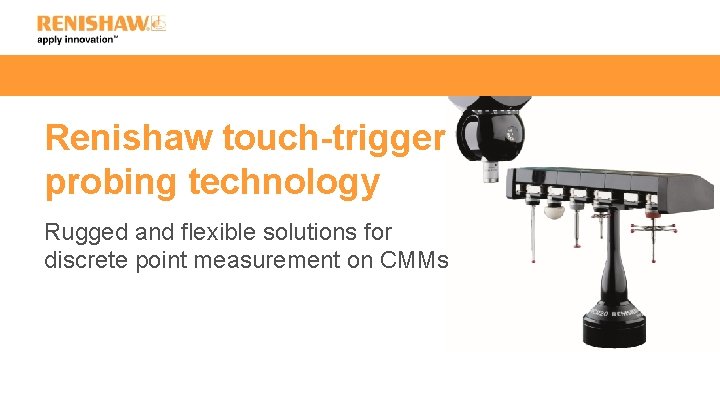
Renishaw touch-trigger probing technology Rugged and flexible solutions for discrete point measurement on CMMs
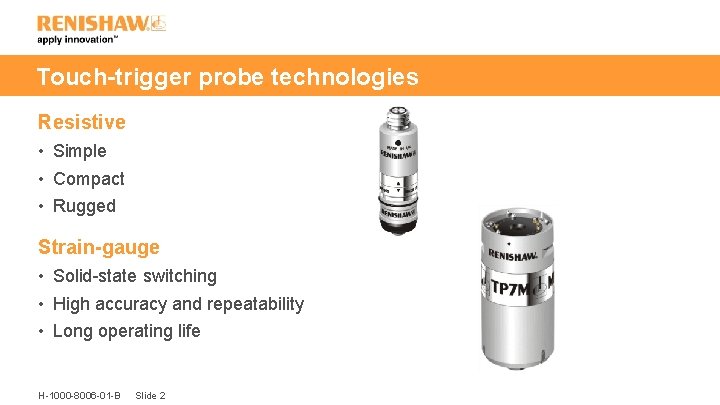
Touch-trigger probe technologies Resistive • Simple • Compact • Rugged Strain-gauge • Solid-state switching • High accuracy and repeatability • Long operating life H-1000 -8006 -01 -B Slide 2
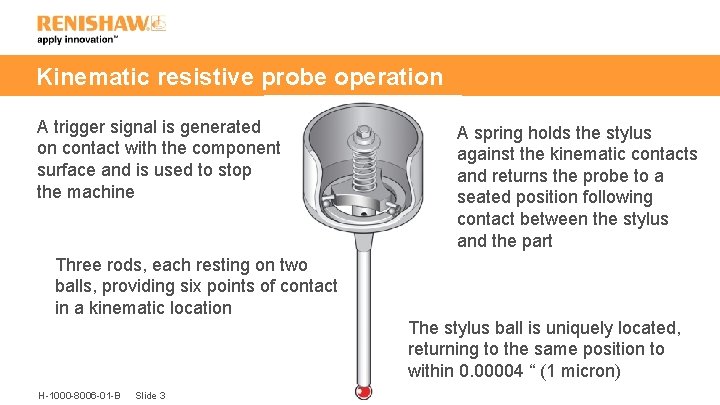
Kinematic resistive probe operation A trigger signal is generated on contact with the component surface and is used to stop the machine Three rods, each resting on two balls, providing six points of contact in a kinematic location H-1000 -8006 -01 -B Slide 3 A spring holds the stylus against the kinematic contacts and returns the probe to a seated position following contact between the stylus and the part The stylus ball is uniquely located, returning to the same position to within 0. 00004 “ (1 micron)
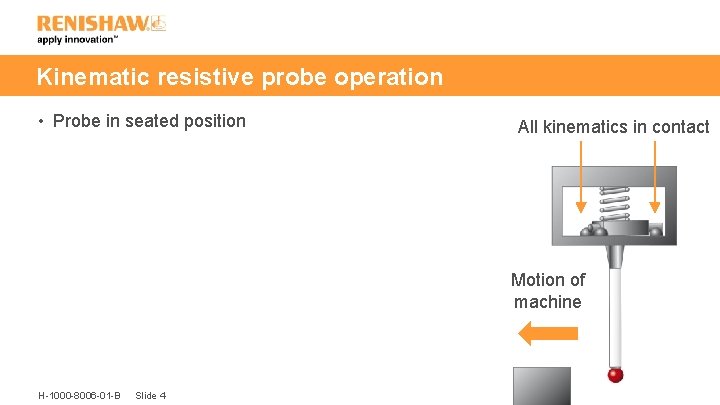
Kinematic resistive probe operation • Probe in seated position All kinematics in contact Motion of machine H-1000 -8006 -01 -B Slide 4
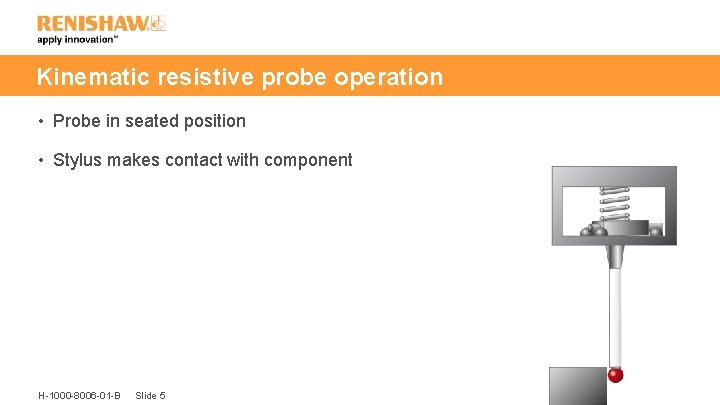
Kinematic resistive probe operation • Probe in seated position • Stylus makes contact with component H-1000 -8006 -01 -B Slide 5
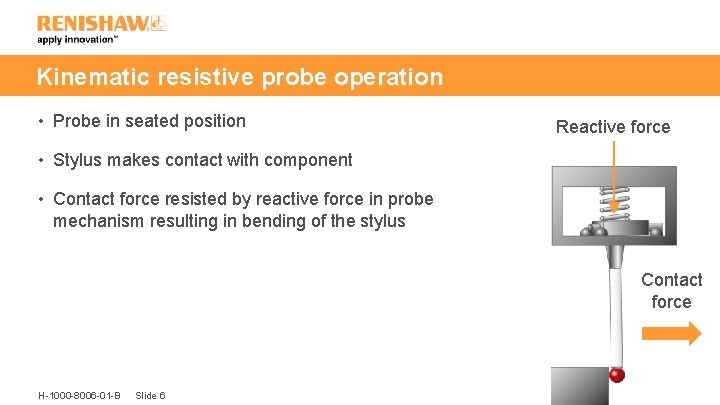
Kinematic resistive probe operation • Probe in seated position Reactive force • Stylus makes contact with component • Contact force resisted by reactive force in probe mechanism resulting in bending of the stylus Contact force H-1000 -8006 -01 -B Slide 6
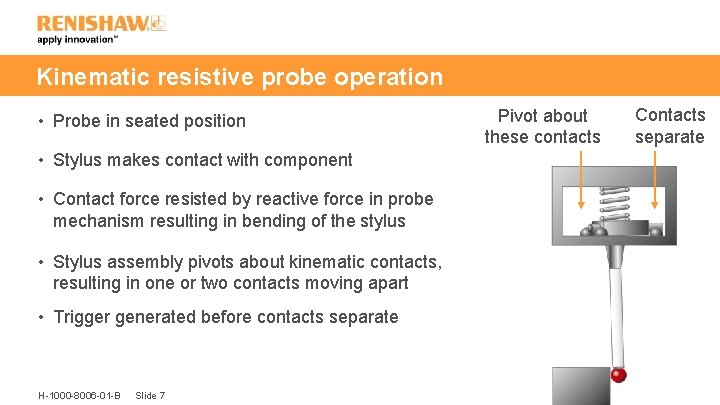
Kinematic resistive probe operation • Probe in seated position • Stylus makes contact with component • Contact force resisted by reactive force in probe mechanism resulting in bending of the stylus • Stylus assembly pivots about kinematic contacts, resulting in one or two contacts moving apart • Trigger generated before contacts separate H-1000 -8006 -01 -B Slide 7 Pivot about these contacts Contacts separate
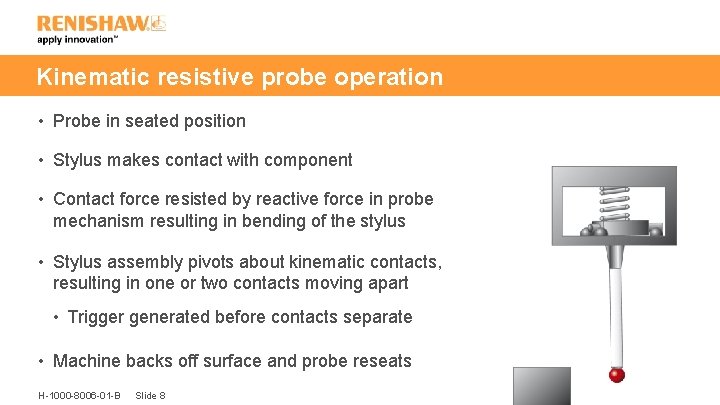
Kinematic resistive probe operation • Probe in seated position • Stylus makes contact with component • Contact force resisted by reactive force in probe mechanism resulting in bending of the stylus • Stylus assembly pivots about kinematic contacts, resulting in one or two contacts moving apart • Trigger generated before contacts separate • Machine backs off surface and probe reseats H-1000 -8006 -01 -B Slide 8
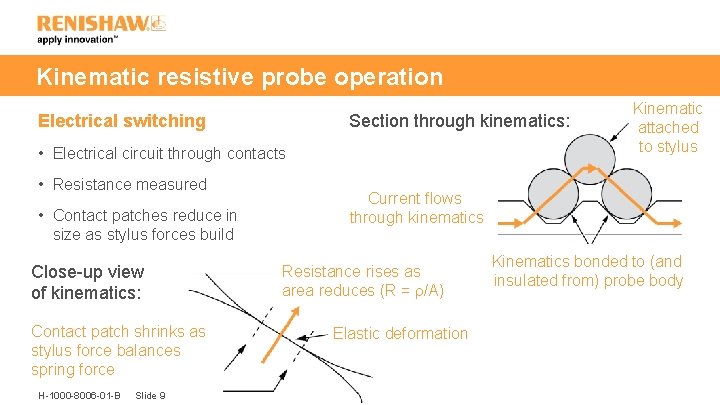
Kinematic resistive probe operation Section through kinematics: Electrical switching • Electrical circuit through contacts • Resistance measured • Contact patches reduce in size as stylus forces build Close-up view of kinematics: Contact patch shrinks as stylus force balances spring force H-1000 -8006 -01 -B Slide 9 Kinematic attached to stylus Current flows through kinematics Resistance rises as area reduces (R = /A) Elastic deformation Kinematics bonded to (and insulated from) probe body
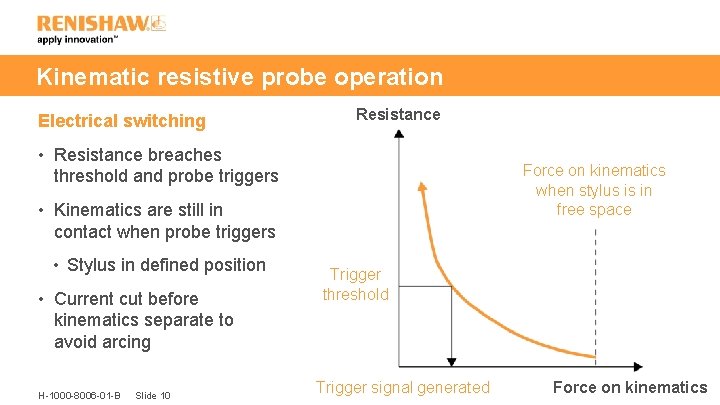
Kinematic resistive probe operation Electrical switching Resistance • Resistance breaches threshold and probe triggers Force on kinematics when stylus is in free space • Kinematics are still in contact when probe triggers • Stylus in defined position • Current cut before kinematics separate to avoid arcing H-1000 -8006 -01 -B Slide 10 Trigger threshold Trigger signal generated Force on kinematics
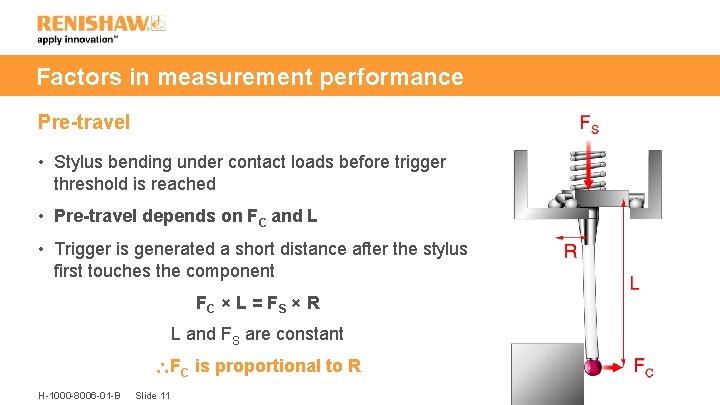
Factors in measurement performance Pre-travel • Stylus bending under contact loads before trigger threshold is reached • Pre-travel depends on FC and L • Trigger is generated a short distance after the stylus first touches the component FC × L = F S × R L and FS are constant FC is proportional to R H-1000 -8006 -01 -B Slide 11
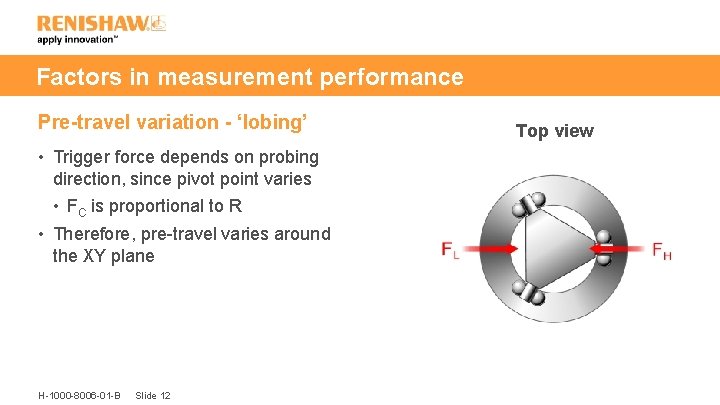
Factors in measurement performance Pre-travel variation - ‘lobing’ • Trigger force depends on probing direction, since pivot point varies • FC is proportional to R • Therefore, pre-travel varies around the XY plane H-1000 -8006 -01 -B Slide 12 Top view
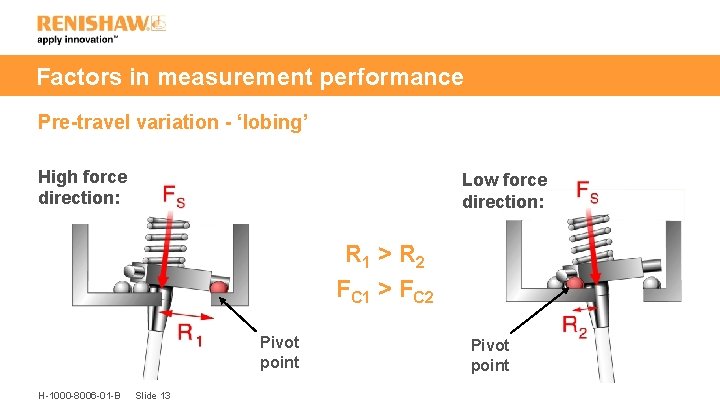
Factors in measurement performance Pre-travel variation - ‘lobing’ High force direction: Low force direction: R 1 > R 2 FC 1 > FC 2 Pivot point H-1000 -8006 -01 -B Slide 13 Pivot point
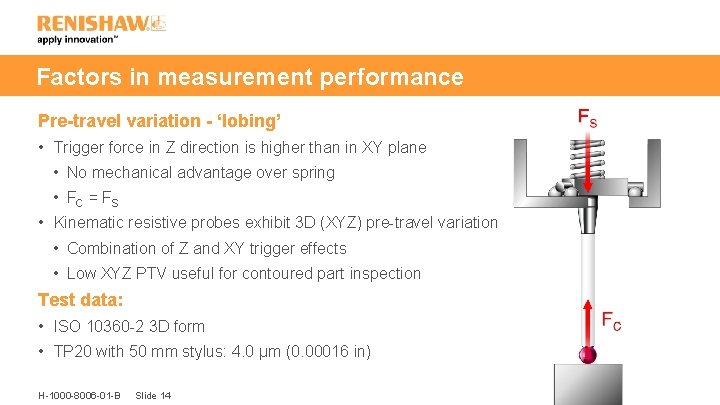
Factors in measurement performance Pre-travel variation - ‘lobing’ • Trigger force in Z direction is higher than in XY plane • No mechanical advantage over spring • FC = F S • Kinematic resistive probes exhibit 3 D (XYZ) pre-travel variation • Combination of Z and XY trigger effects • Low XYZ PTV useful for contoured part inspection Test data: • ISO 10360 -2 3 D form • TP 20 with 50 mm stylus: 4. 0 µm (0. 00016 in) H-1000 -8006 -01 -B Slide 14
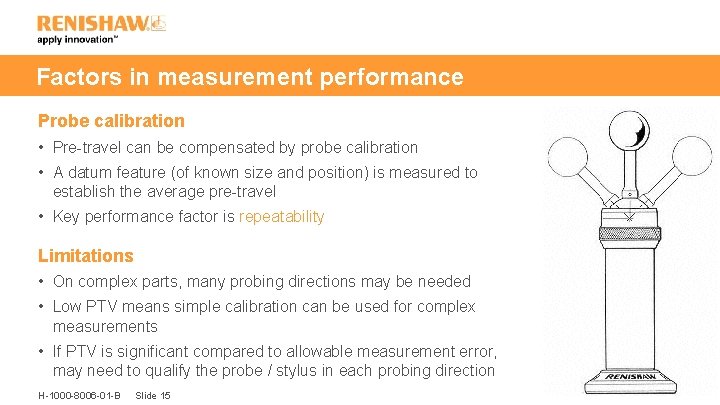
Factors in measurement performance Probe calibration • Pre-travel can be compensated by probe calibration • A datum feature (of known size and position) is measured to establish the average pre-travel • Key performance factor is repeatability Limitations • On complex parts, many probing directions may be needed • Low PTV means simple calibration can be used for complex measurements • If PTV is significant compared to allowable measurement error, may need to qualify the probe / stylus in each probing direction H-1000 -8006 -01 -B Slide 15
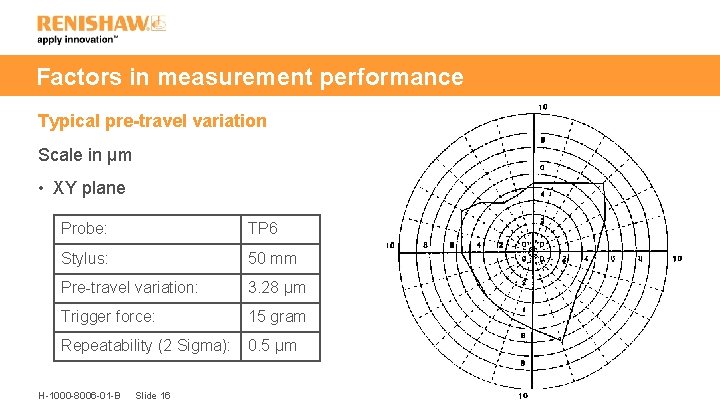
Factors in measurement performance Typical pre-travel variation Scale in µm • XY plane Probe: TP 6 Stylus: 50 mm Pre-travel variation: 3. 28 µm Trigger force: 15 gram Repeatability (2 Sigma): 0. 5 µm H-1000 -8006 -01 -B Slide 16
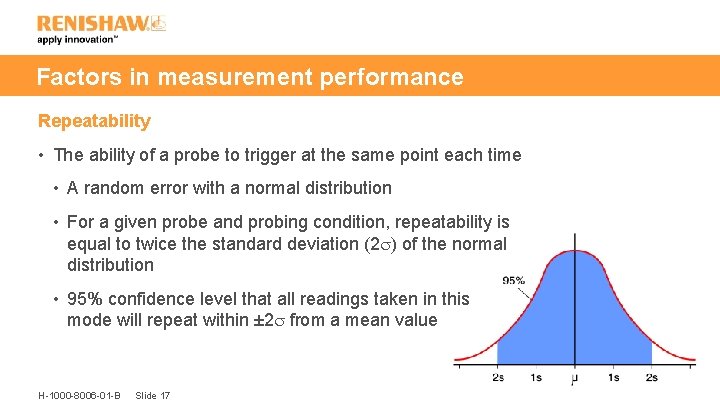
Factors in measurement performance Repeatability • The ability of a probe to trigger at the same point each time • A random error with a normal distribution • For a given probe and probing condition, repeatability is equal to twice the standard deviation (2 ) of the normal distribution • 95% confidence level that all readings taken in this mode will repeat within ± 2 from a mean value H-1000 -8006 -01 -B Slide 17
Factors in measurement performance Hysteresis • Error arising from the direction of the preceding probing move • Maximum hysteresis occurs when a measurement follows a probing moves in opposite directions to each other in the probe’s XY plane • Hysteresis error increases linearly with trigger force and stylus length • Kinematic mechanism minimises hysteresis H-1000 -8006 -01 -B Slide 18
Factors in measurement performance Ranked in terms of importance Repeatability • Key requirement of any trigger probe • Fundamental limit on system measurement performance • Hysteresis contributes to measurement repeatability Pre-travel variation • Can be calibrated, provided all probing directions are known • Measurement accuracy will be reduced if probe used in un-qualified direction and PTV is high • Increases rapidly with stylus length Hysteresis • Small error factor for probes with kinematic mechanisms H-1000 -8006 -01 -B Slide 19
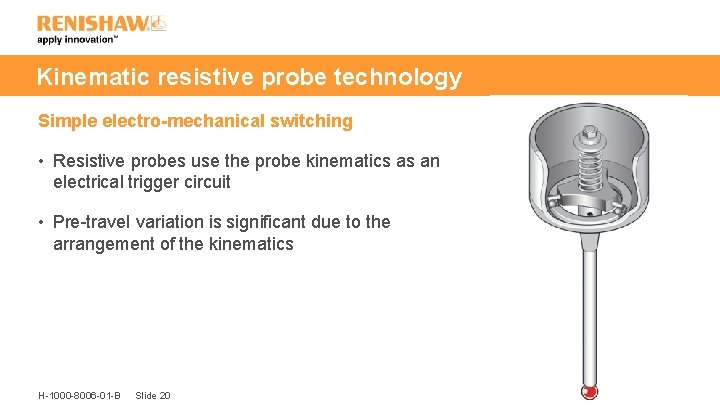
Kinematic resistive probe technology Simple electro-mechanical switching • Resistive probes use the probe kinematics as an electrical trigger circuit • Pre-travel variation is significant due to the arrangement of the kinematics H-1000 -8006 -01 -B Slide 20
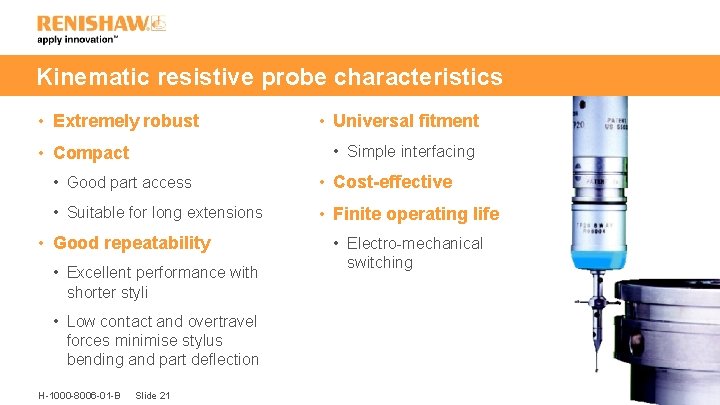
Kinematic resistive probe characteristics • Extremely robust • Universal fitment • Simple interfacing • Compact • Good part access • Cost-effective • Suitable for long extensions • Finite operating life • Good repeatability • Excellent performance with shorter styli • Low contact and overtravel forces minimise stylus bending and part deflection H-1000 -8006 -01 -B Slide 21 • Electro-mechanical switching
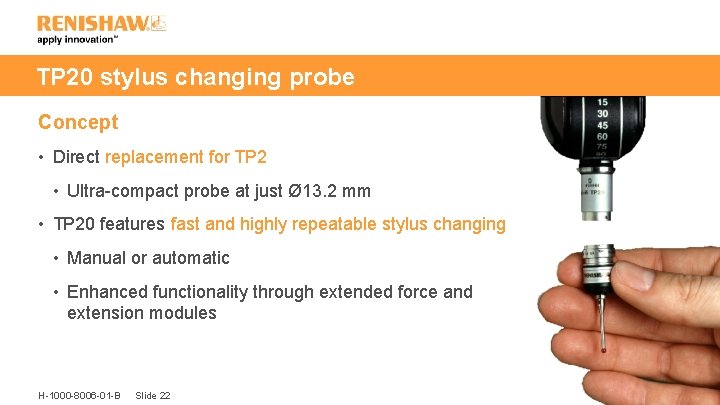
TP 20 stylus changing probe Concept • Direct replacement for TP 2 • Ultra-compact probe at just Ø 13. 2 mm • TP 20 features fast and highly repeatable stylus changing • Manual or automatic • Enhanced functionality through extended force and extension modules H-1000 -8006 -01 -B Slide 22
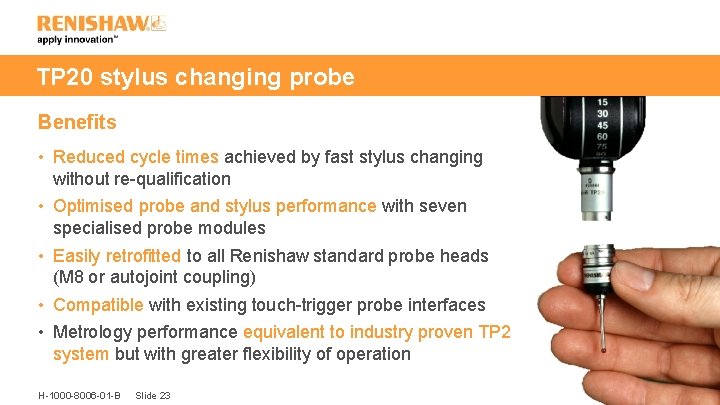
TP 20 stylus changing probe Benefits • Reduced cycle times achieved by fast stylus changing without re-qualification • Optimised probe and stylus performance with seven specialised probe modules • Easily retrofitted to all Renishaw standard probe heads (M 8 or autojoint coupling) • Compatible with existing touch-trigger probe interfaces • Metrology performance equivalent to industry proven TP 2 system but with greater flexibility of operation H-1000 -8006 -01 -B Slide 23
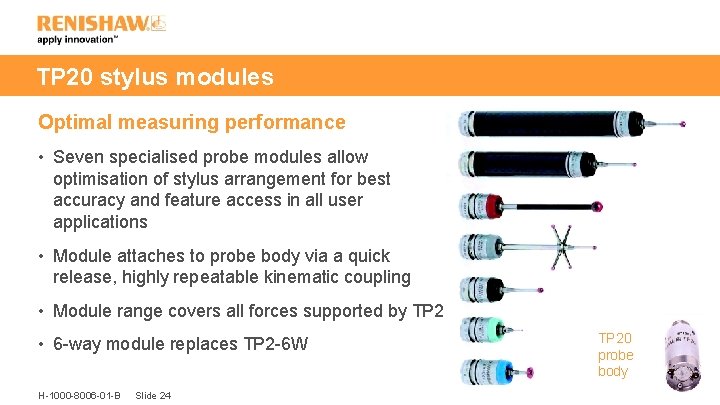
TP 20 stylus modules Optimal measuring performance • Seven specialised probe modules allow optimisation of stylus arrangement for best accuracy and feature access in all user applications • Module attaches to probe body via a quick release, highly repeatable kinematic coupling • Module range covers all forces supported by TP 2 • 6 -way module replaces TP 2 -6 W H-1000 -8006 -01 -B Slide 24 TP 20 probe body
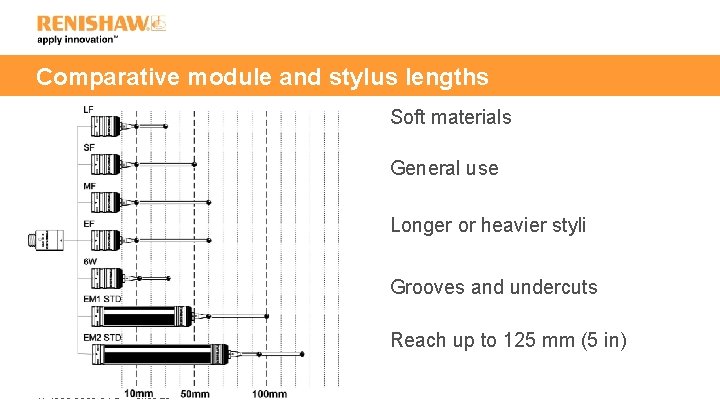
Comparative module and stylus lengths Soft materials General use Longer or heavier styli Grooves and undercuts Reach up to 125 mm (5 in) H-1000 -8006 -01 -B Slide 25
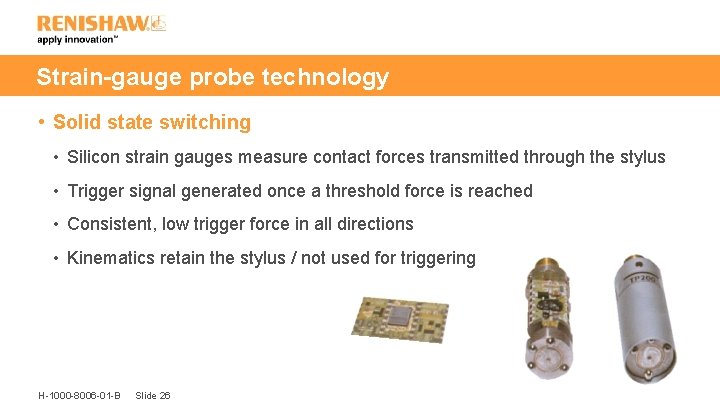
Strain-gauge probe technology • Solid state switching • Silicon strain gauges measure contact forces transmitted through the stylus • Trigger signal generated once a threshold force is reached • Consistent, low trigger force in all directions • Kinematics retain the stylus / not used for triggering H-1000 -8006 -01 -B Slide 26
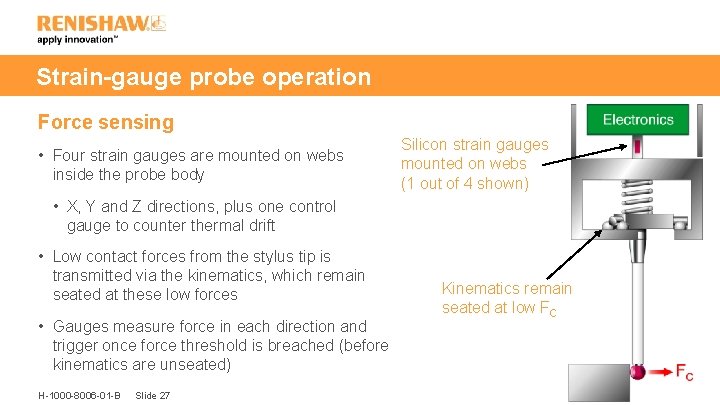
Strain-gauge probe operation Force sensing • Four strain gauges are mounted on webs inside the probe body Silicon strain gauges mounted on webs (1 out of 4 shown) • X, Y and Z directions, plus one control gauge to counter thermal drift • Low contact forces from the stylus tip is transmitted via the kinematics, which remain seated at these low forces • Gauges measure force in each direction and trigger once force threshold is breached (before kinematics are unseated) H-1000 -8006 -01 -B Slide 27 Kinematics remain seated at low FC
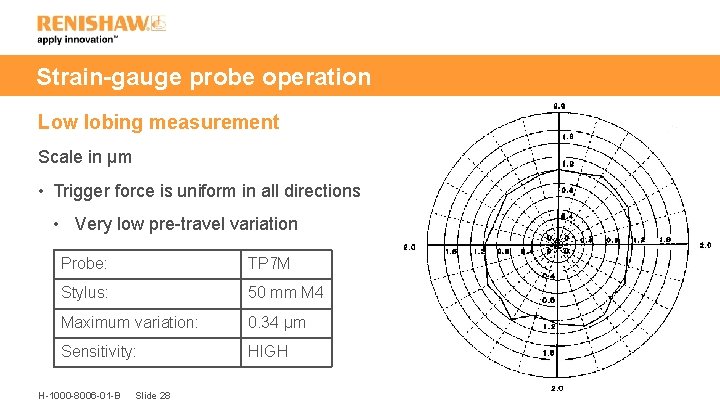
Strain-gauge probe operation Low lobing measurement Scale in µm • Trigger force is uniform in all directions • Very low pre-travel variation Probe: TP 7 M Stylus: 50 mm M 4 Maximum variation: 0. 34 µm Sensitivity: HIGH H-1000 -8006 -01 -B Slide 28
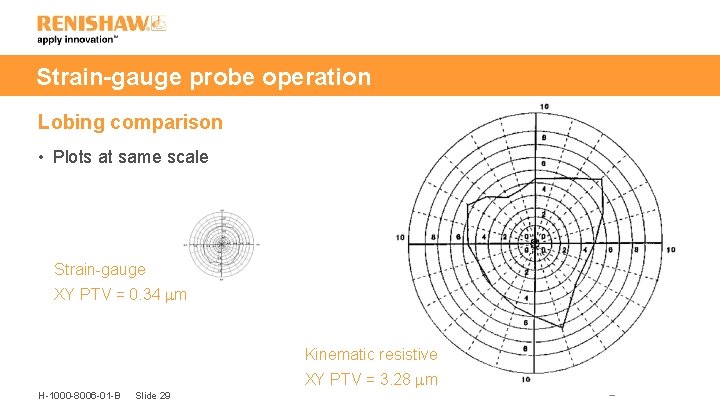
Strain-gauge probe operation Lobing comparison • Plots at same scale Strain-gauge XY PTV = 0. 34 m Kinematic resistive XY PTV = 3. 28 m H-1000 -8006 -01 -B Slide 29
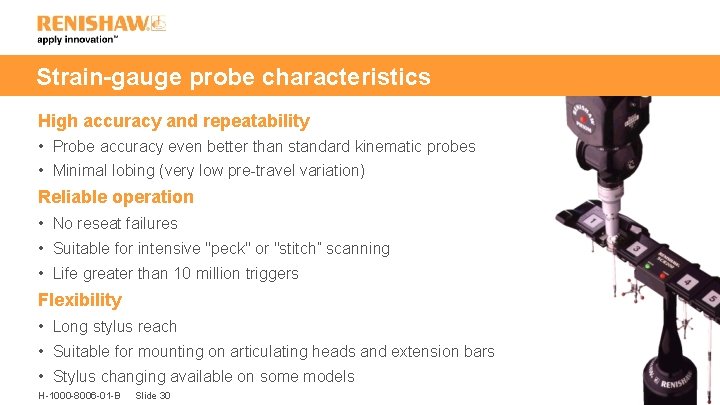
Strain-gauge probe characteristics High accuracy and repeatability • Probe accuracy even better than standard kinematic probes • Minimal lobing (very low pre-travel variation) Reliable operation • No reseat failures • Suitable for intensive "peck" or "stitch” scanning • Life greater than 10 million triggers Flexibility • Long stylus reach • Suitable for mounting on articulating heads and extension bars • Stylus changing available on some models H-1000 -8006 -01 -B Slide 30
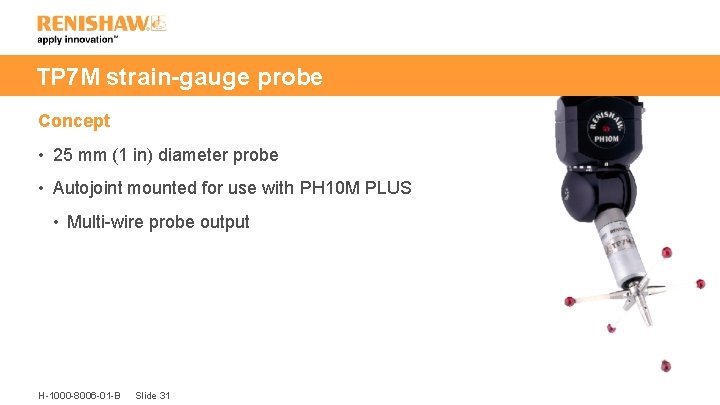
TP 7 M strain-gauge probe Concept • 25 mm (1 in) diameter probe • Autojoint mounted for use with PH 10 M PLUS • Multi-wire probe output H-1000 -8006 -01 -B Slide 31
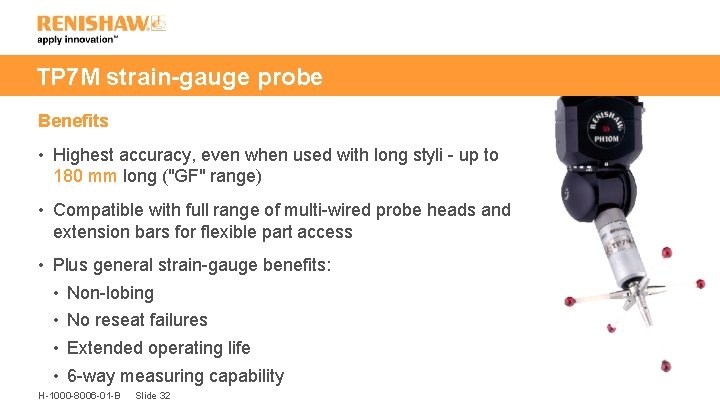
TP 7 M strain-gauge probe Benefits • Highest accuracy, even when used with long styli - up to 180 mm long ("GF" range) • Compatible with full range of multi-wired probe heads and extension bars for flexible part access • Plus general strain-gauge benefits: • Non-lobing • No reseat failures • Extended operating life • 6 -way measuring capability H-1000 -8006 -01 -B Slide 32
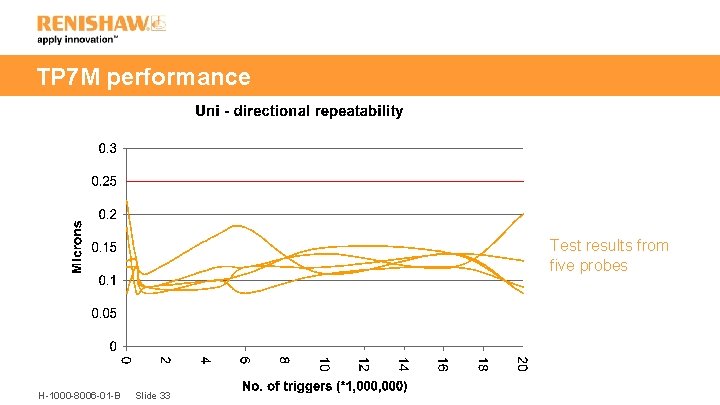
TP 7 M performance Test results from five probes H-1000 -8006 -01 -B Slide 33
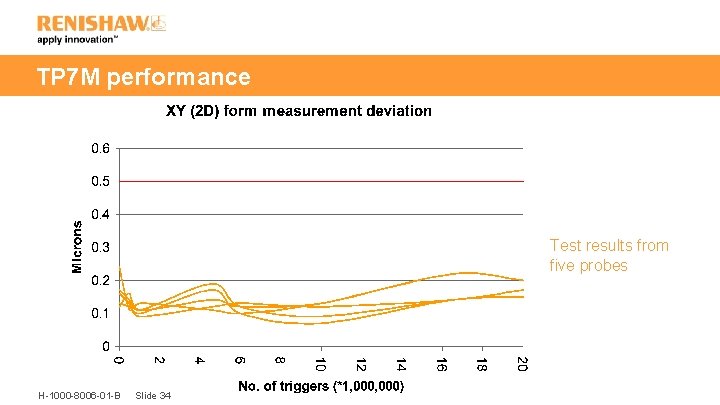
TP 7 M performance Test results from five probes H-1000 -8006 -01 -B Slide 34
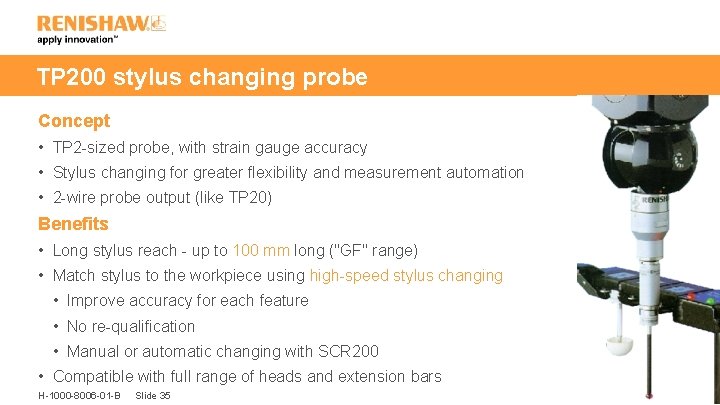
TP 200 stylus changing probe Concept • TP 2 -sized probe, with strain gauge accuracy • Stylus changing for greater flexibility and measurement automation • 2 -wire probe output (like TP 20) Benefits • Long stylus reach - up to 100 mm long ("GF" range) • Match stylus to the workpiece using high-speed stylus changing • Improve accuracy for each feature • No re-qualification • Manual or automatic changing with SCR 200 • Compatible with full range of heads and extension bars H-1000 -8006 -01 -B Slide 35
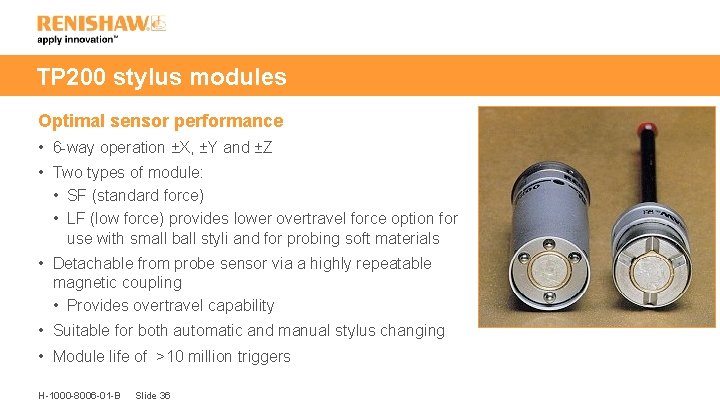
TP 200 stylus modules Optimal sensor performance • 6 -way operation ±X, ±Y and ±Z • Two types of module: • SF (standard force) • LF (low force) provides lower overtravel force option for use with small ball styli and for probing soft materials • Detachable from probe sensor via a highly repeatable magnetic coupling • Provides overtravel capability • Suitable for both automatic and manual stylus changing • Module life of >10 million triggers H-1000 -8006 -01 -B Slide 36
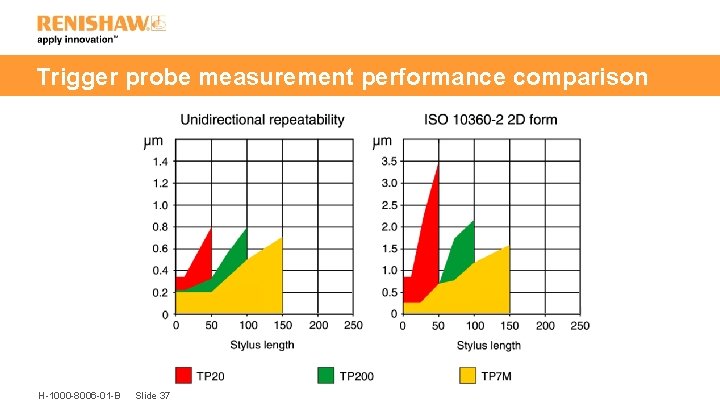
Trigger probe measurement performance comparison H-1000 -8006 -01 -B Slide 37
Renishaw touch-trigger probing technology Thank you for your attention…
- Slides: 38