
Renewing the Controller Workforce Challenges and Opportunities R


- Slides: 42
Renewing the Controller Workforce Challenges and Opportunities R. John Hansman Director, MIT International Center for Air Transportation rjhans@mit. edu
Overview Challenges § Retirement of demographic bulge resulting from the PATCO strike in 1981 § Long Training Times • ab-initio • Cross Facility § Site Specific Staffing Shortfalls § Exacerbated by: • Growth in Traffic • Need for New Technology Implementation • Need for New Procedures • Financial Pressures § Opportunities § Renewed workforce (Knowledge, Skills, Attributes) § New Training Approaches • Efficiency • Groundwork for future capability § Stimulates review of current practices and opportunities to improve efficiency § This generation will operate the NGATS
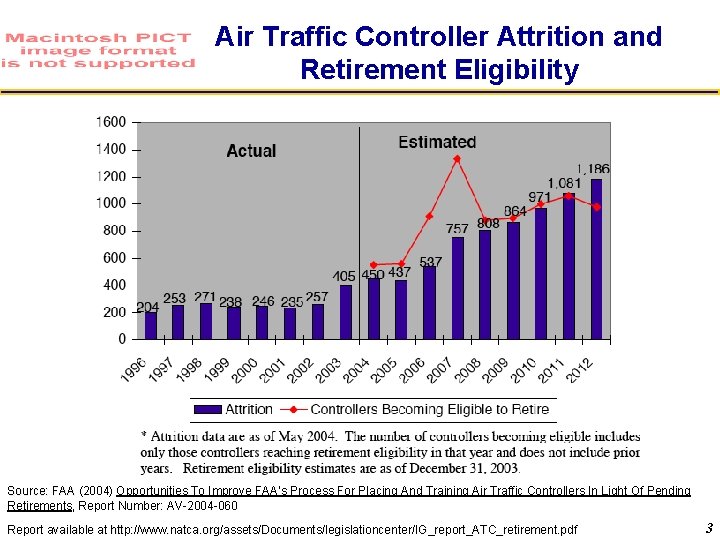
Air Traffic Controller Attrition and Retirement Eligibility Source: FAA (2004) Opportunities To Improve FAA’s Process For Placing And Training Air Traffic Controllers In Light Of Pending Retirements, Report Number: AV-2004 -060 Report available at http: //www. natca. org/assets/Documents/legislationcenter/IG_report_ATC_retirement. pdf 3
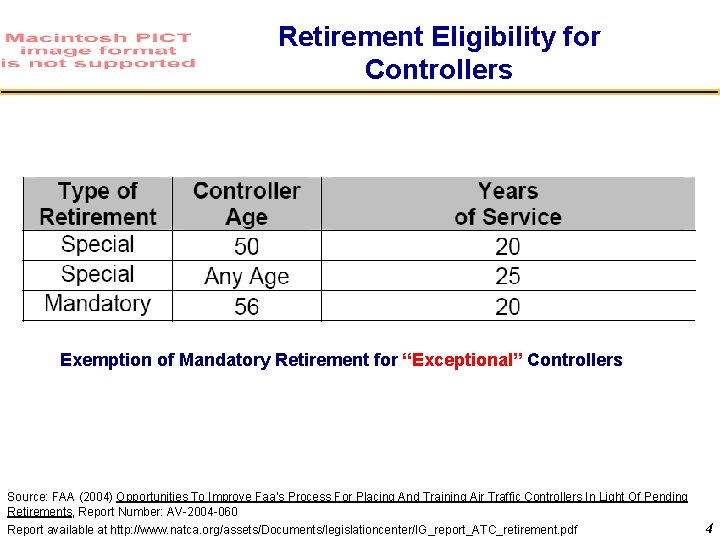
Retirement Eligibility for Controllers Exemption of Mandatory Retirement for “Exceptional” Controllers Source: FAA (2004) Opportunities To Improve Faa’s Process For Placing And Training Air Traffic Controllers In Light Of Pending Retirements, Report Number: AV-2004 -060 Report available at http: //www. natca. org/assets/Documents/legislationcenter/IG_report_ATC_retirement. pdf 4
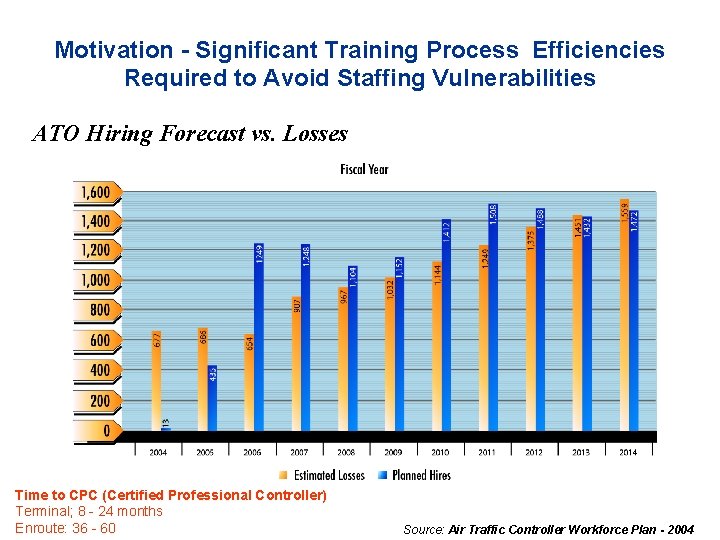
Motivation - Significant Training Process Efficiencies Required to Avoid Staffing Vulnerabilities ATO Hiring Forecast vs. Losses Time to CPC (Certified Professional Controller) Terminal; 8 - 24 months Enroute: 36 - 60 Source: Air Traffic Controller Workforce Plan - 2004
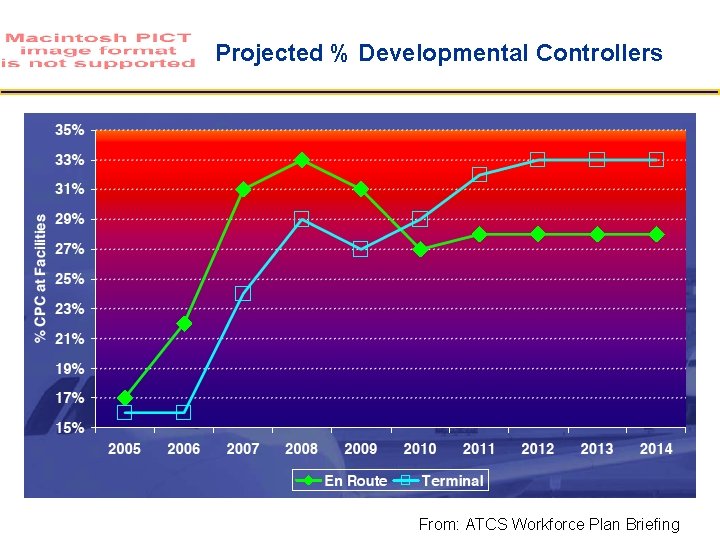
Projected % Developmental Controllers From: ATCS Workforce Plan Briefing
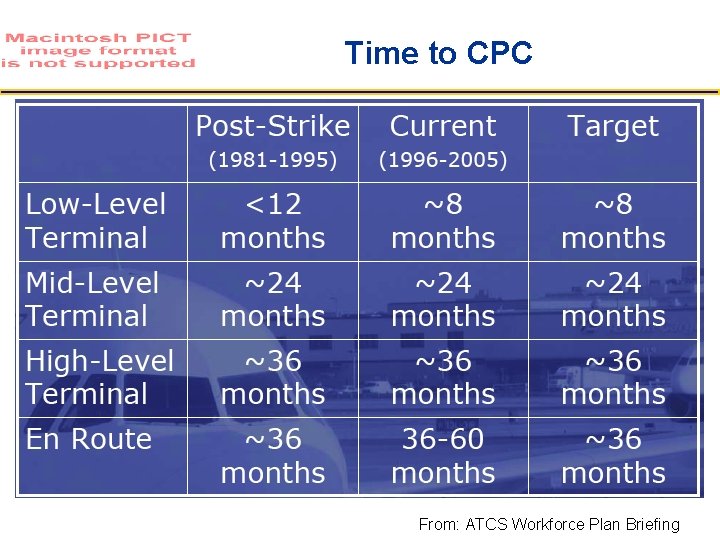
Time to CPC From: ATCS Workforce Plan Briefing
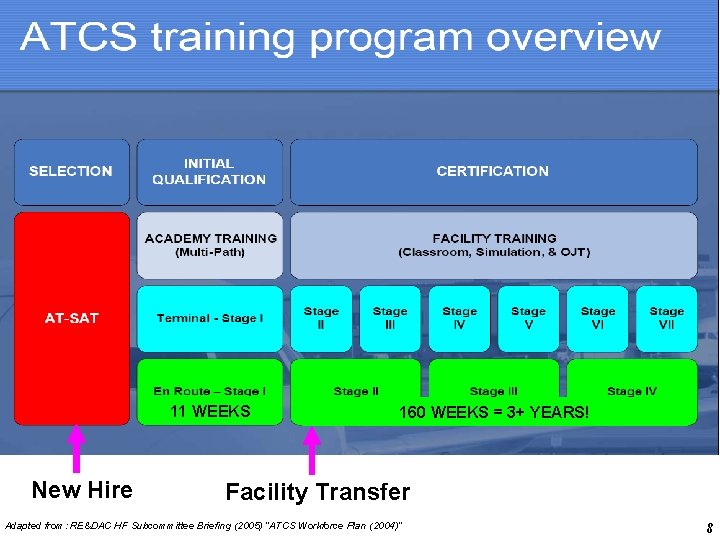
11 WEEKS New Hire 160 WEEKS = 3+ YEARS! Facility Transfer Adapted from: RE&DAC HF Subcommittee Briefing (2005) “ATCS Workforce Plan (2004)” 8
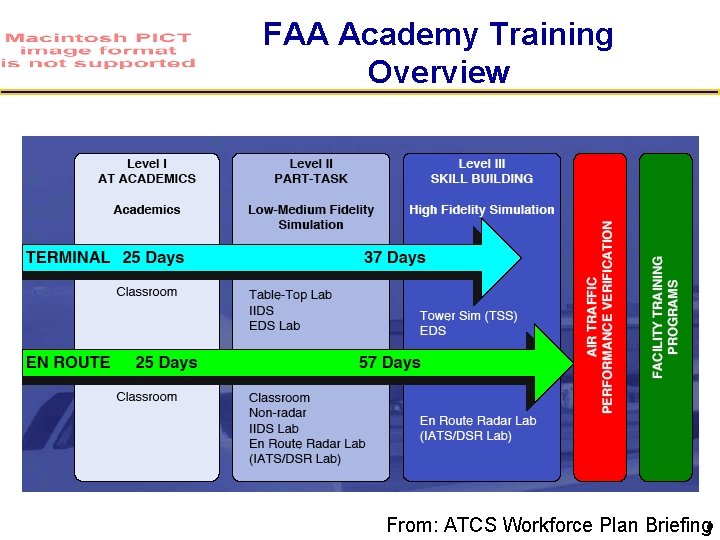
FAA Academy Training Overview From: ATCS Workforce Plan Briefing 9
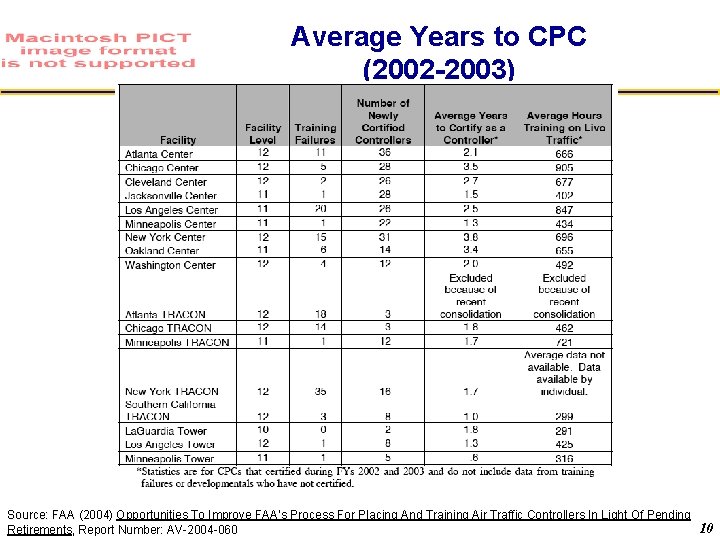
Average Years to CPC (2002 -2003) Source: FAA (2004) Opportunities To Improve FAA’s Process For Placing And Training Air Traffic Controllers In Light Of Pending 10 Retirements, Report Number: AV-2004 -060
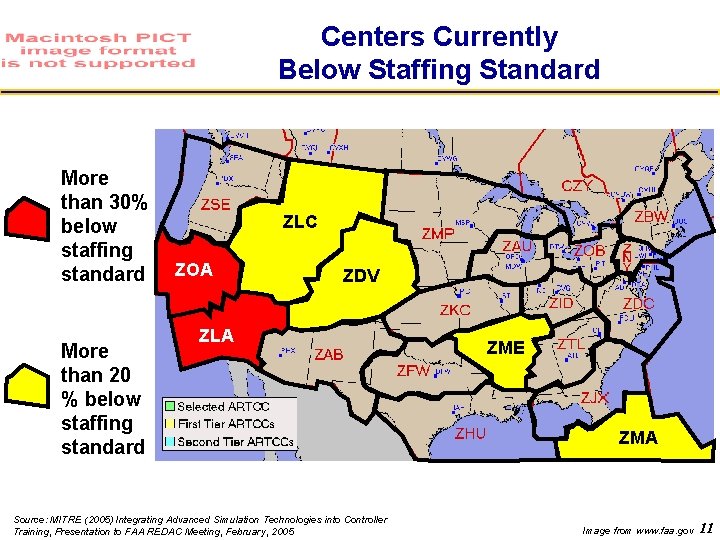
Centers Currently Below Staffing Standard More than 30% below staffing standard More than 20 % below staffing standard ZLC ZOA ZDV ZLA Source: MITRE (2005) Integrating Advanced Simulation Technologies into Controller Training, Presentation to FAA REDAC Meeting, February, 2005 ZME ZMA Image from www. faa. gov 11
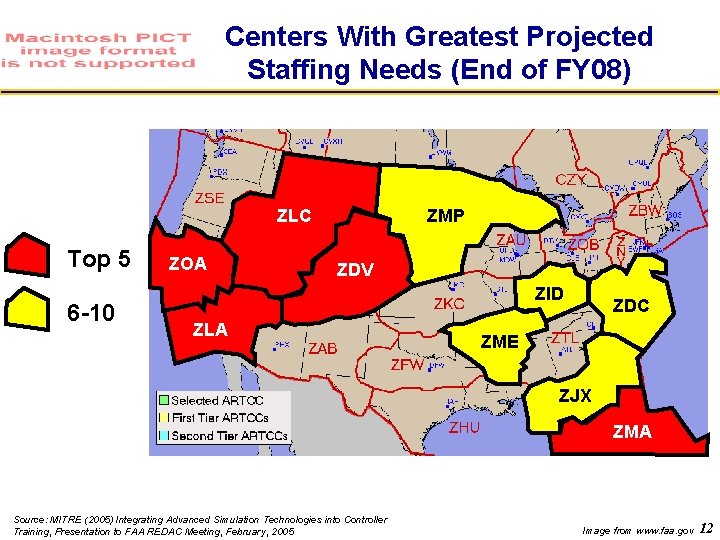
Centers With Greatest Projected Staffing Needs (End of FY 08) ZLC Top 5 6 -10 ZOA ZMP ZDV ZID ZLA ZDC ZME ZJX ZMA Source: MITRE (2005) Integrating Advanced Simulation Technologies into Controller Training, Presentation to FAA REDAC Meeting, February, 2005 Image from www. faa. gov 12
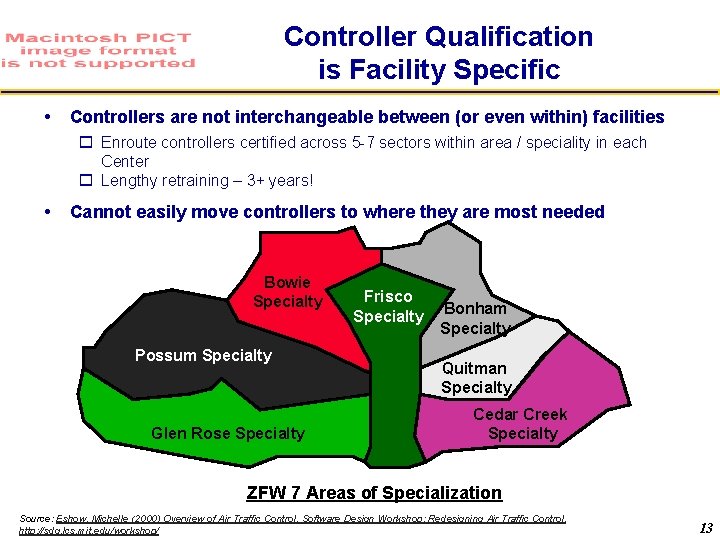
Controller Qualification is Facility Specific Controllers are not interchangeable between (or even within) facilities o Enroute controllers certified across 5 -7 sectors within area / speciality in each Center o Lengthy retraining – 3+ years! Cannot easily move controllers to where they are most needed Bowie Specialty Possum Specialty Glen Rose Specialty Frisco Specialty Bonham Specialty Quitman Specialty Cedar Creek Specialty ZFW 7 Areas of Specialization Source: Eshow, Michelle (2000) Overview of Air Traffic Control, Software Design Workshop: Redesigning Air Traffic Control, http: //sdg. lcs. mit. edu/workshop/ 13
MIT International Center for Air Transportation FAA REDAC Human Factors Subcommittee Chair, Kevin Corker Report on Controller Workforce Development Efforts Presented at the FAA REDAC Meeting September 20, 2005
Charter Administrator’s request to review and assess FAA plans and activities related to the skills training and needs of the next generation controller workforce in anticipation of the upcoming retirement replacement needs 15
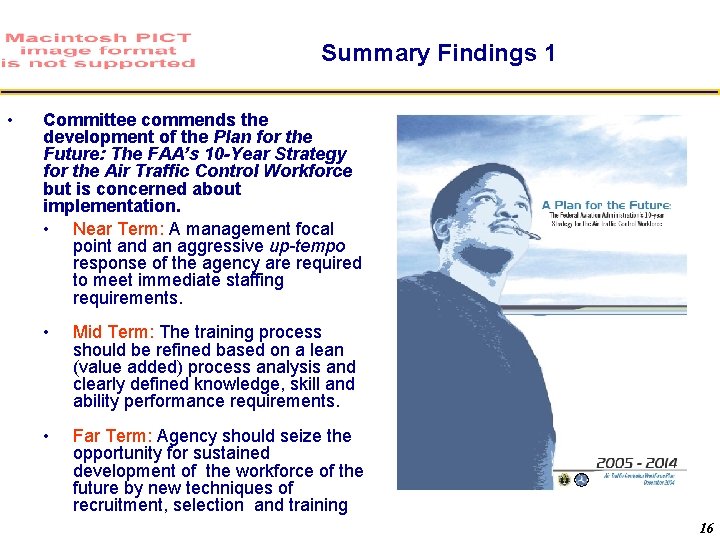
Summary Findings 1 • Committee commends the development of the Plan for the Future: The FAA’s 10 -Year Strategy for the Air Traffic Control Workforce but is concerned about implementation. • Near Term: A management focal point and an aggressive up-tempo response of the agency are required to meet immediate staffing requirements. • Mid Term: The training process should be refined based on a lean (value added) process analysis and clearly defined knowledge, skill and ability performance requirements. • Far Term: Agency should seize the opportunity for sustained development of the workforce of the future by new techniques of recruitment, selection and training 16
Summary Findings 2 Committee has significant concerns with the speed and efficiency of current training practice to meet the system wide and facility specific demands over the next 5 years. • Concern is based on the 2 -5 year time to train to CPC and the cost/time for position transfer-training to facility specific operations • A large portion of the training time is on the job training. This process is of uncertain efficiency and requires significant controller resources. Committee sees an opportunity to improve effectiveness and efficiency of the recruitment, selection and training process (at all stages: Collegiate Training Initiative, Academy, and On The Job (OTJ) training More Detail in Following Slides 17
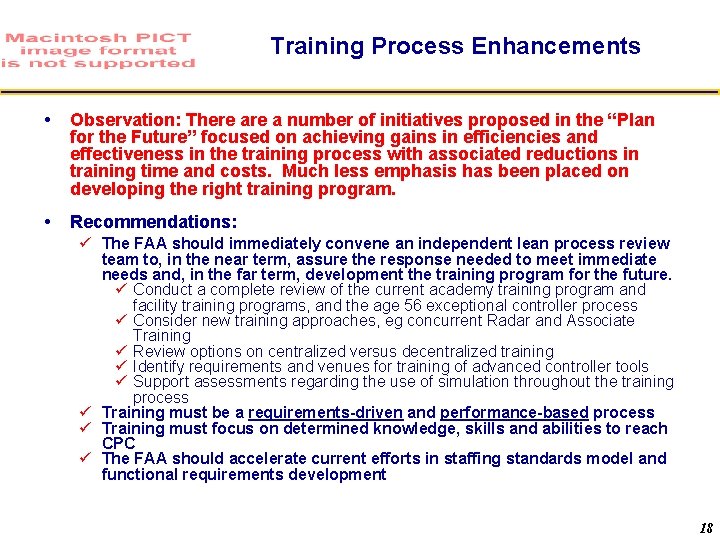
Training Process Enhancements Observation: There a number of initiatives proposed in the “Plan for the Future” focused on achieving gains in efficiencies and effectiveness in the training process with associated reductions in training time and costs. Much less emphasis has been placed on developing the right training program. Recommendations: ü The FAA should immediately convene an independent lean process review team to, in the near term, assure the response needed to meet immediate needs and, in the far term, development the training program for the future. ü Conduct a complete review of the current academy training program and facility training programs, and the age 56 exceptional controller process ü Consider new training approaches, eg concurrent Radar and Associate Training ü Review options on centralized versus decentralized training ü Identify requirements and venues for training of advanced controller tools ü Support assessments regarding the use of simulation throughout the training process ü Training must be a requirements-driven and performance-based process ü Training must focus on determined knowledge, skills and abilities to reach CPC ü The FAA should accelerate current efforts in staffing standards model and functional requirements development 18
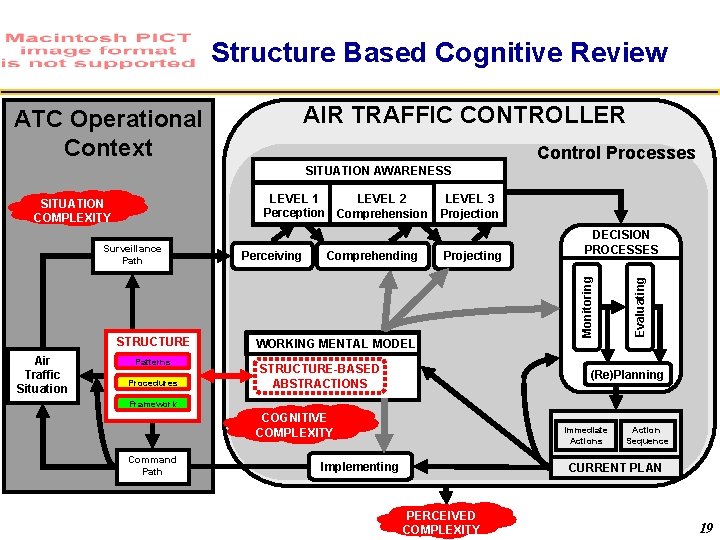
Structure Based Cognitive Review AIR TRAFFIC CONTROLLER ATC Operational Context Control Processes SITUATION AWARENESS STRUCTURE Air Traffic Situation Patterns Procedures Perceiving Comprehending Projecting WORKING MENTAL MODEL STRUCTURE-BASED ABSTRACTIONS DECISION PROCESSES Evaluating Surveillance Path LEVEL 3 Projection Monitoring LEVEL 1 LEVEL 2 Perception Comprehension SITUATION COMPLEXITY (Re)Planning Framework COGNITIVE COMPLEXITY Command Path Immediate Actions Implementing Action Sequence CURRENT PLAN PERCEIVED COMPLEXITY 19
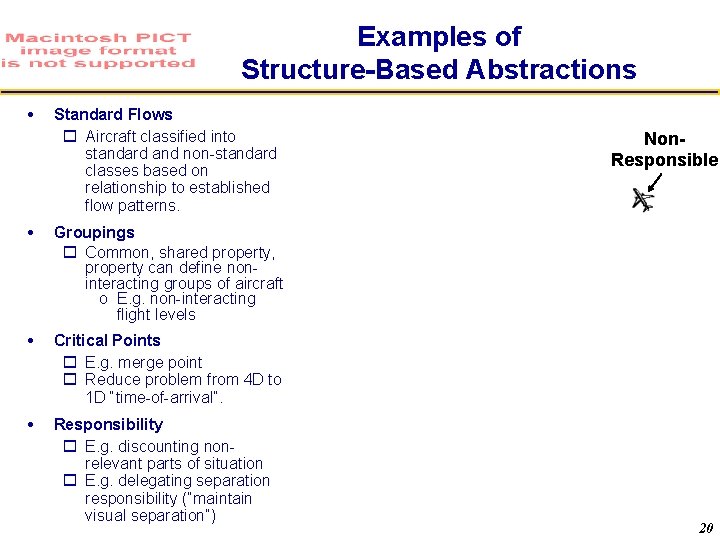
Examples of Structure-Based Abstractions Standard Flows o Aircraft classified into standard and non-standard classes based on relationship to established flow patterns. Groupings o Common, shared property, property can define noninteracting groups of aircraft o E. g. non-interacting flight levels Critical Points o E. g. merge point o Reduce problem from 4 D to 1 D “time-of-arrival”. Responsibility o E. g. discounting nonrelevant parts of situation o E. g. delegating separation responsibility (“maintain visual separation”) Non. Responsible 20
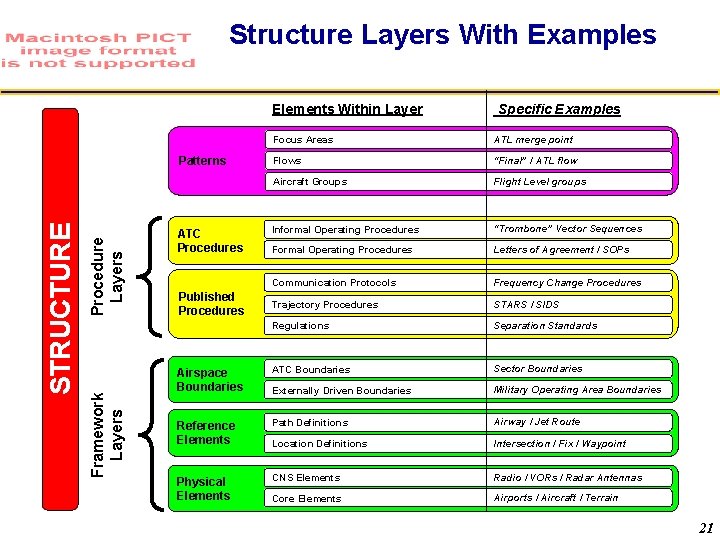
Structure Layers With Examples Elements Within Layer Focus Areas ATL merge point Flows “Final” / ATL flow Aircraft Groups Flight Level groups Informal Operating Procedures “Trombone” Vector Sequences Formal Operating Procedures Letters of Agreement / SOPs Communication Protocols Frequency Change Procedures Trajectory Procedures STARS / SIDS Regulations Separation Standards Airspace Boundaries ATC Boundaries Sector Boundaries Externally Driven Boundaries Military Operating Area Boundaries Reference Elements Path Definitions Airway / Jet Route Location Definitions Intersection / Fix / Waypoint Physical Elements CNS Elements Radio / VORs / Radar Antennas Core Elements Airports / Aircraft / Terrain Framework Layers Procedure Layers Patterns STRUCTURE Specific Examples ATC Procedures Published Procedures 21
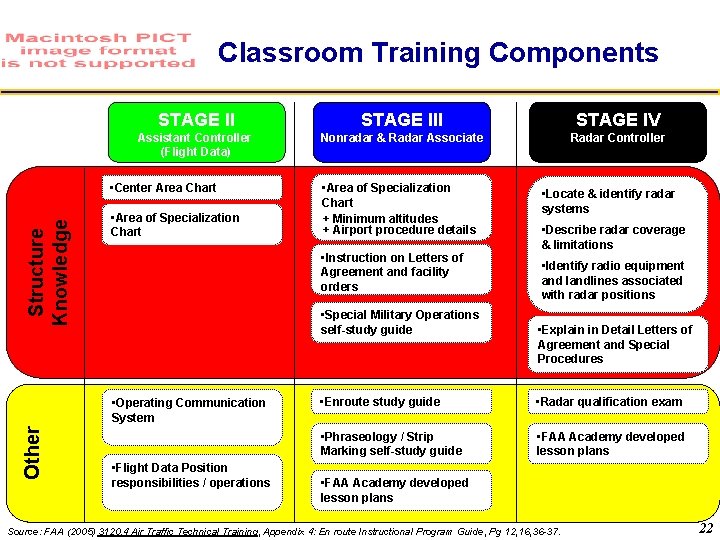
Classroom Training Components STAGE III STAGE IV Assistant Controller (Flight Data) Nonradar & Radar Associate Radar Controller Structure Knowledge • Center Area Chart • Area of Specialization Chart • Instruction on Letters of Agreement and facility orders • Special Military Operations self-study guide • Operating Communication System Other • Area of Specialization Chart + Minimum altitudes + Airport procedure details • Flight Data Position responsibilities / operations • Locate & identify radar systems • Describe radar coverage & limitations • Identify radio equipment and landlines associated with radar positions • Explain in Detail Letters of Agreement and Special Procedures • Enroute study guide • Radar qualification exam • Phraseology / Strip Marking self-study guide • FAA Academy developed lesson plans Source: FAA (2005) 3120. 4 Air Traffic Technical Training, Appendix 4: En route Instructional Program Guide, Pg 12, 16, 36 -37. 22
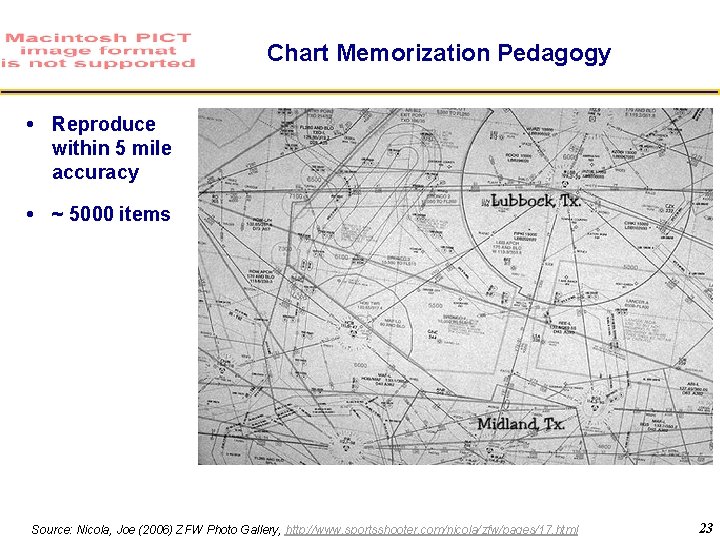
Chart Memorization Pedagogy Reproduce within 5 mile accuracy ~ 5000 items Source: Nicola, Joe (2006) ZFW Photo Gallery, http: //www. sportsshooter. com/nicola/zfw/pages/17. html 23
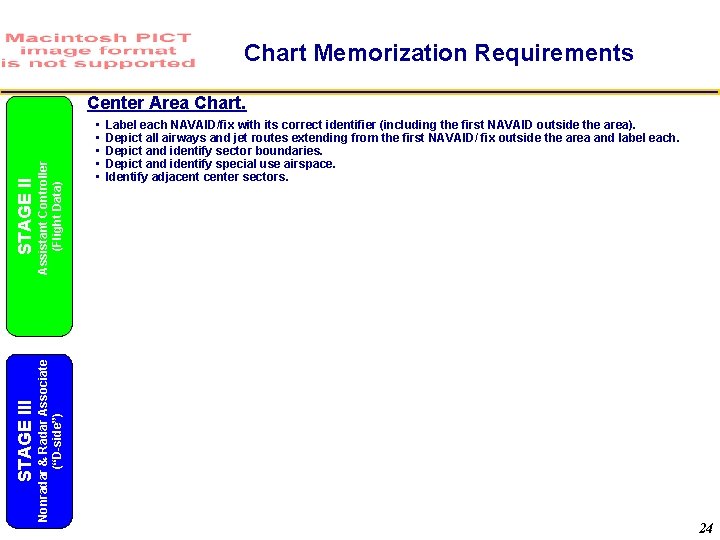
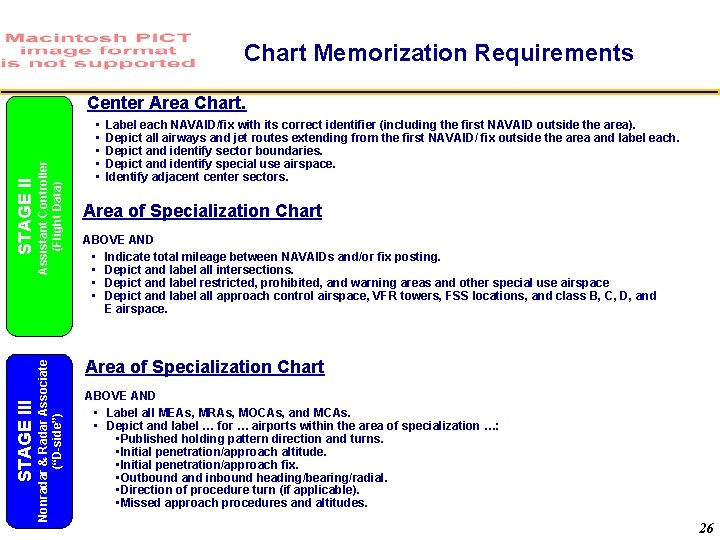
Chart Memorization Requirements STAGE II Assistant Controller (Flight Data) STAGE III Nonradar & Radar Associate (“D-side”) Center Area Chart. • • • Label each NAVAID/fix with its correct identifier (including the first NAVAID outside the area). Depict all airways and jet routes extending from the first NAVAID/ fix outside the area and label each. Depict and identify sector boundaries. Depict and identify special use airspace. Identify adjacenter sectors. 24
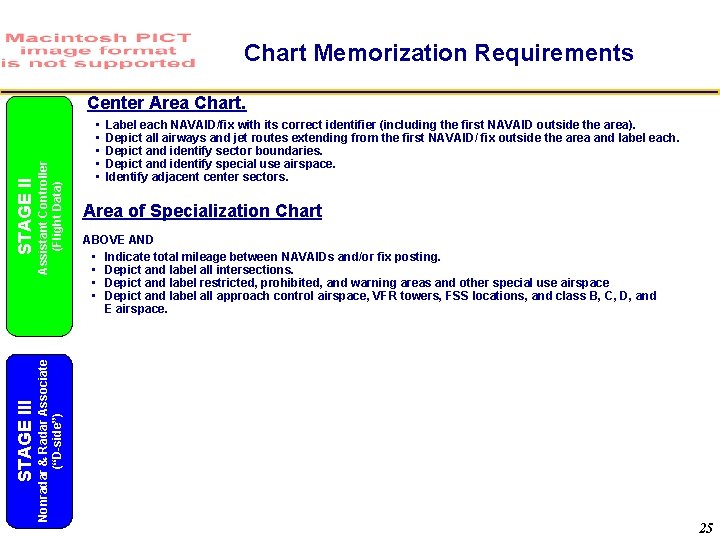
Chart Memorization Requirements STAGE II Assistant Controller (Flight Data) STAGE III Nonradar & Radar Associate (“D-side”) Center Area Chart. • • • Label each NAVAID/fix with its correct identifier (including the first NAVAID outside the area). Depict all airways and jet routes extending from the first NAVAID/ fix outside the area and label each. Depict and identify sector boundaries. Depict and identify special use airspace. Identify adjacenter sectors. Area of Specialization Chart ABOVE AND • Indicate total mileage between NAVAIDs and/or fix posting. • Depict and label all intersections. • Depict and label restricted, prohibited, and warning areas and other special use airspace • Depict and label all approach control airspace, VFR towers, FSS locations, and class B, C, D, and E airspace. 25
Chart Memorization Requirements Assistant Controller (Flight Data) Nonradar & Radar Associate (“D-side”) STAGE III STAGE II Center Area Chart. • • • Label each NAVAID/fix with its correct identifier (including the first NAVAID outside the area). Depict all airways and jet routes extending from the first NAVAID/ fix outside the area and label each. Depict and identify sector boundaries. Depict and identify special use airspace. Identify adjacenter sectors. Area of Specialization Chart ABOVE AND • Indicate total mileage between NAVAIDs and/or fix posting. • Depict and label all intersections. • Depict and label restricted, prohibited, and warning areas and other special use airspace • Depict and label all approach control airspace, VFR towers, FSS locations, and class B, C, D, and E airspace. Area of Specialization Chart ABOVE AND • Label all MEAs, MRAs, MOCAs, and MCAs. • Depict and label … for … airports within the area of specialization …: • Published holding pattern direction and turns. • Initial penetration/approach altitude. • Initial penetration/approach fix. • Outbound and inbound heading/bearing/radial. • Direction of procedure turn (if applicable). • Missed approach procedures and altitudes. 26
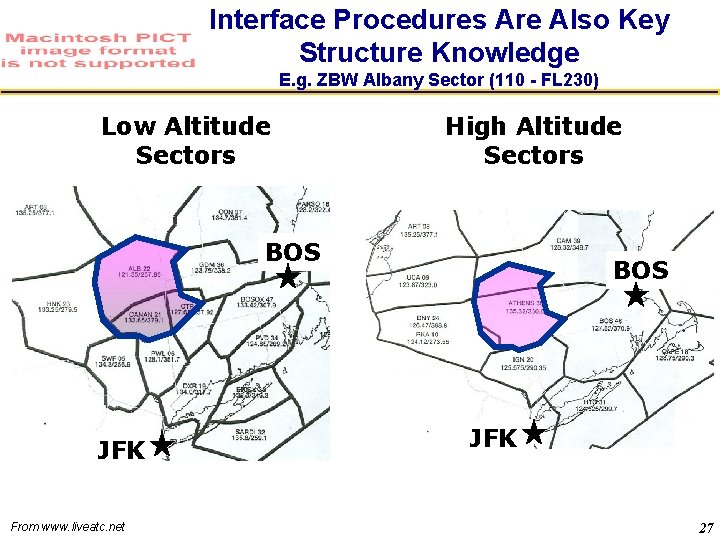
Interface Procedures Are Also Key Structure Knowledge E. g. ZBW Albany Sector (110 - FL 230) Low Altitude Sectors High Altitude Sectors BOS JFK From www. liveatc. net BOS JFK 27
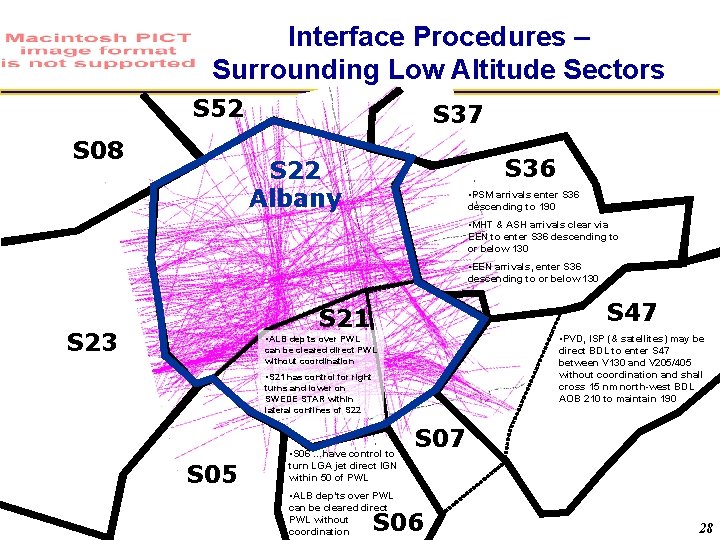
Interface Procedures – Surrounding Low Altitude Sectors S 52 S 08 S 37 S 36 S 22 Albany • PSM arrivals enter S 36 descending to 190 • MHT & ASH arrivals clear via EEN to enter S 36 descending to or below 130 • EEN arrivals, enter S 36 descending to or below 130 S 47 S 21 S 23 • PVD, ISP (& satellites) may be direct BDL to enter S 47 between V 130 and V 205/405 without coordination and shall cross 15 nm north-west BDL AOB 210 to maintain 190 • ALB dep’ts over PWL can be cleared direct PWL without coordination • S 21 has control for right turns and lower on SWEDE STAR within lateral confines of S 22 S 05 • S 06 …have control to turn LGA jet direct IGN within 50 of PWL • ALB dep’ts over PWL can be cleared direct PWL without coordination S 07 S 06 28
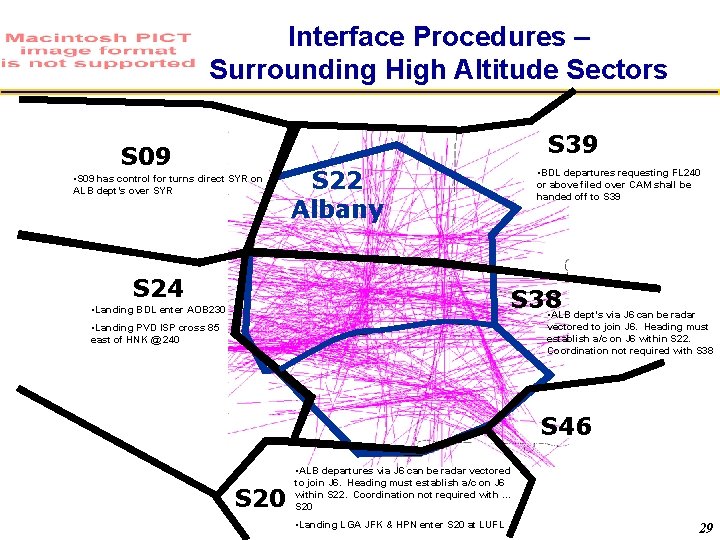
Interface Procedures – Surrounding High Altitude Sectors S 39 S 09 • S 09 has control for turns direct SYR on ALB dept’s over SYR S 22 Albany S 24 • BDL departures requesting FL 240 or above filed over CAM shall be handed off to S 39 S 38 • ALB dept’s via J 6 can be radar • Landing BDL enter AOB 230 vectored to join J 6. Heading must establish a/c on J 6 within S 22. Coordination not required with S 38 • Landing PVD ISP cross 85 east of HNK @ 240 S 46 S 20 • ALB departures via J 6 can be radar vectored to join J 6. Heading must establish a/c on J 6 within S 22. Coordination not required with … S 20 • Landing LGA JFK & HPN enter S 20 at LUFL 29
ATCS Performance Measures & Training Effectiveness Observation: The assessment of Academy training and OJT effectiveness are hindered by a lack of metrics to ensure performance competencies, prioritize efforts to address training and remediation, and track controller development. Training seems largely time-based as opposed to performance and results based. Recommendation: ü The FAA should immediately and consistently develop and implement performance-based metrics and standards for CTI, Academy, facility airspace, and OJT training entry/exit criteria to assess controller competencies ü The FAA should seek to standardize, to the extent possible, scenario characteristics for training and exploit advanced simulation technology to converge on a common set of controller skills ü The FAA should combine the use of objective measures of skill with behaviorally anchored rating scales to ensure effective use of training exit criteria ü The FAA should examine best practice and lessons learned in training for air transport operations and investigate their application to controller performance 30
Use of Simulation Observation: Simulation technology is not properly exploited in ATCS training. The subcommittee observes: o An over-reliance on labor intensive full fidelity simulation to mimic the “real world” as opposed to simulation fidelity selected to match training value o No basis for what should be trained at varying levels of simulator fidelity o Ineffective use of CBT and part-task simulation, which could increase training effectiveness at a lower cost Recommendation: In the next six months develop a set of technology requirements: ü To support performance-based training objectives ü Identify and map skills to training technologies (CBT, part-task simulators, full fidelity simulation) to training objectives ü Address scenario and airspace specific development issues ü Evaluate MITRE (R-SAT) simulation training approach (and others) to be systematically matched with training outcomes for effective training delivery ü Investigate the use of simulators to provide early practice and testing including on airspace knowledge and communications skills 31
MITRE Rapidly-Deployable Stand. Alone ATC Trainer (R-SAT) Stand-alone, dedicated training system at facilities that can supplement Radar and Radar Associate training o o o Independent Operation Automatic assessment of performance Enable quality training during otherwise non-productive time Focus on important tasks and abilities Supplement remedial training Rapidly deployable based on facility needs o Facilities with a large number of trainees expected to need additional simulation training positions Purpose o Validation o Demonstration o Near-Term Use Source: MITRE Briefing 32
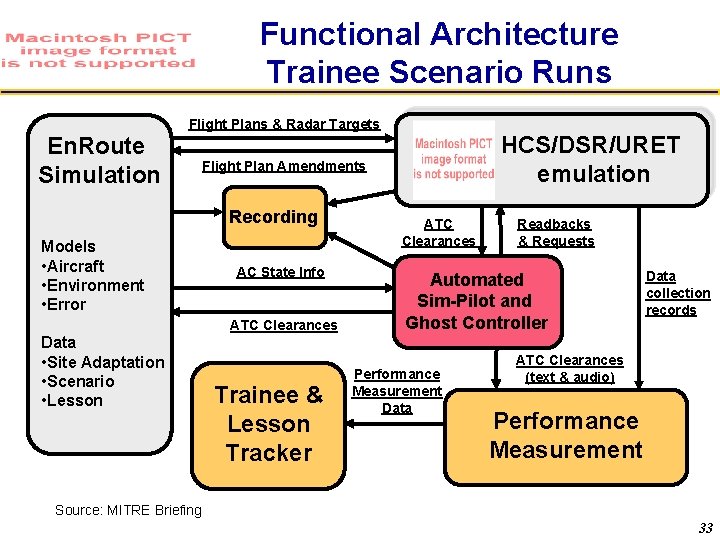
Functional Architecture Trainee Scenario Runs Flight Plans & Radar Targets En. Route Simulation Flight Plan Amendments Recording Models • Aircraft • Environment • Error AC State Info ATC Clearances Data • Site Adaptation • Scenario • Lesson HCS/DSR/URET emulation Trainee & Lesson Tracker ATC Clearances Readbacks & Requests Automated Sim-Pilot and Ghost Controller Performance Measurement Data collection records ATC Clearances (text & audio) Performance Measurement Source: MITRE Briefing 33
Standardization of Procedures Observation: A large portion of training at the facility is dedicated to learning local procedures and memorizing detail which is an artifact of prior technology limits. This is compounded by differences in local practices for use of common ATCS tools such as URET. Recommendation: Immediately determine how to improve, staffing flexibility, OJT and Academy effectiveness through: ü Identification of general techniques and consolidation that standardizes procedures and training across facilities such as control techniques for certain operational flows ü Targeting facilities at risk of personnel shortfall. Focus on procedure simplification and support for controller rapid indoctrination in local techniques ü Enhancing processes for reducing training effort and off-loading sector-specific requirements to perceptual and decision support tools ü Anticipating the impact of future initiatives in procedure and equipment to enhance procedural standardization ü In the next year, determine how standardized procedures could be improved for use of ATCS tools 34
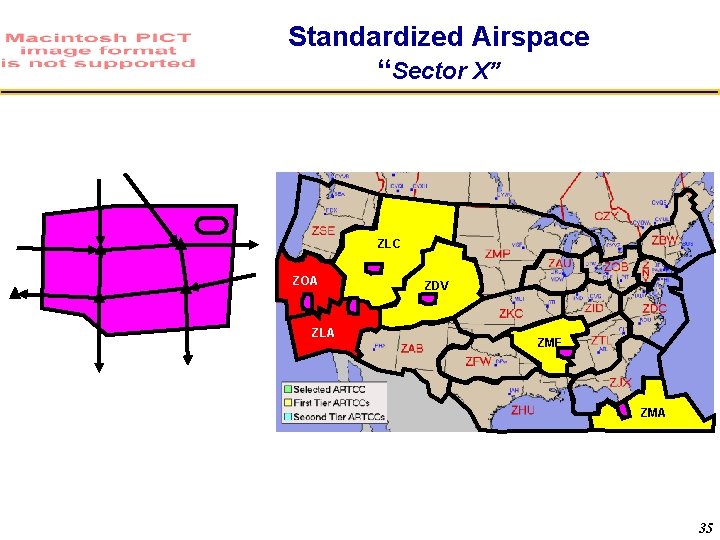
Standardized Airspace “Sector X” ZLC ZOA ZLA ZDV ZME ZMA 35
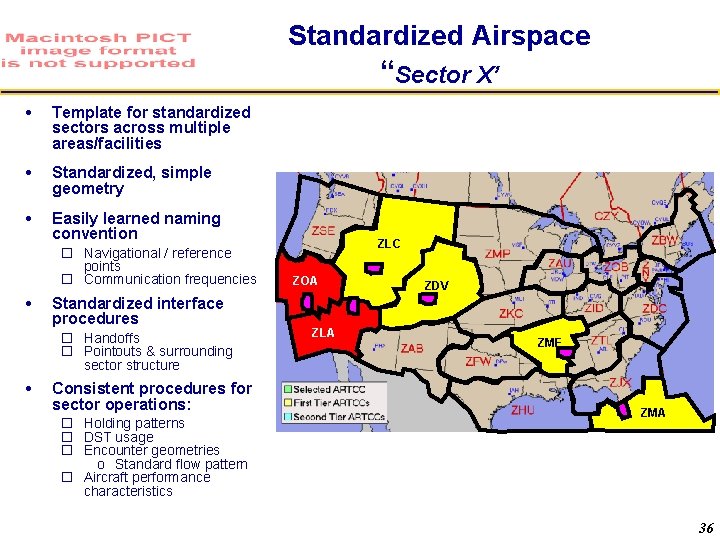
Standardized Airspace “Sector X’ Template for standardized sectors across multiple areas/facilities Standardized, simple geometry Easily learned naming convention o Navigational / reference points o Communication frequencies Standardized interface procedures o Handoffs o Pointouts & surrounding sector structure Consistent procedures for sector operations: o Holding patterns o DST usage o Encounter geometries o Standard flow pattern o Aircraft performance characteristics ZLC ZOA ZLA ZDV ZME ZMA 36
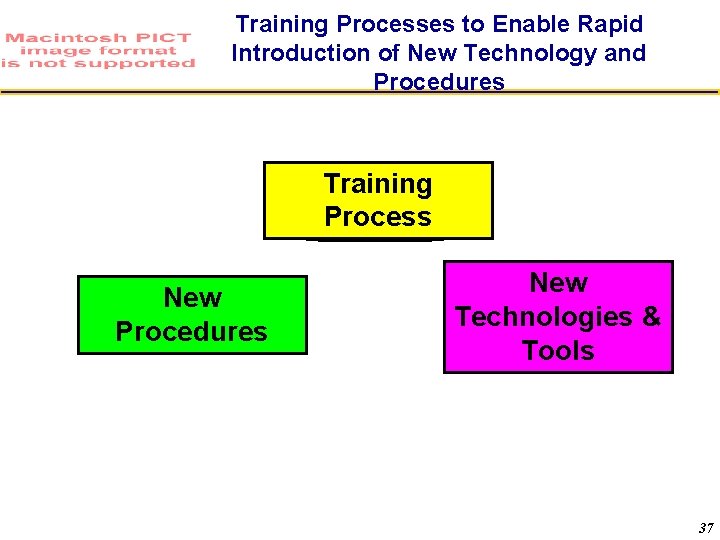
Training Processes to Enable Rapid Introduction of New Technology and Procedures Training Process New Procedures New Technologies & Tools 37
CTI - Academy Alignment Observation: Collegiate Training Initiative (CTI) programs are seen as one way of expanding the FAA training capability. In order to exploit that possible expansion, the CTI programs need to be better aligned with Academy and FAA requirements. Recommendation: ü Immediately, give the CTI schools clear guidance to allow their graduates advance in Academy training. Immediately establish minimum requirements for CTI graduates to enter Academy training as well as requirements for advanced Academy placement ü Streamline the transition between CTI and Academy and support currency training during transition ü Develop a program of feedback to the CTI schools using Academy statistics to improve CTI curricula including use of training technologies. 38
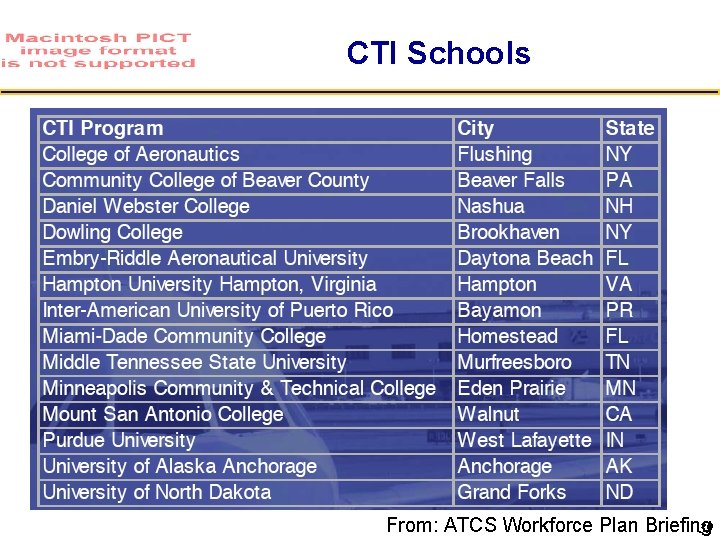
CTI Schools From: ATCS Workforce Plan Briefing 39
Use of Team Training Observation: Use of team training is not addressed in A Plan for the Future: The FAA’s 10 -Year Strategy for the Air Traffic Control Workforce. Part of this strategy should be ensuring safety management and a reporting culture by indoctrinating controllers early on the value of teamwork. Recommendation: ü In the next six months, implement an approach for leveraging the use of team training, whether in the form of team based collaborative learning, Air Traffic Teamwork Enhancement (ATTE), crew resource management (CRM), or some other approach. Principles should be introduced at the Academy, and practiced in OJT. 40
Conclusion The upcoming transition in controller workforce provides both the stimulus and opportunity to define the next generation air traffic controller workforce. Urgent demands will push for short term solutions. We need to assure that the processes result in a next generation air traffic controller workforce that can enable to Next Generation Air Transportation System. 41