
Renewable Energy Certificates REC Primer for REC Transaction
Renewable Energy Certificates (REC) Primer for REC Transaction Management, Accounting and Reporting Karen Utt June 7, 2019
• Introduction • What is a REC? Agenda • REC Tracking Systems • REC settlement business problem • Smart Contracts—value exchange • Operations and security benefits of Smart Contracts in renewable energy • Evolution of reporting and audit response processes • Manual multi-step existing today • Q&A REC 101 | 2
What is a Renewable PPA? • A power purchase agreement relating to a renewable electric generating facility - Wind, solar, biomass, geothermal, etc. Wholesale vs Retail Physical delivery vs Financial settlement Includes applicable RECs “bundled” with electricity. REC 101 | 3
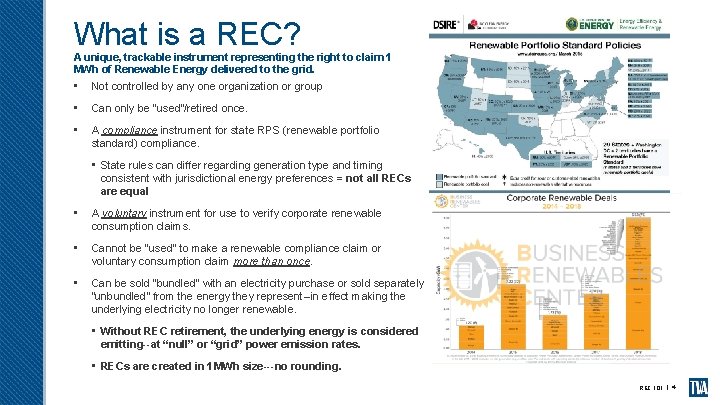
What is a REC? A unique, trackable instrument representing the right to claim 1 MWh of Renewable Energy delivered to the grid. • Not controlled by any one organization or group • Can only be “used”/retired once. • A compliance instrument for state RPS (renewable portfolio standard) compliance. • State rules can differ regarding generation type and timing consistent with jurisdictional energy preferences = not all RECs are equal • A voluntary instrument for use to verify corporate renewable consumption claims. • Cannot be “used” to make a renewable compliance claim or voluntary consumption claim more than once. • Can be sold “bundled” with an electricity purchase or sold separately “unbundled” from the energy they represent--in effect making the underlying electricity no longer renewable. • Without REC retirement, the underlying energy is considered emitting--at “null” or “grid” power emission rates. • RECs are created in 1 MWh size---no rounding. REC 101 | 4
A REC includes several data attributes • • • • Certificate data Certificate type Tracking system ID Renewable fuel type Renewable facility location Nameplate capacity of project Project name Project vintage (build date) Certificate (generation) vintage Certificate unique identification number Utility to which project is interconnected Eligibility for certification or RPS Emissions rate of the renewable source *Note: this is not an exhaustive list and, depending on the market in which the REC is generated, other attributes may be associated with the certificate REC 101 | 5
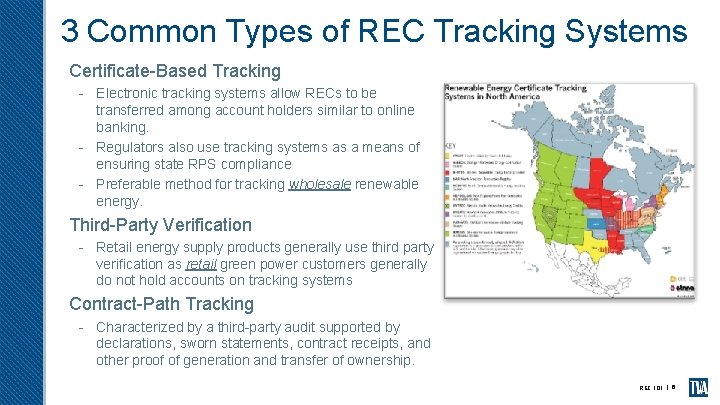
3 Common Types of REC Tracking Systems Certificate-Based Tracking - Electronic tracking systems allow RECs to be transferred among account holders similar to online banking. - Regulators also use tracking systems as a means of ensuring state RPS compliance - Preferable method for tracking wholesale renewable energy. Third-Party Verification - Retail energy supply products generally use third party verification as retail green power customers generally do not hold accounts on tracking systems Contract-Path Tracking - Characterized by a third-party audit supported by declarations, sworn statements, contract receipts, and other proof of generation and transfer of ownership. REC 101 | 6
Threats to the status quo The renewables industry is viewed as less advanced and is still reliant on the exchange of physical documents (email PDFs, Text, etc. ) which can lead to delays, higher costs, and increased risk of fraud. The new platforms will lead to faster, cheaper and more secure ways of completing a trade, as well as settling the transaction and improve efficiency and security. Energy groups, including We. Power, Power Ledger, Acciona Energy & Iberdrola, the Brooklyn Microgrid, and The Sun Exchange are looking to launch new platforms underpinned by blockchain technology. Inaction by a standards organization to adjust to digital age transformation could result in the standards becoming obsolete. Data format, security and Communication standards are all susceptible to rapid changes in a digitalized world. REC 101 | 7
• Security is enhanced by having well Benefits of Distributed Ledger Technology (DLT) designed work flows and integration with adjacent applications • Distributed Ledger Technology (DLT) adds redundancy over single points of failure with peer-to-peer • Creation of a superior audit history • One system of record and not two separate databases that need to be reconciled • Improved efficiency in the settlement process REC 101 | 8
• 1, 000 s of companies today are transacting Why a NAESB Renewable Purchase Contract is needed? renewable energy. • Lack of standardization increases transaction costs and risk. • A digitized contract eliminates the need for purchasing the contract. • A “smart” digital representation of physical Renewable Purchase Contract would serve as a foundation to bridge the wholesale – retail market ensuring authenticity, eliminating duplicity concerns. REC 101 | 9
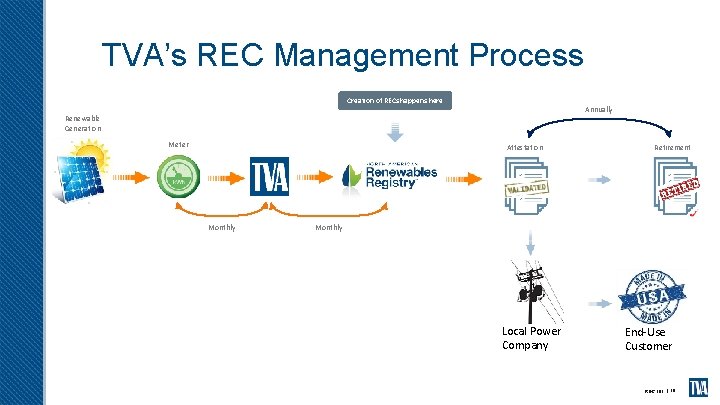
TVA’s REC Management Process Creation of RECs happens here Annually Renewable Generation Meter Attestation Monthly Retirement Monthly Local Power Company End-Use Customer REC 101 | 10
DLT can Streamline Current Monthly & Yearly Processes REC 101 | 11
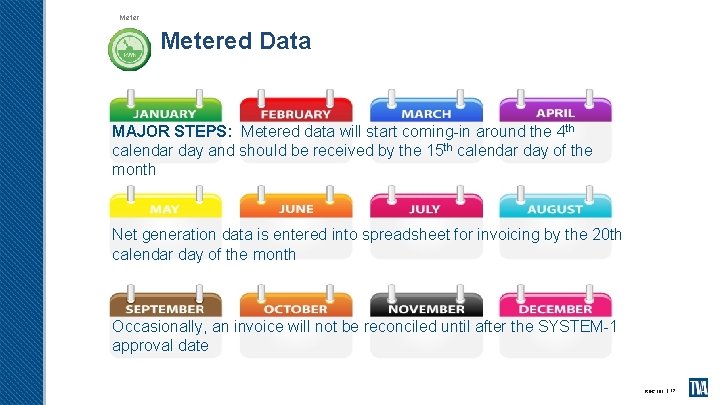
Metered Data MAJOR STEPS: Metered data will start coming-in around the 4 th calendar day and should be received by the 15 th calendar day of the month Net generation data is entered into spreadsheet for invoicing by the 20 th calendar day of the month Occasionally, an invoice will not be reconciled until after the SYSTEM-1 approval date REC 101 | 12
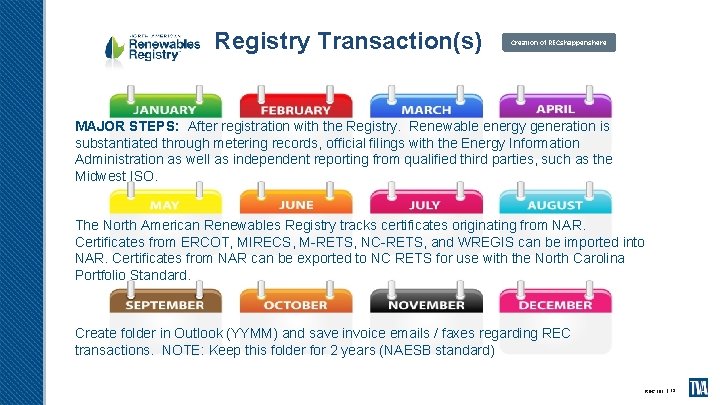
Registry Transaction(s) Creation of RECs happens here MAJOR STEPS: After registration with the Registry. Renewable energy generation is substantiated through metering records, official filings with the Energy Information Administration as well as independent reporting from qualified third parties, such as the Midwest ISO. The North American Renewables Registry tracks certificates originating from NAR. Certificates from ERCOT, MIRECS, M-RETS, NC-RETS, and WREGIS can be imported into NAR. Certificates from NAR can be exported to NC RETS for use with the North Carolina Portfolio Standard. Create folder in Outlook (YYMM) and save invoice emails / faxes regarding REC transactions. NOTE: Keep this folder for 2 years (NAESB standard) REC 101 | 13
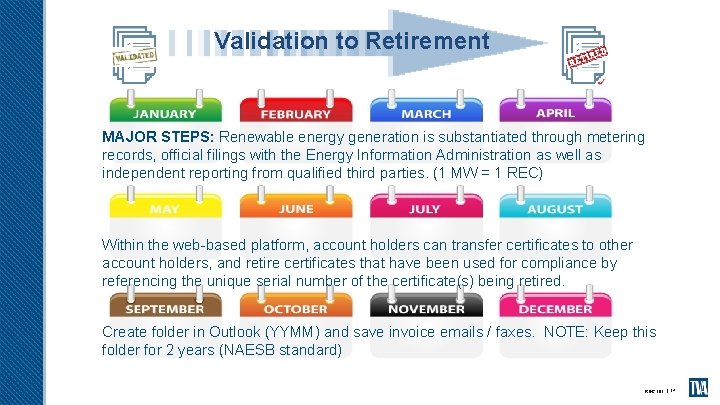
Validation to Retirement MAJOR STEPS: Renewable energy generation is substantiated through metering records, official filings with the Energy Information Administration as well as independent reporting from qualified third parties. (1 MW = 1 REC) Within the web-based platform, account holders can transfer certificates to other account holders, and retire certificates that have been used for compliance by referencing the unique serial number of the certificate(s) being retired. Create folder in Outlook (YYMM) and save invoice emails / faxes. NOTE: Keep this folder for 2 years (NAESB standard) REC 101 | 14
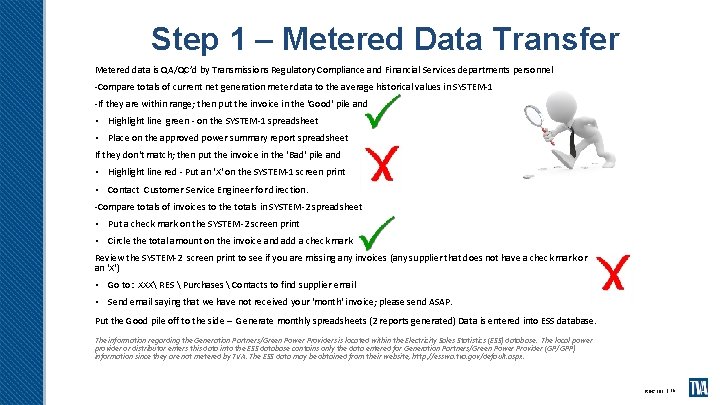
Step 1 – Metered Data Transfer Metered data is QA/QC’d by Transmissions Regulatory Compliance and Financial Services departments personnel -Compare totals of current net generation meter data to the average historical values in SYSTEM-1 -If they are within range; then put the invoice in the 'Good' pile and • Highlight line green - on the SYSTEM-1 spreadsheet • Place on the approved power summary report spreadsheet If they don't match; then put the invoice in the 'Bad' pile and • Highlight line red - Put an 'X' on the SYSTEM-1 screen print • Contact Customer Service Engineer for direction. -Compare totals of invoices to the totals in SYSTEM-2 spreadsheet • Put a check mark on the SYSTEM-2 screen print • Circle the total amount on the invoice and add a check mark Review the SYSTEM-2 screen print to see if you are missing any invoices (any supplier that does not have a check mark or an 'X') • Go to: XXX RES Purchases Contacts to find supplier email • Send email saying that we have not received your 'month' invoice; please send ASAP. Put the Good pile off to the side – Generate monthly spreadsheets (2 reports generated) Data is entered into ESS database. The information regarding the Generation Partners/Green Power Providers is located within the Electricity Sales Statistics (ESS) database. The local power provider or distributor enters this data into the ESS database contains only the data entered for Generation Partners/Green Power Provider (GP/GPP) information since they are not metered by TVA. The ESS data may be obtained from their website, http: //esswa. tva. gov/default. aspx. REC 101 | 15
Step 2 – Creation of REC (NAR-APX and/or NC-RETS) • Using a web-based platform to create, track, and manage renewable energy certificate (REC) origination for renewable energy production facilities, utility energy efficiency and demand-side management programs, and hydro power sold by the Southeastern Power Administration. • Facilities generating RECs must be registered. The facility must meet the criteria, whether its fuel source is, in fact, “renewable. ” Once registered, the facility is eligible to participate. • The facility’s energy production data, such as a monthly meter read, is entered into web-based platform where it creates one unique certificate for each megawatt-hour (MWh) of renewable energy produced. • All certificates issued are tracked using unique serial numbers. (For facilities that produce thermal energy, NC-RETS will create RECs based on a conversion factor of 3, 412, 000 Btu per 1 MWh. ) REC 101 | 16
Step 3 – Validation Web-based platform data infrastructure prevents double-counting of certificates and provides public reports and a full audit trail of all transactions, to ensure the integrity of the certificates issued and held in the system. • Generating facilities must meet the criteria, whether its fuel source is, in fact, “renewable. ” • Once registered, the facility is eligible to participate. • Renewable energy facilities must maintain their energy production data for audit by third parties. • Third parties will need to see if renewable energy production criteria is met which includes meter data; as well as, renewable facility location, nameplate capacity of project , project name, project vintage (build date), certificate (generation) vintage, certificate unique identification number. utility to which project is interconnected, eligibility for certification or RPS Emissions rate of the renewable source, certificate data, certificate type, tracking system ID, and renewable fuel type. REC 101 | 17
Step 4 – Retirement of RECs are retired for various reasons; such as: - Compliance with renewable energy portfolio standard Carbon rate adjustment Aging-out or nearing Shelf-life (RECs can practically expire or lose commercial value over time) Use of a web-based platform data infrastructure prevents double-counting of certificates and provides a public report of the certificates issued and held in the system. • Account holders can transfer certificates to other account holders, and retire certificates that have been used for compliance by referencing the unique serial number of the certificates being retired. All certificates issued and held are tracked using unique serial numbers. REC 101 | 18

- Slides: 19