
Renewable Energy Based Hydrogen Production Presented By H
Renewable Energy Based Hydrogen Production Presented By: H 2 Generation Client: Dr. Tom Acker 9/17/2020 1

Joshua Spear – Team Leader Robert Burke – Team Mediator Ryan Hirschi – Financial Officer Andrew Boone – Secretary/Webpage 9/17/2020 H 2 Generation Systems -- 2
Presentation Overview n. Problem description/State of the Art Research n. Hydrogen n. H 2 Safety Awareness Generation’s Deliverables n. Description n. Analysis of Design n. Conclusion/Questions 9/17/2020 and Answer 3
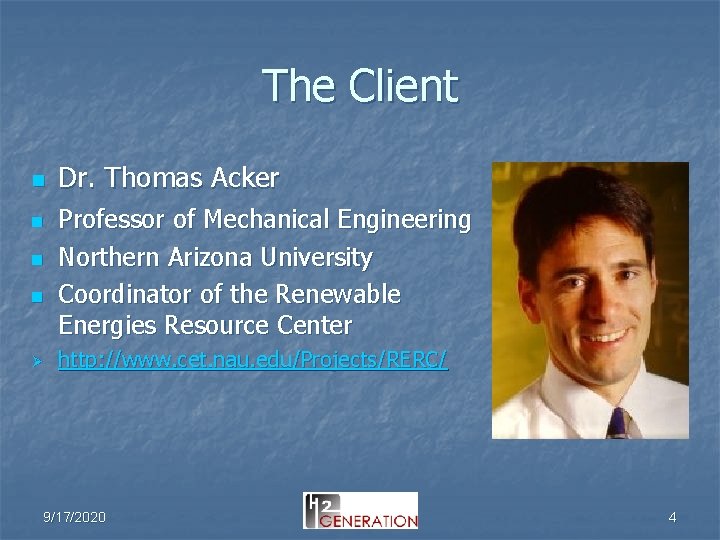
The Client n n Ø Dr. Thomas Acker Professor of Mechanical Engineering Northern Arizona University Coordinator of the Renewable Energies Resource Center http: //www. cet. nau. edu/Projects/RERC/ 9/17/2020 4
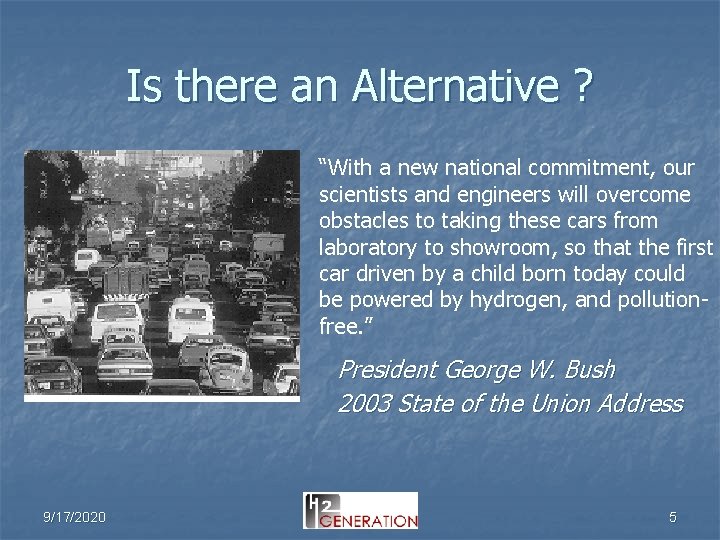
Is there an Alternative ? “With a new national commitment, our scientists and engineers will overcome obstacles to taking these cars from laboratory to showroom, so that the first car driven by a child born today could be powered by hydrogen, and pollutionfree. ” President George W. Bush 2003 State of the Union Address 9/17/2020 5
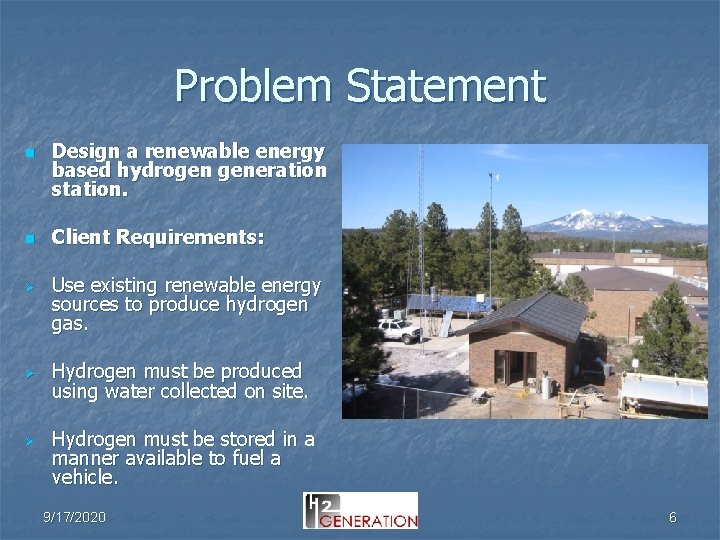
Problem Statement n n Ø Ø Ø Design a renewable energy based hydrogen generation station. Client Requirements: Use existing renewable energy sources to produce hydrogen gas. Hydrogen must be produced using water collected on site. Hydrogen must be stored in a manner available to fuel a vehicle. 9/17/2020 6
Additional Design Criteria Hydrogen use in internal combustion Ø Purity of 99% Ø http: //www. homepower. com/files/Hp 67 p 42. pdf n Hydrogen use in fuel cell technology Purity of 99. 999% Ø USCAR (United States Council for Automotive Research) Ø Ø http: //www. uscar. org/Media/2002 issue 2/hydrogen. htm 9/17/2020 7
H 2 Generation Deliverables: n System design incorporating: Ø Specified Design Thermodynamic analysis Simulation Website n Demonstration of concept model: Ø Design and construct Ø Ø Ø 9/17/2020 8
Team Design Budget n n Ø Ø Ø n Maximum design budget of $1000 Design Costs Documents: $75 Fliers: $15 Poster: $15 n Ø Ø Ø Model Costs Electrolyzer: $160 Engine: $70 Misc: $30 Total Budget Used: $365 (Under budget) 9/17/2020 9
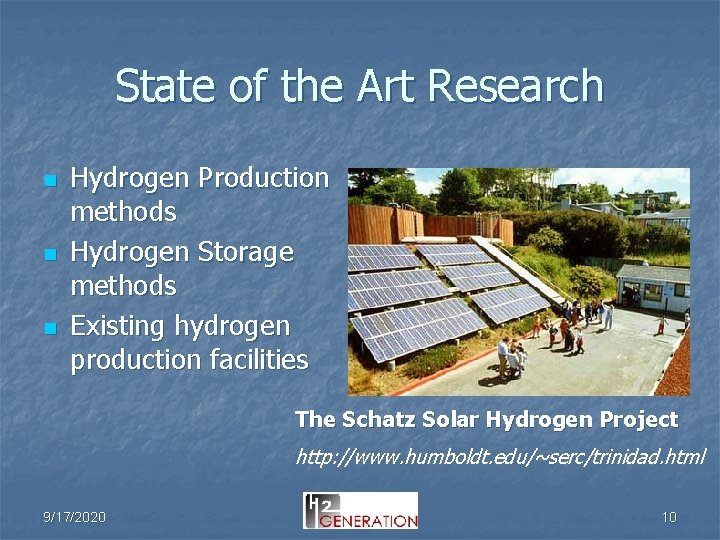
State of the Art Research n n n Hydrogen Production methods Hydrogen Storage methods Existing hydrogen production facilities The Schatz Solar Hydrogen Project http: //www. humboldt. edu/~serc/trinidad. html 9/17/2020 10
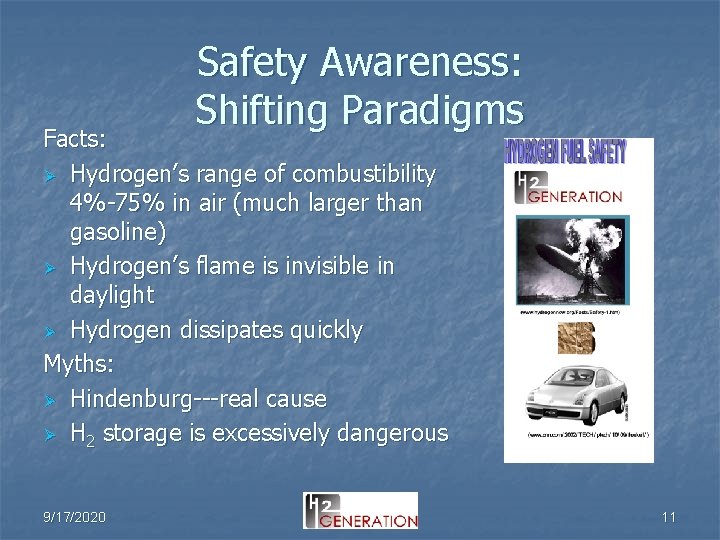
Safety Awareness: Shifting Paradigms Facts: Ø Hydrogen’s range of combustibility 4%-75% in air (much larger than gasoline) Ø Hydrogen’s flame is invisible in daylight Ø Hydrogen dissipates quickly Myths: Ø Hindenburg---real cause Ø H 2 storage is excessively dangerous 9/17/2020 11
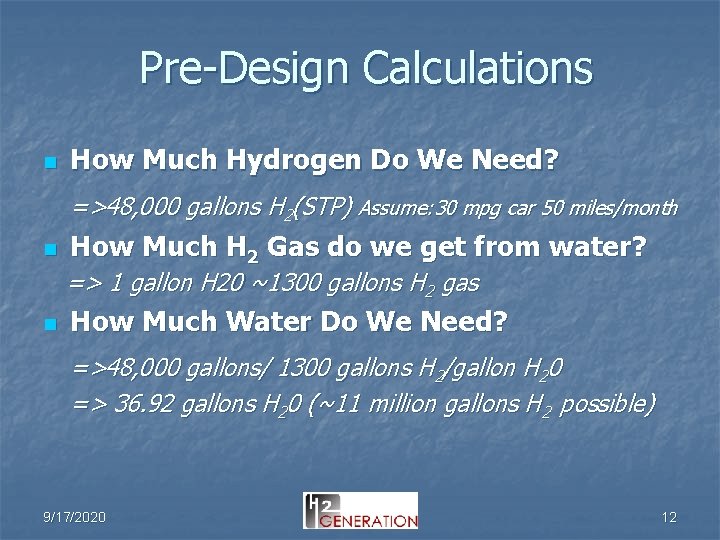
Pre-Design Calculations n How Much Hydrogen Do We Need? =>48, 000 gallons H 2(STP) Assume: 30 mpg car 50 miles/month n How Much H 2 Gas do we get from water? => 1 gallon H 20 ~1300 gallons H 2 gas n How Much Water Do We Need? =>48, 000 gallons/ 1300 gallons H 2/gallon H 20 => 36. 92 gallons H 20 (~11 million gallons H 2 possible) 9/17/2020 12
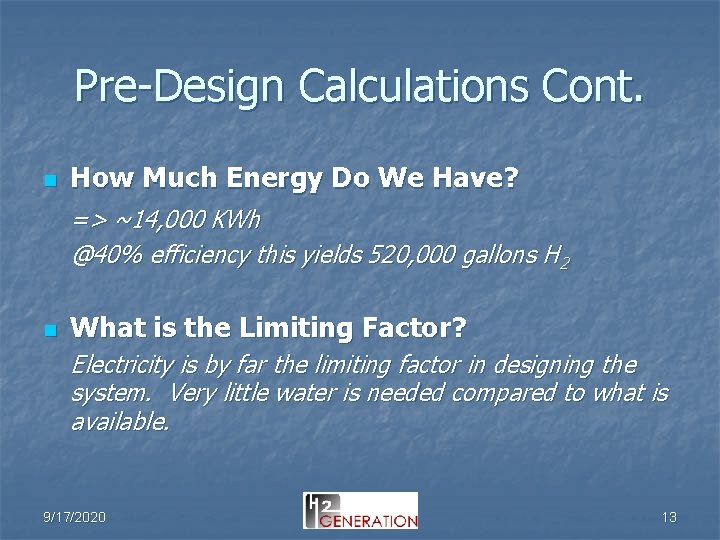
Pre-Design Calculations Cont. n How Much Energy Do We Have? => ~14, 000 KWh @40% efficiency this yields 520, 000 gallons H 2 n What is the Limiting Factor? Electricity is by far the limiting factor in designing the system. Very little water is needed compared to what is available. 9/17/2020 13
Proposed Project Components 9/17/2020 14
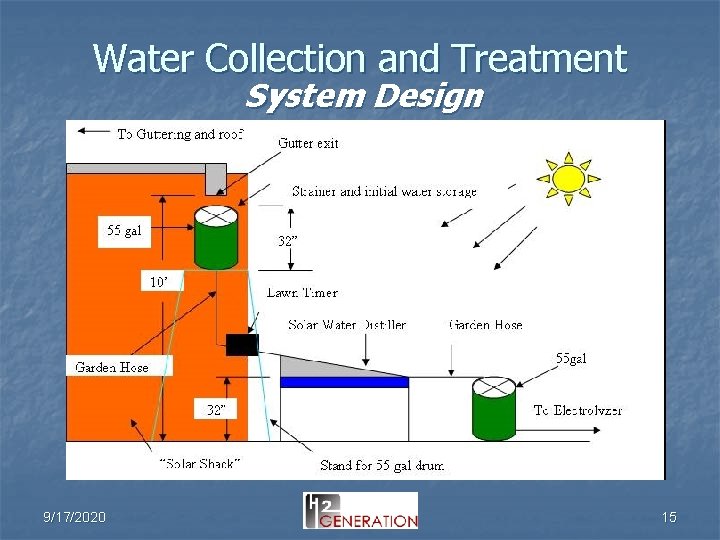
Water Collection and Treatment System Design 9/17/2020 15
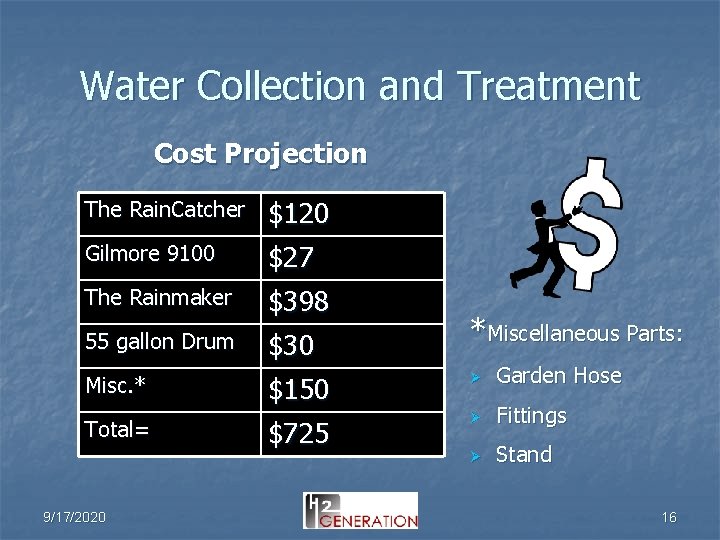
Water Collection and Treatment Cost Projection The Rain. Catcher $120 Gilmore 9100 $27 The Rainmaker $398 55 gallon Drum $30 Misc. * Total= 9/17/2020 *Miscellaneous Parts: $150 Ø Garden Hose $725 Ø Fittings Ø Stand 16
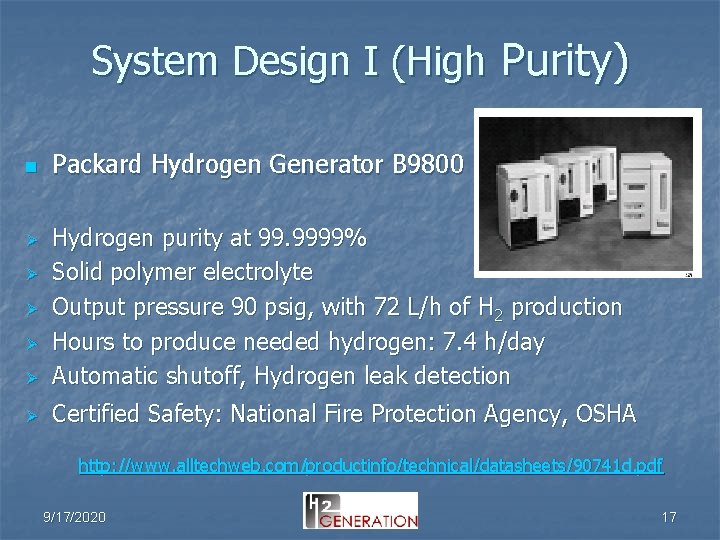
System Design I (High Purity) n Packard Hydrogen Generator B 9800 Ø Hydrogen purity at 99. 9999% Solid polymer electrolyte Output pressure 90 psig, with 72 L/h of H 2 production Hours to produce needed hydrogen: 7. 4 h/day Automatic shutoff, Hydrogen leak detection Ø Certified Safety: National Fire Protection Agency, OSHA Ø Ø http: //www. alltechweb. com/productinfo/technical/datasheets/90741 d. pdf 9/17/2020 17
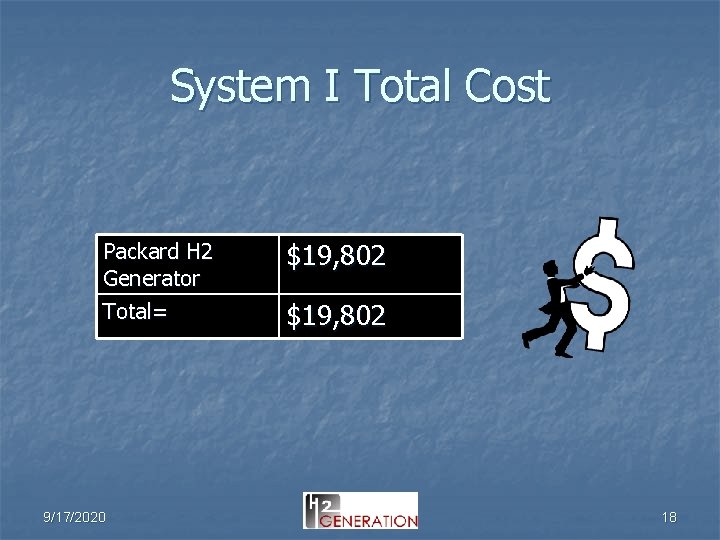
System I Total Cost Packard H 2 Generator Total= 9/17/2020 $19, 802 18
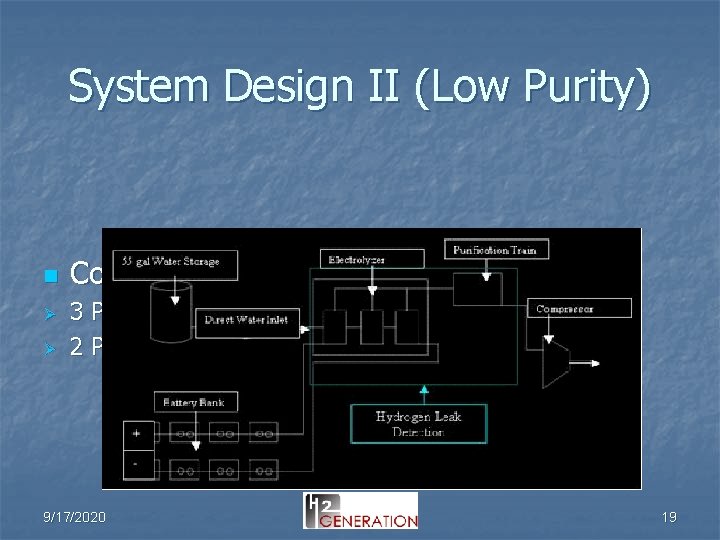
System Design II (Low Purity) n Ø Ø Components: 3 PEM electrolyzers (Polymer-electrolyte membrane) 2 Purification trains, Hydrogen leak detection 9/17/2020 19
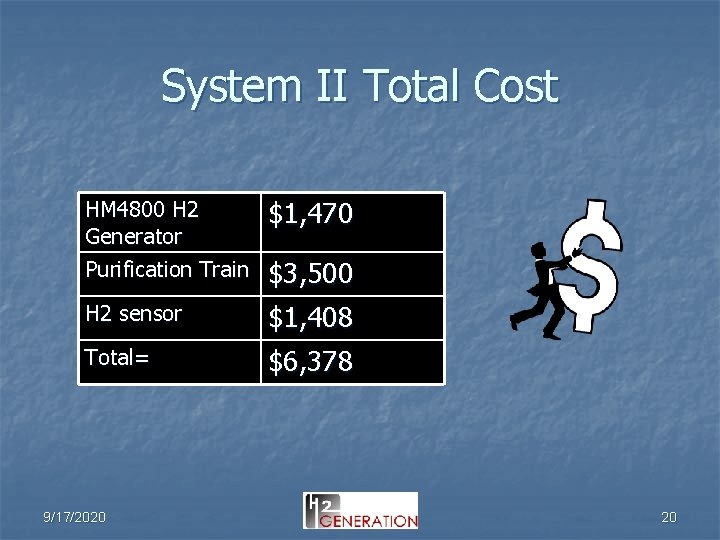
System II Total Cost HM 4800 H 2 Generator Purification Train $1, 470 H 2 sensor $1, 408 Total= $6, 378 9/17/2020 $3, 500 20
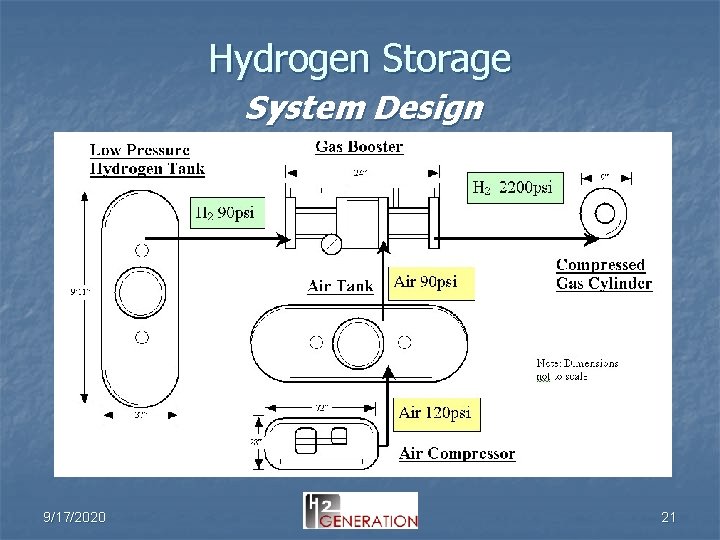
Hydrogen Storage System Design 9/17/2020 21
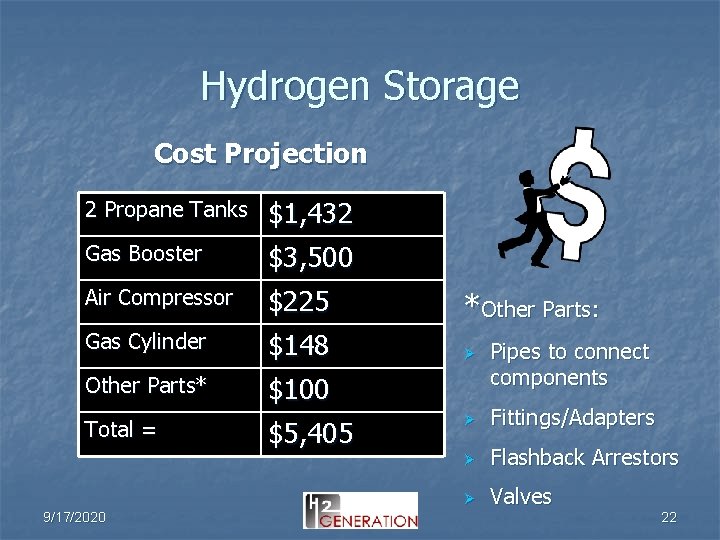
Hydrogen Storage Cost Projection 2 Propane Tanks $1, 432 Gas Booster $3, 500 Air Compressor $225 *Other Parts: Gas Cylinder $148 Ø Other Parts* $100 Total = 9/17/2020 $5, 405 Pipes to connect components Ø Fittings/Adapters Ø Flashback Arrestors Ø Valves 22
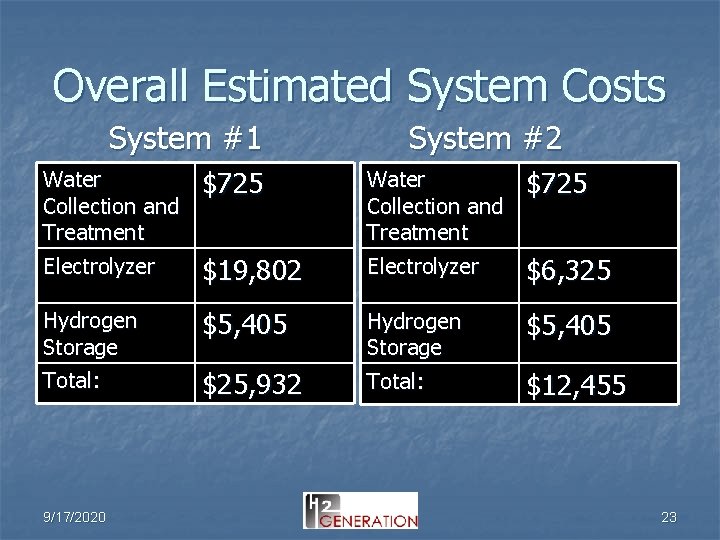
Overall Estimated System Costs System #1 Water Collection and Treatment Electrolyzer $725 Hydrogen Storage Total: $5, 405 9/17/2020 $19, 802 $25, 932 System #2 Water Collection and Treatment Electrolyzer $725 Hydrogen Storage Total: $5, 405 $6, 325 $12, 455 23
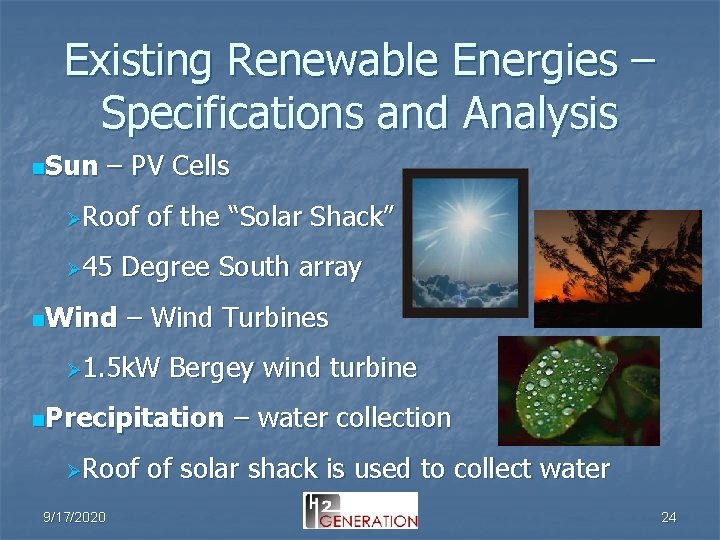
Existing Renewable Energies – Specifications and Analysis n. Sun – PV Cells ØRoof Ø 45 n. Wind of the “Solar Shack” Degree South array – Wind Turbines Ø 1. 5 k. W Bergey wind turbine n. Precipitation ØRoof 9/17/2020 – water collection of solar shack is used to collect water 24
Renewable Energy 9/17/2020 25
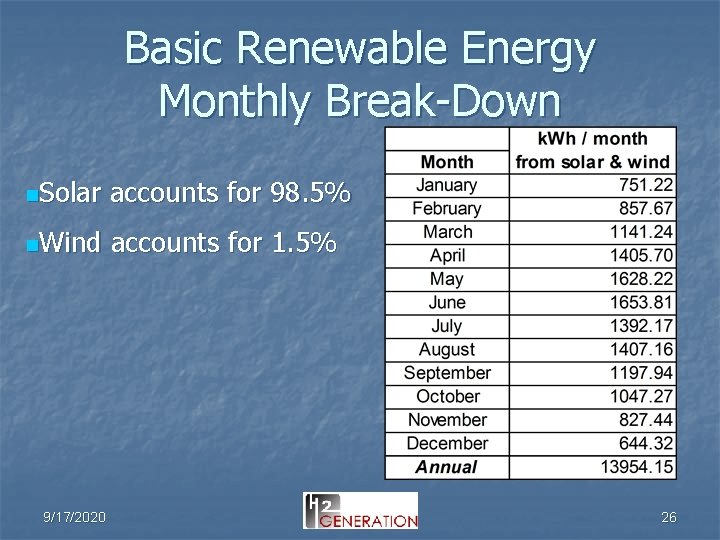
Basic Renewable Energy Monthly Break-Down n. Solar accounts for 98. 5% n. Wind accounts for 1. 5% 9/17/2020 26
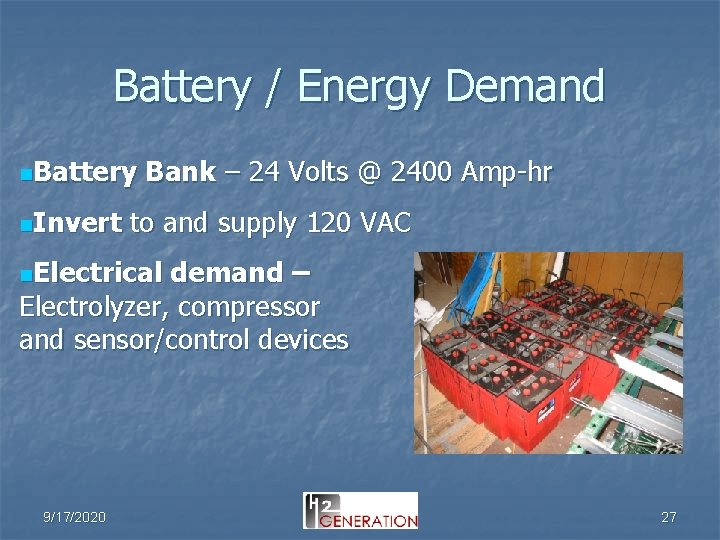
Battery / Energy Demand n. Battery n. Invert Bank – 24 Volts @ 2400 Amp-hr to and supply 120 VAC n. Electrical demand – Electrolyzer, compressor and sensor/control devices 9/17/2020 27
Precipitation Availability n. Area of collection: Roof of “Solar Shack” n. Precipitation averages include over 30 years of data ØOver 10, 000 gallons of water will fall upon the “Solar Shack” Roof. ØRecall: an estimate of 40 gallons required ØEven with evaporation and snow loss, we will have a large excess 9/17/2020 28
Analysis n Ø Ø Ø Thermodynamic Worst Efficiency: Air Compressor ~37% Simulation Using Solar Data from 2000 in Microsoft Excel Neglecting wind power input (~1. 5%) Calculates volume of hydrogen the system could have produced each month Simulation Results Energy collected: 9, 378 k. Wh 133, 965 gallons of H 2 @ STP ~ 1700 miles traveled by theoretical racecar 9/17/2020 29
Working Hours n Total Team Hours: 586 hours n Average teammate hours: 146. 5 hours 9/17/2020 30
Conclusion n H 2 Generation completed deliverables: Ø Specified Design Thermo Dynamic Analysis Computer Simulation Demonstration of concept model n H 2 Generation will soon be completing: Ø Final Report: May 2 nd Ø Ø Ø n Ø Future Recommendations: Improved Hydrogen Compressor 9/17/2020 31
Acknowledgements H 2 Generation sends thanks to: n n n Dr. Thomas Acker, NAU CET Rob Slack, RERC Bill Young, Bill Young Designs & Hobbies Dr. Earl Duque, NAU CET Dr. David Hartman, NAU CET 9/17/2020 32
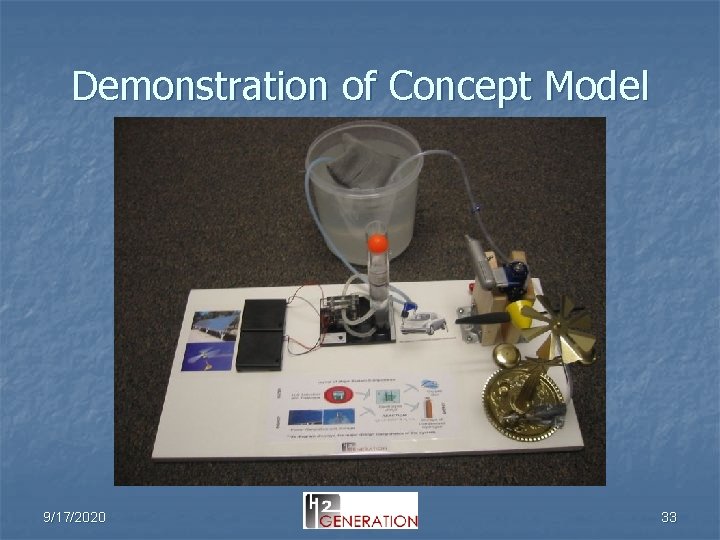
Demonstration of Concept Model 9/17/2020 33

Questions or Comments? http: //www. cet. nau. edu/Academic/Design/D 4 P/ EGR 486/ME/02 -Projects/h 2 gas/index. html 9/17/2020 34
- Slides: 34