
Renee Fife MSN CPNP Associate Clinical Professor Purdue
- Slides: 34
+ Renee Fife, MSN, CPNP Associate Clinical Professor Purdue University Northwest Pediatric Respiratory Infections: When are antibiotics indicated?
+ Antibiotic Resistance is Rising: Regional Trends
+ Antibiotic Prescribing Rates
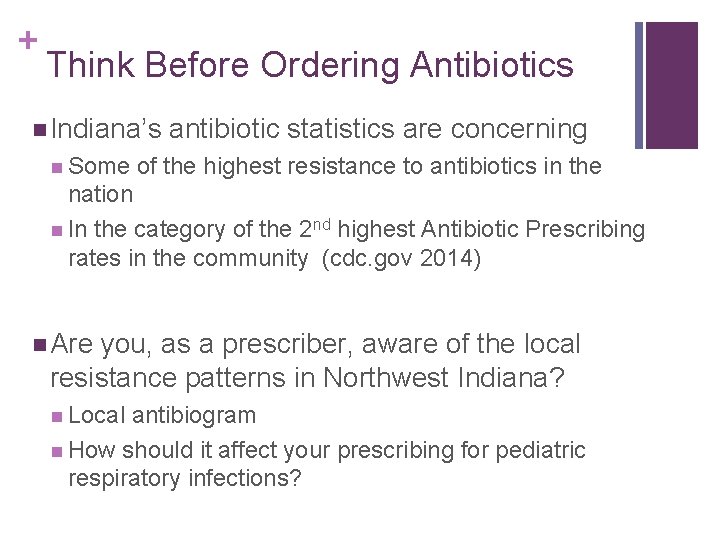
+ Think Before Ordering Antibiotics Indiana’s Some antibiotic statistics are concerning of the highest resistance to antibiotics in the nation In the category of the 2 nd highest Antibiotic Prescribing rates in the community (cdc. gov 2014) Are you, as a prescriber, aware of the local resistance patterns in Northwest Indiana? Local antibiogram How should it affect your prescribing for pediatric respiratory infections?
+ Local Antibiogram
+ Guideline Based Care for Pediatric Respiratory Illnesses Asthma/allergy use of antibiotics for Bronchitis Acute No antibiotics for Bronchiolitis Influenza Judicious Otitis Media Sinusitis GABS Pharyngitis URI/nasopharyngitis Upper Respiratory Pathogens • Streptococcus pneumoniae • Nontypeable Haemophilus influenzae • Moraxella catarrhalis
+ Acute Otitis Media (AOM) Description Acute infection of the middle ear Requires 3 components 1. Recent abrupt onset of signs & symptoms 2. MEE confirmed with pneumatic otoscopy 3. Middle ear inflammation visualized or otalgia that is interfering with activities, including sleep History Sudden, occurring with other signs of illness High fever to 104 F Complaints of feeling ill Pain in the ear (pulling at ear) Sudden hearing loss in the verbal child Vomiting/diarrhea Otorrhea
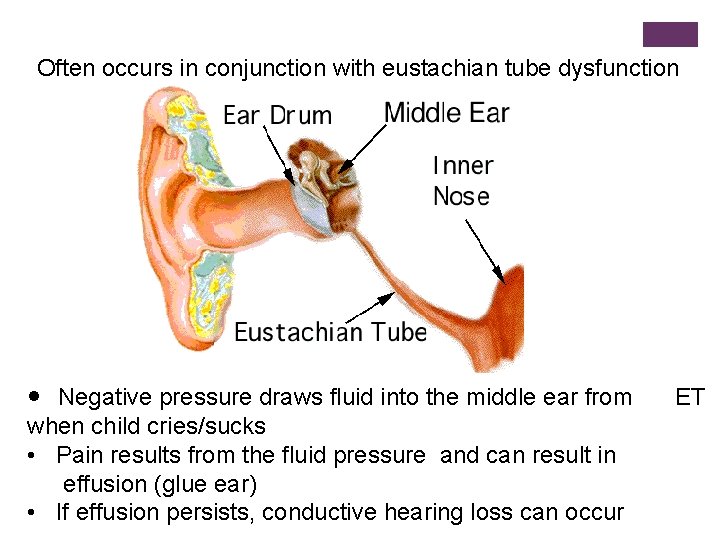
Often occurs in conjunction with eustachian tube dysfunction • Negative pressure draws fluid into the middle ear from when child cries/sucks • Pain results from the fluid pressure and can result in effusion (glue ear) • If effusion persists, conductive hearing loss can occur ET
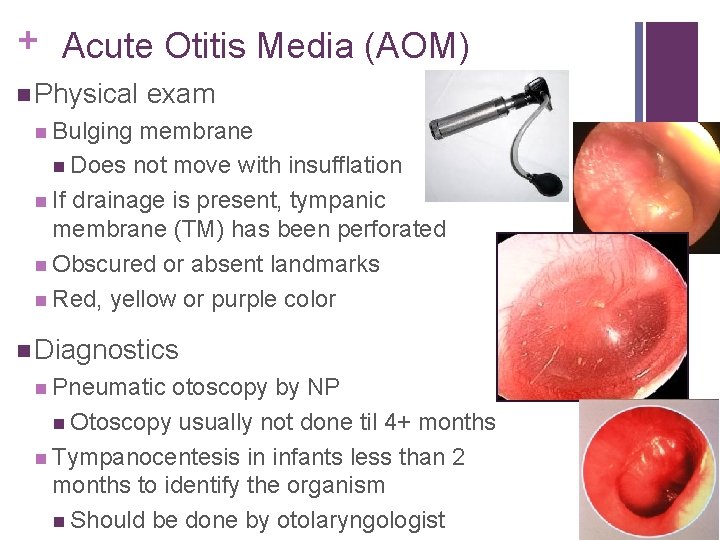
+ Acute Otitis Media (AOM) Physical exam Bulging membrane Does not move with insufflation If drainage is present, tympanic membrane (TM) has been perforated Obscured or absent landmarks Red, yellow or purple color Diagnostics Pneumatic otoscopy by NP Otoscopy usually not done til 4+ months Tympanocentesis in infants less than 2 months to identify the organism Should be done by otolaryngologist
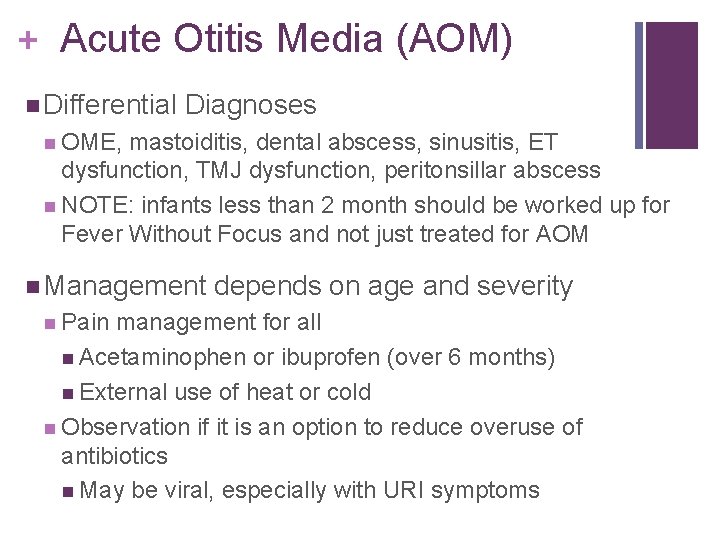
+ Acute Otitis Media (AOM) Differential Diagnoses OME, mastoiditis, dental abscess, sinusitis, ET dysfunction, TMJ dysfunction, peritonsillar abscess NOTE: infants less than 2 month should be worked up for Fever Without Focus and not just treated for AOM Management Pain depends on age and severity management for all Acetaminophen or ibuprofen (over 6 months) External use of heat or cold Observation if it is an option to reduce overuse of antibiotics May be viral, especially with URI symptoms
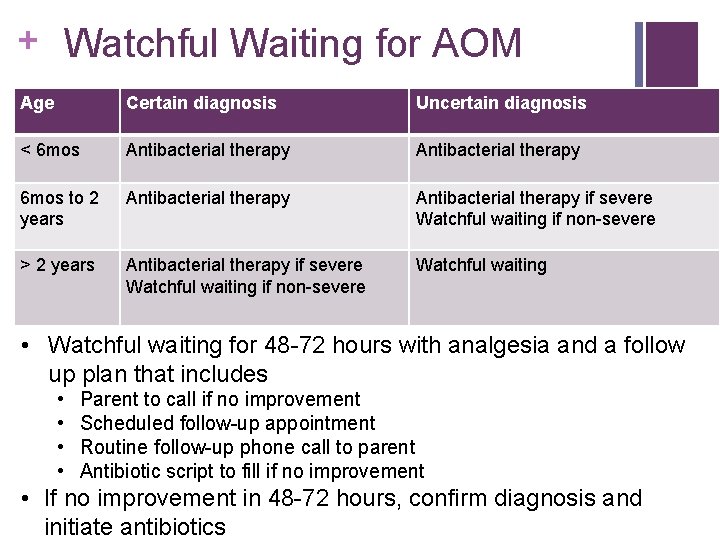
+ Watchful Waiting for AOM Age Certain diagnosis Uncertain diagnosis < 6 mos Antibacterial therapy 6 mos to 2 years Antibacterial therapy if severe Watchful waiting if non-severe > 2 years Antibacterial therapy if severe Watchful waiting if non-severe Watchful waiting • Watchful waiting for 48 -72 hours with analgesia and a follow up plan that includes • • Parent to call if no improvement Scheduled follow-up appointment Routine follow-up phone call to parent Antibiotic script to fill if no improvement • If no improvement in 48 -72 hours, confirm diagnosis and initiate antibiotics
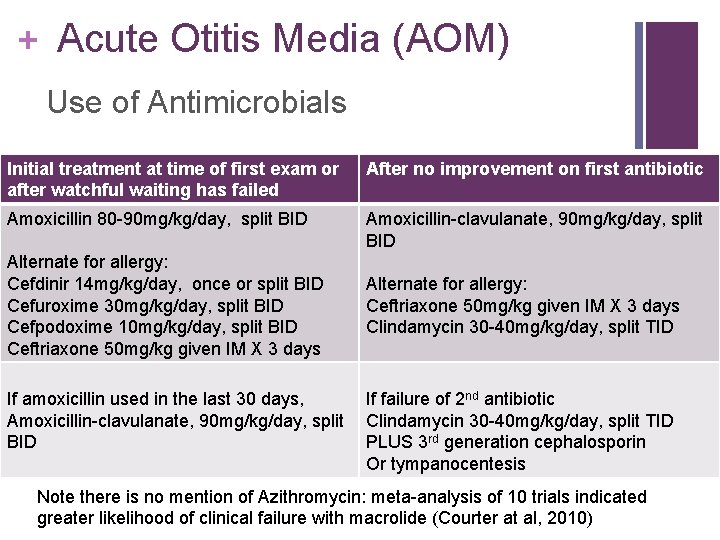
+ Acute Otitis Media (AOM) Use of Antimicrobials Initial treatment at time of first exam or after watchful waiting has failed After no improvement on first antibiotic Amoxicillin 80 -90 mg/kg/day, split BID Amoxicillin-clavulanate, 90 mg/kg/day, split BID Alternate for allergy: Cefdinir 14 mg/kg/day, once or split BID Cefuroxime 30 mg/kg/day, split BID Cefpodoxime 10 mg/kg/day, split BID Ceftriaxone 50 mg/kg given IM X 3 days If amoxicillin used in the last 30 days, Amoxicillin-clavulanate, 90 mg/kg/day, split BID Alternate for allergy: Ceftriaxone 50 mg/kg given IM X 3 days Clindamycin 30 -40 mg/kg/day, split TID If failure of 2 nd antibiotic Clindamycin 30 -40 mg/kg/day, split TID PLUS 3 rd generation cephalosporin Or tympanocentesis Note there is no mention of Azithromycin: meta-analysis of 10 trials indicated greater likelihood of clinical failure with macrolide (Courter at al, 2010)
+ Penicillin Allergy and Cephalosporins There is often concern about ordering a cephalosporin if the patient claims to have an allergy to Penicillin Terico and Gallagher (2014) Reviewed literature from 1950 to 2013 Cross reactivity was less than 5% Campagna et al (2012) Review Overall cross reactivity rate was about 1%
+ Allergies and Antibiotics True Allergy, Type 1, Ig. E-mediated, to Penicillin products is over-reported About 10% of patients report an allergy Only about 1% will have a true allergy These may lose sensitivity after 10 years It is recommended that allergies be confirmed by an allergist This can decrease the use of broad spectrum antibiotics Only 1 -5% of children with a true Penicillin allergy will also be allergic to cephalosporins www. cdc. gov/getsmart
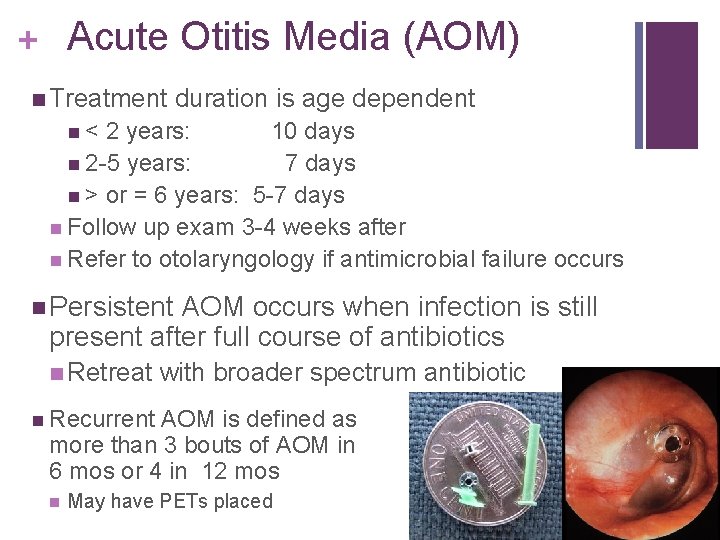
+ Acute Otitis Media (AOM) Treatment duration is age dependent < 2 years: 10 days 2 -5 years: 7 days > or = 6 years: 5 -7 days Follow up exam 3 -4 weeks after Refer to otolaryngology if antimicrobial failure occurs Persistent AOM occurs when infection is still present after full course of antibiotics Retreat with broader spectrum antibiotic Recurrent AOM is defined as more than 3 bouts of AOM in 6 mos or 4 in 12 mos May have PETs placed
+ Acute Otitis Media (AOM) Prevention of AOM Prevnar 13 immunization (pneumococcal AOM) Attend day care with smaller enrollment Annual Flu vaccine if >6 month old (2 shot series for first ) Xylitol chewing gum, 5 -6 sticks per day Bacteriostatic effects against S. pneumoniae Exclusive Breastfeeding for the first 6 months (Ig’s) Avoid feeding the infant while lying down Avoid passive smoke
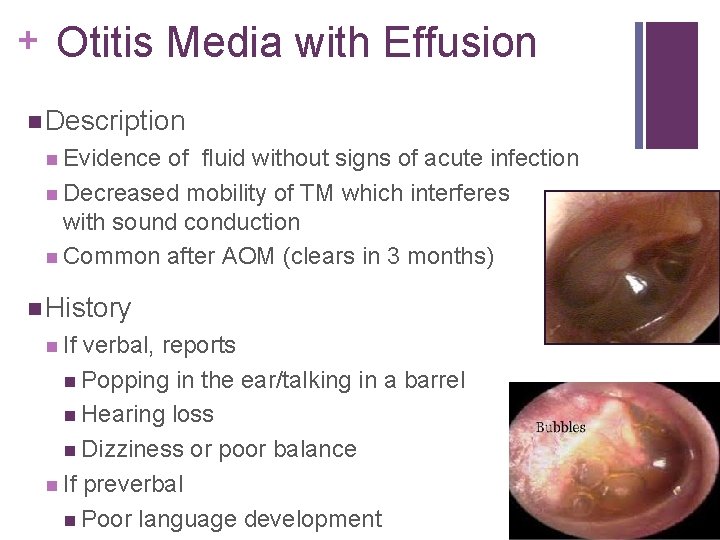
+ Otitis Media with Effusion Description Evidence of fluid without signs of acute infection Decreased mobility of TM which interferes with sound conduction Common after AOM (clears in 3 months) History If verbal, reports Popping in the ear/talking in a barrel Hearing loss Dizziness or poor balance If preverbal Poor language development
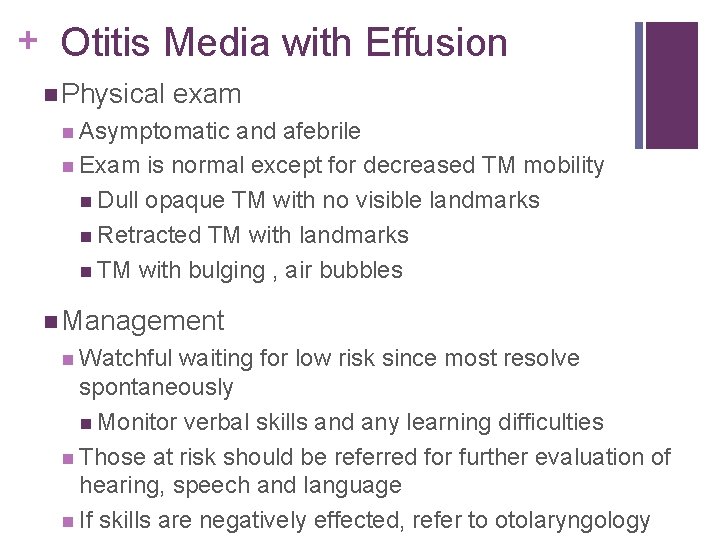
+ Otitis Media with Effusion Physical exam Asymptomatic and afebrile Exam is normal except for decreased TM mobility Dull opaque TM with no visible landmarks Retracted TM with landmarks TM with bulging , air bubbles Management Watchful waiting for low risk since most resolve spontaneously Monitor verbal skills and any learning difficulties Those at risk should be referred for further evaluation of hearing, speech and language If skills are negatively effected, refer to otolaryngology
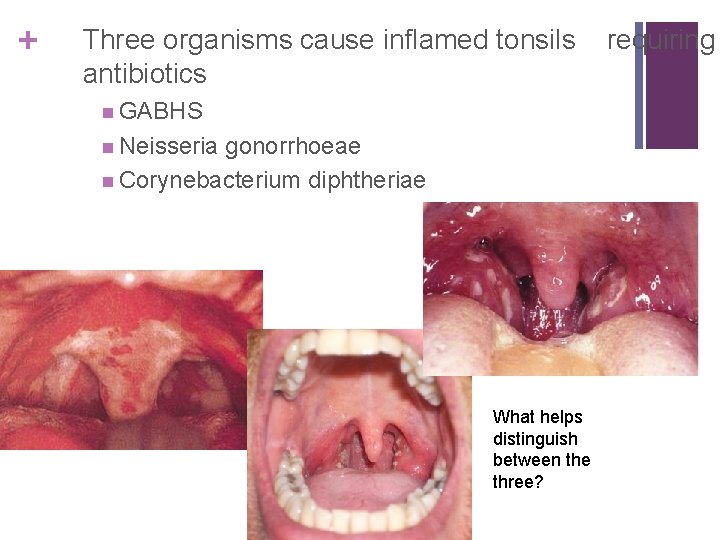
+ Three organisms cause inflamed tonsils antibiotics GABHS Neisseria gonorrhoeae Corynebacterium diphtheriae What helps distinguish between the three? requiring
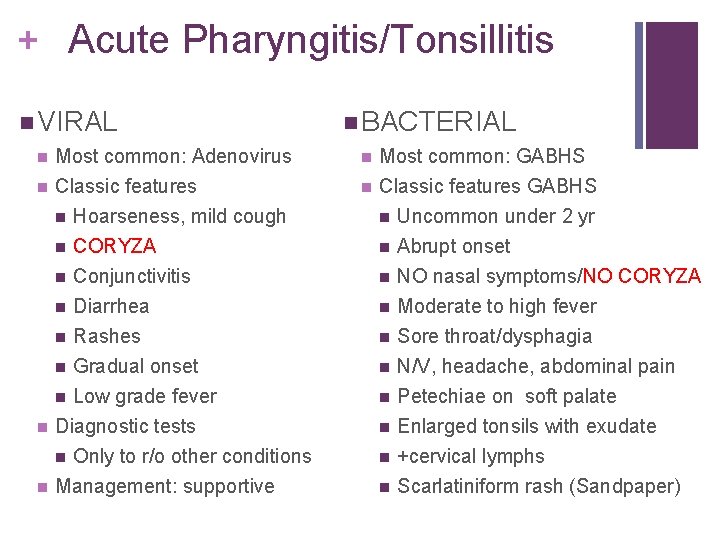
+ Acute Pharyngitis/Tonsillitis VIRAL BACTERIAL Most common: Adenovirus Most common: GABHS Classic features Hoarseness, mild cough CORYZA Conjunctivitis Diarrhea Rashes Gradual onset Low grade fever Diagnostic tests Only to r/o other conditions Management: supportive Classic features GABHS Uncommon under 2 yr Abrupt onset NO nasal symptoms/NO CORYZA Moderate to high fever Sore throat/dysphagia N/V, headache, abdominal pain Petechiae on soft palate Enlarged tonsils with exudate +cervical lymphs Scarlatiniform rash (Sandpaper)
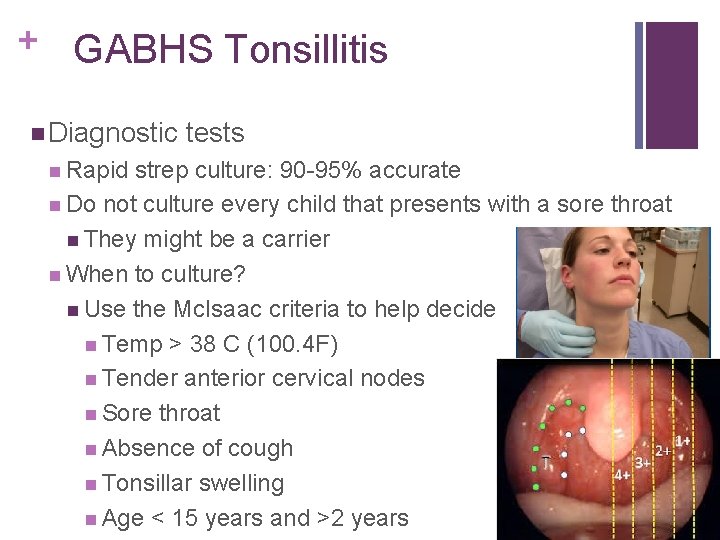
+ GABHS Tonsillitis Diagnostic Rapid tests strep culture: 90 -95% accurate Do not culture every child that presents with a sore throat They might be a carrier When to culture? Use the Mc. Isaac criteria to help decide Temp > 38 C (100. 4 F) Tender anterior cervical nodes Sore throat Absence of cough Tonsillar swelling Age < 15 years and >2 years
+ GABHS Tonsillitis Interpreting rapid strep results If result is negative but has + symptoms, plate it If positive, treat but remember they could be a carrier Other possible lab Antistreptolysin O titer (ASO) Confirms past GABHS infection Confirmed diagnosis is important for treatment Prevent complications (RF or PSGN) Prevent horizontal transmission
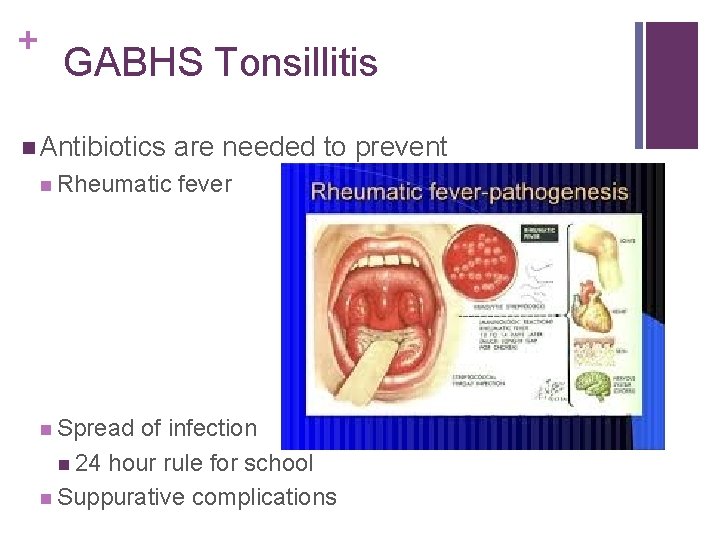
+ GABHS Tonsillitis Antibiotics Rheumatic Spread are needed to prevent fever of infection 24 hour rule for school Suppurative complications
+ GABHS Treatment Penicillin PO: 250 mg BID if <27 kg or 500 mg BID if >27 kg IM: single dose 600, 000 units <27 kg or 1. 2 million >27 kg Amoxicillin, 50 mg/kg/day for 10 days Single daily dose Maximum 1, 000 mg Cephalexin (Keflex) 40 -50 mg/kg/day, split BID Maximum Cefadroxil 500 mg BID (Duricef) 30 mg/kg/day Maximum 1 gram
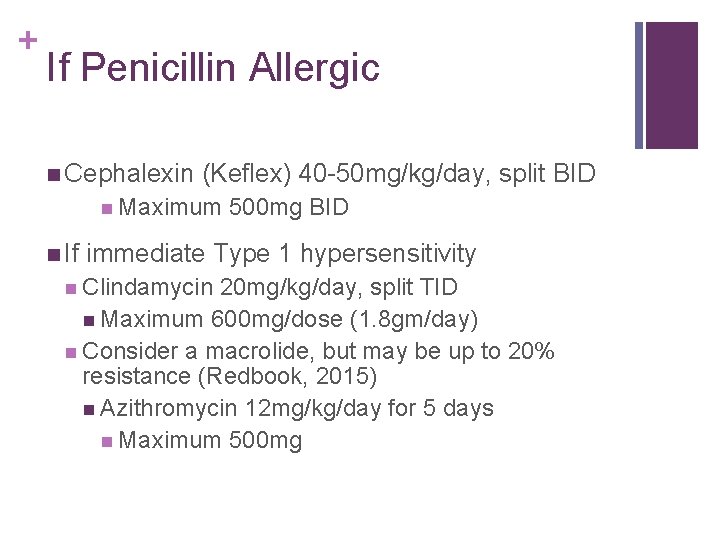
+ If Penicillin Allergic Cephalexin (Keflex) 40 -50 mg/kg/day, split BID Maximum If 500 mg BID immediate Type 1 hypersensitivity Clindamycin 20 mg/kg/day, split TID Maximum 600 mg/dose (1. 8 gm/day) Consider a macrolide, but may be up to 20% resistance (Redbook, 2015) Azithromycin 12 mg/kg/day for 5 days Maximum 500 mg
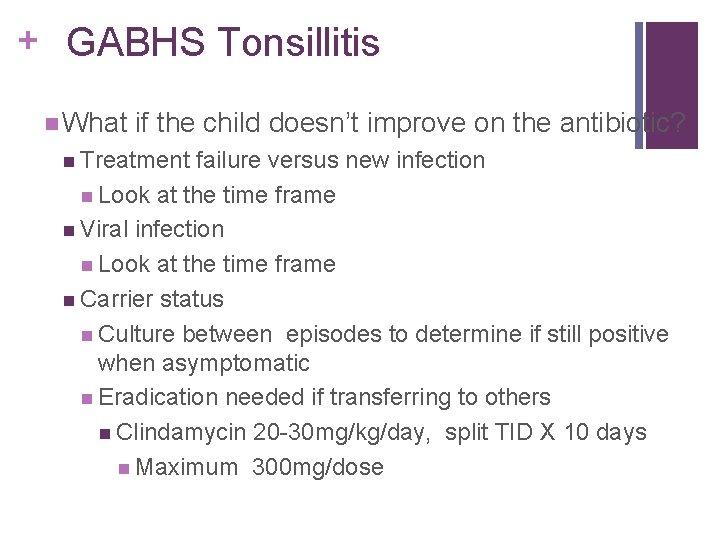
+ GABHS Tonsillitis What if the child doesn’t improve on the antibiotic? Treatment failure versus new infection Look at the time frame Viral infection Look at the time frame Carrier status Culture between episodes to determine if still positive when asymptomatic Eradication needed if transferring to others Clindamycin 20 -30 mg/kg/day, split TID X 10 days Maximum 300 mg/dose
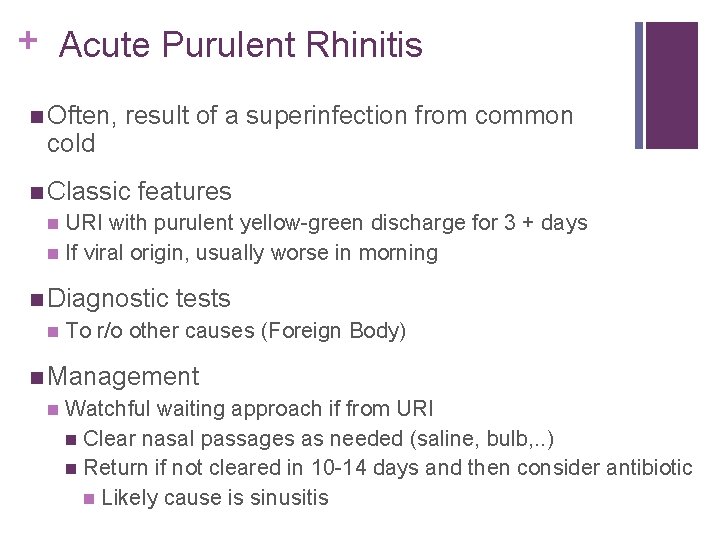
+ Acute Purulent Rhinitis Often, cold result of a superinfection from common Classic features URI with purulent yellow-green discharge for 3 + days If viral origin, usually worse in morning Diagnostic tests To r/o other causes (Foreign Body) Management Watchful waiting approach if from URI Clear nasal passages as needed (saline, bulb, . . ) Return if not cleared in 10 -14 days and then consider antibiotic Likely cause is sinusitis
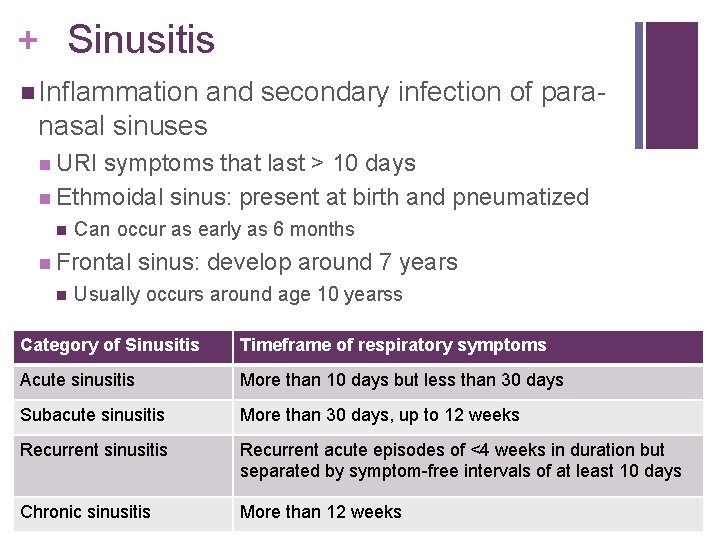
+ Sinusitis Inflammation and secondary infection of paranasal sinuses URI symptoms that last > 10 days Ethmoidal sinus: present at birth and pneumatized Can occur as early as 6 months Frontal sinus: develop around 7 years Usually occurs around age 10 yearss Category of Sinusitis Timeframe of respiratory symptoms Acute sinusitis More than 10 days but less than 30 days Subacute sinusitis More than 30 days, up to 12 weeks Recurrent sinusitis Recurrent acute episodes of <4 weeks in duration but separated by symptom-free intervals of at least 10 days Chronic sinusitis More than 12 weeks
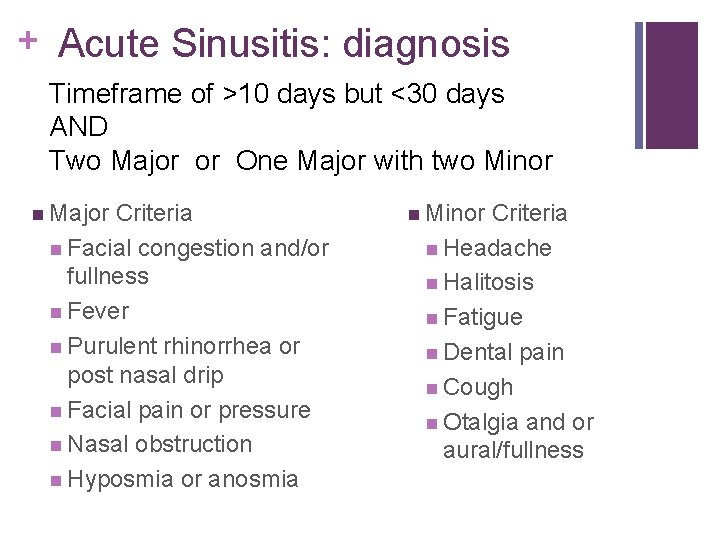
+ Acute Sinusitis: diagnosis Timeframe of >10 days but <30 days AND Two Major or One Major with two Minor Major Criteria Facial congestion and/or fullness Fever Purulent rhinorrhea or post nasal drip Facial pain or pressure Nasal obstruction Hyposmia or anosmia Minor Criteria Headache Halitosis Fatigue Dental pain Cough Otalgia and or aural/fullness
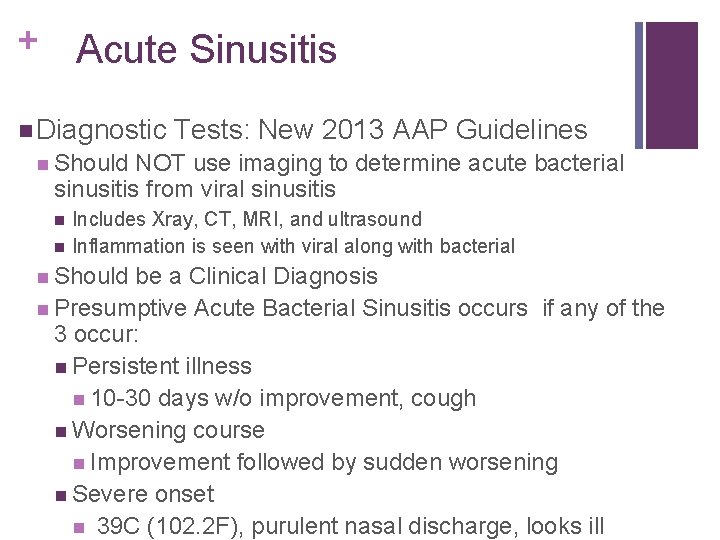
+ Acute Sinusitis Diagnostic Tests: New 2013 AAP Guidelines Should NOT use imaging to determine acute bacterial sinusitis from viral sinusitis Includes Xray, CT, MRI, and ultrasound Inflammation is seen with viral along with bacterial Should be a Clinical Diagnosis Presumptive Acute Bacterial Sinusitis occurs if any of the 3 occur: Persistent illness 10 -30 days w/o improvement, cough Worsening course Improvement followed by sudden worsening Severe onset 39 C (102. 2 F), purulent nasal discharge, looks ill
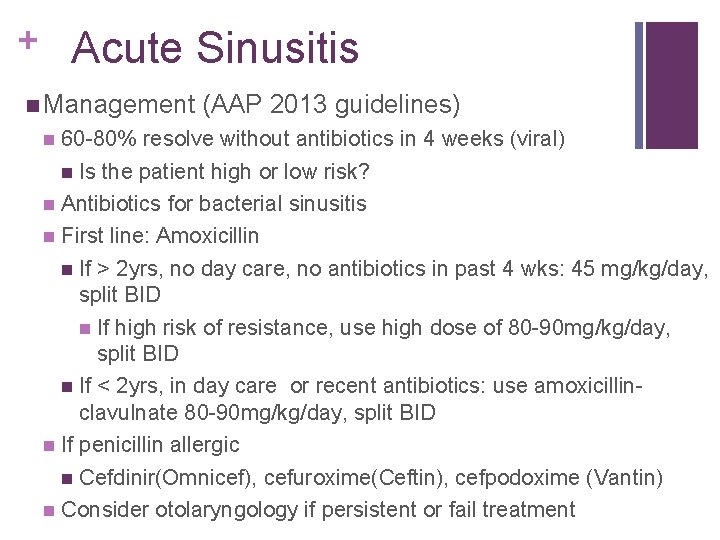
+ Acute Sinusitis Management (AAP 2013 guidelines) 60 -80% resolve without antibiotics in 4 weeks (viral) Is the patient high or low risk? Antibiotics for bacterial sinusitis First line: Amoxicillin If > 2 yrs, no day care, no antibiotics in past 4 wks: 45 mg/kg/day, split BID If high risk of resistance, use high dose of 80 -90 mg/kg/day, split BID If < 2 yrs, in day care or recent antibiotics: use amoxicillinclavulnate 80 -90 mg/kg/day, split BID If penicillin allergic Cefdinir(Omnicef), cefuroxime(Ceftin), cefpodoxime (Vantin) Consider otolaryngology if persistent or fail treatment
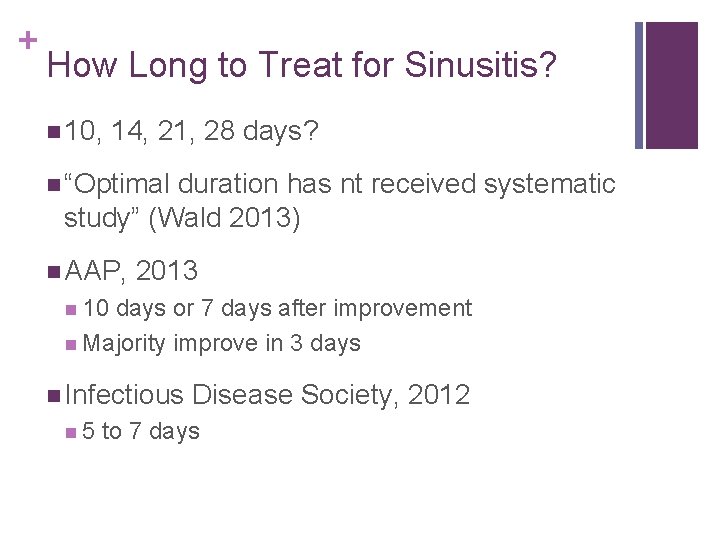
+ How Long to Treat for Sinusitis? 10, 14, 21, 28 days? “Optimal duration has nt received systematic study” (Wald 2013) AAP, 2013 10 days or 7 days after improvement Majority improve in 3 days Infectious 5 Disease Society, 2012 to 7 days
+ Additional Sinusitis Care Remember Saline to include nasal spray or drops Liquifies secretions Decreases crusting near the sinus ostia Topical decongestants Decreases tissue edema and nasal resistance Enhances drainage of secretions from sinus ostia Corticosteroids Helpful in chronic sinusitis or concurrent allergic rhinitis No evidence for acute sinusitis
+ Antibiotic Stewardship in Outpatient Prescribing Know the organism Know the resistance in your area Display Track a Commitment in the office prescribing in the practice Educate the patient/parent about the harms of antibiotic treatment