
Renaming Dan Alistarh EPFL LPD The Renaming Problem

Renaming Dan Alistarh EPFL LPD
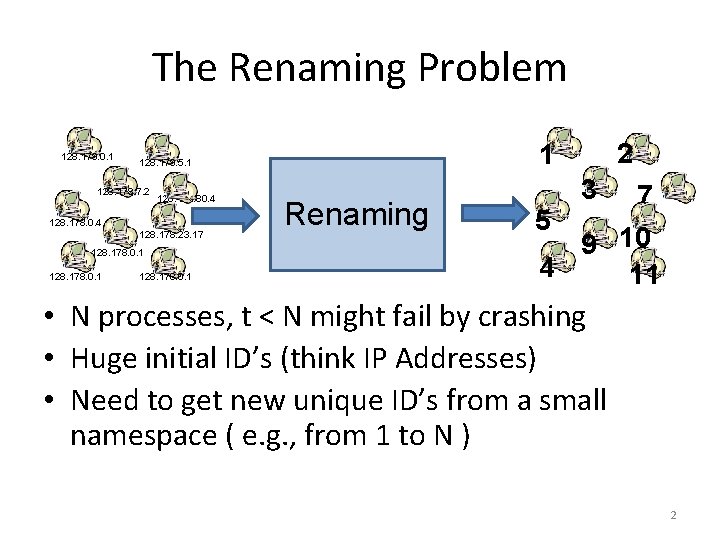
The Renaming Problem 128. 178. 0. 1 128. 178. 7. 2 128. 178. 80. 4 128. 178. 23. 17 128. 178. 0. 1 2 1 128. 178. 5. 1 Renaming 3 7 5 9 10 4 11 • N processes, t < N might fail by crashing • Huge initial ID’s (think IP Addresses) • Need to get new unique ID’s from a small namespace ( e. g. , from 1 to N ) 2
How about Shared Memory? Example: UNIX process ID’s • Are given sequentially from 1 to MAX_PID (default 32768) • They wrap around, and are designed to be unpredictable • Commonly, shared-memory processes get random id’s from 1 to 32767 • …so renaming is also relevant in shared memory 3
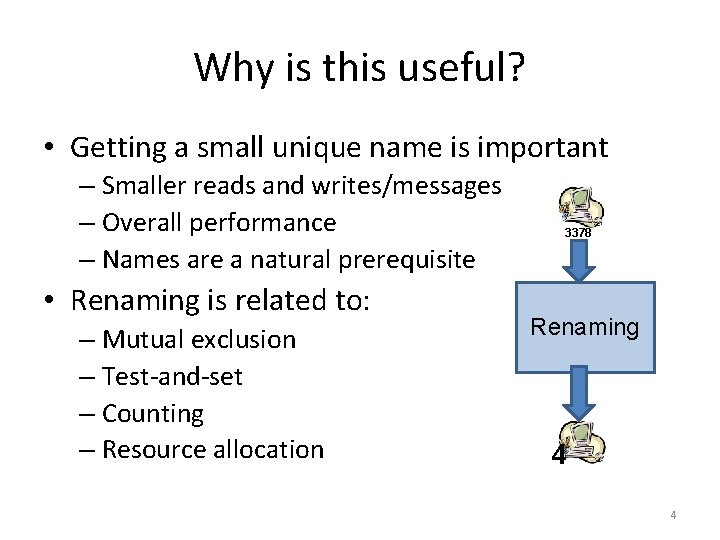
Why is this useful? • Getting a small unique name is important – Smaller reads and writes/messages – Overall performance – Names are a natural prerequisite • Renaming is related to: – Mutual exclusion – Test-and-set – Counting – Resource allocation 3378 Renaming 4 4
![Two versions • “Standard” renaming [Attiya et al. ] – N = max. number](http://slidetodoc.com/presentation_image_h/f714d05fcc3b571042bb47d9e44d013a/image-5.jpg "Two versions • “Standard” renaming [Attiya et al. ] – N = max. number")
Two versions • “Standard” renaming [Attiya et al. ] – N = max. number of processes that may participate concurrently – N is known in advance – Target namespace of size f(N) • Adaptive renaming [Moir et al. ] – k is the number of processes that actually participate (contention) – k is unknown – Namespace size and performance should be f(k) 5
Renaming specification • N processes start with unique identifiers from 1 to Y • t < N processes may fail by crashing • Read-write shared memory (MWMR atomic) Properties 1. Termination: Every non-faulty process returns an integer yi 2. Uniqueness: for all processes pi and pj, yi ≠ yj 3. Namespace: the minimal M such that all outputs yi are in [1, 2, …, M] in all executions. Objective: we want to minimize the size of the resulting namespace. 6
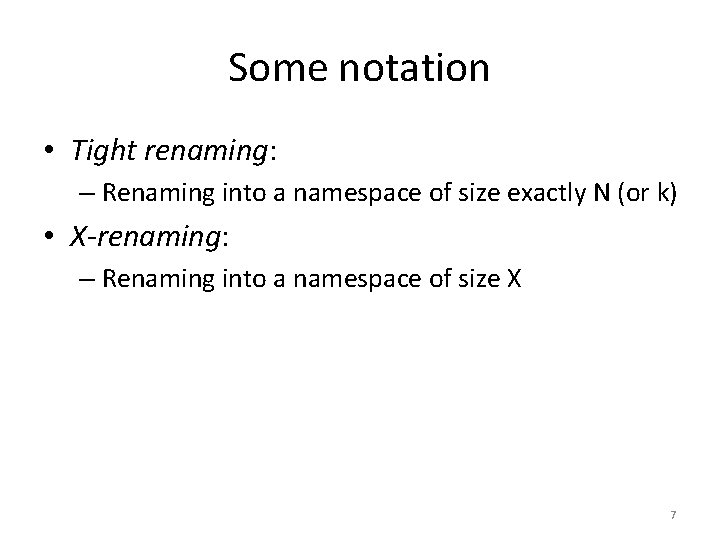
Some notation • Tight renaming: – Renaming into a namespace of size exactly N (or k) • X-renaming: – Renaming into a namespace of size X 7
The plan for today • Renaming definition • Renaming algorithms – (2 n – 1)-renaming algorithm – Can we do better? – Adaptive O(k 2)-renaming algorithm • Renaming versus test-and-set – Consensus number 8
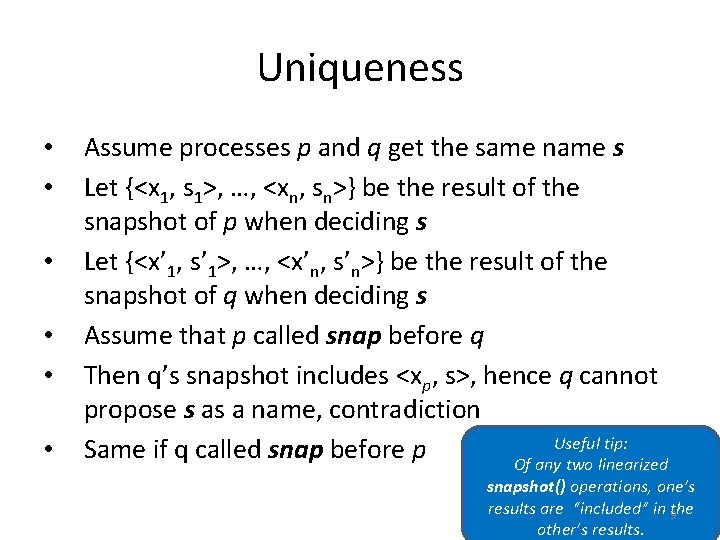
Uniqueness • • • Assume processes p and q get the same name s Let {<x 1, s 1>, …, <xn, sn>} be the result of the snapshot of p when deciding s Let {<x’ 1, s’ 1>, …, <x’n, s’n>} be the result of the snapshot of q when deciding s Assume that p called snap before q Then q’s snapshot includes <xp, s>, hence q cannot propose s as a name, contradiction Useful tip: Same if q called snap before p Of any two linearized snapshot() operations, one’s results are “included” in the 9 other’s results.
![(2 n-1)-renaming Shared: array of registers R[1…Y] each register in R has two components](http://slidetodoc.com/presentation_image_h/f714d05fcc3b571042bb47d9e44d013a/image-10.jpg "(2 n-1)-renaming Shared: array of registers R[1…Y] each register in R has two components")
(2 n-1)-renaming Shared: array of registers R[1…Y] each register in R has two components <x, s> //general structure: procedure get. Name (x) while(true) s← 1 // suggested name try name s while( true ) if ( clash ) s ← new proposal R[x] ← <x, s> else return s (<x 1, s 1>, … , <xn, sn>) ← R. snap() if s = sj for some xj ≠ x //there is a name clash r ← rank of x in { xi | xi ≠ empty } s ← rth positive integer not in { si | i ≠ x xi ≠ empty } else //no clash return s 10
![Namespace size Shared: array of registers R[1…Y] each register in R has two components](http://slidetodoc.com/presentation_image_h/f714d05fcc3b571042bb47d9e44d013a/image-11.jpg "Namespace size Shared: array of registers R[1…Y] each register in R has two components")
Namespace size Shared: array of registers R[1…Y] each register in R has two components <x, s> procedure get. Name (x) s← 1 // suggested name while( true ) R[x] ← <x, s> (<x 1, s 1>, … , <xn, sn>) ← R. snap() if s = sj for some xj ≠ x //there is a name clash r ← rank of x in { xi | xi ≠ empty } s ← rth positive integer not in { si | i ≠ x, xi ≠ empty } else //no clash return s • Claim: y < 2 n in all executions • Step 1: Notice that r≤n • Step 2: Notice that s ≤ r + # proposals made in this “round” – 1 < 2 n • q. e. d. 11
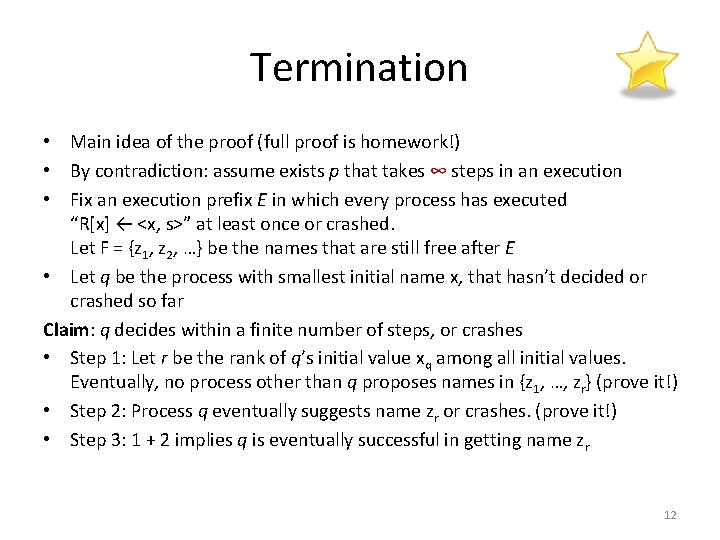
Termination • Main idea of the proof (full proof is homework!) • By contradiction: assume exists p that takes ∞ steps in an execution • Fix an execution prefix E in which every process has executed “R[x] ← <x, s>” at least once or crashed. Let F = {z 1, z 2, …} be the names that are still free after E • Let q be the process with smallest initial name x, that hasn’t decided or crashed so far Claim: q decides within a finite number of steps, or crashes • Step 1: Let r be the rank of q’s initial value xq among all initial values. Eventually, no process other than q proposes names in {z 1, …, zr} (prove it!) • Step 2: Process q eventually suggests name zr or crashes. (prove it!) • Step 3: 1 + 2 implies q is eventually successful in getting name zr 12
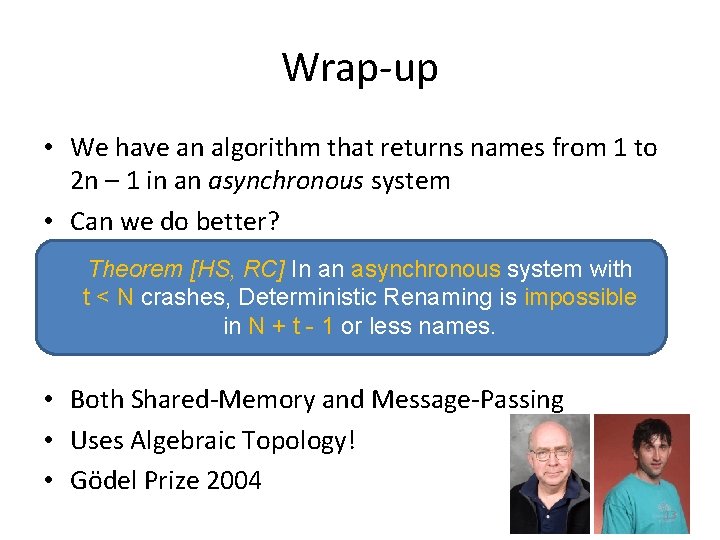
Wrap-up • We have an algorithm that returns names from 1 to 2 n – 1 in an asynchronous system • Can we do better? Theorem [HS, RC] In an asynchronous system with t < N crashes, Deterministic Renaming is impossible in N + t - 1 or less names. • Both Shared-Memory and Message-Passing • Uses Algebraic Topology! • Gödel Prize 2004 13
There’s a problem • In the previous algorithm, the size of the proposal array R[ ] is Θ(Y)! – Huge memory cost – Huge complexity for the snap() operation • We need to make the size of the array depend on k = the number of participating processes • An application of adaptive renaming 14
An adaptive renaming algorithm • Each process starts with a unique initial name from 1 to Y • Will return an integer y from 1 to k 2 • k is the contention in the current execution, i. e. the number of active processes in the execution 15
![The splitter [Moir & Anderson, 1995] k processes stop ≤ 1 process left right](http://slidetodoc.com/presentation_image_h/f714d05fcc3b571042bb47d9e44d013a/image-16.jpg "The splitter [Moir & Anderson, 1995] k processes stop ≤ 1 process left right")
The splitter [Moir & Anderson, 1995] k processes stop ≤ 1 process left right ≤ k-1 processes Solo-winner: A process stops if it is alone in the splitter. 16
![Splitter Implementation [Moir & Anderson, 1995][Lamport, 1986] 1. X = idi // write your](http://slidetodoc.com/presentation_image_h/f714d05fcc3b571042bb47d9e44d013a/image-17.jpg "Splitter Implementation [Moir & Anderson, 1995][Lamport, 1986] 1. X = idi // write your")
Splitter Implementation [Moir & Anderson, 1995][Lamport, 1986] 1. X = idi // write your identifier 2. if Y then return( right ) 3. Y = true 4. if ( X == idi ) // check identifier then return( stop ) 5. else return( left ) 17
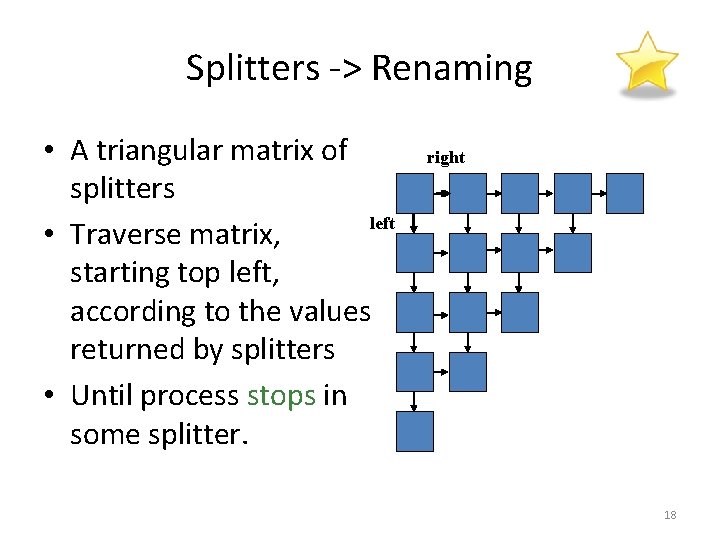
Splitters -> Renaming • A triangular matrix of splitters left • Traverse matrix, starting top left, according to the values returned by splitters • Until process stops in some splitter. right 18
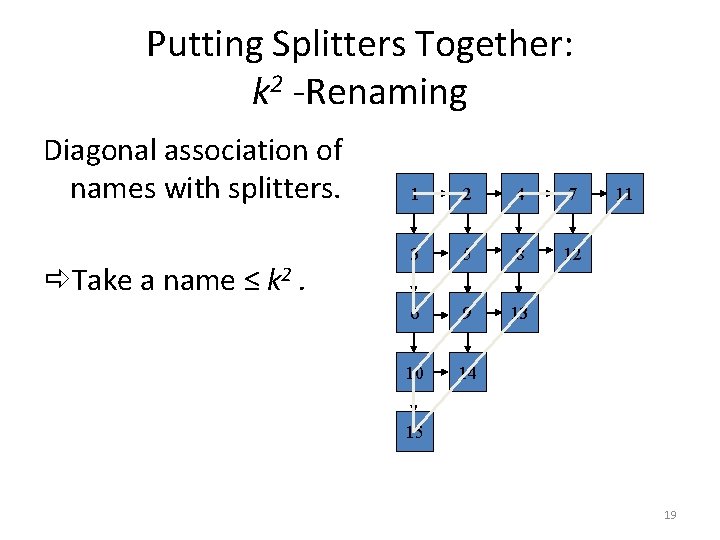
Putting Splitters Together: k 2 -Renaming Diagonal association of names with splitters. Take a name ≤ k 2. 1 2 4 7 3 5 8 12 6 9 13 10 14 11 15 19
Correctness Termination: Every process stops after O(k) read and write steps. – Follows from the solo-winner splitter property Uniqueness: No two processes return the same name. – Since no two processes win the same splitter Namespace size: Every process returns a name between 1 and k 2 / 2. – Follows since no process makes more than k steps. 20
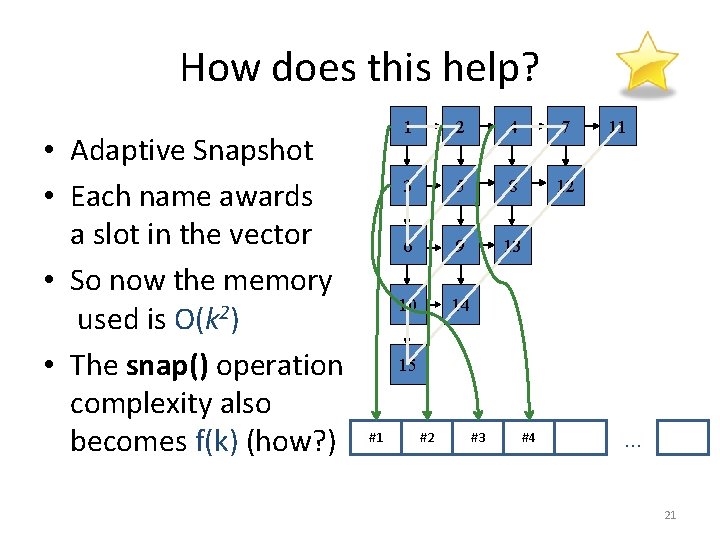
How does this help? • Adaptive Snapshot • Each name awards a slot in the vector • So now the memory used is O(k 2) • The snap() operation complexity also becomes f(k) (how? ) 1 2 4 7 3 5 8 12 6 9 13 10 14 11 15 #1 #2 #3 #4 … 21
The plan for today • Renaming definition • Renaming algorithms – (2 n – 1)-renaming algorithm – Can we do better? – Adaptive O(k 2)-renaming algorithm • Renaming versus test-and-set – Consensus number 22
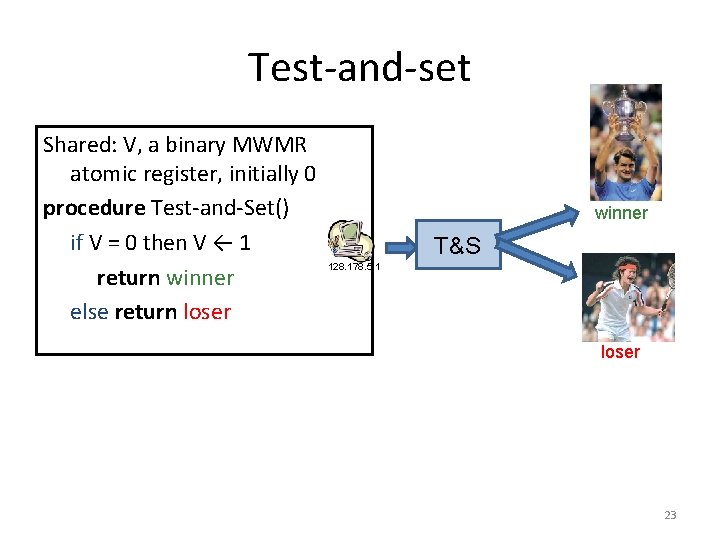
Test-and-set Shared: V, a binary MWMR atomic register, initially 0 procedure Test-and-Set() if V = 0 then V ← 1 return winner else return loser winner T&S 128. 178. 5. 1 loser 23
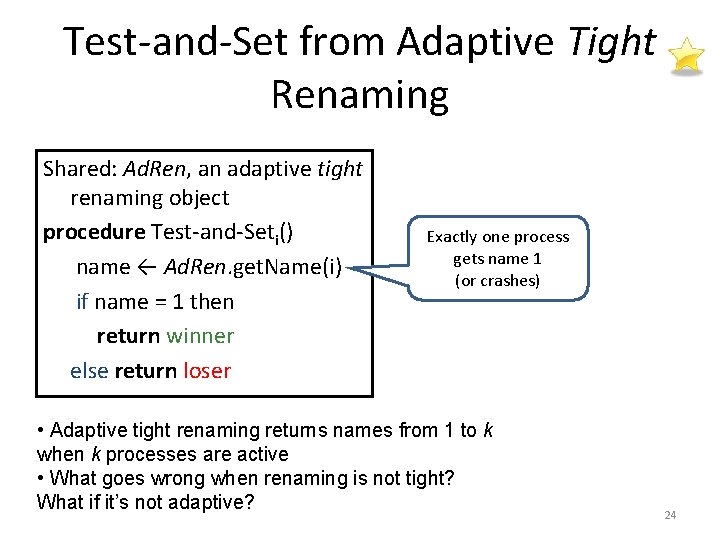
Test-and-Set from Adaptive Tight Renaming Shared: Ad. Ren, an adaptive tight renaming object procedure Test-and-Seti() name ← Ad. Ren. get. Name(i) if name = 1 then return winner else return loser Exactly one process gets name 1 (or crashes) • Adaptive tight renaming returns names from 1 to k when k processes are active • What goes wrong when renaming is not tight? What if it’s not adaptive? 24
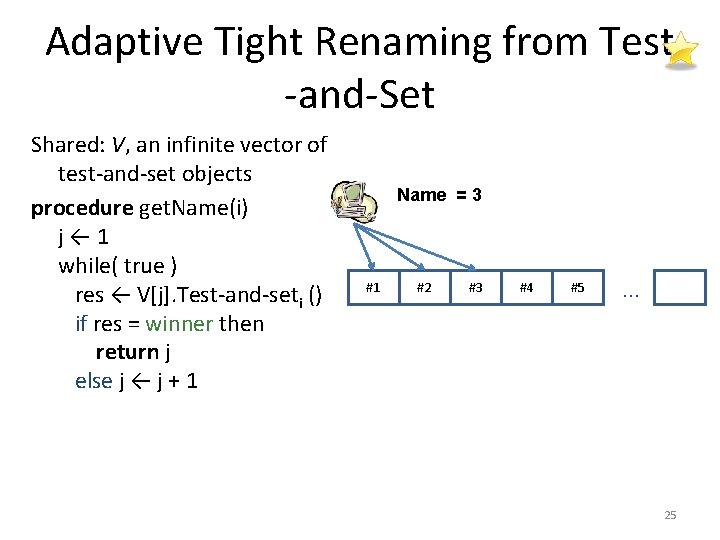
Adaptive Tight Renaming from Test -and-Set Shared: V, an infinite vector of test-and-set objects procedure get. Name(i) j← 1 while( true ) res ← V[j]. Test-and-seti () if res = winner then return j else j ← j + 1 Name = 3 #1 #2 #3 #4 #5 … 25
Tight adaptive renaming • Using read-write registers, tight adaptive renaming is impossible • By Herlihy-Shavit [HS], we can’t even get close to k names! • It all changes when adding test-and-set • How many operations per process does the algorithm have? – We can get O( log k ) operations per process using randomization 26
Consensus number? • Consider adaptive tight renaming • Three steps 1. We can implement it with test-and-set + registers 2. We can implement test-and-set from it 3. Test-and-set has consensus number 2 • Adaptive tight renaming has consensus number 2! • Weaker variants (“standard”) have consensus number ≤ 2 27
References (use Google Scholar) • For definitions + “standard” renaming algorithm – Hagit Attiya, Jennifer Welch: “Distributed Computing”, pages 356 -359 • For topology [HS], see here http: //www. cs. brown. edu/~mph/topology. html • For adaptive renaming – Deterministic – Mark Moir: “Fast, Long-Lived Renaming Improved and Simplified” – Randomized -- Dan Alistarh, Hagit Attiya, Seth Gilbert, Andrei Giurgiu, and Rachid Guerraoui: “Fast Randomized Test-and-Set and Renaming” 28
- Slides: 28