
RENAL SYSTEM ANATOMY AND PHYSIOLOGY PYRAMID POINTS Functions
- Slides: 27
RENAL SYSTEM ANATOMY AND PHYSIOLOGY
PYRAMID POINTS • • Functions of the kidney Functions of the nephron Process of urine formation Maintenance of homeostasis
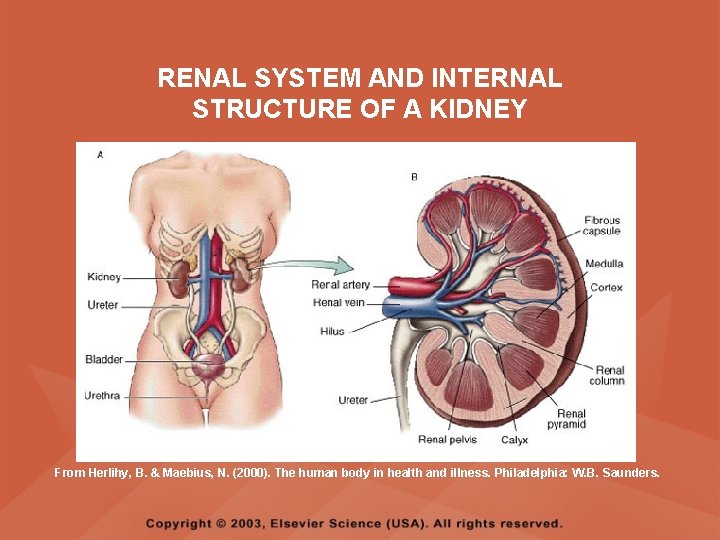
KIDNEYS • There are two; each is attached to the abdominal wall at the level of the last thoracic and first three lumbar vertebrae • Enclosed in the renal capsule • The cortex is the outer layer of the renal capsule • The medulla is surrounded by the cortex • The nephron makes up the functional unit of the kidneys
RENAL SYSTEM AND INTERNAL STRUCTURE OF A KIDNEY From Herlihy, B. & Maebius, N. (2000). The human body in health and illness. Philadelphia: W. B. Saunders.
FUNCTIONS OF KIDNEYS • • Maintain homeostasis of the blood Excrete end-products of body metabolism Control fluid and electrolyte balance Excrete bacterial toxins, water-soluble drugs, and drug metabolites • Secrete renin and erythropoietin, which play a role in the function of the parathyroid hormones and vitamin D
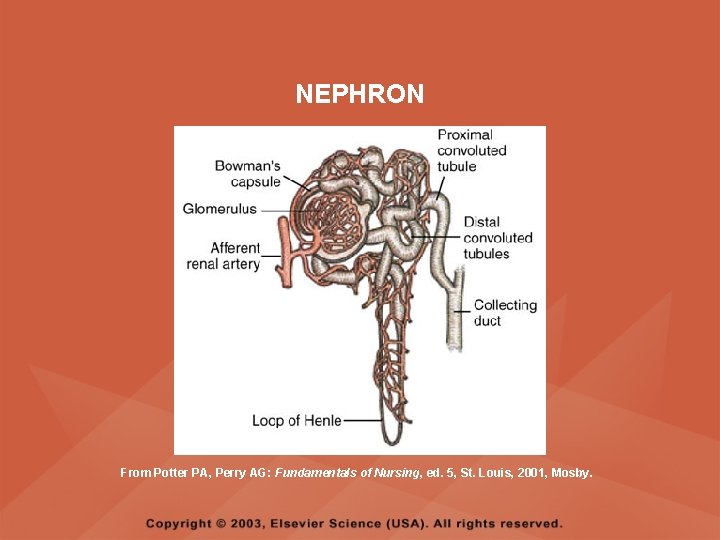
NEPHRON • Functional renal unit • Composed of glomerulus and tubules
NEPHRON From Potter PA, Perry AG: Fundamentals of Nursing, ed. 5, St. Louis, 2001, Mosby.
GLOMERULUS • Is encased in Bowman’s capsule • Filters the fluid out of blood
TUBULES • Include proximal, distal, and Henle’s loop • Fluid is converted to urine in the tubules and then the urine moves to the pelvis of the kidney • The urine flows from the pelvis of the kidney through the ureter, and empties into bladder
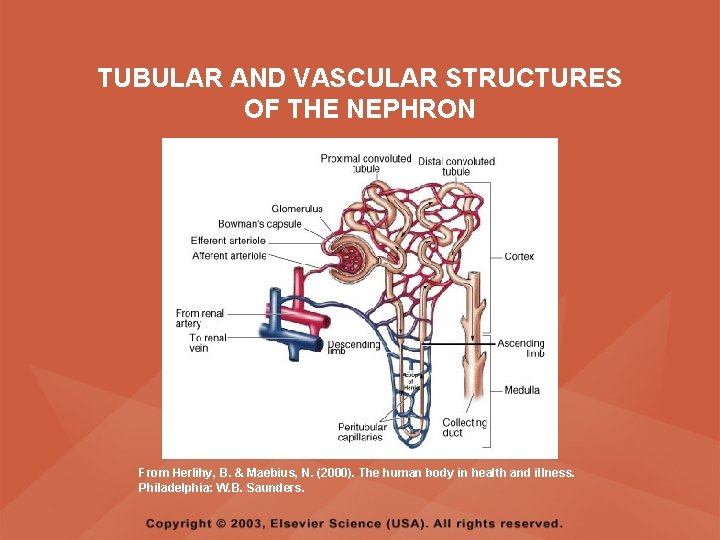
TUBULAR AND VASCULAR STRUCTURES OF THE NEPHRON From Herlihy, B. & Maebius, N. (2000). The human body in health and illness. Philadelphia: W. B. Saunders.
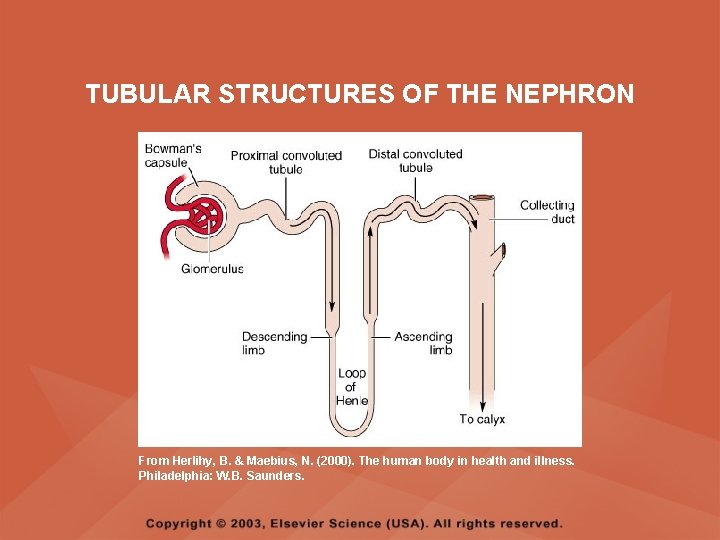
TUBULAR STRUCTURES OF THE NEPHRON From Herlihy, B. & Maebius, N. (2000). The human body in health and illness. Philadelphia: W. B. Saunders.
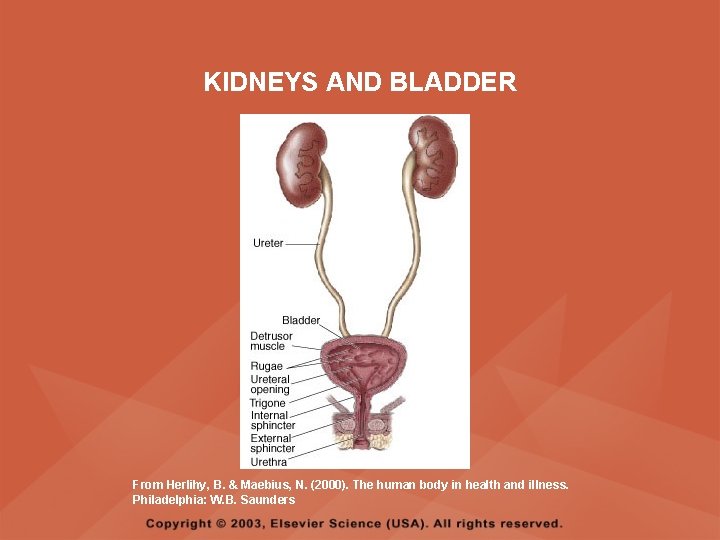
BLADDER • The ureterovesical sphincter prevents reflux of urine from the bladder to the ureter • The total capacity of the bladder is 1 liter
KIDNEYS AND BLADDER From Herlihy, B. & Maebius, N. (2000). The human body in health and illness. Philadelphia: W. B. Saunders
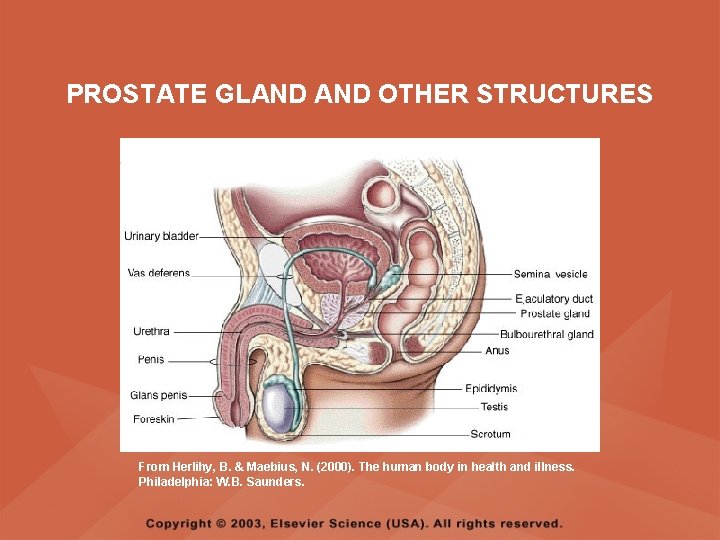
PROSTATE GLAND • Surrounds the male urethra • Contains a duct that opens into the prostatic portion of the urethra and secretes the alkaline portion of seminal fluid
PROSTATE GLAND OTHER STRUCTURES From Herlihy, B. & Maebius, N. (2000). The human body in health and illness. Philadelphia: W. B. Saunders.
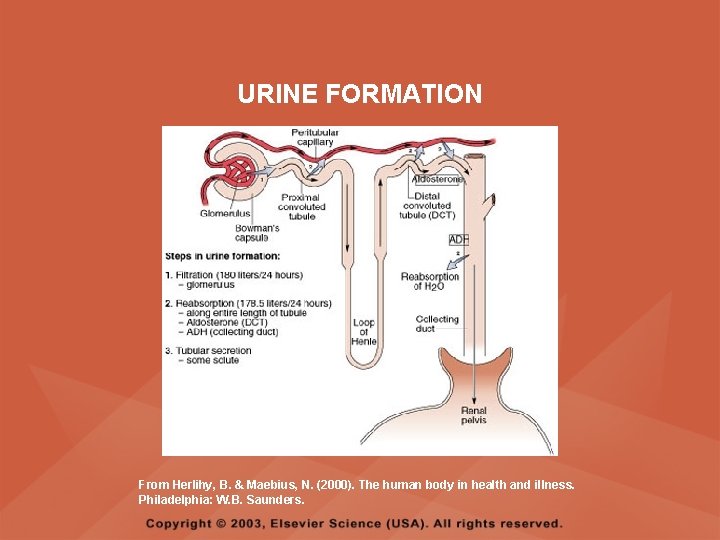
URINE FORMATION • As fluid flows through the proximal tubules, water and solutes are reabsorbed • Water and solutes that are not reabsorbed become urine • The process of selective reabsorption determines the amount of water and solutes to be secreted
URINE FORMATION From Herlihy, B. & Maebius, N. (2000). The human body in health and illness. Philadelphia: W. B. Saunders.
HOMEOSTASIS OF WATER • The antidiuretic hormone (ADH) is primarily responsible for the reabsorption of water by the kidneys • ADH is produced by the hypothalamus and secreted from the posterior lobe of the pituitary gland • Secretion of ADH is stimulated by dehydration or high sodium intake and by a fall in blood volume • ADH increases the permeability to water of the distal convoluted tubules and collecting duct
HOMEOSTASIS OF WATER • Water is drawn out of the tubules by osmosis into a high salt concentration of fluid in the medulla and its capillaries; water returns to the blood and concentrated urine remains in the tubule to be excreted • When the client lacks ADH, they develop diabetes insipidus • Clients with diabetes insipidus produce very large amounts of dilute urine and without treatment have difficulty drinking sufficient water to survive
HOMEOSTASIS OF SODIUM • When the amount of sodium increases, extra water is retained to preserve osmotic pressure • An increase in sodium and water produces an increase in the blood volume and blood pressure (BP) • When the BP increases, glomerular filtration increases, and extra water and sodium are lost; blood volume is reduced and returns the BP to normal
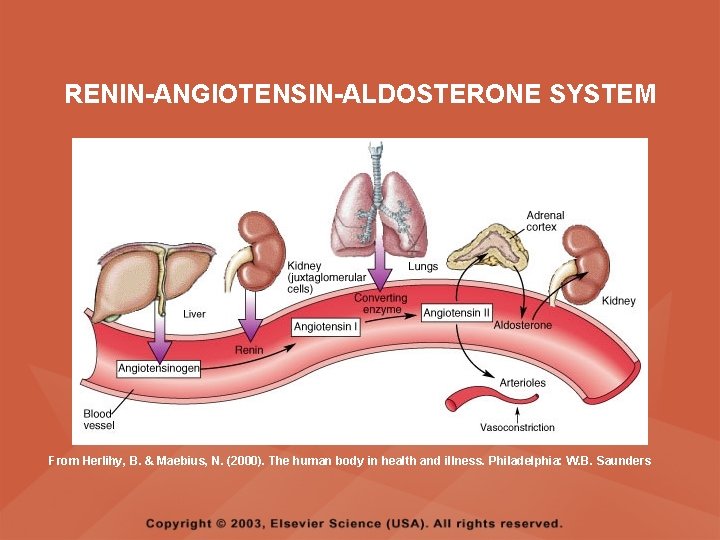
HOMEOSTASIS OF SODIUM • Reabsorption of sodium in the distal convoluted tubules is controlled by the hormones of the renin -angiotensin system • Renin is secreted when the BP or concentration of fluid in the distal convoluted tubule is low • Renin is an enzyme and splits angiotensin I from angiotensinogen, which converts to angiotensin II as blood flows through the lung
HOMEOSTASIS OF SODIUM • Angiotensin II, a potent vasoconstrictor, stimulates the secretion of aldosterone • Aldosterone stimulates the distal convoluted tubules to reabsorb sodium and secrete potassium • The additional sodium increases water reabsorption and increases blood volume and BP, returning the BP to normal; the stimulus for the secretion of renin is then removed
RENIN-ANGIOTENSIN-ALDOSTERONE SYSTEM From Herlihy, B. & Maebius, N. (2000). The human body in health and illness. Philadelphia: W. B. Saunders
HOMEOSTASIS OF POTASSIUM • Increases in potassium stimulate the secretion of aldosterone • Aldosterone stimulates the distal convoluted tubules to secrete potassium; this acts to return the potassium concentration to normal
HOMEOSTASIS OF ACIDITY (p. H) • Blood p. H is controlled by maintaining the concentration of buffer systems • Carbonic acid and sodium bicarbonate form the most important buffer for neutralizing acids in the plasma • The concentration of carbonic acid is controlled by the respiratory system • The concentration of sodium bicarbonate is controlled by the kidneys
HOMEOSTASIS OF ACIDITY (p. H) • Normal blood p. H is 7. 35 to 7. 45, maintained by keeping the ratio of concentrations of sodium bicarbonate to carbon dioxide constant at 20: 1 • Strong acids are neutralized by sodium bicarbonate to produce carbonic acid and the sodium salts of the strong acid; this process quickly restores the ratio and thus blood p. H
HOMEOSTASIS OF ACIDITY (p. H) • The carbonic acid produced dissociates into carbon dioxide and water; because the concentration of carbon dioxide is maintained at a constant level by the respiratory system, the excess carbonic acid is rapidly excreted • Sodium combined with the strong acid is actively reabsorbed in the distal convoluted tubules in exchange for hydrogen or potassium ions; the strong acid is neutralized by the secretion of ammonia and is excreted as ammonia or potassium salts